
Discogs vs eBay: Which Is Better for Selling Vinyl Records & Music Media in 2026?
A side-by-side comparison of fees, audience, grading, and features — plus how to sell on both automatically.



- Choose Discogs if: you sell vinyl, CDs, cassettes, or box sets to a specialist crate-digging audience that already speaks your grading language.
- Choose eBay if: you want the largest possible pool of buyers — including casual shoppers who weren’t specifically hunting for a record but stumble onto your listing.
- Fees: Discogs charges 9% of the item price plus shipping on every sale (raised from 8% in 2023). eBay charges private sellers £0 in final value fees; business sellers pay 8-15% plus 30-40p per order.
- Audience: eBay has 132 million active buyers across 190+ markets. Discogs doesn’t publish an official user count, but its marketplace draws an estimated 45.5 million site visits a month.
- Grading: Discogs uses the Goldmine Standard, a shared grading language the whole crate-digging community understands. eBay leaves condition description up to each seller’s own words.
- Best strategy: List your records on both — FLUF Connect syncs sales and sold-out status across Discogs and eBay automatically, so you never oversell the same pressing twice.
Discogs vs eBay at a Glance
Discogs and eBay solve the same problem — turning a record collection into cash — from opposite ends of the marketplace spectrum. Discogs is a specialist database-turned-marketplace built by crate-diggers, for crate-diggers: every listing is tied to a verified release in Discogs’ music-only marketplace, and every buyer already knows what a “VG+” sleeve means. eBay is the opposite: a general marketplace covering every category imaginable, where your Joy Division 12″ competes for attention against phone cases and power tools, but reaches a vastly larger crowd doing the browsing.
Discogs grew out of a database project started by Kevin Lewandowski in 2000 to catalogue electronic music releases; it operates today under Zink Media LLC and has never been acquired. Its marketplace layer lets any registered user with a verified release list that exact pressing for sale — Mint copies, promos, misprints, and all. eBay launched in 1995 as an auction site and has grown into one of the world’s largest general marketplaces, spanning fixed-price and auction-format listings in practically every category.
The practical difference for a seller: on Discogs, your buyer already collects the exact genre you’re selling and understands grading conventions before they click “buy.” On eBay, your buyer might be a specialist crate-digger who searched directly for the catalogue number — or someone who wasn’t looking for vinyl at all until your listing showed up in a broader search. Neither audience is “better” outright; they behave differently, and which matters more depends on what you’re selling.
| Discogs | eBay | |
|---|---|---|
| Category focus | Music media only — vinyl, CDs, cassettes, box sets, promos | General marketplace — every category |
| Founded | 2000 (marketplace added 2003) | 1995 |
| Operator | Zink Media LLC (founder Kevin Lewandowski) | eBay Inc. |
| Reach | No official user count published; ~45.5M site visits/month | 132 million active buyers, 190+ markets |
| Best for | Vinyl, CDs, cassettes, rare/graded pressings | Everything, including music media as one category among many |
| Seller fees (total) | 9% of item price + shipping | £0 (private sellers) / 8-15% + 30-40p (business sellers) |
| Listing fee | Free — pay only on sale | Free up to monthly allowance, then per-listing fee |
| Grading standard | Goldmine Standard (media + sleeve graded separately) | Seller’s own condition description |
For the full breakdown of either platform on its own, see our guides: How to Sell on Discogs and How to Sell on eBay.
Discogs vs eBay: Feature-by-Feature Comparison
Because Discogs and eBay serve different scopes, their feature sets diverge sharply. Discogs’ whole interface is purpose-built around cataloguing a release — pressing details, matrix numbers, and community-verified metadata — while eBay’s tools are built to be flexible enough for practically anything, from auctions to storefronts.
| Feature | Discogs | eBay |
|---|---|---|
| Auction listings | No — fixed price only | Yes — auction or fixed price |
| Fixed-price listings | Yes | Yes |
| Built-in messaging | Yes | Yes |
| Offer/haggle system | No | Yes — Best Offer |
| Release-level cataloguing | Yes — every listing ties to a verified release ID | No — freeform titles and item specifics |
| Standardised grading | Yes — Goldmine Standard, media + sleeve graded separately | No — seller’s own wording |
| Seller analytics | Basic — sales history, want/have counts | Advanced — traffic, conversion, Terapeak pricing research |
| Promoted listings | No native promotion tools | Yes — Promoted Listings (pay-per-sale ads) |
| Buyer protection | Discogs’ own dispute process | eBay Money Back Guarantee |
| Business/store accounts | No dedicated store tier | Yes — eBay Shops with tiered subscriptions |
| International selling | Yes — global, currency shown per buyer location | Yes — 190+ markets |
The two features that matter most for a record seller: Discogs’ release-level cataloguing and shared Goldmine grading mean buyers arrive already trusting the condition description — a factor sellers on both platforms credit with fewer disputes on Discogs (see what real sellers say, below). eBay’s advantage is the auction format and Best Offer system, which can extract a premium price on a genuinely rare or hyped pressing that a fixed Discogs listing might undersell.
Listing Experience: Discogs vs eBay
Listing a record on Discogs starts with finding — or adding — the release in Discogs’ database rather than writing a title from scratch. Search the artist and title, match the exact pressing (label, catalogue number, year, country), and the release page pre-fills your listing with verified metadata: tracklist, format, label, genre. You then set your price, grade the media and sleeve separately, add photos, and list. Because the catalogue data is already there, listing an already-catalogued pressing on Discogs is often faster than writing an eBay title from nothing — but if your specific pressing isn’t in the database yet, you’ll need to submit it for community review first, which can take longer.
Listing on eBay starts from a blank slate: you write your own title (80 characters, keyword-dense — buyers search by artist, album, catalogue number, and condition terms like “sealed” or “promo”), pick a category, and write your own description of condition in your own words. eBay gives you far more image slots and layout flexibility, and you choose between a 3-, 5-, 7-, or 10-day auction or a fixed “Buy It Now” listing. There’s no shared release database to lean on, so accuracy depends entirely on how carefully you research your own pressing.
Grading is the single biggest workflow difference. Discogs requires the Goldmine Standard — a scale running from Mint down to Poor/Fair, applied separately to the media and the sleeve (so a listing might read “Media: VG+, Sleeve: VG”). Every Discogs buyer already knows exactly what those grades mean. On eBay, you describe condition in free text — “near mint,” “light shelf wear,” “small seam split” — and buyers have to trust your judgment rather than a shared standard, since eBay has no vinyl-specific grading requirement of its own.
Time to list: for a pressing already in Discogs’ database, expect 2-4 minutes once you’ve photographed the item — most of the metadata is pre-filled. On eBay, budget 5-10 minutes to write a keyword-optimised title and full condition description from scratch, longer if you’re researching comparable sold listings to price it.
Best for beginners: Discogs’ database-driven listing flow is more forgiving for a first-time seller — you can’t easily under-describe a pressing when the format fields are already locked in. eBay rewards sellers who already know how to write a compelling, keyword-rich listing, which has a steeper learning curve but a bigger reward ceiling for popular items.
Fees Compared: How Much Do Discogs and eBay Actually Cost?
Fees are where the two platforms diverge most sharply — and where the maths actually favours different sellers depending on their account type. Discogs charges one flat percentage to everyone. eBay charges nothing at all to private sellers and a category-based percentage to business sellers.
Discogs Fees
Listing on Discogs is free — you’re only charged when an item sells. Discogs takes a 9% marketplace fee, calculated on the item price plus the shipping you charge the buyer. This was raised from 8% in May 2023 — the first change to Discogs’ fee structure in a decade — and the move to charge fee on shipping (not just item price) was the part that drew the most seller backlash, since it disproportionately affects international sales, where shipping often costs more than the record itself. Source: Discogs seller forum, DJ Mag, MusicTech.
eBay Fees (UK)
eBay’s fee structure depends entirely on your account type. Private sellers pay £0 in final value fees on almost every category, a change eBay made in October 2024 — source: eBay UK — fees for private sellers. Business sellers pay a category-based final value fee of roughly 8-15%, plus a fixed per-order fee of 30-40p. Both account types get free listings up to a monthly allowance — 300 a month for private sellers, up to 1,000 for business sellers — before a per-listing insertion fee applies.
| Fee Type | Discogs | eBay (private) | eBay (business) |
|---|---|---|---|
| Listing fee | Free | Free (300/month) | Free (up to 1,000/month) |
| Transaction / final value fee | 9% of item price + shipping | £0 | 8-15% (category-based) |
| Per-order fixed fee | None | None | 30-40p |
| Payment processing | Included in the 9% fee | Included | Included |
| Promoted listing cost | N/A — no native promotion tool | Optional, pay-per-sale | Optional, pay-per-sale |
- Discogs: Marketplace fee £3.15 (9% of £35) = you keep £31.85 before your own postage costs
- eBay (private seller): Final value fee £0 = you keep the full £35 before your own postage costs
- eBay (business seller, ~11% mid-range category rate): Final value fee £3.85 + per-order fee £0.35 = you keep £30.80 before your own postage costs
On pure fees, a private eBay listing beats both. But that comparison misses the point for most record sellers: private-seller status caps how much and how often you can sell before eBay expects you to register as a business, and it’s the audience that 9% Discogs fee is buying — buyers who already know what they’re looking for, arrive pre-sold on the format, and grade condition the same way you do. Whether that’s worth 9% depends on how easily the same pressing would move on eBay’s much bigger, much less specialist crowd.
Payout Comparison
| Discogs | eBay | |
|---|---|---|
| Payout method | PayPal or Discogs’ supported processors, seller-configured | Bank transfer via eBay’s managed payments |
| Payout schedule | Depends on payment method used at checkout | Typically 1-2 business days after delivery confirmation |
| New seller holds | None documented | May apply to new or low-feedback accounts |
| Minimum payout | No minimum | No minimum |
Discogs doesn’t route payments through a single in-house processor the way eBay’s managed payments does — sellers typically set up PayPal or another supported processor, so payout timing depends on that processor’s own schedule rather than a Discogs-controlled one. eBay’s managed payments system is more predictable end-to-end.
Audience and Demand: Who’s Buying on Discogs vs eBay?
The honest answer to “which has more buyers” is eBay, by a wide margin — but that’s the wrong question for a specialist product like vinyl. The better question is which platform’s buyers are more likely to want your specific record.
eBay reports 132 million active buyers across 190+ markets, per Business of Apps’ eBay statistics. That’s a general population — the vast majority aren’t shopping for vinyl on any given day, but the sheer scale means even a niche pressing has a chance of being found by the handful of collectors actively searching eBay for it.
Discogs doesn’t publish an official registered-user or active-buyer count. What is measurable is site traffic: Semrush recorded 45.5 million visits to discogs.com in January 2026 — a meaningfully large number, though traffic isn’t the same metric as eBay’s active-buyer figure and the two shouldn’t be read as directly comparable. What that traffic represents, though, is qualitatively different from eBay’s: every visitor arrived specifically to browse or buy music media, not general merchandise.
| Discogs | eBay | |
|---|---|---|
| Audience type | Specialist — music collectors, DJs, crate-diggers | General — includes specialist buyers plus casual browsers |
| Reported reach | No official user count; ~45.5M site visits/month | 132 million active buyers |
| Top markets | Global, strong in US/Europe collector communities | 190+ markets worldwide |
| Buyer intent | High — arrives already searching for the specific release | Mixed — ranges from targeted searches to incidental discovery |
| Best-selling niches | Rare pressings, promos, box sets, graded collector items | Everything from common reissues to hyped/rare items with bidding wars |
There’s forum evidence for both sides of this trade-off. One Discogs seller described listing a rare record at €8 on Discogs with zero interest, then relisting it on eBay where it sold for five times that price within 30 minutes — a case where eBay’s much larger pool of bidders found value a specialist marketplace’s smaller, pickier audience didn’t. But the same thread also has sellers reporting the opposite pattern for common, well-known pressings: steady, predictable sales to Discogs’ collector base without needing an auction format to surface demand.
The takeaway: Discogs’ audience is smaller but pre-qualified — good for steady sales of catalogued, gradeable pressings. eBay’s audience is much larger but unspecialised — better suited to surfacing hype and competitive bidding on genuinely rare items, at the cost of more buyers who don’t know (or care) what “VG+” means.
Shipping: Discogs vs eBay
Neither Discogs nor eBay has a vinyl-specific shipping programme — you set your own shipping price and choose your own carrier and packaging on both platforms. The differences are in how shipping is charged and calculated, not who carries the parcel.
On Discogs, you set a flat shipping price (or price per additional item, for bundled orders) when you list, and the buyer pays it at checkout. Crucially, that shipping charge is included in Discogs’ 9% fee calculation — so a high shipping charge on an international order increases the marketplace fee you pay, not just the amount the buyer sends. This is precisely the mechanic that drove the loudest seller complaints after the 2023 fee change, since vinyl is heavy and international postage is expensive relative to the item price.
On eBay, you can set a flat shipping price, offer free shipping (folding the cost into your item price), or use calculated shipping based on the buyer’s location and your package weight. eBay’s final value fee is calculated on the total amount the buyer pays including shipping for most categories too, but because private sellers pay £0 in final value fees, that distinction is moot for the majority of casual record sellers on eBay — only business-seller shipping charges feed into a fee calculation.
| Discogs | eBay | |
|---|---|---|
| Integrated shipping labels | No — seller arranges their own carrier | Yes — labels purchasable through eBay |
| Who pays shipping | Buyer, at seller-set price | Buyer (flat, free, or calculated — seller’s choice) |
| Shipping counted in seller fee | Yes — included in the 9% marketplace fee | Business sellers: yes, per category. Private sellers: no fee applies at all |
| International shipping | Yes — global, seller sets per-region pricing | Yes — global, calculated or flat by region |
| Return shipping | Negotiated between buyer and seller per Discogs’ dispute process | Covered by eBay’s Money Back Guarantee terms |
| Tracking required | Recommended, not enforced | Recommended; required for seller protection on disputes |
For records specifically, packaging matters more than platform — vinyl needs rigid mailers and corner protection regardless of where you sell it, and neither marketplace enforces or subsidises that. The practical difference is financial: heavy, expensive-to-ship international orders cost more in fees on Discogs than they do for a private eBay seller, which is worth factoring into how you price shipping on each platform.
What Real Sellers Say About Discogs vs eBay
The clearest, most consistent theme across seller communities is that Discogs’ shared grading standard reduces friction — and that the 2023 fee increase was the platform’s most controversial recent decision.
“I’ve made my living with this company for the past decade. It’s just the frustration that you have no control over what they’re doing.”
— Connecticut-based Discogs seller, quoted in MusicTech
That frustration wasn’t isolated. One seller reported to DJ Mag that their sales dropped by roughly half after the fee change, with monthly revenue falling from around €20,000 — they attributed the drop specifically to the new fee-on-shipping mechanic hitting international buyers hardest, since it effectively raised the total cost of every cross-border order. Source: DJ Mag.
On the grading side, sentiment runs the other way — sellers who use both platforms consistently point to Discogs’ Goldmine-based system as a genuine advantage over eBay’s freeform descriptions:
Discogs sellers in a long-running forum thread describe far fewer disputes and returns on Discogs than on eBay, crediting the shared Goldmine grading standard — buyer and seller are working from the same scale, so there’s less room for a “condition” disagreement after the sale.
— Discogs seller forum, discogs.com/forum
But the same thread pushes back on the idea that Discogs always wins for a record seller. One contributor described listing a rare pressing at €8 on Discogs and getting no bites, then relisting the same record on eBay, where it sold for roughly five times that price inside 30 minutes — a direct example of eBay’s larger audience creating a bidding dynamic that a smaller, more specialist marketplace simply couldn’t replicate for a genuinely sought-after item. Source: Discogs seller forum.
Sellers who use both
Reading across these threads, the sellers who sound most satisfied aren’t loyal to one platform — they’re the ones treating Discogs and eBay as different tools for different stock. Catalogued, easily-gradeable pressings with steady collector demand go to Discogs, where the audience is pre-qualified and disputes are rarer. Rare, hyped, or hard-to-value items go to eBay, where an auction format and a much bigger crowd can surface a price a fixed Discogs listing would never reach. Nobody in these threads argues for abandoning either platform entirely — the disagreement is about which one deserves the bulk of a given seller’s catalogue, not whether both are worth using.
How to Choose Between Discogs and eBay
There’s no universal right answer here — it depends on what you’re selling, how much you’re selling, and whether you want a specialist or a general audience. A few criteria to weigh:
- Sell mostly catalogued vinyl, CDs, or cassettes rather than mixed general items
- Want buyers who already understand grading and pressing details without you having to educate them
- Prefer fewer disputes over condition, thanks to the shared Goldmine standard
- Are comfortable paying 9% on every sale in exchange for a pre-qualified audience
- Sell as a private/casual seller and want to pay £0 in final value fees
- Have a rare, hyped, or hard-to-value item that could benefit from an auction-format bidding war
- Want the largest possible pool of potential buyers, not just specialist collectors
- Sell other categories alongside music media and want one account for everything
For casual sellers clearing out a personal collection: eBay as a private seller costs nothing in fees, which is hard to beat for occasional sales. But if your collection is heavy on catalogued, gradeable pressings, Discogs’ collector audience may move them faster and with fewer condition disputes.
For dedicated vinyl resellers buying and reselling regularly: Discogs’ specialist audience and shared grading standard reduce the friction of selling at volume — but the 9% fee on every sale (including shipping) adds up, and eBay’s business-seller fees, while not free, are often lower in percentage terms depending on category.
For sellers with rare or hyped stock: don’t assume Discogs’ specialist audience automatically pays the highest price. The forum evidence above shows eBay’s bigger, more competitive crowd can outbid a niche marketplace on genuinely sought-after items — it’s worth testing both before assuming either platform is the ceiling.
If you’re weighing all of this and landing on “it depends on the item,” that’s the honest answer — and it’s also the case for using both platforms rather than picking just one.
Why Not Both? Sell on Discogs and eBay with FLUF Connect
Limiting your record collection to one marketplace means leaving sales on the table — Discogs’ specialist buyers won’t find you on eBay, and eBay’s bigger, more casual crowd (plus its Best Offer and auction dynamics) won’t find you on Discogs. The catch with selling on both manually is the bookkeeping: track which pressing sold where, delist it everywhere else before someone else buys the same one-of-a-kind copy, and keep both listings’ details in sync. For a specialist product like vinyl — where the item genuinely is one physical copy, not a restockable SKU — overselling a record you no longer own is the single worst outcome of selling on multiple platforms without automation.
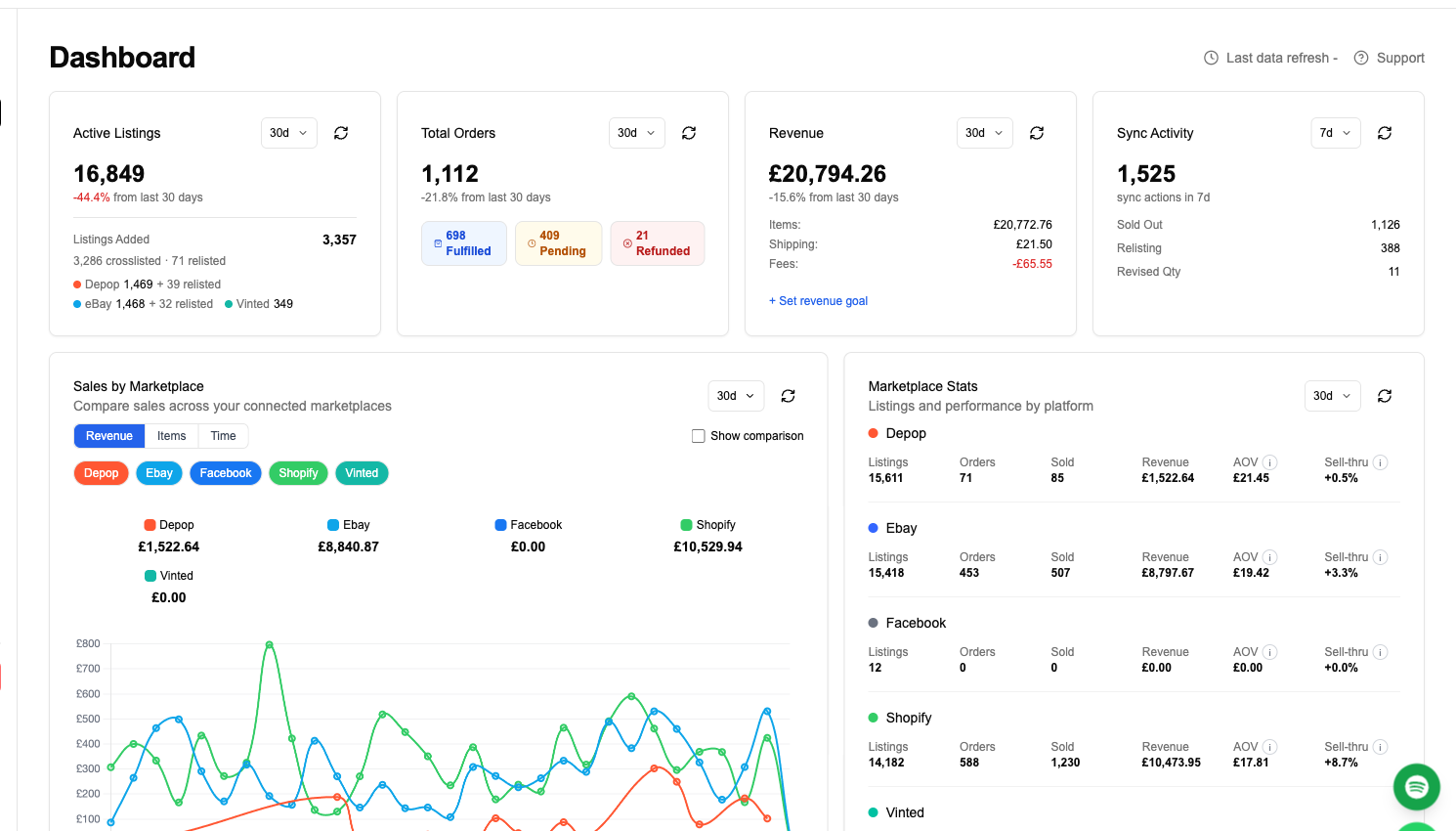
FLUF Connect connects Discogs and eBay without an extension or an open browser. Enter your Discogs personal access token and follow eBay’s authorisation prompts.
| FLUF Connect Feature | Discogs | eBay |
|---|---|---|
| Crosslisting | Yes | Yes |
| Order sync (auto-detects sales) | Yes | Yes |
| Mark as sold (auto-delist elsewhere) | Yes | Yes |
| Auto-relisting | Not supported | Yes |
| Offer management | Not supported | Yes |
| Bulk operations | Yes | Yes |
Practically, that means: list a record once, push it to both Discogs and eBay, and when it sells on either one, order sync catches the sale and mark-as-sold automatically delists it from the other before anyone can buy a copy that’s already gone. Discogs’ feature set through FLUF Connect stops at order sync and mark-as-sold — it doesn’t support auto-relisting or offer management the way eBay does, since Discogs itself has no offer/haggle system and a different relisting model. eBay gets the fuller automation set, including offer management for buyers using Best Offer.
How it works, in three steps: connect both Discogs and eBay to your FLUF Connect account, crosslist your catalogue once, and let sync handle the rest — sold items come off both platforms automatically, so your Discogs want-list and your eBay listings never contradict each other.
Start with a 7-day trial for £1, then plans from £9/month. Automation — including order sync and mark-as-sold for both channels — is included from Seller upwards, not a paid add-on.
Sources & Verification
- Discogs music marketplace overview — discogs.com
- Discogs seller fee increase forum thread — discogs.com/forum
- Discogs fee backlash reporting — DJ Mag
- Discogs fee backlash reporting — MusicTech
- Discogs.com site traffic — Semrush
- Discogs grading standard — Discogs Support — How To Grade Items
- Discogs seller sentiment forum thread — discogs.com/forum
- eBay active buyer/seller/market statistics — Business of Apps
- eBay private seller fees — eBay UK Help
- eBay company history — Wikipedia
- Crosslist from Discogs to WooCommerce — owning your own storefront
- Crosslist from Discogs to eBay
- Crosslist from Discogs to Shopify
Frequently Asked Questions
It depends on what you're selling. Discogs is built specifically for music media, so your listing reaches buyers who already understand pressing details and Goldmine grading, which tends to mean fewer condition disputes. eBay has a far bigger, more general audience, so a rare or hyped record can sometimes fetch a higher price in an auction than it would on Discogs' smaller, more specialist marketplace. Many sellers use both rather than picking one.
Discogs charges a flat 9% marketplace fee on the item price plus shipping, on every sale. eBay charges private sellers £0 in final value fees, while business sellers pay roughly 8-15% depending on category, plus 30-40p per order. On fees alone, a private eBay listing is cheaper than Discogs, but private-seller status has limits on how much you can sell before eBay expects a business account.
Yes. There's nothing stopping you from listing the same record on both platforms, and plenty of sellers do exactly that to reach both audiences. The manual risk is overselling a one-of-a-kind item if it sells on one platform while still listed on the other — that's the problem FLUF Connect's order sync and mark-as-sold features are built to solve automatically.
Discogs is generally more forgiving for a first-time seller, since the listing flow is built around an existing database of verified releases — you're filling in a form rather than writing a listing from scratch. eBay gives you more flexibility but expects you to write your own keyword-rich title and condition description, which has a steeper learning curve.
eBay, by a wide margin — it reports 132 million active buyers across 190+ markets. Discogs doesn't publish an official user or buyer count, though its site draws an estimated 45.5 million visits a month. eBay's audience is much bigger but general; Discogs' smaller audience is entirely music-focused.
Yes. Connect Discogs using your personal access token and follow eBay’s authorisation prompts. Neither needs an extension or open browser. Both support order sync and mark-as-sold; relisting and offer management are available on eBay only.
eBay's managed payments typically pay out within 1-2 business days of delivery confirmation. Discogs doesn't run its own in-house payment processor — sellers usually get paid through PayPal or another supported processor, so payout timing depends on that processor's own schedule rather than a single Discogs-controlled one.
For most vinyl sellers, yes. Discogs brings a specialist, pre-qualified audience with fewer condition disputes; eBay brings a much bigger, more competitive audience that can outbid a niche marketplace on rare or hyped items. The main friction is manual bookkeeping — avoiding overselling a one-off pressing across two listings — which is what automated sync via FLUF Connect is designed to handle.