
Crosslist from Bidzzy to Shopify — Automatically
Bidzzy has no CSV export, no bulk listing and no API, and its roadmap still lists variants as unbuilt. Here is how to get that catalogue into a store you own without re-keying it.



- Bidzzy has no CSV export and no bulk listing. Its own roadmap still lists variants and multiple quantities as unbuilt. Moving a hundred items to Shopify by hand is the default, and it is the reason a crosslisting tool exists.
- Bidzzy is fixed-price, not an auction. Its terms say the platform “uses fixed pricing and offer acceptance only”. There is no bidding in the product.
- Bidzzy takes 0% from sellers — no listing fee, no monthly fee, no commission. The buyer pays a Buyer Protection fee of typically 3–7.5% plus a small fixed fee, capped at £16.99 per order.
- The buyer fee is lower on higher-value items. The percentage falls as the price rises, and the buyer sees the exact fee before paying.
- Shopify UK is £25/month on Basic, or £19 billed yearly, with card fees of 2% + 25p on UK-issued cards. Not using Shopify Payments adds a further 2% on Basic on top of your gateway’s own charge.
- One-of-one stock works, but sold items do not disappear. Shopify makes a zero-quantity product unpurchasable, not invisible — hiding out-of-stock products is a separate setting you must turn on.
- Your own store is not a “platform” for HMRC reporting. HMRC’s manual says software that helps you design and run your own merchant website is not a Platform. That changes who reports, not whether you owe tax.
- The catch is demand. Ahrefs found only 1.74% of newly published pages reach Google’s top ten within a year. Bidzzy already has listings and buyers; a new Shopify store starts with no traffic.
- Cost: FLUF Connect crosslists to 70+ marketplaces from one dashboard. 7 days for £1, then from £9/month. There is no free plan.
What Bidzzy actually is
Two things are worth establishing before anything else, because the internet gets both wrong.
The site is bidzzy.co.uk. The .com is an unrelated parked domain that returns an error. Bidzzy is not an auction platform — its terms state that the platform uses fixed pricing and offer acceptance only. If you arrived expecting bidding, there is none.
Bidzzy is a new marketplace and is still developing its features. Its terms are currently at version 8.7, dated 21 October 2026, so check them before you plan around a specific rule.
Bidzzy’s own sitemap files, read on 1 September 2026, list 100,363 live item URLs and 8,519 seller profiles — roughly twelve listings per seller, across eight top-level categories covering women’s and men’s fashion, kids, school, health and beauty, home, tech and electronics.
Bidzzy is a newer marketplace with a growing catalogue. That is a reason to have your own store alongside it, not instead of it.
The export problem
Here is the practical reason this page exists.
Bidzzy’s public roadmap lists what has shipped and what has not. Shipped: multi-carrier shipping, QR code drop-off, seller analytics, buyer rewards. Still on the ‘on our radar’ list — meaning unbuilt — are product variants and multiple quantities per listing. There is no bulk listing tool or CSV import/export.
Every Bidzzy listing is therefore a single unit, created by hand. If you have built up two hundred items there, the only routes out are re-keying them into Shopify one at a time, or holding your catalogue somewhere upstream that can write to both. That is the entire argument for crosslisting rather than migrating, and it is unusually clean-cut here.
It also shapes what you should do first. Because Bidzzy cannot represent a product with variants, your Shopify catalogue should be the richer record — sizes, colours, quantities — and the Bidzzy listing the flattened projection of it. Build the master where the model is bigger.
Who pays what
Bidzzy’s pricing is genuinely unusual, and it is the strongest thing about it. Its terms are explicit: Bidzzy is free to use for sellers, with no listing fees, no monthly fees and no commission on the sale price. The Buyer Protection fee is typically 3–7.5% of the item price plus a small fixed fee, capped at £16.99 per order, and the buyer pays it; the lower percentage applies to higher-value items. That fee covers payment processing, dispute resolution and the buyer protection guarantee. Delivery is also chosen and paid for by the buyer at checkout.
The buyer sees the exact fee before paying, so check a live listing to see the figure at a given price.
Because the fee is capped at £16.99, it is a smaller share of the price on higher-value items.
Shopify’s cost sits in a different place — a subscription plus card processing, with nothing taken as commission.
| Shopify UK plan | Monthly | Billed yearly | UK card rate | Fee if not using Shopify Payments |
|---|---|---|---|---|
| Basic | £25 | £19 | 2% + 25p | 2% |
| Grow | £65 | £49 | 1.7% + 25p | 1% |
| Advanced | £344 | £259 | 1.5% + 25p | 0.6% |
| Plus | From £1,800 | Negotiated | 0.2% | |
International and American Express cards cost more — 3.1% plus 25p on Basic, falling to 2.5% on Advanced. The extra percentage for not using Shopify Payments is charged on top of whatever your third-party gateway charges, which is why almost every small UK store uses Shopify Payments. Shop Pay, Shop Pay Instalments and PayPal Express also attract no third-party fee.
A worked comparison on a £40 jacket, using published rates. On Bidzzy the seller nets £40.00, and the buyer pays the Buyer Protection fee plus delivery. On Shopify Basic with Shopify Payments the seller nets £38.95 (2% + 25p) — before the subscription, and before any cost of getting someone to the page. On eBay UK as a business seller in Clothes, Shoes and Accessories, at 11.9% plus 0.35% plus a £0.40 per-order fee, the same jacket nets about £34.70, before VAT on those fees and ignoring postage. That arithmetic is ours from the published rates rather than a figure any of them prints.
Getting your money out of each
Bidzzy splits its sellers. A private seller‘s funds are released to the Bidzzy Wallet 72 hours after the buyer receives the item. A business seller waits until the 14-day cancellation window has closed , so payouts come later.
And in Bidzzy’s own words, “payouts are never automatic”. Money sits in the wallet indefinitely until you tap withdraw. There is no minimum withdrawal and no stated withdrawal fee, but there is also nothing that moves it for you. Put a reminder in your week.
Shopify Payments in the UK has a minimum settlement time of three business days, with weekend payments consolidated into a single payout and a £1 minimum. One detail that catches new merchants: settlement starts longer than three days and shortens only as you reliably fulfil orders on time. Do not budget for three-day money in month one. The bank account must be in pounds, held at a UK bank, and eligible for Faster Payments.
On dispatch, Bidzzy gives you five calendar days from payment, generates labels in-platform through Sendcloud, and supports Evri, Royal Mail and InPost. On your own store, the dispatch time is whatever you set and promise to buyers.
Building the Shopify side
Shopify allows unlimited products on every plan from Basic upward, so catalogue size is not a constraint. Variants are: the limit rose from 100 to 2,048 per product on 15 October 2025, for all merchants with no tier gating. For a reseller that ceiling is effectively infinite.
Images can be up to 20MB and 5,000 by 5,000 pixels, with 2,048 square recommended. Usefully for anyone shooting stock on a phone, HEIC is an accepted format alongside JPEG, PNG, WebP and the rest. Products take up to 250 tags of 255 characters each.
Bidzzy’s own listing rules are stricter than Shopify’s in one respect worth carrying across: a minimum of three photos, which must be original images of the actual item, with stock photography and AI-generated images prohibited. That is a good standard to hold your store to anyway, and it means the photographs you already have will satisfy both.
Two costs beyond the subscription. Domains through Shopify start at around $9 a year, quoted in dollars even on the UK page and billed separately from the plan. And of the themes in Shopify’s store, 24 are free and over 1,200 are paid, with paid themes ranging roughly $150 to $500 — the old flat $180 price is gone. Start free.
One thing not to promise yourself on Basic: Shopify Markets region tailoring is listed as an Advanced-and-above feature, and multi-currency requires Shopify Payments. If selling abroad is the plan, that changes the plan you need.
One-of-one stock, and the trap in it
Secondhand sellers hold single units, and Shopify handles that correctly by default. Turn inventory tracking on, set the quantity to one, and when it sells the product becomes unpurchasable — customers cannot buy it until you adjust the level.
The trap is the word unpurchasable. Shopify does not hide sold products; it merely stops them being bought. Hiding out-of-stock products is a separate, opt-in setting. Leave it alone and a one-of-one storefront gradually fills with things nobody can have, which is a poor first impression and a slow collection page.
Turn it on before you import, not after. It is a two-minute job that gets much less pleasant at three hundred products.
What to weigh up
Everything above argues for owning your shopfront. This is the part that argues for patience.
Bidzzy already has a catalogue and a buyer base. Your Shopify store starts with no traffic, and closing that gap is slow. Ahrefs studied a million URLs first crawled in September 2023 and found that only 1.74% reached Google’s top ten within a year — 6.11% when filtered to substantive English content. Of the pages that did get there, about 41% managed it within a month, which tells you the distribution is winner-takes-most rather than steady.
Conversion, once people do arrive, is roughly what you would expect. Dynamic Yield’s June 2026 benchmark puts fashion, accessories and apparel at 2.77% against a 2.66% global average, with luxury and jewellery far lower at 0.63% and home and furniture at 1.29%. If your stock skews to the last two, budget accordingly.
The counterargument for building anyway is that you keep the customer. Litmus’s 2025 survey of around 500 marketing professionals reports email marketing ROI in retail, e-commerce and consumer goods at 45:1 — self-reported rather than measured, so treat it as directional. You cannot build an email list on someone else’s marketplace. That is the whole trade: rented demand now, owned demand later, and no month in which you should have only one of them.
What FLUF Connect syncs, and what it does not
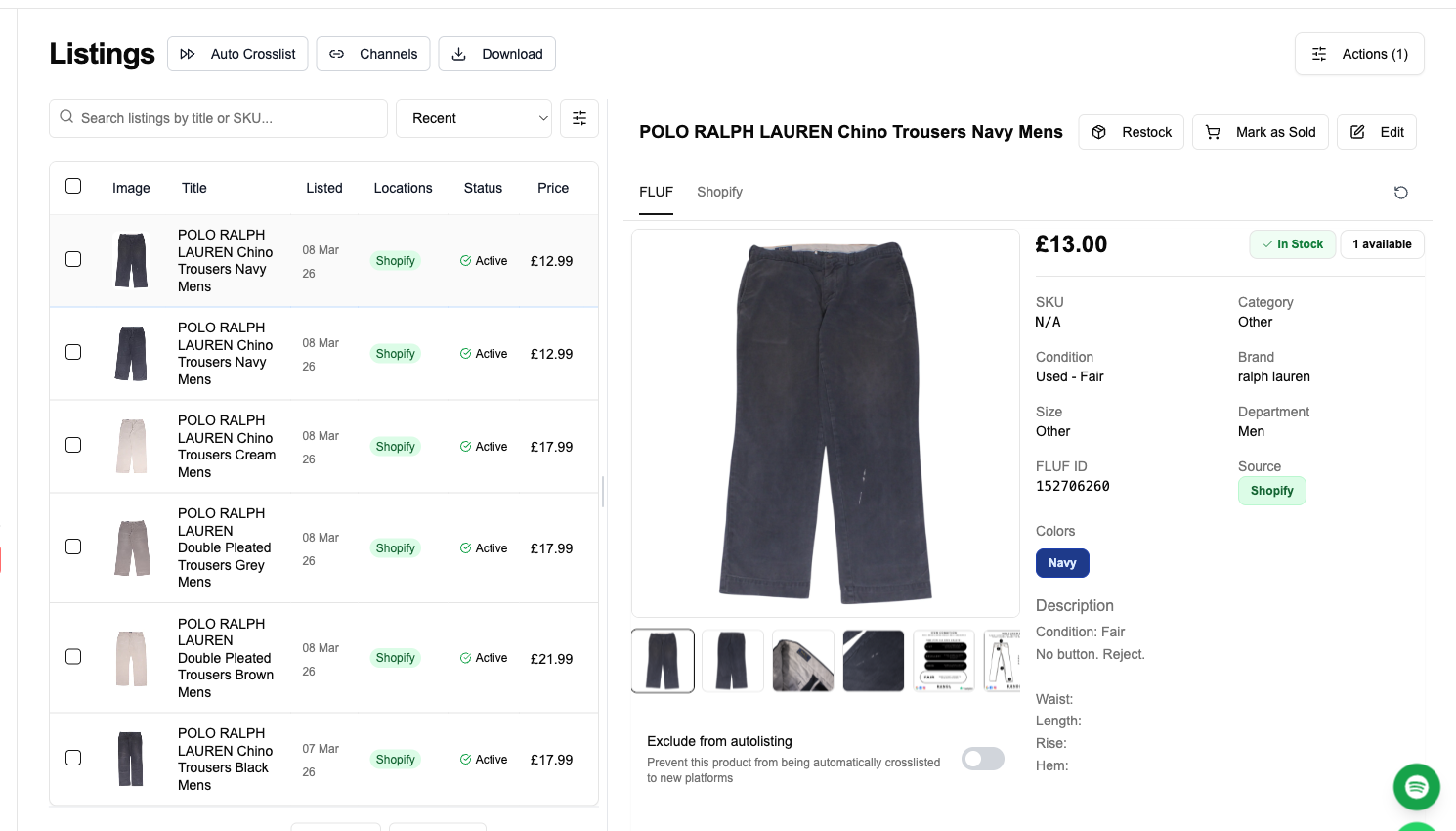
FLUF Connect lets you manage the catalogue in one place and push it to the channels you connect, which works around Bidzzy having no export.
| Capability | Bidzzy | Shopify |
|---|---|---|
| Create and update listings from FLUF | Yes | Yes |
| Mark as sold when it sells elsewhere | Yes | Yes |
| Order sync back into FLUF | Yes | Yes |
| Automated relisting | No | No |
| Offer management from FLUF | No | No |
Both sides participate in sold-out protection, which is the thing that matters most when every listing is a single unit. Sell the coat on your Shopify store and the Bidzzy listing can be pulled before someone else pays for it.
Bidzzy sales are picked up too, so an item that sells on Bidzzy is removed from your Shopify store. Shopify orders show in your dashboard alongside every other channel.
Neither channel supports automated relisting or offer management through FLUF today. Bidzzy’s offer mechanic is handled on Bidzzy.
FLUF Connect also runs on iOS and Android. Check the channels screen in the app for what each channel supports.
HMRC, VAT and the margin scheme
The trading allowance is £1,000 of gross trading income a year. Above it you register for Self Assessment by 5 October in the following tax year. A £3,000 threshold was announced on 11 March 2025 but has no commencement date and is not law; it would change the reporting threshold only, leaving income above £1,000 taxable either way.
Platform reporting commenced 1 January 2024 — not 2025, which was merely the first reporting deadline. Details are not reported where you make fewer than 30 sales of goods in a calendar year and receive under €2,000. Bidzzy states its own obligation plainly on its private-sellers page. As gov.uk puts it, a platform reporting your details to HMRC does not automatically mean you owe tax.
Your own store is different, and the distinction is worth getting exactly right. HMRC’s internal manual says that where a business buys goods in its own name directly via its own website, the seller is not providing relevant activities to third-party users, and the software will not be a Platform. It goes further, in a sentence that describes Shopify almost exactly: software that facilitates the design, maintenance and operation of merchant websites, offering payment functions and back-office support, is not a Platform. That means nobody files a report about your store sales. It does not mean those sales are untaxed — you simply declare them yourself.
On VAT, the registration threshold is £90,000 on a rolling twelve-month basis, with deregistration at £88,000, both set on 1 April 2024. For a UK-established seller the VAT position is the same on a marketplace as on your own site; the rules that shift liability to a marketplace apply to overseas sellers.
The fact most secondhand sellers should know is the VAT margin scheme. It taxes the difference between what you paid and what you sold for rather than the full selling price, at 16.67% — one sixth — of the margin, and it covers secondhand goods, works of art, antiques and collectors’ items. It cannot be used for items you were charged VAT on when buying, nor for precious metals, investment gold or precious stones. A reseller buying privately or from charity shops is precisely who it was written for.
None of this is tax advice, and an accountant should confirm your own position.
Sources and verification
- Bidzzy terms of service, version 8.7 dated 21 October 2026 — the zero seller fees, the Buyer Protection fee (typically 3–7.5% plus a small fixed fee, capped at £16.99), fixed-price-and-offers only, Stripe processing, the Evri/Royal Mail/InPost carriers via Sendcloud, and the five-day dispatch window.
- Bidzzy for private sellers and for business sellers — the 72-hour and 14-day fund-release rules, and Bidzzy’s own statement of its HMRC reporting obligation.
- Bidzzy’s public roadmap — variants and multiple quantities still unbuilt; no bulk listing, CSV or API.
- Bidzzy seller guidelines — minimum three original photos, no stock or AI-generated images.
- Shopify UK pricing — the £25/£19, £65/£49 and £344/£259 plans, the 25% annual discount, UK and international card rates, and the third-party gateway surcharges.
- Shopify Payments in the UK — the three-business-day minimum settlement, the £1 payout minimum, and the note that settlement shortens with reliable fulfilment; and the GBP Faster Payments bank requirement.
- Shopify’s variant limit change to 2,048 on 15 October 2025, and product media requirements including HEIC support.
- Shopify on selling when out of stock — zero-quantity products become unpurchasable but are not hidden.
- eBay UK business seller fees — the 11.9% clothing rate, the £0.30/£0.40 per-order fee and the 0.35% regulatory operating fee used in the worked comparison.
- Ahrefs on time to rank — the 1.74% and 6.11% figures and the published methodology.
- Conversion benchmarks citing Dynamic Yield, June 2026, and Litmus on email ROI.
- gov.uk on digital platform reporting, SI 2023/817 for the 1 January 2024 commencement, and HMRC IEIM901110 on why your own store is not a Platform.
- The £90,000 VAT threshold and the VAT margin scheme at 16.67% of the margin.
What we could not verify, and therefore left out. Bidzzy’s maximum photo count (its help pages require at least three but set no maximum) and any buyer number beyond its own homepage claim. Bidzzy doesn’t publish title or description limits either; the longest live listings we have seen stop at 100 and 2,000 characters. On the Shopify side: the date of its last price change, any maximum images per product, the product description character limit, the Starter plan’s full fee schedule, and whether sole traders are explicitly eligible for Shopify Payments — the documentation names supported countries and prohibited business types but not sole traders. We also found no credible figure for how long a new store takes to make its first sale, and no UK-specific conversion or customer-acquisition-cost benchmark, so we have given none.
Related guides
Frequently Asked Questions
No. Bidzzy's terms state that the platform uses fixed pricing and offer acceptance only, so there is no bidding. The site is bidzzy.co.uk.
No, and that is the practical reason this route needs a tool. Bidzzy's public roadmap lists product variants and multiple quantities per listing as still unbuilt, and there is no bulk listing tool, no CSV import or export, and no public API anywhere in the product or the roadmap. Every listing is a single unit created by hand. If you have built up two hundred items there, the only routes out are re-keying them into Shopify one at a time, or holding your catalogue somewhere upstream that can write to both.
Nothing. Its terms state that Bidzzy is free to use for sellers, with no listing fees, no monthly fees and no commission on the sale price. The buyer pays a Buyer Protection fee of typically 3–7.5% plus a small fixed fee, capped at £16.99 per order, along with delivery, and sees the exact amount before paying.
Basic is £25 a month, or £19 billed yearly; Grow is £65 or £49; Advanced is £344 or £259; Plus starts at £1,800. The annual discount is 25%. UK-issued card rates are 2% plus 25p on Basic, 1.7% on Grow and 1.5% on Advanced, with international and American Express cards higher at 3.1%, 2.7% and 2.5%. Not using Shopify Payments adds a further 2% on Basic, 1% on Grow and 0.6% on Advanced, charged on top of whatever your third-party gateway charges — which is why almost every small UK store uses Shopify Payments.
Correctly, with one trap. Turn inventory tracking on, set the quantity to one, and when it sells the product becomes unpurchasable — customers cannot buy it until you adjust the level. But Shopify does not hide sold products; it merely stops them being bought. Hiding out-of-stock products is a separate, opt-in setting. Leave it alone and a one-of-one storefront gradually fills with things nobody can have. Turn it on before you import rather than at three hundred products.
Bidzzy splits its sellers: a private seller's funds are released to the Bidzzy Wallet 72 hours after the buyer receives the item, while a business seller waits until the 14-day cancellation window has closed. And in Bidzzy's own words, “payouts are never automatic” — money sits in the wallet indefinitely until you tap withdraw, with no minimum and no stated fee. Shopify Payments in the UK has a minimum settlement time of three business days with a £1 payout minimum, but settlement starts longer than that and shortens only as you reliably fulfil orders on time.
The variant limit rose from 100 to 2,048 per product on 15 October 2025, for all merchants with no tier gating — effectively infinite for a reseller. Products are unlimited on every plan from Basic upward, and can take up to 250 tags of 255 characters each. Images can be up to 20MB and 5,000 by 5,000 pixels, with 2,048 square recommended, and HEIC is an accepted format alongside JPEG, PNG and WebP, which is useful if you shoot stock on a phone.
Both sides create and update listings from FLUF, and both support sold-out protection, the thing that matters most when every listing is a single unit. A sale on Bidzzy is picked up and the item is removed from your Shopify store, and Shopify orders show in your FLUF dashboard. Neither channel supports automated relisting or offer management through FLUF today, and Bidzzy's offers are handled on Bidzzy.
It changes who reports, not what you owe. HMRC's internal manual says that where a business buys goods in its own name directly via its own website, the software will not be a Platform — and describes software that facilitates the design and operation of merchant websites with payment functions as not a Platform. So nobody files a report about your store sales, while Bidzzy states plainly that it reports seller data to HMRC. You declare the income yourself either way. The trading allowance is £1,000 gross, platform reporting commenced 1 January 2024, and the VAT threshold is £90,000.
Yes, and most resellers should know about it. The VAT margin scheme taxes the difference between what you paid for an item and what you sold it for rather than the full selling price, at 16.67% — one sixth — of the margin, covering secondhand goods, works of art, antiques and collectors' items. It cannot be used for items you were charged VAT on when buying, nor for precious metals, investment gold or precious stones. A reseller buying privately or from charity shops is precisely who it was written for. None of this is tax advice; an accountant should confirm your position.
Sign up for free
Join the community
You're in.
Open your dashboard