
Designer Wardrobe vs Vestiaire Collective: Which Is Better for Sellers in 2026?
A complete, side-by-side comparison of seller fees, payouts, audience, shipping and authentication — plus how to sell on both at once with FLUF Connect.



Key takeaways
- Different worlds, lightly overlapping: Designer Wardrobe is an Australia/New Zealand designer and preloved fashion marketplace, while Vestiaire Collective is a global, curated luxury and designer pre-owned platform. Most sellers can use both without cannibalising sales.
- Audience size: Vestiaire Collective reports over 23 million members across 70+ countries; Designer Wardrobe reports 325,000+ active members concentrated in AU/NZ with $1.6m+ in monthly transactions.
- Headline seller fees: Designer Wardrobe charges $4.95 under $40 and 12.95% above $40 (cap $249) plus a payment fee (3% + 49c on card, 4.95% on Afterpay). Vestiaire Collective charges a 12% standard selling fee plus 3% payment processing, with fixed minimum fees on low-priced items.
- Choose Designer Wardrobe if you sell contemporary designer and high-street fashion to AU/NZ buyers, want quick wallet payouts and a low flat fee on cheaper items.
- Choose Vestiaire Collective if you sell genuine luxury to a worldwide audience and value optional physical authentication and global reach.
- Authentication: Vestiaire Collective offers optional physical authentication and quality control; Designer Wardrobe offers Purchase Protection on every order and tracked courier shipping.
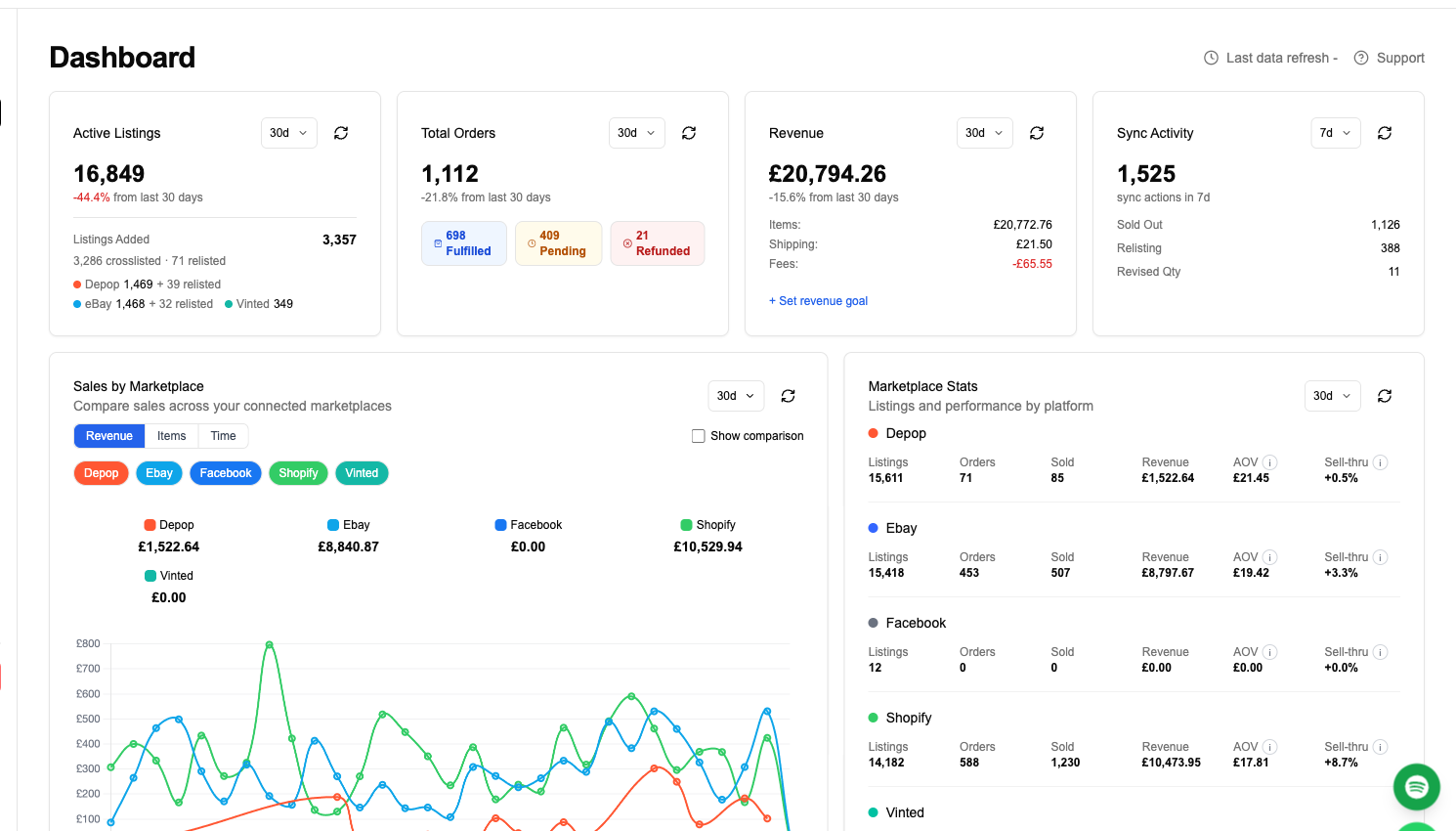
- Why not both? With FLUF Connect you can list to both from one dashboard with inventory sync and order sync. Plans start at £9/month (Starter). There is no free plan, but every new account gets a 7-day trial for £1.
1. At a glance
Designer Wardrobe and Vestiaire Collective are both pre-owned fashion marketplaces, but they sit at almost opposite ends of the resale map. Designer Wardrobe is a regional powerhouse — born in New Zealand, now spanning the Tasman into Australia — built around accessible designer and high-street fashion. Vestiaire Collective is one of the world’s best-known names in curated luxury resale, operating across dozens of countries and specialising in higher-value designer and luxury goods. Comparing them is less about “which is better” and more about “which buyer am I trying to reach”, because the two audiences barely overlap.
Before we dig into each dimension, here is how the two platforms line up on the headline numbers. Notice how the differences in geography and price tier cascade into everything else — fees, payouts, authentication and shipping all follow from who each platform is built to serve.
| Snapshot | Designer Wardrobe | Vestiaire Collective |
|---|---|---|
| Founded | 2014 (grew from a 2013 Facebook buy/sell/swap group) | 2009 (as “Vestiaire de Copines”) |
| HQ | Auckland, New Zealand | Paris, France |
| Active buyers / members | 325,000+ active members (AU/NZ) | 23 million+ members worldwide |
| Top markets | New Zealand & Australia | Global — 70+ countries (Europe, US, Asia) |
| Best for | Designer & high-street preloved fashion for AU/NZ buyers | Curated luxury & designer pre-owned for a global audience |
| Seller fees | $4.95 under $40 / 12.95% over $40 (cap $249) + payment fee | 12% standard selling fee + 3% payment processing (fixed fees on low-value items) |
| Mobile app | iOS & Android | iOS & Android (plus full web) |
The pattern is clear: Designer Wardrobe optimises for fast, low-friction local selling at accessible price points, while Vestiaire Collective optimises for trust and reach on higher-value luxury. Both are legitimate, established businesses; they simply answer different seller questions.
It helps to read the snapshot as a story rather than a list. Designer Wardrobe grew out of a 2013 New Zealand Facebook buy/sell/swap community, was incorporated as a marketplace in 2014, and later expanded across the Tasman into Australia — so its DNA is community-driven, regional and conversational. Vestiaire Collective, founded in Paris in 2009 as “Vestiaire de Copines”, was built from the start around curated, authenticated luxury and has spent more than a decade scaling that model across continents. That origin difference explains the numbers above: Designer Wardrobe’s 325,000+ active members and $1.6m+ in monthly transactions is, proportionally, an extraordinarily engaged base for a two-country market, while Vestiaire Collective’s 23 million+ members across 70+ countries is the depth of demand needed to find a buyer for a niche luxury piece. Weighing the two means weighing concentration against scale — a dense local crowd that moves fast versus a vast global crowd that can absorb almost anything given time.
2. Feature by feature
Stacking the platforms’ core capabilities side by side shows where each invests. Designer Wardrobe leans into a frictionless wallet and quick mobile listing for a regional crowd; Vestiaire Collective leans into curation, optional physical authentication and global logistics.
| Feature | Designer Wardrobe | Vestiaire Collective |
|---|---|---|
| Geographic focus | AU/NZ | Global (70+ countries) |
| Category focus | Designer & high-street fashion, accessories | Luxury & designer fashion, bags, watches, jewellery |
| Listing fee | Free to list | Free to list |
| Physical authentication | No centralised luxury authentication; Purchase Protection on every order | Optional physical authentication + quality control; curated listings |
| Buyer protection | Purchase Protection on every order | Buyer protection + curation/authenticity safeguards |
| Payout method | DW Wallet (withdraw to bank anytime, no withdrawal cost) | Bank transfer or PayPal after sale confirmation window |
| Buy Now, Pay Later | Afterpay supported (optional for sellers) | Instalment options available in some markets |
| Mobile app | iOS & Android (list in ~45 seconds) | iOS & Android + web |
| Offers / negotiation | Buyer–seller messaging & offers | Negotiation and price-drop tools |
Two features stand out as deciding factors for many sellers. First, Vestiaire Collective’s optional physical authentication is a genuine differentiator for high-value goods — buyers paying four figures for a handbag want that reassurance, and Designer Wardrobe does not offer an equivalent luxury authentication hub. Second, Designer Wardrobe’s DW Wallet makes the cash-out experience unusually quick and friction-free for the regional seller who wants to recycle proceeds into their next purchase.
Look more closely at each row and the philosophies sharpen. On buyer protection, both cover the buyer, but differently: Designer Wardrobe applies Purchase Protection automatically to every order, whereas Vestiaire Collective layers protection on top of curation and an authenticity safeguard so the trust is built into the listing before money changes hands. The practical effect is that on Designer Wardrobe trust is largely a function of your own profile and history, while on Vestiaire Collective some of it is delegated to the platform’s quality-control process — useful if you are a new seller of an expensive item with no track record. On payments, Designer Wardrobe offers Afterpay as an optional method (at the higher 4.95% fee), reflecting how embedded Afterpay is in AU/NZ; Vestiaire Collective offers instalment options in some markets, which matters more on luxury price tags. We unpack payout timing fully in section 4.
3. Listing experience
Day to day, the act of getting an item live differs in tempo. Designer Wardrobe is built for speed: the app advertises listing an item in around 45 seconds, and the whole flow is geared toward casual wardrobe rotation — snap, describe, price, publish. That low effort is part of why a relatively small market sustains $1.6m+ in monthly transactions; sellers list often and list easily.
Vestiaire Collective’s listing flow is more involved by design. Because the platform curates and (optionally) authenticates, listings go through more review, and high-value items can take longer to go live and longer to sell. Sellers frequently describe it as a slower, more human-powered process — the trade-off for access to a global luxury buyer base and the trust that curation brings. Neither approach is “better”: Designer Wardrobe rewards volume and immediacy, while Vestiaire Collective rewards patience on higher-ticket pieces.
Dig into the mechanics and the contrast becomes concrete. On Designer Wardrobe, the listing flow is deliberately stripped back: photograph the item, choose a brand and category, write a short description, set a price, and publish — all from the phone. There is no gatekeeper; the item is live almost immediately and discoverable by the local audience straight away, which suits sellers who clear their wardrobe in bursts.
On Vestiaire Collective, the same act carries more ceremony. Listings sit within a curated catalogue, descriptions and photos are held to a higher standard because buyers are spending more, and when a sale completes the seller can route the item through the authentication and quality-control hub before it reaches the buyer. Each step adds buyer confidence and supports the prices luxury items command — but each also adds time. A four-figure handbag may take longer to go live, longer to find its international buyer, and longer again to clear post-sale checks. Sellers who thrive here treat each listing as a small project rather than a quick flip.
Photography expectations diverge too. Designer Wardrobe’s audience is forgiving of honest, well-lit phone photos of everyday pieces. Vestiaire Collective buyers, scrutinising authenticity on expensive goods, expect detail shots of serial numbers, hardware, stitching and any wear — the documentation that lets a stranger on the other side of the world trust a four-figure purchase. A seller who shoots once for Designer Wardrobe will often need to shoot more thoroughly for Vestiaire Collective.
For a seller listing the same coat or bag on both, the practical reality is two different upload experiences, two sets of category trees and two photo standards. That duplication is precisely the friction a crosslisting tool removes — more on that in section 9.
4. Fees & payouts
This is where the two platforms diverge most, and where you should run your own numbers for your typical price point. Both are free to list; both charge when you sell. The difference is in the shape of the fee.
Designer Wardrobe seller fees
Designer Wardrobe charges a success fee plus a separate payment fee, calculated on the final value (item price plus any shipping).
| Fee type | Amount |
|---|---|
| Success fee (sales under $40) | Flat $4.95 |
| Success fee (sales $40+) | 12.95% (maximum fee $249) |
| Payment fee — card | 3% + 49c (50c minimum) |
| Payment fee — Afterpay/BNPL | 4.95% (no minimum) |
| Listing fee | Free |
| Withdrawal fee (DW Wallet to bank) | None |
Vestiaire Collective seller fees
Vestiaire Collective charges a percentage selling fee with fixed minimums at the bottom and a cap at the very top, plus a separate payment processing fee. The exact figures depend on your listing currency; the structure is consistent. (Vestiaire Collective also runs promotional reduced rates on selected brands in some markets — for example a temporary 5% selling fee on 4,000+ selected brands for GBP listings — but the standard rate below is what most items attract.)
| Fee type | USD example | GBP example |
|---|---|---|
| Standard selling fee | 12% (items ~$83–$16,667) | 12% standard |
| Fixed fee — low-value items | $10 (items under $83) | £5 (items under £100) |
| Fixed fee — very high-value items | $2,000 (items over $16,667) | £2,000 (items over £40,000) |
| Payment processing fee | 3% (min $3) | 3% (min £3) |
| Minimum listing price | $18 | £14 |
| Listing fee | Free | Free |
What you keep on a sale — worked examples
Designer Wardrobe: a $120 dress (paid by card)
- Sale price: $120
- Success fee (12.95%): −$15.54
- Card payment fee (3% + 49c): −$4.09
- You keep: ≈ $100.37 (about 84% of the sale)
Vestiaire Collective: a $120 item (standard rate, USD)
- Sale price: $120
- Selling fee (12%): −$14.40
- Payment processing (3%): −$3.60
- You keep: ≈ $102.00 (about 85% of the sale)
At a typical mid-range price the two land remarkably close — within a couple of dollars on a $120 item. The gap opens at the extremes, so it is worth working a low-value and a high-value example through the same fee figures.
A cheap item: a $30 top
- Designer Wardrobe (paid by card): sale $30 → flat success fee −$4.95 (this sits under the $40 threshold) → card payment fee 3% + 49c = −$1.39 → you keep ≈ $23.66, around 79% of the sale.
- Vestiaire Collective (standard rate, USD): a $30 item is under the $83 line, so the fixed fee of $10 applies instead of 12% → plus payment processing 3% (min $3) = −$3 → you keep ≈ $17.00, around 57% of the sale.
The cheap-item example shows the structural point: Designer Wardrobe’s flat $4.95 leaves the small seller with the lion’s share, while Vestiaire Collective’s $10 fixed minimum plus the $3 minimum processing fee eats almost half of a $30 sale — its fee shape signals that it is built for higher-value goods.
A high-value item: a $3,000 designer bag
- Designer Wardrobe (paid by card): sale $3,000 → success fee 12.95% = $388.50, but this exceeds the $249 cap, so the success fee is capped at −$249 → card payment fee 3% + 49c = −$90.49 → you keep ≈ $2,660.51, around 89% of the sale.
- Vestiaire Collective (standard rate, USD): sale $3,000 sits in the standard 12% band (well above the $83 line, well below the $16,667 line) → selling fee 12% = −$360 → payment processing 3% = −$90 → you keep ≈ $2,550.00, around 85% of the sale.
The high-value example flips the cheap-item picture. Because Designer Wardrobe’s success fee is capped at $249, the cap makes it progressively cheaper the more expensive the item gets. Vestiaire Collective keeps charging a true 12% across this range (its own caps only bite at extreme prices — the $2,000 fixed fee for items over $16,667), so on a $3,000 bag the percentage cost stays constant. The catch is reach: a $3,000 bag may not find a buyer in the AU/NZ pool, where it would have a far deeper international market on Vestiaire Collective. The cheaper fee means little if the item never sells.
Pulling the three together: on a cheap item Designer Wardrobe’s flat $4.95 is gentle, whereas Vestiaire Collective’s fixed minimums plus processing swallow a large share of a small sale; at a mid-range price the two are nearly identical; and on a very expensive item Designer Wardrobe’s $249 cap can make it cheaper in percentage terms, while Vestiaire Collective’s caps kick in only at extreme prices — but global demand may justify the extra cost. Fees alone should never decide the channel; fees plus the likelihood of actually selling should.
Payout comparison
| Payout dimension | Designer Wardrobe | Vestiaire Collective |
|---|---|---|
| How funds arrive | Released to DW Wallet once buyer payment clears into holding account | Confirmed after a buyer-receipt / authentication window, then transferred |
| Timing | Withdraw to bank anytime after release | ~14 days after delivery (direct shipping) or after authentication & QC; then 5 working days to bank / 24h to PayPal |
| Withdrawal cost | None | Standard bank/PayPal transfer (no extra DW-style wallet step) |
| Reinvest in-platform | Spend wallet balance on the app instantly | Funds paid out to bank/PayPal |
In short, Designer Wardrobe’s wallet model usually puts money in your hands faster and lets you recycle it into purchases immediately, while Vestiaire Collective builds in a confirmation window that protects buyers but delays the seller. If cash-flow speed matters to you, that is a meaningful difference.
5. Audience & demand
Reach is the clearest contrast between these two. Vestiaire Collective is a genuinely global marketplace; Designer Wardrobe is a dominant regional one. Bigger is not automatically better — a tightly engaged local audience can sell certain items faster than a vast global one where your listing competes with millions of others — but the scale gap is real and worth understanding.
| Audience metric | Designer Wardrobe | Vestiaire Collective |
|---|---|---|
| Members | 325,000+ active members | 23 million+ members |
| Geography | New Zealand & Australia | 70+ countries worldwide |
| Transaction volume | $1.6m+ per month | Millions of items sold annually globally |
| Buyer intent | Designer & high-street preloved at up to ~60% off retail | Curated luxury & designer, authenticity-led |
| Best-selling categories | Contemporary designer fashion, local NZ/AU labels, accessories | Luxury handbags, designer ready-to-wear, watches, jewellery |
It is worth unpacking what “demand” means on each side, because the raw member counts tell only part of the story. On Designer Wardrobe, demand is shallow but intense: a far smaller pool of buyers, but one that is highly motivated, regionally relevant and primed for the exact stock the platform carries — contemporary designer and high-street pieces, local NZ/AU labels and accessories at up to roughly 60% off retail. A well-priced item in a sought-after local brand can move quickly because the audience is concentrated and shopping with intent. The flip side is a ceiling: a piece that does not resonate with AU/NZ taste, or sits well above expected price points, may linger.
On Vestiaire Collective, demand is broad and deep but diffuse. With 23 million+ members across 70+ countries, almost any genuine luxury piece has a potential buyer somewhere — the strength is matching a niche item to the rare buyer who wants it. Luxury handbags, designer ready-to-wear, watches and jewellery are where this global pool really pays off. The cost of that breadth is competition: your listing is one of millions, and surfacing it can take time and patience rather than the near-instant local discovery Designer Wardrobe offers. A seller with a mixed catalogue may genuinely want both rhythms — many small, quick wins and fewer large, slower ones — running at once.
If your inventory is AU/NZ-relevant contemporary fashion, Designer Wardrobe’s concentrated local demand can be a faster route to a sale than getting lost in a global feed. If your inventory is high-value luxury that commands an international buyer pool, Vestiaire Collective’s 23 million members and cross-border reach are hard to match. The smartest sellers match the item to the audience — and, where an item fits both, list it on both.
6. Shipping
Both platforms handle logistics in a way that suits their model. Designer Wardrobe keeps it simple and domestic: sellers send items via tracked courier within AU/NZ, with Purchase Protection covering the order. Vestiaire Collective supports two routes — direct shipping (seller to buyer) and an authentication route where the item passes through its quality-control hub before reaching the buyer — and ships internationally, which is essential for a global luxury platform but adds steps and time.
| Shipping dimension | Designer Wardrobe | Vestiaire Collective |
|---|---|---|
| Reach | Domestic AU/NZ (tracked courier) | International (cross-border) |
| Models | Tracked courier seller-to-buyer | Direct shipping or via authentication/QC hub |
| Authentication detour | None | Optional — adds handling time but adds trust |
| Protection | Purchase Protection on every order | Buyer protection + curation safeguards |
| Typical speed | Fast (domestic) | Slower on authenticated/international routes |
For the seller, the day-to-day difference is one of steps and certainty. Shipping a Designer Wardrobe sale is a single, familiar action: pack the item, send it by tracked courier within AU/NZ, and Purchase Protection covers the order end to end — with no customs forms, currency questions or cross-border delays to manage.
Shipping a Vestiaire Collective sale asks more of the seller but does more for the buyer. Via the authentication route, the seller ships first to the quality-control hub, where the item is checked before being forwarded to the buyer; direct, the seller ships straight to the buyer within the platform’s international framework and protection. Either way, an international sale brings longer transit times and possible cross-border handling, and the optional authentication detour adds further days. None of this is wasted time — it is what lets a buyer on another continent spend four figures with confidence — but a seller should budget for it rather than expect Designer Wardrobe-style speed. Designer Wardrobe’s Purchase Protection is straightforward domestic cover; Vestiaire Collective’s buyer protection is reinforced by curation and the authenticity safeguards baked into shipping.
The trade-off mirrors everything else: Designer Wardrobe is quicker because it stays local, while Vestiaire Collective’s slower shipping is the price of global reach and luxury-grade trust.
7. What real sellers say
Sentiment for both platforms is genuinely mixed — as it is for almost every resale marketplace. The themes below come from public reviews and seller discussion; we have kept them attributed and avoided cherry-picking only the good or only the bad.
“With 16,060 reviews, reviewers had a great experience, with customers consistently satisfied with item quality and many appreciating fast delivery and careful packaging. However, some users mentioned issues with inactive sellers and slow payment processing.”
— Summary of Vestiaire Collective reviews, Trustpilot
“You have to know your stuff when buying on VC or get secondary authentication from a professional… it’s not like Amazon — it’s a slow, human-powered process.”
— Reddit seller sentiment cited in a Vestiaire Collective seller review
“One of my favourite discoveries since being in NZ” — though other sellers flag app bugs (messaging errors, tracking links) and one reported a dispute resolved in the buyer’s favour with the item returned in worse condition.
— Designer Wardrobe user feedback summarised from App Store reviews and customer reviews
Reading the two sets of feedback side by side surfaces a consistent pattern. The positives reported on Vestiaire Collective cluster around item quality, careful packaging and the reassurance of a verified, curated process. The frustrations cluster around speed: inactive sellers and slow payment processing, the natural shadow of an authentication-and-confirmation workflow. The same machinery that earns the trust also creates the lag, and a seller choosing Vestiaire Collective is implicitly accepting that bargain.
Designer Wardrobe’s feedback mirrors that pattern in reverse. The warmth — one reviewer calling it “one of my favourite discoveries since being in NZ” — reflects a community-driven, local platform that is easy and pleasant to use. The complaints are about polish rather than principle: app bugs such as messaging errors and broken tracking links, and at least one dispute resolved in the buyer’s favour with the item returned in worse condition. These are the rough edges of a fast, lightweight regional marketplace, but a reminder that the speed and informality come with thinner guardrails than Vestiaire Collective’s more deliberate process. Both reward sellers who photograph honestly, describe accurately and price for their audience.
8. How to choose
Rather than crowning a winner, match the platform to your goal. Here are two quick decision frames.
Choose Designer Wardrobe if…
- You sell to New Zealand and Australian buyers and want a dense local audience.
- Your stock is contemporary designer and high-street fashion at accessible price points.
- You want a low flat fee on cheaper items ($4.95 under $40) rather than fixed minimums.
- You value fast, free wallet payouts you can spend in-app or withdraw anytime.
- You like quick, ~45-second listing for frequent wardrobe rotation.
Choose Vestiaire Collective if…
- You sell genuine luxury and designer items that command higher prices.
- You want global reach — 23 million+ members across 70+ countries.
- You value optional physical authentication and curation to build buyer trust.
- You can accept a slower, more curated process in exchange for that reach and trust.
- Your items clear the minimum listing price comfortably so fixed low-value fees don’t bite.
Those checklists work for most people, but the right answer also depends on what kind of seller you are. Here is how the decision tends to land for three common profiles.
The casual seller
If you are clearing your own wardrobe a few items at a time — contemporary designer and high-street pieces rather than rare luxury — Designer Wardrobe is the natural home, especially in New Zealand or Australia. The ~45-second listing flow suits the stop-start rhythm of casual selling, the flat $4.95 fee on items under $40 keeps cheaper pieces worthwhile, and the DW Wallet lets you spend proceeds on your next find without waiting. Small items would be eaten by Vestiaire Collective’s fixed minimum fees, so reach for it only on the occasional genuine luxury piece that turns up in your clear-out.
The scaling reseller
If resale is a growing side business with real volume, your priority shifts to throughput and not selling the same item twice. You will likely want both platforms in parallel — Designer Wardrobe for fast-moving AU/NZ stock and Vestiaire Collective for higher-value pieces that justify global exposure — and you will feel the overhead of two listing flows acutely. This is the profile for whom multi-channel tooling stops being a nice-to-have: bulk operations to manage a catalogue at scale, and inventory and order sync to defend against overselling, as covered in section 9.
The luxury specialist
If your inventory is genuine luxury — handbags, designer ready-to-wear, watches, jewellery — Vestiaire Collective is built for you. The 23 million+ global member base is where four-figure pieces find their buyers, optional physical authentication turns your authenticity into platform-verified trust (invaluable with no local reputation behind a $3,000 listing), and the 12% standard fee stays sensible across the range you trade in. Designer Wardrobe can still play a supporting role for AU/NZ-relevant luxury where the $249 fee cap makes a quick local sale attractive — but for a specialist, Vestiaire Collective is the centre of gravity.
For many sellers the honest answer is “both, for different items” — and that is where a single multi-channel workflow pays off. If you want to compare Vestiaire Collective against another major resale player, see our Depop vs Vestiaire Collective breakdown, or browse the full channels hub.
9. Why not both? Sell on both with FLUF Connect
Because Designer Wardrobe and Vestiaire Collective reach almost entirely different buyers — regional AU/NZ versus global luxury — listing on both genuinely widens your market rather than splitting it. The only real downside of multi-channel selling is the manual overhead: duplicate listings, two category systems, and the ever-present risk of selling the same item twice. FLUF Connect exists to remove exactly that overhead.
With FLUF Connect you create a listing once and crosspost it to both marketplaces. Inventory sync keeps stock aligned and order sync records sales, so when an item sells on one channel your other listings reflect it — the core defence against overselling. You can run bulk operations across your catalogue instead of editing item by item. Here is exactly what FLUF Connect supports for each channel:
| FLUF Connect feature | Designer Wardrobe | Vestiaire Collective |
|---|---|---|
| Crosslisting | ✅ | ✅ |
| Inventory sync | ✅ | ✅ |
| Order sync | ✅ | ✅ |
| Bulk operations | ✅ | ✅ |
| Auto-relisting | ❌ | ✅ |
| Offer management | ❌ | ✅ |
If your workflow runs from one platform to the other, FLUF Connect supports that route directly — see Vestiaire Collective to Designer Wardrobe crosslisting. Automation such as inventory sync, order sync and bulk operations is included in every plan, not sold as a paid add-on.
Pricing: Plans start at £9/month (Starter). There is no free plan, but every new account gets a 7-day trial for £1. See full pricing for the tier that fits your catalogue, and explore the auto-relisting feature if Vestiaire Collective is a major channel for you.
Ready to sell on both? Connect Designer Wardrobe and Vestiaire Collective in FLUF Connect, list once, and let inventory and order sync keep everything aligned. Get started with FLUF Connect.
10. Sources & verification
- Designer Wardrobe seller fees ($4.95 under $40 / 12.95% over $40, cap $249): help.designerwardrobe.co.nz — DW Fees
- Designer Wardrobe payment fees (3% + 49c card, 4.95% Afterpay): help.designerwardrobe.co.nz — Payment Fees
- Designer Wardrobe how it works / wallet & payouts: designerwardrobe.co.nz — How it Works
- Designer Wardrobe founding, HQ, members & Australia launch: Ocean Road Magazine, RNZ, designerwardrobe.co.nz — About
- Designer Wardrobe app (iOS/Android, ~45s listing): App Store — Designer Wardrobe
- Vestiaire Collective seller selling fees (USD/CAD, 12% + 3% processing, fixed minimums): Vestiaire Collective Help Center — Selling Fees
- Vestiaire Collective GBP fees & promotional 5% selected brands: Vestiaire Collective Help Centre — Selling Fees (GBP)
- Vestiaire Collective seller payout timing: Vestiaire Collective Help Center — When will I receive payment
- Vestiaire Collective authentication: Vestiaire Collective Help Center — Selling with authentication
- Vestiaire Collective founding, HQ, 23m members & 70+ countries: Wikipedia — Vestiaire Collective
- Seller sentiment: Trustpilot — Vestiaire Collective, Crosslist — Vestiaire Collective review, Designer Wardrobe customer reviews
Fees, member counts and policies are accurate to the cited sources at the time of writing (June 2026) and can change — always confirm current figures on each platform’s official help centre before listing.
More crosslisting guides
Related guides
Frequently Asked Questions
It depends on the item value. Designer Wardrobe charges a $4.95 success fee on sales under $40 and 12.95% above $40 (capped at $249), plus a payment fee of 3% + 49c on card or 4.95% on Afterpay. Vestiaire Collective charges a 12% standard selling fee plus a 3% payment processing fee, with fixed fees on low-priced items (for example a $10 charge under $83 in USD, or £5 under £100 in GBP). On a typical mid-range item the headline percentages are broadly similar, but Vestiaire Collective's fixed minimums make cheap items expensive there, while Designer Wardrobe's flat $4.95 keeps low-value NZ/AU sales viable. Always run the exact numbers for your price point.
Vestiaire Collective is far larger globally, reporting over 23 million members across more than 70 countries. Designer Wardrobe reports over 325,000 active members concentrated in New Zealand and Australia. So Vestiaire Collective wins on raw reach, but Designer Wardrobe offers a dense, engaged audience within the APAC region that a global platform cannot always match locally.
Yes. The two platforms serve different audiences — Designer Wardrobe for AU/NZ resale, Vestiaire Collective for global luxury — so there is little overlap and listing on both widens your buyer pool. FLUF Connect lets you crosslist to both from one place, with inventory sync and order sync so a sale on one channel updates the other, helping you avoid overselling.
For high-end luxury (designer handbags, premium watches, archival pieces) Vestiaire Collective is purpose-built, with optional physical authentication and a global luxury buyer base. Designer Wardrobe covers designer and high-street preloved fashion for the AU/NZ market and is excellent for popular contemporary and local designer brands, but it is not a dedicated high-luxury authentication house in the way Vestiaire Collective is.
Designer Wardrobe releases funds to your DW Wallet once the buyer's payment clears into its holding account, and you can withdraw to your bank at any time with no withdrawal cost. Vestiaire Collective confirms payment 14 days after the buyer receives a directly shipped item (or after authentication and quality control for authenticated sales), then transfers it — credited within around 5 working days to a bank account or 24 hours to PayPal. In practice Designer Wardrobe's wallet model tends to make funds available sooner.
If you have inventory that suits both — contemporary designer pieces for AU/NZ and luxury items for a global audience — yes, because each platform reaches buyers the other does not. The main cost of multi-channel selling is duplicated effort and oversell risk, which is exactly what a crosslisting tool like FLUF Connect is built to remove via shared listings, inventory sync and order sync.
Yes. Vestiaire Collective offers optional physical authentication where the item is routed through its quality-control hub before reaching the buyer, and every listing is reviewed by its curation team. Designer Wardrobe provides Purchase Protection on every order and tracked courier shipping, but does not operate a comparable centralised physical authentication service for luxury goods.
FLUF Connect plans start at £9/month on Starter, with Seller at £29/month and Pro at £99/month; every plan is unlimited on listings and marketplaces, and the tiers differ only by how often we check your channels for sales. There is no free plan. Automation features such as inventory sync, order sync and bulk operations are included in every plan rather than charged as a paid add-on.
Designer Wardrobe is generally friendlier to low-value sales: its $4.95 flat success fee under $40 is a known, modest cost. Vestiaire Collective applies fixed minimum fees on cheaper items (such as a $10 charge under $83 in USD or a £5 charge under £100 in GBP) plus payment processing, which can take a large bite out of a small sale, so it is best reserved for higher-value designer and luxury pieces.
Both Designer Wardrobe and Vestiaire Collective offer iOS and Android apps and listing is quick on mobile (Designer Wardrobe advertises listing an item in about 45 seconds). Vestiaire Collective also has a full web experience. If you sell across several marketplaces, FLUF Connect lets you manage Designer Wardrobe and Vestiaire Collective listings together from one dashboard instead of juggling separate apps.