
Crosslist from Designer Wardrobe to Vestiaire Collective — Sell Pre-Loved Designer to a Global Authenticated Market
Take your Australasian pre-loved designer inventory global — crosslist from Designer Wardrobe to Vestiaire Collective's 23M+ authenticated luxury buyers with FLUF Connect.



Key Takeaways — Designer Wardrobe to Vestiaire Collective
- Designer Wardrobe is Australasia’s largest pre-loved fashion community — 350,000+ members across New Zealand and Australia, women’s designer and contemporary labels, more than 1M items sold and roughly NZD $1.6M in transactions a month (source).
- Vestiaire Collective is a global authenticated-luxury marketplace with 23M+ members across 100+ countries, roughly 88% of them outside the home market — the natural next audience for your higher-value designer and luxury pieces (source).
- Crosslisting copies your titles, descriptions, photos, prices, condition, brand and category from Designer Wardrobe to Vestiaire Collective — with currency converted from NZD/AUD and categories smart-mapped to Vestiaire’s luxury taxonomy.
- Vestiaire charges a 12% selling fee on items listed from 18 July 2025, plus a 3% payment-processing fee, and physically authenticates items over €1,000 through its expert hubs — trust that unlocks higher price points (source).
- On Vestiaire Collective FLUF Connect runs full two-way automation: relisting, offer management, order-sync and mark-as-sold, so a sale on one channel updates the other without you touching a spreadsheet.
- Plans start at £9/month (Starter). There is no free plan, but every new account gets a 7-day trial for £1. Automation is included from Seller upwards, not a paid add-on.
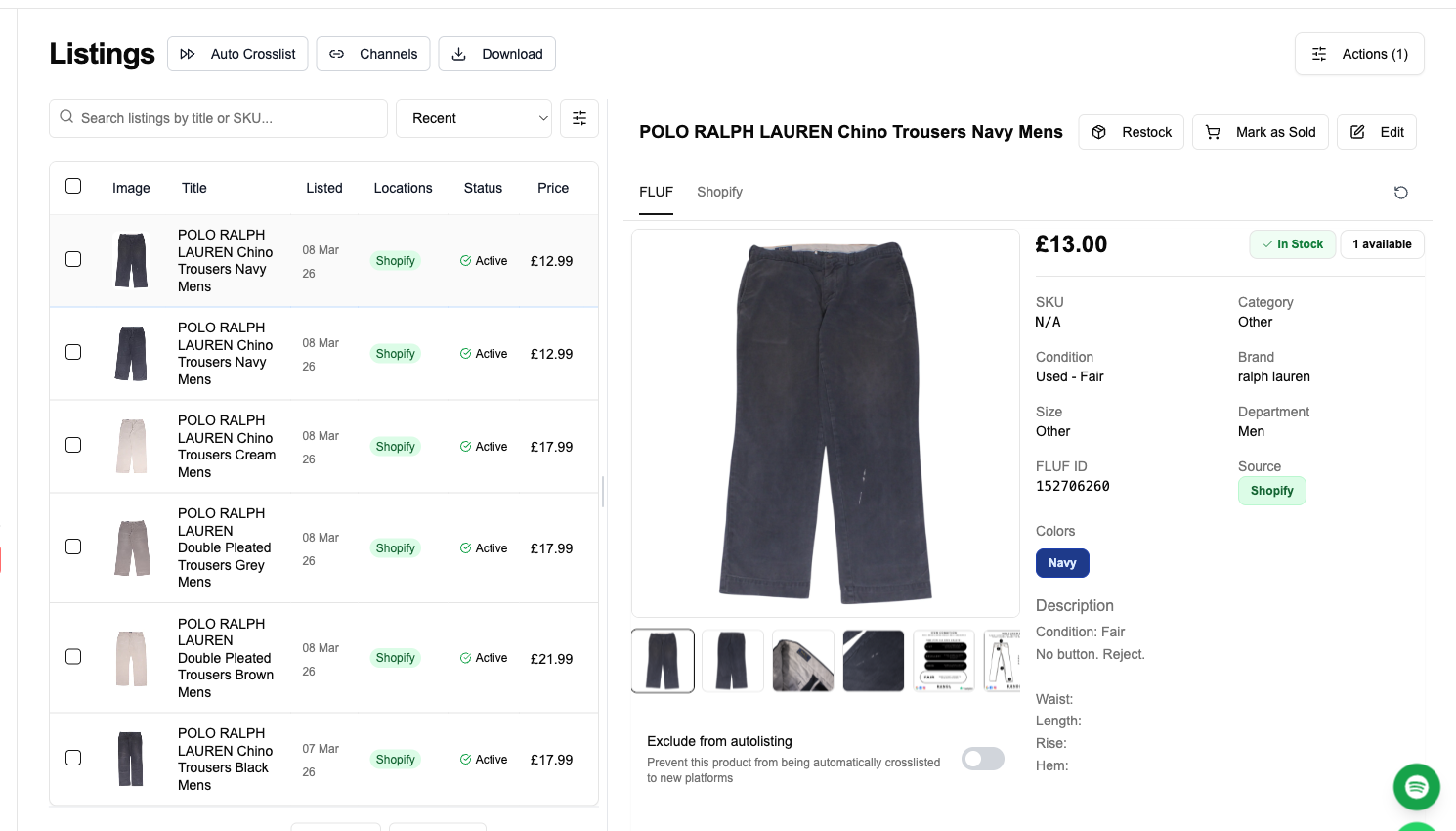
If you sell women’s designer and contemporary pre-loved fashion on Designer Wardrobe, you already reach the most engaged resale audience in New Zealand and Australia. But your Chanel flap, your Gucci loafers, your barely-worn Zimmermann — the pieces that deserve a serious price — are competing for a pool of buyers that stops at the Tasman. Vestiaire Collective is where those same items meet 23 million luxury buyers spread across more than 100 countries, and where physical authentication gives a stranger in Paris or New York the confidence to pay what your handbag is actually worth.
The two platforms don’t talk to each other. Designer Wardrobe has no export to Vestiaire, and Vestiaire has no idea what you already have listed at home. FLUF Connect sits between them: it imports your Designer Wardrobe catalogue once, mirrors it onto Vestiaire Collective with the fields and currency translated for you, and then keeps stock levels in sync so you never sell the same jacket twice. This page explains exactly which of your Designer Wardrobe items belong on Vestiaire, what transfers, what it costs, and how the automation works.
Why Sell on Both Designer Wardrobe and Vestiaire Collective?
The case for keeping Designer Wardrobe is simple: it is Australasia’s largest pre-loved fashion community, with 350,000+ members and around NZD $1.6M changing hands every month (source). It launched cross-Tasman into Australia in October 2024, so a single listing now reaches shoppers in both markets (source). Its women-led, designer-and-contemporary focus means local buyers understand your labels and your sizing. For everyday designer resale in NZD and AUD, it is hard to beat at home.
The case for adding Vestiaire is about ceiling and trust. Vestiaire Collective has 23+ million members across 100+ countries, with roughly 88% of users outside its home market of France and the United States now its largest single market at more than 20% of activity (source). That is a fundamentally different demand curve. A rare designer handbag that draws two watchers in Auckland can attract bids from Milan, Seoul and Los Angeles at once. And because Vestiaire physically authenticates high-value pieces through hubs in the US, UK, France, Hong Kong and Singapore, buyers pay premium prices they simply won’t risk on an unverified listing (source).
The audiences also skew differently in a useful way. Vestiaire reports that more than 70% of its members are Gen Z and Millennials, a cohort that treats pre-owned luxury as a first-choice purchase rather than a compromise (source). Listing the same inventory on both platforms means your entry-level contemporary pieces keep selling quickly to the Australasian community while your true luxury pieces get the global, authenticated stage they need. You are not choosing between them — you are matching each item to the buyer most willing to pay for it.
There is also a currency argument that Australasian sellers feel keenly. On Designer Wardrobe your prices are set in NZD or AUD and your buyers pay through the platform’s wallet-based system, with earnings held in a DW Wallet and released after the buyer receives the item (source). That is convenient at home, but it caps your item in a single currency and a single time zone of demand. Vestiaire lets the same piece be priced in USD, GBP or EUR and sold into whichever market is hottest for that label right now — a Toteme coat that is quiet locally might be in demand in the UK, a vintage Prada bag more sought-after in the US. Selling on both means you stop leaving that geographic price premium on the table.
Finally, resilience matters. Relying on one marketplace means one algorithm change, one quiet season or one policy shift can flatten your sales. A seller listing across both a strong regional platform and a global one smooths those bumps: when Australasian demand cools over winter, the northern hemisphere is heading into its buying season, and vice versa. Crosslisting turns two separate audiences into one continuous stream of buyers.
How to Crosslist from Designer Wardrobe to Vestiaire Collective with FLUF Connect
The workflow is designed so you set up your source once and then work item-by-item or in bulk from a single dashboard.
- Connect Designer Wardrobe as your source. Link your Designer Wardrobe account in FLUF Connect so it can read your live catalogue — titles, descriptions, photos, prices and condition — without you re-keying anything.
- Connect Vestiaire Collective as a destination. Authorise Vestiaire Collective in the same dashboard. FLUF Connect handles the connection so your listings publish under your own Vestiaire seller account.
- Import your catalogue. Pull your existing Designer Wardrobe items into FLUF Connect. Each becomes a central listing you can edit once and push everywhere.
- Choose which items go to Vestiaire. Select the designer and luxury pieces that suit an authenticated global market — think handbags, luxury labels and higher-value contemporary — and crosslist them. You can set auto-rules so new items above a price threshold, or in chosen brands, publish to Vestiaire automatically.
- Let sync run. Once live, FLUF Connect keeps inventory aligned. When a piece sells on either platform, the other listing is updated so you never oversell across markets.
Because Vestiaire is a server-side integration in FLUF Connect, you don’t need a browser extension running for it to work — the crosslist, edit and sync all happen behind the scenes.
What Transfers When You Crosslist from Designer Wardrobe to Vestiaire Collective?
FLUF Connect maps each Designer Wardrobe field to its Vestiaire Collective equivalent, adjusting for the differences between a regional Australasian marketplace and a global luxury one.
| Field | How it transfers to Vestiaire Collective |
|---|---|
| Title | Copied across; FLUF Connect keeps it within Vestiaire’s field limits and can apply your listing rules so brand and model lead the title. |
| Description | Carried over in full. You can edit centrally to add authentication-relevant detail (serial, dust bag, receipt) that global luxury buyers look for. |
| Images | Your Designer Wardrobe photos transfer. Clear, well-lit shots matter more on Vestiaire because higher-value pieces may be routed through authentication. |
| Price | Converted from NZD/AUD into the currency you sell in on Vestiaire (USD, GBP, EUR and more). You can review and lift prices for the luxury audience before publishing. |
| Category | Smart-mapped to Vestiaire’s luxury taxonomy so a Designer Wardrobe category lands in the right handbags, apparel or accessories tree. |
| Condition | Mapped to Vestiaire’s condition grades, which luxury buyers scrutinise closely. |
| Brand | Matched to Vestiaire’s brand list — essential, since Vestiaire’s fee promotions and authentication routing key off recognised designer labels. |
| Variants / size | Size and applicable variant data carry across so the listing is complete and searchable. |
The practical upshot: you can take a Designer Wardrobe listing built in NZD for a local buyer and, in a few clicks, present the same item in USD or GBP to a member in Singapore — without rewriting a word or recalculating a price by hand.
Inventory Sync Between Designer Wardrobe and Vestiaire Collective — What Stays in Sync?
This is where crosslisting either saves you or embarrasses you, and it is where the two channels behave slightly differently inside FLUF Connect.
On Designer Wardrobe, FLUF Connect provides order-sync and mark-as-sold. When a Designer Wardrobe sale comes through, FLUF Connect registers it and can automatically mark the item sold everywhere else you’ve listed it — so the moment your dress sells at home, the Vestiaire copy comes down. This prevents the classic double-sale, where a buyer in New Zealand and a buyer in New York both pay for the same one-off piece.
On Vestiaire Collective, FLUF Connect supports the full set: relisting, offer management, order-sync and mark-as-sold. A Vestiaire sale flows back into your central inventory and delists the item from Designer Wardrobe automatically. Offers made on Vestiaire are surfaced and managed for you, and relisting keeps stale luxury pieces visible in Vestiaire’s feed without manual re-posting. In short, sync runs in both directions: a sale on either side updates the other, and you manage the whole thing from one screen.
It is worth understanding why this matters more for luxury than for fast fashion. A one-off designer handbag is, by definition, a single unit — you have exactly one to sell. List it in two places without sync and you are gambling that both buyers won’t commit at once. When they do, one of them gets a cancellation, your seller rating takes a hit on a platform that lives and dies by trust, and on Vestiaire specifically a cancelled high-value order can mean an item was already in transit to an authentication hub. FLUF Connect’s mark-as-sold removes that risk entirely: the instant either channel confirms a sale, the twin listing comes down before a second buyer can reach it. For high-value inventory, that safety net is not a convenience — it is the whole reason crosslisting is safe to do at all.
Crosslisting from Designer Wardrobe to Vestiaire Collective: Before and After FLUF Connect
| Task | Before FLUF Connect | After FLUF Connect |
|---|---|---|
| Listing on both platforms | Rebuild each item by hand on Vestiaire — re-photograph, re-type, re-categorise. | Import once from Designer Wardrobe, push to Vestiaire in a click. |
| Currency | Manually convert NZD/AUD to USD/GBP/EUR and hope the maths is right. | Prices converted automatically; you review and adjust for the luxury tier. |
| Category & brand | Guess where each item fits in Vestiaire’s luxury taxonomy. | Smart-mapped to the correct category and matched to Vestiaire’s brand list. |
| Avoiding double-sales | Watch two inboxes and delist manually the instant something sells. | A sale on either channel auto-updates the other. |
| Offers & relisting on Vestiaire | Log in daily to answer offers and re-post ageing listings. | Offers managed and relisting handled from the FLUF dashboard. |
| Reach | 350,000 Australasian buyers. | The same 350,000 plus 23M+ global luxury buyers across 100+ countries. |
Automation Features for Designer Wardrobe and Vestiaire Collective Sellers
FLUF Connect’s automation is built to reduce the repetitive work that makes multi-marketplace selling painful, and every automation described here is included in your plan rather than sold as an extra.
Auto-crosslist rules. Set conditions — a minimum price, specific brands, particular categories — so that as new designer pieces land in your Designer Wardrobe catalogue, the ones that suit a global luxury audience publish to Vestiaire Collective automatically while the rest stay local.
Offer management on Vestiaire. Vestiaire buyers negotiate. FLUF Connect surfaces incoming offers and lets you respond from the central dashboard, so you can price-hold or accept without living inside the Vestiaire app.
Relisting on Vestiaire. Luxury listings that sit for weeks lose visibility. FLUF Connect can relist eligible items to keep them fresh in Vestiaire’s feed, giving quiet pieces another run at the global audience.
Order-sync and mark-as-sold across both. Whichever platform the sale happens on, the item is marked sold and removed from the other automatically. This is the safety net that makes crosslisting a genuinely passive way to double your reach rather than a way to double your admin.
Central editing. Change a price, fix a typo or add authentication detail once in FLUF Connect and push the update to both channels. No more editing the same item in two places and forgetting which is current.
Which Designer Wardrobe Items Suit Vestiaire Collective?
Not every Designer Wardrobe listing belongs on Vestiaire, and choosing well is what makes the extra channel pay. Vestiaire’s strength is authenticated luxury and premium designer, so it rewards the pieces where a buyer’s biggest worry is “is it real?”
- Designer handbags. The category Vestiaire is built for. A verified Louis Vuitton, Chanel or Hermès bag reaches buyers globally who will pay a premium precisely because Vestiaire authenticates it.
- Luxury labels and higher-value contemporary. Items where the resale price justifies international shipping and the 12% fee — think premium designer coats, tailoring and statement pieces.
- Accessories, watches and fine jewellery. Small, high-value and shippable worldwide, these travel well to a global buyer and benefit most from authentication.
- Rare or hard-to-find pieces. Anything with thin demand locally but genuine collector interest abroad — a global audience of 23M finds the one buyer who wants it.
Keep your fast-moving, lower-value contemporary pieces working hard on Designer Wardrobe, where the local community buys quickly and shipping is domestic. Route the luxury up to Vestiaire. FLUF Connect’s auto-rules let you encode exactly this split so you don’t have to make the call item by item.
How Much Does It Cost to Crosslist from Designer Wardrobe to Vestiaire Collective?
There are three cost layers to understand: what each marketplace charges, and what FLUF Connect charges to bridge them.
Designer Wardrobe fees. Listing is free; you pay a success fee only when an item sells. Sales under NZD $40 carry a flat $4.95 fee, and sales above $40 are charged at 12.95% commission (capped at a maximum fee of $249), plus a small payment-processing fee. The fee is calculated on the final value including shipping (source).
Vestiaire Collective fees. Listing is also free. Vestiaire charges a 12% selling fee on items newly listed from 18 July 2025 (raised from 10%), plus a 3% payment-processing fee (source). In the US market that 12% applies on sales between roughly $83 and $16,667, with a flat $10 fee under $83 and a minimum listing price of $18 (source). Authentication of high-value items is part of the service, with items over €1,000 routed to expert authentication and an optional Authentication add-on available (source). UK sellers have at times had access to a limited promotional 0% selling fee on thousands of eligible brands — worth checking, but it is a temporary promotion, not a permanent fee waiver (source).
FLUF Connect pricing. Plans start at £9/month (Starter). There is no free plan, but every new account gets a 7-day trial for £1. Automation is included from Seller upwards, not a paid add-on. You can see the full tiers on the pricing page. The way to think about it: Vestiaire’s higher price ceiling for authenticated luxury often means a single successful global sale more than covers a month of crosslisting — you are trading a fixed tool cost for access to a market that pays more for the same item.
A worked example: a designer handbag listed at NZD $1,200 on Designer Wardrobe might sell locally for that, minus roughly 12.95% commission. The same bag, authenticated and presented in GBP or USD to Vestiaire’s global buyers, can command a materially higher price because international collectors compete for it and trust the verification — and Vestiaire’s 12% is charged on that larger number. Crosslisting lets both markets bid, and you keep whichever sale lands first.
Sources & Verification
Designer Wardrobe fees (source); Designer Wardrobe community and transactions (source); Designer Wardrobe Australia launch (source); Designer Wardrobe how-it-works and wallet payments (source); Vestiaire Collective selling fees (source); Vestiaire member count and geography (source); Vestiaire authentication and services (source); Vestiaire expert authentication and trust (source); Vestiaire demographics, BCG report (source); Vestiaire UK promotional 0% fee (source). Last verified: July 2026.
Frequently Asked Questions
Yes. FLUF Connect imports your Designer Wardrobe catalogue once, then lets you push items to Vestiaire Collective in a click or via auto-rules — for example, publishing any new item above a set price or in a chosen designer brand to Vestiaire automatically while keeping the rest local.
Designer Wardrobe charges no listing fee and a success fee on sale: a flat NZD $4.95 under $40, or 12.95% commission above $40 (capped at a $249 maximum fee), plus a small processing fee. Vestiaire Collective charges no listing fee and a 12% selling fee on items listed from 18 July 2025, plus a 3% payment-processing fee.
Route your higher-value designer and luxury pieces to Vestiaire — designer handbags, luxury labels, accessories, watches, fine jewellery and rare items. These benefit most from Vestiaire's global reach and physical authentication, which lets buyers pay premium prices. Keep fast-moving, lower-value contemporary items working on Designer Wardrobe.
Yes. Vestiaire physically authenticates high-value pieces through expert hubs in the US, UK, France, Hong Kong and Singapore, with items over €1,000 routed to expert authentication. An optional Authentication add-on is available. This trust is what lets designer resale command higher prices globally.
FLUF Connect converts your Designer Wardrobe prices from NZD or AUD into the currency you sell in on Vestiaire — USD, GBP, EUR and more. You can review and adjust each price before publishing, which is a good moment to lift prices to suit Vestiaire's global luxury buyers.
No. FLUF Connect keeps inventory in sync in both directions. When an item sells on Designer Wardrobe it is marked sold and removed from Vestiaire automatically, and a Vestiaire sale delists it from Designer Wardrobe — so a one-off designer piece can never be bought on both channels at once.
On Vestiaire Collective FLUF Connect supports the full set: relisting to keep ageing luxury listings visible, offer management so you can respond to buyer offers from one dashboard, order-sync, and mark-as-sold. All of it is included in your plan, not a paid add-on.
Plans start at £9/month (Starter). There is no free plan, and automation is included from Seller upwards rather than sold as an extra. Because Vestiaire's authenticated luxury market supports higher price points, a single successful global sale often more than covers a month of crosslisting.
No. Vestiaire Collective is a server-side integration in FLUF Connect, so crosslisting, central editing and inventory sync all run in the background — you don't need to keep a browser or extension open for it to work.