Gumtree vs Vinted — Which Is Better for Selling?
A clear, fee-by-fee comparison of Gumtree's local classifieds model and Vinted's shipped fashion marketplace to help you sell each item in the right place.
7 days for £1, then from £9/month.



TL;DR: Gumtree and Vinted are two of the UK’s biggest secondhand marketplaces, but they serve very different sellers. Vinted is a national, shipped, clothing-first marketplace with no seller fees and a built-in buyer-protection and payments layer, making it ideal for posting fashion, shoes and accessories to a 17M+ UK audience. Gumtree is a broad local classifieds site for bulky and everything-else items — cars, furniture, white goods, bikes, pets and more — where you arrange your own cash-in-hand collection with no commission and no built-in payments. Choose Vinted when you want to ship clothes and let the platform handle payment and delivery; choose Gumtree when you are selling furniture, a car or anything bulky to a local buyer face to face. Plans start at £9/month (Starter); There is no free plan, but every new account gets a 7-day trial for £1.
If you are clearing out a wardrobe, a garage or an entire house, two names dominate the UK resale conversation: Vinted and Gumtree. On the surface they look like rivals — both let ordinary people sell unwanted things to other ordinary people, and both are free to list on. But the moment you look past that headline, they diverge so sharply that for most items the “which is better” question almost answers itself. Vinted is a shipped, fashion-focused, payments-included marketplace that has grown into one of the largest secondhand platforms in Europe. Gumtree is a long-running local classifieds board where you sell anything to anyone within driving distance and handle the money and the handover yourself. This guide breaks down the real differences — fees, audience, categories, shipping versus pickup, buyer protection and the decision framework — so you can pick the right home for each item. And because the best answer is often “use both,” we will also cover how FLUF Connect lets you list a single inventory across both channels at once.
The Headline Difference: Shipped Fashion vs Local Everything
The single most important distinction between these two marketplaces is the kind of transaction they are built around. Vinted is a peer-to-peer marketplace optimised for shipped goods. You list an item, a buyer in another part of the country buys it, you print a prepaid label, drop the parcel at a locker or shop, and the money lands in your Vinted wallet once the buyer confirms receipt. The whole flow — listing, messaging, payment, shipping label, dispute resolution — happens inside one app. That tight integration is why Vinted has become the default place to sell clothing in the UK and across Europe.
Gumtree works on the opposite principle. It is a classifieds platform: you post an advert with a price and a location, interested buyers contact you, and then you arrange everything else between yourselves — usually a local collection paid in cash or by bank transfer. Gumtree does not process payments, does not generate shipping labels and does not hold money in escrow. It is, in essence, a digital noticeboard with reach. That model is perfect for things you cannot or would not want to post: a sofa, a fridge, a used car, a mountain bike, a litter of kittens. It is far less suited to a single pre-loved jumper, which on Gumtree would sit waiting for a local buyer while on Vinted it could ship to anyone in the country within days.
This difference cascades into everything else — the audience each platform attracts, the categories that thrive, the fee structures and the protections (or lack of them) on each side of the deal. Understanding it up front makes the rest of this comparison click into place.
Vinted at a Glance: Scale, Reach and the Fashion Engine
Vinted has grown from a niche Lithuanian clothes-swapping site into one of the defining names in European resale. In the UK alone it passed 17 million users, cementing its position as a mainstream destination rather than a fringe app source. Globally the platform reports more than 75 million members across over 20 countries, with 2025 revenue of around €1.1bn and gross merchandise value of €10.8bn, up 47% year on year — figures that put it firmly among the heavyweight marketplaces, not the challengers source.
That scale matters to a seller for one simple reason: liquidity. The more active buyers a platform has, the faster items sell and the closer you can hold to your asking price. For clothing, shoes and accessories, Vinted’s concentration of fashion-minded buyers means your listing is shown to exactly the people most likely to want it. The platform’s analysts and commentators describe its rise as a genuine turning point in Europe’s circular-fashion economy — a structural shift in how people buy and sell used clothes, rather than a passing trend source.
Crucially, Vinted’s catalogue is built around personal wardrobe items: womenswear, menswear, kids’ clothing, shoes, bags and accessories, plus adjacent categories like beauty and some homeware. It is not where you would list a car or a washing machine. That focus is a feature, not a limitation — it keeps the buyer base aligned with what most sellers are clearing out, and it is why “selling on Vinted” has become shorthand for selling clothes online in much of Europe.
Gumtree at a Glance: The Local Classifieds Veteran
Gumtree is one of the UK’s oldest and best-known classifieds sites, and over the years it has changed hands several times. Originally part of eBay, it later moved through Adevinta and a holding company before being quietly sold in September 2024 to Ocean Link, the owner of China’s 58.com classifieds giant source. Through all of that, its core proposition has stayed remarkably stable: a free, broad, location-based place to advertise almost anything.
Where Vinted is narrow and deep, Gumtree is wide. Its categories span cars and other vehicles, furniture, electronics, white goods and appliances, bikes, baby and kids’ equipment, pets, jobs, property to rent or buy, and a sprawling services section source. It is the kind of place a household turns to when it needs to sell a dining table, find a flat, hire a plumber or rehome a pet — transactions that are inherently local, often bulky, and frequently handled in cash.
That breadth comes with a trade-off in scale and momentum. Recent UK traffic data shows Gumtree drawing roughly 16.9 million monthly visits in October 2025, while Vinted pulled in about 30.3 million — meaning Vinted overtook Gumtree during 2025 to become the UK’s largest secondhand marketplace by visits source. Gumtree is still enormous and still indispensable for the things it does well, but it is no longer the default first stop it once was for casual sellers — particularly those clearing clothes.
Fees and Costs Compared
One of the most reassuring things about both platforms is that they are genuinely free to the seller for standard listings — neither takes a cut of your sale price as commission. The difference lies in where any money does change hands, and in who carries the protection layer.
On Vinted, listing is free and the seller pays nothing in fees: you keep the full amount the buyer pays for the item. Vinted’s revenue comes from the buyer side instead, through a Buyer Protection fee added at checkout source. That fee is paid by the buyer, not deducted from your payout, and is typically structured as a small fixed amount of roughly £0.30 to £0.80 plus around 3% to 8% of the item price source. In exchange, the buyer gets a layer of protection and the transaction runs through Vinted’s integrated payments and prepaid shipping.
On Gumtree, basic listings are also free across most categories, and there is no sales commission whatsoever — the platform’s revenue comes instead from optional paid promotion, such as featuring or bumping an advert to give it more visibility source. There is no buyer fee because Gumtree does not sit in the middle of the payment at all; the buyer simply pays you directly, usually in cash on collection. That means no protection layer on either side — the platform connects you, and from there you are on your own.
| Feature | Vinted | Gumtree |
|---|---|---|
| Listing cost | Free | Free (optional paid promotion available) |
| Seller commission | £0 — seller keeps full sale price | £0 — no commission |
| Buyer fee | Buyer Protection fee: ~£0.30–£0.80 + 3–8% of price (paid by buyer) | None |
| Payments | Integrated — money held until delivery confirmed | None — buyer pays seller directly (usually cash) |
| Shipping | Prepaid labels generated in-app | None — local collection, self-arranged |
| Buyer protection | Yes — covered by Buyer Protection fee | No built-in protection |
| Primary categories | Clothing, shoes, accessories, bags, kids’, some homeware | Cars, furniture, electronics, appliances, bikes, pets, jobs, property, services |
| Transaction model | National, shipped P2P | Local, in-person cash-in-hand |
| UK monthly visits (Oct 2025) | ~30.3M | ~16.9M |
The practical upshot: for the seller, both platforms cost effectively nothing to use. The real difference is structural. Vinted’s buyer-side fee funds a managed, protected, end-to-end transaction. Gumtree’s no-fee model reflects the fact that it is purely an introduction service — it does not touch your money, which keeps it free but leaves both parties to sort out trust and logistics themselves.
Audience and Scale: Who You Reach
The audience question is really two questions: how many people will see your listing, and are they the right people for what you are selling. On raw reach, the two platforms are now closer than reputation might suggest, with Vinted having edged ahead during 2025 to lead UK secondhand marketplaces on monthly visits source. But headline traffic numbers can mislead, because the two audiences want very different things.
Vinted’s audience is overwhelmingly there to buy and sell fashion. When someone opens the app, they are browsing for a dress, a pair of trainers, a coat or a handbag. That intent is concentrated and consistent, which is why clothing listings move quickly. With more than 17 million UK users and 75 million globally, the pool of fashion buyers is vast and engaged, and the circular-fashion habit is now deeply embedded in everyday shopping behaviour source.
Gumtree’s audience is far more diffuse. People come to Gumtree with a specific local need — a desk for the spare room, a second-hand car within twenty miles, a phone repair service, a flat to rent. Because the platform spans so many unrelated categories, the audience for any one of your listings is essentially “people near you who happen to want this thing right now.” That can work brilliantly for high-value or bulky local items, where even a handful of nearby buyers is plenty, but it is far less efficient for a low-value item that would sell instantly to a national audience on a specialist platform like Vinted.
So the audience comparison is not really about who is bigger; it is about fit. A £15 jumper reaches the wrong crowd on Gumtree and the perfect crowd on Vinted. A £200 sofa reaches no realistic shipping buyer on Vinted and exactly the right local crowd on Gumtree. Match the item to the audience and both platforms shine; mismatch it and even a huge user base will not help.
Categories: What Each Platform Is For
Category fit is where the two marketplaces separate most cleanly, and it is the single most reliable way to decide where an item belongs.
Vinted is a clothing-first marketplace. Its core categories are womenswear, menswear and childrenswear, shoes, bags and accessories, with supporting categories for beauty products and a limited amount of homeware. Everything about the platform — search filters by brand and size, condition grading, the prepaid postage flow — is tuned for personal fashion items that can be packed into a parcel. If what you are selling can be folded into a polymailer and posted, Vinted is built for it. If it cannot, Vinted simply is not the place; there is no meaningful market there for furniture, appliances or vehicles source.
Gumtree is the opposite: a general-purpose classifieds platform whose categories deliberately cover almost everything a household might buy or sell locally. Cars and motorbikes, sofas and dining sets, fridges, freezers and washing machines, televisions and computers, bicycles, prams and cots, pets, job vacancies, rooms and properties to rent, and a deep services directory all live side by side source. The unifying thread is locality and, often, size: these are things people prefer to inspect in person and collect themselves rather than trust to a courier.
There is a sliver of overlap — you can technically advertise clothing on Gumtree and small homeware on Vinted — but in practice the platforms rarely compete for the same item. The honest framing is that they are complementary rather than interchangeable. The right mental model is: clothing and small shippable goods go to Vinted; bulky, local, or non-fashion items go to Gumtree.
Shipping vs Local Pickup: How the Item Gets to the Buyer
How an item physically reaches its buyer is the most underrated factor in choosing a platform, and it is where the two diverge most practically.
Vinted is engineered around shipping. When a buyer purchases, the platform generates a prepaid label, the buyer pays the postage, and you drop the parcel at a designated point. The money you receive is held by Vinted until the buyer confirms the item has arrived as described, at which point your payout is released source. This removes almost all of the friction and risk from posting to strangers: you are not chasing payment, not negotiating delivery, and not exposed to “the parcel never arrived” disputes in the way you would be selling privately. For a clothing seller, this is enormous — it means you can sell to someone three hundred miles away as easily as someone next door.
Gumtree has no shipping or payment infrastructure at all. The platform connects buyer and seller, and from there the logistics are entirely manual. In the overwhelming majority of cases that means local collection: the buyer comes to you (or you meet somewhere), inspects the item, hands over cash or makes a transfer, and takes it away. This is exactly what you want for a wardrobe, a sofa or a car — items you could never post affordably and which buyers want to see before paying. But it also means the seller carries all the coordination and all the risk: arranging viewings, handling potential no-shows, accepting cash and managing safety around in-person meetings. There is no escrow, no label, and no platform to fall back on if something goes wrong.
The decision rule is straightforward. If the item is small enough to post and you would rather not deal with collections, Vinted’s shipping model is a huge advantage. If the item is too big, too heavy or too valuable to post — or you simply prefer a face-to-face cash deal — Gumtree’s local model is the right tool, and Vinted’s shipping focus would actively get in the way.
Buyer Protection and Trust
Trust is the quiet differentiator between these platforms, and it flows directly from their transaction models.
Because Vinted processes the payment and holds it in escrow until delivery is confirmed, it can offer a genuine protection layer. The Buyer Protection fee that buyers pay funds this: if an item does not arrive, or arrives significantly not as described, the buyer has a formal route to a refund, and the seller is shielded from “item not received” claims once the tracked parcel is confirmed delivered source. Neither party is handing money to a stranger on trust alone; the platform sits in the middle as guarantor. For nervous first-time sellers, this is one of the strongest reasons to choose Vinted for clothing.
Gumtree offers no equivalent. Because it never touches the payment, there is no escrow, no refund mechanism and no transaction guarantee from the platform itself. The standard advice for any local classifieds deal applies: meet in a safe public place where possible, inspect goods before paying, prefer cash or an instant confirmed transfer, and be alert to common scams. This is not a flaw unique to Gumtree — it is inherent to any introduction-only classifieds model — but it does mean the seller and buyer carry the trust burden entirely themselves. For a local cash deal on a sofa that the buyer has come to inspect, that is usually fine. For posting a valuable item to someone you cannot see, it is a meaningful gap that Vinted’s model closes.
Which Should You Choose? A Decision Framework
Rather than crown one platform the winner, it is far more useful to match the platform to the item and the seller. Here are four common personas and the clear recommendation for each.
The wardrobe declutterer. You have bags of clothes, shoes and accessories you no longer wear and you want them gone without standing in a car park waiting for collectors. Vinted is the obvious choice. Your items are shippable, the fashion-focused audience is exactly right, the platform handles payment and postage, and Buyer Protection covers the deal. Gumtree would leave your clothes languishing in front of a local audience that mostly is not there to shop for fashion.
The house-clearer with bulky goods. You are selling a sofa, a wardrobe, a fridge-freezer or a dining table — things that are heavy, awkward and impossible to post affordably. Gumtree is built for this. A local buyer can come, inspect the item, pay cash and load it into a van the same day. Vinted has no realistic market or logistics for furniture, so it is simply the wrong tool.
The car or high-value local seller. You are selling a used car, a motorbike or a bike worth a few hundred pounds, and you want local buyers who can see it in person before paying. Gumtree’s vehicle and classifieds categories are made for exactly this, with a local audience used to in-person, cash-or-transfer deals. Vinted has no provision for vehicles at all.
The convenience-first seller. Your priority is integrated payments and shipping — you want to print a label, drop the parcel and get paid without arranging viewings, handling cash or managing no-shows. If your items are shippable, Vinted wins decisively because the whole flow is handled for you. If your priority is instead a simple face-to-face cash handover with no fees and no platform in the middle, and your item is local and bulky, Gumtree is the better fit.
The pattern is clear: clothes to ship go to Vinted; furniture, cars and bulky local items go to Gumtree; sellers who want integrated payment and delivery lean Vinted; sellers who prefer face-to-face cash lean Gumtree. The good news is that you do not have to commit to one for your whole inventory — different items can go to different homes, and you can list across both at once.
Listing on Both via FLUF Connect
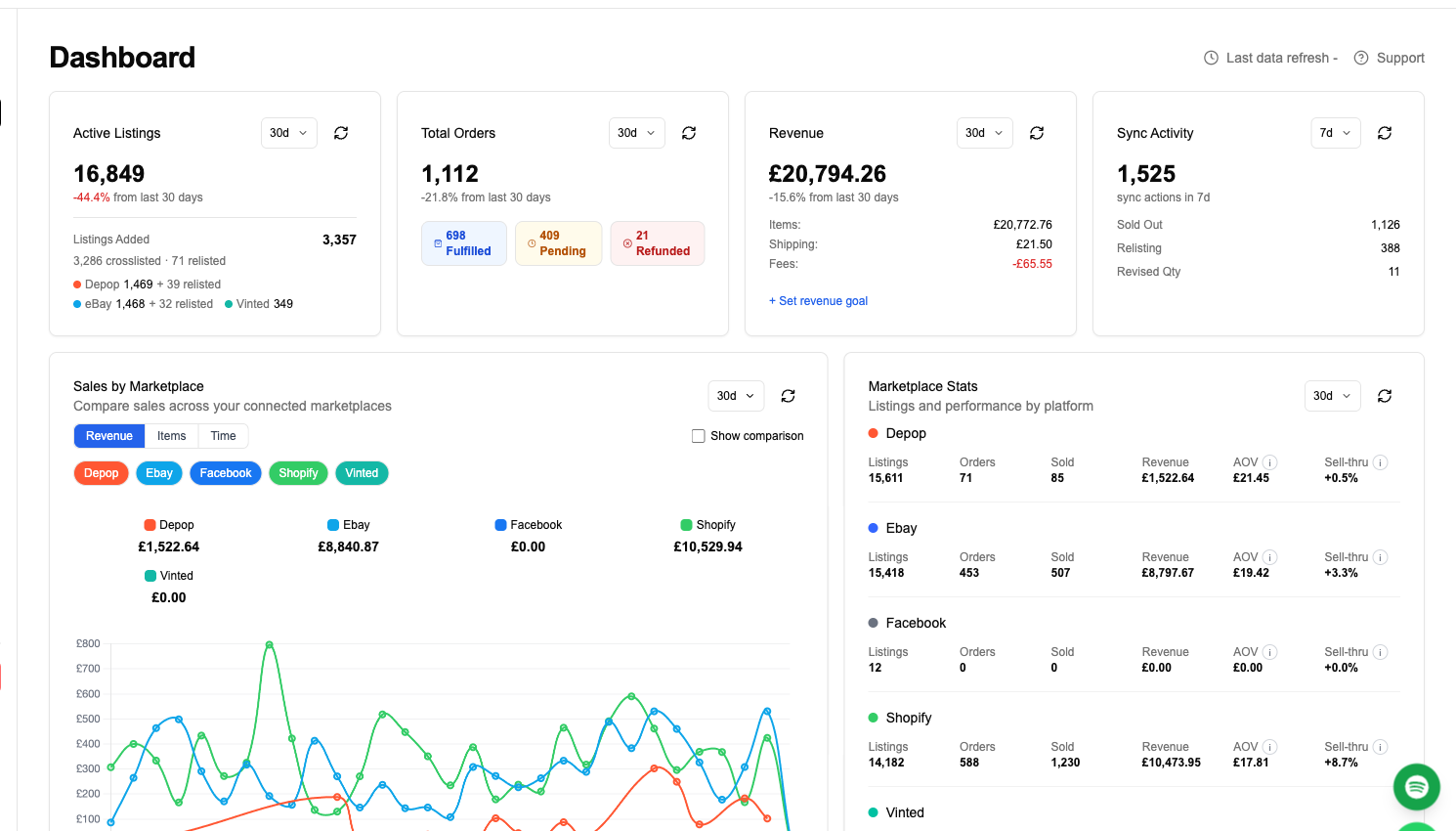
For anyone clearing a mix of items — some clothes to post, some bulky things to sell locally — the smartest approach is not to choose at all, but to put each item where it sells best. The problem with doing that manually is the time it takes: writing the same listing twice, re-uploading photos, keeping prices and details in step. FLUF Connect is built to remove that friction. It is a WordPress plugin plus browser extension that lets you manage one inventory and publish it across many marketplaces, including both Vinted and Gumtree, from a single dashboard.
It is worth being precise about what that looks like in practice, because the two channels behave very differently inside FLUF Connect — and being honest about it matters more than a tidy marketing line. Through FLUF Connect, Vinted is a fully supported automated channel: you can relist items to keep them fresh in search, send and manage offers, sync orders back to your central inventory, and have items automatically marked as sold when they sell elsewhere so you are not double-selling. That automation is included from Seller upwards, not an add-on.
Gumtree, by contrast, is an extension-first local classifieds channel. FLUF Connect helps you list to Gumtree from your central inventory using the browser extension, but Gumtree itself offers no automation hooks — so there is no relisting, no offers, no inventory or order sync, and no mark-as-sold for Gumtree. That is not a shortcoming of FLUF Connect; it reflects what Gumtree is as a manual, introduction-only classifieds platform. Listing is assisted; everything after the listing is handled by you and your buyer directly, exactly as it would be if you posted manually.
In other words, FLUF Connect lets you run a hybrid strategy without the duplicated effort: post your shippable clothing to Vinted with full automation behind it, and list your bulky or local items to Gumtree from the same inventory with the extension doing the heavy lifting on data entry. You write each item once and decide where it goes. For sellers with genuinely mixed stock — a reseller, a house-clearer, a small business offloading varied goods — that single-inventory model is the practical answer to the “Gumtree or Vinted” question: it is both, organised.
Sell on Both — One Inventory
You do not have to pick a side. The right home for a pre-loved coat is Vinted; the right home for a corner sofa is Gumtree; and the right way to manage both without writing every listing twice is a single inventory that publishes to each channel on its own terms — Vinted automated, Gumtree as an assisted manual listing channel. Try FLUF Connect to list one catalogue across Vinted, Gumtree and more from one dashboard. Plans start at £9/month (Starter); There is no free plan, but every new account gets a 7-day trial for £1.
Sources & Verification
- Vinted passes 17M+ UK users — source
- Vinted 75M+ members, €1.1bn 2025 revenue, €10.8bn GMV (+47%) — source
- Vinted has no seller fees; revenue comes from the buyer side — source
- Vinted Buyer Protection fee (~£0.30–£0.80 + 3–8%) paid by buyer — source
- Vinted as a turning point in Europe’s circular-fashion economy; clothing focus — source
- Gumtree sold to Ocean Link / owners of 58.com in September 2024 — source
- Vinted (~30.3M) overtook Gumtree (~16.9M) UK monthly visits in 2025 — source
- Gumtree freemium model: free basic listings, no commission, revenue from optional paid promotion — source
- Gumtree broad categories, local pickup, no built-in payments or shipping — source
Related guides
For Germany, the equivalent comparison is Kleinanzeigen vs Vinted. Kleinanzeigen vs Vinted.
Frequently Asked Questions
Vinted is better for clothes. It is a clothing-first, shipped marketplace with 17M+ UK users, integrated payments and prepaid shipping labels, so a pre-loved item can sell nationally and post easily. Gumtree's audience is local and general-purpose, so clothing tends to move slowly there.
Gumtree. It is a local classifieds platform with categories for cars, furniture, white goods, bikes and more, where buyers collect items in person and pay directly. Vinted has no realistic market or logistics for bulky goods, since it is built around items you can post.
Both are free to list on for sellers with no commission taken from your sale. On Vinted the buyer pays a Buyer Protection fee of roughly 0.30 to 0.80 pounds plus 3 to 8 percent of the price; on Gumtree there is no buyer fee, and revenue comes only from optional paid promotion you can choose to add.
No. Vinted holds payment in escrow until delivery is confirmed and offers a protection layer funded by the buyer's Buyer Protection fee. Gumtree never processes the payment, so there is no escrow or refund mechanism; buyers and sellers arrange and trust the transaction themselves, usually in cash on collection.
Yes. FLUF Connect lets you manage one inventory and publish to both from a single dashboard. Vinted is a fully automated channel with relisting, offers, order sync and mark-as-sold included in every plan, while Gumtree is an extension-first manual listing channel with no automation, offers or sync.
Vinted overtook Gumtree during 2025 to become the UK's largest secondhand marketplace by visits, drawing around 30.3 million monthly visits in October 2025 compared with Gumtree's roughly 16.9 million. Gumtree remains large and dominant for local and bulky categories, but Vinted now leads overall reach.