
Crosslist from Bidzzy to Facebook Marketplace — Automatically
Marketplace cannot ship or take payment in the UK, so every sale is a face-to-face meet with no protection — and no fee. Here is how to run it alongside a Bidzzy catalogue safely.
7 days for £1, then from £9/month.



- Facebook Marketplace cannot ship or take payment in the UK. Loaded from a UK connection, Meta’s own delivery article returns “Selling with delivery on Marketplace isn’t available in your location at the moment.” Every UK sale is a face-to-face meet.
- Which means there is no UK Marketplace selling fee — not 5%, not 2%, not anything. No money passes through Meta, so there is nothing to take a cut of.
- And no Purchase Protection. Meta states that items exchanged in person using cash or person-to-person payments are not eligible. A UK Marketplace sale has no dispute process at all.
- Bidzzy also takes 0% from sellers — no listing fee, no monthly fee, no commission. The buyer pays 5% plus £0.80, minimum £1.00, capped at £15.00.
- Bidzzy bans electronic devices. Phones, tablets, laptops, TVs, consoles and appliances are all prohibited — its “tech” category means accessories. Marketplace takes them happily, so this is the clearest split in your stock.
- Bidzzy is UK mainland only. No Northern Ireland, Isle of Man, Channel Islands or Scottish Highlands and Islands, for buying or selling. Marketplace has no such restriction.
- Marketplace listings never expire — they are only deleted after two years of inactivity, and renewing or editing resets that clock. Bidzzy auto-renews on a 30, 60 or 90-day cycle.
- Bidzzy reports you to HMRC and says so. Marketplace UK, holding no payment data, has nothing to report — which changes who files, not what you owe.
- Cost: FLUF Connect crosslists to 60+ marketplaces from one dashboard. £1 for 7 days, then plans from £9/month (Starter). There is no free plan.
Why add Marketplace to a Bidzzy catalogue
Bidzzy is small and new. BIDZZY LTD was incorporated on 3 June 2026, company number 17259377, with one director and a Luton registered office; its terms are already at version 8.4. Its homepage claims 23,500-plus members and 100,300-plus items, and it is genuinely free to sell on. But 100,000 listings and 8,500 sellers is a young marketplace, and a young marketplace’s buyer traffic is thin.
Facebook Marketplace is the opposite in every dimension. Meta’s own July 2026 figure is 430 million items listed each month globally, the month Marketplace turned ten. It costs nothing to list on. And in the UK it will not handle your money.
The case for running both is therefore simple arithmetic. Bidzzy posts things anywhere on the UK mainland with a prepaid label and holds the buyer’s money until delivery. Marketplace finds you someone in your own town who will meet you with cash. Those are different sales, not competing ones — and neither charges a penny to try.
The fact that shapes everything: no UK checkout
Meta’s help centre is geo-personalised, and this is what it says to a UK visitor on both of its selling-with-delivery articles: “Selling with delivery on Marketplace isn’t available in your location at the moment. Learn how to sell something locally on Marketplace.”
That single string settles a surprising number of questions:
- There is no UK selling fee. Third-party guides quoting a 2% or 5% Marketplace fee are describing a checkout British sellers do not have. No payment flows through Meta, so no percentage is possible.
- There is no Purchase Protection. Meta’s own wording: eligible purchases made with checkout on Facebook are covered, and “items exchanged in person using cash or other person-to-person payment methods are not eligible”.
- There are no chargebacks — which cuts both ways. Nobody can reverse a payment you have already taken in cash, and nobody can help you if the buyer vanishes.
- Bulk listing by spreadsheet is also unavailable in the UK: Meta’s article returns “This feature isn’t available in your country at the moment.”
- The Seller app is US-only. Meta launched a dedicated Marketplace seller app in July 2026 with AI listing creation and bulk tools — iOS, United States, and not for you.
One quirk in the other direction. Meta’s Commerce Policies say Marketplace is intended for consumer-to-consumer sales, and that businesses or people acting commercially in the EEA, the Philippines and India may face restrictions or suspension. The UK is not in the EEA, so that restriction as written does not reach British sellers — a genuine post-Brexit divergence, and one that quietly makes Marketplace friendlier to a UK reseller than to a German one.
Equally, the Marketplace Partner Program — the third-party integration Meta built after the European Commission fined it €797.72 million in November 2024 — is scoped to the EEA, so it does not reach UK sellers either. The divergence runs both ways.
Neither one charges you
This is the rare pair where the fee comparison is genuinely short.
| Bidzzy | Facebook Marketplace (UK) | |
|---|---|---|
| Listing fee | None | None |
| Monthly fee | None | None |
| Seller commission | None — “You keep your full sale price” | None — no checkout exists |
| Buyer pays | 5% + £0.80 Buyer Protection, min £1.00, max £15.00, plus shipping | Nothing to Meta |
| Payment rail | Stripe; UK mainland bank account required | None — buyer pays you directly |
| Payout timing | Wallet 72 hours after delivery (private) or after the 14-day cancellation window (business) | Immediate, in cash, in person |
Bidzzy’s terms state it plainly: no listing fees, monthly fees or commission on the sale price. The Buyer Protection fee covers payment processing, dispute resolution and its guarantee. You can verify the formula against a live listing — an item at £29.99 shows “+ £2.30 Buyer Protection”, which is 5% of £29.99 plus £0.80 exactly.
Note the £15 cap makes that fee regressive: about 9% of a £20 item and 1.5% of a £1,000 one. And note the payout asymmetry — a business seller waits for the 14-day cancellation window where a private seller waits 72 hours after delivery. Withdrawals are manual in either case: “Payouts are never automatic.”
Against which, Marketplace pays you the moment the buyer hands over the notes, with no wallet, no window and no withdrawal to remember.
What you can list where
This is where the two catalogues genuinely diverge, and it is worth auditing your stock against it before you connect anything.
Bidzzy bans electronic devices outright — phones, tablets, laptops, TVs, consoles and appliances. Its “tech and accessories” category means cases, cables and chargers, not the things they plug into. Furniture, food, weapons, alcohol, vapes and opened cosmetics are also out. What it does take: clothing, kids, shoes, bags, fashion accessories, toys, pet, home textiles, handmade and crafts, craft supplies, equestrian, books and media, stationery, and sealed health and beauty.
Facebook Marketplace takes electronics and furniture happily, which are precisely the two categories Bidzzy refuses. Meta’s prohibited list is different in shape: counterfeits, knockoffs and replicas of branded goods; pirated media; animals and animal products; healthcare products, explicitly including thermometers and first-aid kits; recalled products; and services, which are Jobs-only. Its broader Commerce Policies add adult products, alcohol, body parts and fluids, device-tampering tools, currency and financial instruments, and gambling.
So the honest routing rule for a mixed catalogue is: fashion, homewares and crafts go to both; devices and furniture go to Marketplace alone; anything counterfeit-adjacent goes nowhere.
Two different maps of Britain
Bidzzy operates on the UK mainland only. Northern Ireland, the Isle of Man, Jersey, Guernsey and the Scottish Highlands and Islands are excluded for buying and selling alike, and there is no international shipping. That is a meaningful constraint if you or a chunk of your buyers sit outside that footprint.
Marketplace has no such boundary within the UK, and because every sale is local anyway the question of shipping range never arises. What matters instead is your radius: Marketplace search offers Suggested as the default sort, plus Distance and Date listed, with category browse, filters and an adjustable location radius. Beyond that, Meta documents nothing about how ranking works.
Two Marketplace access rules catch people out. You must be an adult under your country’s law with an active account, and additional or secondary Facebook profiles cannot access Marketplace — nor can new or inactive accounts. If you were planning to keep selling separate from your personal profile, that plan does not work.
Buy-and-sell Groups run under the same Commerce Policies as Marketplace and are worth using alongside it. And on ratings: seller ratings only become public at five or more, buyer ratings stay private, ratings can only be given from the mobile app, and Meta does not verify that a rater actually bought anything.
Listing mechanics side by side
| Bidzzy | Facebook Marketplace | |
|---|---|---|
| Minimum photos | 3, original images of the actual item | Not published |
| Maximum photos | Not published | Not published |
| Stock or AI images | Prohibited | Not addressed |
| Listing lifetime | Auto-renews on a 30, 60 or 90-day cycle, resetting the listed date | Indefinite; deleted after 2 years inactive |
| Refreshing | Automatic on renewal | Renewing or editing resets the 2-year clock |
| Review before going live | Not documented | All listings reviewed, up to a day |
| Appeals | Not documented | 180 days, one review per listing |
| Search behaviour | Matches title, brand, category and subcategory only | Undocumented beyond the sort options |
| Pricing model | Fixed price with offers; offers must be ≥50% of asking | Fixed price, negotiated by message |
Two Bidzzy details are worth acting on. First, its search does not index your description — it matches title, brand, category and subcategory. Put the words a buyer would type in the title, not the paragraph. Second, Bidzzy explicitly states that ranking is not affected by photo count, description length or seller rating; browse defaults to newest first, and auto-renewal resets your listed date. Freshness is the whole algorithm.
Bidzzy’s offer mechanic has an unusual rule: an accepted offer gives the buyer a 12-hour window to pay, during which the item stays purchasable by anyone else at full price, and first payment wins. And offers cannot be below 50% of the asking price.
On Marketplace, the useful trick is the two-year rule. Listings do not expire; they are deleted after two years of inactivity, permanently and unrecoverably — but renewing or editing any part of a listing resets that window. A price tweak is a free refresh, indefinitely.
Neither platform publishes a maximum photo count or a title and description character limit. The “10 photos, 100 characters” figures repeated across the internet for Marketplace are not Meta’s, and we will not repeat them.
Risk, scams and who carries them
Bidzzy holds the money. Buyer Protection covers the buyer, disputes have a 72-hour window from delivery for private sellers and the statutory 14 days for business sellers, and payments run through Stripe. You are exposed to the ordinary risks of posting things — but not to being handed counterfeit notes.
Marketplace holds nothing, and Meta’s own scam guidance is unusually candid about what that means. It names as warning signs: a buyer moving the conversation off Facebook or Messenger early, to WhatsApp, phone, text or email, “especially early in your conversation”; screenshots of payments offered as proof; fake overpayments followed by a refund request; refund requests where no payment was ever made; gift-card payment requests; and fake payment-app emails telling you to upgrade your account to receive funds.
Its own defences are the sensible ones: never trust a screenshot of a payment, always check your own account, never hand over the item before funds are confirmed, and be wary of anyone pressuring you to move fast. Meta also warns against listing recalled items, pointing to manufacturer and government recall registers.
There is a third risk that belongs specifically to crosslisting, and it is the one this page exists for. Because no money flows through Meta, nothing tells your other channels that an item sold. A Marketplace handover is invisible to Bidzzy, to your records and to any automation. On a catalogue of single items, that is how the same jacket gets sold twice in a week — once for cash in a car park and once, irreversibly, through Stripe.
What FLUF Connect syncs, and what it does not
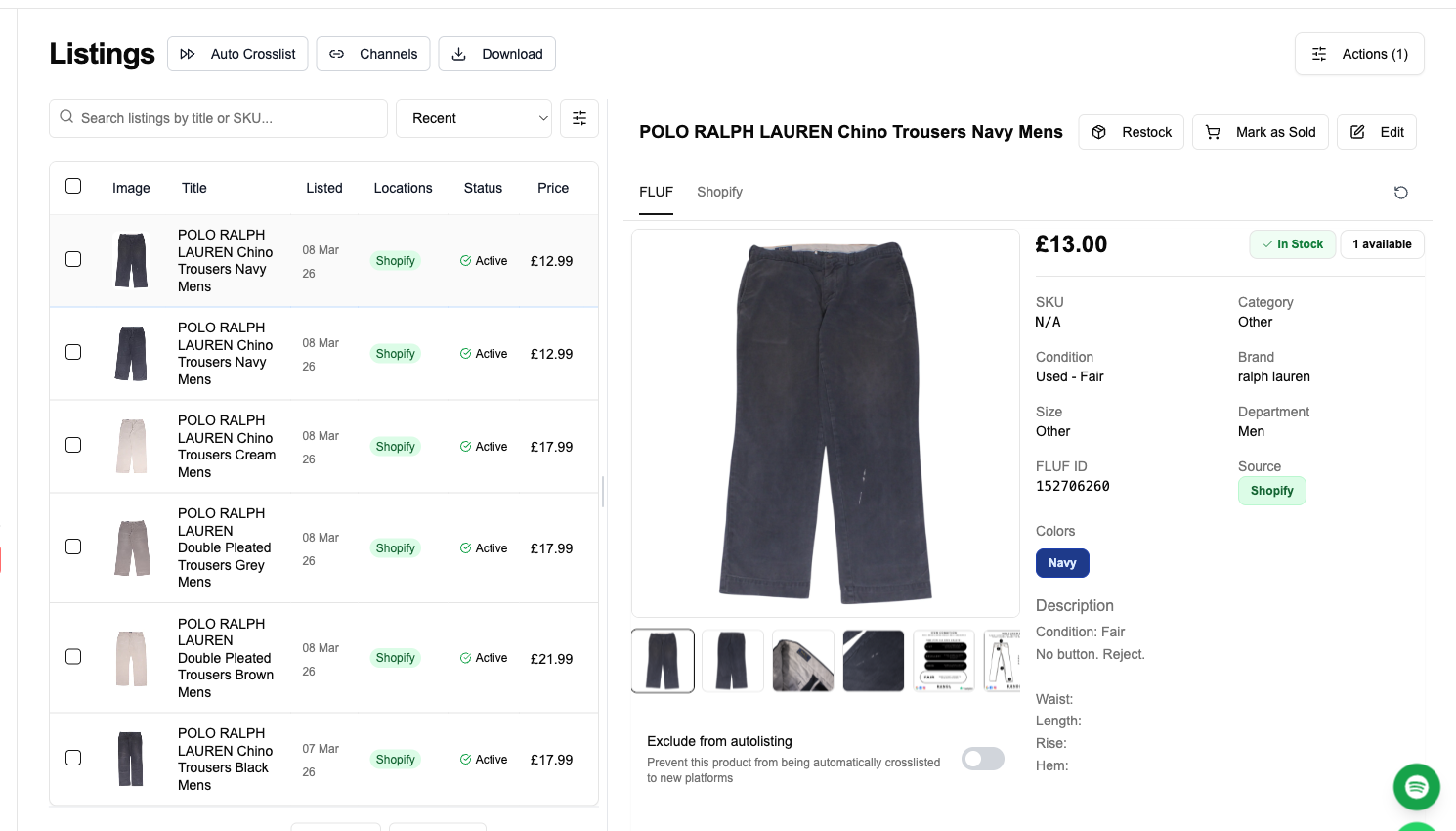
FLUF Connect holds one master record per item and writes it out to the channels you connect. That matters more than usual here, because Bidzzy has no CSV export and no bulk listing — product variants and multiple quantities are still on its published roadmap as unbuilt — and Marketplace’s bulk-listing tool is unavailable in the UK. Neither platform will hand you your own catalogue.
| Capability | Bidzzy | Facebook Marketplace |
|---|---|---|
| Create and update listings from FLUF | Yes | Yes, via the FLUF extension or the mobile app’s in-app browser |
| Mark as sold when it sells elsewhere | Yes | Yes |
| Order sync back into FLUF | No | No |
| Automated relisting | No | No |
| Offer management from FLUF | No | No |
Sold-out protection is the feature that makes this pair safe to run, and specifically because of the invisibility problem above. Sell something on Bidzzy and FLUF can pull the Marketplace listing before anyone drives over for it.
The reverse direction has a limit you should understand. Marketplace will never report a sale to anyone, because Meta never sees one — so a cash handover has to be marked sold by you. Do it there and then, on your phone, before you walk back to the car. FLUF will propagate it everywhere else; it cannot know about it on its own.
Neither channel reports orders back into FLUF, and neither supports automated relisting or offer management through it today. Bidzzy’s offer flow, with its 12-hour payment window, is handled on Bidzzy.
FLUF Connect also runs on iOS and Android, and the mobile app can host some device-executed channels directly — check the channels screen in the app for the current list rather than assuming a desktop is required.
HMRC, and the difference that is real
The trading allowance is £1,000 of gross trading income per tax year — gross, so platform fees do not come off first. Above it you register for Self Assessment by 5 October in the following tax year. The £3,000 threshold announced on 11 March 2025 is not in force, has no commencement date, and would change the reporting threshold rather than the allowance.
Platform reporting commenced 1 January 2024, with the first reports due 31 January 2025 covering calendar 2024 — the “January 2025 rules” people refer to are really the first deadline of a regime that began a year earlier. You are not reported if you make fewer than 30 sales of goods in a calendar year and receive under €2,000, about £1,700. What gets reported for an individual is full name, address, date of birth and tax identification number, alongside your income from the platform.
Bidzzy states its position outright: it reports seller data to HMRC as required under the digital platform reporting rules, and describes the 30-sales or roughly-£1,700 trigger on its own page.
Facebook Marketplace UK is in a different position, and the reason is mechanical. The rules bind a platform that holds, can calculate or can obtain the amount paid to sellers. Marketplace UK processes no payment at all, so it has no consideration figure to report — a cash or bank transfer between two people is simply invisible to Meta. That is our reasoning from Meta’s no-payments position and HMRC’s definition, not something HMRC has published about Marketplace specifically, and it is worth holding loosely.
What is not loose is the consequence. Not being reported is not being untaxed. The £1,000 trading allowance and your Self Assessment duty apply identically to a cash Marketplace sale and a Bidzzy payout. The only thing that differs is whether HMRC receives an automatic feed. Two further numbers worth knowing: capital gains tax can apply to a personal possession sold for £6,000 or more, and the VAT registration threshold is £90,000 measured across all your sales channels together, not per platform.
None of this is tax advice, and an accountant should confirm your own position.
Sources and verification
- Bidzzy’s terms, version 8.4 — zero seller fees, the 5% plus £0.80 Buyer Protection fee with its £1 minimum and £15 cap, Stripe processing, and the fixed-price-and-offers model.
- Bidzzy’s FAQ — the 50% minimum offer, the 12-hour payment window, the banned-electronics rule, the category list, UK-mainland-only coverage, the Evri, Royal Mail and InPost carriers, and the search and ranking behaviour.
- Bidzzy’s seller guidelines — minimum three original photos, no stock or AI images, and the five-day dispatch window; and its private-seller page for the 72-hour hold and its HMRC reporting statement.
- Companies House, BIDZZY LTD — incorporated 3 June 2026.
- Meta’s selling-with-delivery help article, which returns the unavailable-in-your-location message to UK visitors, and the bulk-listing article, unavailable in the UK.
- Meta on avoiding scams — the exclusion of in-person cash exchanges from Purchase Protection, and the named scam patterns.
- Meta’s prohibited Marketplace items and the Commerce Policies, including the EEA, Philippines and India commercial-seller restriction that does not name the UK.
- Meta on listing lifetime — the two-year inactivity deletion and the reset on renewing or editing; listing review; and Marketplace access rules including the secondary-profile exclusion.
- Meta Newsroom, July 2026 — 430 million items listed monthly, and the US-only Seller app.
- The European Commission’s €797.72 million decision of 14 November 2024, whose Partner Program remedy is scoped to the EEA.
- gov.uk on digital platform reporting, SI 2023/817 for the 1 January 2024 commencement, the £1,000 trading allowance, the £6,000 chattels rule and the £90,000 VAT threshold.
What we could not verify, and therefore left out. Bidzzy’s maximum photo count, its title and description character limits, its founders, launch date, funding or any press coverage — the company was incorporated in June 2026 and has essentially no third-party public record. On Meta’s side: the maximum photos per Marketplace listing and its title and description limits, none of which appear on any Meta-owned page; any UK Marketplace user figure; any listing rate limit for the UK, since Meta’s listing-limits article returns “this article doesn’t apply to your region” here; and the widely-quoted “1.1 billion monthly Marketplace users”, which we could not trace to a Meta source. We also found no Marketplace fraud statistics — Meta publishes none — and no stated Meta policy on listing multiple quantities of one item.
Related guides
Frequently Asked Questions
No. Loaded from a UK connection, Meta's own selling-with-delivery articles return “Selling with delivery on Marketplace isn't available in your location at the moment. Learn how to sell something locally on Marketplace.” Every UK Marketplace sale is a face-to-face meet. Bulk listing by spreadsheet is also unavailable in the UK, and the dedicated Marketplace Seller app Meta launched in July 2026 is iOS and United States only.
There isn't one. With no checkout, no money passes through Meta, so there is nothing for a percentage to apply to. Third-party guides quoting a 2% or 5% UK Marketplace fee are describing a checkout British sellers do not have. The trade-off is that Purchase Protection does not apply either — Meta states that items exchanged in person using cash or other person-to-person payment methods are not eligible — so there are also no chargebacks, in both the good and the bad sense.
Nothing to sellers. Its terms state no listing fees, monthly fees or commission on the sale price — “you keep your full sale price”. The buyer pays a Buyer Protection fee of 5% plus £0.80, with a £1.00 minimum and a £15.00 maximum, plus shipping. That £15 cap makes the fee regressive: about 9% of a £20 item and 1.5% of a £1,000 one. Payments run on Stripe, and a UK mainland bank account is required to receive payouts.
Mostly, but not all of it. Bidzzy bans electronic devices outright — phones, tablets, laptops, TVs, consoles and appliances — so its “tech and accessories” category means cases, cables and chargers rather than the things they plug into. Furniture, food, weapons, alcohol, vapes and opened cosmetics are also out. Facebook Marketplace takes electronics and furniture happily, which are precisely the two categories Bidzzy refuses. The routing rule for a mixed catalogue: fashion, homewares and crafts go to both; devices and furniture go to Marketplace alone.
No. Bidzzy is UK mainland only — Northern Ireland, the Isle of Man, Jersey, Guernsey and the Scottish Highlands and Islands are excluded for buying and selling alike, and there is no international shipping. Marketplace has no such boundary within the UK, and since every sale is local anyway the question of shipping range never arises there. What matters on Marketplace instead is your radius and your sort order — Suggested by default, plus Distance and Date listed.
Marketplace listings never expire; they are only deleted after two years of inactivity, permanently and unrecoverably — but renewing or editing any part of a listing resets that window, so a price tweak is a free refresh indefinitely. Bidzzy auto-renews on a 30, 60 or 90-day cycle, which resets the listed date. That matters on Bidzzy because browse defaults to newest first and Bidzzy states that ranking is not affected by photo count, description length or seller rating. Freshness is the whole algorithm.
Not the way you would expect. Bidzzy's search matches title, brand, category and subcategory only — the description is not indexed. Put the words a buyer would type in the title, not the paragraph. Its offer mechanic also has an unusual rule: offers cannot be below 50% of the asking price, and an accepted offer gives the buyer a 12-hour window to pay during which the item stays purchasable by anyone else at full price, with first payment winning.
Meta's own guidance is unusually candid about it. It names as warning signs a buyer moving the conversation off Facebook or Messenger early — to WhatsApp, phone, text or email — screenshots of payments offered as proof, fake overpayments followed by refund requests, refund requests where no payment was ever made, gift-card payment requests, and fake payment-app emails. Its stated defences are the sensible ones: never trust a screenshot of a payment, always check your own account, never hand over the item before funds are confirmed, and be wary of anyone pressuring speed.
This is the real reason to use a tool on this pair. Because no money flows through Meta, a Marketplace handover is invisible to Bidzzy, to your records and to any automation — nothing tells your other channels the item is gone. FLUF Connect supports sold-out protection on both sides, so selling on Bidzzy can pull the Marketplace listing automatically. The reverse has a limit worth understanding: Marketplace will never report a sale, because Meta never sees one, so a cash handover has to be marked sold by you — do it on your phone before you walk back to the car, and FLUF propagates it everywhere else.
Bidzzy does, and says so outright on its own page: it reports seller data to HMRC as required under the digital platform reporting rules. Marketplace UK processes no payment, so it has no consideration figure to report — that is our reasoning from Meta's position and HMRC's definition rather than something HMRC has published about Marketplace specifically. Be careful with the conclusion: not being reported is not being untaxed. The £1,000 trading allowance and your Self Assessment duty apply identically to a cash Marketplace sale and a Bidzzy payout. Reporting commenced 1 January 2024, and the VAT threshold is £90,000 across all channels combined.