Crosslist from Discogs to Facebook Marketplace — Automatically
Move your Discogs vinyl and CD inventory to Facebook Marketplace to reach local buyers, with Goldmine condition grading carried into the description.



- Discogs: the specialist marketplace for vinyl, CDs, and tapes — global collector reach, precise Goldmine-grade condition, 9% seller fee
- Facebook Marketplace: 1.2 billion+ monthly users, hyperlocal reach, zero fees on local pickup sales
- Fields that transfer automatically: title, description, images, price, and condition (mapped from Discogs’ dual Goldmine grade to Facebook’s 4-tier scale)
- Inventory sync: a Discogs sale automatically removes the item from Facebook Marketplace. Mark Facebook sales sold in FLUF or Discogs yourself.
- Why add Facebook Marketplace: reach local buyers who want to browse a crate in person, skip the risk of shipping fragile records, or bundle several records into one pickup
- Cost: From £9/month — automation is included from Seller upwards, not a paid add-on
Why Sell on Both Discogs and Facebook Marketplace?
Crosslisting from Discogs to Facebook Marketplace puts your record collection in front of local buyers who want to flip through a crate in person — a completely different sale to the international, shipping-first collector who finds you through Discogs’ catalogue search. Discogs is built for precision: buyers search by exact release, pressing, and catalogue number, and expect a shipped parcel to arrive from anywhere in the world. Facebook Marketplace buyers are down the road. They want to see the record, check the sleeve themselves, and walk away with it the same day.
That difference matters most for the physical realities of selling vinyl. Records are heavy and breakable — a warped sleeve or a cracked mailer is a real cost, both in refunds and in the reputation hit on your Discogs seller rating. A local buyer collecting from you in person removes that risk entirely, and it also removes the postage cost that eats into the margin on a run of 25 £8 records. Facebook Marketplace’s culture leans into this: buyers regularly want to view “the crate” before they commit, or bundle three or four records into one pickup — a sale shape Discogs’ one-release-at-a-time listing format doesn’t really support.
| Discogs | Facebook Marketplace | |
|---|---|---|
| Monthly users | Millions of registered collectors, global | 1.2 billion+ monthly users1 |
| Primary buyer | Specialist collectors searching by exact release/pressing | Local shoppers browsing nearby listings |
| Top markets | Global — ships anywhere | Local to the seller’s area |
| Strongest categories | Vinyl, CDs, cassettes — music media only | Everything, including music media, furniture, electronics |
| Seller fees | 9% of item + shipping price since May 20232 | No fee on local pickup; ~2% on shipped sales in the UK3 |
| Condition grading | Goldmine Standard — media and sleeve graded separately4 | No formal grading convention — buyers rely on photos and description |
The fee gap is the clearest financial argument. A £30 record sold and shipped through Discogs costs you roughly £2.70 in Discogs fees alone, on top of packaging and postage. The same record sold locally through Facebook Marketplace costs nothing beyond your time. For anything heavy, common, or not worth shipping internationally, Facebook Marketplace is often the better home — while Discogs stays the right channel for the genuinely rare pressing a collector overseas is specifically hunting for.
How to Crosslist from Discogs to Facebook Marketplace with FLUF Connect
Crosslisting a Discogs listing to Facebook Marketplace with FLUF Connect takes a couple of minutes to set up, then seconds per record after that. Here is the exact process.
1. Sign Up and Connect Discogs
Create a FLUF Connect account at fluf.io/connect. Connect Discogs using your Discogs API credentials — no browser extension is needed for Discogs. FLUF imports your existing Discogs inventory, including release title, artist, label, catalogue number, format, and your Goldmine media/sleeve grades.
2. Connect Facebook Marketplace
Connect Facebook Marketplace using the FLUF Connect Chrome extension — or, if you’re on your phone, the FLUF Mobile app’s built-in browser view. Visit Facebook Marketplace with the extension installed (or open Marketplace inside the app) and click through to link your account. Both options let you publish listings; you don’t need a laptop specifically.
3. Select Records to Crosslist
In the FLUF Connect dashboard, select which Discogs listings you want on Facebook Marketplace. You don’t have to crosslist your whole catalogue — many sellers start with common, lower-value pressings that are cheap to hold but expensive to ship, and keep genuinely rare items Discogs-only.
4. Review Field Mapping
FLUF shows a preview of how each record will appear on Facebook Marketplace. Behind the scenes, FLUF resolves the exact release using barcode, artist, and title matching against the MusicBrainz and Discogs catalogues, then maps the fields it finds to Facebook’s format — title, description (with your Goldmine grades carried into the text), images, price, and condition. You can edit anything before it goes live.
5. Crosslist
Click crosslist with the extension or mobile app active. Check your account location to reach local buyers. The listing typically appears within a few minutes.
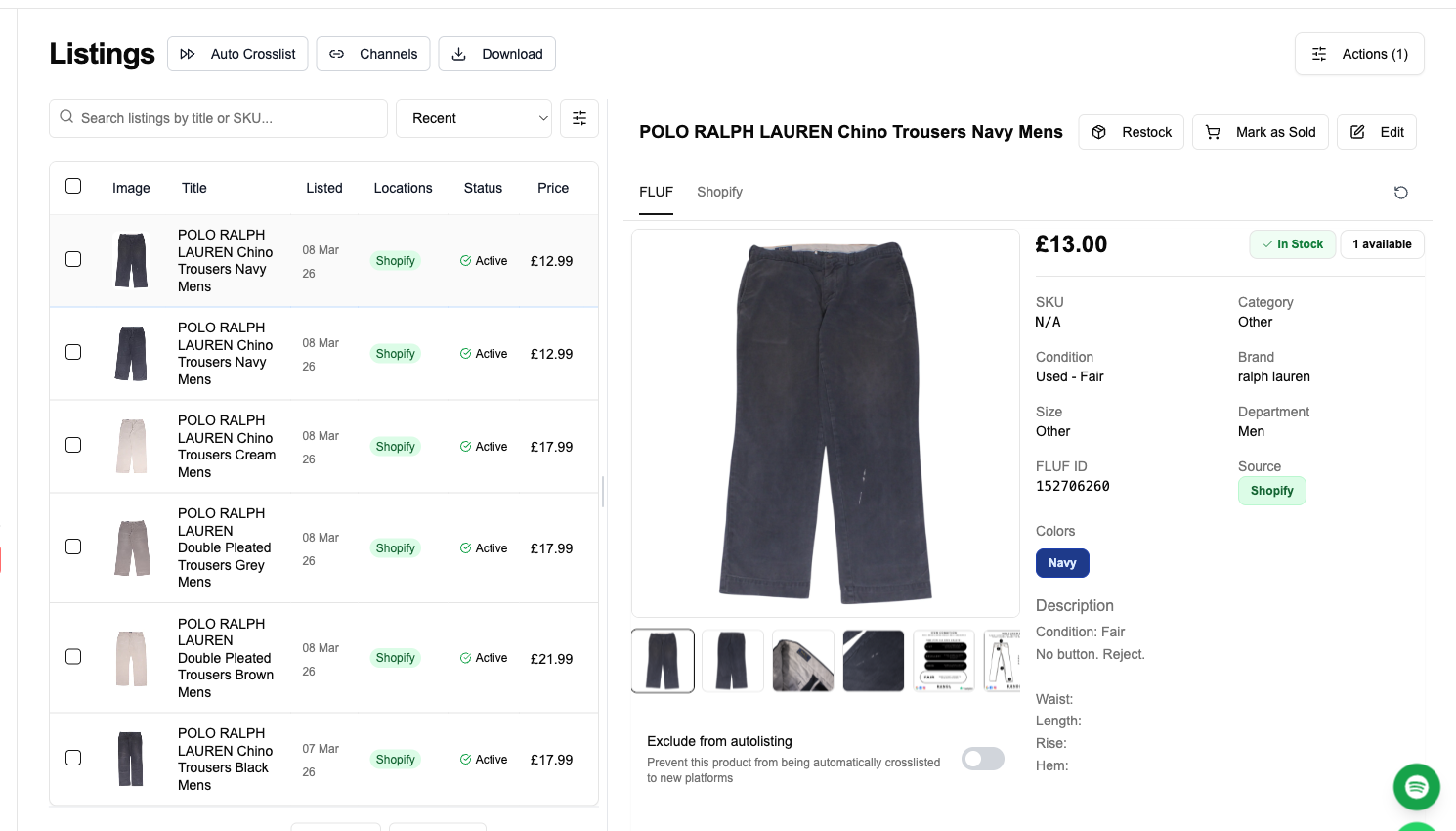
Auto-crosslisting rules: you can set rules so newly added Discogs stock is automatically queued for Facebook Marketplace — useful if you regularly bring in job-lot collections and want the duplicates or common pressings routed to local buyers without touching each one by hand.
Bulk crosslisting: select dozens of records at once and crosslist them in a single batch, rather than working record-by-record.
What Transfers When You Crosslist from Discogs to Facebook Marketplace?
Discogs is a specialist, deeply structured catalogue — release ID, catalogue number, label, pressing year, genre and style are all first-class fields. Facebook Marketplace has none of that structure; it’s a general-purpose listing format built around a title, a description, photos, a price, and a broad category. FLUF maps what has a home on both sides and folds everything else into the description so nothing is silently dropped.
Field Mapping — Discogs to Facebook Marketplace
| Discogs Field | Facebook Marketplace Field | Transfer | Notes |
|---|---|---|---|
| Title (Artist – Release) | Title | ✅ Automatic | Facebook titles cap at 100 characters; a long “Artist – Album (Format, Pressing)” title is trimmed to fit. |
| Description | Description | ✅ Automatic | Your Goldmine media/sleeve grades and catalogue detail are carried into the Facebook description as plain text — Marketplace has no grading field of its own, so this is the only place that detail survives. |
| Images | Images (up to 10) | ✅ Automatic | Sleeve front/back, label shots, and any close-ups of wear all transfer. |
| Price | Price | ✅ Automatic | Converted to your Facebook Marketplace currency if it differs from your Discogs listing currency. |
| Condition — Media grade (Goldmine) | Condition | ⚡ Mapped | Discogs grades media and sleeve separately (Mint, Near Mint, VG+, VG, G+, G, Fair, Poor). Facebook only has four tiers — see the mapping below. |
| Condition — Sleeve grade (Goldmine) | — | ❌ Not available | Facebook’s single condition field can’t hold two grades. The sleeve grade moves into the description instead, in the same Goldmine language Discogs buyers already understand. |
| Format (LP, 7″, CD, Cassette) | — | ⚡ Folded into title/description | Facebook has no dedicated media-format field — it’s kept in the title and description text. |
| Label / Catalogue number | — | ❌ Not available | No equivalent field on Facebook Marketplace. Included in the description for buyers who care about pressing details. |
| Genre / Style | Category | ⚡ Smart mapped | Discogs’ genre and style tags map to Facebook’s broad “Books, Movies & Music” category — there’s no genre-level category on Facebook. |
| Barcode / Discogs Release ID | — | ❌ Not available | Used internally by FLUF to resolve the exact release; not a field Facebook Marketplace exposes to buyers. |
| — | Location | ⚠️ Auto-set | Facebook Marketplace requires a location on every listing. FLUF uses your account’s location — this is what puts your records in front of nearby buyers. |
| — | Delivery type | ⚠️ Auto-set (local pickup) | Defaults to local pickup, which suits the fragile, heavy nature of records. You can switch a listing to shipping in Facebook Marketplace’s own settings if you want to offer it. |
Legend:
- ✅ Automatic — transfers directly, no action needed
- ⚡ Smart mapped / folded in — FLUF converts it or carries it into a field that does exist
- ⚠️ Auto-set — FLUF sets a sensible default you can override
- ❌ Not available — no equivalent field on Facebook Marketplace
Condition Mapping — Goldmine Standard to Facebook’s 4-Tier Scale
Discogs’ Goldmine Standard grades media and sleeve independently, across eight grades each4. Facebook Marketplace has one condition field with four options. FLUF maps your media grade (the more important of the two to a buyer) as follows:
| Discogs Goldmine Grade | Facebook Marketplace Condition |
|---|---|
| Mint (M) / Near Mint (NM) | New |
| Very Good Plus (VG+) | Used — Like New |
| Very Good (VG) / Good Plus (G+) | Used — Good |
| Good (G) / Fair (F) / Poor (P) | Used — Fair |
Because that collapse loses precision Discogs buyers rely on, FLUF writes the full Goldmine grade for both media and sleeve into the Facebook description — “Media: VG+, Sleeve: NM” reads the same way to a buyer who already knows the standard, and gives everyone else a specific, checkable claim rather than a vague “Used — Good”.
Category Mapping Examples
| Discogs Format | Facebook Marketplace Category | Notes |
|---|---|---|
| Vinyl — LP / 12″ | Books, Movies & Music | Facebook has no vinyl-specific subcategory |
| Vinyl — 7″ Single | Books, Movies & Music | Format detail kept in the title instead |
| CD | Books, Movies & Music | Same top-level category as vinyl on Facebook |
| Cassette | Books, Movies & Music | Same top-level category as vinyl and CD |
Fields That Need Your Attention
- Sleeve grade lives in the description now: Facebook’s single condition field can’t carry two Goldmine grades. Check the auto-generated description reads clearly rather than trusting the condition dropdown alone.
- Location drives who sees the listing: Facebook Marketplace is local-first. Confirm your account location is accurate — it’s the difference between reaching buyers 5 miles away and being invisible to them.
- Local pickup is the default: given how easily records warp or crack in transit, this is usually the right call for crosslisted stock. Switch individual listings to shipping only where you’re comfortable packing them properly.
- Pricing for haggling: Facebook Marketplace culture runs on offers and negotiation more than Discogs does. Price 10–20% above your real floor to leave room to come down.
- Catalogue detail moves into free text: label, catalogue number, and pressing year have no dedicated field on Facebook. They’re preserved in the description, but they won’t be searchable the way they are on Discogs.
Inventory Sync Between Discogs and Facebook Marketplace — What Stays in Sync?
Sync between Discogs and Facebook Marketplace runs in one direction with real confidence, and in the other with a real limitation worth knowing about before you rely on it.
| Event | What Happens | Timing |
|---|---|---|
| Item sells on Discogs | A Discogs sale automatically marks the Facebook Marketplace listing as sold. | Within minutes |
| Item sells on Facebook Marketplace | Facebook sale detection is less reliable. Mark the item sold in FLUF or Discogs yourself. | Not guaranteed in real time |
| Price changed on Discogs | Not automatically updated on Facebook Marketplace | — |
| Description or grade edited on Discogs | Not automatically updated on Facebook Marketplace | — |
| Item deleted on Discogs | Left active on Facebook Marketplace | — |
A Discogs sale automatically removes the record from Facebook Marketplace. Facebook sale detection is less reliable: when a buyer collects a record, mark it sold in FLUF Connect or Discogs promptly.
What does NOT sync: neither Discogs nor Facebook Marketplace supports FLUF’s relisting or offer-management automation, so nothing there needs tracking across the two. Price and description edits made on Discogs after the initial crosslist also don’t propagate automatically — update the FLUF Connect dashboard if you want a price change reflected on the Facebook listing too.
Crosslisting from Discogs to Facebook Marketplace: Before and After FLUF Connect
Without FLUF Connect (Manual Crosslisting)
- Open the Discogs listing, note the artist, title, format, and catalogue number
- Note both Goldmine grades — media and sleeve
- Save each photo individually
- Open Facebook Marketplace, start a new listing
- Upload photos one by one
- Write a new title that fits Facebook’s shorter limit
- Rewrite the description in plain language, folding in the grading detail Discogs buyers expect but Facebook has no field for
- Pick the closest Facebook category (there’s no vinyl-specific one)
- Translate the Goldmine grade into one of Facebook’s four condition tiers
- Set price, decide local pickup vs shipping
- Confirm location
- Publish
- Note in a spreadsheet that this record is now listed in two places
- When it sells on either side: manually go and remove the other listing
Time per record: 5–8 minutes. For 100 records: 8–13 hours of repetitive re-entry.
With FLUF Connect
- Select Discogs records in the FLUF Connect dashboard
- Click “Crosslist to Facebook Marketplace”
- Review the pre-mapped preview, including the auto-carried Goldmine grades
- Confirm
- Done — a Discogs sale removes the listing from Facebook Marketplace automatically
Time per record: ~30 seconds. For 100 records: under an hour, including review.
Manual: 8–13 hours of retyping catalogue detail and re-grading records for a platform with no grading field. With FLUF Connect: under an hour. That’s a working day back to actually source and photograph stock.
Automation Features for Discogs and Facebook Marketplace Sellers
Neither Discogs nor Facebook Marketplace supports FLUF’s relisting or offer-management automation — Discogs supports order sync and mark-as-sold only, and Facebook Marketplace supports mark-as-sold only. That’s a real limitation worth being upfront about: if you’re used to FLUF auto-relisting stale Depop or Vinted listings, that specific feature doesn’t extend to either of these two channels.
This pair supports crosslisting, inventory sync and the following automation:
Auto-Crosslisting Rules
Set rules so new Discogs inventory is automatically queued for Facebook Marketplace as it’s added — useful when you’re processing a job-lot collection and want the common pressings routed to local buyers without reviewing each one individually.
Bulk Operations
Select records by filter — format, price range, genre — and crosslist them in one batch rather than one at a time. Bulk price adjustments and bulk delisting work the same way.
| Feature | Discogs | Facebook Marketplace |
|---|---|---|
| Crosslisting | ✅ | ✅ |
| Auto-relisting | ❌ | ❌ |
| Offer management | ❌ | ❌ |
| Order sync | ✅ | ❌ |
| Mark as sold (delist on other channels) | ✅ | ✅ |
| Bulk operations | ✅ | ✅ |
| Auto-crosslisting rules | ✅ | ✅ |
The honest summary: this pair is not FLUF’s most heavily automated combination, because neither channel offers the deeper hooks (relisting, offers) that channels like Depop, eBay, and Vinted expose. What it does automate — reading a Discogs release accurately, carrying Goldmine grading into a Facebook-friendly description, and auto-delisting when a Discogs sale is confirmed — removes the specific, repetitive pain of manually re-entering catalogue and grading detail for every record you want in front of local buyers.
How Much Does It Cost to Crosslist from Discogs to Facebook Marketplace?
FLUF Connect pricing is based on how many products you manage, not which channels you connect. Every plan includes Discogs and Facebook Marketplace crosslisting and the sync behaviour described above — automation is never a separate charge.
| Plan | Monthly | Crosslisted products |
|---|---|---|
| Starter | £9/month | Unlimited |
| Pro | £29/month | Unlimited |
| Priority | Custom pricing — tell us what you need | Unlimited |
Note on marketplace fees: Discogs charges sellers 9% of the item and shipping price on every sale, in place since May 20232. Facebook Marketplace charges no fee on local pickup sales and roughly 2% on shipped sales in the UK3. These are the two platforms’ own fees, separate from FLUF Connect’s subscription.
All plans include crosslisting, inventory sync, and bulk operations across all supported channels — not just Discogs and Facebook Marketplace. See full details on the pricing page.
Sources & Verification
- Facebook Marketplace Statistics 2026 — SQ Magazine — 1.2 billion+ monthly Marketplace users, ~40% of Facebook’s user base.
- Discogs Forum — seller fee change thread — confirms the 9% seller fee on item and shipping price, in effect since May 2023.
- A Guide to Facebook Marketplace Fees in the UK — Vendoo — no fee on local pickup sales, ~2% fee on shipped sales in the UK.
- How To Grade Items — Discogs Support — the Goldmine Standard grading scale, applied separately to media and sleeve.
Related guides
Frequently Asked Questions
Plans start at £9/month (Starter) after a 7-day trial for £1. There is no free plan. Every plan includes crosslisting, inventory sync, and bulk operations across all supported channels — automation is part of the plan, not a separate purchase.
Partly. A Discogs sale automatically marks the Facebook Marketplace listing as sold. Facebook sale detection is less reliable and not guaranteed in real time, so mark Facebook sales sold in FLUF Connect or Discogs yourself.
Yes. Discogs supports order sync, so FLUF Connect detects the sale and automatically marks the Facebook Marketplace listing as sold, typically within minutes.
Not with the same reliability. When a Facebook buyer collects a record, mark it sold in FLUF Connect or Discogs promptly instead of relying on automatic detection.
About 30 seconds per record once your accounts are connected, or a few minutes for a batch of records crosslisted in bulk. Listings typically appear on Facebook Marketplace within a few minutes of crosslisting.
Facebook Marketplace only has one condition field with four tiers (New, Used — Like New, Used — Good, Used — Fair), so FLUF maps your Discogs media grade to the closest tier. Because Facebook has no separate sleeve-condition field, both your media and sleeve Goldmine grades are also written into the listing description in full, so buyers who know the standard can still read the precise grade.
Yes, Facebook Marketplace's own fees apply to sales made there, separately from your Discogs fees and your FLUF Connect subscription. Facebook charges no fee on local pickup sales and roughly 2% on shipped sales in the UK, compared to Discogs' 9% seller fee on the item and shipping price.
Yes. FLUF Connect isn't limited to one destination — you can connect Discogs alongside other channels FLUF supports, and manage everything from one dashboard.
No. Discogs supports order sync and mark-as-sold only; Facebook Marketplace supports mark-as-sold only. Neither channel supports FLUF's auto-relisting or offer-management automation, unlike channels such as Depop, eBay, or Vinted.
Sign up for free
Join the community
You're in.
Open your dashboard