Shopify to Gumtree Australia: Crosslist Your Store’s Stock Locally
Push your Shopify products to Gumtree Australia so local buyers can collect them — and have the ad pulled down automatically when the item sells in your store.
7 days for £1, then from £9/month.



Key Takeaways
- Gumtree Australia is a separate company from Gumtree UK. Adevinta sold Gumtree UK to O3 Industries and Novum Capital (Adevinta) and sold Gumtree Australia separately to Perth-listed The Market Herald for A$86.7 million (Business News Australia). Different owners, different sites, different logins.
- That owner renamed itself after the asset: the ASX-listed parent became Gumtree Australia Markets Limited (ASX:GUM) on 3 February 2025 (ASX).
- Gumtree Group reaches more than four million Australians a month and carries more than 1.7 million live listings (GoAutoNews Premium, February 2026).
- Posting carries no listing fee in most Gumtree Australia categories. Fees are the exception: Pets & Animals, Cars, Vans & Utes and Caravans & Campervans (Gumtree Australia Help).
- Ads run 30 days in almost every category and 45 days for automotive (Gumtree Australia Help).
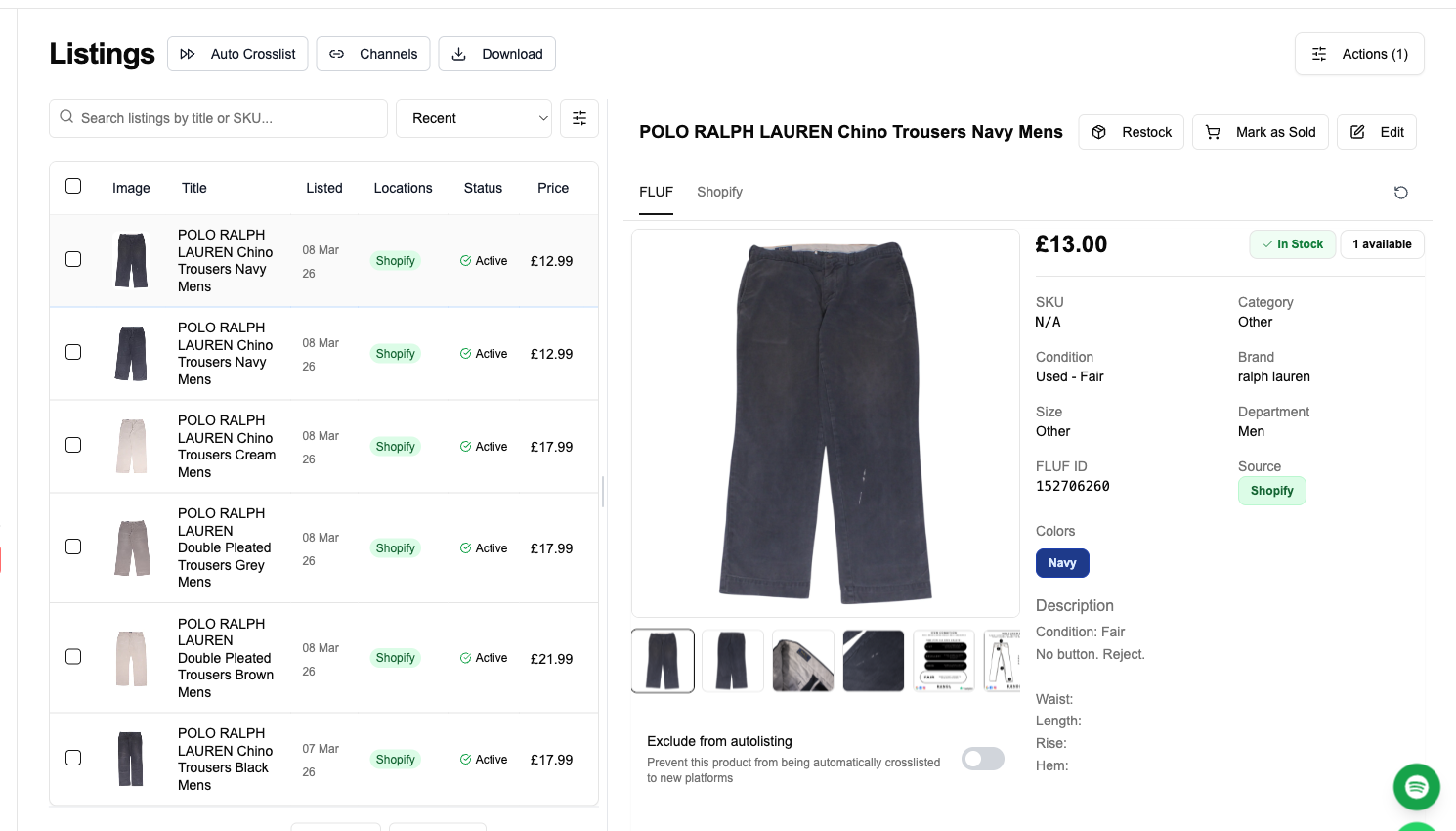
- FLUF Connect crosslists your Shopify products to Gumtree Australia. Use the FLUF Chrome extension for the initial connection; you do not need to keep it open afterwards.
- The honest part: a Gumtree Australia sale is a local cash handover with no order record, so nothing flows back automatically. The direction that works is the useful one — when the item sells in your Shopify store, order sync detects it and FLUF pulls the ad down before a buyer drives across town for something you already shipped.
Why An Australian Shopify Merchant Posts To Gumtree Australia
Your Shopify store already holds the hard part: every product has a clean title, a description, photography, a price, a SKU and a stock number tied to a location. The problem is that the data only works in one place.
Gumtree Australia is where a large slice of Australia goes for something it can pick up this afternoon. Gumtree Group’s 2026 media briefing puts reach at more than four million Australians a month across Gumtree, CarsGuide and Autotrader, with more than 1.7 million live listings and around A$18 billion of monthly listing value (GoAutoNews Premium). A September 2025 partnership with Australian Community Media took combined monthly reach to 7.1 million on Ipsos iris data (Mediaweek) — that spans both companies’ properties, so read it as advertising reach, not Gumtree Australia’s own traffic.
The reason this matters commercially is shipping. Think about what a furniture shop in Brunswick, a homewares store in Fremantle or a bike shop in Newcastle actually sells: a dining table, six chairs, a hardtail, a chest freezer, an ex-display sofa. Domestic freight eats the margin on all of it — a A$450 sideboard can attract a A$140 courier bill, and either you absorb it or you show it at checkout and watch the cart get abandoned.
A classifieds ad removes the freight line entirely; the buyer brings a ute. For bulky, heavy or fragile goods that is not a downgrade from ecommerce, it is the only channel where the unit economics work. It is also the fastest way to clear an ex-display piece, a returned item or last season’s colour holding a bay of your warehouse hostage.
The framing is narrow: your store’s existing stock, in front of local buyers who will drive to you. Not a second catalogue — the same records you already keep correct in Shopify, appearing as ads in the suburbs around your shop and coming down when the item sells.
Two Different Gumtrees, Two Different Companies
Gumtree Australia and Gumtree UK are separate businesses under separate ownership. They share a name and nothing else that matters to you: no shared login, no shared account, no way to post once and appear on both. Selling in both countries means two accounts with two companies.
The split is public record. Both sites once sat inside eBay‘s classifieds group, which Adevinta acquired and then sold to different buyers. Gumtree UK went, with Motors.co.uk, to O3 Industries and Novum Capital (Adevinta, 2021). Gumtree Australia went, with CarsGuide and Autotrader, to the Perth-listed The Market Herald for A$86.7 million (Business News Australia; Lawyers Weekly). That owner has since renamed itself Gumtree Australia Markets Limited, ASX code GUM, effective 3 February 2025 (ASX; AIM Group).
FLUF Connect treats them accordingly: two independent channels, two independent connections, and connecting one does nothing for the other. If your business is British, the page you want is the separate Shopify to Gumtree UK crosslisting guide — the UK site, run by the UK company, with UK fees and categories, and none of the Australian numbers below. FLUF Connect supports those two only; not Gumtree South Africa, and not any Irish site.
What Gumtree Australia Costs A Business Seller In 2026
In the categories a homewares, furniture, bike or secondhand retailer lives in, posting carries no listing fee. Gumtree Australia’s help centre says fees apply in a small number of categories:
| Category | Cost position (Gumtree Australia help centre, 2026) |
|---|---|
| Home & Garden, Furniture, Sport & Fitness, Baby & Children, Electronics, Clothing, Tools, most For Sale categories | No listing fee — where most retail stock sits. |
| Cars, Vans & Utes; Caravans & Campervans | Listing fee applies via a paid feature package. Eligible private sellers in NSW, ACT, TAS and NT can select a Basic listing at no charge. |
| Parts & Accessories | Exempt from the vehicle category fees. |
| Pets & Animals | Mandatory listing fee on all listings. |
| Boats & Jetskis, Real Estate, most Jobs categories, Services for Hire | One ad at a time at no cost; further ads need a Plus, Featured or Premium package. |
On volume, Gumtree Australia states there are no limits on how many ads community users can post. The constraint is the duplicate policy, not a count — and it is what most often gets a Shopify merchant’s ads removed.
Paid promotion. Gumtree Australia’s help centre documents six upgrades: Bump Up (one-off, or recurring every 2, 3 or 7 days), Highlight, Price Drop (7 days), Urgent, Top Ad and Homepage Gallery — the last four sold in 7, 14 or 21-day runs. “Spotlight” is not one of them on the Australian site; if you have seen that name, you have seen a different Gumtree.
Prices for those upgrades are not published: they vary by category and location and are shown during posting, so check yours before committing a budget. Gumtree Australia’s pricing page does state that fees are quoted exclusive of GST, and that automotive dealer subscriptions carry no setup fee, no annual fee and no cost per lead — a monthly rate scaled to listings live.
Ad duration. Ads run 30 days in all categories except automotive and Business for Sale, which run 45 days; expired and deleted ads stay retrievable from your account for three months (source). Plan for that 30-day clock: a slow-moving sideboard needs reposting, and FLUF does not do automatic relisting on Gumtree Australia, so that repost is on you.
How Products Move From Shopify To Gumtree Australia
The mechanics differ at each end, which is what explains the extension step.
Connect Shopify. No extension is required. Import your products and review variants, images, prices and stock. Shopify supports order and inventory sync; relisting and offer management do not apply to a Shopify storefront.
Connect Gumtree Australia. Use the FLUF Chrome extension on a desktop browser while signed in to your account. You do not need to keep the extension open after this initial setup.
The sequence:
- Connect Shopify with your store credentials. Your catalogue imports.
- Install the FLUF Chrome extension once, sign into Gumtree Australia in the same browser, and complete the connection.
- Pick the products worth advertising locally — a judgement call, not a bulk push of everything.
- Map each to a Gumtree Australia category and rewrite the copy. Product-page titles are rarely the right copy for a classifieds ad.
- Publish, then check each ad’s status in FLUF Connect.
- Sell the item — in the shop, on your store, or to the person with the ute — and mark it so the ad comes down.
Facebook Marketplace is the other obvious local option; our Gumtree Australia versus Facebook Marketplace comparison covers the differences. The Gumtree Australia to eBay pair covers turning a local ad into a national listing.
Field And Category Mapping
A Shopify product is a structured record with a variant table underneath. A Gumtree Australia ad is a flat document: one title, one description, one price, one location, one set of photos. Most of the mapping is straightforward; one part is not.
| Shopify field | Gumtree Australia ad field | What actually happens |
|---|---|---|
| Product title | Ad title | Carries over, but wants editing. “Marlow 3-Seater Sofa — Charcoal Boucle” is a product-page heading; a classifieds title leads with the plain noun and pickup context: “3 Seater Sofa, Charcoal, Excellent Condition — Pickup Brunswick”. |
| Product description (rich HTML) | Ad description (plain text) | Strip the formatting, size charts, delivery policy and returns copy. The buyer wants dimensions, condition, whether it comes apart for transport, and where to collect. |
| Variant price | Ad price | One number. If variants are priced differently the ad shows only one — see below. |
| Compare-at price | No equivalent | No RRP field. The nearest thing is the paid Price Drop upgrade, which highlights the old price for seven days — a promotion, not a data field. |
| Images | Ad photos | Carry over; FLUF requires a minimum of one photo. Lead with shots showing scale and condition — a cut-out on white says nothing about whether it fits a hallway. |
| SKU / barcode | No equivalent field | No SKU field exists. Put it as the last line of the description if you need to find the item on the shelf. |
| Inventory quantity (per location) | No equivalent | An ad has no quantity — one item, present or absent. Ten in stock and one in stock look identical. |
| Product type / collections / tags | Category | Chosen manually per product. Collections are merchandising groups, not a taxonomy Gumtree Australia recognises. |
| Shopify location | Ad location / postcode | Useful. With multiple locations, the one holding the stock is the suburb to pin the ad to — nobody drives from Geelong for something in your Sydney warehouse. |
| Weight / dimensions | Description text only | No structured field. Put dimensions in the description — for furniture they are the most-asked question. |
| Shipping profile | Mostly not applicable | The default assumption is collection. See the payments note below. |
| Variant options (size, colour, material) | No concept whatsoever | The hard one. Next section. |
A warning if you run several locations: Gumtree Australia’s duplicate policy says to post only where you are physically located, and that the same ad in multiple locations will be removed. A three-store retailer cannot triple exposure by posting one table in Sydney, Melbourne and Brisbane.
The Variants Problem
This is the hardest part of moving a Shopify catalogue onto any classifieds site. In Shopify a product carries up to three options — size, colour, material — and each combination is a variant with its own price, SKU and inventory; pricing, inventory and shipping are set per variant, not per product. The ceiling was 100 variants until Shopify raised it to 2,048 for all merchants on 15 October 2025 (developer changelog). A bike shop with one frame in four sizes and three colours holds twelve inventory positions under one product.
A Gumtree Australia ad has none of that. No option selector, no dropdown, no quantity — one title, one price, one photo set, one item. There is nowhere to put “also available in oak” except the description, and no mechanism for a buyer to choose. You have to decide per product, and there are only two honest answers.
Option one: one ad per variant. The 52cm charcoal frame is one ad, the 56cm another. This is right when the variants are genuinely different objects to a buyer, and it is the only version that works when they are priced differently, because a wrong number wastes everybody’s time.
The constraint is Gumtree Australia’s duplicate rule: all ads must be unique, meaning substantially different from each other, and posting the same ad repeatedly across categories or locations leads to removal. Four ads differing only by a size number are exactly what that rule catches. So if you go variant-by-variant, make each ad its own — its own photographs of that item, its own opening line, its own condition note. If you will not, do not post four ads.
Option two: one ad, negotiate the variant in messages. Post the product once at a representative price, show the range in the photos, and say in the description which sizes or colours you hold and what each costs. Less work, clearly inside the duplicate policy, and right where the variant is a detail rather than the decision — a lamp in three finishes at one price. The cost is keyword coverage: Gumtree Australia’s search is keyword-driven, so if your ad says “Wool Throw Blanket” and the buyer searched “charcoal wool throw”, the ad naming the colour wins.
A practical rule: variant-by-variant above roughly A$200, or where the variant changes the price; one ad and negotiate for cheaper, same-price variations. Either way, be deliberate about what goes out at all. A store with 800 SKUs and 3,000 variants should not mirror all of it — twenty to fifty well-written ads on the bulky lines will outperform a bulk dump and will not risk the account.
One more consequence: an ad has no quantity, so a product with eight units cannot signal “seven left” — and when that ad sells, Shopify stock has not moved unless you record it.
What Syncs And What Does Not
Gumtree Australia sales are not detected automatically. When an item sells locally, mark it sold in FLUF Connect yourself. Order sync, automatic relisting and offer management are not supported on Gumtree Australia.
The picture is no longer strictly “cash only”: Gumtree Australia runs Gumtree Pay, processed through Adyen, supporting PayPal, Apple Pay, Google Pay, cards and PayTo, with Australia-wide shipping and tracking and a Protected Shipping Policy for eligible transactions up to A$1,000. A service fee is added to payment requests and funds reach the seller in three to five business days. But note the caveat: for pickup purchases the Protected Shipping Policy does not apply, and Gumtree Australia recommends inspection in person before payment. For bulky goods the transaction is still a handover, and still produces no order record in FLUF.
Shopify sales update Gumtree Australia availability. When an item sells in your Shopify store, FLUF Connect removes its matching Gumtree Australia ad.
That single behaviour is why you would run this pair through a tool rather than posting by hand. Without it the failure mode is predictable: you ship on Tuesday, forget the ad, and on Thursday someone drives forty minutes across Melbourne for a sideboard already in Adelaide. Manual ad management stops being viable somewhere around the twentieth listing.
Detection speed depends on your plan: every 90 minutes on Starter, every 15 on Super Seller. See pricing.
A Before And After Workflow
Take a homewares and furniture shop in inner Melbourne: roughly 400 products in Shopify, a couple of hundred of them bulky, one location, two staff.
Before. The owner, usually at 9pm, opens Gumtree Australia in one tab and the Shopify admin in another. Copy a title, retype it as classifieds copy, copy the description and delete the delivery policy out of it, download three photos and re-upload them, pick a category, type the price, set the suburb, post. Six minutes if nothing goes wrong; twenty ads is two hours of unpaid overtime. Then the ads drift: prices change in Shopify and the ads keep the old number, an item sells in-store and the ad runs another three weeks, the 30-day expiry passes on the ads that were working and nobody notices because nobody keeps a list.
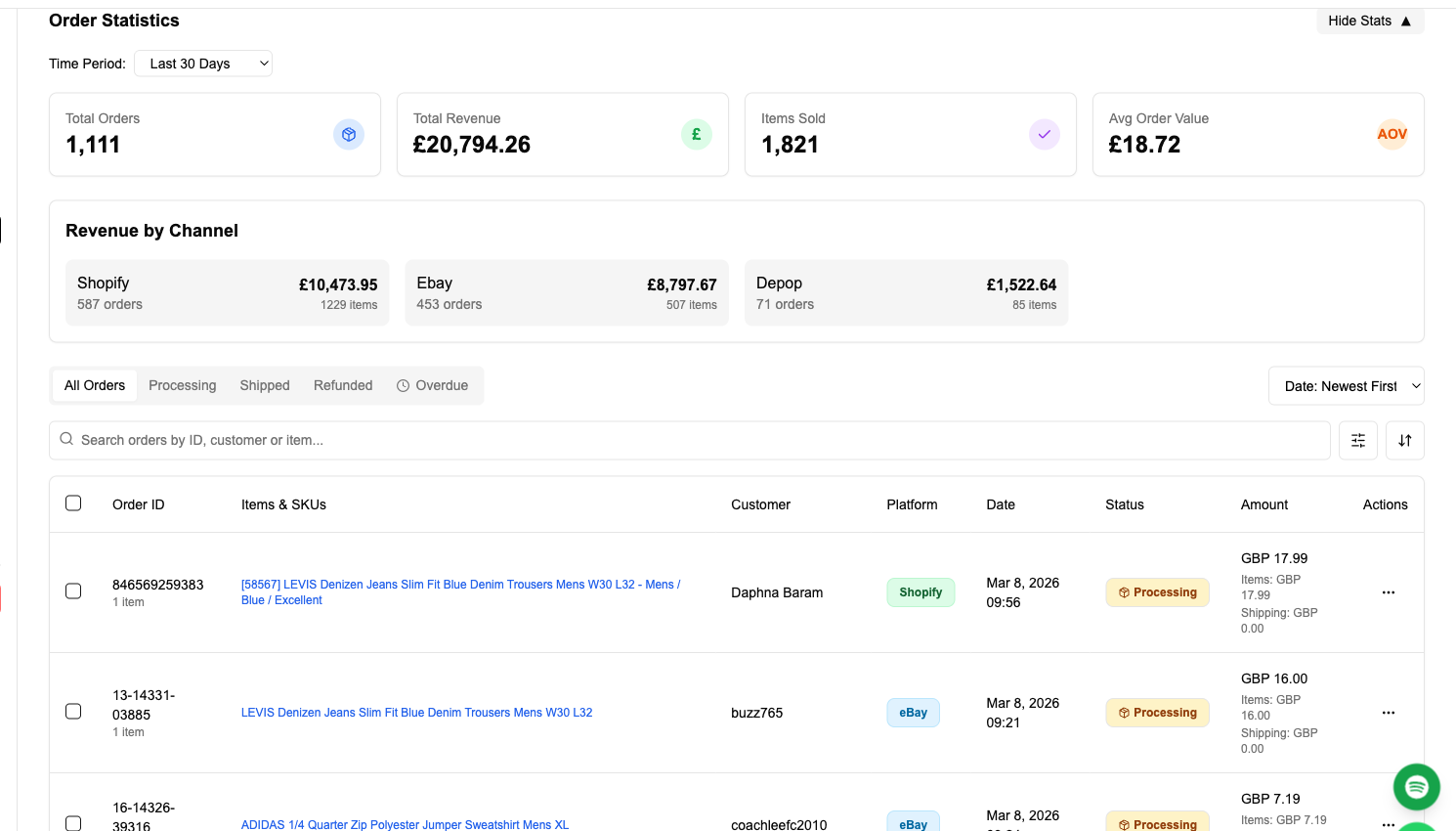
After. Connect both accounts, select your Shopify products and review their titles, descriptions, prices and Gumtree Australia categories before publishing. Use the FLUF Chrome extension for the initial Gumtree Australia connection; it need not remain open afterwards.
After that the routine is short. Shopify sells something also advertised, order sync catches it, the ad comes down untouched. Something sells locally for cash, the owner marks it sold once and it stops being offered anywhere. Every 30 days the unsold ads need reposting — a monthly diary job. The gain is not effortless listing; it is that the catalogue stops lying. The crosslisting guides cover the other pairs and the channel directory lists what FLUF supports on each.
The Honest Limitations
- No automatic relisting. Ads expire at 30 days in most categories, 45 in automotive, and FLUF will not repost them. Thirty ads means a recurring manual job.
- No order sync from Gumtree Australia. A local cash sale creates no record to read. Sold state there is something you tell FLUF, not something it discovers.
- No offer management. Haggling happens in Gumtree Australia’s own messages and you handle it there.
- No variant concept at the destination. The mapping is lossy whichever option you pick, and you pick per product.
- Australia only. Australian buyers, Australian postcodes. Not a route to the UK, and Gumtree UK is not a route into Australia.
- The Chrome extension is required to connect. Once, on a desktop browser. Without it you cannot set the channel up.
- Not everything belongs on a classifieds site. Demand concentrates in furniture and home goods, tools, vehicles and parts, baby and kids’ gear, sporting goods and electronics — things people collect. Small, light consumables that ship for A$9 do nothing there.
- Duplicate ads get accounts restricted. Do not mass-post near-identical listings across suburbs or categories.
Australian Obligations You Keep When You Advertise
A classifieds ad is not a legal grey zone. The ACCC is clear that a business selling online must follow the usual consumer laws, including consumer guarantees, whether it sells from its own website, social media, classifieds or a marketplace, and those guarantees extend to secondhand goods sold by a business. They generally do not apply to one-off private sales — so the private seller advertising a used couch beside your ad does not carry your obligations. In practice: describe condition accurately on ex-display and returned stock, do not call something new after eight months on the shop floor, and do not advertise a price that grows when the buyer arrives.
On tax, the GST registration threshold is A$75,000 of GST turnover in any 12-month period, with 21 days to register once you know or reasonably expect you will reach it (business.gov.au). A Gumtree Australia sale is business income and counts towards it. Gumtree Australia’s own advertising fees are quoted exclusive of GST. None of this is tax advice — talk to your accountant.
On the Shopify side, plans are published in AUD: Basic A$56 a month, Grow A$149, Advanced A$575, Plus from A$3,700, with roughly a quarter off annual billing (A$42, A$114, A$431). Shopify Payments domestic online rates run from 1.75% + 30c on Basic to 1.2% + 30c on Plus; in person, 1.95% to 1.75%. A pickup sale sidesteps both the card rate and the freight, which on a A$450 sideboard is not a rounding error.
Pricing
FLUF Connect is £1 for 7 days, then plans from £9/month (Starter, sales detection every 90 minutes). Every plan is paid; there is no zero-cost tier. The ladder is Starter £9. Every plan is unlimited on listings and marketplaces; the tiers differ by which automations they include and how often we check your channels for sales — every 90 minutes on Starter, down to every 15 on Super Seller. Annual billing saves 40%.
Automation — relisting where a channel supports it, offer management, bulk operations and sync — is included from Seller upwards, not a paid add-on. On Gumtree Australia the supported feature is mark as sold, so what you pay for on this pair is the Shopify side doing the detecting and the ad coming down when it should. Weigh that against the freight you stop absorbing and the buyer who does not drive across town for something you sold on Tuesday. Full detail on the pricing page.
Sources & Verification
All figures checked on 23 August 2026. Gumtree Australia’s individual paid-feature prices vary by category and location and are not published, so no figure for them is stated here.
- Adevinta — sale of Gumtree UK and Motors.co.uk
- Business News Australia — The Market Herald buys Gumtree Australia, A$86.7m
- Lawyers Weekly — Gumtree acquired by The Market Herald
- ASX — change of company name and code to Gumtree Australia Markets Limited (GUM)
- AIM Group — rename, 3 February 2025
- GoAutoNews Premium — Gumtree Group 2026 briefing (audience, listings, listing value)
- Mediaweek — Gumtree Group and ACM, combined 7.1m monthly (Ipsos iris)
- Gumtree Australia Help — categories with a listing fee
- Gumtree Australia Help — Pricing
- Gumtree Australia Help — Paid Feature types
- Gumtree Australia Help — ad duration
- Gumtree Australia Help — how many ads you can post
- Gumtree Australia Help — posting duplicate ads
- Gumtree Australia Help — how to post an ad
- Gumtree Australia Help — Gumtree Pay FAQ
- Shopify — Australian pricing and Shopify Payments rates
- Shopify Help Center — adding variants
- Shopify developer changelog — variant limit raised to 2,048
- ACCC — Selling online
- ACCC — Consumer rights and guarantees
- business.gov.au — Register for GST (A$75,000 threshold)
Related guides
- Gumtree Australia vs eBay — where Gumtree Australia wins and loses
- Designer Wardrobe vs Trade Me
Frequently Asked Questions
No. They are separate companies with separate owners, separate sites and separate accounts. Adevinta sold Gumtree UK (with Motors.co.uk) to O3 Industries and Novum Capital, and sold Gumtree Australia (with CarsGuide and Autotrader) to the Perth-listed The Market Herald for A$86.7 million. That Australian owner is now Gumtree Australia Markets Limited, ASX code GUM, renamed on 3 February 2025. A Gumtree UK login does nothing on Gumtree Australia, and FLUF Connect treats them as two independent channels requiring two separate connections.
In most categories, no. Gumtree Australia's help centre states that listing fees apply in only a small number of categories: Pets & Animals carries a mandatory fee, and Cars, Vans & Utes and Caravans & Campervans require a paid feature package (eligible private sellers in NSW, ACT, TAS and NT can pick a Basic listing at no charge). Boats & Jetskis, Real Estate, most Jobs categories and Services for Hire allow one ad at a time before a paid upgrade is needed. Furniture, homewares, tools, sporting goods, electronics and most other For Sale categories have no listing fee.
You choose per product. Either post one ad per variant, which is right when the variants are genuinely different objects or priced differently, or post one ad for the product and settle the size or colour in messages. Shopify sets price, SKU and inventory per variant (up to 2,048 variants per product since October 2025), while a Gumtree Australia ad is a single flat listing with no options and no quantity. If you go variant-by-variant, make each ad genuinely distinct — Gumtree Australia requires ads to be unique and removes near-identical duplicates.
No. Use the FLUF Chrome extension on a desktop browser for the initial Gumtree Australia connection while signed in to your account. It does not need to remain open afterwards.
No. A Gumtree Australia sale is normally a local handover with no order record for FLUF to read, so there is nothing to detect. FLUF does not do order sync on Gumtree Australia; the supported feature there is mark as sold, which you trigger. The automatic direction is the reverse: when the item sells in your Shopify store, FLUF's order sync detects it and pulls the Gumtree Australia ad down.
Thirty days in all categories except automotive and Business for Sale, which run 45 days. Expired and deleted ads remain retrievable from your account for three months before they are removed permanently. FLUF does not automatically relist on Gumtree Australia, so reposting an unsold ad after 30 days is a manual job.
Gumtree Australia runs Gumtree Pay, an integrated payment system processed through Adyen that supports PayPal, Apple Pay, Google Pay, cards and PayTo, along with Australia-wide shipping and tracking and a Protected Shipping Policy for eligible transactions up to A$1,000. A service fee is added to payment requests and funds reach the seller in three to five business days. For pickup purchases, however, the Protected Shipping Policy does not apply and Gumtree Australia recommends inspection in person before payment — so bulky local sales remain a handover.
Yes, if you are a business. The ACCC states that a business selling online must follow the usual consumer laws, including consumer guarantees, whether it sells from its own website, social media, classifieds or a third-party marketplace, and those guarantees extend to secondhand goods sold by a business. They generally do not apply to one-off sales between private individuals. Separately, the GST registration threshold is A$75,000 of GST turnover in any 12-month period, and Gumtree Australia sales count towards it.
£1 for 7 days, then plans from £9/month (Starter, sales detection every 90 minutes). Every plan is unlimited on listings and marketplaces; the tiers differ by which automations they include and how often we check your channels for sales — every 90 minutes on Starter, down to every 20 on Super Seller. Annual billing saves 40%. Every plan is paid; there is no zero-cost tier. Automation such as relisting where a channel supports it, bulk operations and sync are included in every plan, and offer management from Pro upwards rather than sold as an add-on.
The bulky, heavy, fragile or low-margin-to-ship lines, where freight destroys the economics of an online sale: furniture, homewares, appliances, bikes, tools, sporting goods, baby and kids' gear, and ex-display or returned stock. Small light items that ship cheaply are better left to your store or a national marketplace. A store with hundreds of SKUs should list a curated twenty to fifty ads rather than mirroring the whole catalogue, which also keeps it clear of Gumtree Australia's duplicate-ad policy.