
Crosslist from Squarespace to Shopify — Automatically | FLUF Connect
Move your Squarespace catalogue to Shopify automatically. Prices, images, stock and variants transfer, and one shared inventory count keeps both stores in sync.
7 days for £1, then from £9/month.



- Squarespace: powers 393,432 live Commerce stores (up 12% year on year); connects to FLUF with a pasted Developer API key — no consent screen, no browser extension.
- Shopify: processed $292.28 billion in GMV in 2024; connects by installing the FLUF app from Shopify’s App Store — no key to type in anywhere.
- Fields that transfer automatically: title, description, every product photo in order, price, SKU and stock count. Size and colour become Shopify variant options; a Squarespace tag becomes Shopify’s product type and tag.
- Two-way stock sync: a sale on either storefront zeroes the matching listing on the other, and on every other connected channel, within minutes.
- Where the two differ: relisting and offer management don’t apply to either (both are your own storefront, not an auction or offer-driven marketplace), and only Shopify’s orders land in FLUF’s unified order feed — Squarespace’s are used solely to trigger the stock zero.
- Cost: FLUF Connect plans start at £9/month (Starter). Every plan includes crosslisting, inventory sync and bulk operations across all supported channels. There is no free plan, but every new account gets a 7-day trial for £1.
Connect your Squarespace and Shopify stores to bring your catalogue, photos and stock management into one dashboard. This page explains what transfers and what needs your review.
Why Run Squarespace and Shopify Together?
Merchants add Shopify next to an existing Squarespace site for reasons that rarely mean abandoning Squarespace outright. Some are testing whether Shopify’s bigger toolset — 8,000-plus apps, native routes into TikTok Shop, Meta and Google Shopping, wholesale pricing and multi-location stock — earns its keep before committing fully. Others keep Squarespace permanently as the design-forward brand site while Shopify quietly becomes the operational engine that feeds every other marketplace. And some are mid-migration: pulling a catalogue across gradually rather than flipping a switch and losing months of Squarespace SEO history overnight.
The gap between the two is mostly about where each stops. Squarespace bundles a page builder and a store into one product — good for a brand where the storefront and the content site are the same pages, but its Commerce layer has real ceilings: no wholesale pricing tiers, no product bundling, and stock tracked at a single location rather than across a warehouse network. Payment choice is narrower too — Squarespace Payments (launched 2023), Stripe or PayPal, against Shopify’s 100-plus third-party gateways. Shopify was built the other way round: commerce first, with unlimited products, no per-listing fee, and a checkout Shopify itself claims lifts conversion by 15% on average.
| Squarespace | Shopify | |
|---|---|---|
| What it is | Website builder with a bolted-on Commerce layer | Commerce platform, built store-first |
| Suits | Design-led brands where the site and the shop are one thing | Growing catalogues, wholesale, multi-location stock |
| Scale signal | 393,432 live Commerce stores (Q3 2026) | $292.28bn GMV processed in 2024 |
| Cheapest plan that sells online | Basic, ~$16/month annual, 2% transaction fee | Basic, from £19/month annual (£25 monthly), 0% platform fee |
| Cheapest fee-free plan | Core, ~$23/month, 0% online fee | Every plan, from Basic up |
| Native card processing | Squarespace Payments / Stripe, ~2.9% + $0.30 | Shopify Payments, 2% + 25p on Basic |
| Payment gateway choice | Three: Squarespace Payments, Stripe, PayPal | 100+ third-party gateways plus Shopify Payments |
| Wholesale / bundles | Not supported natively | Supported via apps and native tooling |
| How FLUF connects | Pasted Developer API key | Install the FLUF Connect Shopify app. |
Squarespace’s entry Basic plan takes a 2% cut of every online sale on top of card processing — a cost that disappears once you move to Core at roughly $23/month, which is where most sellers who take Commerce seriously end up. Shopify skips a platform transaction fee entirely on every plan when you use Shopify Payments, charging only a 2% surcharge on Basic if you route through an outside gateway instead. Both sets of fees sit outside FLUF Connect and are worth checking directly against each platform before deciding how much stock to run through which store.
Connecting Squarespace and Shopify to FLUF Connect
Getting a Squarespace catalogue live on Shopify runs in five stages: link both stores, pull the Squarespace catalogue in, check how fields have mapped, choose what to publish, and let FLUF keep the two in sync from there.
- Create a FLUF Connect account and open the dashboard.
- Link Squarespace. Generate a Developer API key in Squarespace’s Developer Platform and paste it into FLUF Connect.
- Link Shopify. Install FLUF Connect from the Shopify App Store and approve the requested access.
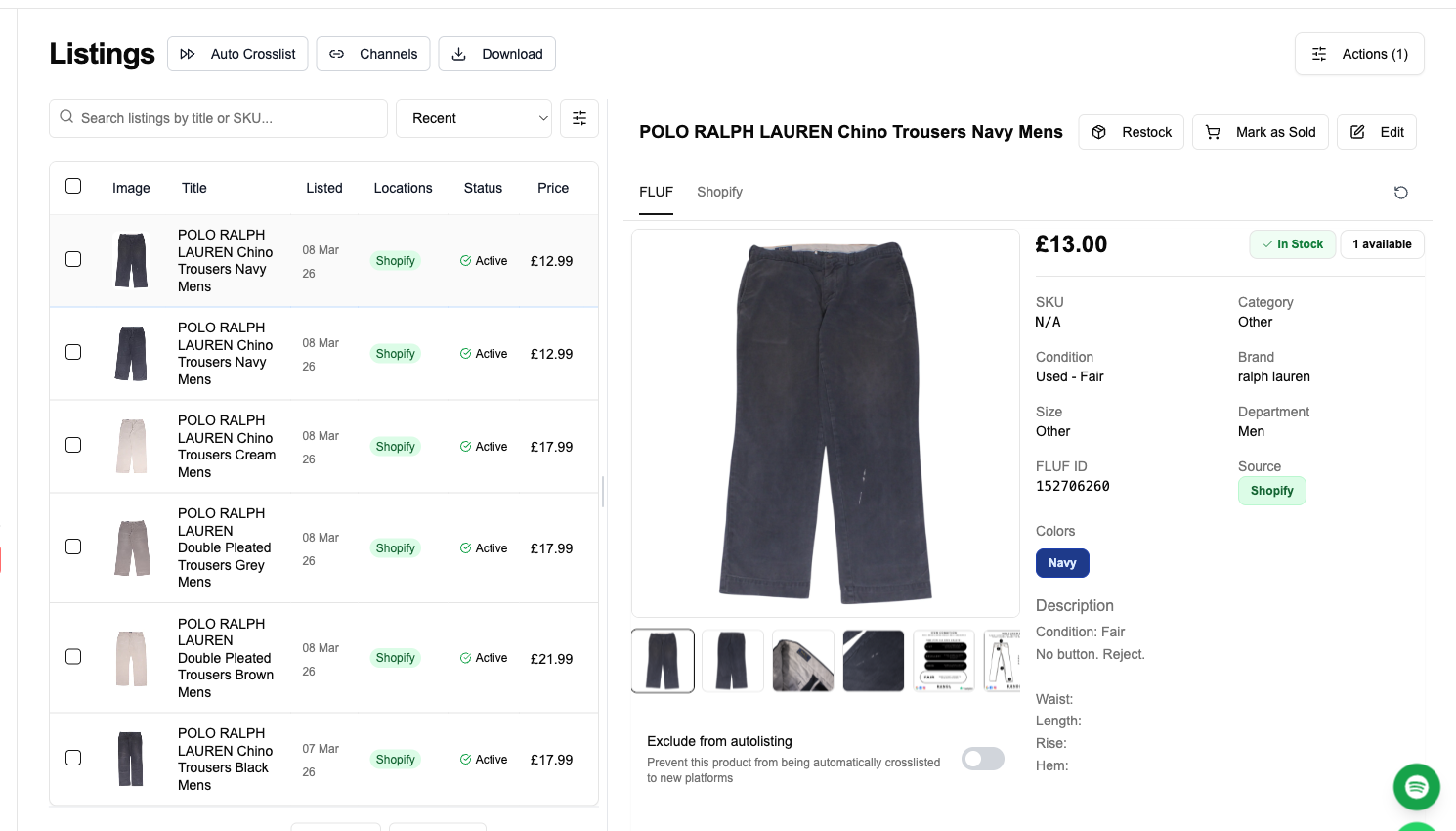
- Pull in the Squarespace catalogue. FLUF reads every product — photos, price, SKU, stock, variant attributes — into one list. Bring everything across or filter to a subset first.
- Check the field mapping. Squarespace carries no brand field and no fixed category tree, so this is where you set a default vendor or product type for Shopify if you want one applied consistently.
- Pick products and publish. Select what should go live, set Shopify as the destination, and crosslist — one at a time or hundreds together.
- Watch it land on Shopify. FLUF creates the matching product, uploads the photos, sets the opening stock count, and switches sync on. New listings usually appear within minutes.
Your Squarespace product details and variants appear together in Shopify. Review names, photos, options, SKUs, prices and stock before publishing.
Price and stock changes may appear at slightly different times. Check both values after an update.
Auto-crosslisting rules can push new Squarespace products to Shopify the moment you add them — filtered by tag, price or brand — and once a catalogue is on Shopify, FLUF can carry it onward again to marketplaces such as Etsy or eBay from the same dashboard.
What Actually Transfers From Squarespace to Shopify
Because neither platform imposes a marketplace’s fixed taxonomy, the overlap is wide and most fields need no manual fix-up. The two real gaps — brand and shipping data — exist because they are not supplied by the Squarespace import, not because anything gets lost in translation.
Field Mapping — Squarespace to Shopify
| Squarespace Field | Shopify Field | Transfer Status | Notes |
|---|---|---|---|
| Product name | Title | Automatic | Shopify has no title length cap, so nothing is trimmed. |
| Description | Description (body HTML) | Automatic | Already a rich-text field on Squarespace’s side; it carries over as HTML rather than plain text. |
| Images | Images | Automatic | Squarespace allows up to 100 photos per product, ordered by an explicit display-order value; the full set transfers in that order onto Shopify’s unlimited image field. |
| Base price / sale price | Price / compare-at price | Automatic | Read as a plain decimal in the store’s own currency and carried straight across. |
| Variant SKU | SKU | Automatic | Squarespace caps SKUs at 60 characters — comfortably inside Shopify’s own ceiling. |
| Stock quantity | Inventory quantity | Automatic | Becomes the single count both storefronts read from and write to. |
| Tags (first one) | Product type & tags | Smart-mapped | Squarespace has no category field whatsoever — tags are the only merchandising signal it has, so one tag seeds both Shopify fields. |
| Variant attributes (Size, Colour) | Variant options | Smart-mapped | Free text on both sides, so there’s no grading scale or size-system conversion to get wrong. |
| — | Brand (vendor) | Manual | Squarespace has no brand field. Set and review the Shopify vendor if needed. |
| — | Weight | Not available | Not included in the Squarespace import; add it on Shopify for weight-based shipping rates. |
| — | Barcode (GTIN/UPC) | Not available | Not carried anywhere in Squarespace’s catalogue data; set it manually if a connected sales channel needs one. |
| — | Collections | Manual | Assign a collection directly, or let Shopify’s automated collection rules pick products up by tag. |
Legend:
- Automatic — moves across with no action needed.
- Smart-mapped — FLUF Connect translates between the two platforms’ own formats.
- Manual — a Shopify field worth setting a default for, or filling in per product.
- Not available — Squarespace has nothing to source it from.
Tag Mapping in Practice
Because Squarespace merchandises purely through tags rather than a category tree, one tag has to do the work of two Shopify fields at once.
| Squarespace tag | Shopify result | Notes |
|---|---|---|
| “Women’s Tops” | Product type “Tops” + tag “Women’s Tops” | One tag becomes a type and a searchable tag together. |
| “Sale” | Tag “Sale” + compare-at price set | Squarespace’s onSale flag carries the original price into Shopify’s compare-at field. |
| “Homeware” | Product type “Homeware” + tag “Homeware” | An untagged Squarespace product lands on Shopify with no type at all — worth tagging consistently before a bulk import. |
Worth Checking Before You Publish
Brand, weight and barcode are the three fields Squarespace’s catalogue data has no room for. None of them stop a listing from going live — a product publishes fine without a vendor, a weight, or a barcode — but a vendor sitting at the “Unbranded” default, or a missing barcode a downstream channel expects, is easy to miss on a big first import if the mapping review step gets skipped.
What Stays in Sync Between Squarespace and Shopify — and What Doesn’t
Once a product is crosslisted, FLUF treats the Squarespace and Shopify listings as one item sharing one stock figure. A sale on either side — or on any other connected channel — drops that figure to zero everywhere else within minutes.
| Event | What Happens | Timing |
|---|---|---|
| Sale on Squarespace | Stock zeroed on Shopify and every other connected channel | Within minutes |
| Sale on Shopify | Stock zeroed on Squarespace | Within minutes |
| Restock on either storefront | Quantity updated on the other | Within minutes |
| Order placed on Shopify | Pulled into FLUF’s unified order feed | Regular sync cycle |
| Order placed on Squarespace | Used for sale sync; Squarespace orders do not appear in the order feed. | Regular sync cycle |
| Price changed directly on Squarespace | Not pushed to Shopify automatically | — |
| Description edited directly on Squarespace | Not pushed after the first crosslist | — |
A Squarespace sale zeroes the matching Shopify stock — and every other connected channel’s — within minutes. Before it does, FLUF checks the Squarespace order is genuinely paid: test orders, unpaid carts, and cancelled or fully refunded orders get recorded but never trigger a delist. The very first sync after connecting a Squarespace store also skips this check entirely, so importing a store with existing sales history can’t wipe out a catalogue you’ve only just brought in.
Shopify orders appear in FLUF’s unified order feed; Squarespace orders do not. Squarespace sales can still update stock on Shopify. Manage Squarespace fulfilment in Squarespace. Price and description edits made directly in either storefront stay there; make changes in FLUF Connect or use a bulk edit to update both.
Copy-Paste vs. One Click
Set side by side, the manual route and FLUF’s route look very different.
Doing it by hand
- Open Squarespace and find the product.
- Copy the name and description across.
- Download every product photo.
- Open Shopify admin and start a new product.
- Paste in the title and description, fixing whatever formatting breaks.
- Upload the photos one by one, in the right order.
- Re-type the price, SKU and stock count.
- Rebuild every variant option — size, colour — from scratch.
- Fill in vendor, product type and tags by hand, since Squarespace never had any of them to copy.
- Publish, then note somewhere that the item now lives on two storefronts.
- When it sells on one, go manually to the other and mark it out of stock.
Roughly 8–15 minutes per item, and the overselling risk never actually goes away between steps 10 and 11.
With FLUF Connect
- Select the products in FLUF’s dashboard.
- Pick Shopify as the destination and click crosslist.
- Review the mapping — it’s already filled in.
- Confirm. Stock then stays in sync on its own.
About 30 seconds per item, and close to nothing once auto-crosslisting rules pick up new stock for you.
By hand: roughly 15–25 hours, a good chunk of it spent typing brand, type and tag values Squarespace never asked you to enter the first time. With FLUF Connect: about 50 minutes. That’s close to a working week handed back for sourcing, photographing and actually growing the business instead of re-typing it.
What’s Automated, and What Isn’t
Squarespace and Shopify are both storefronts a merchant owns outright, not auction- or offer-driven marketplaces, so two FLUF features that matter on channels like eBay or Vinted — relisting and offer management — simply have nothing to attach to on either one. What carries over instead is the automation built for two owned storefronts: catalogue import, bulk publishing, two-way stock sync, and rules.
Auto-crosslisting rules
New Squarespace products can publish to Shopify the moment they’re added — filtered by tag, price band or brand — so fresh stock reaches both storefronts without a manual step each time.
Bulk operations
Publish hundreds of products at once with filters applied, run find-and-replace across titles and descriptions, and push price changes in bulk. Because a FLUF Connect edit applies across every connected storefront, one bulk change updates Squarespace and Shopify together rather than one at a time. More on the bulk operations page.
One stock count, both storefronts
Squarespace and Shopify both read and write the same figure through FLUF, so there’s never a moment of wondering which platform still has an item live. See how the shared count behaves on the inventory sync page.
| Feature | Squarespace | Shopify |
|---|---|---|
| Crosslisting | Yes | Yes |
| Two-way stock sync | Yes | Yes |
| Sold-elsewhere delist | Yes | Yes |
| Unified order feed | No | Yes |
| Bulk operations | Yes | Yes |
| Auto-relisting | No | No |
| Offer management | No | No |
| Browser extension needed | No | No |
Pricing
FLUF Connect starts at £9/month (Starter) and scales up through Growth, Pro and Super Seller as a catalogue grows. Automation — crosslisting, inventory sync, bulk operations — is included from Seller upwards rather than sold as an add-on. There is no free plan, but every new account gets a 7-day trial for £1.
| Plan | Monthly | Crosslisted products |
|---|---|---|
| Starter | £9/month | Unlimited |
| Pro | £29/month | Unlimited |
| Super Seller | Custom pricing — tell us what you need | Unlimited |
Every plan crosslists between every supported channel, not just Squarespace and Shopify — connect as many storefronts and marketplaces as needed and run them from one dashboard. Full detail on the pricing page. Squarespace and Shopify each bill their own separate platform and processing fees on top of FLUF Connect, set out in the comparison table above.
Going the other direction? See Shopify to Squarespace. Squarespace catalogues can also crosslist to Etsy or eBay, or read the guide to selling on multiple platforms. Back to the crosslisting hub. Not set on Shopify yet? compare with crosslisting to WooCommerce instead.
Sources & Verification
- Squarespace live Commerce store count (393,432, up 12% year on year, Q3 2026) — storeleads.app: The State of Squarespace
- Squarespace Commerce plan pricing and transaction fees (Basic ~$16/mo, 2% fee; Core ~$23/mo, 0% fee; Plus ~$39/mo; Advanced ~$99/mo) — startupowl.com: Squarespace Commerce Review
- Shopify plan pricing and transaction fees (Basic from £19/month annual; 2% + 25p online card rate; 2% third-party gateway surcharge) — shopify.com/pricing
- Shopify 2024 GMV of $292.28 billion — Shopify Q4 & Full Year 2024 results
- Shopify’s stated app count (8,000+), checkout conversion claim (+15% average) and unlimited-products-no-listing-fee positioning versus Squarespace — shopify.com: Shopify vs. Squarespace
- Squarespace payment-gateway limitations and reasons merchants migrate to Shopify (wholesale pricing, product bundles, multi-location inventory, payment gateway choice) — letsmetrix.com: The Squarespace to Shopify Migration Guide
- FLUF Connect plans, annual billing and included automation — fluf.io/pricing
Related guides
- Crosslist from Tilt to Shopify — the catalogue you can carry away
- Square vs Shopify — fees by country, the eight-country limit and the catalogue asymmetry that breaks migrations
- Crosslist from Shopify to Square — Square’s two-object catalogue, and why there is no official connector
- Crosslist from Shopify to Wix — the variant surcharge mismatch, the 15-image cap and Wix’s 5,000-redirect ceiling
- Crosslist from PrestaShop to Shopify — what native multistore and daily FX cost to replace
Frequently Asked Questions
FLUF Connect plans start at £9/month (Starter), and every new account gets a 7-day trial for £1. Every plan includes crosslisting, inventory sync and bulk operations across every supported channel — automation is included, not a paid add-on. There is no free plan.
Yes, in both directions. Squarespace and Shopify share one stock count through FLUF Connect: sell an item on either store — or on any other connected channel — and the quantity drops to zero everywhere else within minutes, so you never oversell the same one-off item twice.
Yes. New Squarespace sales update the matching Shopify listing’s stock. Existing sales history is not applied when you first connect your store.
No. Connect Squarespace with a Developer API key and install the FLUF Connect app from the Shopify App Store. Neither needs the browser extension or an open browser tab; both keep syncing when your computer is off.
Stock quantity stays in two-way sync, but ongoing price and description edits made directly in Squarespace after the initial crosslist are not pushed to Shopify automatically. Make the change in FLUF Connect, or with a bulk edit, and it applies to both stores together — this stops an edit on one store from silently overwriting a listing you've deliberately tuned differently on the other.
No — that's a genuine difference between these two channels. Shopify has full order sync in FLUF Connect, so its orders can be centralised in your dashboard for fulfilment alongside every other connected channel. Squarespace only has sold-detection: FLUF watches for a Squarespace sale to zero the matching stock elsewhere, but it doesn't pull Squarespace's own order details into a unified feed.
Yes. Every FLUF Connect plan includes crosslisting between all supported channels, not only the pair you start with — Squarespace or Shopify products can go out to eBay, Etsy, Depop, Vinted, Facebook Marketplace and more from the same dashboard.
No — neither applies. Both are your own branded storefronts rather than auction- or offer-driven marketplaces, so those two FLUF features (built for channels like eBay or Vinted) simply have no equivalent here. What you do get on both: crosslisting, two-way stock sync, and bulk operations.
Squarespace does not supply a brand, weight or barcode in this workflow. Set the Shopify vendor where needed, and add weight and barcode values if you use weight-based shipping or product identifiers.