
Crosslist from Wallapop to Marktplaats — Spain to the Netherlands
Port your whole Wallapop catalogue to the Netherlands' biggest second-hand marketplace — same euro pricing, no conversion, one inventory.
7 days for £1, then from £9/month.



TL;DR: crosslisting Wallapop→Marktplaats (Spain→Netherlands) takes the catalogue you already sell on Spain’s biggest C2C app and re-lists it on the Netherlands’ dominant second-hand marketplace. Because both platforms price in euros there is no currency rework — FLUF Connect ports your titles, descriptions, photos and prices, and the only adjustment worth making is localising your wording for Dutch search. Wallapop is extension-first, so as a source it gives you order-sync; Marktplaats as a destination supports relisting, order-sync and mark-as-sold. Plans start at £9/month (Starter); There is no free plan, but every new account gets a 7-day trial for £1.
If you sell second-hand goods on Wallapop, you already understand the appeal of a low-friction, hyper-local marketplace: snap a photo, write a line of description, set a price, and let nearby buyers come to you. The catch is that Wallapop’s reach, however large, stops at the Spanish border. A wardrobe of vintage jackets, a stack of consoles, a sideboard you no longer need — all of it competes only for the attention of Spanish buyers. Across the continent, the Netherlands runs one of Europe’s most active second-hand economies on Marktplaats, a general classifieds marketplace that handles roughly 350,000 new listings a day and serves around 48 million visits a month. The two countries share a currency, which means the single hardest part of most cross-border selling — pricing — simply does not apply here. This page explains how to crosslist from Wallapop to Marktplaats with FLUF Connect, what genuinely syncs, how the categories and fields line up, and what each platform charges, so you can decide whether opening a Dutch sales channel is worth the few minutes of setup.
Why Crosslist from Wallapop to Marktplaats
Wallapop is Spain’s leading consumer-to-consumer second-hand marketplace, built around a free mobile app (with a web companion) and a hyper-local model that surfaces items from buyers and sellers nearby. It is a genuinely large platform: industry reporting puts it at more than 19 million monthly active users transacting somewhere in the region of €2–2.5 billion in user sales each year, and in August 2025 the Korean group Naver acquired full ownership in a deal that valued Wallapop at roughly €377–600 million (source). Those numbers tell you the demand is real — but it is overwhelmingly Spanish demand. A seller who lists only on Wallapop is, by design, fishing in a single national pool.
Marktplaats is the mirror image of Wallapop one country over. It is the Netherlands’ dominant general second-hand and classifieds marketplace, consistently ranked the second most-visited retail site in the country after bol.com (source). Public figures describe roughly 48 million visits a month as of October 2025 and more than 8 million monthly active users (source), with something like 18.7 million active ads live at any time, around 350,000 new listings added each day, and an estimated 73 percent share of the Dutch online reuse market in 2023 (source). For a Spanish seller, Marktplaats is not a niche export channel — it is the place Dutch buyers go first when they want something second-hand.
The strategic case for the Wallapop→Marktplaats route rests on three things that make it unusually clean compared with most cross-border crosslisting. First, it is a true Spain→Netherlands expansion: you keep selling to your existing Spanish audience on Wallapop and add a second, entirely separate national audience without cannibalising the first. Second, both Wallapop and Marktplaats are general marketplaces rather than fashion-only sites, so your whole catalogue ports — clothing, electronics, furniture, vehicles and accessories all have a home on both ends, not just apparel. Third, and most importantly for your margins, both platforms are euro-native. There is no FX conversion, no rounding artefacts, no need to re-price every item to defend a target margin against an exchange rate. The price you set in Spain is the price a Dutch buyer sees.
What FLUF Connect Actually Does Here
FLUF Connect is a crosslisting tool: you maintain one inventory and it lists that inventory across many marketplaces, keeping the copies in step as items sell. It is honest about the difference between a source channel (where your listings originate) and a destination channel (where FLUF Connect creates and manages new listings), because the two sides have very different automation depending on how the marketplace exposes its data.
Use the FLUF extension for Wallapop. Wallapop order sync can update matching listings on other supported channels, but automated relisting, offer management and marking items sold back on Wallapop are not available. Remove the Wallapop listing yourself after an item sells elsewhere.
Marktplaats, as the destination in this pairing, is the side that does the heavy lifting. As a destination it supports relisting (FLUF Connect creates and re-creates the Marktplaats ad from your source listing), order-sync (sales flow back into your inventory state), and mark-as-sold (when the item goes elsewhere, the Marktplaats copy can be closed out). The one capability it does not cover is offer management — negotiating or accepting buyer offers is something you still handle yourself within Marktplaats. So the realistic mental model is: Wallapop feeds the catalogue and flags its own sales; Marktplaats receives the catalogue, keeps it live, and gets marked sold when needed. Both directions stop short of automating buyer negotiations, which keeps you in control of price conversations.
How Crosslisting from Wallapop to Marktplaats Works
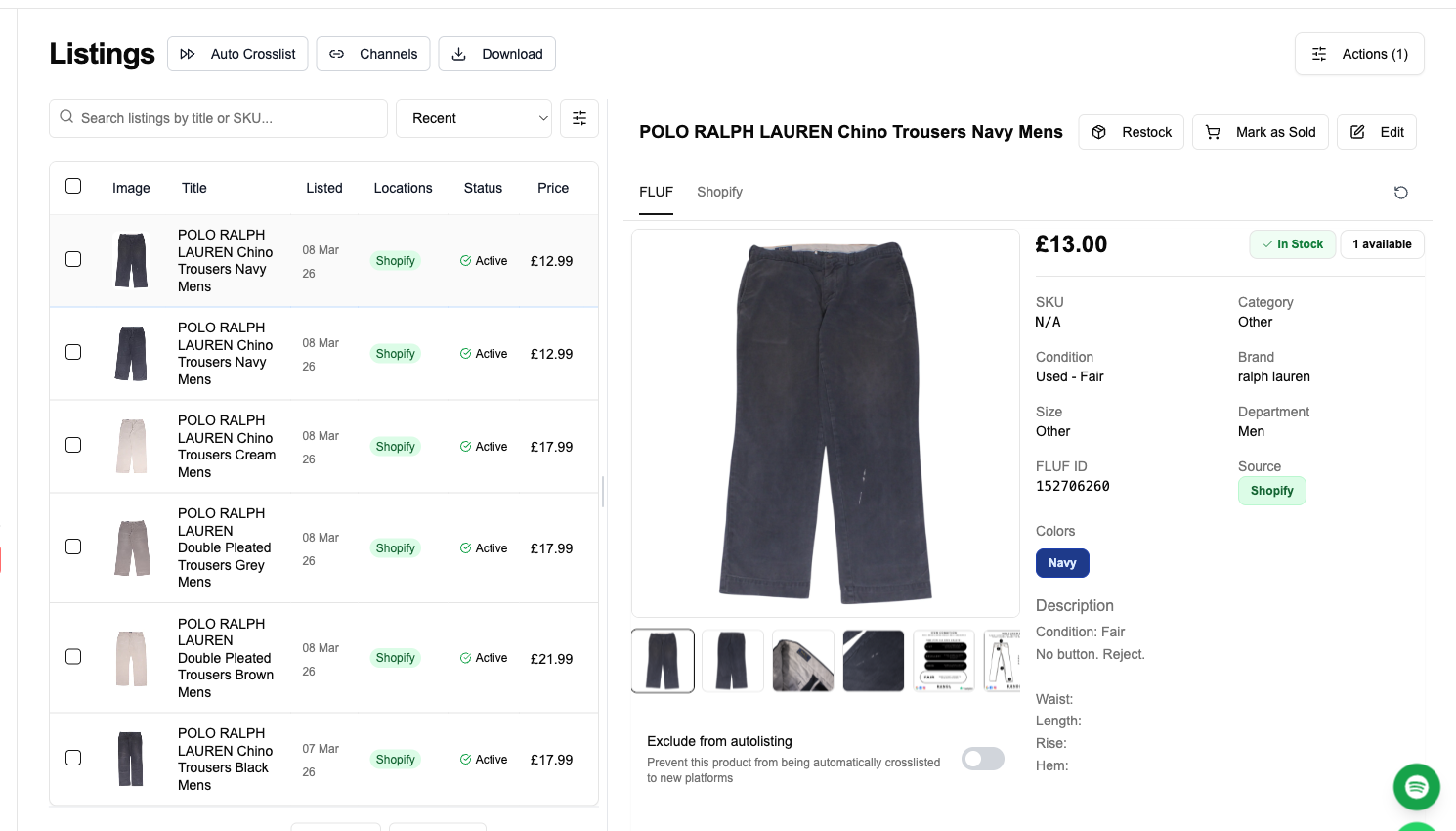
The workflow is deliberately short. You connect your Wallapop account to FLUF Connect through the browser extension. FLUF Connect ingests those items into a single inventory view — titles, descriptions, photographs, prices and the category each item sits in. You then connect Marktplaats as a destination and choose which items, or the whole catalogue, to push across. FLUF Connect builds a Marktplaats ad for each selected item, mapping the fields across and dropping the photos into the new ad, and the listing goes live for Dutch buyers.
From that point the value is in keeping the copies coherent. When an item sells — whether the sale happens on Wallapop or on Marktplaats — order-sync registers it, and the destination-side automation can mark the Marktplaats copy sold so you are not left fielding messages about something you no longer have. Because Marktplaats supports relisting, items that expire or need refreshing can be re-created rather than rebuilt by hand. The practical effect is that adding the Netherlands as a sales channel does not double your admin: you still manage one catalogue, and the second marketplace is a reflection of it rather than a second job.
One step that is worth doing manually, and that FLUF Connect cannot decide for you, is language. Wallapop listings are written in Spanish; Marktplaats buyers search in Dutch. We will get to that in detail below, but flag it now as the single highest-leverage edit you can make to a ported listing.
Field and Category Mapping: Both EUR, No Conversion
The mapping between the two platforms is mercifully direct because both are general second-hand marketplaces structured around the same basic listing primitives. Here is how the core fields line up.
| Wallapop field | Marktplaats field | Notes |
|---|---|---|
| Listing title | Ad title | Port directly; localise to Dutch for search reach. |
| Description | Description | Carries over; a Dutch translation materially helps NL discovery. |
| Photos | Photos | Images transfer as-is; no re-shoot needed. |
| Price (EUR) | Price (EUR) | No conversion. Both platforms are euro-native — the price ports 1:1. |
| Category — Fashion | Kleding | Clothing and accessories. |
| Category — Electronics | Elektronica | Phones, consoles, computing, audio. |
| Category — Furniture / home | Huis & Inrichting | Furniture and home furnishings. |
| Category — Cars / motor | Auto’s | Vehicles and motoring. |
The detail that does the most work in that table is the price row. Cross-border crosslisting normally forces a decision on every single item: do you convert at today’s rate and watch your margins drift, or do you set a fixed foreign price and re-audit it constantly? Selling from a euro country to a euro country removes that decision entirely. A €45 jacket on Wallapop is a €45 ad on Marktplaats, and it stays that way regardless of what currency markets do. That is the practical meaning of “zero pricing friction” — not that pricing is automated away, but that there is genuinely nothing to convert.
Categories map cleanly because both marketplaces are broad. Wallapop’s fashion, electronics, furniture and motor segments correspond to Marktplaats’s Kleding, Elektronica, Huis & Inrichting and Auto’s respectively, and the long tail of accessories and miscellaneous goods that defines general C2C selling has a home on both. This is why the Wallapop→Marktplaats route suits sellers with mixed inventory rather than only clothing resellers: the whole catalogue ports, not a slice of it.
The EN/NL Language Bridge
The biggest lever for performance on the Dutch side is language, and it is the one thing the platforms cannot do for you. Marktplaats is a Dutch-language marketplace and its buyers search in Dutch. A Spanish title that ports across verbatim — or even an English one — will technically be live, but it will not surface for the Dutch-language queries that drive most of Marktplaats’s traffic. Localising your titles and descriptions to Dutch is therefore not cosmetic; it is the difference between an ad that is technically present and an ad that is actually found.
Practically, this means translating the title to use the Dutch terms a buyer would type — “leren jas” rather than “chaqueta de cuero”, “eettafel” rather than “mesa de comedor” — and giving the description a Dutch pass so it reads naturally to a Dutch buyer. You do not need a translation agency for second-hand listings; the goal is to match the words buyers search with, not to win a literary prize. Even a quick localisation of the title and the first line of the description will materially improve how a ported Wallapop item performs on Marktplaats. FLUF Connect ports the original copy faithfully; the Dutch edit is your highest-value manual touch.
Fees on Marktplaats (and How Wallapop Compares)
Both marketplaces are, at their core, free to list on for private sellers, which is part of why this route is low-risk to try. On Marktplaats, private listings are free, with optional paid promotions to boost an ad’s visibility and business subscription tiers for higher-volume or commercial sellers. You can therefore open the Dutch channel and run a catalogue of ads at no listing cost, paying only if you choose to promote specific items or sell at a scale that warrants a business account (source).
Wallapop’s model is similar on the listing side and useful to understand for context, since it is where your items originate. Basic listings on Wallapop are free with no sales commission. Visibility upgrades — the “Destacados” / highlighted placements — are paid, and high-volume sellers can take a “Wallapop PRO” subscription priced around €39 per month (source). Where Wallapop does take a cut is shipping: sales fulfilled through the integrated “Wallapop Envíos” service (which includes buyer protection insurance) carry a deduction of roughly 10 percent on prepaid shipped sales. None of that affects what you owe on the Marktplaats side; the two fee structures are independent, and adding Marktplaats does not increase your Wallapop costs.
The table below summarises the comparison at a glance.
| Wallapop (Spain, source) | Marktplaats (Netherlands, destination) | |
|---|---|---|
| Private listing cost | Free, no commission | Free for private ads |
| Paid visibility | “Destacados” highlighted placements | Optional paid promotions |
| High-volume option | Wallapop PRO (~€39/month) | Business subscription tiers |
| Shipping | Wallapop Envíos, ~10% on prepaid shipped sales (incl. buyer insurance) | Handled per ad / Dutch logistics |
| Currency | EUR | EUR |
| FLUF Connect role | Source: order-sync only | Destination: relisting, order-sync, mark-as-sold (no offer management) |
Who This Route Is For
The Wallapop→Marktplaats pairing fits a specific and common seller profile: someone already moving real volume on Wallapop in Spain, with a mixed catalogue rather than a single category, who wants additional buyers without re-pricing everything or learning a new fee model from scratch. Because both ends are general marketplaces, it suits furniture flippers, electronics resellers and clothing sellers equally — the route does not assume fashion. Because both ends are euro-native, it is especially attractive to margin-conscious sellers who have been put off cross-border selling by the prospect of constant currency management. And because Marktplaats’s reach is so large within the Netherlands — tens of millions of visits a month against a roughly 73 percent share of Dutch online reuse — even a partial catalogue port can meaningfully expand the audience for items that have gone quiet in the Spanish market.
It is less suited to sellers who depend heavily on live buyer negotiation, since neither side of this pairing automates offer management; you will still field and answer offers yourself on each platform. And it asks one bit of effort in return for the reach: the Dutch-language pass on your titles and descriptions. For sellers willing to do that, the route turns a single-country business into a two-country one with no pricing rework and very little added admin.
The Cross-Border Opportunity in Numbers
It is worth dwelling on why the Spain→Netherlands corridor is such a natural fit, because the case is stronger than “two big marketplaces in two countries.” Both Wallapop and Marktplaats are the clear category leaders in their home markets, which means crosslisting between them is not a long-tail bet on a marginal channel — it is connecting the dominant second-hand venue in one large economy to the dominant second-hand venue in another. Wallapop’s reported 19 million-plus monthly active users and €2–2.5 billion in annual user sales establish that your source market is mature and liquid (source). Marktplaats’s roughly 48 million monthly visits, 8 million-plus monthly active users (source), 18.7 million active ads, and an estimated 73 percent share of the Dutch online reuse market in 2023 establish that the destination market is at least as deep (source).
The scale of new supply on Marktplaats — on the order of 350,000 new listings added per day — cuts both ways, and it is worth being honest about it. On one hand, it confirms enormous buyer demand and constant traffic; a marketplace does not absorb a third of a million new ads daily without a vast audience to match. On the other, it means competition for attention is real, which is exactly why the Dutch-language localisation step matters so much: a well-worded Dutch title is how your ad rises above the noise rather than being buried under it. The combination of a deep, liquid destination and a low-cost listing model is what makes the route attractive to test — you are not gambling a large fee to find out whether Dutch buyers want your inventory; you are listing without a listing fee and letting the data tell you.
There is also a timing dimension. Naver’s August 2025 acquisition of full ownership of Wallapop, in a deal valuing the platform at roughly €377–600 million, signals continued investment in the Spanish C2C ecosystem (source). A well-capitalised, actively-developed source platform is a good foundation to build a multi-market selling operation on top of, because the listings you read from it are likely to remain stable and feature-rich. Pairing that with Marktplaats’s entrenched position in the Netherlands gives you two durable channels rather than two experiments.
Practical Tips for a Clean Port
A few habits make the Wallapop→Marktplaats route run smoothly. First, treat the Dutch-language pass as part of listing rather than an afterthought: do it at the moment you push to Marktplaats, while the item is fresh in your mind, rather than promising yourself you will go back and translate later. The title is the highest-leverage element — lead it with the Dutch noun a buyer would type, then qualify with brand, size or condition.
Second, lean on the fact that prices port unchanged. Because there is no conversion, you can set your Spanish prices once and trust that they carry across; the only reason to adjust a Marktplaats price is genuine market difference (a console that commands more in the Netherlands than in Spain, say), not currency. This keeps your pricing decisions deliberate rather than reactive.
Third, let order-sync do its job and resist the urge to manually mirror sales. The entire point of crosslisting through FLUF Connect is that you maintain one inventory; when something sells on Wallapop, order-sync reflects that, and the destination-side mark-as-sold can close the Marktplaats copy so you are not double-selling. Manually shadowing every transaction undoes that benefit. Where you do stay hands-on is offer management — since neither side automates negotiation, keep an eye on buyer messages on both platforms and answer them yourself.
Finally, start with a representative slice of your catalogue rather than everything at once if you are cautious. Push a cross-section — a few clothing items, a couple of electronics, a furniture piece — localise them well, and watch how Dutch buyers respond before porting the full inventory. Because listing is free on both ends and there is no pricing rework, scaling up once you are confident costs you nothing but the few minutes of Dutch wording per item.
Reach Dutch Buyers from Spain
Opening Marktplaats as a second channel for your Wallapop catalogue is one of the lowest-friction cross-border moves available to a European second-hand seller: same currency, same general-marketplace structure, a destination with tens of millions of monthly Dutch visits, and a workflow that keeps you managing one inventory rather than two. Connect Wallapop through the extension, push your catalogue to Marktplaats, give your titles a Dutch pass, and let FLUF Connect keep the copies in step as things sell. Try FLUF Connect to start crosslisting from Wallapop to Marktplaats. Plans start at £9/month (Starter); there is no free plan, and automation is included from Seller upwards.
Sources & Verification
- Wallapop scale, user base, annual user sales, Naver acquisition and valuation — source
- Marktplaats monthly visits, active users and ranking among Dutch retail sites — source
- Marktplaats active ads, ~350,000 new listings per day, ~73% Dutch online reuse market share (2023), free private listings and ownership — source
- Wallapop PRO subscription pricing, Destacados paid boosts and seller features — source