
How to Import Your Shopify Products into FLUF Connect
Your Shopify catalogue is usually the cleanest one you own, because you wrote it for yourself rather than for a marketplace template.
7 days for £1, then from £9/month.



- Shopify is usually the cleanest catalogue a seller owns, because you wrote it for yourself rather than to satisfy a marketplace’s template.
- Variants and SKUs come across properly. Shopify models size and colour variants natively, which most resale marketplaces do not — so this is the one source where that structure exists to begin with.
- No relisting and no offer management on Shopify. Neither concept exists on your own store — there is no feed to refresh and no marketplace offer system. Those features apply to the marketplaces you crosslist to.
- Shopify is the order centralisation hub. Marketplace orders can be brought into Shopify so you fulfil everything from one place.
- No minimum image requirement on Shopify itself — but a product with no photograph will fail on the marketplaces you push it to, so check for gaps before crosslisting.
- Connects with stored credentials. No browser extension, nothing to keep running.
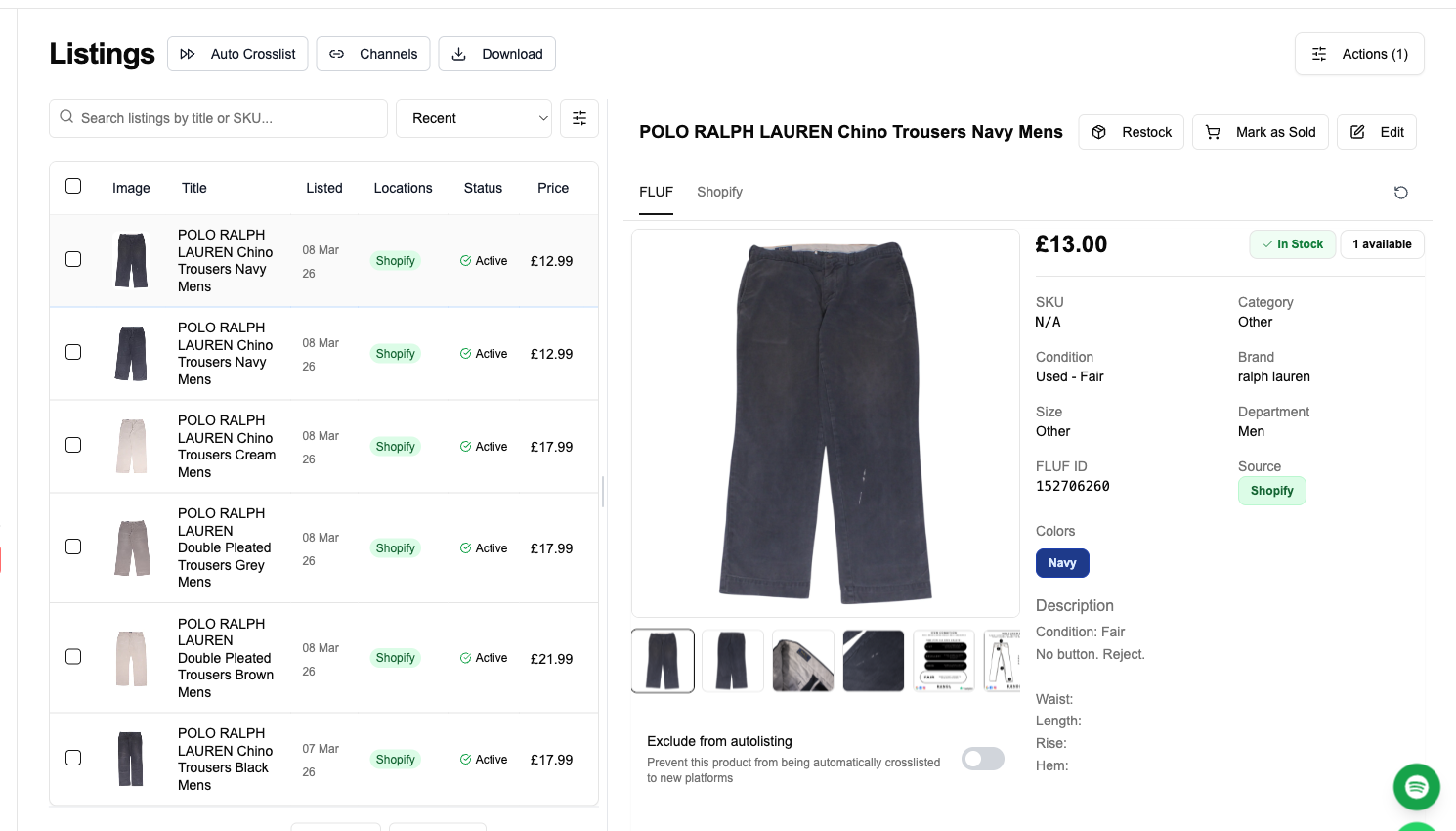
Why a store catalogue beats a marketplace catalogue
If you have a Shopify store and also sell on marketplaces, connect Shopify first. It is nearly always the better import source, and the reason is straightforward: you built it for yourself.
Marketplace listings are shaped by the marketplace. eBay titles are written for eBay’s search engine. Vinted descriptions are short because the audience browses visually. Depop listings carry the platform’s conventions. Each is optimised for the place it lives, which makes it a compromise everywhere else.
A Shopify product is written for your own brand and your own customer. Descriptions tend to be longer and better structured, product names read as names rather than keyword strings, and the data model is genuinely richer — variants, SKUs, vendor, product type, tags, compare-at pricing. Importing from there gives every subsequent crosslist more to work with and less to undo.
What comes across
| Data | Imported | Notes |
|---|---|---|
| Title | Yes | Usually the cleanest titles of any source — written as product names, not keyword strings. |
| Description | Yes | Shopify descriptions are HTML. Formatting is normalised, because marketplaces accept very different markup. |
| Photographs | Yes | Product images come across. Check for products with none — see below. |
| Price | Yes | Pricing rules can adjust per destination channel afterwards. |
| Variants | Yes | The distinguishing feature of a Shopify import. See the section below. |
| SKU | Yes | Genuinely useful — it gives you one identifier that ties an item together across every channel. |
| Stock quantity | Yes | Shopify tracks inventory properly, which makes sync meaningful rather than nominal. |
| Collections | Not as categories | Collections are your own merchandising groups, not a category taxonomy. Destination categories are mapped separately. |
Variants are the thing to think about
Shopify models variants natively: one product, many sizes and colours, each with its own SKU, price and stock level. This is correct for a store and it is the main structural difference between a Shopify catalogue and a resale catalogue.
Destinations vary enormously in how they handle it:
- Other store platforms — WooCommerce, Wix, BigCommerce, Squarespace — model variants too, so the structure survives.
- Large marketplaces — eBay and Etsy support variation listings, though each has its own rules about what may vary.
- Single-item resale marketplaces — Vinted, Depop and similar are built around one-off items and have no real concept of a variant.
This is not a reason to avoid crosslisting a variant catalogue, but it is a reason to run a small batch first and look at the result on the destination marketplace before pushing thousands. What you decide here — whether a size run becomes several listings or one — shapes how your stock behaves everywhere afterwards.
What Shopify does not do, and why
Two features people expect do not apply to Shopify, and the reason is conceptual rather than a gap in coverage.
No relisting. Relisting exists because marketplace feeds rank fresh listings, so refreshing an item wins visibility. Your own store has no such feed — nothing is competing for position in a chronological stream. There is nothing to refresh, so relisting applies to the marketplaces you push to, not to Shopify.
No offer management. Offers are a marketplace mechanism. Shopify has discounts and draft orders, but not the buyer-initiated offer flow that offer management automates on eBay, Depop and Vinted.
So the shape of a Shopify-anchored setup is: Shopify is the catalogue and the fulfilment hub; the marketplaces are where automation earns its keep.
Shopify as the order hub
This is the part that makes Shopify more than an import source. Marketplace orders can be centralised into Shopify, so orders from several marketplaces arrive in one place and you fulfil everything from a single screen with tracking flowing back automatically.
For a seller with real order volume this is often worth more than the crosslisting itself. Managing fulfilment across four marketplace back-ends is where mistakes and delays come from; managing it in one is simply a smaller job.
Check for products with no photograph
Shopify has no minimum image requirement — a product can exist with none, and stores routinely accumulate a few: placeholders, drafts, services, gift cards, items whose photos were never uploaded.
On Shopify these are harmless. On the marketplaces you crosslist to they are not: most require at least one image and Vinted requires two. A product with no photograph will simply fail to list, and if you push several thousand at once those failures are tedious to unpick.
Filtering them out before your first large crosslist is five minutes well spent.
Products you should not crosslist
A store catalogue usually contains things that make no sense on a marketplace, and it is worth excluding them deliberately rather than discovering the problem in a failure report.
- Gift cards. They exist to be redeemed in your store and are meaningless elsewhere.
- Digital products and downloads. Most resale marketplaces are built entirely around physical goods and will not accept them.
- Services, deposits and bookings. Common in stores that sell alterations, repairs or made-to-measure work.
- Bundles built from other products. These usually depend on your store’s own logic and do not survive being sent somewhere that has no view of the components.
- Draft and archived products. Not published, so nothing to distribute.
Filtering these out once, before your first large crosslist, saves repeatedly clearing the same failures. Auto-crosslisting rules can then be scoped to the product types you actually want distributed, so new stock added to Shopify reaches your channels without dragging the exceptions along with it.
Shopify or WooCommerce as your source?
Plenty of sellers run both, or are moving between them, and the question of which to treat as the catalogue of record comes up often.
The answer is not about which platform is better. It is about which one you actually maintain. Whichever store you update when a product changes — where you fix a description, correct a price, add a photograph — is the one to import from. A neglected store is a bad source however good the platform, because everything you crosslist inherits its staleness.
Structurally the two are similar for import purposes: both model variants, both hold SKUs and stock, both let you write proper descriptions. Crosslisting from WooCommerce covers the WooCommerce path, which uses a plugin rather than stored credentials.
What you should avoid is treating both as sources at once without deciding which wins. Two stores with drifting versions of the same product produce a catalogue nobody trusts, and the drift only becomes visible after it has reached several marketplaces.
A sensible order of operations
- Connect Shopify first so your best catalogue is the one everything else is built from.
- Connect your marketplaces second. Items you already sell there are matched into the catalogue rather than duplicated.
- Decide your variant approach on a small batch before running the full catalogue.
- Filter out anything without a photograph.
- Crosslist ten items to one destination and check them on that marketplace.
- Then turn on automation — relisting and offers on the marketplaces, auto-crosslisting rules for new stock so products added to Shopify reach your channels without manual work.
Pricing
Every new account starts with a 7-day trial for £1 with full access. There is no free plan after that; the entry plan is Starter at £9/month, with no cap on how much you list, and the full automation feature set included.
| Plan | Monthly | Yearly | You save | Crosslisted products |
|---|---|---|---|---|
| Starter | £9/month | £59/year | 45% | Unlimited |
| Pro | £29/month | £199/year | 42% | Unlimited |
| Super Seller | Custom pricing — tell us what you need | Unlimited | ||
Automatic relisting, offer management, smart pricing and listing boosts are included from Pro upwards. Starter covers unlimited crosslisting, inventory sync, order sync and Instagram posting without them. Accounting integrations are included from Pro upwards. Yearly billing is charged once a year. New accounts get 7 days for £1, then move onto a plan.
Save 42% when you pay yearlyProduct limits count unsold, active products. Full detail is on the pricing page.
Related guides
This page sits in the FLUF Connect guides hub. See importing your listings for every route in, Shopify to Depop and Shopify to eBay for specific destinations, and inventory sync for how stock stays in step. Running WooCommerce instead? See crosslisting from WooCommerce.
Sources & Verification
Last verified: 2026-08-15. Please contact us if any detail here is out of date.
- FLUF Connect Shopify channel guide — how Shopify works alongside marketplace selling.
- FLUF Connect integrations page — connection types and per-channel feature support.
- FLUF Connect pricing page — plan prices and annual billing.
Frequently Asked Questions
Connect your Shopify store with stored credentials — there is no browser extension and nothing has to stay running. Your products are then read in and become your FLUF Connect catalogue.
Because you wrote it for yourself. Marketplace listings are shaped by the marketplace, which makes them a compromise everywhere else. A Shopify product has longer descriptions, product names that read as names rather than keyword strings, and a richer data model including variants, SKUs and stock.
Yes. Shopify models variants natively and this is the distinguishing feature of a Shopify import. How they land depends on the destination: other store platforms model variants too, eBay and Etsy support variation listings, and single-item resale marketplaces such as Vinted and Depop have no real concept of them.
No, and the reason is conceptual rather than a gap. Relisting exists because marketplace feeds rank fresh listings, and your own store has no such feed. Relisting applies to the marketplaces you crosslist to.
No. Offers are a marketplace mechanism. Shopify has discounts and draft orders but not the buyer-initiated offer flow that offer management automates on eBay, Depop and Vinted.
Yes. Marketplace orders can be centralised into Shopify so you fulfil everything from one screen with tracking flowing back automatically. For sellers with real order volume this is often worth more than the crosslisting itself.
Gift cards, digital products and downloads, services and deposits, bundles built from other products, and draft or archived products. Also check for products with no photograph — Shopify allows them, but most marketplaces require at least one image and Vinted requires two.
Whichever one you actually maintain. A neglected store is a bad source however good the platform, because everything you crosslist inherits its staleness. Avoid treating both as sources at once without deciding which wins.