Marketplace Software for Retail Stores
Crosslist retail inventory to marketplaces, sync stock across channels, and reduce manual listing work with FLUF Connect. Start with a 7-day trial for £1, then from £9/month.
7 days for £1, then from £9/month.



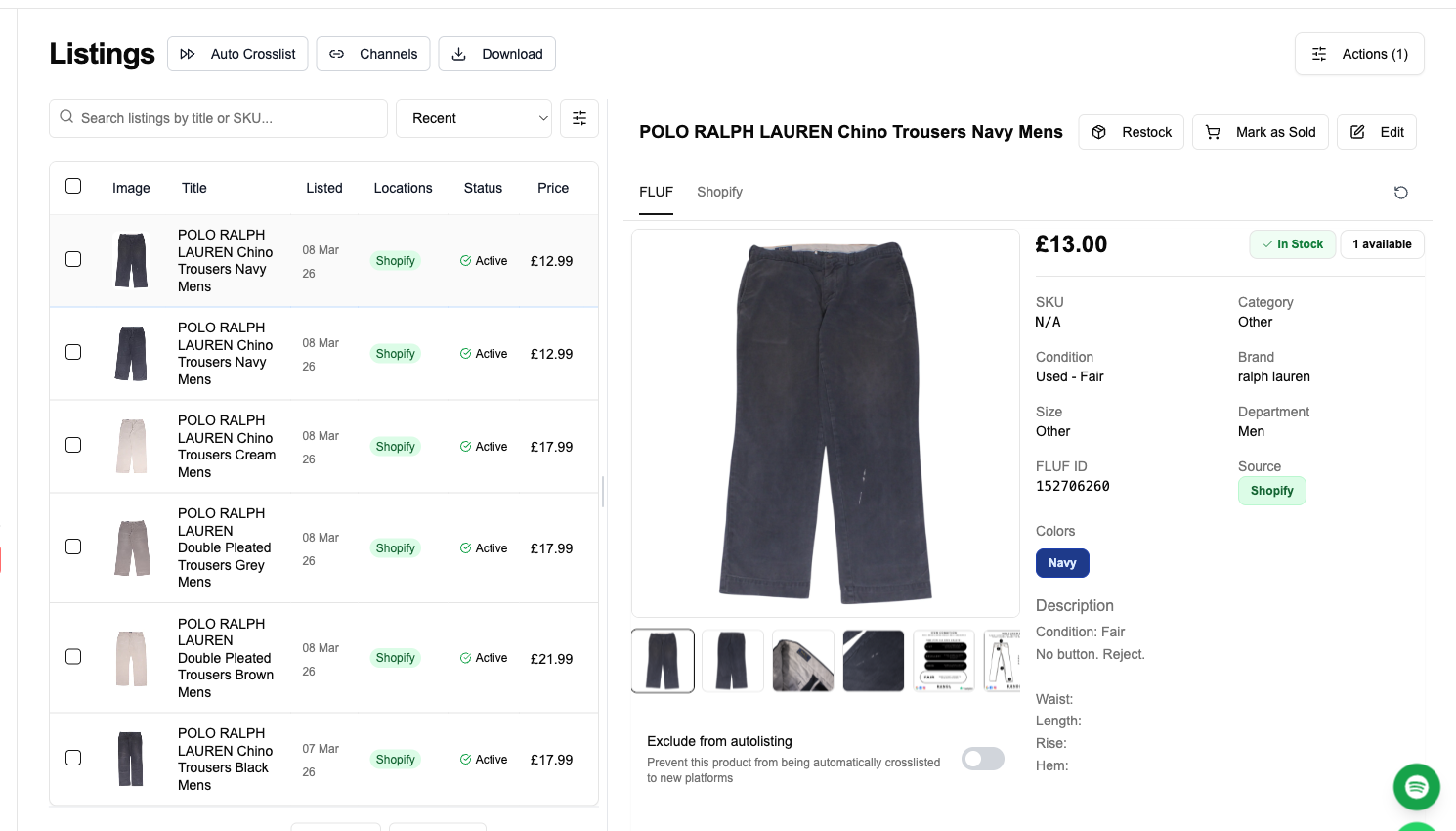
FLUF Connect helps retail stores sell physical inventory across more online channels without maintaining a separate listing workflow for every marketplace. A shop can keep its core catalogue in a central system, then use FLUF to crosslist products, sync stock, update listings in bulk, and reduce overselling risk when the same item is offered in multiple places.
Why retail stores need marketplace software
Retail stores already do hard inventory work: buying stock, pricing it, photographing it, merchandising it, and keeping it available to customers. The moment that inventory also needs to appear on eBay, Etsy, Facebook Marketplace, Vinted, Depop, Shopify, WooCommerce, or another channel, the operating cost changes. Every channel wants product data. Every channel has its own listing form. Every channel can create stock errors if it is not kept in sync.
FLUF Connect is built for that gap between having inventory and distributing it online. It is not a point of sale replacement. It is the marketplace operations layer that helps a retail business get more value from the products it already has.
Retail workflows FLUF supports
Retail teams usually do not need another place to type the same product. They need a repeatable way to turn existing product data into channel-ready listings and keep those listings accurate after they go live.
| Retail workflow | Common manual process | FLUF workflow |
|---|---|---|
| New product intake | Create the product in the shop system, then recreate it on each marketplace. | Use one product record as the basis for marketplace listings, then crosslist to relevant channels. |
| Marketplace expansion | Test one channel at a time because each one adds admin work. | Publish to multiple supported channels from the same dashboard and compare which ones perform. |
| Stock protection | Manually remove listings after an item sells somewhere else. | Use inventory sync so sold or changed stock is reflected across connected channels. |
| Markdowns and clearance | Edit prices one listing at a time. | Use bulk operations to update groups of products faster. |
| Ageing inventory | Let stale listings sit until someone remembers to refresh them. | Use relisting where supported to keep eligible products moving. |
What makes retail different from resale
Many FLUF customers are resale businesses, but retail stores have a different operating pattern. Retailers may carry repeatable SKUs, seasonal collections, supplier-backed stock, or mixed stock that includes both new and second-hand goods. They may have a physical shop, a Shopify store, a WooCommerce site, and a small marketplace presence already.
The value of FLUF for retail is not that the business becomes a reseller. The value is that the business can treat marketplaces as additional sales channels without turning every channel into a separate catalogue job.
How FLUF fits with Shopify, WooCommerce, and marketplaces
Many retail stores already use Shopify or WooCommerce as their main ecommerce layer. FLUF can sit around that catalogue and help push products outward to marketplaces that match the stock. For some stores, Shopify is the central catalogue and fulfilment anchor. For others, the important move is simply getting products from a core listing workflow onto eBay, Etsy, Facebook Marketplace, or resale-heavy marketplaces where demand exists.
This matches how modern commerce platforms talk about sales channels. Shopify sales channels describe syncing and selling products across marketplaces, social platforms, and search surfaces. Shopify’s developer documentation says a sales channel connects a merchant’s online store to surfaces outside Shopify and helps distribute the catalogue to where buyers shop. eBay’s Seller Center highlights listing, order, and growth tools for sellers, while eBay Seller Hub centralises listings and orders. FLUF gives retail stores a practical crosslisting and sync layer across the channels FLUF supports.
Retail store use cases
- Independent clothing shops: publish seasonal or clearance stock to eBay, Depop, Vinted, and Shopify without duplicating every listing manually.
- Homeware and furniture stores: push unique or limited-stock items to eBay, Facebook Marketplace, Shopify, and local-friendly channels.
- Book, record, and media shops: distribute catalogue stock to eBay, Etsy, specialist marketplaces, and ecommerce channels where relevant.
- Gift and craft stores: use Etsy, Shopify, eBay, and Facebook Marketplace as complementary channels for handmade, small-batch, or sourced goods.
- Hybrid retail/resale shops: manage new goods and one-of-a-kind stock from the same marketplace operations workflow.
Retail features that matter most
| Feature | Why retail stores care | Where to learn more |
|---|---|---|
| Crosslisting | Retailers can reach marketplace buyers without rebuilding the same listing repeatedly. | Crosslisting software |
| Inventory sync | Stock that sells in one place should not remain live somewhere else. | Inventory sync |
| Bulk operations | Markdowns, seasonal edits, and batch updates are faster when products can be changed together. | Bulk operations |
| Auto-crosslisting rules | New products can be routed to relevant channels based on brand, category, price, or tags. | Crosslisting hub |
| Pricing and plan limits | Stores can start small and move up as their active product count grows. | Pricing |
Try FLUF before choosing a plan. Retail stores get a 7-day trial for £1, then paid plans start from £9/month. There is no free tier.
How a retail store can start with FLUF
- Connect the channels that fit your stock. Start with channels you already use, then add marketplaces that make sense for the products you sell.
- Bring products into a central workflow. Use FLUF to work from product records instead of scattered marketplace forms.
- Crosslist a controlled batch first. Start with a category, clearance rail, seasonal collection, or group of high-margin products.
- Watch stock movement. Track which channels produce sales and where inventory needs more attention.
- Scale with rules and bulk edits. Once the workflow is proven, use filters, auto-crosslisting rules, and bulk operations to reduce manual work.
Pricing for retail stores
Retail stores can start with a 7-day trial for £1. Paid plans start from £9/month for the Starter plan, with no cap on how much you list. Every paid plan includes the full automation feature set; the main difference between plans is how often we check your channels for sales and sync priority.
| Plan | Monthly | Yearly | You save | Crosslisted products |
|---|---|---|---|---|
| Starter | £9/month | £59/year | 45% | Unlimited |
| Pro | £29/month | £199/year | 42% | Unlimited |
| Super Seller | Custom pricing — tell us what you need | Unlimited | ||
Automatic relisting, offer management, smart pricing and listing boosts are included from Pro upwards. Starter covers unlimited crosslisting, inventory sync, order sync and Instagram posting without them. Accounting integrations are included from Pro upwards. Yearly billing is charged once a year. New accounts get 7 days for £1, then move onto a plan.
Save 42% when you pay yearly
Related FLUF pages
- Sell retailer liquidation stock
- Sell car boot pitch stock online all week
- Solutions for physical inventory sellers
- Inventory sync across marketplaces
- Bulk operations for marketplace listings
- Crosslist from Shopify to eBay
- Supported marketplaces and integrations
Sources and verification
Last verified: 2026-08-11. FLUF pricing and plan limits are verified against product code. External marketplace/channel claims are linked to official sources.
- FLUF pricing — current FLUF plan and trial positioning.
- FLUF integrations — supported channel overview.
- Shopify sales channels — sales-channel positioning.
- Shopify developer docs: sales channels — catalogue distribution definition.
- eBay Seller Center — eBay seller resources.
- eBay Seller Hub — listing and order management context.
- Square — retail operations and selling-anywhere positioning.
Frequently Asked Questions
Yes. FLUF Connect is for physical-goods sellers, including retail stores. It helps retailers crosslist products to supported marketplaces, keep stock synced, and manage bulk listing work from one dashboard.
No. FLUF is not a point of sale replacement. It is marketplace operations software that works around your product catalogue and sales channels.
Yes. Shopify is one of FLUF’s supported channels and can be used as part of a central catalogue and fulfilment workflow. See the integrations page for current channel support.
No. FLUF has a 7-day trial for £1, then paid plans start from £9/month. There is no free plan or free tier.
FLUF can support physical products such as clothing, homeware, books, records, collectibles, handmade goods, and other tangible stock, as long as the target sales channels fit the product.
Retail stores usually care most about crosslisting, inventory sync, bulk operations, auto-crosslisting rules, and Shopify or WooCommerce workflows where relevant.