Crosslist from Marktplaats to Vestiaire Collective — Sell Designer Pieces to a Global Luxury Audience
Take the designer pieces that get lost on Marktplaats and put them in front of Vestiaire Collective's global luxury buyers, backed by authentication. FLUF maps the fields, converts the price and keeps stock in sync.



TL;DR: Marktplaats is the Netherlands’ biggest marketplace, but a designer bag listed there reaches only Dutch buyers and carries no authentication to reassure them — so it sells slowly and below its worth. Vestiaire Collective is the global resale platform built specifically for luxury and pre-owned designer fashion, with physical authentication, a worldwide buyer base and price points a general marketplace can’t support. Crosslisting your designer pieces from Marktplaats to Vestiaire Collective with FLUF Connect puts them in front of a global luxury audience: FLUF maps the fields, converts the price and keeps inventory in sync so a sale on one side takes the copy down on the other. Plans start at £9/month (Starter) and every plan is paid.
Marktplaats is where Dutch buyers go for almost anything second-hand, and for general goods and local pickup it is unbeatable. But luxury fashion is a different problem there. A Chanel bag or a pair of designer boots competes for attention with furniture and car parts, in front of a general, Netherlands-only audience — and crucially, Marktplaats offers no authentication, so a careful buyer paying four figures has nothing but your word that the item is genuine. Vestiaire Collective flips that. It is a curated, designer-only marketplace where every buyer is there to shop pre-owned luxury, it ships worldwide, and it offers physical authentication that builds the trust high-value resale depends on. The historic friction is the listing work — luxury listings need careful detail. Crosslisting from Marktplaats to Vestiaire Collective with FLUF Connect removes that friction: import your items once, map every field automatically, convert the price, and keep both marketplaces in sync.
Why Sell on Both Marktplaats and Vestiaire Collective?
Sell on both because they serve opposite ends of the market. Marktplaats is a domestic, general-goods marketplace built for fast local liquidity; Vestiaire Collective is a global, curated, luxury-only platform whose buyers specifically hunt authenticated designer pieces and will pay accordingly. The same designer coat reaches a local Dutch buyer who might collect it today and a luxury-fashion buyer in Paris, London or Hong Kong who’d never have seen it — and on Vestiaire, authentication and a premium audience often support a meaningfully higher price than a general Dutch listing ever could.
| Marktplaats | Vestiaire Collective | |
|---|---|---|
| Catalogue | General goods — anything second-hand | Designer and luxury fashion only; fast fashion banned |
| Geography | Netherlands only | Global — ships across dozens of countries |
| Audience | All ages, local Dutch buyers | Worldwide luxury-resale buyers |
| Authentication | None — buyer relies on your word | Physical authentication available for designer items |
| Price ceiling | Capped by local trust and audience | Higher — authentication and global demand support premiums |
Vestiaire Collective’s positioning is the reason to bother. It is a global luxury-resale platform that ships across dozens of countries, and its authentication service — a physical check by expert teams across international hubs — is what separates it from a general marketplace (Vestiaire Collective — expert authentication). Its catalogue is strictly curated: designer, luxury and accepted-brand pieces only, with fast-fashion labels banned outright (Vestiaire Collective — catalogue rules). For a Dutch seller, that combination matters: a luxury item that only Dutch buyers could see on Marktplaats becomes visible to a global audience that trusts the platform’s authentication enough to pay premium prices. General second-hand, electronics and everyday clothing don’t belong on Vestiaire — they stay on Marktplaats — but genuine designer pieces are exactly what it’s built for.
What Vestiaire Collective Costs the Seller
Vestiaire Collective charges sellers a commission rather than a listing fee — listing itself is at no cost. The standard seller commission is 12% of the final sale price, with a fixed fee of about $10 on lower-priced items and a 3% payment-processing fee on top, and a minimum listing price applies (Vestiaire Collective — seller fees). Payouts are released after the sale completes — for direct shipping, after the buyer’s window closes; for authenticated items, after the piece passes authentication and quality control (Vestiaire Collective — payment timing). That fee profile is the trade-off for reach and trust: a 12% commission buys you a global luxury audience and an authentication guarantee that, on genuine designer goods, typically lifts the achievable price well above what a fee-free local listing would fetch.
What Syncs Between Marktplaats and Vestiaire Collective
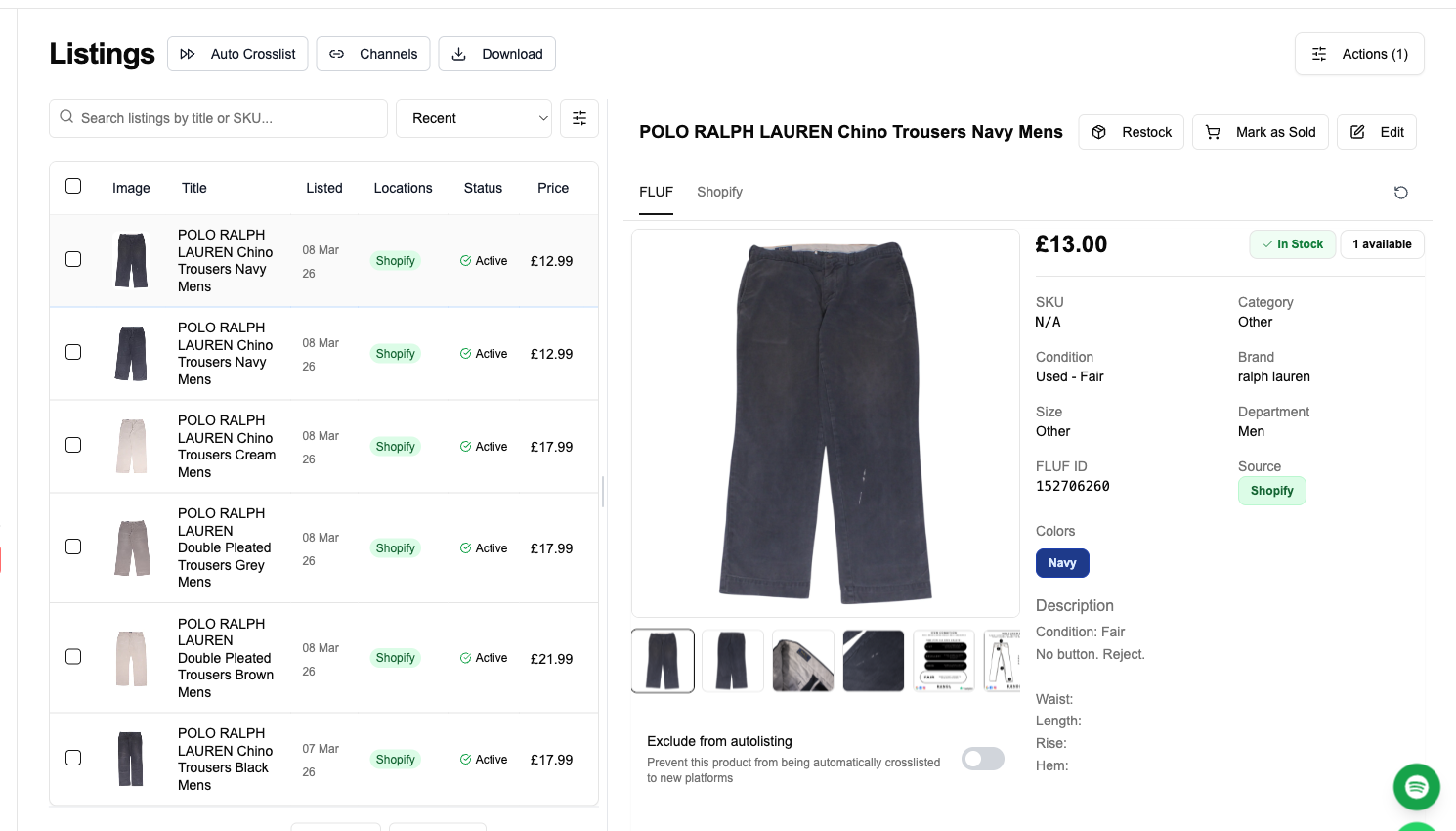
The point of crosslisting is not just to copy a listing — it’s to keep the two in step so you never sell the same item twice. FLUF Connect reads your Marktplaats inventory and creates the listing on Vestiaire Collective, then watches both sides for sales. When an item sells, FLUF marks it sold and removes the counterpart, so you’re never left fielding a buyer for something that’s already gone.
| Capability | Marktplaats (source) | Vestiaire Collective (destination) |
|---|---|---|
| Crosslist — create, update, delete | Yes — live | Yes — live |
| Inventory / mark-as-sold sync | Yes — a Marktplaats sale delists the Vestiaire copy | Yes — a Vestiaire sale syncs back and delists the Marktplaats copy |
| Order sync | Yes | Yes |
| Automated relisting | Not yet for Marktplaats | Yes — keeps listings fresh |
| Offer management | Not yet for Marktplaats | Yes — auto-handles buyer offers |
Two of those are worth dwelling on. Vestiaire buyers negotiate constantly, so FLUF’s offer management can handle incoming offers to your rules on the Vestiaire side — useful on a platform where back-and-forth on price is the norm. And FLUF’s automated relisting keeps your Vestiaire listings fresh without manual effort. Both run on the Vestiaire destination even though Marktplaats itself doesn’t yet support them — the destination does the work the source can’t.
How Crosslisting from Marktplaats to Vestiaire Collective Works
The flow is designed to take minutes, not an afternoon:
- Connect both channels. Link Marktplaats and Vestiaire Collective to FLUF Connect through the browser extension — no re-typing credentials, no re-uploading anything.
- Import your Marktplaats inventory. FLUF reads your existing Marktplaats listings — titles, descriptions, photos and prices — into one dashboard.
- Pick your designer pieces. Select the luxury and designer items that fit Vestiaire’s catalogue; everything general stays on Marktplaats.
- FLUF maps the fields and converts the price. Brand, category, condition, photos and description map across automatically, and your euro price converts to the buyer’s currency — you keep control to set a premium that reflects the global audience.
- Crosslist and sync. The Vestiaire listings go live, and from then on FLUF keeps stock in step: a sale on either side takes the other copy down, relisting keeps items fresh, and offer management handles negotiations.
Which Marktplaats Items Belong on Vestiaire Collective?
The answer is narrow but valuable: genuine designer and luxury fashion. Handbags, shoes, designer clothing, watches and accessories from accepted luxury brands are exactly what Vestiaire’s audience comes for, and they’re the items that suffer most on Marktplaats — under-seen by a general audience and undervalued without authentication. Everything else stays put. Fast-fashion brands are banned on Vestiaire, and general goods, electronics and everyday second-hand belong on Marktplaats or a fashion-broad channel like Vinted. FLUF’s per-item channel selection means you point only your designer stock at Vestiaire and let the sync handle the rest — so the platform’s higher fees only ever apply to the items where its global luxury audience earns them back.
How Vestiaire Authentication Works for the Seller
Authentication is the mechanism that lets Vestiaire support prices a general marketplace can’t, so it’s worth understanding what it asks of you. When a designer item sells, Vestiaire offers two routes depending on the piece and its value. On lower-value items it often uses direct shipping, where you post the item straight to the buyer and the sale completes after their inspection window closes. On higher-value designer goods, the item is routed through one of Vestiaire’s authentication hubs first: expert teams physically inspect it — checking construction, hardware, stitching, serial details and overall condition against the brand’s standards — and only once it passes that quality control is it released to the buyer and your payout issued. For the seller, that means accurate descriptions and honest condition grading matter more than on a casual classifieds listing, because the item will be examined by specialists, not just a buyer. The payoff is trust: buyers pay premium prices precisely because they know the platform stands behind the authenticity of what they’re buying, which is the one thing a Marktplaats luxury listing can never promise.
This is also where the practical contrast with Marktplaats is sharpest. On Marktplaats a four-figure handbag depends entirely on a local buyer’s willingness to trust a stranger and meet in person; the pool of buyers who will do that for a high-value item is small, and the price reflects that caution. Vestiaire removes the trust problem from the equation, which is what unlocks a genuinely global pool of buyers willing to transact at full value. FLUF Connect carries your photos, brand, condition and description across when it builds the Vestiaire listing, so the item arrives already well-documented for the buyers — and the authenticators — who will scrutinise it.
Pricing and Selling Designer Pieces to a Global Market
Pricing on Vestiaire works differently from a quick local sale, and the difference favours genuine designer goods. Because the audience is worldwide and specifically hunting luxury resale, comparable pieces tend to anchor at international resale values rather than whatever a local Dutch buyer happens to offer — so a bag, a pair of designer shoes or a coat from an accepted brand can realistically command more than it would on Marktplaats. Negotiation is part of the culture: buyers send offers, and sellers counter, which is exactly why FLUF’s offer management on the Vestiaire side is useful — it can field that back-and-forth to your rules instead of leaving you to refresh the app. It also pays to know what Vestiaire will and won’t take. Its catalogue is curated to designer, luxury and accepted-brand fashion — handbags, shoes, ready-to-wear, watches and accessories — and fast-fashion labels are refused outright. That restriction is a feature for the crosslister: it concentrates a buyer base that’s there to spend on exactly the kind of pieces that languish, underseen and undervalued, in a general Marktplaats feed.
The strategy that follows is simple. Point only your genuine designer and luxury stock at Vestiaire, where authentication and a global audience earn back the 12% commission several times over, and keep everyday clothing, fast fashion and general goods on Marktplaats or a mass-market fashion channel like Vinted. Used this way, Vestiaire becomes the high-value end of your selling — slower to settle than a local sale, but reaching buyers and prices that the Netherlands-only Marktplaats audience structurally can’t. FLUF’s per-item channel control is what makes that split effortless: you decide once where each item belongs, and the sync keeps every copy honest from there.
A Note on Tax (DAC7)
Both Marktplaats and Vestiaire Collective operate under the EU’s DAC7 rules, which require marketplaces to report sellers who exceed 30 sales or €2,000 in a calendar year to the tax authority (Vestiaire Collective — DAC7 reporting). Selling your own pre-owned luxury items is generally not taxable, but trading for profit is. Crosslisting doesn’t change your obligations — each platform reports independently — it just means keeping one tidy record across both. This is general guidance, not tax advice.
Is It Worth Crosslisting Marktplaats to Vestiaire Collective?
For anyone selling genuine designer fashion, yes. Marktplaats gives you fast local liquidity; Vestiaire Collective gives you a global luxury audience and an authentication guarantee that together support prices a general Dutch listing can’t reach. The 12% commission only applies to items that actually sell on Vestiaire, and on authenticated designer goods that audience typically earns the fee back several times over. The only real cost of adding it is the listing work — and that’s exactly what FLUF Connect automates. Plans start at £9/month (Starter) and every plan is paid; crosslisting and inventory sync are included in every plan, and relisting and offer management from Seller upwards, not a paid add-on. See full pricing or start from the crosslisting dashboard.
Vestiaire Collective’s Reach Beyond the Netherlands
The strategic reason to add Vestiaire is geography paired with trust. Marktplaats stops at the Dutch border and offers no authentication; Vestiaire Collective is a global luxury-resale platform that ships across dozens of countries and verifies designer items for buyers who would never wire four figures to a stranger on a classifieds site. For a Dutch seller, that means a single crosslisted designer piece can be discovered — and trusted — by a luxury buyer anywhere in the world. A bag with a thin, cautious local audience in the Netherlands may have serious international demand once it’s visible globally and backed by authentication, and that combination of worldwide reach and verified trust is what makes Vestiaire the highest-value channel most Marktplaats luxury sellers can add.
Why a Curated Luxury Platform Outsells a Local Listing
It helps to understand why a dedicated pre-loved luxury destination realises so much more value than a general classifieds ad for the same designer item. Part of it is the buyer’s mindset. Someone browsing Vestiaire is a deliberate luxury shopper — often hunting a specific brand, a discontinued style, or an archive piece they can no longer buy new — and that intent supports prices a passer-by on a general site never would. Part of it is provenance and presentation: a curated platform lets a coveted handbag sit alongside comparable pieces with proper brand attribution, measurements and condition grading, so it’s judged against its true market rather than the random mix of a local feed. And part of it is the broader shift toward circular, pre-owned consumption — buyers increasingly choose authenticated second-hand luxury for sustainability as much as savings, and a platform built around that ethos draws exactly the audience willing to pay for a verified pre-loved piece.
Compared with full-service consignment alternatives — where a third party photographs, lists, stores and ships on your behalf in exchange for a much larger cut — selling directly on Vestiaire keeps far more of the sale in your pocket, at the cost of doing the listing work yourself. That trade-off is precisely where crosslisting tips the balance: the listing work is the only real downside of the direct route, and it’s exactly what FLUF Connect automates by carrying your item across from Marktplaats in one motion. You get the higher take-home of self-listing without the hours it normally demands. The result is a clean division of labour across your channels: Marktplaats handles the fast, local, general-goods turnover it’s built for, while Vestiaire becomes the patient, premium, global outlet where your genuine designer pieces reach the buyers — and the prices — they deserve. Run together through FLUF, the two cover the full spread of what a wardrobe clear-out or a reselling business actually holds, from a €15 jacket sold locally tomorrow to a four-figure bag authenticated and shipped to a collector overseas next week.
Sources & Verification
Frequently Asked Questions
Vestiaire Collective charges a seller commission rather than a listing fee — listing is at no cost. The standard commission is 12% of the final sale price, with a fixed fee of about $10 on lower-priced items and a 3% payment-processing fee on top, and a minimum listing price applies. On genuine designer goods, the platform's global luxury audience and authentication typically lift the achievable price well above a fee-free local listing.
No. Vestiaire Collective is designer and luxury fashion only — handbags, shoes, designer clothing, watches and accessories from accepted brands. Fast-fashion labels are banned, and general goods, electronics and everyday second-hand belong on Marktplaats or a fashion-broad channel like Vinted. FLUF Connect lets you point only your designer stock at Vestiaire and keep everything else on Marktplaats.
Yes. FLUF Connect keeps both sides in sync: when an item sells on Vestiaire Collective, FLUF marks it sold and removes the Marktplaats copy, and a Marktplaats sale delists the Vestiaire copy. That two-way inventory sync is what stops you accidentally selling the same item twice.
Yes. Vestiaire Collective offers physical authentication of designer items by expert teams across international hubs — a digital check followed by a physical inspection and quality control. That authentication is what builds the trust high-value resale depends on, and it's a key reason a designer piece can command more on Vestiaire than on a general marketplace like Marktplaats.
Yes — both Marktplaats and Vestiaire Collective connect to FLUF Connect through the browser extension, which is how FLUF reads your inventory and creates listings. Once connected, the crosslisting, inventory sync, relisting and offer management run for you.
Yes. Vestiaire buyers negotiate constantly, so FLUF's offer management can handle incoming offers to your rules on the Vestiaire side, and automated relisting keeps your listings fresh without manual effort. Marktplaats itself doesn't yet support these through FLUF, but the Vestiaire destination does.
For genuine designer fashion, yes. Marktplaats reaches only Dutch buyers and offers no authentication, while Vestiaire Collective reaches a global luxury audience and verifies designer items — together supporting prices a general local listing can't. The 12% commission only applies to items that actually sell on Vestiaire, and the only real cost of adding it is the listing work, which FLUF automates. Plans start at £9/month (Starter) and every plan is paid.