Crosslist from Designer Wardrobe to Vinted — Automatically
List your Designer Wardrobe items on Vinted in minutes — FLUF Connect syncs everything and protects you from overselling, from £19/month.



- Designer Wardrobe reaches buyers in New Zealand and Australia only; Vinted opens up the UK, much of the EU and the US — crosslisting the two is a strong audience-diversification move.
- Designer Wardrobe charges sellers a success fee ($4.95 under $40, 12.95% above, capped at $249); Vinted charges sellers nothing and instead bills buyers a Buyer Protection fee.
- FLUF Connect needs no extension for Designer Wardrobe. Use the FLUF browser extension for Vinted.
- FLUF Connect keeps both channels in sync: it detects sales and can auto-mark items as sold on the other channel to prevent overselling.
- On the Vinted side you also get automated relisting and offers; these aren’t available for Designer Wardrobe.
- Plans start at £9/month with automation included from Seller upwards — no free plan or trial.
Why sell on both Designer Wardrobe and Vinted?
If you sell preloved and designer fashion, Designer Wardrobe and Vinted are two of the most useful resale platforms you can list on — but they barely overlap. That’s exactly why running both makes sense.
Designer Wardrobe is a New Zealand-born marketplace for designer and contemporary preloved fashion. It launched in NZ in 2014, expanded into Australia in 2024, and today has more than 325,000 users and over a million items sold, with curated demand for brands like Zimmermann, Rebecca Vallance, Acne Studios and Levi’s. The catch: its audience is entirely within New Zealand and Australia. If you only list on Designer Wardrobe, your buyer pool is capped at the Tasman.
Vinted is the opposite story on reach. It crossed 100 million registered users in 2023 and in 2025 reported €10.8 billion in gross merchandise value across more than 26 markets, spanning the UK, France, Germany, the Netherlands, Belgium, Spain, Italy, Portugal, Poland and beyond, plus the US. It’s a volume-driven marketplace where the seller keeps the listed price.
Put them together and you cover your home AU/NZ designer audience and a vast European and US buyer base — without choosing one over the other. The same item that might wait weeks for the right Auckland or Melbourne buyer on Designer Wardrobe could sell to someone in Manchester, Lyon or Berlin via Vinted.
The two platforms also attract different shoppers, and that is part of the appeal. Designer Wardrobe is curated and brand-led: its buyers browse for recognisable labels and are comfortable paying for them. Vinted skews towards everyday volume across a far wider price range and spread of categories. Splitting inventory across the two usually means each item finds its most natural audience rather than competing for attention in one crowded place.
There is also a seasonality benefit that is easy to overlook. New Zealand and Australia run on opposite seasons to the UK and most of Europe, so a summer dress that has gone quiet on Designer Wardrobe heading into the southern winter may land in peak demand on Vinted, where buyers are heading into the northern summer. Listing on both keeps the same stock commercially relevant across more of the calendar instead of sitting idle between seasons.
Fee structures are completely different
The two platforms also monetise in opposite ways, which affects how you price. Designer Wardrobe takes a seller-side success fee: a flat $4.95 on sales under $40, or 12.95% on sales of $40 and above (capped at $249), calculated on the item price plus shipping, with a payment fee on top — 3% + 49c for credit/debit cards, 1.45% for online EFTPOS over $50, or 4.95% for Buy Now Pay Later. Listing is always free.
Vinted flips this: sellers pay no listing fee, no commission and no payment-processing fee — you receive 100% of your listed price. Instead, the buyer pays a Buyer Protection fee at checkout (roughly 5% plus a small fixed amount), which covers refunds for items that arrive damaged, not as described, or never arrive, plus secure escrow payment and dispute support. Because the fee burden sits with the buyer, your headline Vinted price can often be a little higher without hurting your take-home.
The practical takeaway is not to copy a Designer Wardrobe price straight onto Vinted, even after converting the currency. On Designer Wardrobe the success fee is netted out of your side, so your take-home is the listed price minus that fee; on Vinted your take-home is the listed price, because the fee sits with the buyer. Working backwards from the take-home you actually want — rather than from the original sticker — is the cleaner way to price each listing for its destination.
Audience comparison
| Designer Wardrobe | Vinted | |
|---|---|---|
| Primary markets | New Zealand & Australia only | UK, much of EU (FR, DE, NL, BE, ES, IT, PT, PL and more) + US |
| User base | 325,000+ users | 100M+ registered users (2023) |
| Strongest categories | Designer & contemporary preloved womenswear (Zimmermann, Rebecca Vallance, Acne Studios) | Everyday & mid-market fashion, kids, menswear, high volume |
| Seller fees | $4.95 under $40 / 12.95% over $40 (cap $249) + payment fee | £0 — no seller fees |
| Who pays protection | Built into seller success fee | Buyer pays Buyer Protection (~5% + fixed) |
| Photos per listing | Multiple | Up to 20 |
| Payout timing | ~24h after delivery confirmed; withdraw free | After buyer confirms / protection window closes |
| Listing currency | NZD / AUD | GBP / EUR / USD |
| Buyer mindset | Brand-led, designer-focused, willing to pay for labels | Bargain-led, high volume, broad price range |
| Connection method (via FLUF Connect) | No browser extension needed. | App login through the browser extension |
A community note: Designer Wardrobe sellers should remember that earnings sit as “Pending” through a post-delivery inspection window before they can be withdrawn — so cash flow is slower than an instant payout. And on Vinted, a recurring frustration is that listings get buried in search after a couple of weeks with no views, which is why relisting matters. FLUF Connect’s automation directly addresses the Vinted visibility problem (more below).
How to crosslist from Designer Wardrobe to Vinted with FLUF Connect
Crosslisting with FLUF Connect means your Designer Wardrobe catalogue becomes the source, and Vinted becomes a destination you push to in bulk. Here’s the flow:
- Create your FLUF Connect account. Sign up at fluf.io and choose a plan (see pricing). You’ll land in the dashboard where channels are connected and managed.
- Connect Designer Wardrobe. Follow the prompts to import your listings, photos, titles, descriptions, prices and categories. No extension is needed.
- Connect Vinted via app login. Vinted is an extension-first channel: install the FLUF Connect browser extension and sign in to your Vinted account through it. This authorises FLUF Connect to publish, relist and manage listings on your behalf.
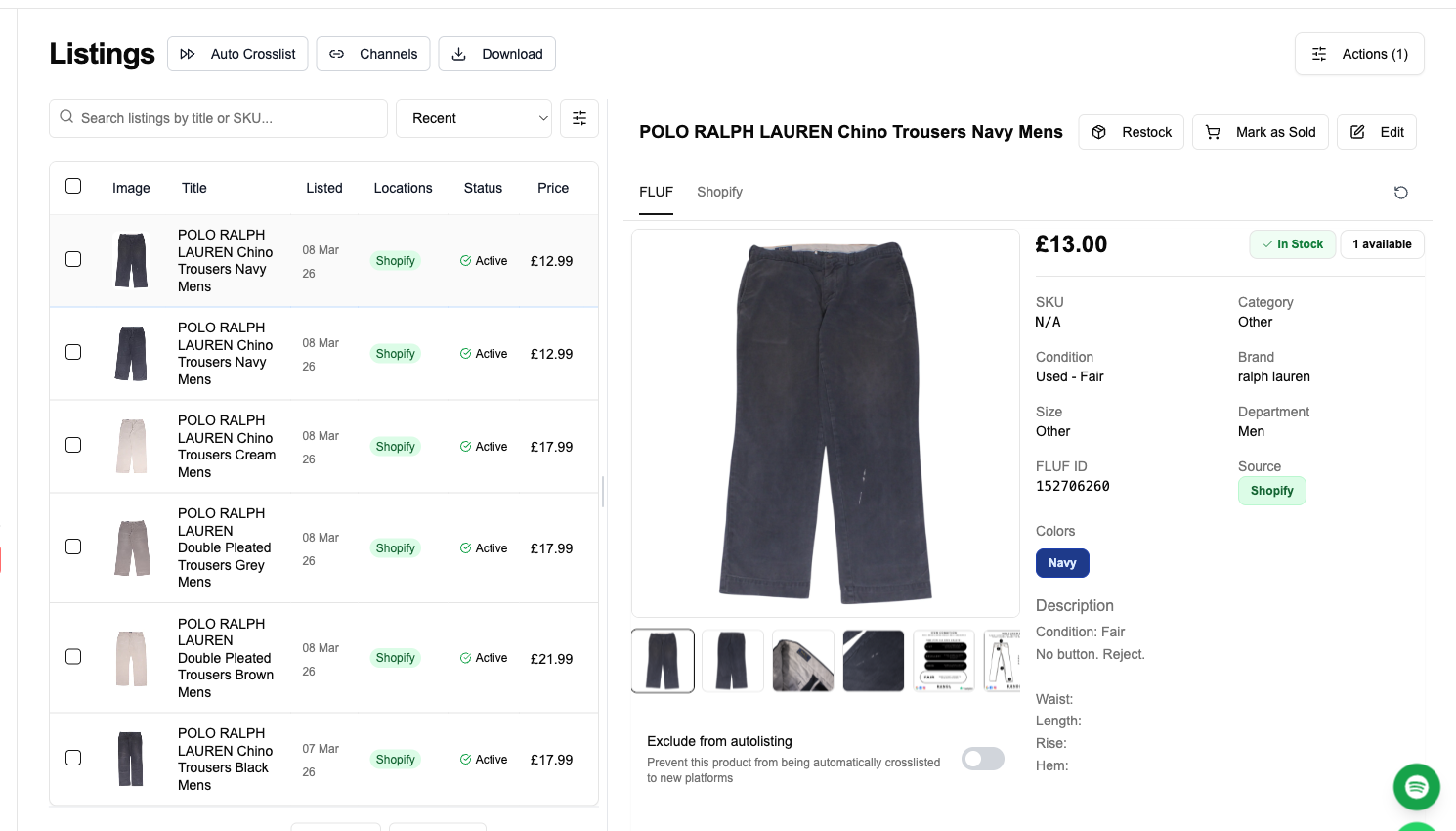
- Review and select the items to crosslist. In the listings view, pick the Designer Wardrobe items you want on Vinted. You can select a single item or a whole batch.
- Map and adjust before publishing. FLUF Connect maps each Designer Wardrobe category to the closest Vinted catalogue category and carries your title, description and photos across. Because Designer Wardrobe prices are in NZD/AUD and Vinted is in GBP/EUR/USD, review your prices so they suit UK/EU/US buyers.
- Push to Vinted. Confirm, and FLUF Connect creates the listings on Vinted. From here, inventory sync and (on the Vinted side) relisting and offers run automatically.
Designer Wardrobe keeps working without an open browser. Keep the FLUF extension signed in and active for Vinted.
What to check before you bulk-publish
Pushing a single test item first is the simplest way to de-risk a large batch. Crosslist one representative listing to Vinted, open it there, and confirm the category, brand, size and condition all landed where you expected before you commit fifty more. A few minutes here saves a lot of editing later. Run through this short checklist:
- Price. Confirm the figure makes sense in GBP/EUR/USD for a Vinted buyer, not just a converted NZD/AUD number — and that it reflects the take-home you actually want given the fee differences above.
- Category. Designer Wardrobe’s taxonomy is broad; make sure the item landed in the right Vinted node rather than a near-miss parent category.
- Brand. Niche or AU/NZ-only labels may not exist in Vinted’s brand list and can need a manual selection or a close substitute.
- Size. AU/NZ sizing does not always map cleanly to Vinted’s size system, so this is the field most worth a second look.
- Photos. Verify the images came across and are in a sensible order; the lead photo does most of the selling on a feed-driven marketplace.
Pricing for the destination market
Beyond the fee mechanics, you are pricing for a different shopper. A designer piece that commands a premium from Designer Wardrobe’s brand-led audience may need a keener number to stand out among Vinted’s bargain-led listings — or, for a sought-after label, may hold its value thanks to the far larger buyer pool. The point is to price each Vinted listing against comparable Vinted listings rather than reusing the Designer Wardrobe figure. And because Vinted buyers can make offers, leaving a little headroom lets you accept a sensible offer without dropping below your floor.
What transfers — field & category mapping
Not every field maps one-to-one between a designer-focused AU/NZ marketplace and a high-volume European one. Here’s an honest breakdown of what comes across cleanly, what needs a glance, and what doesn’t apply.
Legend: ✅ transfers automatically ⚡ transfers, review recommended ⚠️ partial / manual check ❌ not transferred / not supported
| Field | Status | Notes |
|---|---|---|
| Photos | ✅ | Imported and uploaded; Vinted accepts up to 20 per listing. |
| Title | ✅ | Carried across; Vinted has no hard character cap. |
| Description | ✅ | Transferred in full. |
| Price | ⚡ | Numeric value carries over, but NZD/AUD ≠ GBP/EUR/USD — review for the destination market. |
| Brand | ⚡ | Matched to Vinted’s brand list where available; check niche/AU-NZ labels. |
| Category | ⚡ | Mapped to the closest Vinted catalogue node; verify before publishing. |
| Size | ⚠️ | AU/NZ sizing may need aligning to Vinted’s size system. |
| Condition | ⚡ | Mapped to Vinted’s condition scale. |
| Vinted offers / relisting | ✅ | Available on the Vinted side via FLUF Connect (see automation). |
Category mapping examples
| Designer Wardrobe category | Mapped Vinted category | Status |
|---|---|---|
| Women’s Dresses | Women → Clothing → Dresses | ✅ |
| Women’s Designer Handbags | Women → Accessories → Bags | ⚡ |
| Women’s Heels / Shoes | Women → Shoes → Heels | ⚡ |
| Men’s Jackets & Coats | Men → Clothing → Coats & jackets | ✅ |
| Women’s Knitwear & Jumpers | Women → Clothing → Jumpers & sweaters | ✅ |
| Women’s Accessories (belts, scarves) | Women → Accessories → relevant sub-node | ⚡ |
| Kids & Baby clothing | Kids → Clothing → by age/type | ⚡ |
Designer Wardrobe’s taxonomy is relatively coarse and designer-led, while Vinted’s catalogue is deep and granular, so a quick category check before you publish a batch avoids items landing in the wrong node.
The mismatch runs in a predictable direction: Designer Wardrobe groups items into broader buckets and Vinted breaks the same space into narrower ones, so the mapping is usually a one-to-many decision and FLUF Connect picks the closest node. That is why well-defined categories (dresses, coats and jackets, knitwear) map cleanly, while broader groupings (handbags, accessories, shoes by heel type) are flagged for a quick review.
Two fields deserve particular attention because they are the most marketplace-specific. Brand is matched against Vinted’s brand list, which is extensive but not infinite — well-known international labels resolve automatically, whereas smaller AU/NZ or very new labels may need a manual choice or a close alternative. Size is the other: AU and NZ sizing does not line up perfectly with Vinted’s size systems, so it pays to confirm that an AU 12 reads as the size a UK or EU buyer will recognise. Getting both right is also what keeps your listing surfacing correctly in Vinted’s filtered search, where most buyers browse.
Inventory sync & overselling protection
The single biggest risk of listing one physical item in two places is selling it twice. FLUF Connect’s inventory sync exists to stop that. Both Designer Wardrobe and Vinted support order sync and mark-as-sold in FLUF Connect, which means the protection works in both directions for this pair.
| What’s monitored | Designer Wardrobe | Vinted |
|---|---|---|
| Sale detection (order sync) | ✅ | ✅ |
| Auto mark-as-sold on the other channel | ✅ | ✅ |
| Relisting | ❌ | ✅ |
| Offers | ❌ | ✅ |
Overselling callout: when your designer coat sells on Vinted to a buyer in Paris, FLUF Connect detects that sale and automatically marks the matching Designer Wardrobe copy as sold — and vice versa when it sells on Designer Wardrobe in Wellington. You don’t have to remember to log in and pull the duplicate down by hand, which is precisely where manual two-platform sellers get caught out and end up cancelling on a buyer.
It is worth being clear about what “both directions” buys you, the most valuable part of running this pair. Some channels can only be written to, not read from, so a sale there goes unnoticed. Designer Wardrobe and Vinted both support order sync and mark-as-sold through FLUF Connect, so neither is a blind spot: a sale on either is detected and the twin taken down on the other. That symmetry is what makes it safe to leave both listings live at once.
Keep the FLUF extension signed in and active for Vinted sale detection. Designer Wardrobe sync does not need an open browser.
Before & after: the workflow compared
Here’s what running Designer Wardrobe and Vinted side by side actually feels like, with and without FLUF Connect.
| Task | Manual | With FLUF Connect |
|---|---|---|
| List one item on Vinted from a Designer Wardrobe listing | Re-photograph or re-download, retype title/description, re-pick category, set price — ~5–10 min/item | Select & push — under a minute per item, bulk-selectable |
| List 50 items | 4–8+ hours of repetitive data entry | Select the batch, review, publish — minutes |
| Item sells on one platform | Remember to log in to the other and delete it manually | Auto-detected and marked sold — no action needed |
| Keep Vinted listings visible | Manually delete & re-upload each stale item | Automated relisting refreshes them |
| Managing Vinted offers | Check the app, respond by hand | Handled inside FLUF Connect |
| Knowing what’s live where | Cross-reference two apps and a spreadsheet | Single dashboard shows status per channel |
| Currency & price review | Convert and retype every figure by hand | Value carried over ready to adjust per market |
The headline saving isn’t just the listing time — it’s eliminating the mental overhead of tracking which item is live where, which is what makes most people give up on multi-platform selling.
That overhead compounds as inventory grows. Listing ten items in two places by hand is manageable; doing it for two hundred while keeping each pair in sync is where most sellers retreat to a single platform and leave the second audience untapped. Automating the repetitive parts is what keeps a two-channel operation viable at scale.
Common mistakes to avoid
- Copying prices across unchanged. A converted NZD/AUD figure ignores both the currency and the different fee structures; price each Vinted listing for its own market and buyer.
- Letting the Vinted extension fall out of session. Because Vinted connects via app login in the extension, a signed-out extension can interrupt publishing and sale detection on the Vinted side — check it is active before a big batch.
- Skipping the category and size review. These are the two fields most likely to need a human glance; publishing a batch without checking them is the usual cause of items landing in the wrong place or failing to show in filtered search.
- Expecting relisting or offers on Designer Wardrobe. Those are Vinted-side features only — Designer Wardrobe supports order sync and mark-as-sold, but not relisting or offers through FLUF Connect.
- Not pushing a test item first. One trial listing surfaces any mapping surprises before they are repeated fifty times.
Automation features
Automation in FLUF Connect is included from Seller upwards, not a paid add-on. For the Designer Wardrobe → Vinted pair, the features that apply are:
- Bulk crosslisting — push many Designer Wardrobe items to Vinted at once instead of one at a time.
- Order sync (both channels) — FLUF Connect detects sales on Designer Wardrobe and on Vinted.
- Auto mark-as-sold (both channels) — when an item sells on one, its copy on the other is removed automatically to prevent overselling.
- Automated relisting (Vinted only) — refreshes ageing Vinted listings so they reappear at the top of search and the feed, countering the well-known “buried after two weeks” problem. See auto-relisting. This does not apply to Designer Wardrobe.
- Offers (Vinted only) — manage buyer negotiations on Vinted from within FLUF Connect. Not supported on Designer Wardrobe.
To be clear about the limits: Designer Wardrobe does not support relisting or offers through FLUF Connect — those are Vinted-side capabilities. The crosslist, order-sync and mark-as-sold features work for both.
Of these, automated relisting is the feature sellers feel most directly, because it tackles a problem specific to Vinted. Vinted’s feed and search reward freshness, so a listing live for a couple of weeks without selling quietly sinks out of view even if it is priced well and photographed nicely. Relisting refreshes those ageing items so they resurface near the top, giving them repeated chances to be seen. Doing this by hand means deleting and re-uploading each stale listing — exactly the chore that automation removes. The guide to relisting on Vinted covers why the decay happens and how the refresh counters it.
Offers work on a similar principle. Vinted buyers frequently negotiate, and handling those back-and-forths inside FLUF Connect keeps things flowing without you living in the app. Because both relisting and offers sit on the Vinted side, they pair with the order sync and mark-as-sold that run across both channels — covering the full lifecycle of a listing from publish, through visibility and negotiation, to the sale and the automatic takedown of its twin.
If you want to broaden further, the same Designer Wardrobe catalogue can feed other destinations — see the guide on selling on multiple platforms.
Pricing
FLUF Connect plans start at £9/month, and automation — relisting, offers, bulk operations and inventory sync — is included from Seller upwards rather than charged as an add-on. there is no free plan, but every new account gets a 7-day trial for £1.
| Plan | Monthly | Crosslisted products |
|---|---|---|
| Starter | £9/month | Unlimited |
| Seller | £29/month | Unlimited |
| Pro | £99/month | Unlimited |
| Super Seller | Custom pricing — tell us what you need | Unlimited |
Remember these are FLUF Connect’s subscription fees only — separate from each marketplace’s own charges (Designer Wardrobe’s seller success fee, and Vinted’s buyer-paid Buyer Protection fee). Full details are on the pricing page.
Want other Designer Wardrobe pairings? See Designer Wardrobe to eBay and Designer Wardrobe to Shopify.
Sources & verification
- Designer Wardrobe — DW Fees (success fee: $4.95 under $40, 12.95% over $40, cap $249; free listing)
- Designer Wardrobe — Payment Fees (card 3% + 49c; EFTPOS 1.45%; BNPL 4.95%)
- Designer Wardrobe — When do I get paid? (payout ~24h after delivery, free withdrawals)
- Designer Wardrobe — Pending funds / inspection window
- Inside Retail NZ — Designer Wardrobe enters Australia (325,000+ users; 1M+ items sold; brands)
- Vinted Fees 2026 — $0 seller fees explained
- Vinted — Buyer Protection fee
- Vinted — 2025 financial results (€10.8bn GMV, 26+ markets)
- Vinted statistics — 100M+ registered users (2023)
- Vinted — Photos guidance (up to 20 per listing)
- FLUF Connect — How to relist on Vinted (visibility decay)
Related guides
Frequently Asked Questions
FLUF Connect plans start at £9/month on Starter, with Seller at £29/month and Pro at £99/month; every plan is unlimited on listings and marketplaces, and the tiers differ only by how often we check your channels for sales. Every plan includes automation — relisting, offers, bulk operations and inventory sync — as standard. There is no free plan or trial. Note that this is separate from each marketplace's own fees: Designer Wardrobe charges a seller success fee, while Vinted charges buyers a Buyer Protection fee instead of charging sellers.
Yes. FLUF Connect monitors both Designer Wardrobe and Vinted for sales. When an item sells on one platform, FLUF Connect detects the sale and can automatically mark the matching copy as sold on the other so you don't sell the same physical item twice. This two-way order sync and mark-as-sold is included in every plan.
FLUF Connect's order sync picks up the sale on whichever channel it happened, then uses mark-as-sold to remove or close the matching listing on the other channel. This keeps your live inventory accurate across both AU/NZ (Designer Wardrobe) and UK/EU/US (Vinted) and is the main defence against overselling when you list one item in two places.
Once both accounts are connected, crosslisting is a matter of selecting your Designer Wardrobe items and pushing them to Vinted in bulk — typically minutes for a batch rather than the 5–10 minutes per item it takes to retype each listing manually. FLUF Connect maps your titles, descriptions, photos, prices and categories automatically.
Yes. FLUF Connect supports many marketplaces including eBay, Depop, Etsy, Shopify, Vestiaire Collective and more. You can crosslist your Designer Wardrobe inventory to several destinations at once — see the Designer Wardrobe to eBay and Designer Wardrobe to Shopify guides for other Designer Wardrobe pairings.
Designer Wardrobe operates only in New Zealand and Australia, so your listings there are in NZD/AUD, while Vinted prices are in GBP, EUR, USD and other local currencies depending on the market. FLUF Connect carries your numeric price across when you crosslist; because exchange rates and each market's pricing norms differ, it's worth reviewing and adjusting your Vinted prices after import so they make sense for UK, EU and US buyers.
Yes — Vinted supports automated relisting through FLUF Connect, which refreshes older listings so they reappear near the top of search and the main feed. Relisting is not available for Designer Wardrobe, so it applies to the Vinted side of this pair only. Relisting is included in every plan.
Yes, FLUF Connect supports offers on Vinted, so you can manage buyer negotiations as part of your workflow. Offers are not supported on Designer Wardrobe, so this feature applies to your Vinted listings only.
Connect both from the dashboard. Designer Wardrobe needs no browser extension; use the FLUF extension for Vinted.
Yes. FLUF Connect transfers your photos, titles, descriptions and prices, and maps your Designer Wardrobe category to the closest Vinted catalogue category. Vinted allows up to 20 photos per listing, so most Designer Wardrobe galleries import in full. It's always worth a quick check of the mapped category and any size attributes before publishing.