
Crosslist from Designer Wardrobe to Etsy — Automatically
Crosslist genuine vintage designer pieces from Designer Wardrobe to Etsy's global marketplace — synced inventory, automated mark-as-sold, and an honest take on Etsy's vintage-only resale rule.



Key takeaways
- FLUF Connect crosslists from Designer Wardrobe to Etsy. Neither channel needs a browser extension.
- Honesty first: Etsy only allows handmade items, craft supplies, and vintage items at least 20 years old. Ordinary preloved designer clothing — the staple of Designer Wardrobe — is generally not eligible. The realistic Designer Wardrobe → Etsy use case is genuine vintage designer pieces.
- Reach: Designer Wardrobe is a New Zealand and Australia marketplace; Etsy is global with 86.5 million active buyers in Q4 2025.
- No overselling: FLUF Connect detects sales on both channels (order sync) and automatically marks the matching listing as sold on the other — critical for one-off vintage garments.
- Pricing: Plans start at £9/month (Starter). Automation is included from Seller upwards, not a paid add-on.
1. Why sell on both Designer Wardrobe and Etsy?
Designer Wardrobe is one of the largest preloved and designer fashion marketplaces in New Zealand and Australia. Founded in 2014, it has grown to over 325,000 active members facilitating more than NZ$1.6 million in transactions every month, with strong demand for brands like Zimmermann, Aje, Shona Joy, Kowtow and Bec + Bridge. It is a focused, fashion-only audience in two markets: New Zealand and Australia.
Etsy is a very different proposition — a global marketplace that reported 86.5 million active buyers in Q4 2025. But Etsy is not a general resale platform, and this is the single most important thing to understand before crosslisting between these two channels.
The honest constraint: Etsy is vintage-only for resale
Under Etsy’s Seller Policy, everything listed must fall into one of three buckets: handmade items, craft supplies, or vintage items that are at least 20 years old. Reselling mass-produced or modern secondhand goods is not permitted. As Etsy’s help centre puts it, vintage items can be listed under the “handpicked by a seller” category only when they are genuinely 20+ years old.
This means the bulk of a typical Designer Wardrobe wardrobe — current-season Zimmermann, last year’s Aje, a barely-worn pair of contemporary designer boots — is generally not eligible for Etsy. Listing modern preloved clothing on Etsy risks listing removal and account penalties. So the realistic, policy-compliant Designer Wardrobe → Etsy workflow is narrow but valuable: genuine vintage designer pieces that are 20 years old or more. A 1990s Prada slip dress, an early-2000s archive Helmut Lang jacket, vintage Burberry trench — these are exactly what Etsy’s vintage buyers come for, and they often command a premium on Etsy that they would not on a domestic resale app.
If you stock genuine vintage alongside contemporary preloved, crosslisting lets you route the vintage subset to a worldwide audience of collectors while keeping your modern stock on Designer Wardrobe where it belongs. FLUF Connect makes that routing fast, but you remain responsible for ensuring each item you push to Etsy complies with Etsy’s policy.
How to tell if a designer piece is genuinely vintage (20+ years)
Because the viability of this channel pair rests on Etsy’s 20-year threshold, date a garment confidently before you push it — “it looks old” is not a defence if Etsy reviews your shop. The practical signals seasoned vintage sellers rely on, none requiring expensive authentication, are:
- Care and composition labels. Fibre-content and care-symbol regulations have changed over the decades, so the wording, layout and symbols on a label often bracket an era. No care symbols at all, or older country-of-origin phrasing, frequently predates modern labelling.
- Brand logos and wordmarks. Houses like Burberry, Prada and Helmut Lang have all revised their logos and neck-label typography over time. A logo matching a brand’s 1980s or 1990s identity rather than its current one is strong evidence of age — cross-reference against archival photos before committing to a decade.
- Construction and hardware. Metal zips, union-made tags, half-canvas tailoring and older fastening hardware point away from contemporary fast production.
- Provenance. A receipt, lookbook or dated paperwork is the cleanest justification for a vintage listing — keep it.
When dating an item, round down, not up: a piece you believe is “early 2000s, maybe 2003” is a borderline case to treat conservatively. Etsy’s 20-year line is a hard cut-off, so a garment that is genuinely 18 or 19 years old does not belong on Etsy yet — it belongs on Designer Wardrobe.
Fees and reach at a glance
The two platforms also charge very differently. Designer Wardrobe takes a success fee only when an item sells — a flat $4.95 under $40, or 12.95% above $40 (capped at $249), applied to the final value including shipping. Etsy charges per listing and per sale: a $0.20 listing fee, a 6.5% transaction fee, and payment processing (4% + £0.20 for UK sellers, 3% + $0.25 for US sellers), plus Offsite Ads of 12% or 15% on attributed orders.
| Attribute | Designer Wardrobe | Etsy |
|---|---|---|
| Geographic reach | New Zealand & Australia only | Global |
| Active buyers | 325,000+ members (Power Retail) | 86.5 million active buyers, Q4 2025 (Etsy investor relations) |
| What sells best | Contemporary & preloved designer fashion (Zimmermann, Aje, Shona Joy, Kowtow) | Handmade, craft supplies, and vintage 20+ years old — incl. vintage designer fashion |
| Resale eligibility | All preloved fashion welcome | Vintage only (20+ years) for resale (Seller Policy) |
| Seller fee | $4.95 flat under $40, else 12.95% (max $249) (DW Fees) | $0.20 listing + 6.5% transaction + payment processing (Fees policy) |
| Title limit | Standard short title field | 140 characters (Etsy help) |
| Photos per listing | Multiple images | Up to 20 photos + 1 video (Etsy image guide) |
| Payout | To DW Wallet, then withdraw to bank (no withdrawal cost) | Daily / weekly / biweekly / monthly; weekly default (Etsy payments) |
Community pain points worth knowing
- Etsy’s fee stack creeps up. Between the listing fee, 6.5% transaction fee, payment processing and Offsite Ads (which can be mandatory once you cross $10,000 USD in trailing-365-day sales), sellers frequently report effective deductions well above the headline transaction rate. Price your vintage pieces with the full fee stack in mind.
- Designer Wardrobe’s reach is regional. It is excellent in New Zealand and Australia but has no buyer base outside those two markets — which is precisely why routing your genuine vintage to a global platform like Etsy can unlock buyers you would never otherwise reach.
- Etsy’s vintage rule is enforced, not nominal. Sellers who treat the 20-year line loosely risk having listings pulled and, in repeat cases, account-level action. Disciplined vintage sellers benefit: a tightly curated, genuinely-vintage shop earns trust with the collector audience and avoids the churn of removed listings.
- Currency and audience differ. Designer Wardrobe prices in NZD/AUD for a domestic audience; Etsy lists to a global buyer base. Always re-examine the price when it crosses to Etsy.
2. How to crosslist from Designer Wardrobe to Etsy with FLUF Connect
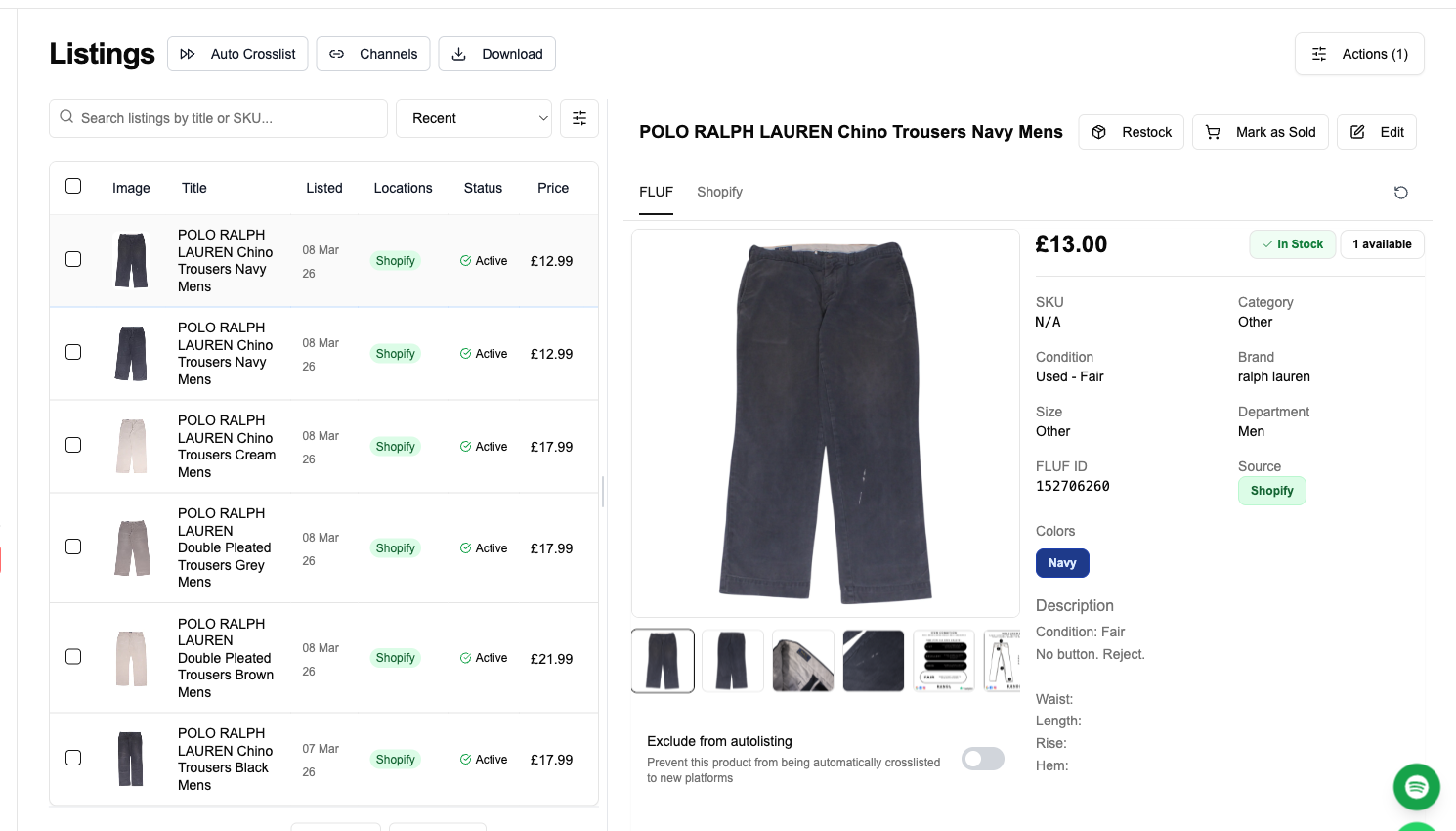
FLUF Connect handles both connections through official, secure channels — there is no browser extension to install for either marketplace.
- Create your FLUF Connect account and choose a plan (from £9/month — see pricing).
- Connect Designer Wardrobe. Follow the prompts to import your listings automatically. No browser extension is needed.
- Connect Etsy. Sign in on Etsy’s page and approve FLUF Connect access.
- Filter to eligible items. Because Etsy is vintage-only for resale, select only the genuine 20+-year-old vintage pieces from your imported Designer Wardrobe inventory. This is a manual, judgement-based step — and an important one.
- Review the mapped fields and category for each item (see the mapping table below), choosing Etsy’s vintage category and adjusting the title to use the full 140-character allowance.
- Push to Etsy. FLUF Connect creates the live Etsy listings and links them to your Designer Wardrobe items so inventory stays coordinated.
For the bigger picture across every supported marketplace, see the crosslisting overview and our guide to selling on multiple platforms.
3. Field & category mapping
FLUF Connect maps your Designer Wardrobe item data onto Etsy’s listing structure automatically, with a review step before anything goes live. The legend below shows how cleanly each field carries across.
Legend: ✅ maps automatically | ⚡ maps with smart assistance | ⚠️ maps but needs your review | ❌ not supported / manual
| Field | Designer Wardrobe → Etsy | Notes |
|---|---|---|
| Title | ⚡ | Carried over and expandable to Etsy’s 140-character limit for keyword-rich vintage titles. |
| Description | ✅ | Transferred in full; add the era/decade for vintage credibility. |
| Photos | ✅ | Images carry across; Etsy supports up to 20 per listing. |
| Price | ✅ | Carried over; review against Etsy’s fee stack and currency. |
| Brand | ✅ | Maps to Etsy’s brand attribute. |
| Category | ⚠️ | Must be placed under Etsy’s vintage category — eligible only for items 20+ years old. Review every item. |
| Vintage / age attribute | ⚠️ | You confirm the item genuinely meets Etsy’s 20-year vintage threshold. |
| Size / measurements | ⚡ | Mapped with assistance; vintage sizing often differs, so verify. |
| Quantity | ✅ | Single-quantity preloved items map cleanly. |
The two fields that carry the most weight on Etsy — and deserve the most attention in the review step — are the category and the vintage / age attribute. Everything else (title, description, photos, price, brand, size, quantity) carries across in a familiar resale shape, but Etsy’s structure makes two demands a domestic resale app does not. First, every resale item must sit beneath the vintage branch of the category tree, never the handmade or craft-supplies branches; FLUF Connect flags this as a review item (⚠️) rather than mapping it silently, because there is no automatic way to know whether a piece truly meets the 20-year threshold — that judgement is yours. Second, the age attribute must be set honestly: Etsy surfaces the era to buyers and collectors filter on it, so an inaccurate decade undermines both credibility and search placement.
It is also worth thinking about how a title and description should change shape on the way to Etsy. On Designer Wardrobe a short, brand-led title works because the audience already knows the labels. On Etsy you have a generous 140-character title field and a global, search-driven audience, so it is worth expanding the title to include the era, the garment type, the brand and a descriptive keyword — for example leading with the decade rather than burying it. Naming the decade explicitly in the description, and noting the construction details that prove age, does double duty: it reassures the buyer and reinforces the vintage credibility that makes the listing compliant in the first place.
Sizing is the field most likely to trip you up
Of the assisted-mapping fields, size deserves special mention. Vintage garments were cut to the sizing conventions of their era and country, which rarely line up with modern Australian, New Zealand, UK or US sizing — a 1990s “size 12” is not a contemporary size 12. This is why FLUF Connect maps size with assistance (⚡) rather than as a clean automatic field: the number from Designer Wardrobe may be technically correct yet misleading to an international buyer. The safest practice for vintage is to lead with actual flat measurements — chest, waist, hip, length, shoulder — taken with a tape measure, and treat the labelled size as secondary context. Measurements travel across every market and every decade; labelled sizes do not.
Category mapping examples
| Designer Wardrobe item | Etsy placement | Eligible? |
|---|---|---|
| 1990s Prada slip dress | Vintage → Clothing → Dresses | ✅ Genuine vintage (20+ yrs) |
| Early-2000s archive Helmut Lang jacket | Vintage → Clothing → Jackets & Coats | ✅ Genuine vintage (20+ yrs) |
| Vintage Burberry trench (1980s) | Vintage → Clothing → Outerwear | ✅ Genuine vintage (20+ yrs) |
| 1990s designer leather handbag | Vintage → Bags & Purses | ✅ Genuine vintage (20+ yrs) |
| Current-season Zimmermann dress | No eligible Etsy category | ❌ Modern resale not allowed |
| Last year’s Aje skirt | No eligible Etsy category | ❌ Under 20 years old |
| Barely-worn contemporary Shona Joy gown | No eligible Etsy category | ❌ Modern resale not allowed |
4. Inventory sync — what stays in sync
For one-off vintage garments, the single most valuable thing crosslisting software can do is stop you selling the same physical item twice. FLUF Connect does this through order sync and automatic mark-as-sold on both channels.
| What syncs | Designer Wardrobe | Etsy |
|---|---|---|
| Crosslist (create listing) | ✅ Source | ✅ Destination |
| Order sync (sale detection) | ✅ | ✅ |
| Mark as sold (auto-delist the duplicate) | ✅ | ✅ |
| Relisting | ❌ Not supported on Designer Wardrobe | ✅ Supported on Etsy |
| Offer management | ❌ Not supported | ❌ Not supported on Etsy (handled on Etsy directly) |
⚠️ Overselling protection
When a vintage piece sells on Designer Wardrobe, FLUF Connect detects the order and automatically marks the matching Etsy listing as sold — and vice versa. Because vintage items are unique and single-quantity, this is the safeguard that keeps two buyers from purchasing the same garment. Learn more on the inventory sync feature page.
Why this matters more for vintage than for ordinary stock
For a seller carrying multiples of a mass-produced item, an overselling slip is an inconvenience — you apologise, restock and ship. For vintage there is no restock. Each archive piece is the only one you have, so selling it twice means cancelling on a real buyer, which on Etsy can mean a poor review, a damaged shop reputation and, in repeat cases, account consequences. The window in which a manual seller is exposed is the gap between a sale landing on one channel and a human noticing it on the other — unforgiving when your two channels sit in different time zones, because a sale can land on Etsy from another hemisphere while you are asleep. Order sync closes that window automatically: FLUF Connect watches both channels for sale events and, the moment one fires, marks the matching listing on the other as sold without waiting for you to intervene.
What does not sync — and why that is fine
To be explicit about the limits: offers are not handled by FLUF Connect on this pair — if a buyer makes an offer through Etsy’s own offer flow, you manage that on Etsy directly. Relisting is supported on Etsy but not on Designer Wardrobe, because Designer Wardrobe does not expose a relist mechanism FLUF Connect can drive. Neither limit undermines the core value of the pairing, because the thing that actually prevents disasters with one-off vintage stock — order sync and automatic mark-as-sold — is fully supported on both channels.
5. Before & after workflow
Before FLUF Connect
- Manually photograph and write each vintage listing twice — once for Designer Wardrobe, once for Etsy.
- Re-key titles, descriptions, prices and categories by hand on each platform.
- Watch both channels constantly so you can pull a listing the moment it sells elsewhere — or risk overselling a one-of-a-kind piece.
- Lose vintage buyers because your stock only ever reaches a New Zealand and Australia audience.
After FLUF Connect
- Designer Wardrobe listings import automatically after connecting.
- Select your genuine vintage pieces, review the mapped fields, and push to Etsy in a few clicks.
- Order sync + automatic mark-as-sold keep both channels coordinated with no manual policing.
- Your archive pieces reach Etsy’s global vintage buyers while your modern stock stays on Designer Wardrobe.
What makes a vintage listing rank and sell on Etsy
Crosslisting puts your archive pieces in front of Etsy’s global vintage audience, but placement still rewards listings that are well built. A few practices, all controlled in the review step, give a vintage listing the best chance of being found and bought:
- Use the full title field. Etsy allows 140 characters; a keyword-rich title naming the decade, garment type and brand gives the listing more ways to match what collectors search for than a short brand-led title.
- State the era explicitly. Vintage buyers shop by decade, so put “1990s” or “early 2000s” in the title and set the age attribute accurately.
- Photograph thoroughly. Etsy supports up to 20 photos plus a video. Detail shots of labels, hardware, construction and any wear convert browsers into buyers — and double as evidence of age.
6. Automation features
FLUF Connect’s automation for this channel pair focuses on the capabilities that genuinely apply to Designer Wardrobe and Etsy:
- Order sync on both Designer Wardrobe and Etsy — FLUF Connect detects when an item sells and propagates that status.
- Automatic mark-as-sold — when an item sells on one channel, FLUF Connect removes the matching copy from the other, your core defence against overselling unique vintage stock.
- Relisting on Etsy — refresh ageing Etsy listings to keep them visible. (Relisting is not available on Designer Wardrobe.) See auto-relisting.
Note the honest limits: FLUF Connect does not manage offers on Etsy (Etsy’s offer flow stays on Etsy), and relisting is not supported on Designer Wardrobe. Automation is included in every FLUF Connect plan.
7. Pricing
FLUF Connect plans start at £9/month (Starter). There is no separate charge for automation; it is included from Seller upwards.
| Plan | Monthly | Crosslisted products |
|---|---|---|
| Starter | £9/month | Unlimited |
| Pro | £29/month | Unlimited |
| Super Seller | Custom pricing — tell us what you need | Unlimited |
These FLUF Connect fees are separate from each marketplace’s own selling fees (Etsy’s $0.20 listing fee, 6.5% transaction fee and payment processing; Designer Wardrobe’s success fee). See full details on the pricing page.
Pricing a vintage piece against Etsy’s fee stack
One of the most common mistakes when moving a piece from Designer Wardrobe to Etsy is carrying the price across unchanged. The two platforms deduct very different amounts, and Etsy’s deductions stack in a way that can surprise a seller used to a single domestic success fee — so work the fee stack into your number before you list rather than discovering it after the sale.
On Etsy you pay a $0.20 listing fee, a 6.5% transaction fee, and payment processing (4% + £0.20 for UK sellers, 3% + $0.25 for US sellers), as set out in the Etsy Fees & Payments Policy. On top of that, Offsite Ads of 12% or 15% apply to attributed orders, and once a shop crosses $10,000 USD in trailing-365-day sales those Offsite Ads become mandatory. Compare that with Designer Wardrobe, where the only deduction is a success fee charged when the item sells — a flat $4.95 under $40, or 12.95% above $40 (capped at $249), per the Designer Wardrobe DW Fees schedule.
The practical implication is that a price netting you a healthy return on Designer Wardrobe may net noticeably less on Etsy once the listing fee, transaction fee, payment processing and any Offsite Ads attribution come off. For genuine vintage this is often workable, because archive designer pieces frequently command a premium from Etsy’s global collector audience that they would not from a domestic shopper — so there is room to set a higher Etsy price that absorbs the heavier fee stack while still leaving you ahead. Do that arithmetic deliberately in the review step. These marketplace fees are also entirely separate from your FLUF Connect subscription; FLUF Connect never takes a cut of your sales.
Explore more
- Crosslist Designer Wardrobe to eBay
- Crosslist Designer Wardrobe to Shopify
- All crosslisting routes
- Guide: sell on multiple platforms
8. Sources & verification
- Etsy seller fees (listing $0.20, 6.5% transaction, payment processing by country, Offsite Ads 12%/15%): Etsy Fees & Payments Policy
- Etsy resale rules — handmade, craft supplies, vintage 20+ years only: Etsy Seller Policy and What Can I Sell on Etsy?
- Etsy active buyers (86.5 million, Q4 2025): Etsy, Inc. Q4 & Full Year 2025 Results
- Etsy photo limit (up to 20) and image guidance: Etsy image requirements
- Etsy payout schedule: How to Receive Your Etsy Payments Deposit
- Designer Wardrobe success fee ($4.95 flat under $40, 12.95% over $40, max $249): Designer Wardrobe DW Fees
- Designer Wardrobe scale and Australia/New Zealand reach (325,000+ members): Power Retail — Designer Wardrobe Launches in Australia