Crosslist from Vakoop to Yaga — Automatically
Cross-post your Vakoop listings to Yaga and reach South Africa's fastest-growing preloved-fashion audience — with two-way inventory sync that stops you overselling across both marketplaces.
7 days for £1, then from £9/month.



- Both are South African marketplaces. Vakoop and Yaga both serve buyers in South Africa, so crosslisting from Vakoop to Yaga keeps your audience, currency and delivery inside one market — a clean South Africa-to-South Africa route.
- Yaga is free for sellers. Yaga charges sellers no selling fee or commission; sellers receive 100% of the item price to their Yaga Wallet. The fee is a Buyer Protection charge paid by the buyer (6.5% + R19.90 in South Africa, varying by category and market).
- Two-way overselling protection. FLUF Connect supports order sync and mark-as-sold on both Vakoop and Yaga, so a sale on either side can automatically remove the duplicate on the other.
- Offers on Yaga. FLUF Connect supports offer management on Yaga. Vakoop does not support offers via FLUF Connect.
- How they connect. Vakoop connects without requiring an extension; Yaga connects through the FLUF Connect browser extension.
- No relisting via FLUF Connect. Relisting is not supported through FLUF Connect for either marketplace.
- Pricing. FLUF Connect plans start at £9/month (Starter). Automation is included from Seller upwards. There is no free plan.
1. Why sell on both Vakoop and Yaga?
If you are a South African reseller, the single biggest lever you have is reach. The same jacket, the same pair of sneakers, the same designer bag will sell faster — and often for more — when more buyers see it. Listing on one marketplace caps your audience at that marketplace’s traffic. Listing the same inventory across two means you tap two distinct pools of buyers without buying any more stock.
Vakoop describes itself as South Africa’s agentic AI marketplace for buying and selling preloved goods, spanning fashion, electronics, sneakers, designer bags and more. It is free to list, offers item authentication, buyer protection, secure wallet payments and free delivery, and uses AI to help draft listings from a photo (vakoop.co.za). That makes it a natural home for a broad resale catalogue — it is not limited to fashion.
Yaga is one of South Africa’s fastest-growing marketplaces for new and preloved fashion. It launched in South Africa in early 2020 after piloting in Estonia, and has since become a leading choice for South Africans selling their preloved clothing online (shop.yaga.co.za/about). Yaga also operates in Estonia, Latvia and Kenya, but for the Vakoop-to-Yaga pair the overlapping, relevant audience is South Africa — which is exactly why this pairing works so neatly.
The strategic case is straightforward: Vakoop gives you a broad preloved marketplace with authentication and AI-assisted listing; Yaga gives you a fashion-first audience that is large and growing. Both keep the transaction in South African rand, with South African delivery and South African buyers. You are not navigating cross-border shipping, currency conversion or import duties — you are simply doubling the shop windows your existing stock sits behind.
And the fee comparison is genuinely seller-friendly. Yaga does not charge sellers a selling fee at all — sellers keep 100% of the item price, with the Buyer Protection fee falling to the buyer (Yaga: selling on Yaga). Vakoop advertises free listing too. So the cost of being present on both marketplaces is low; the main thing standing between you and that dual presence is the manual effort of duplicating and then maintaining listings — which is the problem FLUF Connect exists to solve.
The South Africa-to-South Africa overlap, in detail
Most crosslisting routes wrestle with cross-border friction — different currencies, delivery networks and buyer expectations. The Vakoop-to-Yaga route does not. Both marketplaces are anchored in South Africa, so the item you list, the price you set and the buyer who pays all sit inside the same market. When FLUF Connect copies a listing from Vakoop to Yaga, the description, price and delivery assumptions all remain valid — nothing to translate or re-cost. The overlap is in the market, not the audience: the same country, but two largely separate pools of attention — the ideal shape for crosslisting.
Yaga’s audience is what makes this pairing more than a numbers game. As a preloved-fashion specialist, its shoppers arrive already in the mindset of buying second-hand clothing, footwear and accessories — so a vintage denim jacket, barely-worn trainers or a designer handbag lands in front of people who came looking for exactly that. Vakoop, by contrast, gives you breadth across electronics, sneakers, designer bags and more — the natural home for your full catalogue, including non-fashion stock that has no place on Yaga. The two complement rather than duplicate one another, entirely within the South African market.
Audience comparison: Vakoop vs Yaga
| Vakoop | Yaga | |
|---|---|---|
| Primary market | South Africa | South Africa (also Estonia, Latvia, Kenya) |
| Focus | Preloved fashion, electronics, sneakers, designer bags and more | New and preloved fashion |
| Seller selling fee | Free to list (Vakoop) | None — sellers keep 100% of item price (Yaga) |
| Buyer fee | Buyer protection (per Vakoop site) | Buyer Protection: 6.5% + R19.90 (ZA; varies by category/market) |
| Payout | Secure wallet payments | Yaga Wallet → bank payout, no additional cost |
| Scale signal | SA-focused, AI-assisted listing | ~1M+ users; reported ~12M monthly visits across markets |
| Photos per listing | Photo-led, AI drafts from a photo | Up to 6 photos per item (ZA) |
Audience and scale figures for Yaga are company-reported across all its markets, not South Africa alone; see the Sources section for links.
2. How to crosslist from Vakoop to Yaga with FLUF Connect
FLUF Connect connects to each marketplace according to how it’s designed. Some connections are seamless; others require a browser extension. Here is the full flow.
- Create your FLUF Connect account and open the dashboard. This is your single control panel for every marketplace you sell on.
- Connect Vakoop. In FLUF Connect, choose Vakoop and sign in to grant access. FLUF Connect can then read your catalogue securely without you sharing your password.
- Connect Yaga via the browser extension. Install the FLUF Connect browser extension and sign in to Yaga in the same browser. The extension lets FLUF Connect create and manage your Yaga listings within your authenticated session — the standard approach for marketplaces without an open listing API.
- Import your Vakoop catalogue. With Vakoop connected, FLUF Connect pulls in your existing listings — titles, descriptions, photos, prices and categories — so you are working from real data rather than starting from a blank form.
- Select the items to crosslist. Choose the listings you want on Yaga. Because Yaga is fashion-first, this is a good moment to prioritise your clothing, footwear and accessory items.
- Review the mapped fields and category. FLUF Connect maps each Vakoop field to its Yaga equivalent and suggests a Yaga category. Check the mapping (see section 3), adjust the category where needed, and confirm photos fall within Yaga’s limit of up to 6 images.
- Push to Yaga. Send the selected items to Yaga in a batch. The extension creates the listings in your Yaga shop.
- Turn on sync. With both channels connected, FLUF Connect keeps order status aligned so a sale on one side can remove the copy on the other (section 4).
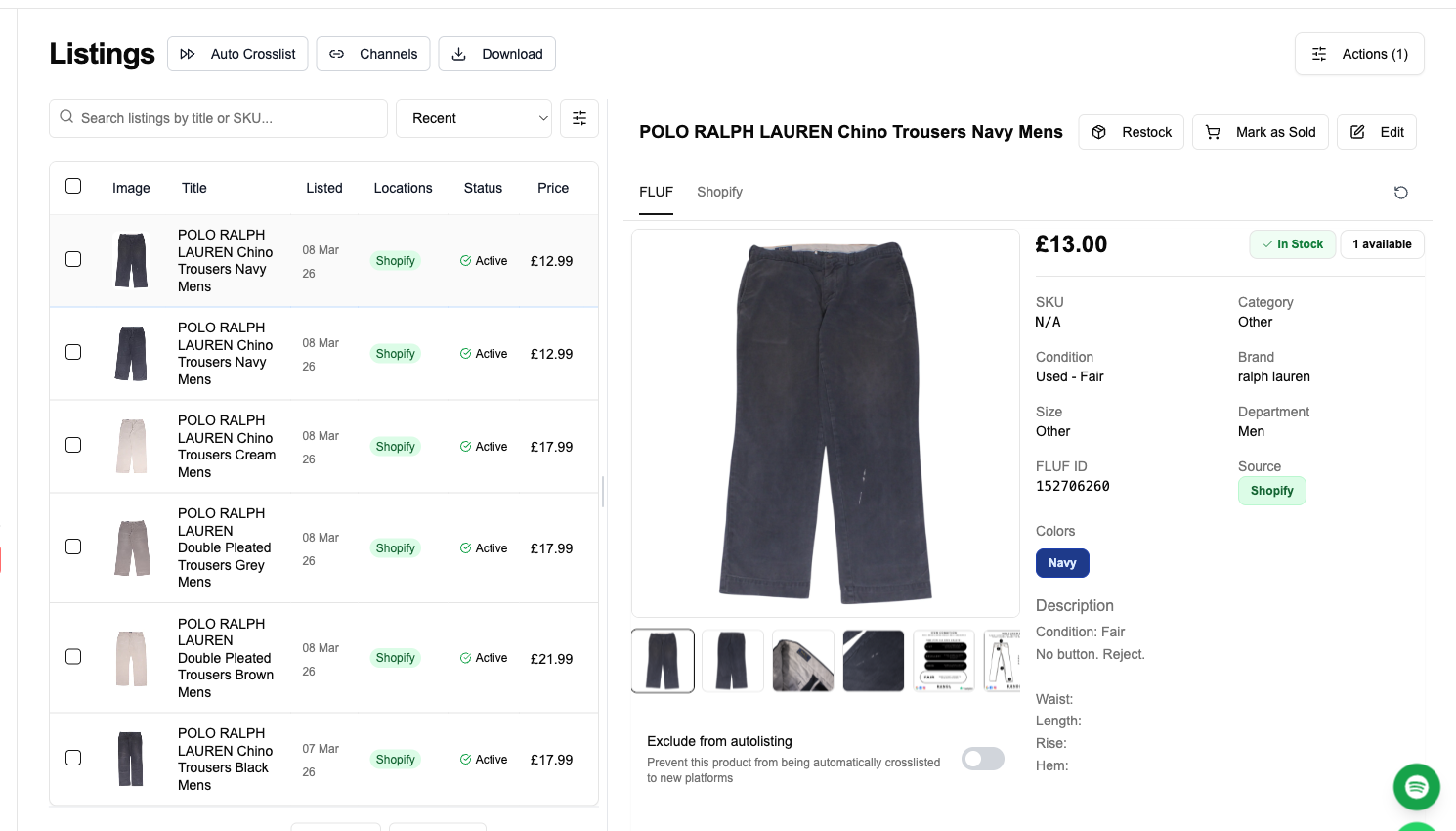
After the first batch, your day-to-day changes very little. New Vakoop items can be selected and pushed to Yaga the same way, and the heavy lifting — keeping the two stores from clashing when something sells — happens in the background.
What the two connection methods mean in practice
Approve the Vakoop connection once to import your catalogue without keeping Vakoop open in a browser. For Yaga, install the FLUF browser extension and stay signed in to Yaga while publishing. Review the imported listings before crosslisting. Sale detection is supported in both directions.
3. Field & category mapping
Crosslisting is only as good as the mapping behind it. Vakoop and Yaga model their listings differently — Vakoop spans many categories including electronics and bags, while Yaga is structured around fashion — so FLUF Connect translates each field as faithfully as it can and flags where a human eye helps. Use the legend below to read the table.
Legend: ✅ Mapped automatically | ⚡ Mapped, quick review recommended | ⚠️ Partial — may need manual input | ❌ Not transferable / not supported
| Field | Vakoop → Yaga | Notes |
|---|---|---|
| Title | ✅ | Carried across. Yaga search is keyword-driven, so spell out item types (e.g. “jeans”, “sneakers”) in the title and description. |
| Description | ✅ | Transferred. Worth enriching with size, condition, colour and material — Yaga ranks search results on description keywords. |
| Photos | ⚡ | Imported, but Yaga (ZA) allows up to 6 photos per item — listings with more are trimmed to fit. |
| Price | ✅ | Carried across in ZAR. Review against Yaga comparables; remember Yaga’s buyer fee sits on top at checkout, paid by the buyer. |
| Category | ⚡ | Auto-suggested. Fashion maps cleanly; confirm the leaf category, especially for borderline items. |
| Brand | ✅ | Mapped where a matching Yaga brand exists. |
| Size | ⚡ | Mapped for clothing and footwear; verify the size system matches Yaga’s options. |
| Condition | ✅ | Mapped to Yaga’s condition values. |
| Colour / material | ⚡ | Mapped where present; add any missing attributes to strengthen Yaga search visibility. |
| Title keywords | ⚡ | Carried inside the title, but worth tuning for Yaga’s keyword-driven search — front-load the item type, brand and size words Yaga buyers actually search. |
| Non-fashion items (e.g. electronics) | ⚠️ | Vakoop sells beyond fashion; Yaga is a fashion marketplace, so non-fashion stock may have no suitable Yaga category and is best left on Vakoop. |
Read the table by the attention each field deserves. The ✅ rows need a glance, no more. The ⚡ rows reward a few seconds of judgement: photos (trim to Yaga’s limit), category (confirm the leaf), size (check the size system) and colour/material (top up missing attributes). The single ⚠️ row, non-fashion stock, is a routing decision: an item with no fashion home on Yaga stays Vakoop-only — the correct outcome.
Category mapping examples
- Women’s denim jacket (Vakoop fashion → Yaga) ✅ — maps to Yaga’s women’s outerwear/jackets; brand, size and condition carry across with a quick category confirmation.
- Sneakers / trainers (Vakoop sneakers → Yaga) ⚡ — maps to Yaga’s shoes category; confirm the shoe-size system and that all photos fit the 6-image limit.
- Designer handbag (Vakoop designer bags → Yaga) ⚡ — maps to Yaga’s bags/accessories; verify the brand match and add authentication detail in the description, as both marketplaces lean on trust.
- Smartphone or electronics (Vakoop electronics → Yaga) ⚠️ — Yaga is fashion-first; electronics typically have no equivalent Yaga category and should remain Vakoop-only.
Writing keyword-rich Yaga titles and descriptions
Yaga’s search is keyword-driven, which makes the title and description the two fields most worth polishing after a crosslist. They carry across from Vakoop intact, but a title written for one marketplace is not automatically the strongest for another.
- Lead with the item type. Put the noun a buyer would type — “jeans”, “sneakers”, “handbag” — at the front of the title.
- Include the brand and the size. Many Yaga searches combine a brand with a size or category; spelling both out gives more ways to match.
- Describe colour, material and condition in words. Repeating these in the description strengthens keyword visibility, since Yaga ranks on description keywords.
A rule of thumb: the words a South African shopper would type to find your item should all appear in your title or description. Because you are only editing the destination copy, you can do this on Yaga without touching the original Vakoop listing.
4. Inventory sync — what stays in sync
The point of selling the same item in two places is reach. The risk is selling the same single item twice. FLUF Connect manages that risk for the Vakoop-to-Yaga pair because both marketplaces support the two capabilities that matter: order detection and mark-as-sold.
| What syncs | Vakoop | Yaga | Result for this pair |
|---|---|---|---|
| Sale detection (order sync) | ✅ | ✅ | A sale on either side is detected by FLUF Connect |
| Auto-remove the copy when sold elsewhere (mark-as-sold) | ✅ | ✅ | Two-way: the duplicate is removed on the other channel |
| Offers | ❌ | ✅ | Offer management applies to the Yaga side only |
| Relisting | ❌ | ❌ | Not handled by FLUF Connect for either marketplace |
Because order sync and mark-as-sold are both supported on Vakoop and Yaga, this is a genuinely two-way protected pair. Sell a jacket on Vakoop and FLUF Connect can remove the Yaga copy; sell it on Yaga and FLUF Connect can remove the Vakoop copy. You learn about your inventory once, in one place, and the other marketplace is kept honest automatically.
Two-way mark-as-sold dramatically reduces the chance of selling the same item twice, but sync is near real-time rather than instantaneous. For very fast-moving items, or during a busy sale, keep half an eye on both marketplaces. Mark-as-sold protects you against the common case; it cannot eliminate the rare race where two buyers check out within the same few seconds.
For more on how this works across all channels, see inventory sync, and for the Yaga-specific offers capability, see offer management.
The two-way sync workflow, step by step
Here is what happens over the life of a single item once both channels are connected and sync is on — the cycle is the same whichever marketplace the sale lands on.
- The item is live on both. Your jacket sits as an active listing on Vakoop (its source) and as a crosslisted copy on Yaga.
- A buyer purchases it — say, on Yaga. The order is created in your Yaga shop, and sync picks it up.
- The Vakoop copy is removed. Mark-as-sold takes the Vakoop listing down, closing the oversell window.
- The reverse case is symmetric. Had it sold on Vakoop first, sync would have removed the Yaga copy instead.
The same loop runs across your whole catalogue, so you fulfil the order on whichever side it came through and FLUF Connect handles the other. Because relisting is not part of this pair, a sold item simply leaves the rotation cleanly.
Handling Yaga offers inside the workflow
Offers are the one capability that applies asymmetrically on this pair. Yaga buyers can send offers, and FLUF Connect supports offer management on the Yaga side, so you can review and respond to them within the same workflow you use to crosslist and sync. Vakoop does not support offers via FLUF Connect, so your Vakoop listings simply transact at their listed price.
Your offer activity for this pair is therefore concentrated on Yaga. Because Yaga charges sellers no selling fee, the amount you accept on an offer is what reaches your Yaga Wallet — no commission erodes a negotiated price.
5. Before & after workflow
It helps to see the difference in plain terms.
Before FLUF Connect
- List an item on Vakoop, writing the title, description and uploading photos.
- Open Yaga separately and re-create the same listing by hand — re-typing the description, re-uploading photos, re-picking the category and size.
- When it sells on one marketplace, remember to log into the other and pull the listing down manually.
- Miss that step once and you risk selling an item you no longer have — an oversell, a refund, and a knock to your seller reputation.
- Multiply all of the above by every item in your catalogue.
After FLUF Connect
- List (or import) on Vakoop once.
- Select the item in FLUF Connect, review the mapped fields, and push it to Yaga in seconds.
- When it sells on either side, FLUF Connect detects the order and removes the duplicate on the other marketplace for you.
- Handle Yaga buyer offers within the workflow.
- Spend the time you saved sourcing more stock instead of duplicating listings.
The before/after gap widens as your catalogue grows. At ten items the manual approach is tedious; at several hundred it is a part-time job in itself — and the oversell risk becomes a question of when, not if.
6. Automation features
For the Vakoop-to-Yaga pair, FLUF Connect’s automation is focused on the capabilities both marketplaces actually support — no overpromising:
- Bulk crosslisting — push a whole selection from your Vakoop catalogue to Yaga in one batch rather than one listing at a time.
- Order sync — automatic detection of sales on both Vakoop and Yaga.
- Mark-as-sold — automatic removal of the duplicate listing on the other channel when an item sells, in both directions.
- Offer management on Yaga — handle buyer offers on your Yaga listings within FLUF Connect. (Not applicable to Vakoop, which does not support offers via FLUF Connect.)
Two things FLUF Connect does not do for this pair, stated plainly: it does not relist items on either Vakoop or Yaga, and it does not manage offers on Vakoop. If you want relisting, you would use any native feature the marketplace provides. Automation is included in every FLUF Connect plan — it is not a paid add-on. To see how the same approach extends across many marketplaces at once, read our guide to selling on multiple platforms.
7. Pricing
FLUF Connect plans start at £9/month. Automation is included from Seller upwards rather than charged separately, and there is no free plan. Choose the tier that fits the size of your catalogue.
| Plan | Monthly | Crosslisted products |
|---|---|---|
| Starter | £9/month | Unlimited |
| Pro | £29/month | Unlimited |
| Super Seller | Custom pricing — tell us what you need | Unlimited |
This is the FLUF Connect subscription only. Vakoop and Yaga each set their own marketplace fees independently of FLUF Connect — and, helpfully for this pair, Yaga charges sellers no selling fee, while Vakoop advertises free listing. See full details on the pricing page, browse all routes on the crosslisting hub, and explore related Vakoop pairs: Vakoop to eBay and Vakoop to Depop.
Pricing with Yaga’s buyer-paid fee in mind
Yaga’s fee structure is seller-friendly. Yaga takes no selling fee; instead, the Buyer Protection charge (6.5% + R19.90 in South Africa, varying by category and market) is added to the buyer at checkout, on top of your item price. The consequences for how you price:
- What you list is what you keep. Set your price to the amount you actually want — no commission to gross up for, and the full item price flows to your Yaga Wallet.
- The buyer sees a slightly higher total. The Buyer Protection fee is added at checkout, so pricing competitively against Yaga comparables keeps that total attractive.
- Leave room for offers. A small margin above your true floor lets you accept or counter on Yaga — and with no seller fee, the accepted figure is what you receive.
None of this requires touching your Vakoop pricing. Tune the Yaga figure on the destination side while Vakoop continues under its own free-listing terms — the prices are independent.
8. Sources & verification
Every marketplace fee and audience claim above is drawn from primary sources. Marketplaces change their terms; verify current figures on the official pages before relying on them.
- Vakoop — marketplace, categories, free listing, buyer protection, secure wallet, AI-assisted listing: vakoop.co.za
- Yaga — no seller selling fee, sellers keep 100%, Yaga Wallet payout: shop.yaga.co.za/blog/selling-on-yaga and Yaga Fees Guide (help centre)
- Yaga — Buyer Protection fee (6.5% + R19.90, ZA; varies by category/market): Yaga Buyer Protection (help centre)
- Yaga — South African launch, market position, scale: shop.yaga.co.za/about
- Yaga — markets (South Africa, Estonia, Latvia, Kenya) and Kenya expansion: aptantech: Yaga expands to Kenya; Latvia storefront: Yaga on the Latvian App Store
- Yaga — photo limit (up to 6, ZA) and keyword-driven search: Getting started as a Seller (help centre)