
How to Sell on Mercari — The Complete Guide for 2026
Everything you need to sell on Mercari US — the real 10% seller fee, shipping tiers and label costs, promotion tools, buyer protection, 1099-K tax rules, scams to avoid, and how to crosslist to eBay, Poshmark and Depop automatically.



Key Takeaways
- What it is: Mercari is a US mobile-first marketplace for almost anything second-hand — fashion, electronics, trading cards, collectibles, toys, home goods. Run by Mercari, Inc., a Tokyo-headquartered company, but the US marketplace is a separate operation from Mercari Japan.
- Seller fee: 10% of the item price plus any buyer-paid shipping. Mercari removed seller fees in March 2024 then reinstated the 10% fee on 6 January 2025, so anything claiming “no seller fees” is out of date (Mercari).
- No listing fee: no listing, monthly or setup charge — you only pay when something sells (Mercari fees).
- Buyers pay too: a 3.6% Buyer Protection fee sits on the buyer’s side. The old buyer payment-processing charge ($0.50 + 2.9%) was eliminated in the same January 2025 change.
- US only, and the buyer base is flat: Mercari US reported 4.3 million monthly active users, down 4% year on year, while US GMV rose ~12% (Value Added Resource).
- Best for: parcel-friendly goods with a US audience — sneakers and streetwear, trading cards, video games, consumer electronics, toys, craft and hobby supplies.
- Cross-list with FLUF Connect: list once and crosspost to Mercari alongside eBay, Poshmark, Depop, Shopify and more — get started in minutes. Plans start at £9/month (Starter); every plan is paid, and delisting when an item sells elsewhere is on every plan, while relisting, offer management and smart pricing are included from Seller upwards.
A simple crosslisting workflow
In practice, selling on Mercari and everywhere else at once looks like this:
- Connect Mercari once through the FLUF browser extension.
- Add a product once in FLUF, or import existing listings from another connected channel.
- Choose where it goes and crosslist. FLUF matches the category, size, colour and condition to what each channel expects.
- Sell anywhere. When the item sells on another connected channel, or you mark it sold in FLUF, your Mercari listing is taken down automatically.
What is Mercari?
Mercari is a mobile-first online marketplace where individuals sell used and new goods to other individuals across the United States. It is a general-goods platform rather than a fashion-only app: one search session will turn up Pokémon cards, a PlayStation controller, a pair of Air Jordans and a KitchenAid mixer. Listing is free, selling is shipping-based, and the whole experience is designed around the phone.
The company behind it, Mercari, Inc., was founded in Japan in 2013 and is headquartered in Tokyo. Mercari launched in the United States in 2014, and the US operation — the one this guide covers — runs as a separate marketplace with its own fees, policies, shipping partners and buyer base.
An important clarification: Mercari US and Mercari Japan are not the same marketplace, and you cannot sell on one from the other. In June 2026 Mercari launched a standalone US app letting American shoppers browse and buy from the Japanese marketplace (Digital Commerce 360) — a cross-border buying bridge, not a route for US sellers into Japan. If you are outside the United States, Mercari US is not a marketplace you can sell on.
Mercari at a glance
| Metric | Detail |
|---|---|
| Founded | 2013 (Japan); US marketplace launched 2014 |
| Company | Mercari, Inc. |
| Headquarters | Tokyo, Japan |
| Marketplace covered here | Mercari US (mercari.com) — US sellers only |
| US monthly active users | 4.3 million (down 4% year on year) |
| US GMV | $602 million for the nine months to 31 March 2026, up 10.0% year on year |
| Group scale | 23 million+ monthly active users worldwide; 4 billion+ cumulative listings |
| Selling model | Fixed price, shipping-first, offers and negotiation supported |
| Revenue model | 10% seller fee + 3.6% buyer protection fee; no listing or subscription fees |
Why the fee history matters
Mercari’s recent past will mislead you if you research it casually. In March 2024 it eliminated seller fees entirely and moved the cost onto buyers. That experiment lasted less than a year: on 6 January 2025 the company reinstated a 10% seller fee, cut the buyer’s payment-processing charge, and introduced the 3.6% Buyer Protection fee. Mercari’s own explanation was blunt — the zero-fee structure “underserved buyers, wasn’t helping sellers sell more” (Mercari Help Center).
A lot of blog content still describes Mercari as fee-free for sellers, and a further tranche misdates the reversal to January 2026. Both official pages say 2025. If a guide tells you Mercari takes nothing from your sale, stop reading it.
Why sell on Mercari in 2026?
Mercari occupies a useful position in a US seller’s mix: broad category coverage, no cost to list, and a buyer base that arrives expecting used goods. The honest case:
It costs nothing until you sell
There is no listing fee, store subscription, per-category charge or monthly minimum. You can put two hundred items up, leave them six months, and pay Mercari nothing — which makes it a low-risk place to test whether a category moves before committing real effort.
Almost every category is welcome
Unlike Poshmark, which is fashion-first, or Depop, which skews to youth streetwear, Mercari is a true general-goods marketplace. Electronics, board games, tools, kitchenware, craft supplies, books and collectibles all sit alongside clothing. If you source from estate sales or thrift stores and end up with a mixed bag, Mercari absorbs the whole lot without splitting inventory across three specialist apps.
Shipping is genuinely well-solved
Mercari’s prepaid labels average 54% below retail carrier rates, and its “Best rate” tier for compact parcels beats what a small seller could negotiate independently (Mercari fees).
Offers and negotiation are built in
Mercari buyers expect to haggle, and the platform gives you structured tools for it — most importantly the ability to send a discounted offer to everyone who has liked your item. Used well, that turns a stagnant listing with twelve likes into a sale in one tap. Mechanics and thresholds are in the algorithm section.
But be realistic about the audience trend
Mercari US reported 4.3 million monthly active users, a 4% decline year on year, even as US GMV rose about 12% in the same quarter (Value Added Resource). Fewer buyers, spending more each. Mercari is a good additional channel in 2026; treating it as your only channel ties your income to a pool that is not currently growing.
When to use Mercari vs another platform
No single marketplace is best for everything, and the fastest way to sell an item is to put it in front of the buyers who want it. Here is how Mercari compares with the other channels US resellers use.
| Platform | Best for | Seller cost | Selling model | Post-sale window |
|---|---|---|---|---|
| Mercari | Mixed general goods, electronics, cards, toys, casual fashion | 10% + 3.6% buyer protection fee (buyer-paid) | Fixed price with offers, shipping-first | 3 days for the buyer to rate or dispute |
| eBay | Anything niche, collectible, technical, or high-value | Final value fees varying by category | Auction or fixed price | 30-day Money Back Guarantee |
| Poshmark | Branded fashion, accessories, shoes | Flat fee on low-value sales, percentage above | Fixed price with offers, social feed | 3 days for the buyer to accept |
| Depop | Vintage, streetwear, Y2K, a young audience | Payment processing plus applicable selling fees | Fixed price, social feed | Handled via payment provider dispute rules |
| Facebook Marketplace | Bulky and local — furniture, appliances, exercise gear | Free for local pickup sales | Local pickup or shipping | Varies by fulfilment method |
| Whatnot | Live-selling cards, collectibles, sneakers | Commission on live sales | Live auction streams | Platform dispute process |
The row worth pausing on is the last column. Mercari gives a buyer three days after confirmed delivery to rate or raise a problem, after which the transaction auto-completes and your money is released (Mercari Buyer Protection). eBay’s Money Back Guarantee runs 30 days — Mercari’s short window is one of the few structural ways it beats its larger rival.
The practical answer for most sellers is “both/and”, not “either/or”: a pair of trainers belongs on Mercari and eBay. The only real cost is the manual labour of listing everywhere and pulling things down when they sell — which is what crosslisting exists to remove.
Mercari fees explained
Mercari charges sellers a 10% selling fee on the item price plus any buyer-paid shipping, and nothing else on a normal sale. There is no listing, monthly or setup fee — the platform only takes money when a sale completes (Mercari: Selling fees and costs). Separately, the buyer pays a 3.6% Buyer Protection fee, which does not come out of your proceeds but does affect what buyers see at checkout.
The core fees
| Fee | Amount | Who pays | When it applies |
|---|---|---|---|
| Selling fee | 10% of item price + buyer-paid shipping | Seller | Every completed sale |
| Buyer Protection fee | 3.6% of item price + buyer-paid shipping | Buyer | Every completed sale |
| Listing fee | $0 | — | Never |
| Monthly / setup fee | $0 | — | Never |
| Buyer payment processing | Eliminated (was $0.50 + 2.9%) | — | Removed 6 January 2025 |
| Direct deposit (ACH) | No fee on successful transfers, one per day | Seller | Standard payout |
| Failed direct deposit | $2, non-refundable | Seller | When a transfer request fails |
| Instant Pay | $3 flat per cash-out, $600/month cap, once daily | Seller | When you want money immediately |
| Cancellation fee | 5% of item price, capped at $25 | Seller | Seller-caused cancellations |
| Mercari Authenticate listing | $5 | Seller | Optional authentication service |
| Authentication Certificate | $10 | Seller | Optional |
All figures above are from Mercari’s official fee page and its January 2025 fee-change announcement.
The shipping-cost trap most sellers miss
Read the selling fee definition carefully: it is 10% of the item price plus buyer-paid shipping. List at $20, charge $7 shipping, and the fee is calculated on $27 — you pay $2.70, not $2.00. The same applies to the buyer’s 3.6%. So inflating shipping to make an item look cheap does not work here: the fee follows the shipping charge.
The underpaid-shipping penalty
Since 10 March 2025, Mercari charges an 8% penalty fee on underpaid shipping — when the parcel you send is heavier or larger than the label you bought (Mercari shipping rate updates). This is the most common surprise deduction new sellers hit. Weigh the packed parcel, box and padding included, before you buy the label.
How to minimise what Mercari costs you
- Never use Instant Pay routinely. $3 a time on weekly cash-outs is $156 a year to receive money you would have received anyway. Standard direct deposit is free.
- Weigh before you buy the label, and keep parcels under the “Best rate” threshold — compact packaging moves an item into a materially cheaper tier (see the shipping section).
- Do not cancel sales. The 5% cancellation fee is small; the damage to your seller metrics is not.
- Check your direct deposit details — a failed transfer costs $2 and is non-refundable.
- Skip authentication unless it pays. The $5 listing and $10 certificate only earn out on high-value branded goods.
What you actually keep — a worked example
Here is the arithmetic on a real-shaped sale: a used pair of trainers listed at $40, with the buyer paying $7.97 for a Best-rate label.
- Item price: $40.00
- Buyer-paid shipping: $7.97
- Fee base (item + shipping): $47.97
- Listing fee: $0.00
- Mercari selling fee (10% of $47.97): −$4.80
- Shipping label cost (deducted from proceeds): −$7.97
- Direct deposit fee: $0.00
- You keep: $35.20 — that is 88% of the $40 item price
- The buyer separately pays a 3.6% Buyer Protection fee of $1.73, so their total is $49.70
Two things follow. Your real take-home is worse than the headline 10% suggests, because the fee is levied on shipping too. And the gap between what you receive ($35.20) and what the buyer pays ($49.70) is nearly $14.50 on a $40 item — so an item priced identically on Mercari and on a free-to-buy local platform is not, to the buyer, the same price at all.
If you offer free shipping instead — absorbing the label and listing at $48 to compensate — the fee base becomes $48, the selling fee $4.80, the label $7.97, and you keep $35.23. Almost identical take-home, but the listing shows as “free shipping”, which many buyers filter for. That is usually the better trade.
How to set up your Mercari seller account
Setting up takes about ten minutes, and you can have your first listing live inside twenty. Mercari does not distinguish “personal” from “business” accounts — everyone lists through the same interface — but there are verification requirements that catch people out.
Step by step
- Download the app or open mercari.com and create an account with an email address, Google, Facebook or Apple sign-in.
- Choose a username that reads like a shop. Buyers see it on every listing and message; something searchable beats a string of numbers.
- Write a profile bio covering what you sell, how fast you ship and your stance on offers — one of the few trust signals a buyer has before purchasing.
- Add your shipping address, which sets your origin for label pricing and delivery estimates.
- Add your bank details for direct deposit. Get these right first time — a failed transfer costs $2.
- Complete tax identity verification. Mercari collects your legal name and SSN or ITIN via a substitute Form W-9. Do this before it becomes urgent (see below).
- List your first item and reply quickly to your first few messages — your first ratings set the tone for everything after.
The W-9 requirement — do not ignore this
Mercari requires sellers to submit a substitute Form W-9 with a legal name and taxpayer identification number, and it may require this before you reach any tax-reporting threshold. If you do not submit it when asked, Mercari restricts your account and your ability to sell (Mercari: W-9 requirements). Handle it during setup, when it costs five minutes rather than a week of stalled sales.
Profile optimisation that actually moves the needle
- Ship fast and say so. “Ships same or next business day” is a promise you can keep and buyers respond to.
- State your offer policy. “Offers welcome — I usually counter” generates more inbound offers than silence does.
- Use a real profile photo or a clean logo. A default avatar reads as an abandoned account.
- Build ratings early with cheap items — a handful of low-value listings that move quickly gets you to a credible rating count faster than waiting on one expensive item.
How to create listings that sell
Mercari is search-driven. Buyers arrive with something specific in mind, type it into a box, and scan a grid of thumbnails. Almost everything determining whether your item sells happens in that grid: whether your title matched their search, whether your photo made them tap, and whether your price looked reasonable against the eleven others on screen.
Title optimisation
Your title is the primary matching surface for search. Front-load the words a buyer would actually type — brand, model, distinguishing attribute — then size, colour and condition.
❌ “Cute jacket, barely worn!!”
✅ “The North Face Nuptse 700 Down Puffer Jacket Black Women’s Medium”
❌ “Nintendo game”
✅ “Nintendo Switch The Legend of Zelda: Tears of the Kingdom — Complete with Case”
The failed titles share a problem: no word in them is a word a buyer would search for. Nobody types “cute jacket”; they type “north face puffer medium”. Enthusiasm belongs in the description. Include the model number if there is one — for electronics and cameras, model numbers are how serious buyers search.
Description writing
Write for the buyer who is trying to decide whether to trust you. A structure that works:
- One-line summary — what it is, brand, size, condition.
- Measurements — for clothing, measurements taken flat matter far more than the label size, because sizing varies wildly between brands and eras.
- Condition, stated precisely — “Good condition — small scuff on the right toe, shown in photo 4.”
- What’s included — box, cables, dust bag, original tags, manual.
- Shipping note — when you dispatch and how it is packed.
Disclose flaws explicitly and photograph them. It feels like it costs you a sale; in reality it prevents the far more expensive not-as-described return.
Pricing strategy
The most useful research tool on Mercari is its own sold-listings data. Search your item, filter to sold, and look at what actually transacted. Asking prices tell you what sellers hope for; sold prices tell you what the market pays. Three Mercari-specific considerations:
- Leave negotiating room, but not much. Pricing 10–15% above your true floor gives you somewhere to move without looking overpriced in the grid.
- Remember the buyer’s 3.6% and shipping. Your $40 item costs a buyer around $49.70 delivered — sanity-check that total against what it goes for elsewhere.
- Price with the promotion thresholds in mind. Promote and Offer to Likers both require dropping below your item’s historically lowest price — 5% and 10% respectively. List at your absolute floor on day one and you have disarmed both permanently.
That last point is the one experienced Mercari sellers wish they had known earlier — see the algorithm section.
Category and condition
Pick the most specific category available rather than a broad parent: category drives which filtered searches your item appears in, and a jacket filed under “Women” rather than “Women > Coats & Jackets > Puffer” will not surface when a buyer filters. Grade condition honestly — over-grading is the leading cause of not-as-described disputes.
Photography and presentation
Mercari is a grid of thumbnails. Your first photo does almost all the work of getting a buyer to stop scrolling, competing against every other seller’s first photo at roughly the size of a postage stamp.
The shot list
- Hero shot — the whole item, well lit, clean background, filling the frame. This is the thumbnail; make it obvious what the item is at a glance.
- Front and back, then brand label and size tag — or, for electronics, the model and serial plate.
- Detail shots — texture, hardware, stitching, screen, ports, buttons.
- Every flaw, close up, referenced by photo number in the description.
- What’s included — box, accessories, cables and tags together.
Practical rules
Shoot in daylight near a window with the overhead lights off — mixed lighting produces the yellow-green cast that makes items look grubby. Use a plain background, avoid flash, and steam or iron clothing first, because creases photograph as damage. Flat-lay is the safe default for clothing: Mercari is a general-goods marketplace, not a style feed like Depop, so buyers are assessing the garment rather than the vibe. And never use manufacturer stock images as the primary photo for a used item — a stock shot followed by a real one that looks worse is a reliable route to a dispute.
Shipping on Mercari
Shipping is where Mercari is genuinely strong, and where the largest avoidable losses happen. It offers discounted prepaid labels across USPS, UPS and FedEx, averaging 54% below retail carrier rates (Mercari fees).
Best rate vs Standard rate
Mercari splits labels into two tiers, and the difference is worth real money (Mercari: Best rate shipping):
| Tier | Eligibility | Example: 9 oz T-shirt | Example: 4.5 lb speaker |
|---|---|---|---|
| Best rate | Parcel ≤1 cubic foot with longest side ≤22 inches — Mercari’s “smaller than a shoebox” prompt | $6.29 | $7.97 |
| Standard rate | Anything larger | $6.99 | $10.99 |
| Saving | — | ~10% | ~27% |
Those are Mercari’s own published examples, and the 27% saving on the heavier item is the headline: how you pack determines your shipping tier. Use the smallest box the item safely fits in rather than whatever oversized box is nearest.
Media Mail and First-Class Envelope labels are priced flat on actual weight rather than by tier, making them very cheap for books, media and thin flat goods. Mercari has been running a 49¢ First-Class Envelope promotion for 1–3 oz items, extended through 31 December 2026 (Mercari shipping promotion) — which makes trading-card and pin listings viable that otherwise would not be worth posting.
Rate changes you should know about
Shipping prices have moved repeatedly, and Mercari publishes each change (Mercari: shipping rate updates):
- 18 February 2025 — average Mercari rates up ~1%; USPS Ground Advantage introduced for parcels up to 20 lbs.
- 10 March 2025 — the 8% underpaid-shipping penalty took effect.
- 20 January 2026 — industry rates rose ~11.9%; Mercari raised its Standard rates in response, leaving Best rate unchanged — a further argument for packing small.
- 7 May 2026 — a USPS 8% fuel surcharge applies to Ground Advantage and Priority. Media Mail and First-Class Envelopes are exempt.
Because rates change, always check the live label price at the point of sale.
Who pays for shipping
You choose per listing whether the buyer pays or you absorb the cost as free shipping. As the worked example showed, the take-home difference is negligible once you adjust the price, so choose on presentation rather than arithmetic. Free shipping presents better in search results; buyer-paid shipping is usually better above about 5 lbs, because absorbing an $18 label into a $30 price makes the listing look expensive in the grid.
Local delivery: what is and is not available
Mercari Local, the Uber-powered same-day delivery service, was discontinued in November 2024 (Value Added Resource), partially replaced by a “Meetups” feature in selected Los Angeles and New York City zip codes only. If a guide tells you to use Mercari Local to shift furniture, it is out of date.
Shipping protection
Mercari includes up to $200 of Shipping Protection against loss or damage in transit — but only when you use a Mercari prepaid label (Mercari Seller Protection). Your own label forfeits that cover entirely. Unless you have a negotiated rate beating Mercari’s 54% average discount, their labels are both cheaper and safer.
How the Mercari algorithm works
Mercari’s search results are strongly influenced by recency and price movement: new and recently-updated listings surface above stale ones, which is why an item that got twenty views on day one can sit untouched for a month. Mercari’s answer is a pair of promotion tools with strict published rules — and understanding those rules is the difference between using them and locking yourself out of them.
Promote
Promote boosts your listing’s search position and notifies everyone who has liked it (Mercari: promotions):
- You must make a permanent price drop of at least 5% below the item’s historically lowest price.
- The price can never go below $1.
- You can promote a given item once per 24 hours.
The phrase carrying all the weight is “historically lowest price” — Mercari remembers the lowest your listing has ever been, not where it is now. Drop an item to $18, raise it back to $25, and your next Promote must take it to $17.10 or below. Each promotion permanently ratchets your floor down.
Offer to Likers
This is the more powerful tool, because it targets people who have already signalled interest (Mercari: promotions):
- Requires an offer at least 10% below the historically lowest price.
- The discount is temporary — it does not permanently reset your listed price.
- It reaches a maximum of the 50 most recent likers, newest first.
- The offer is valid for 24 hours.
- Acceptance is binding. If a liker accepts, the sale is made at that price.
- New likers automatically receive your latest offer unless you disable this in promotion settings.
That last point is a genuine trap: an offer sent once keeps going out to every new person who likes the item. If you have raised your price or changed your mind, check your promotion settings rather than assuming it expired.
The implication of both tools is the same: do not list at your floor price. Build in 15–20% of headroom on day one — that headroom is the fuel for every promotion you will run over the item’s life.
Smart Offers is gone
Mercari discontinued Smart Offers on 4 November 2024 (Value Added Resource). Its own help documentation still references the feature in places — a reminder that platform docs lag reality. If a guide tells you to configure Smart Offers, it no longer exists.
The signals you control
| Factor | Impact | What you can do |
|---|---|---|
| Listing freshness | High | Promote eligible items daily; keep adding new listings |
| Title keyword match | High | Front-load brand, model and attribute in the title |
| Price competitiveness | High | Research sold listings, leave promotion headroom |
| Likes and engagement | Medium–High | Convert likers with Offer to Likers within 24 hours |
| Photo quality | Medium–High | Strong thumbnail; use all photo slots |
| Category accuracy | Medium | Choose the deepest, most specific category |
| Seller ratings and response speed | Medium | Ship fast, reply within hours, never cancel |
The top three are all set once, at listing time. Getting the title, price and category right on day one costs nothing and outperforms any amount of promotion of a badly-built listing.
Getting paid, protection and tax
How and when you get paid
Buyers have 72 hours from carrier-confirmed delivery to rate the transaction. Once they rate, or the window expires and the transaction auto-completes, funds are released into your Mercari balance (Mercari Buyer Protection). Standard direct deposit is then free, one request per day; Instant Pay moves money immediately for a $3 flat fee, capped at $600 per month.
The three-day window favours sellers on balance: you wait a few days beyond delivery for your money, but your exposure ends quickly. Once a buyer rates, their right to return is extinguished.
Seller protection — what it does and does not cover
Mercari’s Seller Protection provides up to $200 of Shipping Protection for loss or damage in transit when you use Mercari prepaid labels, plus fraud and prohibited-item monitoring (Mercari Seller Protection). The cover is conditional on using their labels, and $200 is a ceiling — high-value items need separate insurance.
Returns
A buyer may request a return within the three-day rating window if an item is not as described. If approved, the buyer must ship it back within three days (Mercari returns).
In 2024 Mercari introduced a “returns for any reason” policy, which was reversed after seller backlash, restoring the narrower not-as-described standard (Modern Retail). The current policy is the seller-friendlier one, but the episode is a prompt to watch policy announcements rather than assume terms are static. The best defence against returns is accurate listings: every flaw photographed is a return that cannot be requested on not-as-described grounds.
Tax and 1099-K reporting
This area changed significantly and much published advice is now wrong. The One Big Beautiful Bill Act, signed 4 July 2025, repealed the phased-in lower 1099-K thresholds and reverted reporting to more than $20,000 in gross payments AND more than 200 transactions — retroactively, so it applies to 2025 and 2026 (IRS). Mercari’s own policy page states the same figures (Mercari 1099-K policy).
So if you read that a $600 threshold applies from 2026, that is out of date — the $600 rule was repealed before it ever took effect. Note that some individual states set their own lower thresholds, so your state may require reporting well below the federal number. Two things get conflated with the threshold and should not be:
- Receiving a 1099-K is not what makes income taxable. Profit is reportable whether or not a form is issued. Selling your own used belongings for less than you paid generally produces no taxable gain; buying to resell at a profit does.
- The W-9 requirement is separate. Mercari can require your taxpayer information before you approach any threshold, and will restrict selling if you do not provide it (Mercari).
Keep records from day one — what you paid, what it sold for, shipping, supplies and fees. A spreadsheet is enough, and far easier than reconstructing a year retrospectively.
This is general information, not tax advice. Consult a qualified accountant about your own situation.
What sells best on Mercari
A note on honesty first: Mercari does not publish category-level sales data for its US marketplace, and the percentages circulating online — “collectibles are 40% of transactions” and similar — trace back to no primary source, so we have left them out. What follows is directional guidance based on how the platform is structured, not invented statistics.
| Category | Why it works on Mercari | Practical tip |
|---|---|---|
| Trading cards and collectibles | Flat, light, and covered by the 49¢ First-Class Envelope promotion | Photograph corners and edges; grade condition conservatively |
| Video games and consoles | Strong search intent, model-number-driven, easy to describe precisely | State whether the case, manual and cables are included |
| Consumer electronics | Buyers search by exact model; Mercari’s general-goods positioning suits it | Include model and serial plate photos; confirm working condition |
| Sneakers and streetwear | High search volume, well-defined sizing, strong resale demand | Photograph soles and box; state true-to-size fit |
| Toys and kids’ items | Parents buy used readily; sets and bundles perform well | Count and photograph all pieces; note any missing parts |
| Craft, hobby and sewing supplies | Underserved on fashion-only platforms; bundles well | Bundle small items to clear the shipping-cost threshold |
| Books and media | Media Mail makes thin margins workable | Use Media Mail; it is priced on actual weight, not tier |
The reliable way to find out what sells is to check yourself: search your item, filter to sold listings, and see what actually transacted and at what price. Two minutes, and it beats any generic category ranking.
Because Mercari’s shipping economics reward small, light parcels so heavily, the rule is that anything fitting in a small box with a specific searchable name does well, and anything bulky or vaguely-named struggles. A cast-iron skillet and a folding treadmill are both worth money and both bad Mercari listings — those belong on Facebook Marketplace.
Scams and disputes to watch for
Mercari’s rules are more seller-protective than most — the three-day dispute window in particular — but there are recognised patterns worth knowing.
- The empty-box or swap claim. A buyer reports the parcel arrived empty or containing a different item. Your defence is evidence: photograph the packed item before sealing the box and record the weight — a carrier-scanned weight matching your packing photo is hard to argue with.
- Return fraud. A buyer requests a not-as-described return and sends back a different or damaged unit. Photograph serial numbers and distinguishing marks before dispatch.
- Off-platform payment requests. Anyone asking you to settle by Venmo, Zelle, Cash App, wire or gift card is attempting a scam. It forfeits every protection Mercari offers and violates Mercari’s Prohibited Conduct policy. There is never a legitimate reason for it.
- Prohibited items. Listing one violates the terms of service regardless of intent (Prohibited Items policy). Cosmetics, supplements, replicas, recalled products and some electronics all have restrictions.
- Fund holds after account action. Mercari may hold funds following suspension or termination to cover chargeback, reversal or refund risk (Prohibited Conduct). Withdraw your balance regularly rather than letting a large sum sit on the platform.
- Crosslist from Mercari to Etsy
- Sell on Discogs
- Sell on AbeBooks
- Crosslist from Vinted to Mercari — for US Vinted sellers
Three habits neutralise most of this: photograph everything before it goes in the box, always use Mercari’s labels and messaging, and never move a conversation off-platform.
Pro tips from experienced sellers
- List high enough to promote. Both Promote (5%) and Offer to Likers (10%) measure against your historically lowest price, so listing at your floor on day one disarms both tools for the item’s entire life. Start 15–20% high.
- Promote selectively. Promotion costs no money, but each one permanently ratchets your price floor down. Promote items you genuinely want to move, not everything indiscriminately.
- Send Offer to Likers on the second day, not the twentieth. Interest decays, and the offer only reaches your 50 most recent likers anyway.
- Buy a kitchen scale and pack small. A $12 scale eliminates the 8% underpaid-shipping penalty permanently, and the Best-rate threshold — one cubic foot, longest side 22 inches — is a hard economic line worth up to 27% on a label.
- Reply within hours, not days. Mercari buyers are impulsive and mobile-first; a question answered tomorrow is answered to someone who has already bought elsewhere.
- List consistently rather than in bursts. Search order rewards freshness, so five items a day for a week beats thirty-five items on Sunday.
- Do not depend on Mercari alone. The sellers who do consistently well treat it as one of several channels rather than the whole business.
Common mistakes to avoid
- Believing Mercari has no seller fees. The 10% fee returned on 6 January 2025. Sellers still pricing on the assumption of zero fees are quietly losing 10% of every sale.
- Forgetting the fee applies to shipping. On a $20 item with $7 shipping you pay $2.70, not $2.00.
- Guessing the parcel weight. Since March 2025 a wrong guess costs an 8% penalty. Weigh the packed box.
- Listing at your absolute floor. It permanently locks you out of Promote and Offer to Likers.
- Shipping with your own label. It forfeits the up-to-$200 Shipping Protection, and Mercari’s labels are usually cheaper anyway.
- Writing titles for humans instead of search. “Cute vintage jacket!” matches no query anyone types. Brand, model, size, colour.
- Hiding flaws. Photograph every one and you cannot be claimed against on not-as-described grounds.
- Postponing the W-9. Mercari restricts selling until it is submitted, and asks at the least convenient moment.
- Following guides that mention Mercari Local or Smart Offers. Both were discontinued in November 2024 — which tells you what the rest of that guide’s advice is worth.
Is Mercari worth it? The verdict
Yes — as a secondary channel, for parcel-friendly general goods, if you are a US seller. Mercari costs nothing to list on, takes a straightforward 10%, offers good shipping rates, accepts almost any category, and gives sellers a three-day dispute window far friendlier than eBay’s 30 days. For clearing a mixed inventory of small, searchable items to a US audience, it is a sound choice.
The reservations are equally clear. The US buyer base is contracting — 4.3 million monthly active users, down 4% year on year — so depending on Mercari alone is betting on a platform that is not growing its audience. The fee model has changed twice in two years. And it is US-only: Mercari Japan is a separate marketplace, and Hong Kong and Taiwan are cross-border buying regions, not places you can sell from.
The sensible posture is to treat Mercari as one channel among several — list here and on eBay, Poshmark and wherever else your category has buyers, and let whichever marketplace has the right buyer today make the sale. That is more work by hand, which is the problem the next section solves.
Cross-list Mercari to sell faster
The biggest lever on how fast an item sells is how many buyers see it, and no one marketplace reaches everyone. An item sitting only on Mercari is invisible to shoppers on eBay, Poshmark, Depop and Vinted. Given Mercari’s flat-to-declining US audience, relying on it alone means competing for a shrinking pool of attention.
Listing everywhere by hand is the obvious answer, and the reason most sellers do not do it: re-typing every title, description and price on every site, re-uploading every photo set, then remembering to pull the item down everywhere the moment it sells.
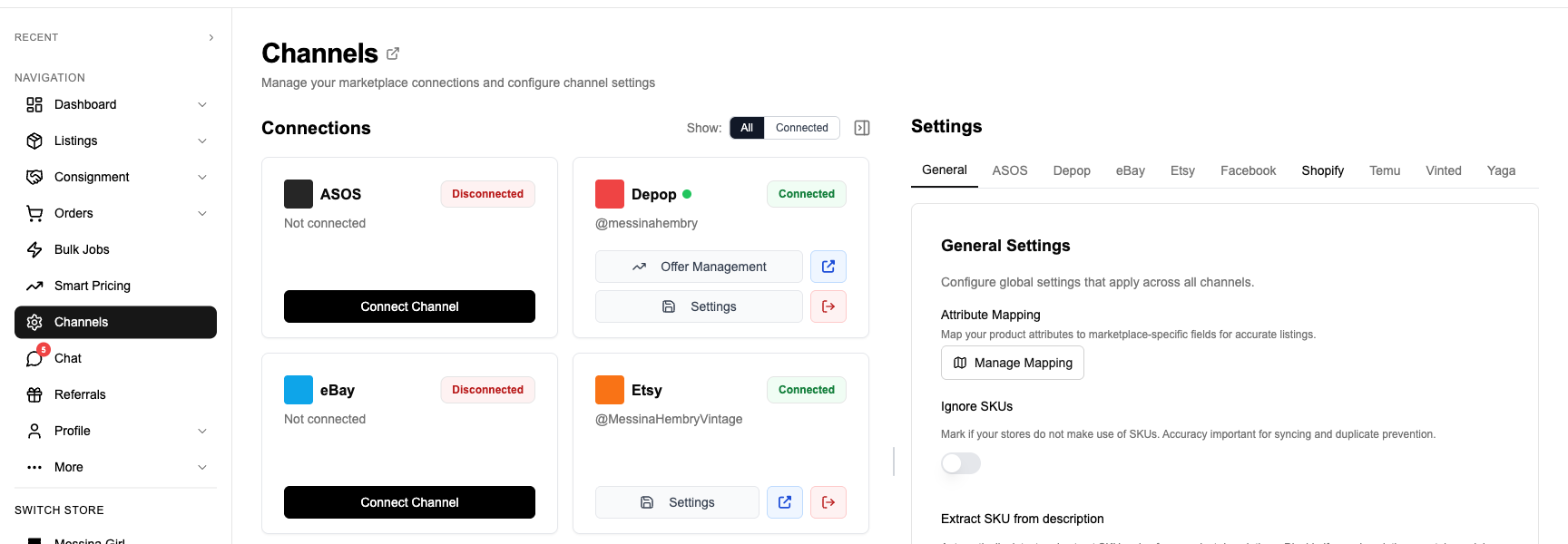
FLUF Connect automates that. You list once and it crossposts to Mercari and every other marketplace you sell on from a single dashboard, with the category, size, colour and condition matched per channel. Connect Mercari once through the FLUF browser extension; after that, listing is a matter of ticking which channels an item should go to.
What FLUF Connect does with Mercari
| Feature | Mercari support in FLUF Connect |
|---|---|
| Crosslisting | Yes — push products to Mercari alongside eBay, Poshmark, Depop, Vinted, Shopify and more |
| Mark as sold / delist | Yes — when an item sells on another connected channel, or you mark it sold in FLUF, the Mercari listing is taken down |
| Bulk listing | Yes — select multiple products and crosslist them together |
| Any product type | Yes — clothing, electronics, collectibles, homeware; not fashion-only |
| Auto-relisting | Not currently supported for Mercari |
| Offer management | Not currently supported for Mercari |
| Order sync | Yes — FLUF runs a sold scan against your Mercari account through the extension, so a sale on Mercari clears the item from your other connected channels |
We would rather be precise than oversell. FLUF Connect’s Mercari support today is crosslisting and mark-as-sold: you can list to Mercari from FLUF, and when an item sells on another connected channel — or you mark it sold yourself — FLUF removes the Mercari listing. Sales originating on Mercari are picked up too: FLUF runs a sold scan against your Mercari account through the extension, and a detected sale clears the item from your other connected channels. Relisting and offer management are not supported for Mercari either.
FLUF Connect plans start at £9/month (Starter), and every plan is paid; delisting when an item sells elsewhere is on every plan, while relisting, offer management and smart pricing are included from Seller upwards. See how crosslisting works, compare Poshmark and Mercari, or compare plans.
Sources & verification
We keep this guide accurate and cite primary sources for factual claims. Please contact us if any figure is out of date.
- Mercari — Selling fees and costs — 10% selling fee, 3.6% Buyer Protection fee, $0 listing fee, payout fees, 54% average label saving.
- Mercari — fee structure update — the 6 January 2025 reinstatement of the 10% seller fee.
- Mercari — Best rate shipping — 1 cubic foot / 22-inch eligibility and price examples.
- Mercari — shipping rate updates — 8% underpaid-shipping penalty, January 2026 Standard rate rise, May 2026 USPS fuel surcharge.
- Mercari shipping promotion — 49¢ First-Class Envelope rate through 31 December 2026.
- Mercari — promotions — Promote and Offer to Likers thresholds and rules.
- Mercari — Buyer Protection — the 72-hour rating window.
- Mercari — Seller Protection — up to $200 Shipping Protection, Mercari labels only.
- Mercari — Returns — not-as-described returns and the 3-day requirement.
- Mercari — Prohibited Items and Prohibited Conduct.
- Mercari — W-9 requirements for sellers.
- IRS — 1099-K threshold under the One Big Beautiful Bill and Mercari 1099-K policy.
- Value Added Resource — US MAU 4.3 million, down 4% year on year.
- Digital Commerce 360 — US GMV $602m for the nine months to 31 March 2026; the June 2026 US app.
- Value Added Resource — Mercari Local discontinued November 2024.
- Value Added Resource — Smart Offers discontinued 4 November 2024.
- Modern Retail — the 2024 return-policy reversal.
Deliberately omitted: we found no primary source for Mercari US category-share percentages, Smart Pricing’s current status, Pack & Ship mechanics, or the scam-loss and chargeback statistics that circulate on content-farm sites, so we have left them out rather than repeat unverifiable numbers.
Weighing the two? Read our head-to-head comparison. Mercari vs eBay.
Already on Mercari? You can crosslist to Poshmark automatically. Crosslist from Mercari to Poshmark.
Mercari sellers can crosslist to eBay’s much larger buyer pool. Crosslist from Mercari to eBay.
Depop is Mercari’s closest fashion-first rival — see the comparison. Depop vs Mercari.
Related guide
- Crosslist from Poshmark to Mercari — the same closet without the sharing grind
- Sell on Kijiji — Canada’s largest classifieds site — fees, rules and what FLUF can and cannot automate
- Crosslist from Whatnot to Mercari — the always-on shelf for the stock that sits idle between your live shows
Related guides
- Crosslist from Etsy to Mercari — no eligibility wall, but a possession wall
- Selling online from the United States
Related guides
- Mercari vs Facebook Marketplace — fees, reach and which one to sell on
- Crosslist from Mercari to Depop — where a US seller pays no selling fee at all
- Crosslist from Facebook Marketplace to Mercari
FLUF data This week on Mercari via FLUF: 7,077 active listings.
Subscribe to seller brief
Choose topics firstFrequently Asked Questions
Yes. Mercari charges sellers a 10% selling fee on the item price plus any buyer-paid shipping. Mercari removed seller fees entirely in March 2024, but reinstated the 10% fee on 6 January 2025, so any guide claiming Mercari has no seller fees is out of date. Buyers separately pay a 3.6% Buyer Protection fee; the buyer payment-processing charge of $0.50 + 2.9% was eliminated in the same January 2025 change.
Yes. There is no listing fee, no monthly fee and no setup fee on Mercari — you only pay when an item actually sells. Optional costs exist but you choose them: Instant Pay cash-out is $3 flat (standard direct deposit costs nothing), a failed direct deposit costs $2, seller-caused cancellations cost 5% of the item price capped at $25, and Mercari Authenticate is $5 to list plus $10 for a certificate.
Mercari sells discounted prepaid labels across USPS, UPS and FedEx, averaging 54% below retail carrier rates. Labels split into two tiers: Best rate for parcels under one cubic foot with a longest side of 22 inches or less, and Standard rate for anything bigger. Mercari's own examples show a 9 oz T-shirt at $6.29 Best versus $6.99 Standard, and a 4.5 lb speaker at $7.97 versus $10.99 — a 27% saving for packing small. Since March 2025 there is also an 8% penalty on underpaid shipping, so weigh the packed box before buying the label.
No. The Mercari marketplace this guide covers is US only — you need to be selling from the United States. Mercari Japan is a completely separate marketplace, not somewhere US sellers can list, and Hong Kong and Taiwan are cross-border buying regions rather than places you can sell from. In June 2026 Mercari launched a standalone US app that lets American shoppers browse and buy from the Japanese marketplace, but that is a buying bridge, not a selling route.
Profit from selling is reportable whether or not a form is issued. Separately, the 1099-K reporting threshold changed: the One Big Beautiful Bill Act, signed 4 July 2025, repealed the phased-in lower thresholds and reverted reporting to more than $20,000 in gross payments AND more than 200 transactions, retroactively covering 2025 and 2026. The $600 threshold was repealed before it took effect. Some states set their own lower thresholds. Mercari also requires a substitute Form W-9 and can restrict your selling if you do not submit it. This is general information, not tax advice.
Mercari's search order rewards recency and price movement, and it gives you two promotion tools. Promote boosts your search position and notifies likers, but requires a permanent price drop of at least 5% below the item's historically lowest price, once per 24 hours. Offer to Likers sends a temporary discount of at least 10% below that historic low to your 50 most recent likers, valid 24 hours, and acceptance is binding. Because both measure against your lowest-ever price, list 15-20% above your floor so you keep the headroom to use them.
As a secondary channel for parcel-friendly general goods, yes. It costs nothing to list, takes a straightforward 10%, has strong discounted shipping, accepts almost any category, and gives sellers a three-day dispute window that is far friendlier than eBay's 30-day Money Back Guarantee. The caveat is the audience: Mercari US reported 4.3 million monthly active users, down 4% year on year, so relying on it as your only channel means competing for a pool of buyers that is not currently growing.
Yes. FLUF Connect lets you list a product once and crosspost it to Mercari alongside eBay, Poshmark, Depop, Vinted, Shopify and more from a single dashboard, with the category, size, colour and condition matched per channel. When an item sells on another connected channel, or you mark it sold in FLUF, the Mercari listing is taken down automatically. To be precise about scope: FLUF's Mercari support today is crosslisting and mark-as-sold — it does not yet import Mercari orders, relist on Mercari, or manage Mercari offers. Plans start at £9/month (Starter); There is no free plan, but every new account gets a 7-day trial for £1.