
Whatnot to Mercari: Crosslist the Stock Between Your Shows
An honest guide for US Whatnot livestream sellers putting unsold lots and never-ran collectibles onto Mercari's always-on shelf — fees, grading fields, two-way order sync and the limits.
7 days for £1, then from £9/month.



Key Takeaways
- A live show is an event. Your inventory is not. Whatnot is built around scheduled streams — when the stream ends, the bin of unsold lots stops earning. Mercari is the always-on shelf that stock can sit on between shows.
- Mercari’s growth is led by exactly your categories. Its own investor material names Entertainment and Hobbies as the focus for GMV growth (Mercari IR), and its FY2026 results credit the US recovery to “strong demand in Entertainment & Hobbies… particularly collectibles and trading cards” (Value Added Resource).
- Fees, briefly. Whatnot takes 8% of the final sale price in the US, Canada and Australia, plus 2.9% of order value and $0.30 (Whatnot Help Center). Mercari takes 10% of item price plus buyer-paid shipping, no separate processing fee, and charges the buyer 3.6% Buyer Protection (Mercari Help Center).
- Mercari is United States only. Whatnot approves sellers in ten countries (Whatnot Help Center) and FLUF Connect covers nine of them. If you stream from the UK, Germany, France, Austria, Australia, Belgium, Canada or the Netherlands, this pair is closed to you.
- Both sides run through the FLUF Chrome extension. Neither channel offers a third-party seller API, so every listing action happens in your own signed-in browser. You need a desktop or laptop with Chrome and the extension open while listings are created.
- Order sync runs both ways. A Whatnot sale can pull the Mercari listing; a Mercari sale can clear the Whatnot one. For graded singles and one-of-one collectibles that is the whole reason to use software rather than a spreadsheet.
- Mercari will not reproduce auction energy. No bidding war, no chat, no impulse. Expect quieter, slower, and often lower prices on the same card.
- Cost: £1 for 7 days, then plans from £9/month (Starter). There is no free plan. See pricing.
Why A Live Seller Needs An Always-On Shelf
Whatnot has been the best thing to happen to collectibles selling in a decade. Its global GMV passed $8 billion in 2025, roughly double the year before, according to its own State of Live Selling report (cllct), and in August 2026 the company raised $545 million at a $20 billion valuation (PYMNTS). Buyers spend an average of 80 minutes a day on the platform (Whatnot trends report). Nobody selling cards, comics, sneakers or vintage toys needs convincing that live works.
But live works in bursts. That is the design, not a flaw. You schedule a show, promote it, run for three hours, and close the stream. Everything that sold, sold in that window. Everything else goes back in the bin, where two piles accumulate.
The pass-throughs. Lots that got one bid or none — a PSA 8 opened at $40 that nobody chased because the room wanted modern basketball, a run of Funko exclusives that would move on any other night. Their audience was somewhere else at 8pm on Tuesday, and the only remedy on Whatnot is to re-run them, which costs show minutes: the scarcest thing a live seller has.
The stock that never got a slot. Every live seller buys in volume and runs a fraction of it. You take a shop buyout or a storage unit, cherry-pick twenty pieces that will hold a room, and the remaining hundred sit in longboxes waiting for a themed show that keeps getting bumped. That is capital sitting still, and it does not age gracefully — sealed product drifts, sneaker sizing goes stale, a hot rookie cools off.
Neither pile is bad stock. It needs a buyer who is browsing rather than watching. Someone searching “1999 Pokémon Base Set Machamp PSA 7” at two in the afternoon will never find a stream you are not running — but they will find a listing.
Why Mercari Specifically, And Not Just Anywhere
The generic second outlet is eBay, and for high-value graded material that is often correct — see Whatnot to eBay. Mercari earns its place for a different reason: its growth is currently carried by the categories a Whatnot seller already holds.
Mercari’s investor FAQ states it will pursue GMV growth by “strengthen[ing] categories with high price ranges, and focusing on the Entertainment and Hobbies category” (Mercari IR). Its FY2026 results are more specific: US GMV of $810 million, up 11%, with “Entertainment & Hobbies continu[ing] to drive much of the improvement, particularly collectibles and trading cards” (Value Added Resource).
That matters because Mercari’s reseller reputation was built in apparel, and apparel is not where its momentum is. If you sell clothing, read Poshmark vs Mercari or Poshmark to Mercari instead. If you sell cards, comics, figures and hobby stock, you are listing into the part of Mercari the company is pushing marketing at.
The hard constraint before anything else. Both channels require the FLUF Chrome extension for every listing action. This pair requires a desktop or laptop, Chrome, the extension installed, and the browser open while listings are created. If your whole operation runs from a phone in front of a ring light, solve that first.
The United States Limit, Stated Up Front
Mercari’s marketplace is United States only — its own shipping documentation confirms it ships “to all 50 states and the District of Columbia” and cannot ship to territories or PO/APO/FPO addresses (Mercari Help Center). Whatnot approves sellers in ten countries (Whatnot Help Center), and FLUF Connect’s Whatnot channel covers nine of them: the US, United Kingdom, Germany, France, Austria, Australia, Belgium, Canada and the Netherlands.
The conclusion is blunt. If you stream from the UK, Germany, France, Austria, Australia, Belgium, Canada or the Netherlands, you cannot use this route — not with FLUF, not with anything else, because there is no Mercari to sell on. Whatnot’s rules also stop you sidestepping it: bank account country and currency must match your registration, and selling from a second country needs a separate account and application. British and European live sellers should read the crosslisting guides for their own market. The rest of this page assumes you stream and ship from the United States.
Which Of Your Stock Can Actually Be Crosslisted
This is the part most crosslisting advice skips, and on Whatnot it decides everything. Whatnot has two listing types, and only one of them produces a record that survives long enough to be worth mirroring.
Whatnot’s own guide is plain about it. Temporary Listings are “only visible during the live show in which they’re created” and “disappear when the show ends”. Quality Listings “stay active even after the show ends” and “require detailed descriptions and photos” (Whatnot Help Center).
Layered on that is the format: Auction, Buy It Now, or Giveaway. Buy It Now listings appear in your Profile Shop by default — “your storefront on your profile where buyers can browse and purchase eligible Buy It Now listings anytime” — while Auction and Giveaway listings are reserved for the Live Shop of a specific show (Whatnot Help Center). So Whatnot does support persistent, non-live listings in 2026, and a Quality Buy It Now listing stays in your Profile Shop until you remove it or run out of stock.
What this means for crosslisting:
- Quality Buy It Now listings are the natural source. They already carry photos, a description, a weight and a price, and they persist. They are the closest thing a live seller has to a conventional catalogue.
- Temporary Listings are uncrosslistable as-is. A lot titled “1–2 kilos #37” — Whatnot’s own suggested pattern for high-volume shows — has no title, description or photo worth putting in front of a Mercari search.
- Unsold auction lots need converting. An unsold auction is a Whatnot artefact, not a product record. Recreate it as a Quality Buy It Now listing at the price you would accept.
The discipline, then: stock you want on Mercari should be created as a Quality Buy It Now listing on Whatnot first. That is a habit change, not a software feature, and the highest-leverage thing on this page. Whatnot charges nothing to create, store or manage listings, so the cost is your time at the listing table.
What Each Side Takes
Whatnot’s fee schedule is category-dependent. In the US, Canada and Australia the standard commission is 8% of the final sale price, excluding shipping and taxes, with Coins & Money and Pallets at 4%. On top sits 2.9% of total order value plus $0.30 — and order value includes buyer-paid shipping and tax, so the bite varies between two sales at the same hammer price. A reduced-commission promotion currently runs in Comics, TCG, Sports Singles and Toys & Hobbies: 8% up to $1,500, 0% above (Whatnot Help Center). There are no fees to create, store or manage listings.
Mercari, since 6 January 2025, charges the seller a 10% selling fee on the item price plus buyer-paid shipping, with no separate payment processing fee, and charges the buyer a Buyer Protection fee of 3.6% of item price plus buyer-paid shipping (Mercari Help Center). Listing costs nothing.
On a $100 card with $10 of buyer-paid shipping, Whatnot takes $8 commission plus roughly $3.20 processing; Mercari takes $11 on the same $110. They diverge at the extremes — above $1,500 in the promoted categories Whatnot is far cheaper, and under $10 Mercari’s flat 10% beats Whatnot’s fixed $0.30. Neither gap justifies moving a business. Availability is the argument here, not price.
On Whatnot, shipping is charged to the buyer at checkout and you download a prepaid label from Seller Hub; approved sellers can use Bring Your Own Label in limited cases. Earnings become available once the carrier confirms delivery, or at label generation with Early Payout (Whatnot Help Center).
Mercari sells prepaid labels in weight brackets across USPS Ground Advantage, Priority Mail, Media Mail and First-Class Envelope, plus UPS Ground and Ground Saver and FedEx Ground Economy. Standard labels cover up to 50 lbs actual or dimensional weight, 34″ on the longest side and 20″ on the second-longest; First-Class Envelope caps at 3 oz. Shipping Protection covers up to $200 on standard, economy, Local and Media Mail rates, and up to $20 on First-Class Envelope (Mercari Help Center).
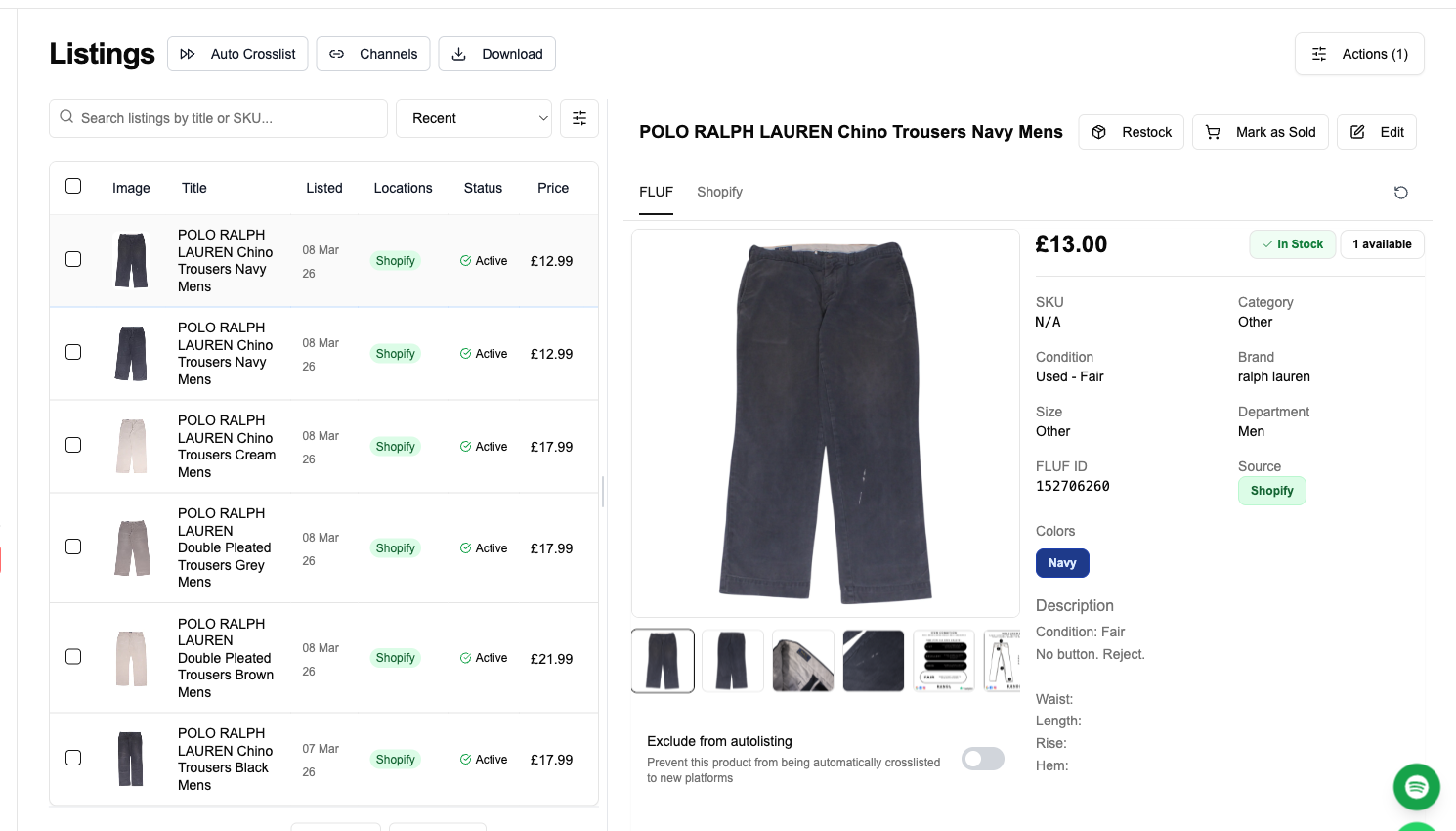
How Stock Moves From Whatnot To Mercari
The mechanics are the same as any FLUF pair, with one wrinkle that is specific to a live seller: your Whatnot catalogue is not automatically a catalogue.
Connect both channels. Both are self-serve — you sign in to each in your own browser with the extension installed, and neither is an API integration, so there is no developer key to wait for. Whatnot does gate selling behind an application: most sellers “unlock seller access within minutes”, and categories such as Luxury Bags & Accessories and Wholesale need extra approval afterwards (Whatnot Help Center).
Bring the source listings in. FLUF reads your persistent Whatnot inventory and creates a master product record per item — photos, title, description, price, quantity, condition, weight. Anything that only existed as a Temporary Listing in a finished show will not be there, because it no longer exists on Whatnot either.
Review before you push. Live-show titles are written to be read aloud, not searched. “Big slab, huge eye appeal, going cheap” is great on a stream and useless as a Mercari title. Fix the title and category, add the detail Mercari wants, then push.
Push to Mercari. With the extension running, FLUF creates the listing in your signed-in session, so everything appears exactly as if you had typed it and Mercari’s own rate rules apply. Bulk pushes are paced deliberately; a 300-item first run is an afternoon, not a click.
Field And Category Mapping
Whatnot’s listing model is built for a seller talking to a room. Mercari’s is built for a database. That gap is where crosslisted collectibles go wrong.
| Whatnot lot / listing field | Mercari listing field | What actually happens |
|---|---|---|
| Listing title | Title | Rarely usable as-is. Whatnot titles are show shorthand; Mercari titles are search bait. Rewrite to year, set, player or character, card number, parallel, grade. |
| Description | Description | Carries over. Strip live-selling language — “first to comment”, “no returns on rips”, show bundle terms — and add what a browsing buyer needs. |
| Photos (minimum 1) | Photos (minimum 1) | Transfers. Both accept a single image, but a slab needs front, back and a legible cert number. |
| Price (BIN) or hammer price | Price | Transfers. An unsold auction has no price to carry — you set one. |
| Quantity | Quantity | Transfers. Most collectibles are quantity one, which is precisely why sync matters. |
| Condition | Condition | Partial. Mercari’s condition ladder is generic; Whatnot’s hobby vocabulary is not. See below. |
| Shipping Profile (weight band) | Shipping weight tier / carrier | Re-select. Whatnot profiles are bands you defined; Mercari has its own brackets and carrier caps. |
| Category | Category and subcategory | Manual. Whatnot’s taxonomy is organised around show verticals; Mercari’s around a general marketplace tree. |
| Grading company and grade | No structured field | Goes in the title and description. This is the single most important manual step. |
| Set / series / year | No structured field | Title and description only — buyers search this text. |
| Player, character or franchise | Brand field (approximate) plus title | Mercari’s Brand field was designed for apparel labels. Use it where a real brand exists — Topps, Panini, Funko, Bandai; otherwise the title carries it. |
Grading Is The Field That Does Not Exist
Mercari has a policy on graded cards but no data field for them. Its Sports Collectibles policy names the graders it accepts — PSA, BGS, SGC, CSG and CGC — and the autograph authenticators PSA/DNA, BAS and JSA. Cards graded by anyone else are treated as raw and “may be removed if the authenticity of the item cannot be determined”. It recommends listings display “identification information about the encased card, the grade the card received, as well as a unique serial number that can be verified at the authenticator’s website”, and states that Mercari is “not a third-party trading card or autograph authentication company” (Mercari Help Center).
That is a policy expressed entirely in free text. There is no dropdown where you select “PSA” and “9”, nothing validates the claim, and nothing stops a buyer missing you because you wrote “PSA9” and they searched “PSA 9”. On Mercari your title is your structured data, and a sloppy one is the difference between appearing in search and not existing.
A workable convention for a slab, in order: year, set, subset or parallel, player or character, card number, grading company, grade, serial if numbered — 2021 Topps Chrome Update Bobby Witt Jr RC #USC5 PSA 10 Gem Mint. Ugly, and exactly what people type. The same logic covers graded comics and sealed product, where set name, language, year and exact configuration are the searchable facts — “booster box” and “booster bundle” are different objects to a buyer and identical to a category tree.
Condition Vocabulary Has No Clean Translation
Mercari’s condition selector is a general-purpose ladder built for a marketplace selling phone cases alongside slabs. The hobby’s vocabulary — near mint, lightly played, heavily played for singles; very fine, fine, good for comics; deadstock, VNDS, beaters for sneakers; C9 with a soft corner for Funko — has no equivalent in it.
No mapping table fixes that, and any tool claiming to is lying. Pick one condition value, then use the description to say what you actually mean. A “Like New” listing for a lightly played Magic card that says “minor edge wear on the back, no creases, plays in a sleeve” is honest and will not generate a return. The same listing with no elaboration will.
What Syncs, What Does Not
For a collectibles seller this is the reason software exists. Almost everything you own is quantity one, and a PSA 10 rookie is not restockable. If it sells in a show at 9:14pm and the Mercari listing is still up at 9:15pm, that is a real problem, not a theoretical one.
Order sync runs on both sides. FLUF supports order sync and mark-as-sold on Whatnot and on Mercari. A Whatnot sale can pull the Mercari listing; a Mercari sale can pull the Whatnot one. Neither channel is the passive side. For one-of-one items that symmetry is the whole point — a pair where only one side reports sales leaves you exposed in the other direction, and this pair does not have that hole.
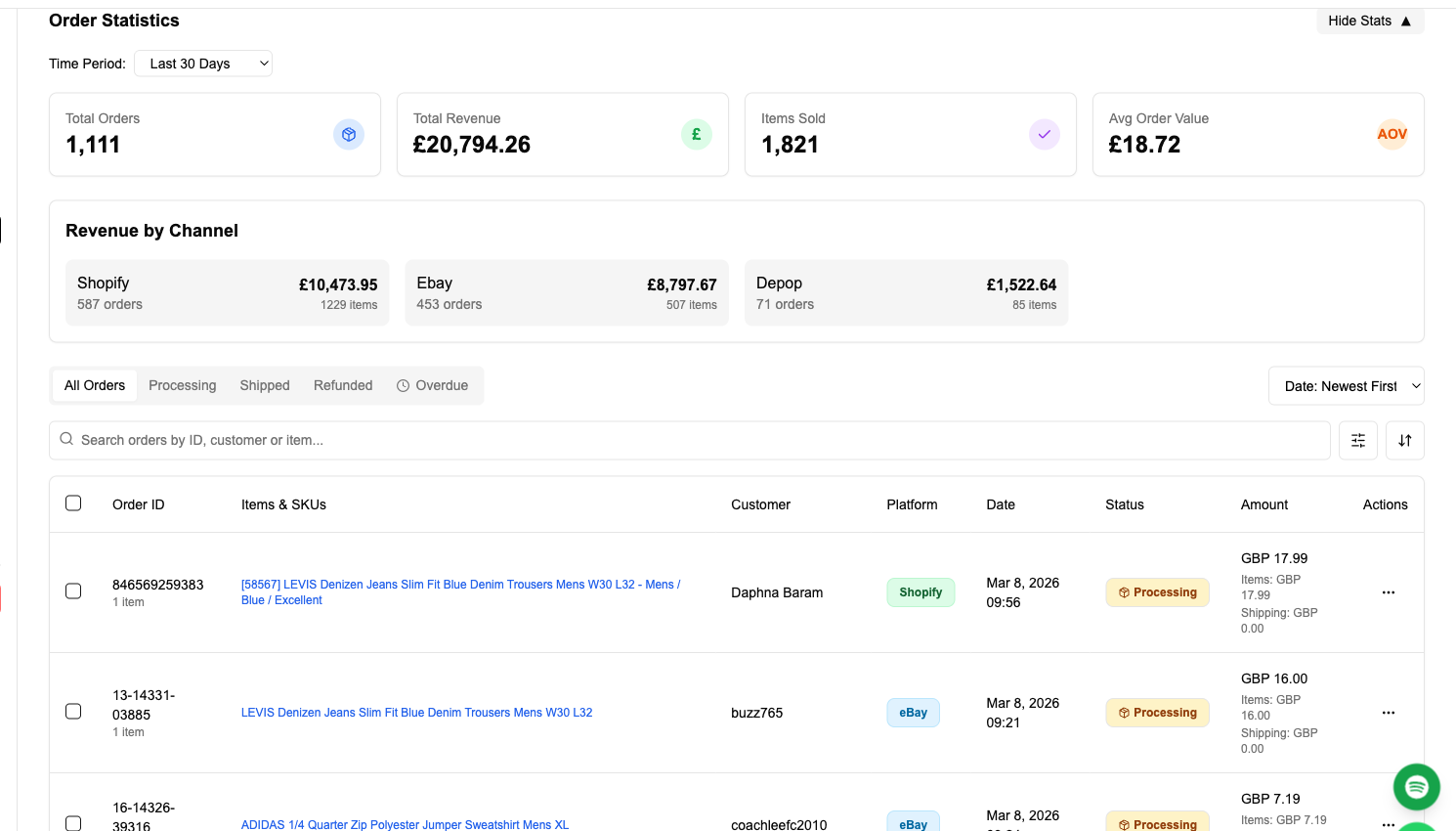
It is a detection cycle, not a webhook. Your plan sets how often FLUF checks: every 90 minutes on Starter, down to every 15 on Super Seller (pricing). During a show, where a hundred lots can close in an hour, that gap is real. Two habits close it: mark items sold in FLUF as you run them, and keep headline lots off Mercari entirely. The shelf is for the pass-throughs and the never-ran stock anyway.
What does not sync. FLUF does not offer automatic relisting on Whatnot or Mercari, so neither side is refreshed on a schedule. It does not manage offers on either channel either, which matters more than it sounds: Whatnot Buy It Now listings can accept offers and Mercari buyers negotiate constantly, so every offer is yours to answer by hand. That capability exists in FLUF for other channels — see the crosslisting overview — but not for this pair.
Before And After: A Week In The Bin
Before. Tuesday and Thursday shows, three hours each, roughly 120 lots run and maybe 85 sold. The rest goes back into a plastic tub. On Sunday you promise yourself you will list the tub, get eleven items in and stop, because each one means retyping a title, re-uploading photos and guessing a weight. Three months later you find a slab in there worth $180 in March and $95 now — and the estate-buyout boxes have still never been opened on camera.
After. The habit changes first. Anything you would sell at a fixed price gets created as a Quality Buy It Now listing rather than a Temporary Listing, so it exists as a real record with photos and a description and sits in your Profile Shop between shows — already better than the tub.
FLUF picks those listings up as products. On Sunday you spend forty minutes doing the part software cannot: rewriting titles into search language, setting Mercari categories, choosing weight tiers, writing out grading detail. Then you push the batch, and with Chrome open sixty listings go up while you make dinner.
Through the week, order sync watches both shelves. A Mercari buyer takes the Machamp on Wednesday; the Whatnot Profile Shop listing comes down and you do not accidentally run it on Thursday. You run a lot on Thursday that was also on Mercari; you mark it sold as you pack it, and the Mercari listing clears.
One thing to plan for as volume climbs: the IRS requires third-party settlement organisations to report on Form 1099-K “when the total amount of payments you receive for goods or services through the platform exceeds $20,000 in more than 200 transactions” (IRS). Several states set lower thresholds, so check your own. Two platforms means two forms that both need to agree with your books.
The Honest Downsides
Mercari will not reproduce auction energy. A live auction produces a price because two people in a chat want the same card in the same sixty seconds and the timer is running. Nothing on a static listing page does that. The card that hammered at $220 in a hot room might sit at $150 on Mercari for a fortnight. That is not Mercari failing; it is the absence of the mechanism that produced the $220. Price the shelf for patient buyers, not for the room.
The audience is smaller. Mercari US had 4.2 million monthly active users in Q4 FY2026 (Value Added Resource) — a real marketplace growing in your categories, but not eBay. For genuinely high-value graded material you will find deeper bidding elsewhere; Mercari to eBay covers that combination.
No automatic relisting on either side. FLUF does not relist on Whatnot and does not relist on Mercari. A listing that has sat for ninety days will keep sitting unless you refresh it yourself. On a marketplace where recency affects visibility that is a genuine gap, and we would rather say so than have you discover it.
No offer management on either side. Mercari buyers negotiate as a matter of routine. Whatnot Buy It Now listings can accept offers too. All of it is manual for this pair.
The extension is a real dependency. A machine that is asleep is not listing, and a logged-out browser session stops the queue. If you travel for card shows, plan around it.
What It Costs
FLUF Connect is £1 for 7 days, then plans from £9/month (Starter). There is no free plan. Every plan is unlimited on listings and marketplaces; the tiers differ by which automations they include and how often we check your channels for sales — every 90 minutes on Starter, down to every 15 on Super Seller. Annual billing saves 40%. Detail on the pricing page.
Automation — sync, bulk operations, relisting and offer management on the channels that support them — is included from Seller upwards, not a paid add-on. For this pair, relisting and offer management are not available on either channel, so what you pay for is the crosslisting and the two-way order sync.
Selling in more places than these two? The channel guides cover the rest, including which channels do support relisting.
Sources & Verification
Every figure here was checked against a primary source on 23 August 2026. Fees and policies change; verify before relying on them.
- Whatnot Help Center — Whatnot seller fees
- Whatnot Help Center — New seller guide to listing products
- Whatnot Help Center — Create product listings
- Whatnot Help Center — Apply to sell on Whatnot
- Whatnot Help Center — Seller location & currency requirements
- Whatnot Help Center — When you’ll get paid for your sales
- Whatnot Help Center — Bring Your Own Label
- Whatnot — 2026 & Whatnot: How Live Shopping is Redefining Retail
- cllct — Whatnot doubled sales to more than $8 billion in 2025
- PYMNTS — Whatnot raises $545 million
- Mercari Help Center — Fees on Mercari
- Mercari Help Center — Sports Collectibles
- Mercari Help Center — Shipping labels, tracking, and carrier options
- Mercari, Inc. — Top Investor Questions
- Value Added Resource — Mercari US GMV up 15% as active users return to growth
- IRS — Understanding your Form 1099-K
FLUF Connect channel capabilities described here — extension requirement, supported countries, order sync and mark-as-sold, and the absence of relisting and offer management on both channels — reflect the live channel registry as at 23 August 2026.
Related guides
Frequently Asked Questions
No. Mercari's marketplace is United States only — it ships to all 50 states and the District of Columbia and nowhere else. Whatnot approves sellers in ten countries and FLUF Connect covers nine of them, but a Whatnot seller based in the UK, Germany, France, Austria, Australia, Belgium, Canada or the Netherlands has no Mercari account to list to. This route is available to US-based Whatnot sellers only.
You need a desktop or laptop running Chrome, with the FLUF Chrome extension installed. Stay signed in to Whatnot and Mercari and keep Chrome open while creating listings on either channel.
Quality Buy It Now listings. Whatnot has two listing types: Temporary Listings, which are only visible during the show they were created in and disappear when it ends, and Quality Listings, which stay active afterwards and carry proper photos and descriptions. Buy It Now listings sit in your Profile Shop by default. Anything that only existed as a Temporary Listing in a finished show no longer exists on Whatnot, so there is nothing to mirror. The practical habit is to create stock you want on Mercari as a Quality Buy It Now listing first.
Whatnot charges an 8% commission on the final sale price in the US, Canada and Australia (4% for Coins & Money and Pallets), plus a payment processing fee of 2.9% of total order value and a $0.30 transaction fee. A limited-time promotion drops commission to 0% on the portion of a sale above $1,500 in Comics, TCG, Sports Singles and Toys & Hobbies. Mercari charges the seller 10% of item price plus buyer-paid shipping, with no separate processing fee, and charges the buyer a 3.6% Buyer Protection fee. Both charge nothing to create a listing.
Yes, in both directions. FLUF supports order sync and mark-as-sold on Whatnot and on Mercari, so a Whatnot sale can pull the Mercari listing and a Mercari sale can clear the Whatnot one. It is a detection cycle rather than an instant webhook — every 90 minutes on Starter, down to every 20 minutes on Super Seller — so during a live show you should also mark items sold in FLUF as you run them.
Put the grading detail in the title. Mercari has a policy on graded cards but no structured field for them: it accepts PSA, BGS, SGC, CSG and CGC for cards, and PSA/DNA, BAS and JSA for autographs, and treats anything else as raw. A workable title order is year, set, subset or parallel, player or character, card number, grading company, grade and serial number if the card is numbered. On Mercari the title is your structured data, so an imprecise one keeps you out of search results entirely.
No. FLUF does not offer automatic relisting on Whatnot or Mercari, and does not manage offers on either. Whatnot Buy It Now listings can accept offers and Mercari buyers negotiate routinely, so every offer on both sides is yours to answer by hand. Those capabilities exist in FLUF for other channels, but not for this pair.
Usually not. A live auction produces its price because two people in a chat want the same item in the same sixty seconds with a timer running, and nothing on a static listing page reproduces that. The same card that hammered at $220 in a hot room may sit at $150 on Mercari for a fortnight. Price the Mercari shelf for patient buyers, and keep your headline lots for the stream.
£1 for 7 days, then plans from £9/month (Starter). There is no free plan. Every plan is unlimited on listings and marketplaces; the tiers differ by which automations they include and how often we check your channels for sales — every 90 minutes on Starter, down to every 20 on Super Seller. Annual billing saves 40%.
You will potentially receive a Form 1099-K from each platform. The IRS requires third-party settlement organisations to report when payments for goods or services exceed $20,000 in more than 200 transactions, and several US states set lower thresholds than the federal one. Selling in two places does not increase your tax liability, but it does mean two forms whose numbers need to agree with your own books.