Poshmark to Mercari: Crosslist Without the Sharing Grind
An honest guide for established Poshmark closet owners adding Mercari as a lower-effort, lower-commission second outlet — fees, worked examples, category breadth and the sync asymmetry.



Key Takeaways
- This pair is about labour, not just fees. Poshmark rewards constant self-promotion — its own Posh Ambassador criteria ask for 5,000 self-shares and 5,000 community shares (Poshmark Blog). Mercari has no sharing feed to feed.
- Poshmark takes 20% on anything $15 or over, and a flat $2.95 below that (Poshmark Fee Policy v1.7). Mercari takes a flat 10% selling fee on item price plus buyer-paid shipping (Mercari Help Center).
- Both channels require the FLUF Chrome extension. Use a desktop or laptop and keep Chrome open and signed in while listings are created.
- The sync is asymmetric. FLUF supports order sync on Mercari, so a Mercari sale can pull the Poshmark listing down automatically. Poshmark has no order feed — you mark the item sold in FLUF and FLUF clears it from Mercari.
- Mercari is United States only. A Canadian Poshmark seller cannot use this pair at all.
- Mercari’s fashion demand is weaker than Poshmark’s, and Mercari buyers negotiate harder. Treat Mercari as a second outlet for the same stock, not a replacement closet.
- Cost: £1 for 7 days, then plans from £9/month (Starter). There is no free plan. See pricing.
Why A Poshmark Closet Owner Lists On Mercari
If you have run a Poshmark closet for more than a season you know the deal. Poshmark gives you a buyer base — the company puts its community at “80+ million Poshers” (poshmark.com/sell) — and in exchange asks you to work the feed. Share your listings. Share other people’s. Turn up to Posh Parties. Drop prices during Closet Clear Out. Send offers to likers. The closet that gets shared is the closet that gets seen.
That bargain is fine when it is the only game you are playing. It gets expensive when you notice that the same 200 items could be sitting on a second marketplace, earning nothing extra in effort, at roughly half the commission. Mercari is that second marketplace for a lot of Poshmark sellers, for three reasons:
- There is no sharing mechanic. No follower feed, no equivalent of a Posh Party. Listings sit in search and category browse. You can promote — Mercari’s Promote button boosts a listing in search if you cut the price by 5% or more (Mercari Help Center) — but that is a price lever, not a labour lever.
- The commission is lower. Poshmark takes 20% flat once a sale reaches $15 (Poshmark Fee Policy). Mercari takes 10% of item price plus buyer-paid shipping (Mercari Help Center). Arithmetic below.
- Mercari takes categories Poshmark restricts. Poshmark’s Prohibited Items Policy describes a marketplace for “most types of new and pre-owned fashion, new personal care items, as well as select home goods, pet items, and electronics with certain restrictions” (Prohibited Items Policy v4.0, 26 May 2026). Mercari is a general marketplace.
None of that means Mercari is a better marketplace than Poshmark for clothing. It is not, and we say so plainly further down. It means Mercari is a cheap, low-maintenance second shelf for stock you are already holding.
Use a desktop or laptop with Chrome and the FLUF extension. Keep the browser open and signed in while listings publish. Mercari is US-only: Canadian Poshmark closets cannot use this pair. Consider a channel with wider availability, such as eBay.
The Effort Argument: What A Sale Costs You In Time
Fees are easy to compare because both companies publish them. Effort is harder, so most comparison pages skip it. It is the more important number for an established closet.
What Poshmark asks of you
Poshmark’s visibility model is explicitly social. The company’s own seller-facing copy tells you to “share listings with your followers to help shoppers discover your merchandise” (poshmark.com/sell). The clearest published measure of how much sharing Poshmark considers normal is the Posh Ambassador programme. To qualify, a seller needs:
- 5,000 community shares — sharing items from other Poshers’ closets
- 5,000 self-shares — sharing your own items to the community
- at least 50 available listings and 15 sales
- an average ship time under three days and a rating of 4.5 stars or better
Those thresholds are Poshmark’s, published on its own blog (How to Become a Posh Ambassador). Ten thousand share actions is not a badge requirement dreamt up by sellers; it is the platform telling you what engagement it wants.
On top of that sit the Posh Parties — four a day, at 9am, noon, 4pm and 7pm PT, and sharing on-theme listings into them is how your items surface (Posh Parties 101). Then Closet Clear Out: drop a listing at least 10% below its lowest historical price and Poshmark notifies everyone who liked it, sometimes with a six-hour shipping discount attached (Poshmark Price Drop Policy).
How long does that take daily? Poshmark publishes no figure and neither will we. Seller communities routinely describe 30 to 90 minutes a day on a few-hundred-item closet, and a small industry of third-party sharing bots exists on the assumption that it is too much by hand. That is anecdote, not data — but the bot market is itself evidence about the workload.
What Mercari asks of you
Materially less. No feed, no party schedule, no follower graph. Mercari’s discovery is search-led, and its seller-side levers automate inside Mercari itself:
- Offer to Likers — cut a price by 10% or more and Mercari notifies up to 50 recent likers; the offer lasts 24 hours. Mercari can also auto-send your most recent offer to new likers after a delay you configure (Mercari Help Center).
- Smart Pricing and Smart Offers — Mercari’s own automated pricing and offer-handling tools, which sit on the listing and keep working without you. Mercari notes that promoting below your set minimum price disables them, so they are price-floor driven (Mercari Help Center).
- Time-limited sale — a discount on anything listed seven days or more.
The honest framing: Poshmark converts your time into visibility; Mercari converts your margin into visibility. If your closet is large and your hours short, the second trade is usually better — and crosslisting means you do not have to choose.
What Each Platform Actually Takes
Both platforms publish current fee schedules. Verified 23 August 2026.
| Poshmark (US) | Mercari (US) | |
|---|---|---|
| Listing fee | None | None |
| Seller commission | $2.95 flat on sales under $15; 20% on sales of $15 and above | 10% of item price + buyer-paid shipping |
| Payment processing | Included in the commission | No separate processing fee since 6 January 2025 |
| Buyer-side fee | None — removed 24 October 2024 | 3.6% Buyer Protection fee on item price + buyer-paid shipping |
| Shipping | Buyer pays a flat $6.49 for USPS Ground Advantage up to 5 lb; one prepaid label or QR code per order | Prepaid labels via USPS, UPS and FedEx; seller chooses whether the buyer pays or the cost comes out of proceeds |
| Payout release | After the buyer accepts, or automatically three days after delivery | Direct deposit, no fee, typically five business days; Instant Pay $3 per transfer, up to $600/month |
| Buyer protection model | Posh Protect — refund if the item never ships or does not match the description; 72-hour window to open a case | Mercari Buyer Protection, funded by the 3.6% buyer fee |
| Countries | United States and Canada | United States only |
Sources: Poshmark Fee and Shipping Policies, Posh Protect, Poshmark shipping announcement, Fees on Mercari, Mercari shipping labels.
Worked Examples: What You Keep At $15, $40 And $120
To keep these comparable we hold shipping constant at $6.49 — Poshmark’s published flat rate — and assume the buyer pays it on both sides. Mercari’s rates vary by weight, carrier and service, so $6.49 in the Mercari column is a modelling assumption, not a Mercari-published price. Mercari’s 10% applies to item price plus buyer-paid shipping.
| Sale price | Poshmark fee | Poshmark take-home | Mercari fee | Mercari take-home | Difference |
|---|---|---|---|---|---|
| $12.00 | $2.95 (flat) | $9.05 | $1.85 | $10.15 | +$1.10 on Mercari |
| $15.00 | $3.00 (20%) | $12.00 | $2.15 | $12.85 | +$0.85 on Mercari |
| $40.00 | $8.00 (20%) | $32.00 | $4.65 | $35.35 | +$3.35 on Mercari |
| $120.00 | $24.00 (20%) | $96.00 | $12.65 | $107.35 | +$11.35 on Mercari |
The gap widens with price. At $15 the difference is under a dollar and not worth reorganising your business over. At $120 it is $11.35 — nearly 12% of the sale. If your closet skews towards $60-plus items, Mercari’s commission advantage is real money. If you mostly move $10 t-shirts, it barely registers, and Poshmark’s flat $2.95 under $15 is actually the worse deal on a percentage basis (24.6% on a $12 sale) while Mercari’s effective rate there is about 15.4%.
Mercari’s effective rate on the item alone is not 10%. Because the fee is levied on item price plus shipping, a $15 item with a $6.49 label carries an effective 14.3% rate on the item; at $40 it is 11.6%, at $120, 10.5%. The headline number flatters the platform most on expensive items.
The buyer pays more on Mercari. Poshmark removed its Buyer Protection Fee on 24 October 2024, so a Poshmark buyer pays item price plus $6.49 plus tax. A Mercari buyer pays item price plus shipping plus 3.6% — an extra $1.67 on a $40 item. One reason Mercari buyers haggle: the checkout number is bigger than the listing.
Category Breadth: The Stock Poshmark Turns Away
Poshmark has broadened out — its navigation now runs Women, Men, Kids, Home, Electronics, Pets and Beauty & Wellness — but its Prohibited Items Policy is still a fashion policy with adjacent categories bolted on. It accepts “most types of new and pre-owned fashion, new personal care items, as well as select home goods, pet items, and electronics with certain restrictions”, then attaches conditions: electronics factory reset and signed out; makeup new, never swatched and alcohol-free; aerosols, perfumes and nail polish not shippable on Poshmark labels at all (Prohibited Items Policy v4.0).
Mercari carries no such framing. It is a general secondhand marketplace with a prohibited-items list rather than a permitted-categories list (Mercari Prohibited Items), and its investor reporting names Entertainment & Hobbies as the driver of its US growth in the year to June 2026 (Mercari FY2026.6 results presentation). Mercari also offers Media Mail labels for books, films and printed music, and First-Class Envelope labels up to 3 oz for trading cards — infrastructure Poshmark does not have (Mercari Help Center).
Practically, the sourcing bin you currently ignore becomes sellable. Resellers who buy estate lots, storage units or thrift-by-the-pound end up with non-clothing items — games, controllers, LEGO, vinyl, kitchenware, tools, trading cards — that Poshmark either restricts or has no buyer base for. One product record in FLUF Connect can serve both the fashion stock and the odds and ends.
How Products Move From Poshmark To Mercari
Keep Chrome open with the FLUF extension installed and both marketplace accounts signed in.
- Connect both channels in FLUF Connect. Both appear in the channels list, both flagged as requiring the FLUF Chrome extension, both self-serve — no application, no approval wait.
- Install the FLUF Chrome extension on a desktop computer. Chrome only. Sign in to Poshmark and Mercari in that same browser profile.
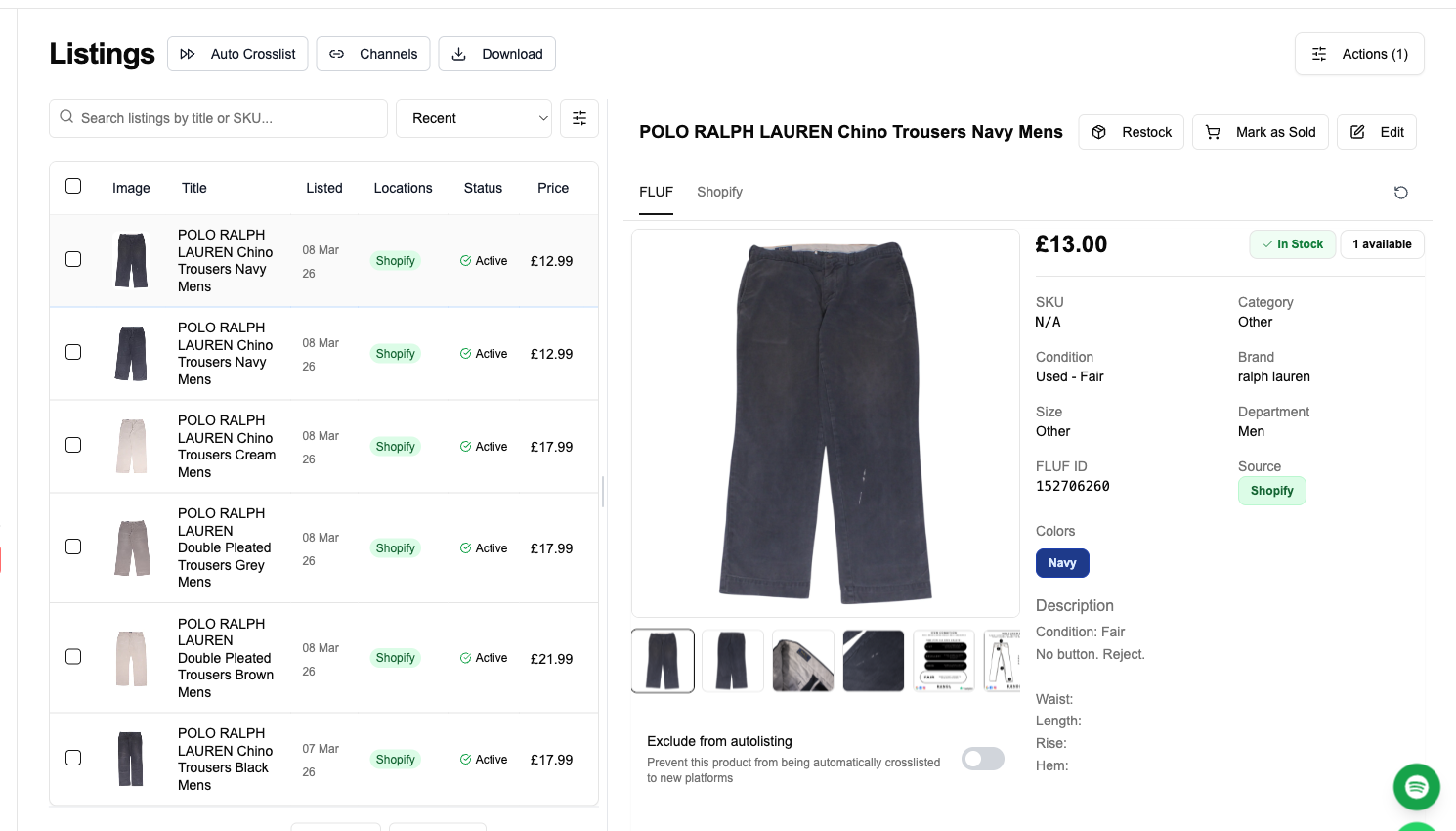
- Import your Poshmark closet. FLUF reads it through the extension and builds a product record per item: title, description, photos, price, brand, size, condition, category.
- Review the mapping. This is where the human work is — the two category trees are different shapes.
- Push to Mercari. Keep Chrome and the extension open while publishing. Each listing needs at least one photo.
- Let sync run on the interval your plan sets — every 90 minutes on Starter, down to every 15 on Priority.
Field And Category Mapping
Poshmark listings are richer in some fields than Mercari’s and poorer in others. Here is what actually carries across.
| Field | On Poshmark | On Mercari | How FLUF handles it |
|---|---|---|---|
| Title | Short, brand-led, padded for the feed | Search-led | Carried across verbatim. Worth editing — titles written for the share feed read oddly in Mercari search. |
| Description | Free text; often contains bundle prompts and Posh Party references | Free text | Carried across. Strip the Poshmark-specific language before pushing. |
| Photos | Minimum 1 | Minimum 1 | Carried across. Replace Poshmark-branded cover overlays. |
| Brand | Structured brand field with a controlled list | Structured brand field | Review the brand and enter it if needed. |
| Size | Structured, department-specific | Structured for apparel, absent for most non-apparel categories | Mapped for clothing and shoes. Non-apparel items carry no size. |
| Condition | New with tags / without tags / boutique / pre-owned | Explicit condition ladder on every listing | Mapped to the nearest Mercari condition. Lossy — check it on high-value items. |
| Category | Department → Category → Subcategory, fashion-first | Broader top-level tree covering electronics, toys, collectibles, home, sports | Mapped automatically where an equivalent exists; needs review for anything outside clothing, shoes and bags. |
| Price | Listing price; estimated earnings shown at listing time | Listing price | Carried across as-is. You may want a higher Mercari price to absorb harder negotiation. |
| Shipping | Flat $6.49 buyer-paid label, up to 5 lb | Weight-tiered label; seller picks buyer-paid or seller-paid | Not mapped. Mercari needs a weight class per listing, and an under-declared weight costs you the difference. |
| Followers, shares, likes | Central to visibility | No equivalent | Does not transfer. There is nothing to transfer it to. |
Category mapping is the part worth slowing down for. Women → Jackets & Coats maps cleanly. A Poshmark Electronics listing — allowed there, but a minor category — often maps into a far more granular Mercari tree. Getting it wrong does not fail the listing; it buries it, because Mercari discovery is category and search driven with no feed to rescue it.
What Syncs, What Does Not, And The Asymmetry
This is the section to read twice, because this pair carries a genuine oversell risk and the two sides are not symmetrical.
What FLUF supports on each side
| Capability | Poshmark | Mercari |
|---|---|---|
| Create listings | Yes, via the Chrome extension | Yes, via the Chrome extension |
| Order sync (FLUF reads sales from the channel) | No | Yes |
| Mark as sold | Yes | Yes |
| Automatic relisting | No | No |
| Offer management | No | No |
| Minimum photos | 1 | 1 |
| Countries | United States, Canada | United States only |
The asymmetry, stated plainly
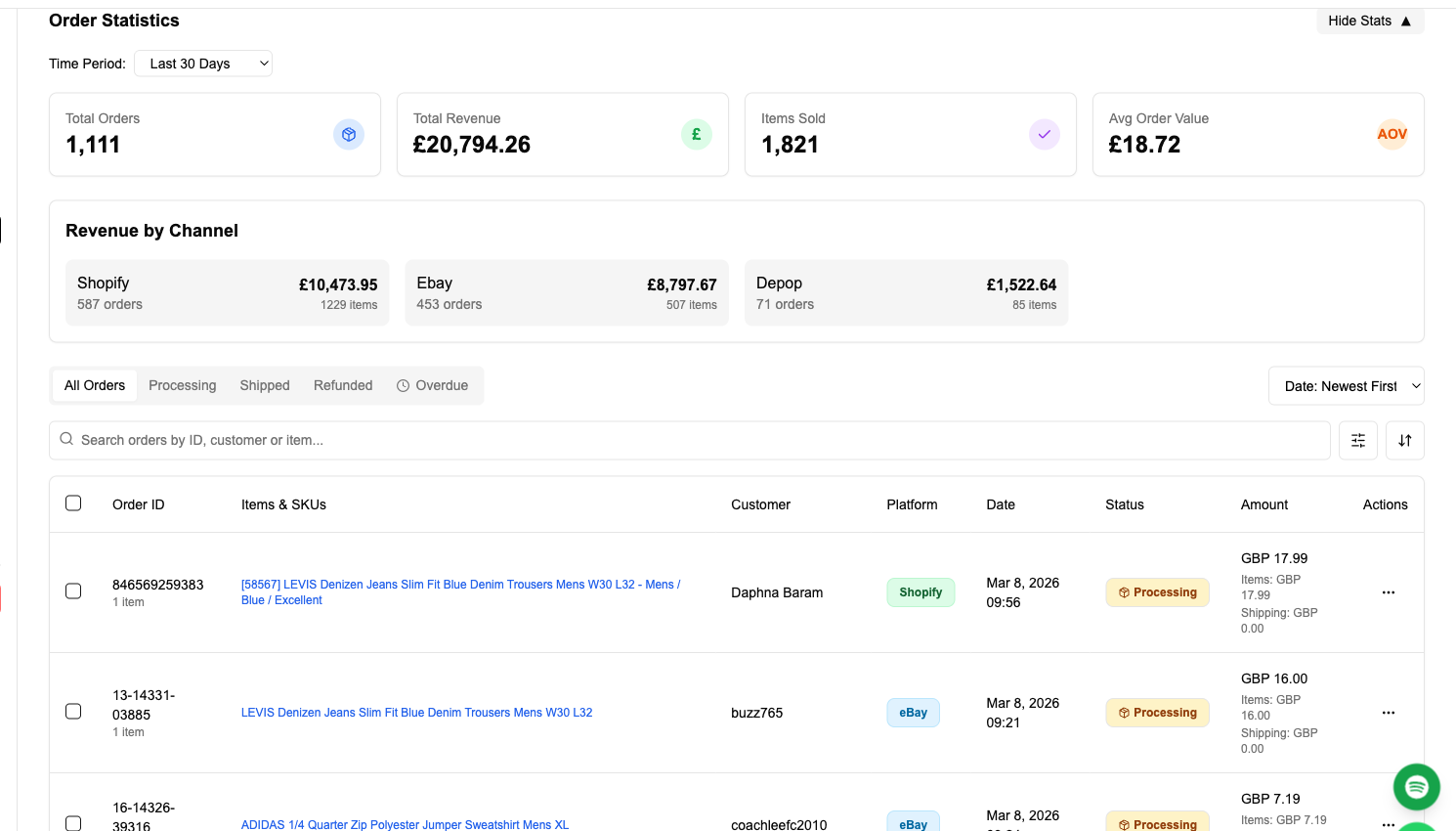
A Mercari sale is detected. FLUF has order sync on Mercari. When an item sells there, FLUF sees the order on the next sales-detection pass and can pull the matching Poshmark listing down. That direction is handled.
A Poshmark sale is not detected. FLUF has no order feed for Poshmark — the channel supports mark-as-sold only. When something sells on Poshmark, you mark it sold in FLUF, and FLUF then clears the item from Mercari. Until you do that, the Mercari listing is live and sellable.
The practical rule: check Poshmark first, and mark sold immediately. Poshmark allows seven days from purchase to ship (Poshmark Shipping Policy), but the risk is not the shipping deadline — it is the same jumper selling twice in the hour between a Poshmark order landing and you opening FLUF.
The cost of getting it wrong is asymmetric too. A cancellation counts against you on both sides, but Poshmark now folds it into a performance-based seller programme: from October 2026, sellers must hold cancellations and approved return cases at 2% or less to keep the visibility benefits (Poshmark seller update, 30 July 2026).
What FLUF does not do here
- No automatic relisting on either channel. If you rely on the Poshmark habit of deleting and relisting stale items to get a fresh timestamp, that stays manual. Worth noting that Poshmark removed its Excessive Listing Removal policy in July 2026, so deleting listings freely no longer carries a penalty on that side (Poshmark seller update).
- No offer management on either channel. Offers to likers, Closet Clear Out drops, Mercari’s Smart Offers and Smart Pricing — all of those stay inside each platform’s own tools. FLUF will not send offers for you here.
- No price sync as a negotiation tool. If you accept a lower offer on Mercari, that is a Mercari transaction; it does not rewrite your Poshmark price.
Automation that FLUF does support elsewhere — bulk operations and sync on every plan, relisting and offer management from Seller upwards — is never sold as an add-on. On this pair it is channel support that limits what runs, not the subscription tier.
Before And After: The Real Workflow
Before
- List on Poshmark from the app: photos, title, description, brand, size, category, price.
- Open Mercari. Re-upload the photos, retype the title and description, pick a category from a different tree, pick a weight class, set a price.
- Repeat per item. Fifteen to twenty minutes each if you are careful.
- Track which items are live where, by spreadsheet or by memory.
- When something sells on either side, delete it on the other. Miss one and you cancel an order.
- Share on Poshmark daily to keep the closet visible.
After
- Import the Poshmark closet into FLUF Connect once, through the extension.
- Review the category and condition mapping in bulk rather than per item, and fix the ones that look wrong.
- Push to Mercari. The extension executes in your browser while you do something else — but Chrome stays open.
- New stock is listed once and pushed to both.
- Mercari sales are picked up by sync; the Poshmark listing comes down.
- Poshmark sales get marked sold in FLUF as you process them, and FLUF clears Mercari.
- Keep sharing on Poshmark if you want Poshmark’s visibility. Mercari needs none of it.
The honest read is that this does not abolish work — it moves it. You trade per-item retyping for a one-off mapping review and the discipline of marking Poshmark sales sold. For a 300-item closet that is a good trade. For a 20-item closet it probably is not.
The Honest Downsides
Mercari’s fashion demand is weaker than Poshmark’s. No way to dress this up. Poshmark is a fashion marketplace with a fashion audience. Mercari’s growth in its most recent financial year was led by Entertainment & Hobbies, not apparel; US monthly active users grew 4% year on year in Q4 and US GMV 11% across the year (Mercari FY2026.6 results presentation) — respectable, but a smaller base than Poshmark’s 80-million community claim. Expect mid-range clothing to move more slowly on Mercari, and designer pieces to do worse there.
Mercari buyers negotiate harder. The interface pushes towards offers: Offer to Likers, Smart Offers auto-countering, and a Promote button that rewards price cuts with search placement (Mercari Help Center). Buyers learn the pattern and open low. Add the 3.6% Buyer Protection fee they see at checkout and the incentive to haggle is structural. Many sellers price slightly higher on Mercari for that reason — fine, but make it a deliberate decision rather than drift.
Both channels need the extension and a desktop. Said at the top, repeated here: no Chrome, no listings. If your entire reselling operation currently runs from a phone, this pair will change how you work.
Mercari is US-only. Canadian Poshmark sellers cannot use this pair.
You lose the social capital. Your Poshmark follower count, your Posh Ambassador badge, your Love Notes — none of it exists on Mercari. You start from zero on reputation there, and Mercari has no mechanism that lets a large Poshmark following do you any good.
Weight declaration is a new failure mode. Poshmark’s flat $6.49 label up to 5 lb means you have probably never thought about weight. Mercari prices labels by weight class and holds you responsible for the shortfall if you under-declare (Mercari Help Center). Weigh your packed parcels for a fortnight.
Tax reporting. The federal Form 1099-K threshold is payments exceeding $20,000 across more than 200 transactions (IRS). Crosslisting does not change that, but it splits your gross across two payers, each applying the threshold separately. Several states set lower thresholds; check yours. Income from sales is reportable whether or not a form arrives.
If Mercari’s fashion demand turns out to be the binding constraint for your stock, the answer is not to abandon crosslisting — it is to pick a different second channel. Depop suits vintage and streetwear closets, and eBay suits anything where completed-sale data and international buyers matter. See Poshmark to Depop and Poshmark to eBay. If you are coming at this from the other direction — an established Mercari seller looking at Poshmark — read Mercari to Poshmark instead, which is a different argument with different trade-offs. For a straight feature-by-feature comparison, see Poshmark vs Mercari.
What It Costs
FLUF Connect is £1 for 7 days, then plans from £9/month (Starter). There is no free plan.
| Plan | Monthly | Yearly | You save | Crosslisted products |
|---|---|---|---|---|
| Starter | £9/month | £85/year | 21% | Unlimited |
| Pro | £29/month | £155/year | 55% | Unlimited |
| Priority | Custom pricing — tell us what you need | Unlimited | ||
Automatic relisting, offer management, smart pricing and listing boosts are included from Pro upwards. Starter covers unlimited crosslisting, inventory sync, order sync and Instagram posting without them. Accounting integrations are included from Pro upwards. Yearly billing is charged once a year. New accounts get 7 days for £1, then move onto a plan.
Yearly billing saves 21% on every plan. Bulk operations and sync are included in every plan, and relisting and offer management from Seller upwards, not as paid add-ons; what limits this pair is what Poshmark and Mercari expose, not your tier.
The sales-detection interval matters most here: it sets how quickly a Mercari sale pulls the Poshmark listing down — up to 90 minutes of exposure on Starter, up to 15 on Priority. For a fast-moving closet of one-of-one items, the shorter interval is worth paying for. Full detail on pricing, and the wider channel list on the crosslisting overview.
Start crosslisting from Poshmark to Mercari
Sources & Verification
External figures verified 23 August 2026.
- Poshmark Terms of Service — Fee Policy v1.7, Shipping Policy, Prohibited Items Policy v4.0
- Poshmark — Posh Protect
- Poshmark — Price Drop Policy
- Poshmark — Sell on Poshmark
- Poshmark — What is Poshmark
- Poshmark Blog — How to Become a Posh Ambassador
- Poshmark Blog — Posh Parties 101
- Poshmark Blog — Lower shipping starting September 12th
- Poshmark Blog — Seller Updates, July–August 2026
- NAVER Corp — Naver to Acquire Poshmark, October 2022
- Naver Completes Acquisition of Poshmark (5 January 2023)
- Mercari Help Center — Fees on Mercari
- Mercari Help Center — FAQs about our new fee structure
- Mercari Help Center — Shipping labels, tracking, and carrier options
- Mercari Help Center — Promote, Offer to Likers, Smart Pricing and Smart Offers
- Mercari Help Center — Prohibited Items
- Mercari, Inc. — FY2026.6 Financial Results Presentation
- IRS — Understanding your Form 1099-K
- Crosslist from Whatnot to Mercari — the always-on shelf for the stock that sits idle between your live shows
Related guides
- Crosslist from Mercari to Depop — the fashion half of a Mercari shop, moved
- Crosslist from Poshmark to StockX
Frequently Asked Questions
Yes. Use a desktop or laptop with Chrome and the FLUF extension installed. Keep the browser open and signed in while listings publish.
Poshmark charges a flat $2.95 on sales under $15 and 20% on sales of $15 and above. Mercari charges a flat 10% selling fee on the item price plus any buyer-paid shipping, with no separate payment processing fee since 6 January 2025. On a $40 sale with a $6.49 buyer-paid label, that works out at $8.00 to Poshmark versus $4.65 to Mercari.
No. Poshmark operates in the United States and Canada, but Mercari's marketplace that FLUF connects to is United States only. If your Poshmark closet is Canadian, this pair is not available to you and you will need a different second channel.
Partly, and the two directions are not the same. FLUF supports order sync on Mercari, so a Mercari sale is detected on the next sales-detection pass and the matching Poshmark listing can be pulled down automatically. Poshmark exposes no order feed, so a Poshmark sale is not detected — you mark the item sold in FLUF and FLUF then clears it from Mercari. Check Poshmark first and mark sales sold promptly.
No. FLUF supports mark-as-sold on Poshmark and order sync plus mark-as-sold on Mercari. It does not do offer management or automatic relisting on either channel, so Poshmark sharing, Posh Parties, Closet Clear Out price drops, and Mercari's Offer to Likers, Smart Pricing and Smart Offers all stay inside each platform's own tools.
Generally no, and it is worth planning around. Poshmark is a fashion marketplace with a fashion audience and puts its community at over 80 million. Mercari is a general marketplace whose reported US growth in the year to June 2026 was led by Entertainment & Hobbies rather than apparel. Expect mid-range clothing to move more slowly on Mercari, and treat it as a second outlet rather than a replacement closet.
The interface encourages it. Offer to Likers notifies up to 50 recent likers when you cut a price by 10% or more, the Promote button rewards a 5% price cut with better search placement, and Smart Offers can auto-counter. Buyers also see a 3.6% Buyer Protection fee added at checkout, so the total they pay is above the listed price. Many sellers price slightly higher on Mercari to absorb this.
On Poshmark the buyer pays a flat $6.49 for a USPS Ground Advantage label covering shipments up to 5 lb, with one prepaid label or QR code per order. On Mercari you choose per listing: a prepaid label's cost is either added at buyer checkout or deducted from your proceeds. Mercari prices labels by weight class, so weigh packed parcels — under-declaring costs you the difference.
FLUF Connect is £1 for 7 days, then plans from £9/month (Starter, sales detection every 90 minutes). There is no free plan. Higher tiers raise the product ceiling and shorten the detection interval, down to every 20 minutes on Priority. Annual billing saves 40%.
Sign up for free
Join the community
You're in.
Open your dashboard