How to Sell on Allegro — The Complete Guide for 2026
Commission rates, the business-account requirement, the Polish-language rule, Smart! costs and delivery expectations on Poland's dominant marketplace — plus how to crosslist to Allegro across 60+ channels.
7 days for £1, then from £9/month.



- n
- Poland’s dominant marketplace, not merely a large one: 15.5 million active buyers in Poland and PLN 18.5bn of Polish GMV in a single quarter.
- Listing is free. Allegro charges no insertion fee — “the only basic fee is the sales commission”.
- Commission varies enormously by category: 8.5% flat on books, 2.5% on laptops, and 11.5% on most clothing up to PLN 110. Many categories carry a cash cap.
- You need a business account. Register an Allegro business seller account before trying to publish listings through FLUF Connect.
- Your listings must be in Polish. Allegro enforces a language match against your account’s location setting, and auto-translation works outward from Polish, never into it.
- UK sellers are treated as EEA for registration — which matters, because genuinely non-EEA sellers are capped at one account and 500 offers.
- Cost to crosslist with FLUF: £1 for 7 days, then plans from £9/month (Starter). There is no free plan.
n
n
n
n
n
n
n
n
nn
 n
nnn
nn
What is Allegro?
nn
Allegro is the marketplace in Poland. Not a marketplace — the one. It is larger there than Amazon and eBay combined, and for a Polish shopper it occupies roughly the position that Amazon holds in Germany or eBay once held in Britain: the default place you start looking, whatever you are buying.
nn
The numbers make the point better than the adjectives. Allegro reported PLN 18,513.9 million of Polish GMV in Q2 2026 alone, up 12.0% year on year, and PLN 35.0 billion across the first half. It counts 20.4 million active buyers group-wide and 15.5 million in Poland, against a national population of about 37 million — which is to say that a clear majority of Polish adults who shop online have an Allegro account. On the supply side there are more than 150,000 merchants listing over 80 million products.
nn
Its dominance of attention is even starker than its dominance of spend. An OECD analysis reported in May 2026 put Allegro at 81% of traffic among Poland’s general e-commerce platforms, with Empik at 8% and Amazon Polska at 6%. Separate consumer research found 73.8% of Poles name Allegro as the site where they most often shop online.
nn
Allegro is listed on the Warsaw Stock Exchange as Allegro.eu, and beyond Poland it also operates allegro.cz, allegro.sk and allegro.hu. Those are real marketplaces but they are small relative to the Polish original; if someone tells you they are “selling on Allegro”, they mean allegro.pl.
nn
Why sell on Allegro?
nn
Because there is no alternative route to the Polish consumer at scale. That is the entire argument, and it is unusually clean. In most European markets a seller can reasonably ask whether to use the local marketplace or the international one. In Poland the local marketplace is the market, and the international ones are rounding errors.
nn
Compare monthly web traffic, using one consistent source so the numbers are like-for-like — Semrush’s Polish retail ranking for July 2026:
nn
| Site | Monthly visits (July 2026) | What it is |
|---|---|---|
| allegro.pl | 136.3 million | The general marketplace |
| olx.pl | 75.7 million | Classifieds — C2C and secondhand |
| mediaexpert.pl | 46.2 million | Electronics retailer |
| ceneo.pl | 35.7 million | Price comparison |
| amazon.pl | 23.9 million | Amazon’s Polish marketplace |
| vinted.pl | 18.1 million | Secondhand fashion |
| ebay.pl | ~3.1 million | Marginal in Poland |
nn
Allegro has roughly five and a half times Amazon Poland’s traffic and more than forty times eBay’s. For an exporter, that ratio is the whole decision: the effort of learning one unfamiliar marketplace buys you the Polish market, and skipping it means not being in Poland in any meaningful sense.
nn
Three further reasons it is worth the setup cost:
nn
The market is growing and the buyers are spending. Allegro’s Polish GMV grew 12% year on year in Q2 2026 — that is a mature market still compounding at a double-digit rate. Receipt analysis reported in April 2026 put the average Allegro basket at PLN 143 across 1.6 items, against PLN 98 and roughly four items on Temu. Allegro buyers buy fewer, more expensive things — which is the customer a margin-carrying seller wants.
nn
Listing costs nothing. Allegro’s own fee page is explicit: “Listing offer is free. The only basic fee is the sales commission.” There is no insertion fee and no mandatory subscription. You can test the market with a hundred items and pay only when they sell — a materially lower-risk entry than marketplaces that charge to list or require a monthly plan.
nn
Commission is competitive in the right categories. Laptops at 2.5% and smartphones at 4.5% are extraordinarily cheap by marketplace standards. Books at a flat 8.5% undercut most competitors. Clothing at 11.5% is unremarkable. The point is that Allegro’s rate card rewards some categories heavily and punishes others, so the honest answer to “is Allegro cheap?” is “look up your own category first” — which the next section helps you do.
nn
Allegro fees explained
nn
Allegro’s fee structure has four parts: commission, which everyone pays; subscriptions, which are optional; promotion, which is optional; and Smart! delivery co-funding, which is not optional if you qualify. That last one catches people out, so it has its own section below.
nn
Sales commission
nn
Commission is charged when the transaction concludes. Two details from Allegro’s fee page that materially change your maths: the published rates are net amounts, and commission is “calculated on the price together with the delivery cost”. If you are pricing an item at PLN 100 with PLN 15 delivery, commission is assessed on PLN 115, not PLN 100.
nn
The full rate card runs to nearly ten thousand category rows — the current version is published as a downloadable table headed “Commission rates effective from March 2, 2026”. Across the whole table the rates span 1% to 17%, with caps ranging from PLN 30 to PLN 500. Here are the patterns that cover most sellers:
nn
| Category | Commission | Cap |
|---|---|---|
| Clothing and footwear (most of Fashion) | 11.5% up to PLN 110; above that, PLN 12.65 + 7.5% on the excess | None |
| Fashion accessories | 13% up to PLN 90; above that, PLN 11.70 + 8% on the excess | None |
| Books, and Music | 8.5% flat | None |
| Laptops | 2.5% | None |
| Smartphones and mobile phones | 4.5% | None |
| Art, and most of Collections | 11% | PLN 210 |
| Electronics accessories and parts | 15% up to PLN 60; above that, PLN 9 + 8% on the excess | None |
| Much of Home and Garden | 8–11% depending on leaf category | Often PLN 250 |
| “Other” catch-all leaves, across categories | 17% | None |
nn
Three things to take from that table.
nn
The tiering is real money on mid-priced goods. A PLN 300 coat is not charged 11.5%. It is charged PLN 12.65 plus 7.5% of PLN 190 — PLN 26.90, an effective 9.0%. The structure deliberately tapers, which makes Allegro friendlier to higher-value fashion than a flat rate would be.
nn
The caps matter enormously in art and collectibles. An 11% commission capped at PLN 210 means everything above roughly PLN 1,900 ships at a declining effective rate. On a PLN 10,000 painting you pay 2.1%. If you deal in high-value collectibles, Allegro is one of the cheapest venues in Europe.
nn
Avoid the “Other” leaves. Twenty-three catch-all rows in Fashion alone charge a flat 17% — roughly 50% more than the proper clothing categories. Landing in a catch-all because your category mapping was lazy is a pure, avoidable loss on every sale.
nn
One more quirk worth knowing: a large block of categories, mostly automotive, charges by condition — 9% capped at PLN 140 on items flagged New, and 16% capped at PLN 140 on everything else. Nothing equivalent applies in Fashion, where used and new pay the same rate.
nn
Subscriptions and promotion
nn
Allegro offers three optional subscription tiers — Basic at PLN 49 gross per 30 days, Professional at PLN 199, and Expert at PLN 3,000. None is required to sell.
nn
For visibility, the published options are a Featured offer at PLN 19.90 per 10 days (PLN 5.90 in selected categories) plus an additional 0.75× the category commission — so a featured sale costs 1.75 times normal commission, which is a much larger number than the headline fee suggests. There is also a flexible feature at PLN 2.90 per day, and Allegro Ads on a cost-per-click basis from PLN 0.10 per click with a minimum PLN 3 daily budget.
nn
Our advice for a new seller: ignore all of it for your first month. Get your categories, Polish copy and delivery right first. Paying to promote a listing that is in the wrong category with a machine-translated title is buying traffic for a page that cannot convert.
nn
Business vs private accounts — the hard gate
nn
This is the section to read before you do anything else, because it determines whether you can sell on Allegro at all.
nn
A business seller account is required to publish Allegro listings through FLUF Connect. Connecting a private account does not remove this requirement.
nn
Register and verify the correct Allegro business seller account before crosslisting. If publication is refused, check the account requirements and complete any missing setup.
nn
If you intend to sell on Allegro, register a business account (konto firmowe) from the outset. Converting later is possible but is more friction than starting correctly.
nn
Registering as a UK or EEA seller
nn
There is a genuinely favourable quirk here that is worth knowing: Allegro treats UK companies as EEA companies for registration purposes. Its own help page states that if you want to register an Allegro account for a company from the UK, “you can do it in the same way as an entrepreneur from the EEA”.
nn
That matters more than it sounds, because Allegro’s rules for genuinely non-EEA sellers are restrictive: “You can create only one account using the same business details. You can list a maximum of 500 offers on that account.” A 500-offer ceiling is crippling for any serious catalogue. UK sellers escape it.
nn
Non-EEA sellers additionally need company registration documents and photo ID issued within the last four months, in English and the native language, and must take payouts through Payoneer, WorldFirst, LianLian, PingPong or direct transfer to an account that accepts PLN. A Polish bank account is not required. Prices on allegro.pl must be set in PLN.
nn
The Polish-language requirement
nn
This is the requirement that most often defeats a crosslisting setup, and it is absolute.
nn
Since a policy change announced in February 2025, Allegro checks that your offer description matches the language of your account’s location settings: “if your account language is set to Polish, it will be the base language for your offer and you need to provide the offer description in it.” New offers with a mismatched-language description cannot be listed at all, and existing ones may be terminated.
nn
The trap is that Allegro does have automatic translation, which leads sellers to assume English copy will be handled. It will not. Translation runs outward from your base language, not into it: English appears only when you offer delivery outside Poland, Czech only when you deliver to Czechia, and Ukrainian translates titles only, leaving descriptions in Polish. There is no path where you write English and Allegro produces the Polish original.
nn
So: your Polish titles and descriptions have to be produced by you, before the listing is created. If you are crosslisting from an English-language channel, that is a translation step in your workflow, not a checkbox. Budget for it, and get a native speaker to check your top fifty listings — Allegro’s title rules ban puffery like tanio, okazja and promocja, which is exactly the vocabulary a machine translation of British marketing copy tends to reach for.
nn
Listing rules: titles, photos, catalogue and parameters
nn
Titles
nn
An Allegro title must contain between 12 and 75 characters and at least three words. Beyond length, Allegro bans repeated keywords, price puffery, your seller username, your location, invoice or dispatch claims, warehouse reference numbers, unrelated brands, and special characters such as @, ! and square brackets except within a genuine brand name or size.
nn
Seventy-five characters is tight. The pattern that works is Brand · Model · Key attribute · Size or capacity, with no adjectives.
nn
Photos
nn
Allegro’s image rules are stricter than most marketplaces and are enforced:
nn
- n
- Minimum 400 px on the longer side; maximum 26 megapixels; displayed at up to 2560 × 2560.
- White background (RGB 255,255,255), with a uniform light grey permitted in some categories. Used items, furniture sets, plants, art and vehicles are exempt.
- No watermarks on the thumbnail, and no logos — of the product or of your store.
- No text, icons, graphics, borders or decorations in the thumbnail.
- The first image you upload becomes the thumbnail.
- AI-generated or AI-modified photos must be labelled as such.
n
n
n
n
n
n
nn
The white-background rule is the one that trips up fashion sellers arriving from Vinted or Depop, where lifestyle photography on a bedroom floor is the norm. If your existing photos are all flat-lays on carpet, expect to reshoot for Allegro, or lean on the used-item exemption where it genuinely applies.
nn
The Product Catalogue
nn
Since 1 July 2024, “you will list new offers only if you link them to the Allegro Product Catalog — regardless of the category”. Unlinked existing offers are reviewed over time and Allegro “may automatically end them”.
nn
This does not mean you must have a barcode. Allegro is explicit that GTIN is required only in categories where it has said so — “if we have not required you to provide the GTIN (EAN) code in a given category, we have not started doing it” — and where you have none, you select “My product does not have a GTIN (EAN) code” and supply a product name instead. Secondhand and unique categories such as Collections, Art and Handicraft can use temporary products and are exempt from automatic removal, which is what makes Allegro workable for one-of-a-kind stock at all.
nn
Parameters
nn
Allegro calls its structured attributes parameters. The important ones are GTIN, Brand or Manufacturer, Manufacturer code and Model. Required parameter sets differ per category and Allegro revises them monthly; an offer missing a required parameter is rejected. Junk placeholder values such as “xyz” or “111” are explicitly prohibited, so filling a mandatory field with nonsense to get past validation will cost you the listing rather than save it.
nn
Allegro Smart! and what it costs you
nn
Smart! is Allegro’s buyer subscription — free delivery above a minimum order value, currently PLN 49.90. It has 7.7 million subscribers in Poland plus 1.3 million abroad, and Allegro reports that Smart! subscribers spend on average seven times more than non-subscribers.
nn
Here is the part sellers miss. Smart! is not something you opt into, and you cannot opt out. Allegro’s own help page states it plainly: “If you meet our conditions, we will automatically mark your offers with the Smart! badge. You cannot disable the Smart! badge with any button.”
nn
And Smart! parcels cost you money. Sellers co-fund each one, on a scale that steps with the buyer’s order value across five bands. Sampled published rates run from about PLN 0.99 for a low-value order going to a DHL locker up to roughly PLN 11.89 for a courier delivery on a high-value order; Allegro Paczkomaty InPost sits around PLN 1.59 to PLN 5.19 across the lower bands. You are refunded automatically on returns and uncollected parcels.
nn
Practically: if your margin model assumes commission is your only variable cost per sale, it is wrong. Add roughly PLN 1–6 per Smart! parcel for typical order values, and price accordingly. The upside is real — Smart! badging puts you in front of 7.7 million subscribers who filter for it — but it is a cost, not a gift.
nn
Separately, Smart! Coins are a genuinely optional promotional layer: one coin costs PLN 1.23 gross and is charged only when the item sells, so five coins on an offer adds PLN 6.15 to the cost of that transaction.
nn
Delivery, lockers and buyer expectations
nn
Poland is the most locker-centric e-commerce market in Europe, and this shapes what a buyer considers acceptable. Gemius research found parcel lockers used by 81% of Polish online shoppers, against 41% for courier-to-door. InPost’s own reporting shows roughly three-quarters of its Polish parcel volume going to lockers rather than doorsteps.
nn
The infrastructure is correspondingly dense. InPost operates 28,965 automated parcel machines in Poland; Allegro’s own One Box network reached 10,700 lockers by the end of June 2026, the fastest-growing network in the country. Across all its partners Allegro Delivery spans over 38,000 lockers and 37,000 pickup points.
nn
Speed expectations follow from that density. Allegro’s seller documentation describes next-day delivery to One Box and One Punkt as standard across Poland, with same-day delivery to lockers in selected cities for items dispatched by 12:30.
nn
The hard truth for UK-based fulfilment
nn
You can register easily. Shipping from a British warehouse is a different matter, and you should go in clear-eyed:
nn
- n
- No Smart! badge. Allegro publishes a specific ruleset for Smart! on offers dispatched from abroad, and the permitted dispatch countries are Germany, France, the Netherlands, Czechia, Slovakia and Hungary. The UK is not on that list.
- Return address. The same ruleset requires a return address in Poland, Germany, Czechia, France or the Netherlands. A UK-only returns address disqualifies you on its own.
- Transit time. UK-to-EU e-commerce shipments typically run three to five days against a market whose norm is next-day-to-a-locker. That gap, not cost, is what loses you the sale.
n
n
n
nn
The realistic routes into Poland are therefore to get stock inside the EU customs union first — either via a Polish or EU third-party logistics provider, or via Allegro One Fulfillment, Allegro’s own service, which opened to all allegro.pl sellers at the end of February 2026 and requires only a business account. Its published pricing is a base per-product shipping fee of PLN 2.69–11.49 by volume, plus storage at PLN 0.49 per cubic metre per day after a free first 30 days.
nn
VAT, customs and the July 2026 duty change
nn
Selling into Poland from outside it carries real compliance obligations, and two things changed recently enough that older guides are now wrong.
nn
The €150 duty exemption is gone. From 1 July 2026 the EU abolished the customs-duty exemption for low-value consignments and introduced an interim flat €3 duty per item category — not per parcel — running to 1 July 2028. A mixed parcel can therefore attract several €3 charges. IOSS still handles VAT, but it no longer means duty-free, and DDP pricing is becoming the practical default for anyone shipping into the EU.
nn
The distance-selling threshold does not help you. The EU’s €10,000 threshold for distance sales applies only where the supplier is established in a Member State. A UK-established seller is not, so VAT is due in the destination country from the first sale. For goods shipped direct from the UK to a Polish consumer, IOSS covers consignments up to €150 but a non-EU seller must appoint an EU-established intermediary to use it.
nn
Allegro’s own requirement is that a seller be a VAT taxpayer registered in Poland and present on the biała lista whitelist, with NIP verification inside 48 hours, and it states plainly that “sellers are responsible for tax compliance”.
nn
One caution we will state rather than gloss: EU rules do make marketplaces “deemed suppliers” for VAT in certain circumstances, and a non-EU seller on an EU platform sits squarely in that territory — but Allegro publishes no statement confirming it collects Polish VAT on your behalf, and its own guidance puts compliance on you. Do not assume Allegro handles your VAT. Take advice before your first shipment.
nn
This is general information, not tax advice.
nn
What sells best on Allegro
nn
Because Allegro is the default shopping destination rather than a niche one, the honest answer is “almost everything” — but the commission table tells you where the margin is, and it is worth reading it as a strategy document rather than a price list.
nn
Electronics is where Allegro is unusually cheap. Laptops at 2.5% and smartphones at 4.5% are rates you will not find on a comparable Western European marketplace. If you are a hardware reseller, the arithmetic on Allegro is materially better than on Amazon, and that alone can justify the setup cost. The catch is that these are also the categories where Polish price comparison is most ruthless — Ceneo draws 35.7 million monthly visits and Polish buyers use it — so you are competing on a genuinely transparent price.
nn
Art and collectibles benefit from the caps. An 11% rate capped at PLN 210 makes Allegro one of the cheapest places in Europe to sell a high-value collectible or an original artwork. Above roughly PLN 1,900 your effective rate starts falling, and on a five-figure item it is negligible. Combined with the temporary-product allowance for unique stock, this is the category where Allegro’s rules and its rate card actually align in a seller’s favour.
nn
Books and media are reliable rather than lucrative. A flat 8.5% with no cap is fair, the catalogue matching is straightforward because ISBNs exist, and demand is steady. It is a volume business.
nn
Fashion works, but is contested. At 11.5% tapering to 7.5% above PLN 110, Allegro is reasonable for mid and higher-value clothing. For cheap secondhand clothing it is the wrong venue — Vinted charges sellers nothing, has 18 million monthly Polish visits and an engaged audience that spends nearly two hours on site. Allegro is where you sell a PLN 400 coat; Vinted is where you sell a PLN 40 one.
nn
Home and garden is the volume category and carries frequent PLN 250 caps, which makes larger items — furniture, tools, garden equipment — comparatively cheap to sell once you are past the cap threshold.
nn
The category to avoid is any “Other” catch-all leaf at a flat 17%. If your mapping puts stock there, the fix is worth more than any promotion you could buy.
nn
Allegro against Amazon, eBay, Vinted and Temu
nn
Amazon.pl is investing heavily — a reported PLN 23 billion across 2026–2028, including a new fulfilment centre in Lower Silesia — and is not visibly taking share. Its traffic runs at roughly a fifth of Allegro’s while Allegro’s Polish GMV still grew 12% year on year. Amazon is scaling absolute volume in a growing market rather than compressing the incumbent.
nn
eBay is marginal in Poland: ebay.pl draws around 3.1 million monthly visits, about 2% of Allegro’s. Its relevance to Polish sellers is as an export channel outward, not as a domestic destination.
nn
OLX at 75.7 million monthly visits is the genuine number two, but it competes on classifieds and C2C secondhand rather than on new-goods retail. If you are selling used consumer goods peer-to-peer, OLX is a real alternative; if you are a retailer, it is a different business.
nn
Vinted is the specialist threat in fashion. Poland is one of its largest markets, vinted.pl draws about 18 million monthly visits, and its engagement is extraordinary — Polish media panel research found Vinted matching Allegro’s engaged-user rate with average time on site of nearly two hours. For secondhand clothing specifically, Vinted is where the attention is.
nn
Temu is the genuine disruption, and the honest picture is more complicated than the headlines. Media panel data for January 2026 put Temu at 20.3 million Polish users against Allegro’s 19 million — but that is a brand-level figure combining site and app, and the same panel’s domain-level measurement for May 2026 shows a very different ranking. Do not put those two numbers side by side. What is solid is the basket difference: Allegro PLN 143 across 1.6 items, Temu PLN 98 across roughly four. Temu is winning attention and low-value volume; Allegro retains the spend.
nn
The July 2026 duty change is expected to compress Temu’s price advantage. Allegro’s own commercial chief framed it as reducing “the artificial price disparity on the cheapest, unbranded products from Asia”. Whether that is borne out is genuinely not yet known, and any figure you see quantifying the effect this soon should be treated with suspicion.
nn
Common mistakes to avoid
nn
- n
- Registering a private account. It will read, connect and index perfectly, then refuse every listing. Register a business account first.
- Assuming Allegro will translate your English. It translates outward from Polish only. The Polish copy is your job.
- Letting items fall into “Other” categories. A 17% catch-all rate against 11.5% in the correct clothing leaf is money thrown away on every sale.
- Forgetting delivery is in the commission base. Commission is charged on price plus delivery cost, not price alone.
- Budgeting for commission but not Smart! You cannot switch Smart! off, and it costs roughly PLN 1–6 a parcel.
- Lifestyle photography. White backgrounds, no logos, no watermarks, no text in the thumbnail.
- Planning UK-warehouse fulfilment around Smart! The UK is not an eligible dispatch country, and a UK return address disqualifies you regardless.
n
n
n
n
n
n
n
nn
Crosslisting to Allegro with FLUF Connect
nn
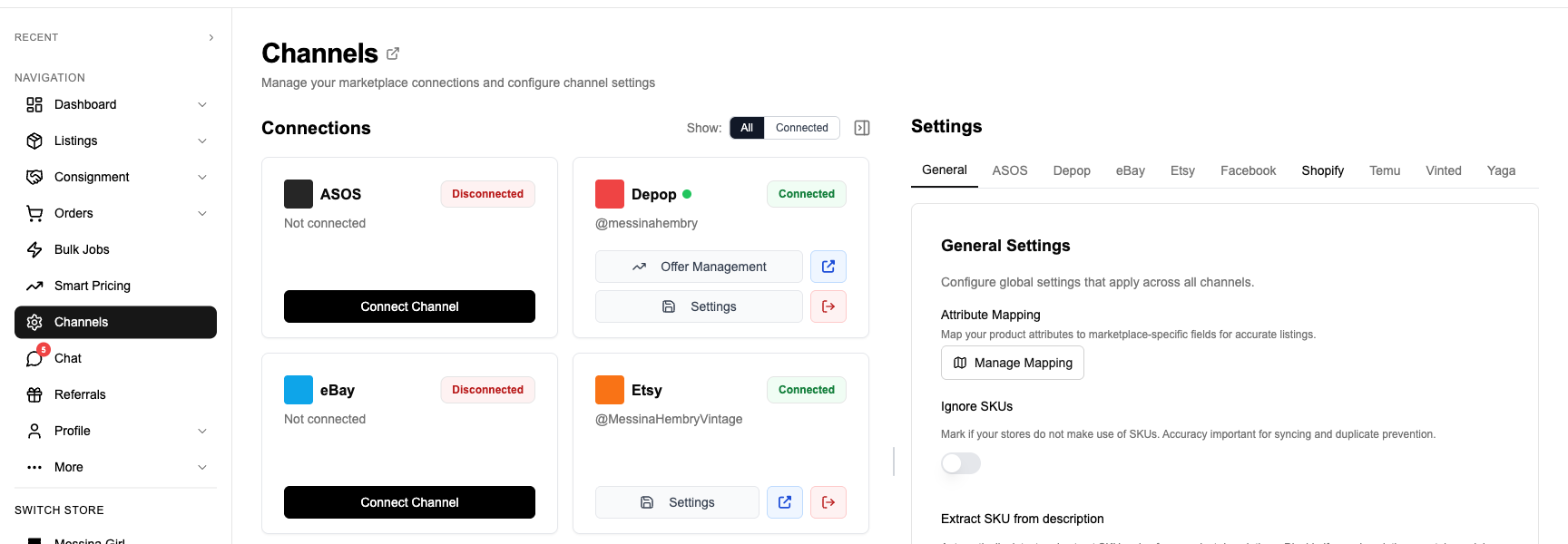
FLUF Connect pushes listings to Allegro from the channels you already sell on — Shopify, WooCommerce, eBay, Vinted, Etsy and the rest of the roster — so you are not rebuilding your catalogue by hand in an unfamiliar interface.
nn
Select Allegro in FLUF Connect and authorise the connection on Allegro’s screen. No browser extension is required.
nn
What transfers
nn
| Field | Transfer | Notes |
|---|---|---|
| Title | Automatic | Fitted to Allegro’s 12–75 character window. Must be Polish. |
| Description | Automatic | Converted to Allegro’s structured description format. Must be Polish. |
| Photos | Automatic, up to 16 | Allegro rejects an offer with no photo, so at least one is required. |
| Price | Automatic | In PLN on allegro.pl. |
| Category | Mapped | Resolved against Allegro’s own tree before the offer is built. |
| Parameters | Mapped where available | Brand, model and manufacturer code are carried where your source listing has them. |
| Stock | Automatic | Quantity is synced. |
| Delivery | Your Allegro settings | Price lists live on Allegro and are inherited, not pushed. |
nn
What syncs, and what does not
nn
We would rather be exact here than flattering.
nn
- n
- Sold elsewhere → withdrawn from Allegro. Wired and working. If an item sells on eBay or Vinted, FLUF pulls it from Allegro so you cannot sell the same piece twice.
- Sold on Allegro → withdrawn elsewhere. Not yet. Allegro sale detection is deliberately held back until a real Allegro order has been observed, because guessing at an order format is how a tool mass-delists a catalogue by mistake. Until then, a sale that originates on Allegro will not automatically stock the item out on your other channels — so check your Allegro orders before relying on cross-channel stock levels.
- No automated relisting and no offer management on Allegro. Both exist on other channels — see auto-relisting and offer management — but neither is available for Allegro in FLUF Connect.
n
n
n
nn
And the constraint that governs everything: your Allegro account must be a business account, or the create step will be refused by Allegro no matter which tool you use.
nn
What it costs
nn
FLUF Connect starts at £1 for 7 days, then plans from £9/monthFLUF Connect plans start at £9/month on Starter, with Seller at £29/month and Pro at £99/month; every plan is unlimited on listings and marketplaces, and the tiers differ by which automations they include and how often we check your channels for sales. There is no free plan. Crosslisting and inventory sync are included in every plan, and relisting and offer management from Seller upwards rather than sold as add-ons — the full table is onpricing.
nn
nn
Related Guides
- Crosslist from Allegro to Etsy — Which Polish Stock Is Actually Eligible
- Crosslist from Allegro to Vinted — Automatically
- Allegro vs eBay — Which Should You Sell On in 2026?
- Allegro vs Vinted — Which Should You Sell On in 2026?
- Inventory Sync Across Depop, eBay, Vinted, Shopify, and Etsy
- Selling online from Slovakia
- Selling online from Hungary
- PrestaShop to Allegro
- Sell on eMAG
- Sell on Empik
Sources & verification
nn
- n
- GMV and growth: Allegro preliminary Q2/H1 2026 financial data, 13 July 2026.
- Active buyers, merchant and product counts, Smart! subscribers: Allegro Q1 2026 press release, 14 May 2026.
- Commission rates, listing fee, subscriptions, promotion pricing, Smart! Coins: Allegro seller fee price list, and the full category table, commission rates effective from 2 March 2026.
- Language enforcement: Allegro offer-language policy; translation behaviour, offer translations FAQ.
- Title rules: how to create a good offer title. Image rules: rules regarding product images. Catalogue linking: product catalogue requirement.
- Non-EEA seller limits: registration for sellers outside the EEA.
- Locker networks: cashless.pl parcel-machine census, 2 July 2026; InPost Q1 2026 results. Buyer preferences: Gemius E-commerce w Polsce 2025.
- Market share and competitors: OECD analysis reported 27 May 2026; Semrush Polish retail traffic, July 2026; basket analysis, April 2026; consumer survey, March 2026.
- EU VAT and the distance-selling threshold: Your Europe cross-border VAT.
n
n
n
n
n
n
n
n
n n
nn
Allegro publishes its Smart! per-carrier fee tables as images rather than text, so the PLN 0.99–11.89 range above is read from sampled published rows — check the current table for your own carriers before modelling margins. Allegro’s commission table runs to nearly 10,000 category rows; the figures above are the dominant patterns per category, not a complete rate card. Allegro publishes no dedicated VAT guidance for foreign sellers, and we do not assert that it acts as deemed supplier on your behalf.
nn
Subscribe to the seller news brief
The marketplace news that changes how you list, in one short email.
- Fee, policy and algorithm changes across 60+ marketplaces
- Only the topics you pick — the marketplaces you actually sell on
- Short enough to read in a minute. Daily or weekly, unsubscribe in one click
No spam. We never share your address.
Pick your topics first ›Frequently Asked Questions
No. Register an Allegro business seller account before publishing listings through FLUF Connect. A private account does not support this listing workflow.
Yes, on allegro.pl. Since February 2025 Allegro checks that the offer description matches your account's location language, and a mismatched listing simply cannot be created. Allegro's automatic translation works outward from your base language — English appears only when you offer delivery abroad — so there is no route where you write English and Allegro produces the Polish. You must supply the Polish title and description yourself.
It depends heavily on category and there is no single rate. Most clothing is 11.5% up to PLN 110, then PLN 12.65 plus 7.5% on the excess. Books are a flat 8.5%, laptops 2.5%, smartphones 4.5%, and art and most collections 11% capped at PLN 210. Catch-all “Other” categories charge 17%. Across the whole table rates run from 1% to 17%. Note that commission is calculated on the price together with the delivery cost, not the price alone.
No. Allegro's fee page states that listing an offer is free and that the sales commission is the only basic fee. Subscriptions (PLN 49, 199 or 3,000 per 30 days) and promotion options exist but are entirely optional. The one cost that is not optional is Smart! delivery co-funding, which applies automatically if your offers qualify.
Yes, and on better terms than you might expect. Allegro treats UK companies as EEA companies for registration, which matters because genuinely non-EEA sellers are limited to one account and a maximum of 500 offers. The harder problem is fulfilment: the UK is not an eligible dispatch country for the Smart! badge, a UK-only return address disqualifies you from it, and UK-to-EU transit of three to five days compares poorly with a market used to next-day locker delivery. Most serious sellers hold stock inside the EU.
No. Allegro's help documentation states that if you meet the conditions your offers are marked with the Smart! badge automatically and that you cannot disable it with any button. You then co-fund each Smart! parcel on a scale that steps with the buyer's order value — roughly PLN 1 to PLN 6 for typical orders, up to about PLN 11.89 for a courier delivery on a high-value order. Budget for it alongside commission rather than treating commission as your only variable cost.
Not yet, and we would rather say so. Sold-elsewhere-to-Allegro works: if an item sells on eBay or Vinted, FLUF withdraws it from Allegro so you cannot oversell. The reverse direction is deliberately held back until a real Allegro order body has been observed, because guessing at an order format is how a tool mass-delists a catalogue by mistake. Until it is enabled, check your Allegro orders before relying on cross-channel stock levels.
Not always. Every offer must be linked to the Allegro Product Catalogue, but GTIN itself is only mandatory in categories where Allegro has said so. Where you have no barcode you select “My product does not have a GTIN (EAN) code” and supply a product name instead. Secondhand and unique categories such as Collections, Art and Handicraft can use temporary products, which is what makes Allegro viable for one-of-a-kind stock.
The EU abolished the €150 customs-duty exemption for low-value consignments on 1 July 2026 and introduced an interim flat €3 duty per item category — per category, not per parcel, so a mixed parcel can attract several charges. It runs to 1 July 2028. IOSS still handles VAT but no longer means duty-free, and a non-EU seller needs an EU-established intermediary to use it. Any guide written before mid-2026 is out of date on this point.