
Crosslist from Shopify to Mercari — Automatically
Shopify has no first-party channel for Mercari, or for any resale marketplace. Here is what actually transfers, how variants and quantity fan out into single-item listings, and how sale detection stops you overselling.



- Shopify has no first-party route to Mercari. Shopify Marketplace Connect covers Amazon, eBay, Walmart and Target Plus, and has closed new Etsy connections. There is no Shopify sales channel for Mercari, Depop, Vinted, Poshmark, Grailed or Vestiaire Collective at all.
- This is a United States page. Mercari requires you to reside in the US and will not accept a non-US bank account. Shopify is global; Mercari is the constraint.
- The structural mismatch is variants. A Shopify product can carry up to 2,048 variants and a quantity at up to 200 locations. A Mercari listing is one item. Fifteen sizes and colours means fifteen listings, and something has to remember which is which.
- Shopify has no condition field. Mercari requires one. The nearest thing Shopify has is a Google-channel metafield that is empty on virtually every store, so condition has to be supplied at crosslist time.
- Mercari costs 10% of the item price plus buyer-paid postage, reinstated on 6 January 2025, and charges your buyer a further 3.6%. There is no listing fee and no monthly fee.
- Mercari’s own importer will not read Shopify — it supports eBay, Poshmark and Depop only. Crosslisting is the route.
- Cost: £1 for 7 days, then plans from £9/month (Starter). There is no free plan.
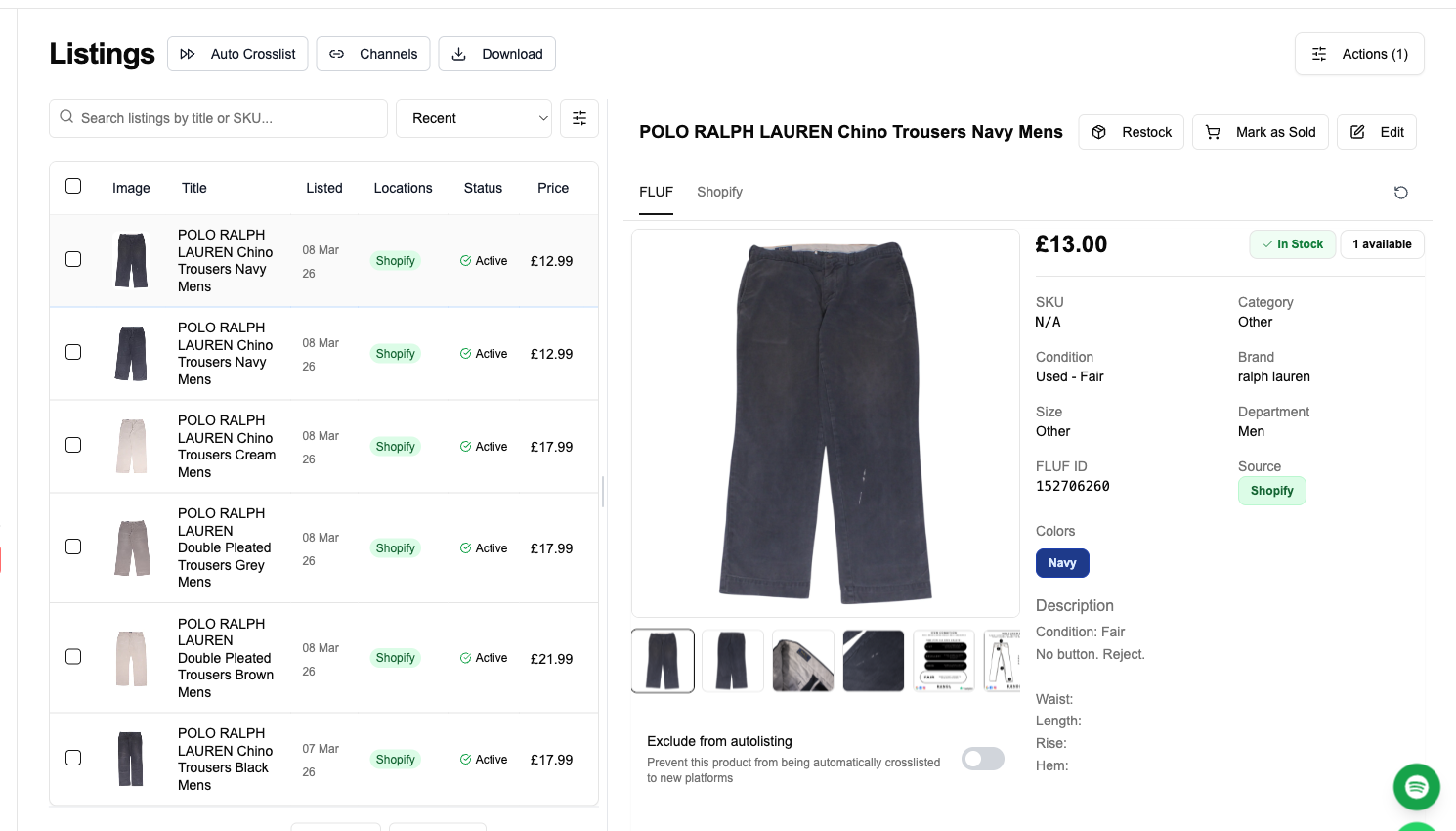
The gap Shopify leaves
Start with the thing nobody says out loud in Shopify’s own marketing. Shopify builds exactly one marketplace channel of its own — Marketplace Connect, formerly Codisto — and its supported list is Amazon, eBay, Walmart in the US and Target Plus in the US. Shopify’s help documentation states plainly that new connections to Etsy cannot be made at this time.
For the entire resale and secondhand category — Mercari, Depop, Vinted, Poshmark, Grailed, Vestiaire Collective — Shopify offers nothing. Not a deprecated app, not a limited beta. Nothing. If your store sells anything one-of-a-kind, vintage, refurbished or pre-owned, the second-channel problem is yours to solve outside Shopify.
That is a strange gap given the size of the opportunity. Mercari reported 4.2 million US monthly active users and $810 million of US GMV in the year to 30 June 2026, and eBay — which Shopify does support — says pre-loved and refurbished goods are now around 40% of its GMV. The demand for secondhand is not a niche any more; Shopify’s channel roadmap simply has not followed it.
Why a Shopify store should be on Mercari
Running your own store means paying a fixed platform fee and then buying all of your own traffic. Shopify’s UK plan pricing runs from £25 a month on Basic through £65 on Grow and £344 on Advanced, with Plus starting from £1,800, plus a transaction fee of 2%, 1%, 0.6% or 0.2% respectively if you do not use Shopify Payments. Those numbers are the floor, not the cost of acquisition.
Mercari inverts the model. There is no monthly fee and no listing fee; you pay only when something sells. What you are renting is buyer inventory — 4.2 million people a month who are already there and already shopping.
Category fit matters more than raw scale, and Mercari’s mix has moved sharply. Entertainment and Hobbies — collectibles and trading cards — grew from 19.2% to 30.8% of Mercari’s US GMV in two years and is now its single largest category, ahead of womenswear. So the strongest Shopify stores for this pair are the ones selling collectibles, hobby goods, electronics, games and books. If your Shopify catalogue is clothing, Mercari is worth testing rather than betting on, and this page’s advice is to test it cheaply rather than commit to it.
| Shopify | Mercari | |
|---|---|---|
| What it is | Your own store on rented software | A US consumer marketplace |
| Cost shape | Fixed monthly fee plus your own traffic costs | No fixed fee; 10% when it sells |
| Scale | $115.6bn of merchant GMV in the quarter to 30 June 2026 | 4.2m US monthly active users, $810m US GMV |
| Product model | One product, up to 2,048 variants, quantity per location | One listing, one item |
| Condition field | None in the core product form | Required |
| Where buyers come from | You bring them | Already there |
| Countries | Global, 175+ | United States only |
Variants, quantity and the one-item rule
This is the section that makes or breaks a Shopify-to-marketplace push, and it is worth understanding before you click anything.
Shopify raised its variant ceiling to 2,048 per product for all merchants in October 2025, up from the long-standing 100, though it caps options at three per product and warns that apps not on its current GraphQL product APIs may have a degraded or broken experience above the old 100-variant line. Media is capped at 250 items per product, and — this is the bit that hurts — only one media item can be attached to each variant.
Mercari does not have variants. One listing is one physical item at one price with one set of photos.
So a Shopify product with five sizes and three colours is fifteen Mercari listings. Each needs its own title, its own price, and ideally its own photographs — and Shopify has given you exactly fifteen variant-attached images to draw on, out of a shared pool. Something outside both systems has to hold the mapping between Shopify variant and Mercari listing, or the next inventory update goes to the wrong place.
Quantity is the same problem in a different coat. A Shopify variant with twelve in stock has nowhere to put the twelve. Either you fan it out into twelve listings and track twelve external IDs against one SKU, or you list one and silently misrepresent your stock.
FLUF Connect helps keep each variant’s availability up to date across Shopify and Mercari. Review the size, colour, price, stock and photos for each destination listing before publishing.
How to crosslist from Shopify to Mercari
- Create a FLUF Connect account and start the £1 seven-day trial.
- Connect Shopify. Install the app through the connection prompts, then import and review your products, variants, images, prices and stock. No extension is required.
- Connect Mercari. Mercari authenticates against a session tied to its own origin, so it is connected through the FLUF Chrome extension on a computer rather than by a stored key.
- Choose what to push. Filter by collection, product type, tag or stock level. Pushing an entire multi-variant catalogue is almost never the right first move; start with the one-of-a-kind and single-variant stock.
- Set condition. Shopify has no condition field, so this is supplied once in FLUF and carried to every channel that needs it.
- Review the fan-out. For multi-variant products, confirm how many Mercari listings you are about to create and which images each will carry.
- Crosslist. Listings appear on Mercari and are recorded against their Shopify source.
Worth noting what you are not doing: Mercari’s own importer exists, but it reads eBay, Poshmark and Depop only. It has never supported Shopify and there is no sign of it being added.
What transfers, field by field
| Shopify field | Mercari field | Status | Notes |
|---|---|---|---|
| Product title | Title | Automatic | For a multi-variant product the variant options are appended, so the fifteen listings are distinguishable. |
| Description (body HTML) | Description | Automatic, converted | Shopify descriptions are HTML. Mercari’s field is plain text, so markup is stripped rather than shown as tags. |
| Product media | Photos | Automatic, capped at 12 | Mercari rejects an upload batch above twelve photos, so FLUF sends the first twelve. Remember only one Shopify media item attaches to each variant. |
| Variant price | Price | Automatic | Price rules can add a Mercari-specific uplift to cover the 10% fee. |
| Product category | Category | Smart mapped | Shopify’s Standard Product Taxonomy moved twice in 2026, adding over 2,000 categories in the May release alone, so mapping is maintained rather than fixed. |
| — | Condition | Manual input | Shopify has no condition field. See the next section. |
| Vendor | Brand | Mapped with care | Shopify’s vendor field is semantically the supplier, not the brand. On plenty of stores it holds a wholesaler name, which is not what a Mercari buyer is searching for. |
| Variant SKU | — | Not displayed on Mercari | Kept by FLUF as the link between the Shopify variant and its Mercari listing. |
| Weight | Shipping | Used | Mercari’s prepaid labels carry weight caps, so this matters for anything bulky. |
| Inventory quantity | — | Does not exist | Mercari listings are single items. Quantity above one must be fanned out or reduced. |
| Multiple locations | — | Not applicable | Shopify supports up to 200 active locations on Plus and ten on the standard plans. Mercari has one seller address. |
The condition field Shopify does not have
Every resale marketplace requires condition. Mercari requires it, eBay requires a condition ID valid for the specific category, Vinted requires a status from its own ontology. Shopify does not have the field at all.
The closest thing that exists is a metafield used by the Google sales channel, holding new, used or refurbished. It exists only because Google’s product feed demands it, it is not surfaced in Shopify’s core product form, and on the overwhelming majority of stores it has never been populated.
The practical consequence is that condition cannot be migrated. It has to be created — asked for once, at crosslist time, and then stored. FLUF stores it against the product, so the second, third and fourth channel you add all inherit it rather than asking again. For a store where every item is genuinely new, one bulk default does the job in a single action.
Brand has a quieter version of the same problem. Shopify’s vendor field is required and free text, but it means supplier. If your vendor values are wholesaler names, mapping them straight into Mercari’s brand field produces listings nobody searches for. Check that mapping before a bulk push rather than after.
Fees and what you actually keep
Mercari’s fee model is simple and it changed materially in 2025, so ignore anything written before then.
- Seller: 10% of the item price plus buyer-paid postage, reinstated on 6 January 2025.
- Buyer: 3.6% Buyer Protection.
- No listing fee, no monthly fee, no fee for unsold stock.
On a $60 item with $8 of buyer-paid postage, Mercari takes 10% of $68, which is $6.80, and your buyer pays roughly $2.45 on top of the $68. You net about $53.20 before your own cost of goods and packaging.
Compare that to the same item sold through your Shopify store, where you pay no marketplace commission but do pay Shopify’s monthly fee, your payment processor, and whatever an incremental customer costs you to acquire. The honest framing is that Mercari’s 10% is not competing with 0% — it is competing with your customer acquisition cost, and for a lot of stores that comparison goes Mercari’s way on the margin.
One thing to price in deliberately: Mercari’s buyer pays 3.6% at checkout, which makes your listing look more expensive than the sticker price. If you are competing against other Mercari sellers this is neutral, because they carry it too.
Inventory sync and the overselling problem
Overselling is the single biggest risk in this pair and it deserves its own section, because Shopify merchants running multiple channels hit it constantly.
The mechanics are unforgiving. A Shopify variant with one in stock, listed on Mercari and on your store, must come off Mercari before the next buyer reaches checkout. Shopify’s own community has a thread from January 2026 on exactly this, where the useful reply notes that sync in practice happens at intervals, so merchants build stock buffers to compensate.
What FLUF does on this pair:
| Event | What happens |
|---|---|
| Item sells on Shopify | FLUF reads the order and removes the matching Mercari listing. |
| Item sells on Mercari | FLUF reads the sale and decrements or delists the Shopify side. |
| Stock goes to zero in Shopify | The Mercari listing comes down. |
| Price or description edited | Pushed to Mercari. |
| Orders | Both channels feed one order list, so revenue is countable in one place. |
| Automated relisting | Not supported on Mercari. |
| Offer management | Not automated. Mercari takes buyer offers natively; you respond in its app. |
Keep your Mercari browser connection signed in and available for publishing. Large batches take time and inventory sync is not instantaneous. Check pending sales and availability for one-of-a-kind items.
It is also worth knowing that Shopify’s own channel is not immune. A June 2026 community thread documents Marketplace Connect sending the parent SKU instead of the variant SKU to eBay for more than six weeks, breaking inventory matching, with support offering only relist and unlink-relink as remedies. Multi-channel inventory is hard everywhere; the question is whether the tool tells you when it breaks.
Before and after
Before. Export your Shopify products to CSV. Work out which variants are actually separate sellable items. Re-key each one into Mercari by hand, choosing a category and a condition, uploading photos again because Mercari wants uploads rather than URLs, and setting a weight. Keep a spreadsheet mapping Shopify variant IDs to Mercari listing IDs, because nothing else will. Then check both channels daily forever, because a sale on one does not touch the other.
After. Install the app. Set condition once. Filter to the products worth listing. Push. Sales on either side close the other.
The listing time saved is real, but the spreadsheet is the thing you actually get rid of — and the spreadsheet is what causes the double sales.
What merchants report
Shopify merchants are consistent about where multi-channel hurts. The January 2026 overselling thread is about peak-season stock going negative across Shopify, Amazon and eBay simultaneously. A May 2026 thread describes a merchant trying to migrate 460,000 eBay listings through Marketplace Connect and watching the sync loop endlessly, with the replies recommending third-party tools instead. And the parent-SKU bug above ran for six weeks in Shopify’s own first-party channel.
On the Mercari side, seller sentiment is mixed and worth reading honestly. A widely discussed July 2026 thread ties a decline in activity to the decision to move fees onto buyers, with one seller arguing the move tanked everything, and others pointing out that on rival platforms shipping starts cheaper, so a $20 purchase turns into $35 or more once Mercari’s postage and buyer fee are added.
The counter-case is about category rather than fees: sellers who do well there consistently describe Mercari as the place people go for deals on collectibles, electronics and hobby goods, with searchable descriptions and listings that rank in Google, rather than a fashion venue. Since that is also what Mercari’s own GMV mix now shows, it is the better guide to whether your Shopify catalogue belongs there.
What it costs
FLUF Connect is £1 for 7 days, then plans from £9/month on Starter. Seller is £29/month and Pro is £99/month; every plan is unlimited on listings and marketplaces, and the tiers differ by which automations they include and how often we check your channels for sales. There is no free plan. Crosslisting and inventory sync are included in every plan, and automated relisting and offer management from Seller upwards rather than sold as add-ons, on the channels that support them. Full detail on pricing.
Mercari charges nothing to list, so the only fixed cost on top of your existing Shopify plan is the subscription.
Sources and verification
- Shopify Marketplace Connect’s supported marketplaces and the closure of new Etsy connections: Shopify Help Center. The app itself: Marketplace Connect on the Shopify App Store.
- Shopify plan pricing and third-party transaction fees: Shopify pricing and third-party transaction fees.
- Merchant GMV of $115.6 billion in the quarter ended 30 June 2026: Shopify Q2 2026 results, released 5 August 2026.
- The 2,048-variant limit: Shopify developer changelog, 15 October 2025. Three options per product: Add variants. Media limits and one media item per variant: Add media. Location limits by plan: Locations.
- Shopify Standard Product Taxonomy releases: 2026-05 release notes.
- Mercari US GMV, monthly active users and category mix: Mercari, Inc. FY2026 results, fiscal year ended 30 June 2026.
- Mercari selling fee and Buyer Protection fee: Mercari fees, effective 6 January 2025. US residency requirement: Terms of Service. Non-US bank accounts: W-9 FAQs. Supported import sources: importing listings.
- Pre-loved and refurbished as a share of eBay GMV: reported comments from eBay’s chief executive.
- Merchant experience: overselling across channels (January 2026), Marketplace Connect sending parent SKUs to eBay (June 2026), a 460,000-listing migration failing (May 2026), and Mercari seller sentiment. Read 31 August 2026.
Shopify does not publish a product title or description character limit, so none is quoted. Mercari does not publish its title or description limits either. Shopify’s US dollar plan prices appear only in third-party write-ups and are not quoted here; the sterling figures come from Shopify’s own pricing page. Shopify has not published a merchant count since an older figure and none is quoted. Community quotes are individual experiences, not measured data. Fees are current as of August 2026; Mercari’s structure changed on 6 January 2025 and Shopify’s variant limit changed in October 2025, so older guides are unreliable.
Related pages
- Crosslist from Mercari to Shopify — the reverse direction
- Crosslist from Shopify to eBay — the larger US marketplace
- Crosslist from Vinted to Mercari — the same destination from a resale source
- Sell on Mercari — fees, limits and shipping
- Sell on Shopify — the store-owner’s guide
- Crosslisting hub — every supported channel pair
- Crosslist from Facebook Marketplace to Mercari
Frequently Asked Questions
No. Shopify Marketplace Connect supports Amazon, eBay, Walmart in the US and Target Plus in the US, and Shopify has closed new Etsy connections. There is no first-party Shopify channel for Mercari, and none for Depop, Vinted, Poshmark, Grailed or Vestiaire Collective either. Crosslisting through a third-party tool is the only route.
No. Mercari requires you to reside in the US and will not accept a non-US bank account, so this pair is only available to American sellers. Shopify itself is global, but Mercari is the constraint.
Each sellable variant becomes its own Mercari listing, because a Mercari listing is one item and has no variant concept. A product with five sizes and three colours becomes fifteen listings. FLUF records each listing against the Shopify product and variant it came from, so stock changes and sales resolve back to the right row.
Mercari has no quantity field on a listing, so twelve in stock either fans out into twelve listings tracked separately, or you list one and accept that your Mercari stock does not reflect your real stock. Fanning out is the correct answer for anything you genuinely have multiples of.
Condition has to be created rather than migrated. Shopify has no condition field in its core product form; the nearest thing is a Google-channel metafield that is empty on almost every store. FLUF asks once and stores condition against the product, so every channel you add afterwards inherits it. If everything you sell is new, one bulk default handles it.
Sellers pay 10% of the item price plus buyer-paid postage, reinstated on 6 January 2025, and buyers pay a 3.6% Buyer Protection fee. There is no listing fee, no monthly fee and no charge for unsold stock. On a 60 dollar item with 8 dollars of postage Mercari takes 6.80 dollars from you.
Twelve. Mercari rejects an upload batch above twelve photos, so FLUF sends the first twelve. Note that Shopify only attaches one media item to each variant, so multi-variant products often have fewer distinct images available than you expect.
A Shopify sale removes the matching Mercari listing, and a Mercari sale updates Shopify stock. Sync is not instantaneous, so check pending sales and availability for one-of-a-kind items.
No. Mercari own listing importer supports eBay, Poshmark and Depop only. It has never read Shopify.
FLUF Connect is 1 pound for 7 days, then plans from 9 pounds a month on Starter. There is no free plan. Mercari charges nothing to list, so the subscription is the only fixed cost on top of your existing Shopify plan.
Sign up for free
Join the community
You're in.
Open your dashboard