Where to Sell Pokémon Cards in 2026: eBay, TCGplayer, Cardmarket, Whatnot and More
eBay, TCGplayer, Cardmarket, Whatnot, Mercari, Facebook Marketplace, Vinted and TodoColección compared on fees, buyers and grading, with Magic: The Gathering and Yu-Gi-Oh! covered too.



- US: eBay has the widest reach for singles and graded cards. TCGplayer is the specialist for singles, and Mercari charges a flat 10%.
- UK and Europe: Cardmarket is the specialist for singles. eBay UK charges private sellers no final value fee, and Vinted charges sellers no selling fee.
- Live auctions: Whatnot suits sellers who will stream, especially for packs and chase cards.
- Grading: only grade a card when the graded price beats the raw price by more than the grading fee, postage and the risk of a low grade.
- Fastest cash: a local card shop or buylist pays on the spot, but well below what the card sells for online.
The best place to sell Pokémon cards depends on three things: where you live, what the card is worth, and how much work you’ll put in. A £2 bulk rare and a graded chase card need different marketplaces. This page compares the main options in the US, UK and Europe on fees, buyers and grading, then covers Magic: The Gathering and Yu-Gi-Oh!, which sell through most of the same places.
Where Is the Best Place to Sell Pokémon Cards?
For most US sellers it’s eBay, and for most UK and European sellers it’s a mix of eBay and Cardmarket. eBay has the largest general audience for cards of every value, graded or raw. Specialist sites such as TCGplayer and Cardmarket are faster for singles, because buyers search for the exact card and printing. Whatnot works if you want to sell live. Mercari, Facebook Marketplace, Vinted and TodoColección are useful second outlets for the same stock.
| Marketplace | Where | Seller fee | Best for |
|---|---|---|---|
| eBay | US, UK, worldwide | US: 13.25% up to $7,500 plus $0.30 or $0.40 per order. UK private sellers: no final value fee | Graded cards, high-value singles, lots |
| TCGplayer | US | 10.75% commission, capped at $75 a card, plus payment processing | Raw singles priced against the market |
| Cardmarket | Europe, UK | Commission per sale, lower for professional sellers | Raw singles for European buyers |
| Whatnot | Online, live video | Commission plus processing per sale | Live auctions, sealed product, chase cards |
| Mercari | US | 10% of item price and buyer-paid postage | Bundles and mid-value cards |
| Facebook Marketplace | Local, worldwide | A fee on shipped orders where offered | Collections and local cash sales |
| Vinted | UK, Europe | No selling fee. The buyer pays a Vinted fee | Low-value bundles to casual buyers |
| TodoColección | Spain | 8.75% up to €300, falling to 4.5% above €1,000 | Spanish collectors, vintage cards |
Is eBay Good for Selling Pokémon Cards?
Yes, and it’s the default for graded cards. eBay sold listings are also the price record most buyers check, so a card listed there at a fair price tends to find a buyer. In the US, eBay charges 13.25% of the sale up to $7,500 for trading cards, 2.35% on any amount above that, and a $0.30 per-order fee on orders of $10 or less ($0.40 above $10). On a $50 card with free shipping, that’s $6.63 plus $0.40, so you keep $42.97 before postage.
In the UK, private sellers pay no final value fee on most items, cards included. That makes eBay UK one of the cheapest places to sell a personal collection. Business sellers pay a fee by category. Use eBay’s free Product Research tool to see what a card actually sold for, which is often below the asking prices you see in search.
Should You Sell on TCGplayer?
TCGplayer is the US specialist for singles. Like Cardmarket, it lists cards against a catalogue, so a buyer searching for one printing sees every seller’s copy side by side, ranked by price and condition. You don’t take photos for most raw singles, which makes it quick for large binders.
Since February 2026, standard sellers pay a 10.75% commission, capped at $75 per item, plus payment processing. On that same $50 card the commission is $5.38. Because buyers compare prices directly, you compete on price more than on presentation. FLUF Connect doesn’t connect to TCGplayer, so stock you list there has to be managed on TCGplayer itself.
Where Do You Sell Pokémon Cards in the UK and Europe?
Cardmarket is the main specialist marketplace for European card buyers. It works like TCGplayer: you pick the card from its catalogue and set the condition, language and price. Our Cardmarket seller guide covers the commission levels, verification and condition grades.
A UK seller with a mixed collection often uses three outlets: Cardmarket for singles, eBay UK for graded cards and lots, and Vinted for cheap bundles. On Vinted, sellers pay no selling fee. The buyer pays a Vinted fee at checkout, usually 3% to 8% plus £0.30 to £0.80. Sellers only pay for optional extras such as bumps. Vinted buyers are mostly casual, so bundles and single cards under about £20 suit it better than graded slabs.
In Spain, TodoColección is the long-standing collectibles marketplace. Its commission is 8.75% on lots up to €300, 7% from €301 to €500, 5.5% from €501 to €1,000 and 4.5% above that, plus VAT. A €40 card costs €3.50 in commission.
Is Whatnot Worth It for Pokémon Cards?
Whatnot is worth it if you’ll sell live on camera. Buyers join shows to watch packs opened and bid on cards in real time, so chase cards and sealed product can fetch more than a fixed-price listing. It’s hard work if you only want to clear a binder. Our guide to selling Pokémon cards on Whatnot covers its fees, show formats and what sells.
What About Mercari and Facebook Marketplace?
Both are general marketplaces where cards sell next to everything else. On Mercari in the US, the selling fee is 10% of the item price plus any postage the buyer pays, with no separate payment processing fee. On a $50 card with free shipping, that’s $5. Mercari suits bundles and mid-value cards, and buyers there often make offers.
Facebook Marketplace is strongest for local sales. It’s a good way to sell a whole collection to someone who can inspect it in person, and to reach parents clearing out a child’s cards. Meet in a public place, and count cash before you hand over valuable cards. Shipped checkout is only available in some countries, and Facebook charges a fee on those orders.
Should You Grade Pokémon Cards Before Selling?
Grade a card only when the numbers work. Grading means sending the card to a company such as PSA, CGC or Beckett, which seals it in a slab with a grade from 1 to 10. A high grade can multiply a card’s price. A low grade can leave you with less than the raw card was worth, after fees.
The fees add up. CGC charges $17 a card on its US Bulk tier and $20 on Economy. Its UK office charges £12 a card plus VAT on Bulk. Postage and insurance both ways come on top, and cheaper tiers take longer.
A simple test before you grade:
- Check recent eBay sold prices for the raw card and for the grade you realistically expect.
- Subtract the raw price, the grading fee and postage from the graded price.
- If the answer is small, or only works at a perfect 10, sell it raw.
Most modern cards are worth more sold raw. Grading pays off on vintage cards, sought-after modern chase cards in near-perfect condition, and cards buyers won’t trust without a slab.
Where Can You Sell Magic: The Gathering Cards?
Magic sells through the same specialist marketplaces as Pokémon. TCGplayer is the main US outlet for singles, and Cardmarket is the main European one. Both list Magic cards by set and printing, so the right printing matters more than photos. eBay suits older and graded Magic cards, sealed product and large lots. Buyers on general apps such as Vinted and Facebook are less likely to be looking for Magic singles, so use those for bulk lots rather than individual cards.
Where Can You Sell Yu-Gi-Oh! Cards?
Yu-Gi-Oh! follows the same pattern. TCGplayer and Cardmarket handle singles, with the printing and edition setting the price, and eBay handles graded cards, older sets and lots. Check the set code and rarity printed on the card before you list it, because reprints of the same card can sell for very different prices.
Should You Sell to a Local Card Shop or Buylist?
Sell to a shop when speed matters more than price. A local card shop pays cash on the day, and a buylist (a shop’s published price list for cards it will buy) lets you post cards in and get paid without listing anything. Both pay well below what the card sells for online, because the shop has to resell it at a profit. Shop credit is often worth more than cash. Shops are a good home for bulk commons that aren’t worth listing one by one, and for a quick sale before a price drop.
Can You Sell the Same Cards on Several Marketplaces?
Yes, and many card sellers do. A card listed on eBay, Cardmarket and Vinted reaches three sets of buyers. The risk is selling the same card twice: you must remove it from the other marketplaces as soon as it sells, or cancel an order and take a hit to your seller rating.
FLUF Connect is a crosslisting app that does this for you. You list a card once and send it to each marketplace you sell on, from eBay and Vinted to Whatnot, Mercari and Facebook Marketplace, out of 80+ marketplaces. When the card sells on one of those five, FLUF takes it off the others. Two exceptions apply to cards. On Cardmarket, sales aren’t synced in either direction, so you update your stock there yourself. On TodoColección, FLUF removes the card when it sells elsewhere, but a sale on TodoColección has to be taken off your other marketplaces by hand. Vinted, Whatnot, Mercari and Facebook Marketplace connect through the FLUF browser extension or the FLUF Mobile app, and Cardmarket through the browser extension.
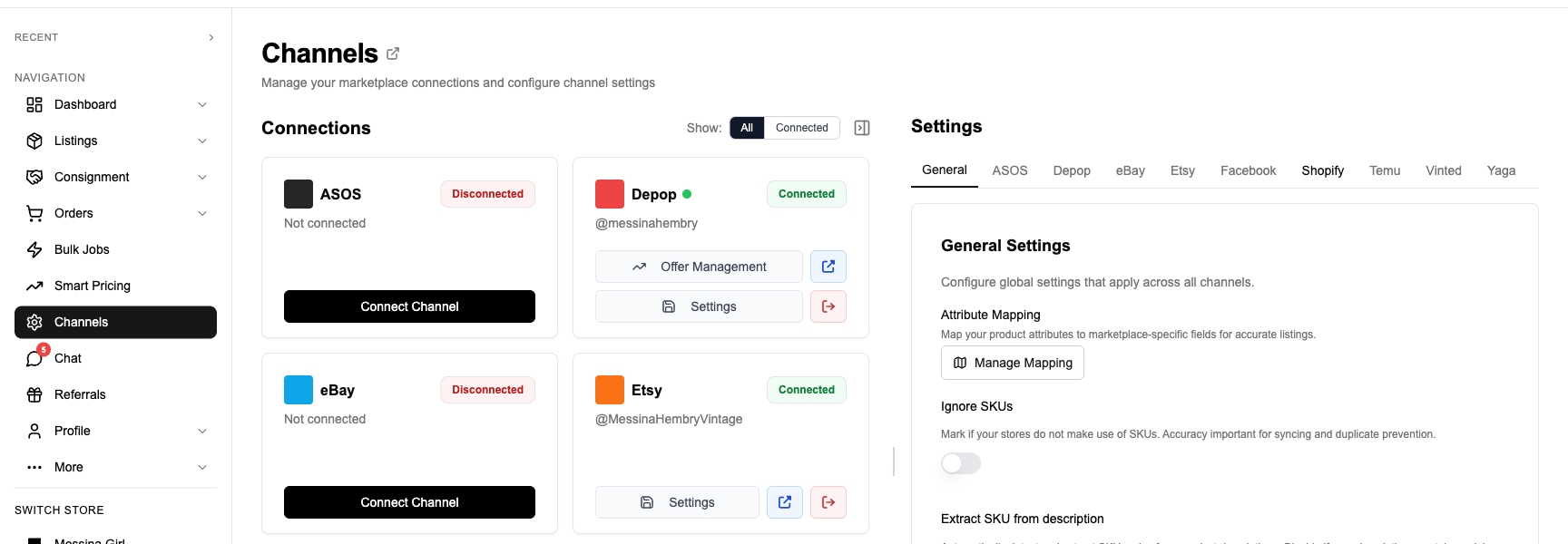
FLUF Connect doesn’t price or identify cards for you. Use sold prices on eBay or the market price on TCGplayer and Cardmarket for that.
List your cards once, sell them on several marketplaces
7 days for £1, then from £9/month.
For more on the software side of reselling, see reseller apps and our crosslisting app comparison.
Sources & Verification
Last verified: 2026-11-09. Please contact us if any figure is out of date.
Frequently Asked Questions
For a personal collection, eBay UK and Vinted cost the seller least. eBay UK charges private sellers no final value fee on most items, and Vinted charges sellers no selling fee because the buyer pays a fee at checkout. Cardmarket takes a commission on each sale.
TCGplayer is quicker for raw singles because buyers search the exact printing and you rarely need photos. Standard sellers pay 10.75% commission plus processing. eBay is better for graded cards, lots and high-value cards, and charges 13.25% plus a per-order fee in the US.
Only when the expected graded price is higher than the raw price plus the grading fee and postage. CGC's cheapest US tier is $17 a card. Most modern cards sell better raw. Vintage and near-perfect chase cards are the usual exceptions.
Yes. Vinted charges sellers no selling fee, and the buyer pays a Vinted fee of usually 3% to 8% plus £0.30 to £0.80. Its buyers are mostly casual, so it suits bundles and low-value cards more than graded slabs.
No. FLUF Connect doesn't connect to TCGplayer. It lists cards to eBay, Cardmarket, Whatnot, Mercari, Facebook Marketplace, Vinted, TodoColección and other marketplaces, and removes a sold card from the others where the marketplace supports it.
Sign up for free
Join the community
You're in.
Open your dashboard