Where to Sell Vinyl Records: Discogs, eBay, Etsy, Vinted and Facebook Compared
Collectable pressings, everyday albums and whole crates each sell best in a different place. Discogs, eBay, Etsy, Vinted, Facebook Marketplace, Reverb, record shops and fairs compared, with fees from their own pages, grading and safe posting.



- Collectable pressings: Discogs is where record collectors look for an exact pressing. You list against a release in its database, so the grade you give is most of your listing.
- Rare records and auctions: eBay reaches the widest audience. UK private sellers pay no selling fee, and US sellers pay 13.6% plus a small per-order fee on records.
- Everyday records in the UK and Europe: Vinted has a vinyl records category and charges sellers nothing.
- Old records as vintage: Etsy accepts records at least 20 years old in its vintage category. Local buyers, crates and job lots suit Facebook Marketplace, record shops and record fairs.
The best place to sell vinyl records depends on what you have. A first pressing that collectors hunt for, a shelf of 1980s pop albums and a box of scratched 7-inch singles each have a different buyer, and those buyers shop in different places. This guide compares Discogs, eBay, Etsy, Vinted, Facebook Marketplace and Reverb, plus record shops and fairs. Fees are taken from each company’s own pages on 9 November 2026.
We make FLUF Connect, a tool for listing the same items on several marketplaces. Most of this guide is about the marketplaces themselves.
What Is the Best Place to Sell Vinyl Records Online?
| Where | Best for | What the seller pays | Buyers |
|---|---|---|---|
| Discogs | Specific pressings, collectable records | A percentage of the sale; see our Discogs guide for the current rate | Collectors worldwide who search by release |
| eBay | Rare records, auctions, job lots | US: 13.6% plus $0.30 or $0.40 per order. UK private sellers: nothing | The widest general audience |
| Etsy | Records 20 or more years old | $0.20 per listing, 6.5% of the order, plus payment processing | Gift buyers and vintage shoppers |
| Vinted (UK and Europe) | Popular albums at modest prices | Nothing; the buyer pays a fee | Casual buyers browsing second-hand |
| Facebook Marketplace | Crates, collections and local sales | Depends on whether you ship | Local buyers and dealers |
| Reverb | Turntables and audio gear sold alongside records | See Reverb’s seller fee page | Musicians and audio enthusiasts |
| Record shops and fairs | Whole collections, quick cash | No fee; the dealer’s offer is below resale value | Dealers who resell |
A simple rule: identify the exact pressing first, then check what that pressing has sold for. A record worth £20 or $25 or more is worth listing on its own. Records that sell for a pound or two are usually better sold as a bundle or to a dealer.
How Do You Find Out Which Pressing You Have?
Two copies of the same album can differ in value many times over. Collectors pay for a particular pressing, so a buyer needs to know which one you have before they will pay a collector’s price. Check these details:
- Label and catalogue number: printed on the centre label and the spine of the sleeve.
- Country of manufacture: usually on the label or the back of the sleeve.
- Matrix or runout: the letters and numbers scratched or stamped into the smooth run-out area between the last track and the label. These often tell an early pressing from a later one.
- Barcode: present on most records made since the 1980s, but not on older ones.
- Extras: an inner sleeve, insert, poster or hype sticker that came with the original can add value. Missing extras lower it.
Compare these details with the release entries on Discogs, then look at sold prices for that pressing rather than the album in general. Reissues are often worth far less than originals, and a reissue described as an original is the fastest way to get a return.
How Should You Grade a Vinyl Record?
Grading tells the buyer how the record plays and how the sleeve looks, graded separately. Two scales are in common use, so say which one you are using.
In the UK, many sellers use the scale of Record Collector magazine, published in its Rare Record Price Guide. It has seven grades and gives the value of each as a share of the Mint price:
| Record Collector grade | Value of the Mint price | What it means |
|---|---|---|
| Mint | 100% | Brand new, no surface marks; sealed or unplayed records should be Mint |
| Excellent | 80% | Some signs of play, very little loss in sound; slight wear on the cover |
| Very Good | 50% | Played many times, surface marks and the occasional light scratch |
| Good | 30% | Sound noticeably worse, some distortion and mild scratches |
| Fair | 15% | Still just playable, considerable surface noise; it may jump |
| Poor | 8% | Will not play properly |
| Bad | About 3% | Unplayable or broken |
Discogs and most US sellers use a different set of grades: Mint, Near Mint, Very Good Plus (VG+), Very Good (VG), Good Plus, Good, Fair and Poor. The grades don’t map one to one onto Record Collector’s, so don’t translate “Excellent” into “Near Mint” without looking again.
Whichever scale you use, grade by eye under a bright light and then play the record. Marks you can see don’t always make a sound, and some noise comes from wear you can’t see. When you are unsure between two grades, choose the lower one. Buyers rarely complain about a record that is better than described.
Who Buys Records on Each Marketplace?
Discogs: collectors looking for an exact release
Discogs is a database of music releases with a marketplace attached. Each listing belongs to one release in the database, so buyers can search for the exact pressing they want and see every copy for sale. You don’t upload your own photos. Buyers see the release’s picture, and your grade and comments are the description. That makes Discogs the strongest place for collectable pressings, and less useful for records you can’t match to a release. Our Discogs selling guide covers its fees, grading and getting paid in detail.
eBay: the widest audience and auctions
eBay suits rare records where you don’t know the right price, because an auction lets buyers set it. It also suits job lots and mixed collections. In the US, vinyl records are not in eBay’s music fee group, so they pay the standard final value fee of 13.6% of the total sale, plus $0.30 on orders of $10 or less and $0.40 above that. The first 250 listings each month are free. In the UK, eBay is free for UK-based private sellers, with no final value fee.
Etsy: older records as vintage
Etsy’s vintage category takes items at least 20 years old. Its listing rules say “Newer, vintage-style, or collectible items aren’t allowed” there, so a recent reissue doesn’t belong in it. Etsy buyers often shop for gifts, which suits classic albums with good sleeves. Etsy charges $0.20 per listing, whether or not it sells, plus a 6.5% transaction fee on the order total, including postage, and a payment processing fee that varies by country.
Vinted: everyday records in the UK and Europe
Vinted is best known for clothes, but it has a vinyl records category. There are no selling fees on Vinted. The buyer pays a Vinted fee of usually 3% to 8% plus £0.30 to £0.80 at checkout, and pays for postage too. It suits popular albums at modest prices more than rare pressings, since collectors search Discogs and eBay first.
Facebook Marketplace, record shops and fairs: whole collections
If you have a crate of records to clear, a local sale saves you packing every one. Facebook Marketplace lets buyers collect in person, and dealers watch it for collections. A record shop or a stall holder at a record fair will buy the whole lot in one go. Expect an offer well below what the records would fetch one by one, because the dealer has to resell them at a profit. It is still the quickest option, and a good one for common records that would take months to sell online.
Reverb: if you also sell audio gear
Reverb is a marketplace built for musicians, best known for instruments and audio equipment. If you are selling a turntable, amplifier or speakers with your records, it is worth a look. Check its seller fee page for the current rates.
Selling a guitar or other instrument too? Our guide to where to sell guitars compares Reverb with eBay, Facebook Marketplace and local sites.
How Much Do Marketplaces Take From a Record Sale?
Here is what each marketplace would take from a $25 or £20 record, leaving postage aside.
| Marketplace | Record price | Fees | You keep |
|---|---|---|---|
| eBay US, no Store | $25.00 | $3.40 final value fee + $0.40 per order = $3.80 | $21.20 |
| Etsy | $25.00 | $0.20 listing + $1.63 transaction = $1.83, plus payment processing | $23.17 before processing |
| eBay UK, private seller | £20.00 | £0 | £20.00 |
| Vinted UK | £20.00 | £0 (the buyer pays the Vinted fee) | £20.00 |
eBay US and Etsy both charge on the total the buyer pays, so the real fee is a little higher once postage is added. For Discogs, see the fee breakdown in our Discogs guide.
Where Do You Sell Records in the UK and Europe?
In the UK, Vinted, Discogs and eBay cover most of the audience. Across Europe, second-hand records also sell on local classifieds sites, where buyers usually collect or ask for postage:
- Kleinanzeigen (Germany): free for private sellers up to 100 listings in 30 days, according to its fee page.
- Marktplaats (Netherlands): a Dutch second-hand classifieds site, marktplaats.nl.
- Wallapop (Spain, Italy and Portugal): a second-hand marketplace, wallapop.com, for local buyers.
- leboncoin (France): a French classifieds site, leboncoin.fr.
FLUF Connect connects to Vinted, Discogs, Kleinanzeigen, Marktplaats, Wallapop and leboncoin. Whether a marketplace notifies FLUF Connect of a sale, and whether FLUF Connect takes the listing down there, varies by marketplace. Check each channel page before you rely on automatic delisting.
How Do You Post Vinyl Records Safely?
Records arrive broken or warped more often than they arrive lost, and most of that damage is avoidable.
- Use a proper LP mailer. Rigid cardboard record mailers are made for 12-inch records. Add a sheet of card on each side as a stiffener.
- Take the record out of the sleeve. Put the disc in its inner sleeve next to the outer sleeve, not inside it. A record moving inside the sleeve in transit splits the seams.
- Protect the sleeve. A clear outer sleeve keeps the cover clean and stops scuffs.
- Keep it flat and cool. Heat warps vinyl. Don’t leave parcels in a hot car or by a radiator.
- Use tracked postage for valuable records. If a buyer says a parcel never arrived, tracking is your evidence.
Can You Sell the Same Record on Several Sites at Once?
Yes, and it helps a record find its buyer sooner. A collectable pressing might sell on Discogs to a collector abroad or on eBay to someone in your country. A classic album might sell on Etsy as a gift, or on Vinted to someone browsing. The risk is selling the same copy twice. If you list one record in three places, you need to take it down from the other two as soon as it sells.
That is the job FLUF Connect does. You create the listing once and send it to the marketplaces you choose, including Discogs, eBay, Etsy, Vinted and Facebook Marketplace, out of 80+ marketplaces. When the record sells on one of them, FLUF Connect takes it off the others. You need your own seller account on each marketplace. Vinted and Facebook Marketplace connect through the FLUF browser extension or the FLUF Mobile app.
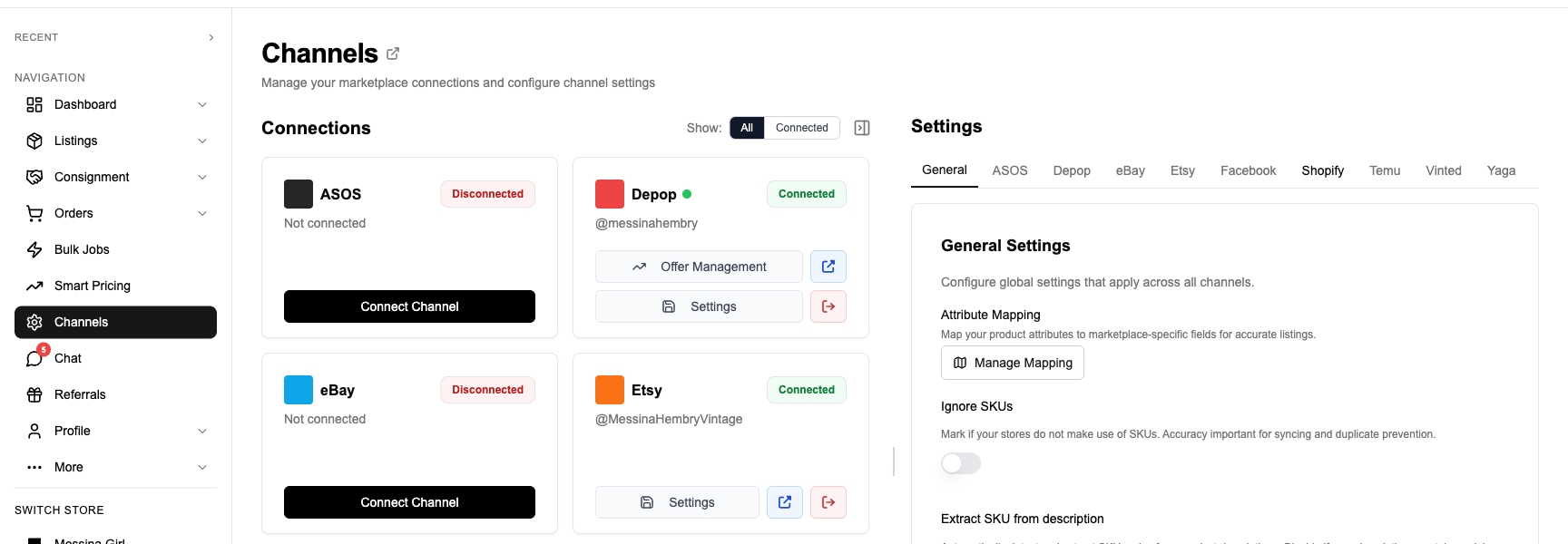
On Discogs, FLUF Connect finds the matching release in the Discogs database for you. If it can’t find a confident match, the record isn’t listed on Discogs, rather than being listed against the wrong pressing. Typing in record details is slow, so if the barcode on the sleeve is in one of your photos, FLUF Connect fills in the title, format and tracklist. You add the grade and the price. Older records with no barcode are listed from your photos and details in the usual way.
Send your records to several marketplaces from one place
7 days for £1, then from £9/month.
How Do You Get a Better Price for Your Records?
- Check sold prices, not asking prices. Asking prices are what sellers hope for. Sold prices show what buyers pay for that pressing.
- Photograph what matters. Where you can add photos, show both labels, the runout, the sleeve front and back, and any damage.
- Grade honestly. Grade the record and the sleeve separately and name the scale you use.
- Clean before you grade. Dust can sound like wear. A clean record often plays a grade higher.
- Bundle the common ones. Ten albums by one artist or a crate of 1970s rock sells better as a lot than one by one.
Selling other collectables too? See where to sell books online and where to sell Pokémon cards. If you sell more than records, our crosslisting app comparison covers seven tools for listing on several marketplaces.
Sources & Verification
Last verified: 2026-11-09. Please contact us if any figure is out of date.
- eBay: selling fees (US)
- eBay: fees for private sellers (UK)
- Etsy: fee basics
- Etsy: how to create a listing (vintage rules)
- Vinted: vinyl records category
- Vinted: selling fees
- Vinted: price list
- Record Collector Rare Record Price Guide: condition rating
- Kleinanzeigen: fees (Gebühren bei Kleinanzeigen)
- Marktplaats
- Wallapop
- leboncoin
- Reverb
Frequently Asked Questions
Discogs is better for a specific pressing that collectors search for, because each listing belongs to one release in its database. eBay is better for rare records where an auction can find the price, and for job lots. Many sellers list on both and remove the record from one when it sells on the other.
In the US, vinyl records pay eBay's standard final value fee of 13.6% of the total sale, plus $0.30 on orders of $10 or less and $0.40 above that. UK-based private sellers pay no final value fee.
Yes. Vinted has a vinyl records category, and there are no selling fees. The buyer pays a Vinted fee at checkout, usually 3% to 8% plus £0.30 to £0.80, and also pays for postage.
Not as vintage. Etsy's vintage category only takes items at least 20 years old, and its rules say newer, vintage-style or collectible items aren't allowed there. Older original pressings qualify.
Only if that pressing sells for more than a few pounds or dollars. Check sold prices for the exact pressing first. Common records usually do better as a bundle, sold locally, or to a record shop or fair dealer who buys the whole lot.
Sign up for free
Join the community
You're in.
Open your dashboard