
Poshmark vs Depop: Which Is Better for Sellers in 2026?
Fees, audience, geography and what sells — an honest comparison of the two app-first fashion resale marketplaces.



- Poshmark and Depop are both app-first fashion resale marketplaces, but they sit at opposite ends of the fee scale: Poshmark charges sellers a flat $2.95 on sales under $15 and 20% on anything $15 or more, while Depop charges sellers no selling fee at all in the US and UK — only a payment-processing fee.
- Poshmark is the larger US community — 165 million members as of March 2026 — and skews to women’s fashion sold through a social “sharing” loop. Depop is smaller but Gen Z–native (nearly 90% of buyers are under 34), built around vintage, streetwear and Y2K.
- Poshmark operates only in the US and Canada; Depop is strongest in the US, UK, Australia and Italy, so for sellers outside North America Depop is usually the only one of the two that is available.
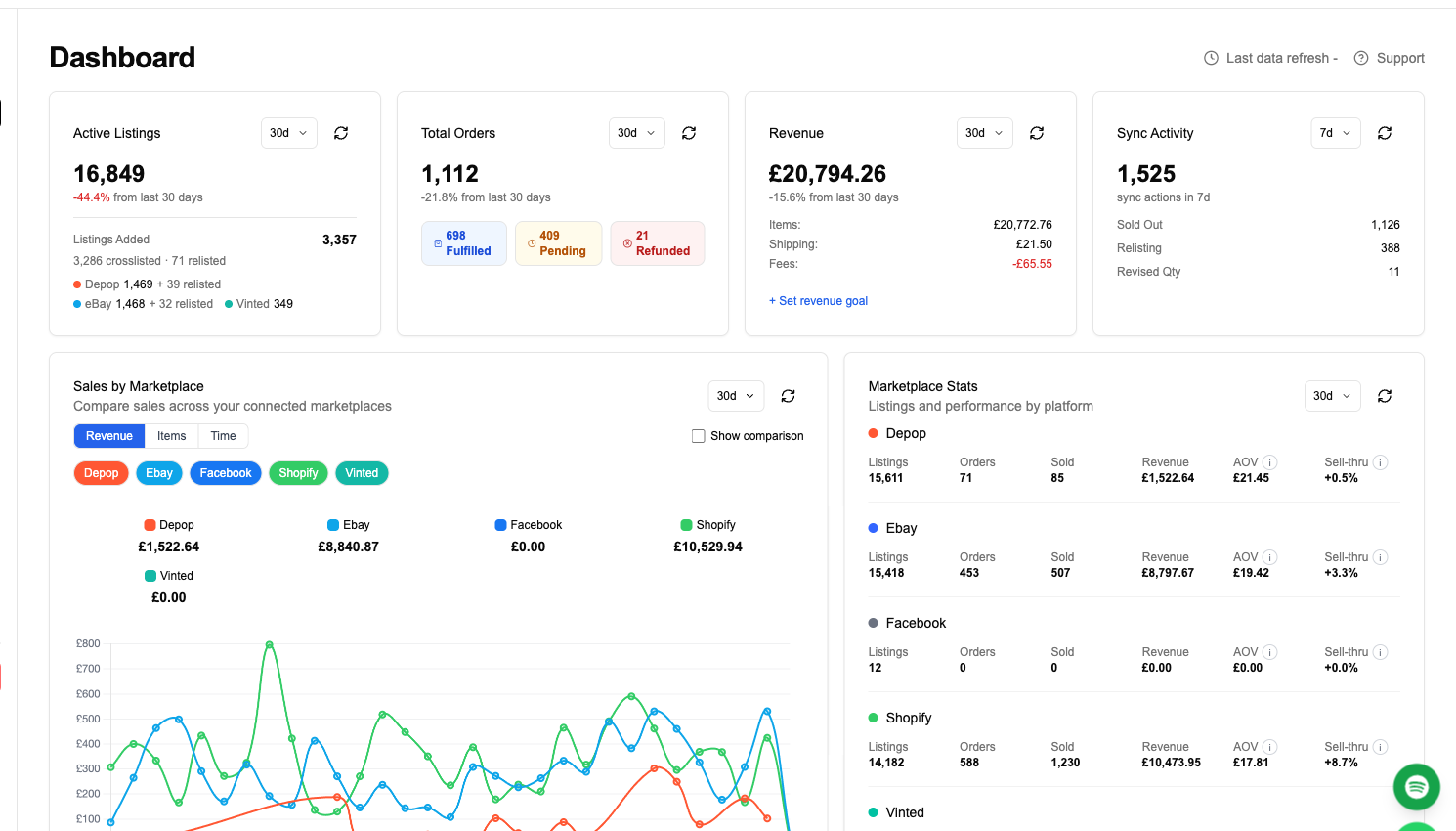
- You do not have to choose. FLUF Connect crosslists one catalogue to both — and to a dozen other marketplaces — so you reach Poshmark’s huge US buyer base and Depop’s younger, fee-free audience from a single dashboard.
- Poshmark vs Depop at a glance
- Feature-by-feature comparison
- Fees and payouts compared
- Shipping
- Audience and geography
- Listing experience
- Sell-through: what it is actually like to sell
- What each platform is best for
- How to choose between Poshmark and Depop
- Why not both? Crosslisting with FLUF Connect
- Pricing
- Sell on both at once
If you resell fashion in 2026, Poshmark and Depop are two of the names that come up first — and they are easy to confuse because both are mobile-first, photo-led, peer-to-peer marketplaces for clothing. Under the hood they are very different businesses, aimed at different buyers, charging fees in completely different ways. This guide compares them honestly on fees, audience, geography, listing effort and what actually sells, so you can decide where your inventory belongs — or run both at once and stop choosing.
Poshmark vs Depop at a Glance
| Poshmark | Depop | |
|---|---|---|
| Seller fee | $2.95 flat under $15; 20% on sales $15+ | No selling fee (US & UK); payment processing only |
| Buyer fee | Flat shipping $6.49; no separate buyer fee | Marketplace fee up to 5% + up to $1/£1 |
| Community size | 165 million members (Mar 2026) | ~7 million active buyers, 3M+ active sellers (Dec 2025) |
| Core audience | Women’s fashion, millennials, US-centric | Gen Z; ~90% of buyers under 34 |
| Available in | US and Canada only | US, UK, Australia, Italy and more |
| Best for | Women’s apparel, shoes, handbags, mid-range brands | Vintage, streetwear, Y2K, one-of-a-kind |
| Owned by | Naver (since Jan 2023) | Etsy; being acquired by eBay (Feb 2026) |
| Listing style | App-first; manual “sharing” to stay visible | App-first; photo-led, no sharing requirement |
The headline takeaway: Depop is cheaper to sell on, Poshmark has the bigger US audience. Everything below is the detail behind that trade-off — and the reason a growing number of resellers stop treating it as a choice and simply list on both.
Feature-by-Feature Comparison
| Feature | Poshmark | Depop |
|---|---|---|
| Listing fee | Free to list | Free to list |
| Selling commission | 20% (or $2.95 flat under $15) | 0% in US & UK |
| Payment processing | Included in the commission | ~3.3% + $0.45 (US) / 2.9% + £0.30 (UK)* |
| Offers / negotiation | Offers to likers; bundle discounts | Make Offer; buyer–seller chat |
| Live selling | Posh Shows (live video) | No native live format |
| Promotion | Manual sharing, Posh Parties | Optional paid Boost |
| Authentication | Posh Authenticate on luxury items | Not a luxury-authentication platform |
| AI listing help | Smart List AI (since Jan 2025) | Photo-led manual listing |
| Shipping model | Flat-rate label, buyer pays $6.49 | Prepaid label, ships peer-to-peer |
*Depop’s official page confirms a payment-processing fee applies but does not publish the rate; the figures above are commonly reported by third-party fee guides and should be treated as indicative.
Fees and Payouts Compared
Fees are the single biggest practical difference between these two platforms, and a lot of the comparison content online is out of date — so here is the current, verified picture, with worked examples.
Poshmark fees
Poshmark is free to list, and you only pay when an item sells. The commission is a flat $2.95 on sales under $15, and 20% on any sale of $15 or more (Poshmark fees). On a $100 sale you keep $80. Importantly, the tiered 5.99% fee structure Poshmark briefly tested in late 2024 was reversed after seller backlash, so the 20% model is what is actually in force in 2026 (Modern Retail). There is no monthly fee, no payment-processing surcharge on top of the commission, and no charge for unsold items.
Depop fees
Depop removed its 10% selling fee for US sellers on 15 July 2024, and the UK selling fee had already been dropped earlier that year — so in both markets sellers now pay no selling commission (Depop newsroom). A payment-processing fee still applies on every sale. To fund buyer protection, Depop introduced a buyer-paid marketplace fee of up to 5% plus a fixed amount of up to $1 (US) or £1 (UK), charged to the buyer at checkout, not deducted from the seller (Depop newsroom). An optional Boost promotion is the only material seller-side cost, and only if a boosted item sells.
What you actually take home
The cleanest way to see the gap is on the same sale price. The Poshmark column assumes the 20% commission; the Depop column assumes a roughly 3.3% + $0.45 US processing fee and no selling commission.
| Sale price | Poshmark net | Depop net (US) | Difference |
|---|---|---|---|
| $30 | ~$24.00 | ~$28.56 | ~$4.56 more on Depop |
| $100 | ~$80.00 | ~$96.25 | ~$16.25 more on Depop |
| $300 | ~$240.00 | ~$289.65 | ~$49.65 more on Depop |
It is worth stress-testing that table against your own catalogue rather than taking the percentages at face value. If your average sale price is under $15, Poshmark’s flat $2.95 can actually be the more expensive option in percentage terms on the very cheapest items, while Depop’s processing-only model stays proportional all the way down. If you sell mostly in the $80–$300 band, the dollar gap per item is large enough that, over a year of steady sales, it can fund the cost of the tools you use to run both platforms several times over. And if your inventory is genuinely premium — designer bags, archive pieces, rare sneakers — the 20% line is the single biggest reason fee-conscious sellers keep a Depop shop open even when most of their volume runs through Poshmark.
The pattern is clear: the higher the price, the more the 20% commission costs you, so Depop’s advantage compounds on premium items. Poshmark’s counter-argument is reach and sell-through speed in the US — a $100 item that nets $80 but sells in a week can beat a $100 item that nets $96 but sits unseen for two months. That is the real trade-off, and it is why so many sellers stop arguing about it and list on both.
Shipping
On Poshmark, shipping is standardised: the buyer pays a flat $6.49 for USPS Ground Advantage on parcels up to 5 lb, a rate Poshmark cut from $8.27 in September 2025 (Poshmark blog). The seller prints the pre-paid label; anything over 5 lb costs the seller the upgrade. That predictability is part of why Poshmark suits heavier items like boots, denim and bundles.
Depop also issues pre-paid labels through its shipping integration, and the cost is typically passed to the buyer or built into the price. Because Depop’s audience leans toward lighter, trend-led pieces, shipping rarely makes or breaks a sale the way it can on heavier Poshmark inventory. For sellers crosslisting both, FLUF Connect maps each item’s weight and shipping settings into the right format per platform, so you are not re-entering parcel details twice.
Buyer Protection and Getting Paid
Both platforms hold the buyer’s money until the item is delivered and back the transaction with protection, which matters as much to your reputation as to your payout. Poshmark runs Posh Protect: payment is released to you once the buyer accepts the item, or automatically three days after delivery if they do nothing, and buyers can open a case for items not as described. Depop’s buyer-paid marketplace fee funds Depop Protection, covering items that do not arrive or that arrive significantly not as described, with the fee refunded to the buyer if the order is refunded.
Payout timing differs in practice. Poshmark lets you redeem earnings by direct deposit or instant transfer once a sale clears, and the standard window is a few business days after delivery acceptance. Depop pays out through its integrated payments to your linked bank account on a similar post-delivery cadence. Neither charges you to withdraw, but both deliberately delay release until delivery is confirmed — so if cash-flow speed is critical, factor that in rather than assuming a sale equals instant money. For sellers running both channels, this is another reason to let a tool track which platform a sale came from, so reconciliation does not become a spreadsheet chore.
Audience and Geography
Poshmark reported 165 million community members as of March 2026, up from 150 million in mid-2025 (Poshmark). That base is overwhelmingly American — roughly 96% of Poshmark’s web traffic is in the United States (Similarweb) — and the platform closed its UK, Australian and Indian operations in October 2023 to refocus on North America (TechCrunch). The buyer skews female and millennial, with the largest age band at 25–34. Poshmark is owned by South Korea’s Naver, which completed its ~$1.2 billion acquisition in January 2023 (Naver/PR Newswire).
Depop is smaller but younger and more international. The marketplace reported around 7 million active buyers and more than 3 million active sellers at the end of 2025, with about 90% of active buyers under the age of 34, and roughly 60% year-over-year growth in the US (Etsy/eBay filing). It is strongest in the US, UK, Australia and Italy. Depop was bought by Etsy for $1.625 billion in 2021, and in February 2026 eBay agreed to acquire Depop for approximately $1.2 billion, a deal expected to close later in 2026 (TechCrunch).
For sellers, the geographic split is decisive: if you are outside North America, Poshmark is not available to you and Depop is the natural choice. If you are in the US, Poshmark gives you the bigger domestic audience while Depop gives you the cheaper fees and a younger buyer. And because their buyers barely overlap — a 22-year-old hunting Y2K on Depop is not the same shopper as a 34-year-old browsing contemporary brands on Poshmark — listing on both is additive, not cannibalising.
Listing Experience
Both platforms are built for phone-by-phone listing: shoot photos, write a title and description, set a price and size, publish. The big behavioural difference is what happens after you list.
On Poshmark, visibility depends on sharing. Sellers repeatedly tap “Share” to push listings to followers’ feeds and to Posh Parties — four themed in-app shopping events every day. Active Poshmark sellers describe spending one to two hours a day sharing to stay visible, and an entire ecosystem of share-automation tools exists because of it. Poshmark layers on more social mechanics than any other resale app: following and being followed, bundle offers to likers, and Posh Shows, its live-video selling format. It has tried to ease the listing side with Smart List AI, launched January 2025, which generates a title, description and category from a photo and which Poshmark says cuts listing time by roughly half (Poshmark).
Depop has no sharing requirement. Listings surface through search, hashtags and the Explore feed, and the optional paid Boost can promote an item. Curation and aesthetic matter more than activity: a tightly styled Depop shop with strong photography tends to outperform a busier one. The practical upshot is that Depop is lower-effort to maintain per listing, while Poshmark rewards daily, active participation. If your time is the constraint, that difference is as important as the fee gap.
Sell-Through: What It Is Actually Like to Sell
Numbers and fees only tell half the story; the day-to-day feel of each platform is different. Poshmark is a relationship and momentum marketplace — you build a following, share into parties, send offers to people who liked an item, and sales tend to cluster around how active you are. It rewards sellers who treat it like a part-time job and punishes set-and-forget listing with invisibility.
Depop is closer to a discovery and aesthetic marketplace. Sales come from search, hashtags and the algorithm surfacing your photos to the right Gen Z buyer, so well-shot, on-trend inventory can sell while you sleep, but generic or poorly-styled items can languish regardless of effort. Neither model is universally better — they suit different sellers and different stock. The sellers who get the most out of resale usually run both: Poshmark for the active, US, women’s-fashion engine, and Depop for the lower-fee, trend-led, international channel. The only thing stopping most people from doing that is the duplicated work, which is exactly the problem crosslisting solves.
What Each Platform Is Best For
Where Poshmark wins
Poshmark began as a women’s fashion marketplace and that is still its centre of gravity: women’s apparel, shoes, handbags and accessories in mid-range contemporary brands — think Lululemon, Free People, Madewell, Coach and the broad mall-to-premium tier. It has since expanded into Men’s, Kids, Home, Pets and Beauty & Wellness (Poshmark). If you sell contemporary women’s brands to a US audience and you can put in the daily sharing, Poshmark’s scale and sell-through are hard to beat.
Where Depop wins
Depop is the home of vintage, streetwear, Y2K and one-of-a-kind pieces, sold to a trend-led Gen Z audience. Curated, characterful inventory — thrifted finds, reworked pieces, archive streetwear, band tees, 90s and 2000s nostalgia — typically performs better on Depop than on Poshmark, and the fee-free model means more of each sale stays with you. Menswear and unisex streetwear are among Depop’s fastest-growing segments, so it is no longer only a womenswear platform. If your inventory has a point of view rather than a brand label, Depop is usually where it sells.
Pricing and Positioning the Same Item on Each
One subtlety that trips up sellers who run both: the right price for an item is not always the same on Poshmark and Depop, because the fee structures and audiences differ. On Poshmark, the 20% commission means many sellers price slightly higher and lean on the “offer to likers” mechanic and bundle discounts to close — the platform’s whole culture expects a little negotiation, so a sticker price with headroom is normal. On Depop, with no seller commission, you can often list the same item a touch lower and still net more, which also helps it win the algorithm’s price-sensitive Gen Z buyer.
Condition and presentation also read differently. Poshmark buyers respond to clean, catalogue-style flat-lays and clear brand and size callouts. Depop buyers respond to styled, editorial, “outfit” photography and a strong shop aesthetic. The same jacket can be the hero of a Depop moodboard and a straightforward listing on Poshmark. When you crosslist with FLUF Connect you start from one set of photos and details and adjust per platform where it matters, rather than building each listing from scratch — so positioning becomes a quick edit, not a second photoshoot.
How to Choose Between Poshmark and Depop
If you only have appetite for one platform to start, match it to who you are:
- Choose Poshmark if you sell women’s fashion to a US audience, you can commit to daily sharing, and reach and sell-through speed matter more to you than fee percentage.
- Choose Depop if you sell vintage, streetwear or Y2K, your buyers are Gen Z, you are outside North America, or you simply want to keep more of each sale with less daily upkeep.
- Choose both if your inventory spans these audiences — which, for most resellers, it does. The two buyer pools barely overlap, so listing on both multiplies your reach rather than splitting it.
A useful rule of thumb: if you have ten of one kind of thing, lead with the platform that fits it. If you have a mixed rail — some contemporary women’s pieces, some vintage, some streetwear — you have already outgrown the single-platform question, and crosslisting is the answer.
Why Not Both? Crosslisting Poshmark and Depop with FLUF Connect
The reason most sellers pick one platform is the work, not the strategy — relisting the same items by hand on two apps, then remembering to remove the duplicate when something sells so you do not oversell and disappoint a buyer. FLUF Connect removes that friction. You build your catalogue once and crosslist it to Poshmark, Depop and a dozen more marketplaces — including eBay, Vinted, Etsy, Shopify and Facebook Marketplace — from one dashboard, with titles, photos, sizes and prices mapped to each platform’s format.
It is worth being precise about what FLUF automates on each side, because the two marketplaces expose different capabilities. On Depop, FLUF runs the full toolkit: crosslisting, inventory sync, order sync, automated relisting and offer management. On Poshmark, FLUF handles crosslisting and automatic sold-detection — when an item sells anywhere, FLUF marks it sold so you avoid the dreaded double-sale — while relisting and offers are managed natively in the Poshmark app. In other words, FLUF gets your listings onto Poshmark and keeps your stock honest across every channel; Depop additionally benefits from FLUF’s relisting and offer automation. That honest division of labour is the point: you get the reach of both audiences without the duplicated admin or the oversell risk.
A simple workflow for running both
If you have only ever sold on one platform, adding the second does not have to double your workload. A typical FLUF Connect routine looks like this:
- Build the item once. Photograph it, write the title and description, set the brand, size, condition and price in FLUF.
- Crosslist to both. Push the listing to Poshmark and Depop together; FLUF maps your fields into each platform’s format and converts currency where needed.
- Tune per platform if it matters. Nudge the price or swap the lead photo for the Depop aesthetic — a quick edit, not a rebuild.
- Let stock stay honest. When the item sells on either channel, FLUF’s sold-detection marks it sold everywhere so you never sell the same piece twice.
- Relist and send offers where supported. On Depop, FLUF can automate relisting and offers; on Poshmark you keep using the native sharing and offer tools, which is where Poshmark’s engagement lives anyway.
That loop is the whole pitch: the strategic upside of two audiences with roughly the admin of one.
What each platform will not take
Knowing the limits saves wasted listings. Poshmark restricts certain categories — beauty and personal-care items must be new and sealed, and some electronics are prohibited — but is otherwise broad across fashion, home and kids. Depop is fashion-and-lifestyle focused and leans heavily into pre-loved, vintage and creator inventory; brand-new mass-manufactured goods feel out of place there even when technically allowed. Neither is a luxury-authentication marketplace in the way Vestiaire Collective is, so for high-value designer pieces you may want to add an authenticated channel alongside them — another argument for a crosslisting setup that is not locked to two apps.
Pricing
FLUF Connect plans start at £19/month (Growth — 1,000 products). There is no free plan. Automation such as relisting, offers and bulk operations is included in every plan, not a paid add-on. You can crosslist to Poshmark, Depop and every other supported marketplace on any plan; the tiers differ by how many products you manage. See FLUF pricing for the full breakdown.
Sell on Poshmark and Depop at the Same Time
Poshmark and Depop are not really rivals for your inventory — they are two different audiences. Poshmark gives you the largest resale community in the US; Depop gives you a fee-free, Gen Z–native channel that reaches buyers Poshmark never will. With FLUF Connect you list once and sell on both, plus eBay, Vinted, Etsy, Shopify and more, while FLUF keeps your stock in sync so nothing oversells. Try FLUF Connect and let one catalogue work both audiences at once, without the duplicated listing work that makes most sellers settle for just one.
Sources & Verification
- Poshmark seller fees and listing — support.poshmark.com
- Poshmark 2024 fee reversal — Modern Retail
- Poshmark shipping reduction — Poshmark blog
- Poshmark 165M members — PR Newswire
- Poshmark US traffic share — Similarweb
- Poshmark international closures — TechCrunch
- Naver acquisition of Poshmark — PR Newswire
- Depop fee changes (2024) — Depop newsroom
- Depop active buyers/sellers and eBay acquisition — Etsy investor relations and TechCrunch
- Poshmark Smart List AI — PR Newswire
Related guides
Frequently Asked Questions
It depends on what you sell and where you are. Poshmark has the larger US community — 165 million members — and is strongest for women's fashion, but charges sellers 20% on sales of $15 or more. Depop is smaller but Gen Z–native and best for vintage, streetwear and Y2K, and charges sellers no selling fee in the US and UK. If you are outside North America, Depop is usually your only option of the two.
Depop. Depop removed its selling fee for US sellers in July 2024 and had already dropped it in the UK, so sellers pay only a payment-processing fee. Poshmark charges a flat $2.95 on sales under $15 and 20% on sales of $15 or more. On a $100 item a Poshmark seller nets about $80, while a Depop seller in the US or UK nets roughly $96 after processing.
Yes. Depop operates in the US, UK, Australia and Italy among other markets. Poshmark, by contrast, operates only in the US and Canada after closing its UK, Australian and Indian operations in October 2023. For sellers outside North America, Depop is the available choice of the two.
Yes, and most resellers should. The two audiences barely overlap, so listing on both multiplies your reach. FLUF Connect lets you build your catalogue once and crosslist it to both — plus eBay, Vinted, Etsy and more — then keeps your stock in sync so an item that sells on one channel is marked sold across the others.
Poshmark is strongest for women's apparel, shoes, handbags and mid-range contemporary brands, with growing Men's, Kids, Home and Beauty categories. Depop is the home of vintage, streetwear, Y2K and one-of-a-kind pieces sold to a Gen Z audience. Curated, characterful inventory tends to perform better on Depop; mainstream women's fashion tends to sell faster on Poshmark in the US.
Yes. Poshmark briefly tested a tiered 5.99% seller fee in late 2024 but reversed it after seller backlash, so the original structure is in force: a flat $2.95 on sales under $15 and 20% on sales of $15 or more. There is no listing fee — you pay only when an item sells.
Poshmark has been owned by South Korea's Naver since its roughly $1.2 billion acquisition closed in January 2023. Depop was bought by Etsy for $1.625 billion in 2021, and in February 2026 eBay agreed to acquire Depop for approximately $1.2 billion, a deal expected to close later in 2026.
FLUF Connect crosslists one catalogue to Poshmark, Depop and a dozen other marketplaces from a single dashboard, mapping titles, photos, sizes and prices to each platform. On Depop it also runs inventory sync, order sync, automated relisting and offer management; on Poshmark it handles crosslisting and automatic sold-detection so you never oversell. Plans start at £19/month (Growth — 1,000 products); there is no free plan.