
Sell on Gettit — The Complete 2026 Seller Guide
Zero commission, zero listing fees, and a postage label Gettit buys for you — but a marketplace that is only weeks old. Here is exactly what Gettit costs, how its protection and dispatch clocks work, and whether it is worth your stock yet.



- A Gettit seller pays nothing. No commission, no listing fee, no subscription, no payment-processing charge. The published fees schedule carries buyer-side charges only, and the App Store listing says it in one line: “Sellers keep the full asking price.”
- The buyer pays for protection instead — 7.5% of the item price plus $1.50 on a posted order, or a flat 3.5% on a Secured Pickup. Card-processing costs come out of that fee rather than being added on top.
- There are three ways to sell, and they are not equally safe. A free local handover costs nothing and carries no protection at all — Gettit says plainly that it is “at your own risk”. Secured Pickup and posted orders both hold the buyer’s money.
- Gettit buys the postage label. It is Australia Post only, generated by the platform, and the buyer pays the postage at checkout. You drop the parcel and pay nothing out of pocket.
- The clocks are published and they are short. Three business days to dispatch, 48 hours for the buyer to confirm, 21 days maximum transit — and a missed dispatch is recorded on your seller profile.
- It is a general marketplace, not a fashion app, spanning 17 categories from electronics to caravans. Its stated wedge is baby and kids: “where we are deepest, and where nobody else will go”.
- Be realistic about the size. Gettit Pty Ltd took its ABN on 24 June 2026 and the marketplace opened at the end of August. On 5 September 2026 its unfiltered search page rendered 24 listings. This is a launch, not an established channel.
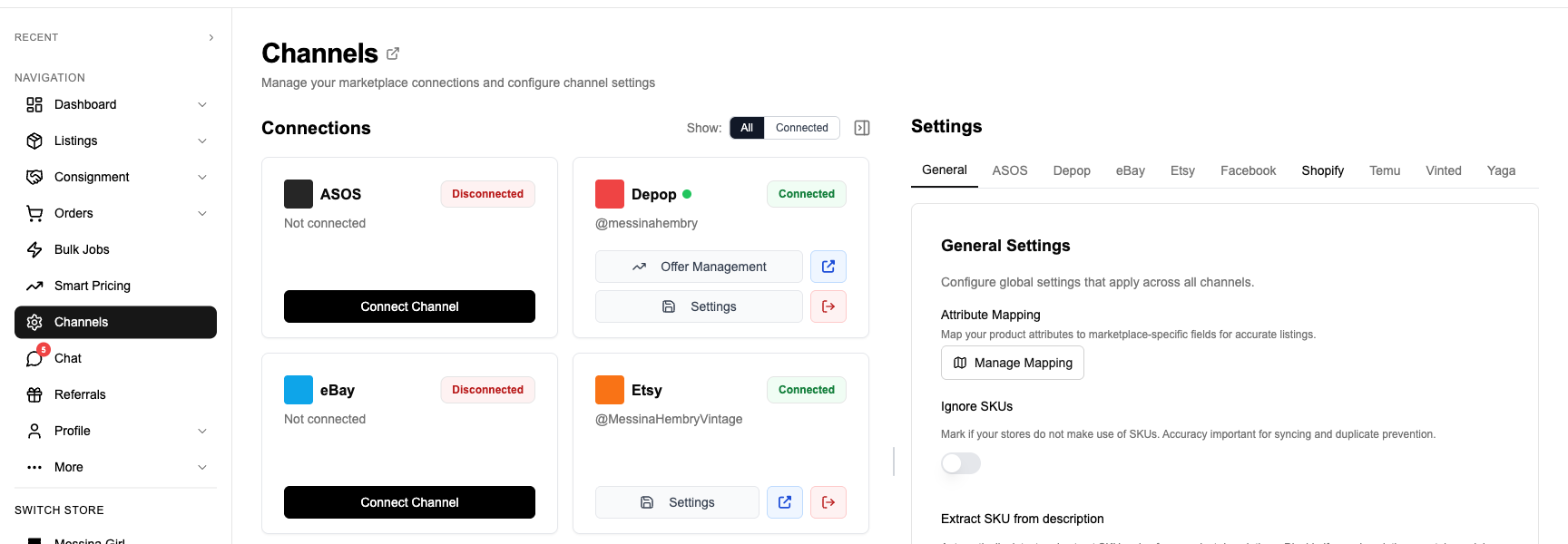
- What FLUF Connect does here: connect Gettit alongside your other marketplaces, push listings to it, and pull them down automatically when the item sells somewhere else. 7 days for £1, then from £9/month. There is no free plan.
What is in this guide
- What Gettit is, and how new it is
- How big it actually is right now
- What it costs to sell — the short version
- Gettit Protection, and who pays for it
- Three ways to sell, and the one with no safety net
- The clocks you are agreeing to
- Postage, satchels, and the $4 mistake
- Writing a listing that is allowed to stay up
- What sells there, and the baby-and-kids wedge
- Verification, KYC and the rules that catch people out
- Pricing when the platform takes nothing
- What a sensible first month looks like
- How it sits against Gumtree Australia, Facebook and the rest
- Is it worth your time in 2026?
- Gettit and FLUF Connect — what works today
- Sources and verification
- Related guides
What Gettit is, and how new it is
Gettit is an Australian peer-to-peer marketplace for second-hand goods, built around a simple proposition: the seller keeps the whole asking price, and the buyer pays a protection fee that funds the guarantee. It handles the payment, generates the Australia Post label, holds the money until the buyer confirms, and steps in when something goes wrong. It is Australia-only, AUD-only, and eighteen-plus.
That is unusual enough in the Australian market to be worth a page on its own. The dominant local option, Gumtree Australia, is a classifieds board where most transactions still end with two people meeting in a car park and exchanging cash. Facebook Marketplace is the same idea with a bigger audience and even less structure. Gettit is trying to be the thing in between: local enough to hand something over in person, structured enough that the money is held and the parcel is tracked.
Now the part most write-ups will leave out. Gettit is days old. GETTIT PTY LTD registered its ABN, 55 699 431 886, on 24 June 2026, from an address in Brighton, Victoria. The iOS app shipped on 27 July 2026. The fees and timings schedules are both effective from 1 August 2026. The marketplace itself opened at the end of that month. There is no funding announcement, no founder interview, no trade-press coverage, no Trustpilot profile and no Reddit thread — not because anyone is hiding anything, but because there has not been time for any of it to exist.
That shapes how you should read everything below. Every fee, window and rule on this page comes from Gettit’s own published schedules, which are unusually clear and unusually specific. None of it comes from seller experience, because there is not yet a body of seller experience to draw on. Treat the rules as reliable and the outcomes as unproven.
How big it actually is right now
Gettit publishes no user count, no listing count and no transaction volume. What can be measured from the outside, on 5 September 2026, is modest and worth stating plainly rather than dressing up.
| Measure | Observed |
|---|---|
| Company age | ABN active 24 June 2026; trading name registered 25 June 2026 |
| iOS app | Released 27 July 2026, version 1.0.9 on 30 August 2026; 5.0 stars from 3 ratings |
| Android app | 500+ installs, too few ratings for a star average to display |
| Live listings | 24 rendered on the unfiltered search page; most category facets read zero |
| Largest single category observed | 11 items |
| Marketing output | One blog post, published 27 August 2026 |
Three ratings on the App Store is not social proof and should not be presented as any. Nor is 500-plus Android installs a meaningful audience; Google Play reports installs in wide buckets and the true number could be anywhere in that band. A handful of the listings visibly come from the same seller in one Melbourne suburb.
None of that makes Gettit a bad place to put stock. It makes it a cheap place to put stock, which is a different judgement and the one that actually matters. Listing costs nothing, takes nothing off your sale price, and does not lock the item away from anywhere else. The question for a seller is not “is Gettit big” — it plainly is not — but “does listing here cost me anything I would miss”. On the published fee schedule, no.
What it costs to sell — the short version
Nothing. That is the whole answer, and it survives a careful read of the schedule.
| Charge | Amount to the seller |
|---|---|
| Listing fee | None |
| Commission on a sale | None — the seller keeps the full asking price |
| Payment processing | None; Gettit meets the processor’s cost out of the buyer’s protection fee |
| Payout fee | None |
| Subscription or seller tier | None published |
| Postage label | Generated by Gettit; the buyer pays the postage at checkout |
| Return handling | $9.95 flat, and only when a parcel comes back through the buyer’s own error |
| Optional visibility upsell | Paid — live listings can carry a “Boosted listing” badge; the price is not published |
The one number in that table that is not zero, the $9.95, is worth understanding because it is not a seller penalty. It applies when a buyer puts in the wrong address and the parcel returns; in that scenario the buyer is refunded the item price and the protection fee, while the postage and the $9.95 are retained. It is a cost of the failed delivery, not a charge on your sale.
The absence of a subscription is stated by omission rather than by declaration — there are no tiers anywhere in the fees page, the terms or the FAQ. Fees are quoted in Australian dollars, inclusive of GST where it applies, and Gettit commits to 14 days’ notice before changing any of them, with changes not applying to orders already placed.
What the buyer pays
| Sale method | Buyer protection fee |
|---|---|
| Posted order | 7.5% of the item price plus $1.50 |
| Secured Pickup | 3.5% of the item price, no fixed component |
| Free local handover | Nothing — “Free. No fee of any kind, and no commission.” |
This is worth a moment’s thought before you price. On a $40 item posted to a buyer, the protection fee is $4.50 on top of the item and the postage — a meaningful uplift on a cheap thing, and close to invisible on an expensive one. Sellers who list a lot of low-value stock should expect the fee to be more noticeable to their buyers than it is to them.
Gettit Protection, and who pays for it
Gettit Protection covers two failure modes: the item never arrives, and the item is not as described. Cover is capped at the order amount. It applies to posted orders and Secured Pickups, and it does not apply to free local handovers at all.
Gettit is careful about what it is not. In its own words the guarantee “is NOT insurance… and it’s not a third-party stakeholding arrangement” — it is Gettit’s own promise, backed by Gettit, and it lives or dies with the company. That is a fair disclosure and worth reading as one.
What is excluded: change of mind, minor variation that is consistent with the condition you stated, damage occurring after the buyer confirms, anything paid for off-platform, and prohibited items. The refund matrix is published in full and is more generous to buyers than most:
| What went wrong | What the buyer gets back |
|---|---|
| Item never arrived | Item price, postage and the protection fee |
| Not as described, faulty or damaged | Everything, and return postage is met by Gettit or the seller |
| Seller missed the dispatch window | Everything |
| Buyer’s own address error | Item price and protection fee; postage and $9.95 retained |
| Fault genuinely ambiguous | The buyer gets the benefit of the doubt |
That last line is the one to internalise. Where the evidence is unclear, Gettit says it will find for the buyer. The practical response is not to argue with the policy but to remove the ambiguity in advance: photograph the actual flaw, describe it in words, and keep the lodgement receipt.
Three ways to sell, and the one with no safety net
When you list, you choose how the item can be bought: local handover, posted, or both. Buyers then see up to four delivery options — can be posted, free post, local pickup, and Secure pickup.
Free local handover
Costs nothing to either side. No payment is held, no dispute process exists, and Gettit’s FAQ describes it as being at your own risk. Functionally this is a Gumtree or Marketplace transaction that happens to have been arranged on Gettit: you meet, you look, cash or bank transfer changes hands, and the platform is not involved in the money. Everything that is true of meeting a stranger to sell something is true here.
Secured Pickup
The interesting one, and the feature that most distinguishes Gettit from the local classifieds it competes with. The buyer pays in the app before meeting you, inspects the item in person, and then releases the payment with a six-digit code. You get an in-person handover with no postage and no packaging, but the money is real and held before anybody drives anywhere. The buyer pays 3.5% for it. For anything bulky, fragile or expensive enough that you would rather not post it, this is the option worth pushing.
Posted
Gettit generates an Australia Post label, the buyer pays the postage at checkout, and the payment is held until the buyer confirms or the 48-hour confirmation window lapses. This is where the protection, the clocks and the tracking all apply, and it is the only method that reaches buyers outside your own city.
The clocks you are agreeing to
Gettit publishes a separate timings schedule, effective 1 August 2026, and it is unusually explicit. Most marketplaces bury dispatch expectations in a policy page; Gettit gives you a table of windows with named consequences.
| Window | Whose | Length | Starts from | If it lapses |
|---|---|---|---|---|
| Dispatch | Seller | 3 business days | Payment authorised or label issued | Order cancelled, buyer refunded, missed dispatch recorded on your profile |
| Confirmation | Buyer | 48 hours | Australia Post delivered scan | Payment released to you |
| Return dispatch | Buyer | 3 business days | Return label issued | Return closed, you are paid |
| Seller inspection | Seller | 48 hours | Returned parcel delivered scan | Return accepted, buyer refunded |
| Maximum transit | Gettit | 21 calendar days | Lodgement scan | Non-delivery review opens, payment stays held |
Two details matter more than they look. The business-day windows exclude weekends and public holidays; the 48-hour ones do not, so a confirmation window that opens on a Saturday closes on Monday. And the missed-dispatch mark is public — it sits on your seller profile, which on a marketplace with two dozen listings is a considerably larger share of your reputation than it would be on eBay.
The 21-day transit ceiling is the seller-friendly one. Australia Post to a remote address can genuinely take a fortnight, and Gettit will not open a non-delivery review before three weeks have passed. Your money stays held during that time rather than being refunded out from under you.
Postage, satchels, and the $4 mistake
Shipping is Australia Post and only Australia Post. There is no Sendle option, no courier choice, and no bring-your-own-label. Gettit generates the label; you drop the parcel at a post office or a parcel locker.
At listing time you pick a size: small satchel, medium satchel, large satchel, or your own box. The satchel options are flat-rate up to 5 kg regardless of distance, which is why they are almost always the cheaper choice. Gettit’s own FAQ works the example: a 500-gram jumper sent in a five-centimetre mailer rather than a genuine Medium satchel is priced on size and weight instead of the flat rate, and costs roughly $4 more. On a $25 jumper that is the difference between a sale worth making and one that is not.
Cubic weight applies to large light parcels, which is the usual trap for anything bulky and hollow — prams, lampshades, empty cases. Tracking is automatic and visible to the buyer from the moment of lodgement, and it is the delivered scan that starts their confirmation clock, so getting the parcel into the network promptly is what actually gets you paid.
Some listings carry a “Free post” badge, which means the seller has chosen to absorb the postage. On a marketplace where you are already keeping 100% of the sale price, that is the obvious lever to pull if you want to compete on a crowded item — and on Gettit today, very few items are crowded.
Writing a listing that is allowed to stay up
The published requirements are short and the enforcement line is clear.
- Your own photos of the actual item. Stock photography is prohibited outright, and Gettit says stock photos and misleading descriptions get listings removed. This is not the usual soft guidance — it is a stated removal ground.
- An honest condition disclosure, chosen from five values: brand new, new unused, very good, good, and fair.
- A category, from the 17 top-level branches below.
- A price, in Australian dollars.
- A sale method — local handover, posted, or both.
One genuinely unusual capability: you can attach documents to a listing. An invoice, a manual, a service history. Almost no consumer marketplace supports this, and on prams, power tools, electronics and anything with a warranty it is the single fastest way to justify a higher price than the identical item three listings down.
What is not published anywhere: a minimum or maximum photo count, a title character limit, a description character limit, or any structured brand and size taxonomy. The search page shows no brand or size facets, which suggests there is no structured vocabulary behind the fashion tree — but Gettit does not say so, and neither will we. Write your titles as if there is no brand field, because there does not appear to be one.
What sells there, and the baby-and-kids wedge
Seventeen top-level categories: Electronics; Fashion; Bags & Accessories; Home & Garden; Baby & Kids; Prams & Car Seats; Nursery & Furniture; Sports & Leisure; Vehicles & Parts; E-Bikes & E-Scooters; Beauty & Health; Books, Music & Games; Collectables; Tools & DIY; Craft & Hobbies; Pets & Pet Supplies; and Antiques. Cars, motorcycles, caravans and trailers all have a home.
The fashion tree is deeper than the breadth suggests — women’s and men’s clothing and shoes each run to roughly a dozen leaves, and handbags subdivide into tote, shoulder, crossbody, clutch, bucket and bum bag. So the shape is Gumtree-style breadth with something closer to Depop-style depth where fashion is concerned.
But Gettit’s own positioning is not fashion. The site says it directly: baby and kids is “where we are deepest, and where nobody else will go”, under a strapline about “the gear everyone else says no to”. The terms carry an explicit clause about Australian mandatory safety standards naming cots, prams, strollers and toys, which is consistent with a platform that intends to take that category seriously rather than quietly ban it. Three of the seventeen categories — Baby & Kids, Prams & Car Seats, Nursery & Furniture — are carved out of what most marketplaces treat as one.
If you sell used baby equipment in Australia, that is the most interesting sentence on this page. It is a category that Vinted handles only for clothing, that eBay handles nervously, and that Facebook groups handle without any protection at all.
The live mix on 5 September 2026 was genuinely general rather than fashion-led: baby swaddles and a bassinet, ASICS runners, a Garmin watch, an iPhone 13 Pro, Y2K boots, golf balls, a board game, a 1970 map, a Ned Kelly bust and some sewing patterns.
Verification, KYC and the rules that catch people out
To list, you need email and phone verification. To be paid, you need to clear Stripe’s identity checks — payouts run through Stripe Connect and Gettit will not release money to an unverified seller. Browsing needs neither. One person, one account, eighteen or over, Australia only.
On payout timing, Gettit does something refreshing and slightly frustrating: it refuses to give a number. Its FAQ says it cannot promise an exact payout time beyond the sequence — buyer confirms, or the window closes, then release. Take that at face value rather than assuming same-day.
Prohibited items are the usual list, and worth reading before you bulk-list: weapons, drugs and paraphernalia, tobacco and vaping products, prescription medicines and medical devices, live animals, stolen, counterfeit or recalled goods, adult services, hazardous materials, and anything infringing someone’s intellectual property.
On listing you warrant that you own the item, that your description is accurate and lawful, and that you will dispatch promptly. Gettit is explicit that you are the supplier, not it, and that your tax and GST position is yours to manage. Ratings are two-sided after every transaction, and profiles show a display name, photo, bio and rating history alongside a blurred suburb-level area — never an exact address.
How it sits against Gumtree Australia, Facebook and the rest
The honest comparison is not flattering on reach and is very flattering on economics.
| Gettit | Gumtree Australia | Facebook Marketplace (AU) | |
|---|---|---|---|
| Seller commission | None | 0.5% via Gumtree Pay, minimum 50c, maximum $7.50 | None — no checkout on local listings |
| Listing fee | None, every category | Mandatory in cars, vans and utes, caravans and campervans, and all pets; upgrades in boats, real estate, jobs and services | None |
| Default transaction | Payment always held on posted and Secured Pickup orders | Predominantly cash in person; Gumtree Pay is an opt-in layer | Cash in person |
| Shipping | Built in, Australia Post label generated by the platform | Not the core model | Not the core model in Australia |
| Audience | 500+ Android installs, two dozen live listings | Six million users, 2.5 million-plus live listings, 45,000-plus new listings a day | Very large; Meta publishes no Australian figure |
| Category range | 17 goods categories, no jobs, property or services | Full classifieds including cars, real estate, jobs and services | Goods, vehicles, property, plus groups |
Two things follow. First, the audience gap is not close and no amount of framing makes it close — Gumtree Australia’s own help centre puts it at six million users against Gettit’s two dozen listings. Anyone selling something time-sensitive should list it on Gumtree Australia first and Gettit as well, not instead.
Second, the economics genuinely do favour Gettit, and in a specific way: it is the only one of the three that combines zero seller cost with held payment and platform-generated postage. Gumtree Pay charges the seller 0.5% and the buyer more; Marketplace charges nothing because it does nothing, and in practice hands you a stranger, a meeting place and a hope.
A note on the Gumtree name. Gumtree Australia and Gumtree UK are separate businesses that share a name and a logo. eBay sold the Australian operation to Adevinta in 2021 and it passed to The Market Herald in 2022; the Australian help centre’s copyright sits with Gumtree IP Aus Holding Ltd. There is no shared login, no shared account and no shared listing between them, and any figure you see quoted for one does not describe the other. If you sell in Australia, Gumtree in the United Kingdom is simply a different marketplace.
Is it worth your time in 2026?
For most sellers, yes — but as an addition, never as a destination.
The argument for is arithmetic. Listing is free, the commission is zero, the label is bought for you, and nothing about a Gettit listing prevents the same item selling on eBay, Gumtree Australia or Marketplace an hour later. The marginal cost of being there is the minutes it takes to create the listing — and if you are running FLUF Connect, not even that. An empty marketplace is also an uncontested one: on a platform where the largest category we could observe held eleven items, being the only decent listing of a thing is a position you cannot buy on eBay at any price.
The argument against is equally simple. Two dozen live listings means very few buyers, which means most items will not sell there this month. If your time is scarce and you list manually, Gettit is not where the next hour should go.
The seller for whom this is most clearly worth doing today is the one with used baby and children’s equipment — prams, cots, car seats, nursery furniture. That is Gettit’s stated priority, it is a category with real safety anxiety on both sides where held payment and a return path are worth something, and it is a category most alternatives are actively uncomfortable with.
Pricing for a marketplace with no commission
Zero commission changes the arithmetic in a way that is easy to get wrong, so it is worth doing the sum properly once.
Take a $60 jacket. On Gettit you receive $60. The buyer pays $60, plus 7.5% and $1.50 in protection — $6.00 — plus the postage, which on a Medium satchel is a flat rate whatever the distance. On eBay Australia the same jacket at $60 costs you a percentage of the total including postage, and on a Gumtree Pay transaction you would lose 0.5% and the buyer a further 1.5% surcharge. Gettit is the only one of the three where the number you type is the number you receive.
The temptation is to pass the saving on and undercut. Resist it for two reasons. First, your buyer is not comparing your Gettit price to your eBay price — they are comparing it to other Gettit listings, of which there are currently very few. Second, if you crosslist, an item priced differently on two channels is an item you will eventually sell at the wrong price on the wrong one. Set one price you are happy with everywhere and let the fee-free channel simply be the one where you keep more of it.
Where the zero commission genuinely does buy you something is the “Free post” badge. Absorbing $12 of postage on a $60 item costs you 20% — roughly what a high-fee marketplace would have taken anyway — and on a platform this quiet, a Free post badge is one of the very few visible differentiators available to you. It is the lever worth pulling before a price cut.
One more consideration for anyone selling regularly: Gettit is explicit that you are the supplier and your tax position is yours. Zero commission does not mean zero record-keeping, and a marketplace that pays out through Stripe leaves exactly the paper trail you would expect.
What a sensible first month looks like
If you are going to try Gettit at all, try it properly — a half-hearted three-listing experiment on a marketplace with two dozen listings tells you nothing.
- Clear Stripe verification before you list anything. You can list on email and phone verification alone, but you cannot be paid without passing Stripe’s identity checks. Doing it on day one means a first sale does not sit in limbo while you photograph a driving licence.
- Lead with baby and children’s gear if you have any. It is the category Gettit says it is deepest in and the one it built a safety-standards clause for. Being the best listing in the category the platform is actively promoting is worth more than being the twelfth listing in Fashion.
- Offer Secured Pickup on anything bulky. Prams, furniture, e-bikes and anything else you would rather not put in a satchel. It is the feature Gumtree Australia and Facebook Marketplace cannot match, and the 3.5% falls on the buyer.
- Attach the documents. If you have the receipt, the manual or the service record, put it on the listing. Very few marketplaces let you, and on a used pram or a power tool it is the difference between a cautious buyer and a converted one.
- Set a dispatch routine before your first sale, not after. Three business days is not generous if you post once a week. The missed-dispatch mark is permanent and public, and on a profile with a handful of transactions it is a large proportion of everything a buyer can see about you.
- Do not delist from anywhere else. Gettit is an addition. Keeping the item live on eBay and Gumtree Australia costs nothing and is where most of your sales will still come from this year.
Then measure it honestly after a month. If nothing sold, that is information, and the listings cost you nothing to have made. If something did, you kept all of it.
Gettit and FLUF Connect — what works today
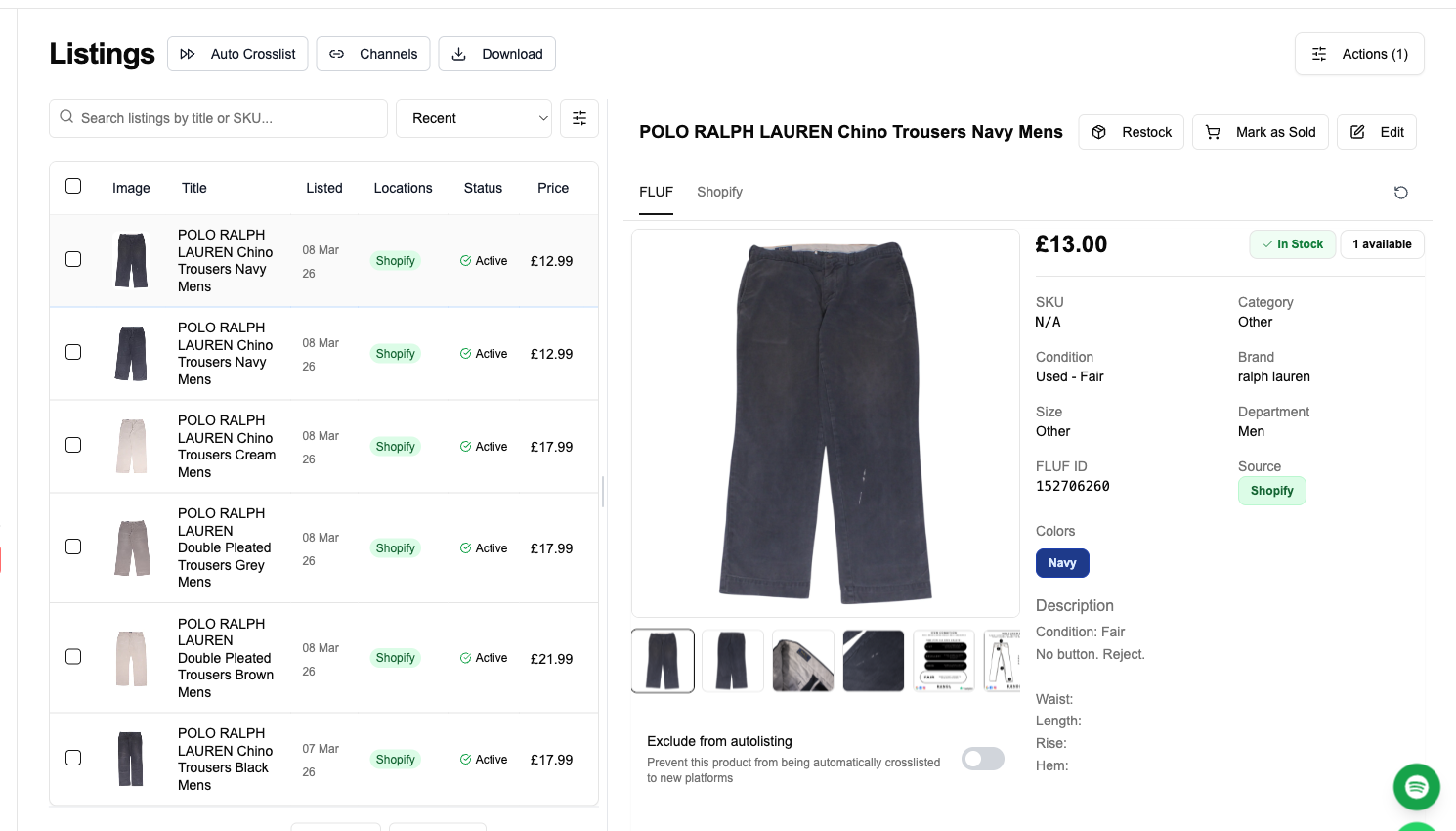
FLUF Connect holds one master record per item and writes it out to every channel you connect, so adding Gettit does not mean maintaining a separate catalogue.
| Capability | Gettit through FLUF Connect |
|---|---|
| Create and update listings | Yes |
| Inventory sync | Yes |
| Mark as sold when it sells elsewhere | Yes |
| Order sync back into FLUF | No |
| Automated relisting | No |
| Offer management | No |
| Browser extension required | No browser extension required |
The row that earns its place is mark-as-sold. On a marketplace this quiet, the risk is not that Gettit sells your item — it is that you forget the listing exists, sell the item on eBay in November, and get an order on Gettit in December for something you no longer own. That is precisely the failure the dispatch clock punishes, and it is the one thing that would put a missed-dispatch mark on a new profile. Sold-out protection removes the Gettit listing when the item goes anywhere else, automatically.
Order sync and relisting are not available for Gettit today, and offer management is not either. Crosslisting and inventory sync are on every FLUF plan; relisting, offer management and smart pricing are included from Growth (£19 a month) upwards. See the plans — 7 days for £1, then from £9/month, then plans from £9 a month.
Sources and verification
Every fee, window and rule on this page was read from a Gettit-published document on 5 September 2026, and the platform’s scale was measured rather than estimated.
- Gettit fees schedule — the absence of seller commission, the 7.5% + $1.50 and 3.5% buyer protection fees, the processing-cost statement, the $9.95 return handling fee, the refund matrix, and the 14-day notice commitment.
- Gettit FAQ — free local handover being at your own risk, what protection covers and excludes, Australia Post exclusivity, the satchel sizes and the non-genuine-satchel example, listing requirements, document attachments, verification and Stripe KYC, prohibited items, ratings and the blurred suburb, and the refusal to state a payout SLA.
- Gettit timings schedule — all five windows, the business-day rule, and the missed-dispatch record.
- Gettit terms of service — the seller-is-supplier position, the Victorian governing law, and the mandatory-safety-standards clause naming cots, prams, strollers and toys.
- Gettit’s search page and its home page — the category tree, the five condition values, the four delivery options, the live listing count and the baby-and-kids positioning, all as rendered on 5 September 2026.
- the iOS app listing for the release date, version and rating count, and “Sellers keep the full asking price”; the Google Play listing for the install band.
- the Australian Business Register entry for GETTIT PTY LTD — ABN 55 699 431 886, active from 24 June 2026.
- Gettit’s blog for the single published post and its date.
- Gumtree Australia’s own help centre for its six million users, 2.5 million listings and 45,000 daily listings; its service fees page for the 0.5% Gumtree Pay platform fee and its 50c/$7.50 bounds; its listing-fee categories page; and the ownership history for the Adevinta and Market Herald sales.
What we could not verify, and therefore left out. Any Gettit user, listing, transaction or revenue figure beyond what the public search page renders. Funding, investors, founders or team — none is published and no outlet has covered the company. The price of a boosted listing. The actual dollar cost of each satchel size, which is only shown at checkout on a live listing. Photo count minimums and maximums, title and description character limits, and whether any structured brand or size taxonomy exists. A payout time in days, which Gettit explicitly declines to give. And seller sentiment of any kind: there is no Trustpilot profile, no ProductReview page, no Reddit thread and no seller-group discussion about Gettit anywhere we could find. Note also that Trustpilot carries reviews for two similarly-named and entirely unrelated businesses; neither describes this one.
Related guides
- Sell on Gumtree Australia — the complete seller guide
- Sell on Facebook Marketplace — the complete seller guide
- Sell on eBay — the complete seller guide
- Sell on Depop — the complete seller guide
- All marketplace guides
- All crosslisting routes
- Crosslist from eBay to Gettit
- Crosslist from Depop to Gettit
- Selling online in Australia — the full marketplace shortlist
- Gettit vs Facebook Marketplace — a held payment against a handshake
- Crosslist from Vinted to Gettit
- Crosslist from Gumtree Australia to Gettit
- Gettit vs eBay for Australian sellers
Subscribe to seller brief
Choose topics firstFrequently Asked Questions
Nothing. There is no listing fee, no commission, no payment-processing charge, no payout fee and no subscription. Gettit's published fees schedule carries buyer-side charges only, and its App Store listing states that sellers keep the full asking price. The buyer pays a protection fee instead: 7.5% of the item price plus $1.50 on a posted order, or a flat 3.5% on a Secured Pickup. A free local handover costs both sides nothing. The only charge a seller can meet is a $9.95 return handling fee, and only when a parcel comes back because the buyer entered the wrong address.
No, and Gettit says so directly — a free local handover is at your own risk. No payment is held, no dispute process applies and Gettit Protection does not cover it. It is functionally a classifieds transaction that happened to be arranged on Gettit. If you want an in-person handover with the money actually secured, use Secured Pickup instead: the buyer pays in the app first, inspects the item in person, then releases the payment with a six-digit code, and pays 3.5% for the privilege.
Australia Post only. Gettit generates the prepaid label and the buyer pays the postage at checkout, so the seller pays nothing out of pocket — you just drop the parcel at a post office or parcel locker. At listing time you choose a small, medium or large satchel, or your own box. Satchels are flat-rate up to 5 kg regardless of distance, which is usually cheaper: Gettit's own example is that a 500-gram jumper in a five-centimetre mailer rather than a genuine Medium satchel costs about $4 more, because it gets priced on size and weight instead. Cubic weight applies to large light parcels.
Three business days from the payment being authorised or the label being issued. Business days exclude weekends and public holidays. If you miss it, the order is cancelled, the buyer is refunded, and the missed dispatch is recorded on your seller profile. The buyer then has 48 hours from the Australia Post delivered scan to confirm, after which the payment is released to you automatically — and those 48 hours are calendar hours, so a window opening on a Saturday closes on Monday. Gettit allows 21 calendar days of transit before it opens a non-delivery review.
Very small, and very new. GETTIT PTY LTD registered its ABN on 24 June 2026, the iOS app shipped on 27 July 2026 and the marketplace opened at the end of August. On 5 September 2026 its unfiltered search page rendered 24 listings, most category facets read zero, and the Android app showed a 500-plus install band with too few ratings to display a star average. Gettit publishes no user, listing or transaction figures. Treat it as a free extra channel worth being early on, not as a replacement for anywhere you currently sell.
Seventeen top-level categories covering electronics, fashion, bags and accessories, home and garden, baby and kids, prams and car seats, nursery and furniture, sports and leisure, vehicles and parts, e-bikes and e-scooters, beauty and health, books, music and games, collectables, tools and DIY, craft and hobbies, pets, and antiques. Cars, motorcycles and caravans are included. Its stated speciality is used baby and children's gear. Prohibited: weapons, drugs, tobacco and vaping, prescription medicines and medical devices, live animals, stolen, counterfeit or recalled goods, adult services, hazardous materials and anything infringing intellectual property.
Reach and structure sit on opposite sides. Gumtree Australia's own help centre reports six million users, over 2.5 million live listings and more than 45,000 new listings a day, against Gettit's two dozen; it also covers cars, property, jobs and services, which Gettit does not. But Gumtree Australia is predominantly a cash-in-person classifieds board where Gumtree Pay is an opt-in layer costing the seller 0.5%, while Gettit holds the payment by default on posted and Secured Pickup orders, generates the postage label, and takes nothing from the seller in any category. Note that Gumtree Australia and Gumtree UK are separate businesses with no shared account or login.
Yes. FLUF Connect creates and updates Gettit listings from the same master product record it uses for your other marketplaces, keeps stock in sync, and removes the Gettit listing automatically when the item sells on another channel — which matters here, because Gettit's three-business-day dispatch clock puts a missed-dispatch mark on your profile if you accept an order for something you no longer have. No browser extension is needed. Order sync, automated relisting and offer management are not available for Gettit today. Crosslisting and inventory sync are on every plan; relisting, offer management and smart pricing are included from Growth upwards.