eBay to AbeBooks: Crosslisting for Booksellers
Push your eBay book listings to AbeBooks' bibliographic catalogue, and let two-way order sync stop a one-of-one copy selling twice.
7 days for £1, then from £9/month.



Key Takeaways
- This page is about books — used, rare, out-of-print, antiquarian and textbooks — sold by someone already listing on eBay. Selling clothing or homeware? The general crosslisting guides suit you better.
- eBay is a browsing audience; AbeBooks is a searching one. Owned by Amazon since December 2008, AbeBooks lists millions of new, used and rare books from thousands of sellers in more than 50 countries, across AbeBooks.com,.co.uk,.de,.fr,.it,.ca, AbeBooks Aus/NZ, IberLibro.com and ZVAB.com (AbeBooks, About).
- Every used book is a one-of-one. Hence software: FLUF Connect syncs orders on both channels, so a sale on either side pulls the listing on the other.
- AbeBooks has no minimum photo count — a listing can be text-only. Its data model is bibliographic (author, title, publisher, ISBN, edition, binding, condition, jacket condition), and image URLs hosted on eBay or Amazon are blocked (AbeBooks Inventory Update API guide).
- Direction matters. In FLUF, AbeBooks is a push-only destination: FLUF creates and manages AbeBooks listings from stock held elsewhere, but cannot read an existing AbeBooks catalogue or use AbeBooks as a source. There is no AbeBooks-to-eBay import.
- Costs, verified. eBay UK business sellers pay 9.9% in Books, Comics & Magazines plus a per-order fee and 0.35% regulatory operating fee. AbeBooks UK sellers pay £0.75 per item plus 15%/10% commission (Basic), or £17–£350 a month plus 8% (Premium).
- FLUF Connect costs £1 for 7 days, then plans from £9/month (Starter). There is no free plan. See pricing.
Why An eBay Bookseller Lists On AbeBooks
eBay is not a bad place to sell books. It is a very large general marketplace — eBay Inc. reported $22.4 billion of gross merchandise volume in the second quarter of 2026 alone (eBay Inc. Q2 2026 results) — and plenty of books move through it. But how a buyer arrives at a book differs sharply between the two sites, and that difference is the argument for running both.
On eBay, most book buyers are browsing: a title typed into a general search box that also ranks trainers and lawnmowers, then a grid of photographs of copies that may or may not be the same edition. eBay does support ISBN listing — enter a UPC, ISBN, part number or product name and it will try to match its catalogue and pre-fill title, description, item specifics, category and a stock photo (eBay, Listing your item with details from our catalog). That helps a mass-market paperback with a barcode. It does nothing for a 1911 privately printed pamphlet, or a first edition whose value turns on a point of issue on the copyright page.
AbeBooks is built the other way round. The buyer usually knows what they want and arrives with an ISBN, an author-and-title pair, or specific bibliographic criteria — this edition, this publisher, this year, this binding, signed or not. The catalogue is the product. AbeBooks’ policies require that “Listing information must accurately represent the item being offered for sale”, down to the ISBN, and restrict the description to the item itself — condition, inscriptions, size and weight (AbeBooks Seller Policies). That is a marketplace expecting a catalogue record, not a sales pitch.
The audience follows: students chasing a specific edition of a set text, researchers chasing an out-of-print monograph, collectors chasing a state or issue. They are hard to reach on eBay, whose search does keyword matching against an 80-character title you wrote, not bibliographic matching. A title reading “RARE VINTAGE BOOK Hardback 1st Ed” is optimised for eBay and invisible to the buyer searching by publisher and year. Same book, same shelf, two kinds of demand.
The One-Of-One Oversell Problem
A used book is a one-of-one. List that 1963 Faber hardback on both sites and, if it sells on eBay at 9:40 in the morning, the AbeBooks listing stays live and sellable until you notice. If an AbeBooks buyer orders it in that window you must cancel — and AbeBooks measures you on it. It requires sellers to process and ship all orders within 48 hours of receipt, treats credit card orders left unprocessed after 96 hours as automatically cancelled and counted as unfulfilled, and expects a 90%+ order completion rate as a condition of selling (AbeBooks Seller Policies; AbeBooks, Sell Books). Cancellations are the metric that decides whether you keep the account.
AbeBooks built an Inventory Update API for exactly this. Its documentation says the advantage is near real-time updates, “resulting in fewer books being sold on AbeBooks that were previously sold by the bookseller, improved fulfillment ratings … and better customer service” (AbeBooks Inventory Update API guide). AbeBooks knows its sellers list elsewhere; the API exists so that “elsewhere” does not wreck the completion rate.
FLUF supports order sync and mark-as-sold on both sides of this pair. Neither requires a browser extension. A detected sale on either channel removes the corresponding listing on the other.
How Books Move From eBay To AbeBooks
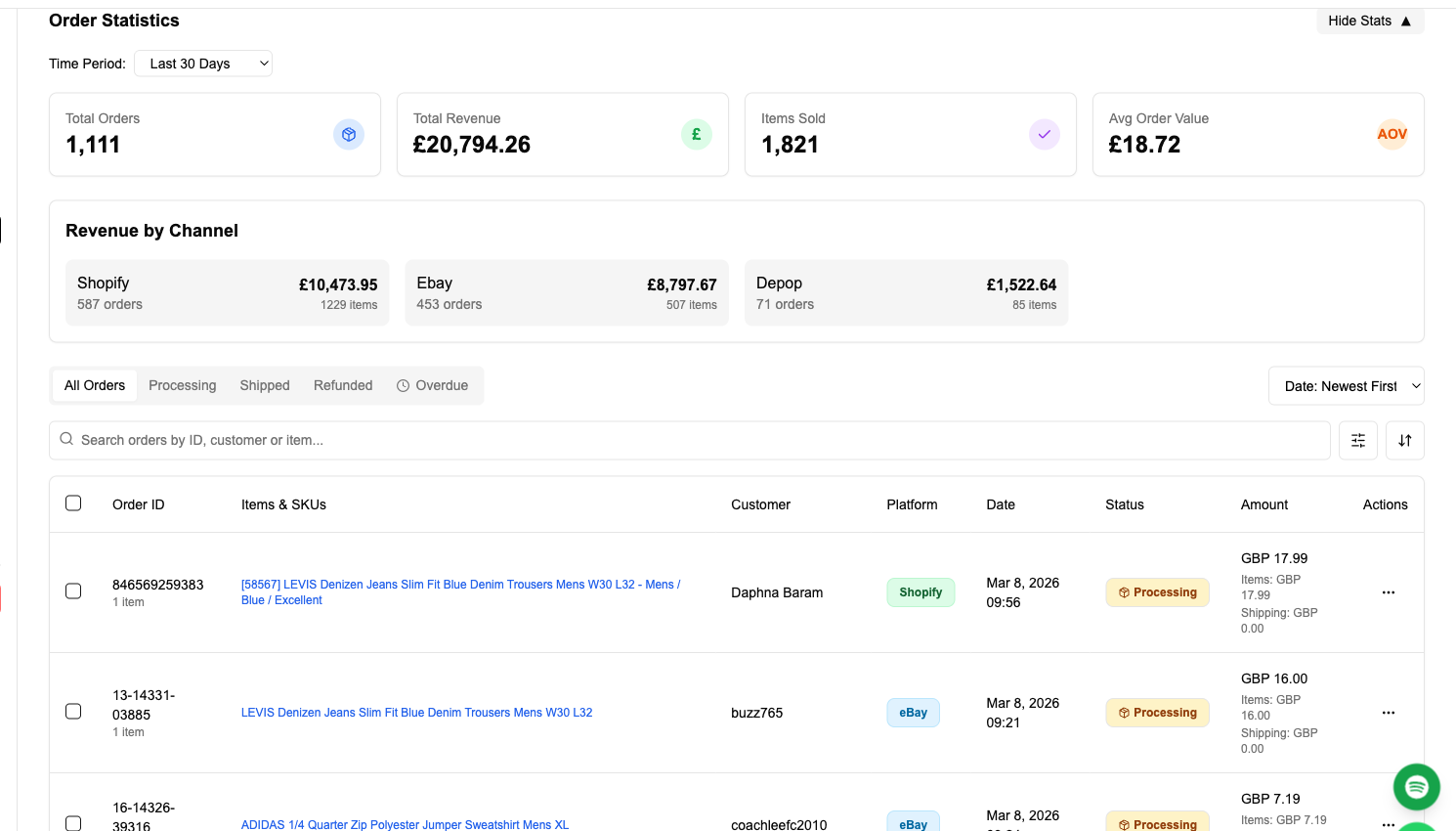
Import your eBay listings into FLUF, including title, price, quantity, photos, condition and item specifics. eBay requires at least one photo; no browser extension is needed.
Then you map the bibliographic fields, and this step cannot be fully automated. eBay’s item specifics for a book may include Author, Publisher, Publication Year, Format and ISBN — or may be blank, because eBay does not force a bookseller to fill them in. AbeBooks needs them. Where your eBay data has them they carry across; where it does not, you supply them once.
Crosslist your books to AbeBooks at a fixed price. Auctions are not supported on AbeBooks. Sale sync works in both directions for this pair.
Keep complete book details in FLUF and make listing changes there. Separate AbeBooks edits may be overwritten by later updates.
Field Mapping: eBay Listing To AbeBooks Record
| eBay listing field | AbeBooks field | Notes and where it goes wrong |
|---|---|---|
| Listing title (80 characters) | title (750) |
eBay titles are keyword-optimised; AbeBooks wants the actual title. Needs trimming. |
| Item specific: Author | author (750) |
One of author, title or publisher is required on every add or update. Trade convention: “Surname, Forename”. |
| Item specific: Publisher | publisher (750) |
Often blank on eBay. Supply it — AbeBooks buyers filter on it. |
| Item specific: Publication Year | publishYear (4) |
Four digits only; “c.1890” or “n.d.” goes in the description. |
| (no eBay equivalent) | publishPlace (50) |
Place of publication; helps identify an edition. No eBay field. |
| Item specific: ISBN | isbn (15) |
Optional on AbeBooks — see Books With No ISBN. |
| Item specific: Format | Binding: hardback or paperback | eBay’s two-value Format collapses everything; AbeBooks takes “Leather” or “Cloth” while still declaring hard or soft. |
| Condition | bookCondition (30) |
Lossy — see the condition table. |
| (no eBay equivalent) | Jacket presence and condition | The trade grades the jacket separately; eBay has one value for the object. By hand. |
| Condition description / description | description (4,000) |
Strip the HTML, postage terms and shop banner; the item only. |
| Special Attributes: Signed | Signature and inscription details | eBay has a boolean at best; AbeBooks separates signed from inscription type. |
| Item specific: Edition | Edition details | AbeBooks accepts multiple edition descriptors; eBay has one free-text value. |
| Topic / Genre / Subject | Subject and bookseller catalogue | Your own shelving scheme. Warning: sending the value “Sold” there deletes the book. |
| (no eBay equivalent) | bookType (30) |
Where “Ex-Library” and similar trade flags live. |
| Price | Price and currency | Format #.##, positive number. One price, no bidding. |
| Quantity | Quantity: up to 999 | Mark the listing sold when the copy is no longer available. |
| Custom label / SKU | Your book reference | Your key; every update and delete matches on it. |
| Photos (eBay allows up to 24) | Up to five photos | Anything past the fifth is ignored, and URLs hosted on Amazon, eBay “or other sites where you are unlikely to hold the image copyright are not permitted and will be blocked”. |
| Auction format, reserve, duration | (no equivalent) | AbeBooks inventory is fixed price; an auction has no counterpart. |
| Best Offer | (no equivalent) | Supported on eBay in FLUF; not available on AbeBooks. |
Source: AbeBooks Inventory Update API guide.
The photo row is the commonest surprise for a seller coming off eBay: you cannot point AbeBooks at eBay-hosted images, and because there is no minimum photo count plenty of professional booksellers list without images at all. Normal there; a dead listing on eBay.
Condition: Five eBay Grades Against The Trade’s Seven
This is the mapping that needs a human.
eBay’s Books & Magazines category defines five conditions: Brand new, Like new, Very good, Good and Acceptable (eBay, Item conditions by category). They are written for a buyer deciding whether a paperback is readable, and say nothing about issue points, endpapers or the jacket as a separate object.
The trade grades differently, and AbeBooks publishes the vocabulary itself: As New (“pristine, original condition as when published”), Fine (“nearly As New … without being crisp”), Near Fine (“a couple of very minor defects”), Very Good (“small signs of wear but no tears”), Good (“average wear while maintaining complete text pages”), Fair (“worn … may lack endpapers, half-title”) and Poor or Reading Copy (“heavily worn … primary value is its complete, legible text”), plus “As Described” for a seller who details the condition instead of assigning a grade (AbeBooks, A guide to used book conditions).
| eBay book condition | Closest trade grade | Is the mapping safe? |
|---|---|---|
| Brand new — “new, unread, and unused in perfect condition” | As New | Safe for genuinely new stock. Not for an old book that is merely unread: As New means as when published. |
| Like new — “looks new but has been read … dust jacket (if applicable) is included” | Fine, or Near Fine | Needs a human. Fine and Near Fine differ, and the difference is money; eBay cannot express which. |
| Very good — “does not look new and has been read but is in excellent condition” | Very Good | The one place the words line up — and even here eBay’s means a good readable copy while the trade’s permits small wear but no tears. |
| Good — “very minimal damage … the dust jacket for hard covers may not be included” | Good | Workable, but eBay folds “jacket missing” into Good; the trade records it via dustJacket. |
| Acceptable — “obvious wear … possible writing in the margins and underlining” | Fair, or Poor / Reading Copy | Ambiguous: one eBay grade spans two trade grades priced very differently. |
| (no eBay equivalent) | Near Fine | Cannot be reached from eBay data at all. |
| (no eBay equivalent) | As Described | The trade’s escape hatch, and often the honest choice. |
| (no eBay equivalent) | Jacket condition, graded separately | Entered by hand; nothing on the eBay side to derive it from. |
Read that as an argument for a default plus a review queue, not full automation. Let the mapping run untouched for ordinary reading copies and textbooks. Route anything signed, any first edition, anything with a jacket and anything above your own price threshold to a human who assigns the trade grade and writes the bookseller’s note in the 4,000 characters AbeBooks gives you. There is a compliance edge: buyers can return under “Item Not as Described” within 30 days of estimated delivery, with restocking fees “strictly prohibited” (AbeBooks Seller Policies). A too-generous automatic grade is a return you pay for.
Books With No ISBN
Much of the interesting stock in any second-hand bookshop predates the ISBN, and this is where eBay’s catalogue-first flow stops helping.
The ISBN grew out of a book numbering system introduced in the United Kingdom in 1967 by J. Whitaker & Sons and in the United States in 1968 by R. R. Bowker, and was approved as an ISO standard in 1970, later extended from ten to thirteen digits (International ISBN Agency, ISBN Users’ Manual). Publishers assign numbers at publication; they are not applied retrospectively. Anything published much before the early 1970s has no ISBN and never will.
AbeBooks accepts books without an ISBN. Describe the copy fully, including author, title, publisher, edition, binding and condition. Check whether the selected FLUF workflow supports ISBN-less stock before publishing.
So your pre-1970 stock, worst-performing on eBay, benefits most from AbeBooks. Push that across first.
What Syncs And What Does Not
| Capability | eBay (source) | AbeBooks (destination) |
|---|---|---|
| Availability in FLUF | Live, self-serve, global | Live, self-serve, global |
| Authentication | No browser extension required | Bookseller username and API key; no extension required |
| Browser extension needed | No | No |
| Create and update listings | Yes | Yes |
| Order sync | Yes | Yes |
| Mark as sold / pull the duplicate | Yes | Yes |
| Automatic relisting | Yes | No |
| Offer management | Yes | No |
| Minimum photos | 1 | None — text-only listings are valid |
| Usable as a source channel in FLUF | Yes | No — push only |
No automatic relisting: on eBay, relisting matters because listings expire and a fresh one gets a search bump. AbeBooks inventory does not expire that way — a record stays live until you delete it or set quantity to zero — so the absence hurts less than it sounds, but scheduled relisting does not reach AbeBooks. No offer management: eBay Best Offer negotiations are handled in FLUF; AbeBooks has no equivalent surface.
Shipping, Payment And Currency
AbeBooks does not run a shipping programme. You set your own rates and speeds per destination country — select the country, enter the delivery speed in days, define the cost — and post the book yourself (AbeBooks seller guide; AbeBooks, Sell Books).
You must be willing to ship internationally. It is a stated condition of being a qualified seller, and AbeBooks’ policies prohibit rejecting an order based on the buyer’s location; for EU shipments under €150 sellers must use Delivery Duty Paid shipping with tracking (AbeBooks Seller Policies). If your eBay operation is UK-only postage, that is a change of habit, not just of channel.
Currency is per listing: the price field carries a three-letter ISO code and buyers pick a display currency. You are paid your balance weekly by Electronic Funds Transfer (AbeBooks, Sell Books) — more batched than eBay’s rhythm.
What Each Channel Costs
eBay, Books, Comics & Magazines
For UK business sellers the final value fee in Books, Comics & Magazines (category #267) is 9.9% of the total sale amount, which includes item price, postage and applicable taxes. On top sits a per-order fee of £0.30 for orders of £10.00 or less and £0.40 above that, plus a 0.35% regulatory operating fee. Listing fees depend on your Shop subscription tier (eBay UK, Fees for business sellers, last updated 4 August 2026).
UK private sellers sit differently: since 1 October 2024 eBay charges them no final value or regulatory operating fees, with an allowance of 300 listings a month (eBay UK, Fees for private sellers). AbeBooks has no private-seller equivalent.
AbeBooks
AbeBooks has run two plans since 22 July 2025. UK figures:
| Basic plan | Premium plan | |
|---|---|---|
| Monthly subscription | None | £17 – £350, by average listing count |
| Per-item fee | £0.75 per item sold | None |
| Commission | 15% on the first £385 per item, 10% above | 8% (minimum £0.30, maximum £22 per item) |
| Processing fee | None | 5.5% on the first £275 per order, 3.5% above |
Source: AbeBooks, Sell Rare, Used & New Books Online.
The USD schedule shows the tiers in full: $25 for 0–500 listings, $37 for 501–4,000, $42 for 4,001–10,000, $53 for 10,001–20,000, $80 for 20,001–30,000, $125 for 30,001–50,000, $200 for 50,001–100,000, $300 for 100,001–150,000, $400 for 150,001–500,000, $500 above (AbeBooks Fee Schedule, 22 July 2025). At low AbeBooks volume Basic’s higher commission costs less than a subscription; above that Premium’s 8% wins.
The Requirement Most eBay Sellers Do Not Expect
AbeBooks is not open to anyone with a box of books. It connects “professional booksellers with an established business” to buyers, defined by commitments: process orders within 96 hours, respond to enquiries within 48 hours, ship internationally, accept returns without restocking fees, hold a 90%+ completion rate and comply with international tax regulations. The application asks for business name, phone and address, a credit card, bank details, tax information such as EIN, SSN, VAT or GST, and a description of your business (AbeBooks, Sell Books). Accounts are approved before you list. If you are a hobby seller on a private eBay account with no business identity, that is the gate you pass first, and no crosslisting tool shortcuts it.
Before And After: A Bookseller’s Week
Before. Monday, you list forty books on eBay from a house clearance. eBay rewards speed and photographs, so you shoot each book, write an 80-character title, pick one of five conditions and move on; publisher and year go unfilled on most. Eleven sell over the fortnight. You know AbeBooks would suit the older half of the box, but re-keying forty bibliographic records is an afternoon you do not have — and you have been caught before, when a book sold on eBay on the Tuesday and again on AbeBooks on the Wednesday and you had to cancel, apologise and watch your completion rate drop.
After. The same forty books exist once, as forty product records, and eBay listings are created from them as before. The bibliographic fields are filled in once, on the record, in a batch while you check the books rather than while photographing them. Ordinary reading copies push straight through to AbeBooks with the mapped condition. The eight interesting ones — two signed, one first edition, three with jackets, two pre-1900 — go to a review queue where you assign the trade grade, grade the jacket separately and write a proper bookseller’s note.
When the Faber hardback sells on eBay, order sync detects it and the AbeBooks record is pulled. When the 1911 pamphlet sells on AbeBooks — to a university library that found it by searching the author’s name, exactly the buyer eBay was never going to bring you — the eBay listing comes down.
The gap between “sold” and “pulled” is your sales detection interval, set by your plan: 90 minutes on Starter, 15 on Super Seller. For one-of-one stock that interval is your oversell window — the most important number on the pricing page for a bookseller. At a handful of books a week, 90 minutes is fine. At fifty a day it is not.
Honest Limitations
AbeBooks is push-only in FLUF. FLUF can create, update and delete AbeBooks listings from products held elsewhere, and read orders back. It cannot read an existing AbeBooks inventory or use AbeBooks as a source channel. If your catalogue lives on AbeBooks and nowhere else there is no import path — you cannot pull it into FLUF and fan it out to eBay. The direction runs eBay to AbeBooks, not the reverse. Keep whatever inventory system you already use as the master and treat both marketplaces as outputs.
The bibliographic gap is real work. Nothing here turns a thin eBay listing into a good AbeBooks record; if your item specifics are empty you are typing publishers and years — once, at least. And condition mapping cannot be fully trusted: five eBay grades do not become seven trade grades plus a jacket grade by machine. Treat the map as a default for cheap stock and review everything else.
Photos do not transfer as URLs. AbeBooks blocks image URLs hosted on eBay and Amazon; images must come from somewhere you hold the rights to, and only the first five are used. No relisting and no offer management on AbeBooks — both work on eBay through FLUF; neither exists on the AbeBooks side.
Keep your book details current in FLUF. Separate changes made in AbeBooks may be overwritten by later updates.
AbeBooks vets sellers, and auctions have no counterpart — if much of your eBay turnover is auction-format, that part does not map across at all.
If your stock is mixed, the same push-only logic applies to the other AbeBooks pairs: Discogs to AbeBooks if you also sell on Discogs, or WooCommerce to AbeBooks if your own shop is the master catalogue. Full set on the crosslisting index; per-channel detail under channels.
FLUF Connect Pricing
FLUF Connect is £1 for 7 days, then plans from £9/month (Starter). There is no free plan.
| Plan | Monthly | Yearly | You save | Crosslisted products |
|---|---|---|---|---|
| Starter | £9/month | £59/year | 45% | Unlimited |
| Pro | £29/month | £199/year | 42% | Unlimited |
| Super Seller | Custom pricing — tell us what you need | Unlimited | ||
Automatic relisting, offer management, smart pricing and listing boosts are included from Pro upwards. Starter covers unlimited crosslisting, inventory sync, order sync and Instagram posting without them. Accounting integrations are included from Pro upwards. Yearly billing is charged once a year. New accounts get 7 days for £1, then move onto a plan.
Yearly billing saves 42% on every plan. Bulk operations and sync are on every plan; relisting and offer management are included from Seller upwards, not as paid add-ons.
Pick on two axes: whether you want automated relisting and offers (Seller and above) and detection interval, which for single-copy stock decides how often you apologise. Detail on the pricing page.
Sources & Verification
- AbeBooks — About AbeBooks
- AbeBooks — Sell Rare, Used & New Books Online (UK)
- AbeBooks — Fee Schedule (USD), effective 22 July 2025
- AbeBooks — Seller Policies
- AbeBooks — Inventory Update API User Documentation
- AbeBooks — A guide to used book conditions
- AbeBooks — Seller guide (shipping rates and speeds)
- eBay UK — Fees for business sellers
- eBay UK — Fees for private sellers
- eBay — Item conditions by category
- eBay — Listing your item with details from our catalog
- eBay Inc. — Second Quarter 2026 Results
- International ISBN Agency — ISBN Users’ Manual
FLUF channel capabilities described here reflect FLUF’s live channel registry as at 23 August 2026 and may change.
Frequently Asked Questions
No. In FLUF, AbeBooks is a push-only destination. FLUF can create, update and delete AbeBooks listings from products held elsewhere, and it can read orders back from AbeBooks, but it cannot read an existing AbeBooks catalogue or use AbeBooks as a source channel. The supported direction is eBay to AbeBooks, not the reverse.
No. Neither eBay nor AbeBooks requires a browser extension.
AbeBooks runs two plans. On the Basic plan there is no monthly subscription: you pay GBP 0.75 per item sold plus commission of 15% on the first GBP 385 per item and 10% above that, with no processing fee. On the Premium plan the subscription runs from GBP 17 to GBP 350 a month based on your average listing count, with no per-item fee, 8% commission (minimum GBP 0.30, maximum GBP 22 per item) and a processing fee of 5.5% on the first GBP 275 per order and 3.5% above. Figures from AbeBooks' own UK seller page, checked on 23 August 2026.
For UK business sellers, the final value fee in the Books, Comics & Magazines category (#267) is 9.9% of the total sale amount, which includes item price, postage and applicable taxes. There is also a per-order fee of GBP 0.30 for orders of GBP 10.00 or less and GBP 0.40 above that, plus a regulatory operating fee of 0.35%. UK-based private sellers have paid no final value or regulatory operating fees since 1 October 2024, within an allowance of 300 listings a month.
Yes. AbeBooks has no minimum photo count, so a listing can be text-only. Its data model is bibliographic, so author, title, publisher, ISBN, edition, binding, condition and jacket condition matter more than photography. Note that AbeBooks blocks image URLs hosted on eBay or Amazon, and only the first five images are used.
Perfectly well. The ISBN field is optional in the AbeBooks inventory model. What is required on an add or update is the transaction type, your own unique vendorBookID, a price, and at least one of author, title or publisher. Since the ISBN scheme only became an ISO standard in 1970 and is never applied retrospectively, most antiquarian stock has no ISBN, and AbeBooks identifies those copies by publisher, place, year, edition, binding and condition instead.
Review every condition before publishing. eBay and AbeBooks use different grading scales, and AbeBooks buyers may expect a separate jacket grade and detailed notes. Pay particular attention to signed copies, first editions and books with dust jackets.
Effectively, yes. AbeBooks describes its sellers as professional booksellers with an established business, and expects order processing within 96 hours, replies to enquiries within 48 hours, willingness to ship internationally, returns accepted without restocking fees, a 90%+ order completion rate, and compliance with international tax regulations. The application asks for business contact details, a credit card, bank details and tax information such as EIN, SSN, VAT or GST, and accounts are approved before you list.
No. FLUF supports relisting and offer management on eBay, but neither is supported on AbeBooks. AbeBooks listings do not expire the way eBay listings do, so the missing relisting matters less than it might sound, and AbeBooks has no offers surface at all.
FLUF Connect is GBP 1 for 7 days, then plans from GBP 9/month (Starter). There is no free plan. FLUF Connect plans start at £9/month on Starter, with Pro at £29/month and custom Super Seller plans above that; every plan is unlimited on listings and marketplaces, and the tiers differ by which automations they include and how often we check your channels for sales. Annual billing saves 40%. For single-copy books the sales detection interval matters as much as the product cap: it runs from every 90 minutes on Starter to every 20 minutes on Super Seller.