
Crosslist from Facebook Marketplace to eBay — Automatically
Move your Facebook Marketplace inventory to eBay in minutes — titles, descriptions, images, and prices map automatically. Inventory stays in sync.
7 days for £1, then from £9/month.



- Marketplace caps you; eBay does not. A Facebook Marketplace account tops out at 150 active listings, and a new account may start at 1–10. eBay gives a UK private seller 300 free listings a month and a business seller 1,000.
- Local pickup does not travel. Most Marketplace listings assume someone drives over with cash. An eBay listing has to be postable, which means a weight, a parcel size and a postage price — the one thing this route always asks you to add.
- Both sides are free for a UK private seller. Facebook charges nothing on local sales and 2% on shipped ones. eBay removed selling fees for UK private sellers on 1 October 2024. Business sellers still pay 8–15% plus 30–40p an order on eBay.
- eBay wants structured fields Marketplace never collected. Brand, size and a condition grade are real search filters on eBay and free text on Facebook. Anything not in a proper field has to be recovered from your title or set on the eBay side.
- Titles get 80 characters instead of a feed glance. Marketplace buyers scroll; eBay buyers search. The same item usually needs a more literal, keyword-led title once it lands on eBay.
- Sold on eBay takes the Facebook copy down. The reverse does not. A Facebook sale is not currently detected, so if the item goes locally you remove the eBay listing yourself. Said plainly rather than promised as a closed loop.
- Cost: 7 days for £1, then from £9/month — unlimited crosslisting on every plan. There is no free plan.
Why move Marketplace stock to eBay at all
Facebook Marketplace is the best place in Britain to sell a sofa and one of the worst to sell a rare paperback. It is local, feed-driven and free, and it rewards the things that are expensive to post: furniture, appliances, tools, anything bulky. What it does not do is put your item in front of someone who is actively looking for exactly that item, today, from anywhere in the country.
eBay does. It has roughly 132 million active buyers across 190+ markets, and its buyers arrive by searching rather than scrolling. For a seller, that is a different kind of demand: narrower, more intentional, and not limited to people who can collect.
The two are not really competitors. Marketplace gets you the local sale with no fee and no postage; eBay gets you the national one. Crosslisting is how the same item waits in both queues.
The 150-listing ceiling
This is the limit most sellers meet first. A Facebook Marketplace account can hold up to 150 active listings, and a new account often starts far lower — as few as 1–10 — with messaging limits and posting cooldowns until some selling history exists.
If you have more stock than that, Marketplace simply cannot be your catalogue. eBay can: 300 free listings a month for a UK private seller, 1,000 for a business seller, and a store subscription above that. Sellers usually end up keeping their bulky and local-only items on Facebook and putting the full catalogue on eBay.
Local pickup becomes postage
A Marketplace listing can legitimately say “collection only” and stop there. An eBay listing cannot. Before an item crosses, you need to know what it weighs, roughly what size box it needs, and what you will charge for postage — or whether you are absorbing it into the price.
The upside is that eBay buys the label for you. Discounted Royal Mail and Evri rates are bought inside the platform, tracking is attached automatically, and the buyer sees a delivery estimate rather than a message thread about pickup times. If an item is genuinely too heavy or too fragile to post, that is a sign it should stay a Facebook-only listing.
What carries over, and what eBay asks for
Photos, title, description and price all move. The gap is in structured fields.
Facebook Marketplace collects a category, a price and free text. eBay collects item specifics: brand, size, colour, type, and a condition grade from a fixed list. Those are not decoration — they are the filters buyers use to narrow a search, and a listing missing them is a listing that never appears in the filtered results.
Brand is the one that bites. On Facebook it lives in your title, if it appears at all. On eBay it is a field, and it is worth setting properly rather than leaving eBay to infer it.
| Field | Facebook Marketplace | eBay |
|---|---|---|
| Title | Free text, read at a glance in a feed | 80 characters, matched against a search query |
| Brand | No dedicated field | Item specific and a search filter |
| Size | Free text | Item specific, per category |
| Condition | New / Used, loosely applied | Fixed grades per category |
| Postage | Optional — local pickup is the default | Required, with labels bought in-platform |
| Photos | Up to 10, feed-first thumbnail | Up to 24, gallery-first thumbnail |
Titles: scrolled versus searched
A good Marketplace title reads like a shop sign: “IKEA KIVIK 3-Seat Sofa Grey — Excellent Condition”. A good eBay title reads like a query: the same words, plus the ones a buyer would type but not say out loud — model number, size, colour, material.
You have 80 characters on eBay. Use them on facts, not on “bargain” or “must go”. Nobody searches for those.
Who pays what, on each side
| Cost | Facebook Marketplace (UK) | eBay (UK) |
|---|---|---|
| Listing fee | £0 | £0 within the free monthly allowance |
| Local sale | £0 | Not applicable |
| Shipped sale, private seller | 2% of the total order | £0 since 1 October 2024 |
| Shipped sale, business seller | 2% of the total order | 8–15% plus 30–40p per order |
| Free listing allowance | 150 active listings | 300/month private, 1,000/month business |
For a UK private seller this route costs nothing on either platform. What you are paying for is the tool that copies the listing and keeps the two in step.
How to crosslist with FLUF Connect
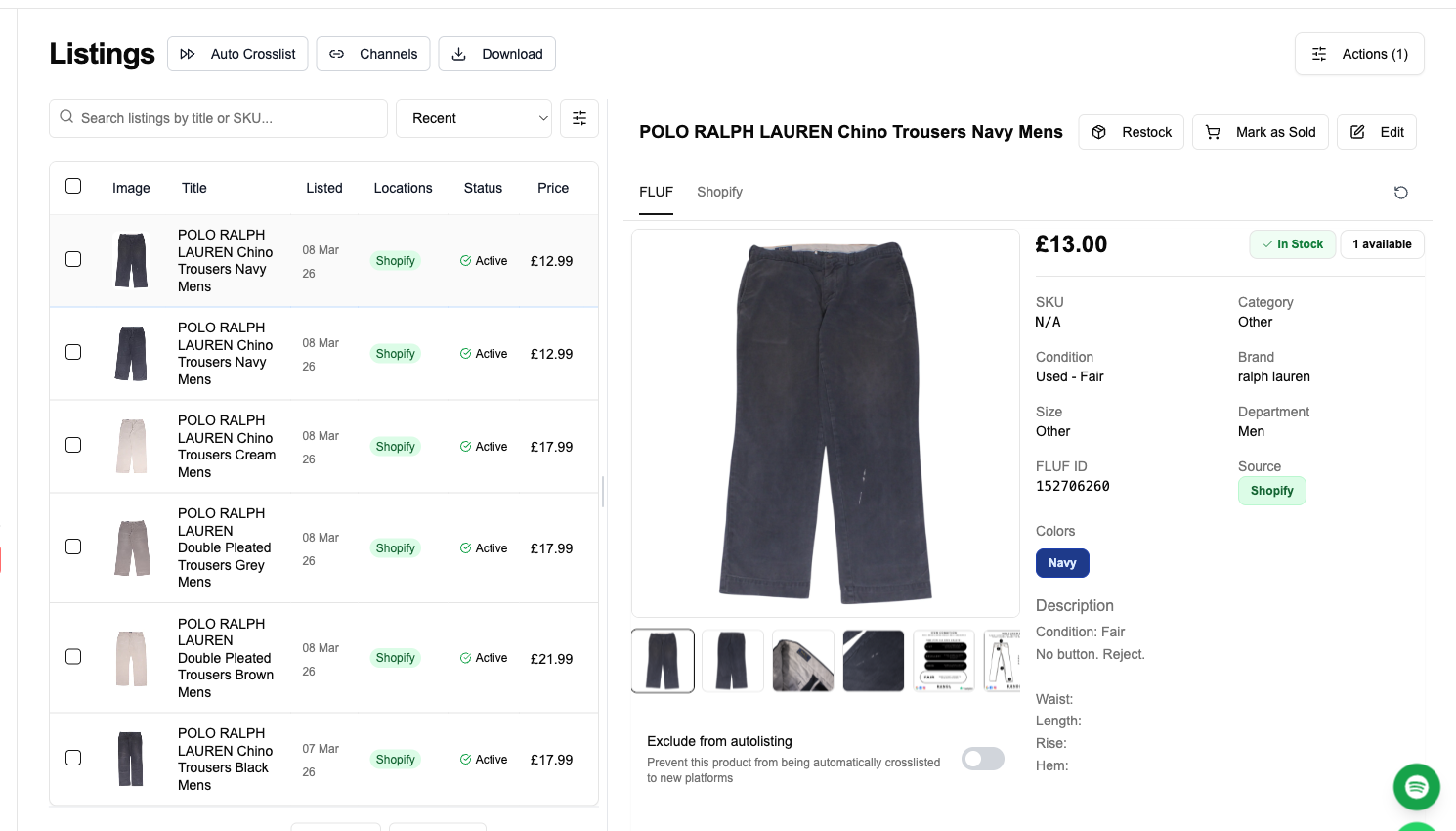
- Connect your Facebook Marketplace account and your eBay account in Channels.
- Open Listings and pick the items worth posting — the ones that fit in a box.
- Check brand, size and condition on each, since Facebook never asked you for them.
- Set a postage price or let eBay’s calculated postage handle it.
- Push to eBay. The photos, description and price come with it.
FLUF crosslists to 60+ marketplaces, so the same catalogue can go further than these two once it is in one place.
What syncs — and what does not
Sells on eBay: FLUF takes the Facebook Marketplace copy down for you, along with every other channel it was listed on.
Sells on Facebook: a Marketplace sale is not currently detected, so the eBay listing stays live until you end it. If you sell locally, end the eBay copy yourself — that is the honest state of this route today, and it is the one manual step worth remembering.
Relisting: eBay listings can be relisted automatically by FLUF. Marketplace listings cannot — renewing a Facebook listing is still a manual job on Facebook’s side.
Why keep the Facebook listing
Because it costs nothing and it catches a buyer eBay never will: the one twenty minutes away who wants it today and will pay cash. Bulky items in particular sell on Marketplace and sit on eBay, where the postage quote is larger than the item.
The sensible split is to list everything postable on eBay, keep the heavy and awkward things on Facebook, and let the overlap sit in both.
Questions sellers actually ask
Will my Facebook photos be good enough for eBay? Usually yes. eBay allows up to 24 images and shows a gallery rather than a feed thumbnail, so extra angles and close-ups of flaws help more there than they do on Facebook.
Do I need a business eBay account? Only if you are buying stock specifically to resell. A private account keeps the £0 selling fees.
Can I crosslist the other way, eBay to Facebook? Yes — see selling on Facebook Marketplace for what changes in that direction.
What happens to an item that sells on both at once? Sell it to whoever paid first and cancel the other. Crosslisting narrows that window but cannot close it entirely when one side does not report its sales.
Sources and verification
Last verified: 20 September 2026.
- eBay UK seller fees — the removal of private seller final value fees on 1 October 2024, the 8–15% business rates and the 30–40p per-order charge.
- eBay listing allowances — 300 free listings a month for private sellers, 1,000 for business sellers.
- Facebook Marketplace seller limits — up to 150 active listings, with lower initial limits on new accounts.
- Facebook Marketplace fees — free local sales and a 2% fee on shipped UK sales.
- FLUF Connect channel support — taken from the live channel registry on the date above.
Related Guide
Related guides
- Mercari vs Facebook Marketplace — where Facebook Marketplace wins and loses
- How to use Facebook Marketplace
Frequently Asked Questions
Yes. FLUF Connect supports automatic crosslisting from Facebook Marketplace to eBay, including bulk operations and auto-crosslisting rules for new products.
When an item sells on Facebook Marketplace, FLUF Connect automatically removes it from eBay and all other connected marketplaces to prevent overselling.
FLUF Connect includes a free tier so you can try it at no cost. Paid plans start at £9/month, with no cap on how much you list, with all automation features included.
Yes. FLUF Connect provides real-time inventory sync between Facebook Marketplace and eBay. When stock changes on one platform, it updates automatically on the other.
Yes. FLUF Connect supports bulk crosslisting — you can move hundreds of listings at once using filters by brand, category, price, or tags.
No. FLUF Connect handles the listing creation on eBay automatically, mapping your product details, images, and pricing across platforms.
FLUF Connect supports 10 marketplaces: Depop, eBay, Etsy, Facebook Marketplace, Shopify, Temu, Vestiaire Collective, Vinted, Whatnot, and Yaga — all manageable from one dashboard.
FLUF Connect maps your product details intelligently across platforms, adapting to each marketplace's format while preserving your titles, descriptions, images, and pricing.