
Crosslist from Kloset Klub to Depop — Selling Out of South Africa
A piece priced normally in Johannesburg is imported vintage in London. Here is what earning in GBP actually involves from South Africa: Depop's 10% non-UK fee, the missing seller protection, courier costs out of ZA, and the one automation gap you have to cover by hand.



- A South African seller can absolutely sell on Depop — on worse terms than a British one. Depop charges no selling fee at all to sellers based in the UK, US and Australia. Everyone else, South Africa included, pays 10% on every sale, settled through PayPal (Depop seller fees).
- Depop Protection does not reach you. Depop’s own policy states that if you are a seller based outside the UK or US, Depop Protection is not available. A parcel lost between Johannesburg and London is your loss, not Depop’s.
- Your money lands in PayPal and legally cannot stay there. PayPal’s South African terms require you to withdraw the balance to a South African bank account within 30 days of receipt, under exchange control (PayPal user agreement, South Africa).
- Stack the real costs before you price. 10% Depop + 4.40% PayPal + a 4.0% currency-conversion spread on the way into rand — roughly 18–19% of the gross, against Kloset Klub‘s flat 5% success fee and a R5 withdrawal.
- The asymmetry that will bite you operationally: FLUF supports order sync only on Kloset Klub — there is no mark-as-sold. A Depop sale cannot retire the Kloset Klub listing for you. You remove it yourself.
- Cost: £1 for 7 days, then plans from £9/month (Starter). There is no free plan.
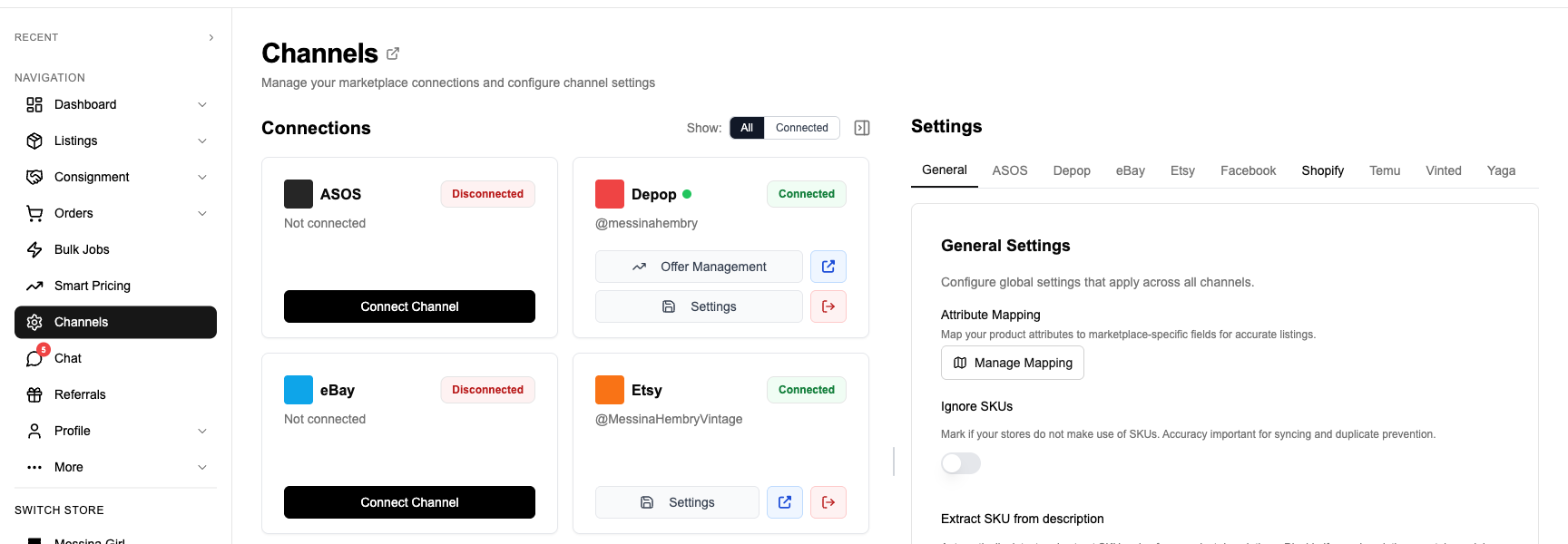
The honest position for a South African seller
Yes, you can sell on Depop from South Africa. Depop’s help centre documents the non-UK, non-US, non-Australian seller path explicitly: you are paid through PayPal, you arrange your own shipping, and you set your own worldwide postage price when you list. South Africa appears nowhere in Depop’s sanctions restrictions.
What differs is the deal. Depop removed selling fees for sellers based in the UK, the US and Australia. Based anywhere else, the schedule reads 10% on all sales, charged on the item price and — since you cannot use a Depop Shipping label, which exists only in those three markets — on the shipping cost too. Processing runs through PayPal rather than Depop Payments.
Then the part most sellers discover only after a parcel goes missing. Depop Protection covers items lost or damaged in transit, and the last exclusion on its policy page is the one that matters: if you are a seller based outside the UK or US, Depop Protection is not available. Not smaller cover — no cover.
So this is not a free upgrade. It is a decision with a calculable cost, taken in exchange for something Kloset Klub genuinely cannot give you: buyers who pay in pounds and dollars. Kloset Klub is a South African marketplace with a R400 minimum listing price and a Pudo network that stops at the border. Depop — which eBay agreed in February 2026 to acquire from Etsy for approximately $1.2 billion — carried around 7 million active buyers and roughly $1 billion of gross merchandise sales in 2025, nearly 90% of them under 34.
The strategic case is simple. A piece correctly priced at R1,200 in Sandton — a Thebe Magugu shirt, a Maxhosa knit, a genuinely good vintage jacket — is not competing against R1,200 pieces in London. It competes against £55 pieces, and the London buyer is not thinking in rand at all. That gap is the whole opportunity, and it has to absorb about a fifth of the sale in fees plus an international parcel.
What R1,200 in Cape Town becomes in London
Work the numbers before you list. Here is the same jacket sold twice: once on Kloset Klub for R1,200, once on Depop for £60 to a UK buyer with £30 of postage charged to the buyer. Rates are the published ones as of August 2026, at roughly R21.85 to the pound.
| Deduction | Kloset Klub (R1,200) | Depop (£60 + £30 postage) |
|---|---|---|
| Marketplace fee | 5% success fee — R60 | 10% of item and shipping — £9.00 |
| Payment processing | Included; escrow via SafePay/TradeSafe | PayPal international commercial: 4.40% + £0.20 — about £4.16 |
| Currency conversion | None — you are paid in rand | PayPal charges 4.0% over the base rate for South Africa — about £3.07 |
| Withdrawal | R5 (VAT excl.) to your bank | An FNB fee per withdrawal, set by FNB |
| Postage you actually pay | Buyer pays Pudo at checkout | You buy the international label — see the next section |
| Roughly what you keep | About R1,135 — near 95% | About £73.60 of £90 gross, before postage cost comes out of it |
Read the last row carefully. The £73.60 is not profit — postage still comes out of it. If the EMS parcel to Great Britain cost R646 for the first 500g, about £29.60, you keep roughly £44 on a piece you asked £60 for: an effective take-rate near 26% on the item, and that assumes you estimated the postage correctly when you listed. Against that, R1,200 on Kloset Klub nets about R1,135, with the buyer separately paying a checkout protection fee of 6.5% plus R15, capped at R150.
Two consequences. First, do not crosslist cheap stock: a R450 item, barely over the R400 floor, is roughly £20 on Depop, and £20 will not survive 10% plus PayPal plus 4% FX plus international postage. Crosslist the top of your closet. Second, price in the destination market’s terms, not by converting rand — a South African label unknown in London is not automatically cheap there, it is unfamiliar, which is either a discount or a story depending on how you write the listing.
One more line in the fee table is worth knowing: Boosted Listings, Depop’s paid promotion, cost 8% for sellers outside the UK and US, on top of the 10% selling fee — an 18% marketplace charge before PayPal touches it. Boost sparingly.
Your money lands in PayPal, and it cannot stay there
This part has nothing to do with Depop and everything to do with being a South African resident receiving foreign payments. PayPal’s user agreement carries a South Africa-specific clause worth knowing by heart: you must comply with South African exchange control. Concretely, funds received into your PayPal balance may not be sent on to another PayPal user for any reason, and must be withdrawn to your South African bank account within 30 days of receipt. To send money you use a linked credit card or a top-up from an FNB account, one top-up per purchase, and FNB charges a fee for each top-up and each withdrawal.
Your sale proceeds are therefore not a float. They are a stream you must repatriate, at your own cost, on a clock — so build the FX spread and the withdrawal fee into your pricing from the first listing.
The tax side is equally unambiguous: the South African Revenue Service states that all foreign income must be declared in South African currency, and your Depop earnings are foreign income. Keep sale receipts, PayPal statements and conversion records together per sale from the start — reconstructing a year of pound-denominated sales into rand is a miserable job that a weekly spreadsheet makes trivial.
Getting the parcel out of South Africa
Kloset Klub sellers are used to a good domestic experience: Pudo, powered by The Courier Guy, over 1,200 lockers nationwide, door collection, one to four business days. None of it leaves the country. International shipping is the single biggest operational change in this route. Your realistic options, and roughly what they cost:
| Option | Indicative cost | Notes |
|---|---|---|
| SAPO small packet, airmail, rest of world | R72.60 per 100g, max 2kg | A 500g garment is about R363. Add R67.15 per item if you want tracking — and you must have tracking. |
| SAPO parcel, Zone D (Great Britain, Germany, France, Netherlands) | R403.50 + R33.30 per 100g | A 1kg parcel is roughly R736. |
| SAPO parcel, Zone E (United States) | R300.10 + R52.00 per 100g | A 1kg parcel is roughly R820. |
| EMS (Expedited Mail Service) to Great Britain | R646 for the first 500g, R132 per additional 500g | Priority, door-to-door, trackable, up to 30kg. |
| EMS to the United States | R735 for the first 500g, R178 per additional 500g | Same service, higher zone. |
| DHL Express Easy or PostNet Global Express, over a PostNet counter | Quoted per parcel | Fastest and most reliable; priced accordingly. PostNet2PostNet is domestic only — it does not cross borders. |
Two caveats that a South African seller genuinely needs, and that no crosslisting tool can solve for you.
Post Office insurance is suspended. The 2026/27 rates brochure marks insurance on both letter post and parcels as suspended until further notice; registered letter post carries an indemnity of only 30 SDR. Combined with Depop Protection being unavailable to you, an uninsured lost parcel is simply an uninsured loss — which is the strongest argument for paying for a courier on anything above roughly R1,500 of value.
The South African Post Office is in business rescue, and says so on its own homepage. Outbound surface mail to the rest of the world has been terminated except for Lesotho, eSwatini, Mozambique and Botswana, registered surface mail is gone, and the rates brochure repeatedly advises enquiring at a branch about service suspensions. Do not assume a specific SAPO product will still exist next quarter — price a courier fallback into your worldwide shipping figure.
On timing, be conservative with buyers: courier out of South Africa to the UK or US runs in days, postal services run in weeks and go quiet in customs. Depop’s guidance for sellers outside the US and UK is to ship promptly with tracked shipping, keep proof of posting until delivery, and add the tracking number with “Mark as shipped”. Follow all three literally — without tracking, neither you nor Depop can prove anything, and you have no protection programme behind you.
The paperwork that has to go on the outside of the box
This is where South African sellers lose money invisibly — not to fees, but to parcels that stall, get taxed twice, or come back.
UK buyers, item under £135. Depop charges the buyer VAT at checkout, and you must write Depop’s UK tax number on the outside of the package with a note that UK VAT has been collected. The number appears in your sold receipt and confirmation email, but only once the buyer has paid the tax. Miss it and your buyer is charged VAT twice on delivery — a dispute you will lose.
EU buyers, item under €150. The buyer pays VAT at checkout plus a flat customs charge of €3 per item, and you must share Depop’s IOSS number with your shipping provider. Above €150, VAT and duty are charged on delivery instead.
US buyers. The United States has removed the $800 de minimis exemption, so parcels that once entered duty-free can now attract tariffs, and Depop does not collect these at checkout the way it does VAT. Either pay up front through your carrier (delivered duty paid) and build it into the price before the item sells, or let the buyer pay on delivery — and say so in the listing, because a buyer who refuses the charge sends the parcel back and the sale is refunded.
The South African side. The Post Office’s rates brochure states that exchange control applies to postal items exactly as to other exports, and that items worth more than R1,000 generally require specific export documents. Customs declarations follow Universal Postal Union rules: CN22 for small packets under R2,000 of contents, CN23, CP71 or PP4 for parcels depending on destination.
SARS’s exporter guidance is written broadly: any person, local or foreign, who wishes to export goods from South Africa must register as an exporter. We could not find a published de minimis exemption for occasional low-value postal exports by an individual, and will not invent one. If you are going beyond the odd parcel, confirm your position with SARS or your courier’s customs desk before you scale — a twenty-minute conversation that protects a whole channel.
The reach is not automatic
The seductive version of this page would say crosslisting puts your closet in front of 7 million Depop buyers. Depop’s own ranking documentation says otherwise, and after the fee stack this is the most important fact here.
Among the factors Depop’s search algorithm weighs is the seller’s location, described directly: it mainly shows buyers listings from the country set in their preferences. Sorting does not escape it — Depop says that when you sort by price or age, the algorithm still considers relevance and seller location first. Read plainly, your South African listings compete first inside the pool of buyers whose Depop country is South Africa, which is far smaller than the headline. A London buyer browsing casually is unlikely to trip over your jacket by accident.
This does not kill the strategy; it changes what the strategy is. For a South African seller, Depop behaves less like a search marketplace and more like a shopfront you drive traffic to — the same muscle Kloset Klub already asks you to build when it tells sellers to put their store link in their social profiles and share listings on WhatsApp. Post the Depop link, use the five hashtags and two brand hashtags a listing allows, and write the description so a specific search finds it: brand, era, measurements, condition, and the words a UK buyer would actually type. It also means the pieces worth crosslisting are the searchable ones — recognisable international brands, and the African designers Kloset Klub curates for, described properly rather than left to discovery.
What transfers from a Kloset Klub listing
Structurally these are close cousins — both are fashion resale listings with a brand, a size, a condition and photographs — so the mapping is far less painful than moving a general classified onto a curated marketplace. The friction sits in three places.
| Kloset Klub field | Depop field | Status | Notes |
|---|---|---|---|
| Title | Title | Automatic | Depop titles are short and search-driven. Front-load brand and item type. |
| Description | Description | Automatic | Add measurements — Depop’s own advice is that measurements and flaw disclosure are what sell a listing. |
| Photos | Photos | Capped | Depop allows up to four photos and one video per listing. If your Kloset Klub listing carries more, only the first four go. |
| Video | Video | Manual | One Depop video slot, worth filling by hand on your best pieces. |
| Price (ZAR) | Price (listing currency) | Needs a decision | Not a conversion. Re-price for the destination market and for the ~18–19% fee stack. |
| Condition | Condition | Mapped | Kloset Klub runs three grades — new, like-new and used. FLUF maps those onto Depop’s scale. |
| Brand | Brand | Mapped | Unrecognised names fall through to free text on the Depop side. |
| Size | Size | Mapped | Kloset Klub uses separate gendered and accessory size vocabularies; FLUF picks the right one from category and department. |
| Colour | Colour | Automatic | Review the colour selection before publishing. |
| Category | Category | Mapped | Different taxonomies; FLUF maps to the nearest Depop equivalent. |
| Shipping | Worldwide shipping price | Manual | Kloset Klub prices Pudo at checkout. On Depop you set a figure per listing, before you know the destination. Estimate by size and weight, and lean high. |
| Hashtags | Five, plus two brand hashtags | Manual | No Kloset Klub equivalent to derive them from. |
The shipping figure decides whether the sale is profitable, and no crosslister can compute it for you, because at listing time you do not know whether the buyer is in Manchester or Miami. Estimate on the heavier, further assumption. Depop’s worldwide toggle is off by default per listing; turning it on is a deliberate act, and so is switching it off if a route stops working.
The price. Never let a converted rand figure become your Depop price. These are not the same market, and the R400 floor that shapes your Kloset Klub catalogue means nothing in London.
The catalogue restrictions run one way. Kloset Klub declines ultra-fast-fashion — Shein, Mr Price, Jet, Legit, Pep, Miladys, Ackermans and similar — and enforces the R400 minimum. Depop has no such rules. So everything on Kloset Klub is eligible for Depop but not the reverse, and the curation Kloset Klub already imposed on you is conveniently close to the right filter for what is worth the postage.
How to crosslist from Kloset Klub to Depop with FLUF Connect
- Start your FLUF Connect account. £1 for 7 days, then plans from £9/month.
- Connect Kloset Klub. It is an extension-first channel: the work runs through your own browser (the FLUF Chrome extension) or the FLUF mobile app, signed in to your own Kloset Klub account.
- Connect Depop. No extension at all — it connects directly and keeps working whether or not your browser is open.
- Import your Kloset Klub listings. Photos, titles, descriptions, brands, sizes, conditions and colours come into your FLUF catalogue.
- Filter before you push. Sort by price and take the top of the closet. This is the highest-value step on this route: pushing the whole catalogue loses money on the bottom half of it.
- Set the Depop price and worldwide shipping figure per item. Not a conversion — a decision. Review the mapped category and size on the first few.
- Crosslist. Listings appear on Depop in minutes. Bulk operations are included in every plan, and relisting and offers from Seller upwards.
The same catalogue pushes to other channels at once — see the crosslisting hub, the reverse route at Depop to Kloset Klub, or related routes into the same destination — Vinted (Vinted to Depop) and eBay to Depop.
What syncs between them
Be exact here: the two channels are not symmetrical, and the gap is on the Kloset Klub side.
| Capability in FLUF | Kloset Klub | Depop |
|---|---|---|
| Crosslisting | Yes | Yes |
| Order sync | Yes | Yes |
| Mark as sold (auto-retire when it sells elsewhere) | No | Yes |
| Automated relisting | No | Yes |
| Offer management | No | Yes |
| Messaging | No | Yes |
| Refunds and fulfilment | No | Yes |
| Needs your browser or the FLUF mobile app | Yes | No |
In plain terms: when a piece sells on Depop, FLUF can retire it from channels that support mark-as-sold — and Kloset Klub is not one of them. The Kloset Klub listing stays live until you take it down. Since Kloset Klub holds the buyer’s payment in escrow until delivery is confirmed, a double sale is a cancelled order against your record on a small, curated marketplace where reputation carries further than it does on Depop.
Practical habit: when a Depop sale notification arrives, delist on Kloset Klub before you pack the parcel — first step of fulfilment, not something you mean to do later. Order sync still brings the Kloset Klub sale into FLUF, so your records stay whole; it is the outbound retirement that is manual.
The other direction is safe: a Kloset Klub sale can retire the Depop listing, because Depop supports mark-as-sold.
Prices, descriptions and photos do not re-sync continuously either way: edit in FLUF and re-push rather than editing on one marketplace and expecting the other to notice. See inventory sync and selling on multiple platforms.
What it costs
FLUF Connect is £1 for 7 days, then plans from £9/month (Starter). There is no free plan.
| Plan | Monthly | Yearly | You save | Crosslisted products |
|---|---|---|---|---|
| Starter | £9/month | £59/year | 45% | Unlimited |
| Pro | £29/month | £199/year | 42% | Unlimited |
| Priority | Custom pricing — tell us what you need | Unlimited | ||
Automatic relisting, offer management, smart pricing and listing boosts are included from Pro upwards. Starter covers unlimited crosslisting, inventory sync, order sync and Instagram posting without them. Accounting integrations are included from Pro upwards. Yearly billing is charged once a year. New accounts get 7 days for £1, then move onto a plan.
Every plan includes crosslisting to all supported channels, order sync, bulk operations — automation is included, not an add-on, Seller and above add relisting, and Seller and above add offers. Full detail on the pricing page. For a South African seller the subscription is the small number here: one £60 sale a month more than covers Starter, and marketplace fees and postage dwarf it either way.
Sources and verification
- Depop — Seller fees and charges (21 July 2026): no selling fee in the UK, US and Australia; 10% on all sales elsewhere, charged on item price and, where no Depop Shipping label is used, on shipping; processing via PayPal; Boosted Listings 8% outside the UK and US.
- Depop — Depop Protection for sellers (4 August 2026): “If you’re a seller based outside of the UK or US Depop Protection is not available.”
- Depop — What is Depop Payments? (7 January 2026) and Using PayPal on Depop (13 August 2026): Depop Payments is required in the US, UK and Australia; PayPal is for users outside those three.
- Depop — How to ship, Worldwide (19 January 2026): sellers outside the US or UK use their own shipping method, set a worldwide price at listing time, ship tracked and keep proof of posting.
- Depop — How Depop ranks search results (21 August 2026): seller location is a ranking factor; Depop “mainly show[s] you listings from the country set in your preferences”, including when results are sorted.
- Depop — tax and customs by country (14 August 2026): UK under £135, VAT at checkout and Depop’s UK tax number on the outside of the package; EU under €150, VAT at checkout plus €3 flat customs and Depop’s IOSS number.
- Depop — Tariffs on parcels into the US: the $800 de minimis exemption has been removed; Depop does not collect tariffs at checkout.
- Depop — How to list an item: four photos and one video, five hashtags and two brand hashtags. Sanctions Policy (9 June 2026): South Africa is not a restricted territory.
- eBay investor news, 18 February 2026: agreement to acquire Depop for approximately $1.2 billion; about $1 billion GMS in 2025; roughly 7 million active buyers, nearly 90% under 34. eBay and Depop share an owner but remain separate marketplaces.
- PayPal — user agreement, South Africa clause: exchange-control compliance required; received balances may not be sent to another PayPal user and must be withdrawn to a South African bank account within 30 days; top-ups from an FNB account, FNB fees apply.
- PayPal merchant fees and consumer fees, South Africa (28 May 2026): 4.40% plus a fixed fee (£0.20 / $0.30) for receiving international commercial transactions; 4.0% currency-conversion fee above the base rate.
- Kloset Klub — how selling works, help centre, payments and payouts, buyer protection fees, Pudo delivery, our story: 5% success fee, R5 withdrawal, R400 minimum, declined fast-fashion brands, SafePay via TradeSafe, buyer fee 6.5% + R15 capped at R150, Pudo in 1–4 business days across 1,200+ lockers, built as WISI-Oi in 2021 and renamed in 2025.
- South African Post Office — 2026/27 postal rates (1 April 2026 to 31 March 2027): every rate, zone, insurance-suspension, surface-mail termination, exchange-control and customs-form figure quoted above. Business rescue notices are published on the operator’s homepage.
- PostNet — DHL Express Easy and PostNet Global Express: counter-based international courier options; PostNet2PostNet is domestic.
- SARS — Exporters: “Any person (local or foreign) who wishes to export goods from South Africa must register as an exporter.” No published de minimis for occasional low-value postal exports was found, and none has been assumed. SARS — foreign income: must be declared in South African currency.
- FLUF channel capabilities come from the live channel registry as at 24 August 2026. Rand conversions use roughly R21.85 to the pound and R16.00 to the dollar, the mid-market rates that day. Depop’s help pages could not be retrieved by ordinary browser fetch during research, so the text was read through Depop’s own help-centre content API; the URLs cited are the canonical public pages. Fees, tax thresholds and postal rates change — verify before you price.
Frequently Asked Questions
Yes. Depop's help centre documents the seller path for people based outside the UK, US and Australia: you are paid through PayPal, you arrange your own shipping, and you set a worldwide shipping price when you list. South Africa is not on Depop's sanctions restriction list. The terms are simply worse than a British seller's — you pay a 10% selling fee and you are not covered by Depop Protection.
10% on all sales, charged on the item price and, because Depop Shipping labels are not available to you, on the shipping cost as well. On top of that PayPal charges roughly 4.40% plus a fixed fee for receiving an international commercial payment, and a 4.0% currency-conversion fee when the money is converted for a South African account. Budget around 18-19% of gross before postage, against Kloset Klub's flat 5% success fee.
No. Depop's own policy states that if you are a seller based outside the UK or US, Depop Protection is not available. If a parcel is lost or damaged in transit the loss is yours. Since South African Post Office insurance is currently suspended, ship tracked and use a courier for anything of real value.
No, and this is the most important operational fact on this route. FLUF supports order sync only on Kloset Klub — there is no mark-as-sold — so a Depop sale cannot retire the Kloset Klub listing for you. Remove it yourself, ideally before you pack the parcel. The reverse works: a Kloset Klub sale can retire the Depop listing, because Depop supports mark-as-sold.
It lands in PayPal. PayPal's South African terms require you to comply with exchange control: you may not spend a received balance by sending it to another PayPal user, and you must withdraw it to a South African bank account within 30 days of receipt. FNB charges a fee for each withdrawal, and SARS requires all foreign income to be declared in South African rand.
Using the South African Post Office 2026/27 rates: an airmail small packet to the rest of the world is R72.60 per 100g up to 2kg, plus R67.15 for tracking. A 1kg parcel to Great Britain is roughly R736, and to the United States roughly R820. EMS is R646 for the first 500g to Great Britain and R735 to the United States. DHL Express Easy over a PostNet counter is faster and priced per parcel.
Not automatically. Depop's ranking documentation says the seller's location is a ranking factor and that it mainly shows buyers listings from the country set in their preferences — even when results are sorted by price or age. Treat Depop as a shopfront you drive traffic to with social links and precise, searchable descriptions, not as a search marketplace that will discover you.
For a UK buyer with an item under £135, Depop collects VAT at checkout and you must write Depop's UK tax number on the outside of the package with a note that UK VAT has been collected. For an EU buyer under €150, share Depop's IOSS number with your shipping provider. For US buyers, the $800 de minimis exemption has been removed, so decide up front whether you or the buyer pays the tariff. On the South African side, postal items worth more than R1,000 generally require specific export documents.
No. A R450 item is roughly £20 on Depop, and £20 will not survive a 10% selling fee plus PayPal fees plus a 4% currency spread plus international postage. Crosslist the top of your closet — recognisable international brands, African designer pieces, genuine vintage and sought-after sneakers — and leave the rest on Kloset Klub, where the economics are much better for you.
£1 for 7 days, then plans from £9/month (Starter). There is no free plan. Every plan includes crosslisting across all supported channels, order sync, bulk operations — automation is included from Pro upwards, not a paid add-on, Pro and above add relisting, and Pro and above add offers.
Sign up for free
Join the community
You're in.
Open your dashboard