
Crosslist from Square to Vinted with FLUF Connect
Turn your Square catalogue's returns, preloved and clearance stock into live Vinted listings — synced, never double-sold.
7 days for £1, then from £9/month.



Crosslist your Square stock to Vinted with FLUF. Review photos, title, description, price and stock before publishing. Vinted requires the FLUF browser extension or mobile app; Square does not. A detected Vinted sale updates the corresponding Square stock.
\n\n
A Square setup is built around the till, not the feed. You take payments in person, your online store mirrors the same catalogue, and stock moves between the two automatically — but nothing about that stack puts your items in front of someone browsing a resale marketplace for exactly what you’re holding. Vinted is that marketplace: tens of millions of buyers actively searching for secondhand and preloved stock, with no listing fee standing between you and a sale. If your Square catalogue includes anything secondhand-adjacent — returns, last-season stock, a vintage or thrift sideline, overstock you’d rather clear than discount in-store — that inventory has an audience on Vinted it will never find sitting in your Square dashboard alone.
\n\n
The obstacle has always been the mechanics. Square was never built to talk to Vinted, and Vinted itself doesn’t offer sellers an API to push listings through — it expects a human, in a browser, on their own account. Bridging that gap by hand means re-photographing or re-uploading every item, retyping titles and prices into the Vinted app one at a time, and then manually keeping two stock counts honest so you don’t sell the same item twice. FLUF Connect exists to remove exactly that friction.
\n\n
\n\n
Why Sell on Both Square and Vinted?
\n\n
Because they solve different problems for a small or local business. Square is the operational backbone — take a card payment at the counter, ring up a sale on the same catalogue online, keep one stock count across both. It is, deliberately, a tool built around your own storefront and your own domain rather than a marketplace with its own audience. Square’s seller base reflects that: the large majority of Square Online stores are small, with roughly three in four selling fewer than ten distinct products, and small-to-medium businesses account for around 70% of the payment volume moving through Square. It is a platform built for the corner shop, the market stallholder, the studio and the boutique — not for chasing marketplace discovery.
\n\n
Vinted supplies exactly the discovery layer Square doesn’t have. It reported GMV of €10.8bn in 2025, up 47% year on year — growth most channels would kill for — built on a buyer base that comes to the app specifically hunting for secondhand fashion, and increasingly, since a 2025 category expansion, homeware and electronics too. France is Vinted’s largest market, with Germany and the UK close behind, and in January 2026 it launched in the United States, opening an entirely new pool of buyers to sellers who list early. None of that traffic exists inside Square’s own storefront tools, however well you run them.
\n\n
The fee structures make the pairing more attractive still. Square’s entry point costs nothing to start — its base tier is $0/month, with higher tiers at $49/month and $149/month buying deeper POS, marketing and reporting features as a shop grows — and on top of whichever tier you’re on, Square takes a processing fee per transaction, not a listing fee. Vinted goes further in the other direction: there are no selling fees at all — you keep 100% of what you earn, with the buyer covering a separate Buyer Protection charge instead. Stack the two together and a Square seller moving secondhand-adjacent stock onto Vinted isn’t handing over a cut to either side of the transaction beyond ordinary payment processing — the marginal cost of testing whether an item sells on Vinted is close to zero.
\n\n
There’s a structural point underneath both of those numbers. Square is where you run the business you already have; Vinted is where you reach the buyer you don’t have yet, without opening a second shopfront or a second marketing budget. A returns rack, an end-of-season clearout, or a standing sideline in preloved or vintage pieces sitting in your Square catalogue is, on Vinted, simply inventory a buyer is actively looking for. The work FLUF Connect removes is the part that made testing that theory not worth the hassle before — the manual re-listing and the risk of double-selling the one unit you actually have.
\n\n
How to Crosslist from Square to Vinted with FLUF Connect
\n\n
The two channels connect very differently under the hood, and it’s worth understanding why before you start, because it changes what “connected” means for each side.
\n\n
Step 1: Connect your Square account
\n\n
Connect Square by approving FLUF in your Square account. No browser extension is required for Square. Confirm your location, country and currency, and review the imported items, prices, stock and photos.
\n\n
Step 2: Connect your Vinted account — and get the FLUF extension or app running
\n\n
Install and connect either the FLUF browser extension or mobile app for Vinted. Keep it available when creating or managing your listings; a FLUF dashboard login alone is not enough.
\n\n
Step 3: Select the products to crosslist
\n\n
With both sides connected, pick which Square items go to Vinted from the FLUF dashboard. Most sellers don’t mirror their whole till — you’d typically send the secondhand, preloved, vintage or clearance lines that suit Vinted’s buyers, and leave brand-new, full-price or B2B-only stock on Square alone. Selection works item by item or in bulk.
\n\n
Step 4: One-click crosslist
\n\n
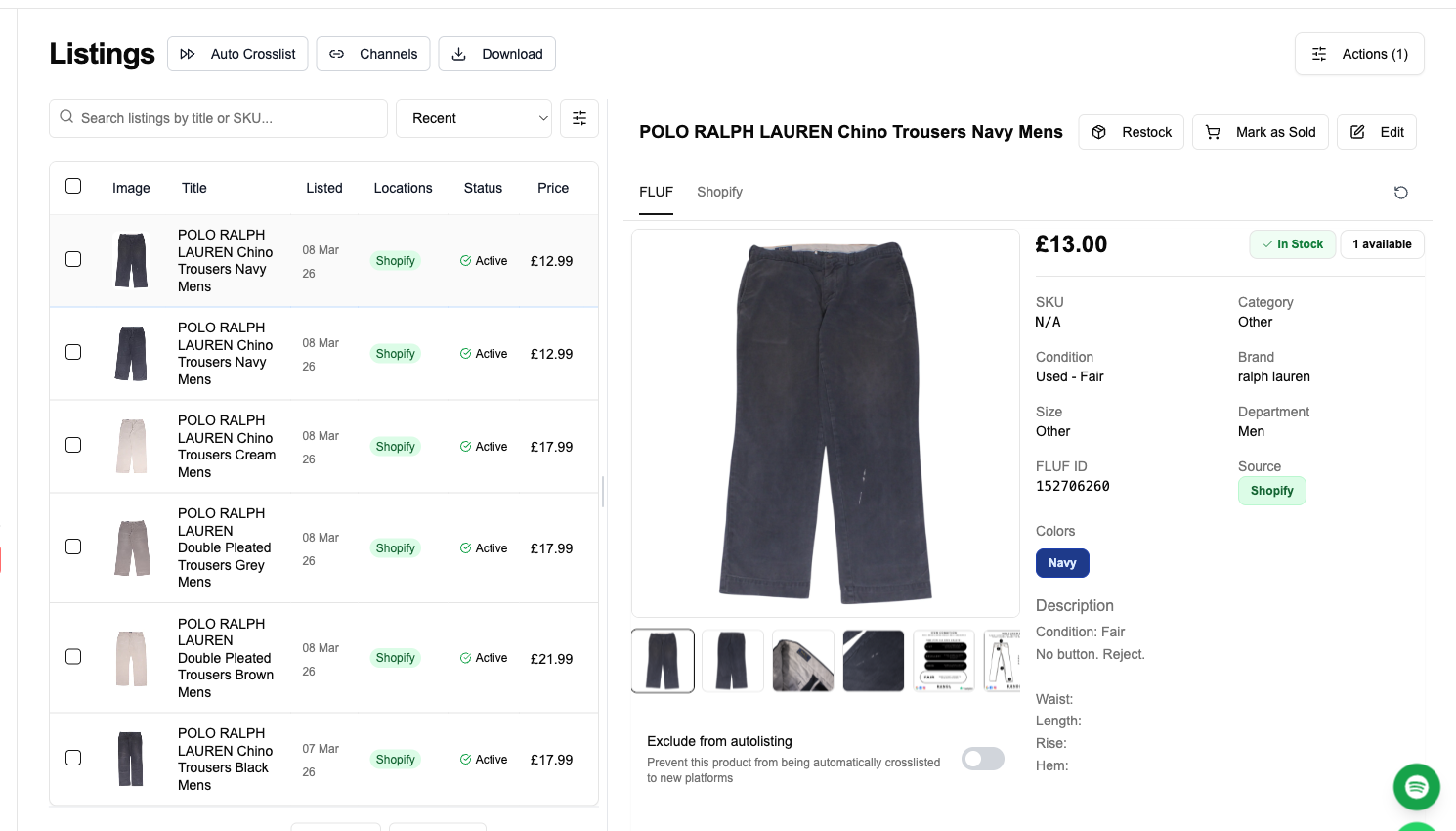
Hit crosslist and FLUF builds the Vinted listing from your Square data — photos, title, description, price, stock and, where it can be mapped, category — via the extension or app connection, then tracks the resulting listing centrally. From that point a sale on either side is reflected on the other without you touching either dashboard again.
\n\n
What Transfers When You Crosslist from Square to Vinted?
\n\n
The aim is a Vinted listing that reads like you built it by hand on Vinted, populated from what’s already sitting in your Square catalogue.
\n\n
Photos
\n\n
Square stores a catalogue item’s photos as separate IMAGE objects linked to the item, and FLUF resolves and carries across the full set, not just a single thumbnail. Vinted is a visual, mobile-first marketplace where the lead photo does most of the persuading before a buyer even opens the listing, so the order your images sit in on Square is preserved — whichever photo you set first on Square becomes the lead shot on Vinted.
\n\n
Title and description
\n\n
Your item’s name and description transfer as the starting point for the Vinted listing. Square stores description text as plain text with line breaks preserved, so what you wrote in Square shows up formatted the same way on Vinted rather than losing its paragraph breaks. Vinted shoppers scan differently than someone browsing your till’s item list, so it’s worth leading with brand, item type, size and condition once the listing’s live — but you’re editing existing copy, not starting from a blank field.
\n\n
Price and stock
\n\n
Review the imported price and stock before publishing on Vinted, and check that they match the item you intend to sell.
\n\n
Category mapping
\n\n
Square doesn’t use a fixed category taxonomy — your categories are ones you defined yourself in your own Square dashboard. FLUF reads those seller-defined categories and maps each item to the closest matching category in Vinted’s fixed taxonomy, so a “Vintage Denim” category you built yourself in Square lands in the right branch of Vinted’s clothing tree rather than a generic catch-all. On Vinted, category — together with brand, size and condition — is core to how buyers actually find an item, so getting this mapping right isn’t cosmetic.
\n\n
Condition
\n\n
Condition is a first-class, filterable field on Vinted in a way it typically isn’t on a Square catalogue built for in-store retail. Where your Square listing signals an item’s state — new, preloved, well-worn — FLUF maps that into Vinted’s condition field rather than leaving it buried in the description, which matters for setting buyer expectations up front on a resale marketplace.
\n\n
One honest caveat: Square’s catalogue is built for whatever you sell in your own shop, and not every SKU maps cleanly onto a resale audience. Brand-new, full-margin stock with no secondhand angle is a poor fit for Vinted regardless of the tooling — curate toward the preloved, vintage, returns and clearance lines that actually belong there.
\n\n
A Before & After: One Square Seller Reaching Vinted’s Buyers
\n\n
Picture a small independent seller running a Square till in a physical shop — a vintage or general clothing boutique, say — with an online store mirroring the same stock, plus a back room of returns, last-season pieces and the odd preloved item that came in as part-exchange.
\n\n
Before: everything lives inside Square. In-store customers see the front-of-shop stock; online customers see the same catalogue on the seller’s own site. The returns rack and the slow-moving vintage pieces just sit there — the seller knows secondhand marketplaces exist, but Vinted doesn’t plug into Square, so listing there would mean re-photographing every item, typing titles and prices into the Vinted app by hand, one at a time, and then remembering to update Square manually the moment something sells on Vinted so the till doesn’t ring up an item that’s already gone. That manual reconciliation is exactly the kind of thing that gets skipped under a busy shop day, and skipping it is how you end up apologising to a customer for a sale that can’t actually be honoured.
\n\n
With FLUF: connect Square, bring Vinted online with the extension or mobile app, then select and review the items you want to crosslist. A detected Vinted sale updates Square stock. Check sync status for single-copy items because updates are not instantaneous.
\n\n
That’s the practical shift: the same shop stock, a resale audience with real buying intent actively searching for it, and none of the manual bookkeeping that used to make a second channel more trouble than it was worth.
\n\n
What Syncs (and What Doesn’t)
\n\n
It’s worth being precise here rather than promising a blanket “everything syncs both ways” — the two channels don’t carry the same capabilities, and knowing the actual shape of the sync is more useful than a vague guarantee.
\n\n
Vinted supports the full set: order sync, mark-as-sold, relisting and offer management are all live.
\n\n
- \n
- Orders flow back. A Vinted sale is registered centrally in FLUF, not left sitting inside a separate app you have to remember to check.
- Mark-as-sold is supported on the Vinted side. When an item sells on any other connected channel, FLUF can take the Vinted listing down so it never gets sold twice from the Vinted side.
- Relisting is supported. Vinted listings lose visibility as they age in the feed, and FLUF can relist them so they resurface.
- Offer management is supported. Vinted buyers negotiate constantly, and FLUF can automate how offers are answered rather than leaving you to catch every one manually.
\n
\n
\n
\n
\n\n
Square’s role in the pair is narrower, and it’s worth saying plainly what that means. The direction that’s live and confirmed today is: sell the item on Vinted (or any other connected channel), and FLUF writes an updated stock count straight to Square, so your till and your Square Online store reflect the sale immediately — that’s the protection against double-selling described above, and it’s a real, working guarantee. Relisting and offer management aren’t Square concepts at all — there’s no public marketplace feed or negotiation layer on a POS catalogue for them to apply to. What Square doesn’t yet do is feed its own in-person and web sales back into FLUF’s central order view the way Vinted’s do; FLUF reads your Square orders, but automatically reflecting a sale that happened at your own till back onto the live Vinted listing isn’t part of the integration yet. In practice, that means the sync that protects you today runs from Vinted (and your other connected channels) into Square — which is exactly the direction that stops a shop-floor double-sell, the failure mode that actually costs you a refund and an awkward conversation with a customer.
\n\n
Automation for Square + Vinted Sellers
\n\n
Listing an item once is the easy part. Staying visible in Vinted’s feed and responsive to offers over weeks is where sellers running a physical shop on the side genuinely don’t have spare time — which is exactly what FLUF’s automation on the Vinted side is built to absorb. All of it is included from Seller upwards, not sold separately.
\n\n
Auto-relisting
\n\n
Vinted’s feed rewards freshness — a listing that’s sat untouched for weeks quietly slips down the ranking. FLUF can relist your Vinted items automatically so they resurface near the top without you manually deleting and re-uploading each one. For a Square seller treating Vinted as a standing clearance or preloved channel, that keeps slow-moving stock in front of buyers instead of going quiet.
\n\n
Offer automation
\n\n
Vinted’s buyers negotiate, and offers land at any hour — including while you’re mid-shift behind a Square till and nowhere near your phone. FLUF can respond to offers within rules you set, so a fair offer gets answered promptly and doesn’t sit unattended until it’s forgotten.
\n\n
Inventory sync and never-oversell
\n\n
Everything above sits on top of the sync layer described above: a Vinted sale updates your Square stock count without you touching either system. That’s what actually makes running a Vinted sideline alongside a working shop floor sustainable rather than one more thing to manually check at close-out — the risk it removes is the single most common failure mode of running two channels by hand.
\n\n
Put together, auto-relisting, offer automation and the stock sync mean a Square seller can run Vinted as a genuine second channel for their secondhand-adjacent stock, rather than a side project that only gets attention when someone remembers to check it.
\n\n
Pricing
\n\n
FLUF Connect plans start at £9/month (Starter), with higher tiers checking your channels for sales more often. Every new account gets a 7-day trial for £1, so you can connect Square and Vinted and see the crosslist and sync working before committing. There is no free plan — but critically, the automation that makes a Vinted sideline worth running alongside a Square till — auto-relisting, offer management, order sync and never-oversell inventory protection — is included in every plan, not billed as a paid add-on. Setup for both channels takes about ten minutes end to end, and both connections are revocable whenever you choose.
\n\n
Sources & Verification
\n
- \n
- Vinted financial results 2025 (GMV €10.8bn, +47% YoY, US launch January 2026, electronics & homeware expansion)
- Vinted — how it works (no seller fees, buyer covers Buyer Protection)
- Square Online — subscription plans
- Square — 2026 seller/partner ecosystem data (Square Online micro-merchant base, SMB share of GPV)
- Square — omnichannel inventory sync between POS and online store
- Crosslist from Square to Depop
- Crosslist from Square to Poshmark
\n
\n
\n
\n
\n
Related guides
Frequently Asked Questions
Yes, for Vinted: keep the FLUF browser extension or mobile app connected. Square requires neither.
Yes. The FLUF mobile app runs a background session on your phone that connects to Vinted the same way the Chrome extension does on desktop. You need one of the two connected — it doesn't have to be the browser extension specifically.
No, FLUF doesn't add its own selling fees on top of either platform. Vinted itself charges sellers no selling fees at all. Square charges its own processing fee per transaction depending on your Square plan, which is separate from FLUF's subscription.
FLUF writes an updated stock count straight to Square automatically, so the item can't be sold again at your till or on your Square Online store. This direction of the sync is live and confirmed.
Not yet. FLUF reads your Square orders, but Square doesn't currently feed its own point-of-sale and web sales back into FLUF's central order view the way Vinted does, so a sale made at your till doesn't yet automatically delist the matching Vinted listing.
No. FLUF Connect has no free plan. Plans start at £9/month (Starter), and every new account gets a 7-day trial for £1 so you can test the connection first.
Photos, title, description, price, stock and, where it maps cleanly, category and condition. Square's category tree is merchant-defined, so FLUF maps your own categories to the nearest match in Vinted's fixed taxonomy.
Not automatically. Vinted's audience is secondhand, preloved, vintage and resale-minded, plus homeware and electronics since its 2025 expansion. Brand-new, full-margin or B2B-only Square stock is usually a poor fit regardless of the tooling.