
How to Sell on eBay — The Complete Guide for 2026
Everything you need to know about fees, listing strategy, shipping, and growing your eBay business — plus how to cross-list automatically.



- Active buyers: 132 million worldwide across 190+ markets
- Seller fees: Private sellers pay £0 in fees (since October 2024). Business sellers pay 8-15% final value fee + 30-40p per order
- Free listings: 300/month (private), up to 1,000/month (business)
- Best for: Electronics, collectibles, vintage fashion, auto parts, branded goods — any product type
- Biggest advantage: Massive global buyer base actively searching for specific items by brand, model, and condition
- Cross-list with FLUF Connect: Sync eBay with Depop, Vinted, Wallapop, Shopify & more — all in one dashboard
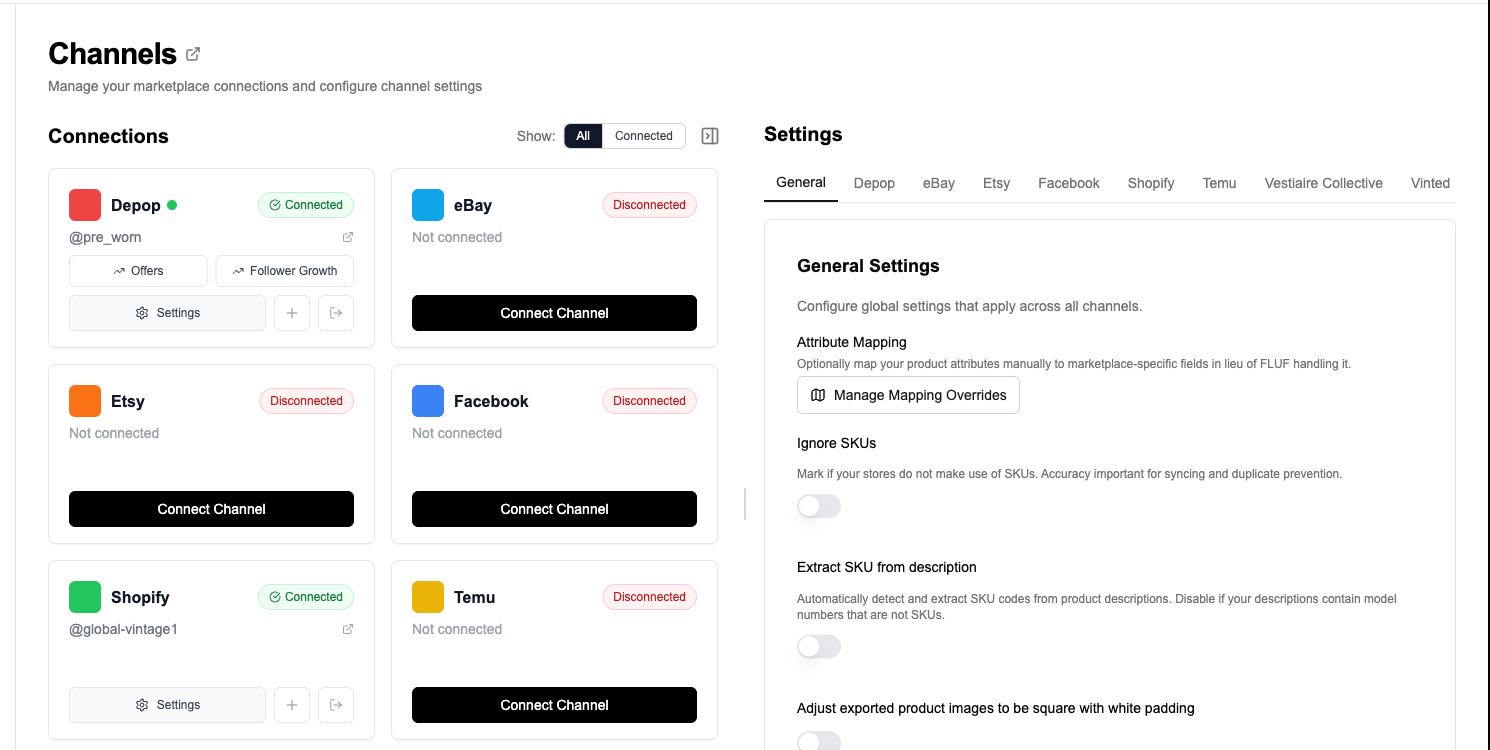
Table of Contents
- What Is eBay?
- Why Sell on eBay in 2026?
- How Much Does It Cost to Sell on eBay? — Fees Explained
- How to Set Up Your eBay Seller Account
- How to Create eBay Listings That Actually Sell
- Photography Tips for eBay Sellers
- Shipping and Returns on eBay
- How Does the eBay Algorithm Work?
- Getting Paid and Tax Obligations
- What Sells Best on eBay in 2026?
- Pro Tips from Experienced eBay Sellers
- Common Mistakes New eBay Sellers Make
- Cross-List Your eBay Products to Sell Faster
What Is eBay?
eBay is a global online marketplace where individuals and businesses buy and sell new and pre-owned goods across virtually every product category. Founded in 1995 by Pierre Omidyar in San Jose, California, eBay pioneered online auctions and has since evolved into one of the world’s largest e-commerce platforms, supporting both auction-style and fixed-price listings.
Today, eBay connects 132 million active buyers with over 18 million sellers across 190+ markets worldwide. Unlike fashion-focused platforms such as Depop or Vinted, eBay covers everything from electronics and car parts to rare collectibles and vintage clothing. The platform processes approximately $74.7 billion in gross merchandise volume annually, with over 2.3 billion live listings at any given time.
In a landmark change in October 2024, eBay UK removed final value fees entirely for private sellers — making it effectively free to sell on eBay for casual and side-hustle resellers. Business sellers still pay commission-based fees. Listing is free for the first 1,000 items per month, and eBay handles payment processing through its Managed Payments system.
| Metric | Detail |
|---|---|
| Founded | 1995 |
| Headquarters | San Jose, California, USA |
| Active buyers | 132 million |
| Active sellers | 18.3 million |
| Countries | 190+ markets |
| Live listings | 2.3 billion |
| Annual GMV | $74.7 billion (2024) |
| Monthly visits | ~714 million |
| Top categories | Electronics, Fashion, Collectibles, Home & Garden, Motors |
| Revenue model | Free for private sellers; commission-based for business sellers |
Why Sell on eBay in 2026?
eBay remains one of the most profitable marketplaces for resellers in 2026, and for good reasons that go beyond its size. Here’s why serious sellers still consider eBay essential.
Massive, Intent-Driven Buyer Base
Unlike social marketplaces where users browse casually, eBay buyers search with purchase intent. They type specific queries — “Nike Air Max 90 UK 9 used” or “Canon EOS R6 body only” — and eBay’s search engine matches them directly with your listings. That means your products are shown to buyers who are actively looking to purchase, not just scrolling.
Every Product Category Welcome
eBay isn’t limited to fashion. Electronics, car parts, home appliances, musical instruments, trading cards, industrial equipment — if it’s legal to sell, eBay probably has a market for it. This makes eBay ideal for sellers with diverse inventory.
Zero Seller Fees for Private Sellers
Since October 2024, private sellers on eBay UK pay no final value fees at all — across nearly every category (vehicles are the exception). This makes eBay one of the cheapest platforms to sell on, rivalling Vinted and Depop’s zero-fee models. Business sellers still pay commission, but the rates are transparent and predictable.
Established Trust and Buyer Protection
eBay’s Money Back Guarantee programme gives buyers confidence, which drives higher conversion rates. Sellers with strong feedback scores benefit from increased visibility and buyer trust.
Global Reach from Day One
With the Global Shipping Programme and international listings, you can sell to buyers in 190 countries without managing customs paperwork yourself.
| eBay (Private Seller) | eBay (Business Seller) | Depop | Vinted | |
|---|---|---|---|---|
| Listing fee | Free (first 300/month) | Free (first 1,000/month) | Free | Free |
| Transaction fee | £0 (since Oct 2024) | 8-15% + 30-40p per order | 0% (no seller fees) | 0% (no seller fees) |
| Payment processing | Included | Included | Included | Included |
| Monthly subscription | N/A | Optional (from £19.99/month) | None | None |
| Total cost on £30 item | £0 | ~£4.14-£4.70 | £0 | £0 |
| Buyer base | 132 million | 132 million | ~35 million | ~100 million |
| Best for | Side-hustle sellers, all categories | High-volume, all categories | Fashion, streetwear, vintage | Everyday fashion, bargain hunters |
How Much Does It Cost to Sell on eBay? — Fees Explained
eBay’s fee structure changed significantly in October 2024 when eBay UK removed final value fees for private sellers across nearly all categories. This makes understanding the difference between private and business seller fees essential. Here’s every fee broken down.
Private Sellers: Zero Selling Fees
Since October 2024, private sellers on eBay UK pay no final value fees when their items sell. This applies to all categories except Motors (vehicles). You still get up to 300 free listings per month, with additional listings costing £0.35 each. This means a private seller can list and sell items on eBay with zero commission — the same model as Depop and Vinted.
Business Sellers: Final Value Fees
Business sellers pay a percentage of the total sale amount (item price + postage + taxes) plus a fixed per-order charge. As of February 2026, the per-order charge is £0.30 for orders up to £10 and £0.40 for orders over £10.
Fee rates vary by category:
| Category | Final Value Fee | Per-Order Charge |
|---|---|---|
| Clothing, Shoes & Accessories | ~10.9% (excl. VAT) | £0.30-£0.40 |
| Electronics (most sub-categories) | ~8-12% | £0.30-£0.40 |
| Books, DVDs, Music & Video Games | ~14.6% | £0.30-£0.40 |
| Home & Garden | ~10-12% | £0.30-£0.40 |
| Collectibles, Art, Coins, Stamps | ~10-12% | £0.10 |
| Musical Instruments | ~5.85% | £0.30-£0.40 |
| Items above £5,000 | Additional 3% on portion above £5,000 | — |
| Motors (vehicles) | £29-£49 flat fee | £0.00 |
Business sellers also pay a Regulatory Operating Fee of 0.35% + VAT on the total sale price.
Fee rates as published on eBay.co.uk. Always verify on eBay’s official fee page before listing, as rates may change.
Insertion Fees (Listing Fees)
Private sellers receive up to 300 free listings per month (400 with a paid listings upgrade); business sellers receive up to 1,000 free listings per month. After that, each additional listing costs £0.35. eBay Store subscribers receive more free listings depending on their tier.
eBay Store Subscriptions (UK)
Store subscriptions are for business sellers and give you more free listings, branded storefront features, and access to Terapeak analytics.
| Store Level | Monthly Cost | Free Listings |
|---|---|---|
| Basic | £19.99/month | ~1,000 |
| Featured | £77/month | ~10,000 |
| Anchor | £437/month | Significantly more |
Note: Unlike eBay US, UK Store subscriptions do not reduce final value fee percentages. The value comes from listing credits, storefront branding, and marketing tools.
Promoted Listings
eBay offers two promotion models:
- Promoted Listings Standard — you set an ad rate (typically 2-20% of the sale price) and only pay when a buyer clicks your promoted listing and purchases within 30 days. As of 2025, any buyer click within the attribution window triggers the fee, not just the original clicking buyer.
- Promoted Listings Advanced — a cost-per-click (CPC) model starting from £0.10+ per click. Since January 2026, Advanced campaigns get exclusive access to the top ad slot in search results.
International Fees
If you sell to a buyer in a different country, eBay charges an additional 1.65% on the total sale amount for cross-border transactions. This covers currency conversion and cross-border payment processing. The Global Shipping Programme handles customs and international delivery, with the buyer paying international shipping costs upfront.
Worked Examples: What You Actually Pay on a £30 Sale
- Insertion fee: £0.00 (within free allocation)
- Final value fee: £0.00 (removed for private sellers since Oct 2024)
- Per-order charge: £0.00
- Total fees: £0.00
- You keep: £30.00 (before postage costs)
- Insertion fee: £0.00 (within free allocation)
- Final value fee (~10.9% of £33.50): £3.65
- Per-order charge: £0.40 (order over £10)
- Regulatory operating fee (0.35% of £33.50): £0.12 + VAT
- Total fees: ~£4.31 (12.9% of sale price)
- You keep: ~£29.19 (before postage costs)
How to Minimise Your eBay Fees
- Sell as a private seller if eligible — if you’re clearing out personal items or selling casually, register as a private seller and pay zero commission. Switch to a business account only when you’re buying stock specifically to resell
- Use your free listings wisely — list your best-selling items first within your monthly free allocation
- Consider a Store subscription — for business sellers listing more than 1,000 items monthly, a Basic Store (£19.99/month) pays for itself through extra free listings
- Avoid unnecessary upgrades — subtitle fees (£1.50), bold listing fees, and gallery plus rarely justify their cost for most sellers
- Start promoted listings conservatively — begin at the suggested minimum ad rate and increase only if you’re not getting enough visibility
Already selling on eBay? Cross-list to Depop, Vinted, and more to double your reach.
How to Set Up Your eBay Seller Account
Setting up an eBay seller account is straightforward and you can be listing within 15 minutes. Here’s how to get started.
Personal vs Business Account
| Private (Personal) Account | Business Account | |
|---|---|---|
| Monthly fee | Free | Free |
| Seller fees | £0 (no final value fees since Oct 2024) | 8-15% + 30-40p per order |
| Free listing allowance | Up to 300/month | Up to 1,000/month |
| Store subscription | N/A | Optional (from £19.99/month) |
| VAT registration | Not required (under £90k threshold) | Required if VAT-registered |
| Best for | Casual sellers, clearing personal items, side hustles | Registered businesses, buying stock to resell |
Step-by-Step Setup
- Create an eBay account — Visit ebay.co.uk and click “Register.” You’ll need an email address and to create a password. Choose between personal and business account based on your selling volume and business status.
- Verify your identity — eBay may ask for photo ID (passport or driving licence) and proof of address. This is standard for new sellers and helps protect against fraud.
- Set up Managed Payments — Provide your bank details so eBay can pay you directly. eBay Managed Payments replaced PayPal as the default payment method in 2021. Payouts arrive within 2-3 business days.
- Choose your username — Pick something professional and memorable. If you plan to build a brand, your username becomes your shop name. Avoid random numbers or anything that looks like a bot account.
- Create a seller profile — Add a profile photo, write a short bio about what you sell, and complete any remaining verification steps. A complete profile builds buyer trust.
- Set up business policies — Configure your default shipping, return, and payment policies. These save time when listing because they auto-apply to new listings. eBay recommends accepting returns (30 days minimum) — sellers who accept returns get higher search visibility.
- List your first item — You’re ready. Tap “Sell” from the app or click “Sell” on the website. Follow the guided listing flow.
Time estimate: You can be listing your first item within 15-20 minutes of starting the registration process.
How to Create eBay Listings That Actually Sell
Creating an eBay listing is simple. Creating one that actually sells requires understanding what buyers search for and how eBay’s algorithm ranks results.
Title Optimisation
Your title is the single most important field. eBay allows up to 80 characters, and every word should earn its place. Include the brand, model, size, colour, condition, and material — in that order.
Before and after:
❌ “Nike shoes for sale”
✅ “Nike Air Force 1 ’07 White Leather Trainers UK 9 — Excellent Condition”
The second title targets specific search queries that buyers actually type. Every word matches a potential search filter.
Title rules:
- Lead with brand name (it’s what most buyers search first)
- Include size with country prefix (UK 9, US 10, EU 43)
- Add colour and material where relevant
- End with condition if pre-owned
- Don’t waste characters on “LOOK” or “L@@K” or “FREE P&P” — these don’t match search queries and look unprofessional
- Don’t repeat words — eBay’s search already handles variations
Description Writing
eBay descriptions don’t need to be essays. Buyers want facts, not stories. Structure your description clearly:
- Opening line: One sentence about what the item is (brand, model, key feature)
- Condition details: Be specific about wear, flaws, marks, or missing parts. Honesty prevents returns and negative feedback
- Measurements: For clothing, include chest, length, shoulder, and sleeve measurements in both cm and inches
- What’s included: List everything the buyer receives (box, tags, accessories, cables)
- Postage info: Processing time, carrier, and any international shipping notes
Keep descriptions under 500 words. Use bullet points for specifications. Avoid HTML templates — they slow down mobile loading and eBay’s algorithm prefers clean, fast-loading descriptions.
Pricing Strategy
- Research completed listings — Filter search results by “Sold Items” to see what similar products actually sold for, not just what sellers are asking
- Price 5-10% below the average sold price if you want a fast sale, or match the average if you’re happy to wait
- Use psychological pricing — £29.99 feels significantly cheaper than £30 to buyers, even though the difference is 1p
- Consider Best Offer — enabling Best Offer increases your visibility in search results and lets buyers negotiate. Set your auto-accept threshold to your minimum acceptable price
Category Selection
Choosing the right category affects both your visibility and your fees. eBay suggests categories based on your title, but always verify the suggestion is correct:
- Wrong categories mean your item won’t appear in category-filtered searches
- Some categories have different fee rates (musical instruments at 5.85% vs 12.8% for most others)
- Use the most specific sub-category available — “Men’s Trainers” not just “Men’s Shoes”
Condition Grading
eBay has specific condition options that vary by category:
| Condition | When to Use |
|---|---|
| New with tags | Brand new, original tags still attached |
| New without tags | Brand new, never worn, but tags removed |
| New with defects | New but with minor flaws (e.g., missing button, small mark) |
| Pre-owned — Excellent | Worn but shows minimal signs of use |
| Pre-owned — Good | Shows moderate wear but fully functional |
| Pre-owned — Fair | Obvious signs of wear, may have flaws |
Be accurate. Overgrading condition is the fastest path to returns and negative feedback.
Item Specifics
eBay shows filter buttons (brand, size, colour, material, style) at the top of search results. If you don’t fill in item specifics, your listing is invisible when buyers use these filters.
Always complete: Brand, Size, Colour, Material, Style, Department (men’s/women’s/unisex), Type, and any category-specific required fields. eBay marks some as required — fill in the optional ones too. Listings with complete item specifics get up to 15% more visibility in search results.
Photography Tips for eBay Sellers
eBay allows up to 24 photos per listing — all free. Using more photos correlates directly with faster sales and fewer returns.
Photo Requirements
- Minimum: 1 photo required, but listings with 5+ photos sell significantly faster
- Resolution: At least 500px on the longest side; eBay recommends 1600px for zoom functionality
- Format: JPEG is standard; eBay also accepts PNG
- Background: Clean, well-lit backgrounds work best on eBay. Unlike Depop’s styled aesthetic, eBay buyers prefer clear product photos over lifestyle shots
What to Photograph
Capture every angle and detail. For clothing and accessories:
- Front view — full item clearly visible
- Back view — shows the complete reverse
- Labels and tags — brand label, size tag, care label (authentication proof)
- Close-up of material/texture — shows quality
- Any flaws — marks, stains, loose threads, scratches. Photograph every imperfection clearly
- Measurements — show the tape measure against the item or include a measurement photo
For electronics: include all ports, the serial number plate, screen condition, and all included accessories.
Lighting
Natural daylight is best — photograph near a window during daytime. Avoid direct sunlight (causes harsh shadows) and overhead artificial lights (creates yellow tints). If natural light isn’t available, a £20 ring light or desk lamp with a daylight bulb works well.
Background
A clean white or light neutral background is the eBay standard. A large piece of white card or a bedsheet works. Avoid busy patterns, cluttered rooms, or heavily styled shots — eBay’s audience responds to clear, trustworthy product photos, not Instagram aesthetics.
Shipping and Returns on eBay
Shipping is where many eBay sellers either build competitive advantage or lose money. Getting this right matters for both profitability and seller ratings.
Shipping Options
| Option | Cost (approx.) | Speed | Tracking | Best For |
|---|---|---|---|---|
| Royal Mail 2nd Class | From £3.35 (Small Parcel) | 2-3 days | Standard only | Lightweight items under 2kg |
| Royal Mail 1st Class | From £4.45 (Small Parcel) | Next day | Standard only | Lightweight items, faster delivery |
| Royal Mail Tracked 48 | From £3.60 | 2-3 days | Full tracking | Items under 2kg, proof of delivery |
| Royal Mail Tracked 24 | From £4.85 | Next day | Full tracking | Higher-value items, fast delivery |
| Evri (formerly Hermes) | From £2.90 | 3-5 days | Full tracking | Budget option, heavier parcels |
| DPD | From £5.50 | Next day | Full tracking | High-value items, premium service |
| eBay Packlink | Varies | Varies | Full tracking | Compare multiple carriers in one place |
Free Postage vs Charged Postage
Offering free postage increases your listing’s visibility in search results — eBay’s algorithm gives a small ranking boost to free-postage listings. However, build the postage cost into your item price. Buyers on eBay expect free or cheap postage, and listings with high separate shipping charges get fewer clicks.
Packaging
- Use appropriate-sized packaging — oversized boxes mean higher postage costs and a worse unboxing experience
- Protect items properly — bubble wrap for fragile items, tissue paper for clothing, anti-static bags for electronics
- Recycle packaging — many eBay buyers appreciate eco-friendly packaging. Save boxes and padding from your own online orders
- Include a thank-you note — a small card encouraging positive feedback or repeat purchase costs almost nothing and makes a genuine difference
International Shipping
eBay’s Global Shipping Programme (GSP) is the easiest way to sell internationally. You ship to eBay’s UK hub in Enderby, Leicestershire, and they handle customs, duties, and international delivery. The buyer pays international shipping costs upfront.
Alternatively, you can ship directly internationally via Royal Mail International or a courier. This gives you more control but means handling customs forms and accepting responsibility for international delivery.
Returns Policy
eBay strongly encourages sellers to accept returns. Sellers who offer at least 30-day returns receive:
- Higher search ranking (eBay’s algorithm favours return-friendly sellers)
- Eligibility for “Top Rated Plus” status
- Greater buyer confidence (leading to more sales)
If a buyer opens a return request for “item not as described,” you’ll pay for return postage regardless of your returns policy. This is another reason accurate descriptions and photos matter — honest listings mean fewer costly returns.
Tracking Requirements
Upload tracking numbers within your stated handling time. eBay tracks your shipping metrics, and late shipments or missing tracking hurt your seller rating. For items over £20, always use tracked delivery — it protects you against “item not received” claims.
How Does the eBay Algorithm Work? — Getting Your Listings Seen
eBay’s search engine, known as Cassini, determines which listings appear first when buyers search. Understanding how it works is the difference between your listings sitting unseen on page 10 and appearing on page 1.
Search Ranking Factors
eBay’s algorithm evaluates listings based on relevance, seller performance, and listing quality. Relevance is primarily driven by title keywords matching the buyer’s search query — which is why title optimisation matters so much.
Freshness Signals
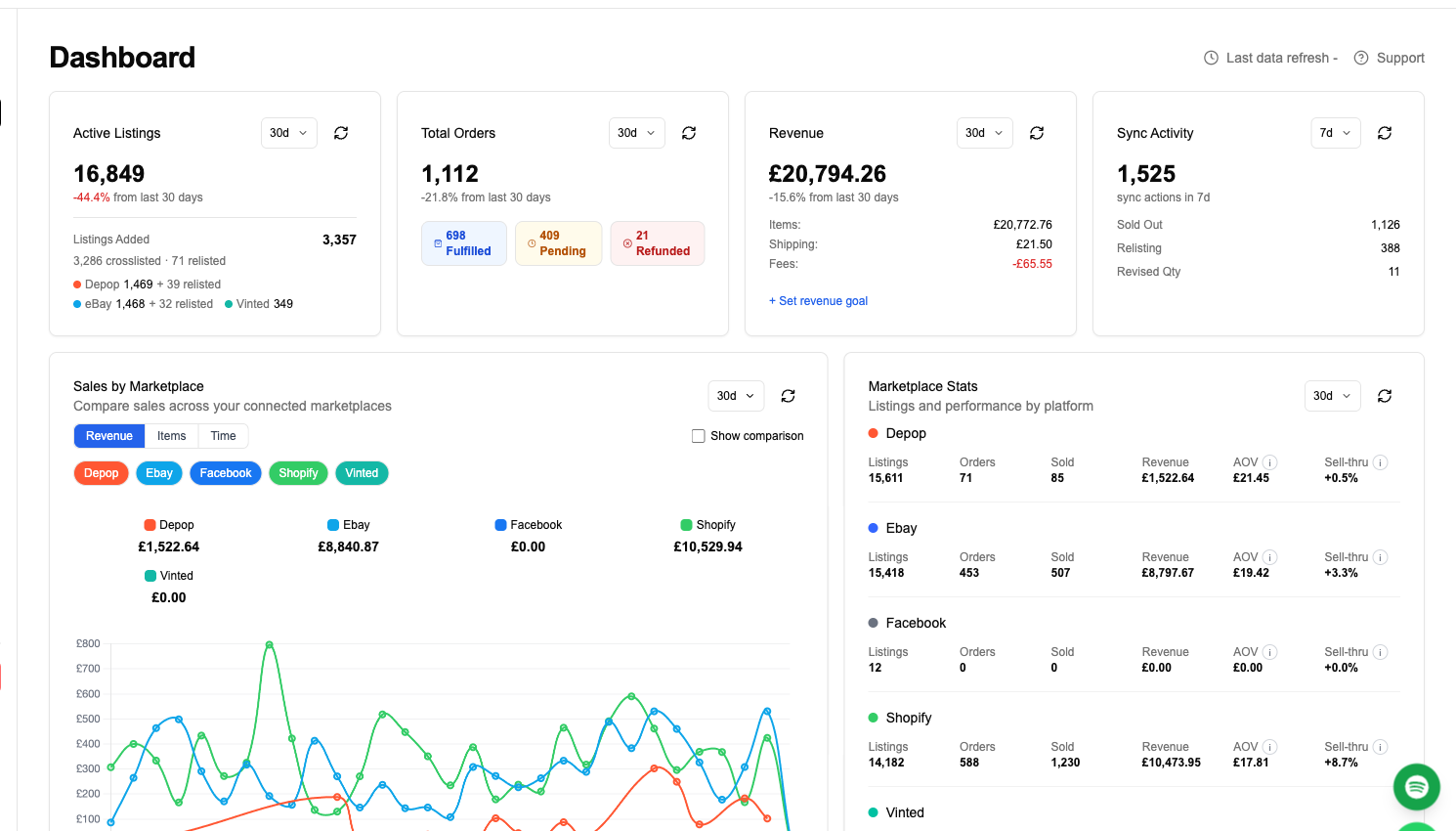
Newly listed and recently relisted items get a temporary visibility boost. This is why experienced sellers regularly relist older inventory — removing and re-creating a listing resets its “freshness” in Cassini’s ranking model. FLUF Connect’s auto-relisting feature handles this automatically, rotating a portion of your inventory daily so your entire eBay shop stays visible.
Seller Performance Signals
eBay rewards reliable sellers with better search placement:
- Defect rate: Keep below 2% (late shipments, cases closed without resolution, cancelled transactions)
- Late shipment rate: Ship within your stated handling time
- Cases closed without seller resolution: Respond to buyer issues quickly
- Tracking upload rate: Upload tracking numbers promptly
Achieving Top Rated Seller status unlocks a badge on your listings and a 10% discount on final value fees — a significant saving at scale.
Engagement Signals
Listings that get clicks, watchers, and purchases send positive signals to Cassini. This creates a virtuous cycle — well-optimised listings get clicks, which improves ranking, which drives more clicks.
Promoted Listings
eBay’s Promoted Listings Standard is a pay-per-sale advertising model. You set an ad rate (e.g., 5%) and only pay when a buyer clicks your promoted listing and purchases within 30 days. It’s a low-risk way to boost visibility, especially for competitive categories.
Best Times to List
eBay traffic peaks on Sunday evenings (7-9pm) and weekday evenings. If using auction-style listings, time your auction to end during peak hours for maximum last-minute bidding. For fixed-price listings, timing matters less — but listing during peak hours means your item appears in the “Newly Listed” sort when more buyers are browsing.
| Factor | Impact | What You Can Control |
|---|---|---|
| Title keyword relevance | Very high | Include brand, model, size, colour, condition |
| Listing freshness | High | Relist regularly (FLUF auto-relisting handles this) |
| Seller rating / defect rate | High | Fast shipping, accurate descriptions, responsive communication |
| Complete item specifics | High | Fill in every available field |
| Price competitiveness | Medium | Research sold listings, price realistically |
| Photo quantity and quality | Medium | Use all available photo slots, show every angle |
| Promoted listing ad rate | Medium | Start at suggested minimum, increase if needed |
| Best Offer enabled | Low-Medium | Lets buyers negotiate, increases engagement signals |
Getting Paid and Tax Obligations on eBay
Understanding when you’ll get paid and what tax obligations you have is essential before you start scaling your eBay sales.
How You Get Paid
eBay Managed Payments processes all transactions. Buyers can pay via debit card, credit card, Apple Pay, Google Pay, or PayPal — but all funds flow through eBay to your bank account.
- Payout schedule: Daily, weekly, bi-weekly, or monthly — you choose. Established sellers can receive daily payouts. Since August 2025, private sellers with 10+ sales and £150+ total in the last 5 years receive funds within 24 hours.
- Processing time: Typically 1-3 business days from initiation to arrival in your bank
- Payment holds: New sellers and high-risk transactions may see holds of up to 21 days. UK private sellers (since February 2025) have payouts delayed until 2 days after delivery confirmation (tracked) or 14 days after order date (untracked), provided the buyer reports no issues. Holds decrease as you build positive selling history.
Tax Obligations by Country
Important disclaimer: This is general guidance, not tax advice. Consult a qualified accountant for your specific situation.
United Kingdom
- HMRC’s trading allowance lets you earn up to £1,000 per tax year from self-employment (including eBay sales) without reporting it
- Above £1,000, you must register for Self Assessment and report your eBay income
- Since January 2024, eBay reports seller data to HMRC if you exceed 30 transactions or €2,000 (~£1,740) in a calendar year (DAC7 reporting) — but this is information reporting, not a tax threshold. It doesn’t automatically trigger a tax bill
- VAT registration required if your taxable turnover exceeds £90,000
European Union
- DAC7 directive requires eBay to report seller information to tax authorities if you exceed 30 transactions or €2,000 in a calendar year
- VAT rules vary by country; selling into the EU from the UK may trigger import VAT obligations
United States
- 1099-K reporting threshold: $20,000 and 200+ transactions per year (restored by the Big Beautiful Bill Act, 2025). Below both thresholds, no 1099-K is issued
- State sales tax is collected and remitted by eBay automatically (marketplace facilitator laws)
- Personal item sales at a loss are generally not taxable even if reported on a 1099-K
Australia
- eBay collects 10% GST on imported goods up to AUD $1,000 on behalf of international sellers and remits it to the ATO
- For goods over AUD $1,000, standard customs and import duty applies
- Australian sellers must register for GST if annual turnover exceeds AUD $75,000
Hobby vs Business
When does selling on eBay become a “business” for tax purposes? Generally:
- Occasional selling of personal items (clearing out your wardrobe, selling gifts you don’t want) is not taxable — you’re disposing of personal possessions
- Buying items to resell at a profit is trading, regardless of volume. If you source stock specifically to resell, you’re likely running a business and should report your income
- The distinction matters — HMRC looks at the pattern, frequency, and intent of your selling activity
Record Keeping
Keep records of everything: purchase costs (receipts from charity shops, car boot sales, wholesale suppliers), eBay fees, postage costs, packaging expenses, and mileage for sourcing trips. These are all deductible expenses that reduce your taxable profit.
What Sells Best on eBay in 2026?
eBay’s strength is its breadth — almost anything can sell. But some categories consistently outperform others in terms of sell-through rate and average sale price.
| Category | Avg. Sale Price | Competition | Sell-Through Rate | Tip |
|---|---|---|---|---|
| Vintage clothing | £15-45 | Medium | High | Brand and era matter most — 80s/90s sportswear and workwear are consistently strong |
| Trainers/Sneakers | £40-120 | High | High | Nike, Adidas, New Balance dominate. Include exact model name and colourway |
| Electronics | £25-200 | High | Medium | Phones, tablets, gaming consoles. Accurate condition grading critical |
| Collectibles & Trading Cards | £5-500+ | Medium | High | Pokemon, Yu-Gi-Oh, sports cards. Niche knowledge = competitive advantage |
| Auto Parts | £10-100 | Low-Medium | High | Part numbers are essential in titles. eBay’s Motors category is massive |
| Books (first editions, rare) | £5-50 | Low | Medium | ISBN in title helps. Rare/signed editions command premiums |
| Home & Garden | £15-60 | Medium | Medium | Kitchen appliances, garden tools, storage. Heavy items = higher postage costs |
| Musical Instruments | £30-300 | Low | Medium | Lower fees (5.85%). Include brand, model, condition |
Trending in 2026
- Pre-loved fashion — sales surged 400% year-on-year on eBay UK. Sustainable and thrifted clothing is a defining market trend, with the UK fashion market projected at £75 billion by 2026
- Refurbished electronics — eBay’s Certified Refurbished programme is growing rapidly, with buyers trusting refurbished items more than ever
- Trading cards — nine consecutive quarters of sales growth. Pokemon, Yu-Gi-Oh, and sports cards continue to drive demand
- Watches — Seiko and fashion watches performing strongly, with some styles seeing 900%+ sales increases
- Trainers and sneakers — Nike metallic P-6000 up 222%. Limited editions and retro models maintain high demand
How to Research What’s Selling
- Completed listings search — search for your item on eBay, then filter by “Sold Items” to see actual sale prices and volumes
- Terapeak (eBay Seller Hub) — free for all sellers, shows 90 days of sales data including average prices, sell-through rates, and trending items
- Watch competitor shops — find successful sellers in your niche and study what they list, how they photograph, and how they price
Pro Tips from Experienced eBay Sellers
These tips come from real eBay sellers who’ve shared their strategies on Reddit and seller forums — not generic advice you’ll find in eBay’s own help pages.
- Relist stale inventory every 30 days — the freshness boost from relisting is real. Experienced sellers rotate their oldest 3-5% of listings daily. FLUF Connect’s auto-relisting does this automatically, keeping your entire eBay shop fresh without manual work.
- Use Best Offer on everything over £15 — Best Offer listings get more visibility in search results, and most accepted offers are within 10-20% of the asking price. Set auto-accept at 85% and auto-decline at 50% to filter out time-wasters.
- Build a niche, then expand — sellers who specialise in one category (vintage Levi’s, retro gaming, mechanical keyboards) build reputation faster than generalists. Once you’ve established expertise, expand into adjacent categories.
- Cross-list to multiply your exposure — top eBay sellers don’t rely on a single platform. Listing the same inventory on Depop, Vinted, Wallapop, and Shopify simultaneously multiplies your buyer reach without tripling your work. Tools like FLUF Connect make this automatic.
- Respond to messages within 1 hour during business hours — eBay tracks response time, and fast replies convert browsers into buyers. Turn on mobile notifications for eBay messages.
- Offer same-day dispatch — sellers who ship within 24 hours consistently outsell those with 3-5 day handling times. Buyers on eBay are often comparison-shopping and will choose the faster shipper at the same price.
- Accept returns gracefully — fighting returns damages your metrics more than the return costs. Accept, refund promptly, relist the item. The algorithmic benefit of a clean seller record far outweighs the occasional return.
- Photograph items before you list, not when they sell — batch your photography. Spend one session photographing 20-50 items, then list them over the following days. This prevents the bottleneck of shooting photos under time pressure after a sale.
Common Mistakes New eBay Sellers Make
- Using only one or two blurry photos — Listings with 5+ clear photos sell significantly faster. Use all available photo slots and show every angle, including flaws. eBay gives you 24 free photos — use them.
- Writing vague titles — “Nice dress for sale” tells eBay’s search engine nothing. Include brand, size, colour, material, and condition in every title. Think about what a buyer would type into the search bar.
- Overpricing based on asking prices, not sold prices — check “Sold Items” in search filters, not just current listings. There are millions of overpriced listings that never sell — don’t add yours to the pile.
- Ignoring item specifics — buyers filter by brand, size, colour, and condition. If your item specifics are empty, your listing is invisible to filtered searches. Fill in every field.
- Not accepting returns — sellers who accept 30-day returns rank higher in search and qualify for Top Rated Plus. Most items are never returned, but the listing boost from accepting returns is meaningful.
- Only selling on one platform — your item can only sell once, but it can be visible on eBay, Depop, Vinted, Wallapop, and Shopify simultaneously. Selling on multiple platforms with automatic inventory sync is the single biggest growth lever for resellers.
- Shipping slowly — late shipments damage your seller metrics, which directly affects search visibility. Set realistic handling times and aim to beat them consistently.
Cross-List Your eBay Products to Sell Faster
Selling exclusively on eBay means your products are only visible to eBay’s buyers. Adding Depop, Vinted, and Shopify to the mix puts the same inventory in front of three additional buyer bases — without creating duplicate work.
Research from multi-marketplace sellers consistently shows that items listed on 3+ platforms sell 2-3x faster than single-platform listings. The maths is simple: more eyeballs = more sales.
Which Marketplaces Pair Well with eBay?
- eBay + Depop: Your eBay fashion and vintage inventory reaches Depop’s younger, trend-driven audience. Cross-list between Depop and eBay automatically.
- eBay + Vinted: Vinted’s 100 million buyers are actively searching for the same pre-owned items you sell on eBay, and Vinted charges no seller fees. Cross-list to Vinted for zero-fee additional exposure.
- eBay + Shopify: Build your own branded online store while maintaining your eBay presence. Sync Shopify and eBay for centralised order management.
How FLUF Connect Works for eBay Sellers
FLUF Connect is a multi-marketplace crosslisting and automation platform that connects your eBay account with Depop, Vinted, Wallapop, Shopify, and Facebook Marketplace. Here’s what it does for eBay sellers specifically:
- Connect your eBay account — authorise FLUF Connect via eBay’s secure OAuth flow. Takes under 5 minutes.
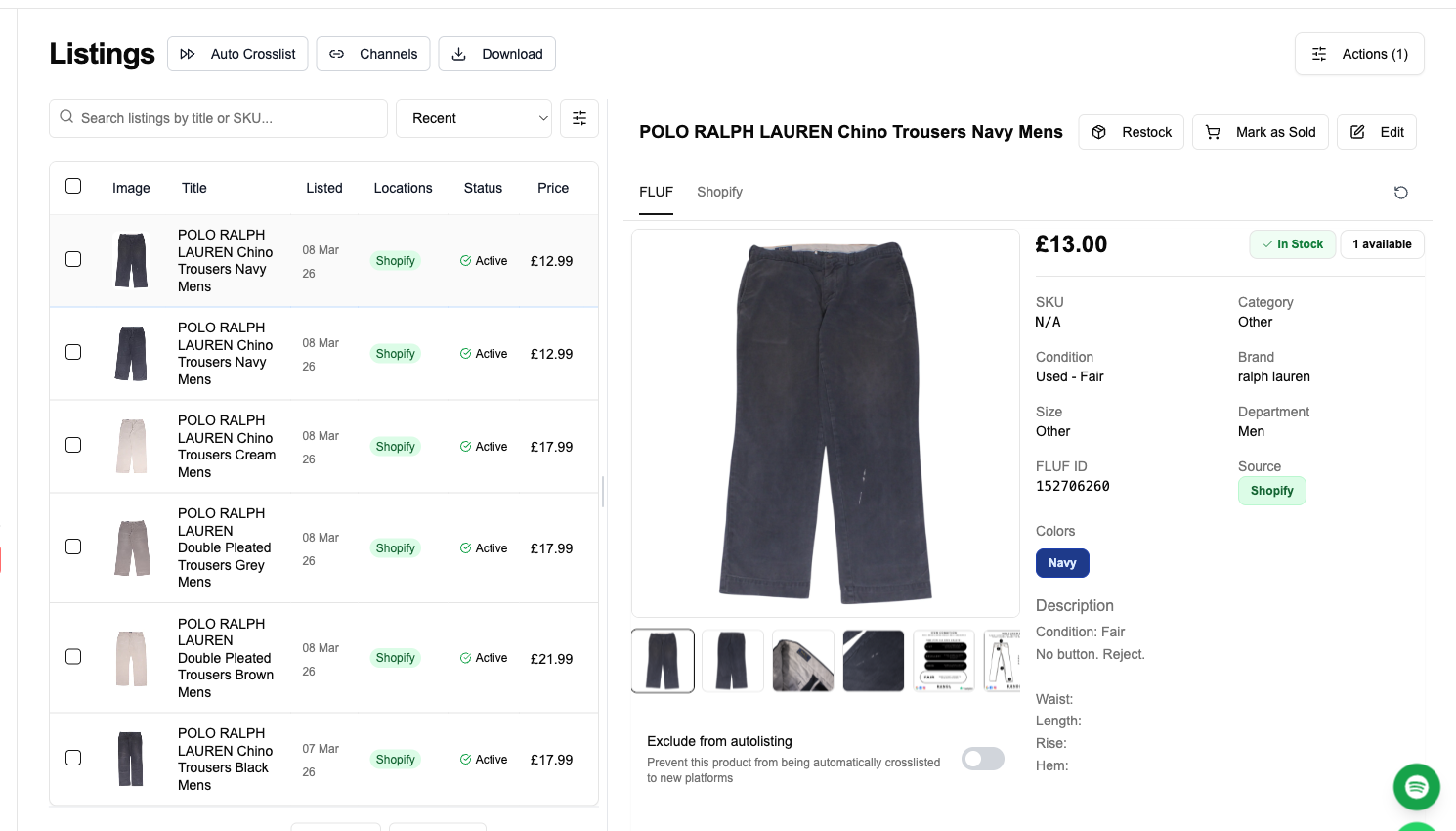
- Select products to cross-list — choose individual items or bulk-select hundreds at once. FLUF transfers your photos, title, description, price, condition, and item specifics automatically.
- Automatic inventory sync — when an item sells on any platform, FLUF removes it from all others within minutes. No more overselling, no manual delisting.
| Feature | eBay Support |
|---|---|
| Crosslisting | Yes — to/from Depop, Vinted, Shopify, Facebook Marketplace |
| Inventory sync | Yes — real-time across all connected channels |
| Auto-relisting | Yes — configurable daily rotation with smart strategies |
| Offer management | Yes — auto-accept, counter, and decline Best Offers |
| Order sync | Yes — orders sync to Shopify for centralised fulfilment |
| Bulk operations | Yes — bulk crosslist, bulk price changes, find & replace |
FLUF Connect supports 17+ eBay regional markets including UK, US, Canada, Australia, Germany, France, Italy, Spain, and more.
Pricing
Plans start from £19/month for up to 1,000 products. All plans include crosslisting, inventory sync, auto-relisting, and offer management. 1,000 products on the £19/month Growth plan included. See full pricing.
Why eBay Sellers Choose FLUF Connect
- automation included in every plan — auto-relisting and offer management included in every plan. Competitors like List Perfectly and Vendoo charge £30-50+/month for comparable features
- Vinted support — most competitors don’t support Vinted. FLUF gives your eBay inventory access to Vinted’s 100 million buyers
- Dedicated support — responsive, knowledgeable support from people who understand reselling
- Any product type — not limited to fashion. Works for electronics, collectibles, home goods, auto parts — anything you sell on eBay
Related Guides
- Sell on Trade Me — New Zealand’s largest marketplace
- Crosslist from eBay to Marktplaats
- Crosslist from eBay to Gumtree
- Crosslist from eBay to Grailed — give your sneakers and hype the right audience
- Selling on Grailed — reach Grailed’s brand-literate sneaker and streetwear buyers
- Crosslist from Wallapop to eBay — Push your Wallapop catalogue to eBay’s 136M+ global buyers with automatic field mapping and inventory sync.
- Crosslist from Gumtree to eBay
- Crosslist from Yaga to eBay — For Yaga sellers expanding from the Baltics to eBay’s global audience
- Sell on Designer Wardrobe (AU & NZ)
- TradeMe vs eBay for sellers
Related guide: how to crosslist from Temu to eBay.
New crosslisting guides (May 2026)
- Selling luxury on Vestiaire Collective? Crosslist to eBay for faster shipping and auction-format price discovery. Crosslist from Vestiaire Collective to eBay
Crosslist from Poshmark to Ebay
Poshmark sellers expanding outward: see our Poshmark to Ebay crosslisting guide for field mapping, condition translation and inventory sync details.
New crosslisting guides (2026-05-29)
- Crosslist from eBay to Leboncoin — reach 29M French buyers
- Crosslist from eBay to Wallapop — reach 19M Spanish/Italian/Portuguese buyers
More Crosslisting Guides
More crosslisting guides
Related guides
Related guide: How to crosslist from BigCommerce to eBay.
Sources & Verification
Last verified: 2026-06-28. Please contact us if any figure is out of date.
- eBay Inc. — Fourth Quarter and Full Year 2024 Results — full-year 2024 GMV of $74.7 billion (active buyers were 134 million in Q4 2024)
- Business of Apps — eBay statistics — ~132 million active buyers, ~18 million active sellers, 190+ markets
- eBay UK Help — Fees for private sellers — removal of final value & regulatory operating fees for private sellers from 1 October 2024 (Motors excepted)
- eBay UK Help — Fees for business sellers — business final value fee structure and the fixed per-order charge (£0.30 up to £10 / £0.40 over £10)
- eBay — Wikipedia — founding (1995, Pierre Omidyar, San Jose, California)
- GOV.UK — Tax-free trading allowance & VAT registration threshold — £1,000 trading allowance, £90,000 VAT threshold
- GOV.UK — Selling goods or services on a digital platform — digital-platform (DAC7) reporting at 30 sales or €2,000 from 1 January 2024
- IRS — Form 1099-K threshold under the One Big Beautiful Bill — reporting threshold reverts to over $20,000 and more than 200 transactions
- Australian Taxation Office — Registering for GST — A$75,000 GST registration turnover threshold
- eBay — Free listings — private-seller 300/month allowance (400 with a paid upgrade); business 1,000/month
Frequently Asked Questions
Yes, for private sellers. Since October 2024, eBay UK has removed final value fees for private sellers across nearly all categories. You get up to 1,000 free listings per month and pay zero commission when items sell. Business sellers still pay final value fees of 8-15% plus a per-order charge, and can optionally subscribe to an eBay Store starting at £19.99 per month for additional features.
Private sellers pay zero fees on eBay UK — no final value fee, no per-order charge. Business sellers pay a final value fee that varies by category (typically 8-15% of the total sale amount including postage) plus 30-40p per order, plus a 0.35% regulatory operating fee. Both account types get 1,000 free listings per month, with additional listings at 35p each.
eBay's top-selling categories include electronics (phones, gaming consoles, laptops), vintage and branded clothing, trainers and sneakers, collectibles and trading cards, auto parts, and home and garden items. Refurbished electronics and sustainable fashion are growing particularly fast in 2026.
Optimise your titles with specific keywords (brand, model, size, colour, condition), use 5+ high-quality photos, fill in all item specifics, accept returns, enable Best Offer, and relist stale inventory regularly. Cross-listing to other platforms like Depop, Vinted, and Shopify also multiplies your exposure without extra listing work.
Yes. Many successful sellers list on eBay, Depop, Vinted, and Shopify simultaneously. Tools like FLUF Connect automatically sync inventory across all platforms so when an item sells on one, it is removed from the others — preventing overselling.
If you earn under £1,000 per tax year from all self-employment income (including eBay), you can use the trading allowance and don't need to report it. Above £1,000, you must register for Self Assessment. Note that selling personal possessions at a loss is generally not taxable. This is general guidance — consult a qualified accountant for your specific situation.
You choose how to ship — Royal Mail, Evri, DPD, or any carrier you prefer. eBay also offers Packlink, which compares carrier rates within the eBay interface. For international sales, the Global Shipping Programme handles customs and delivery. Offering free postage boosts your search ranking.
Yes. eBay has 132 million active buyers worldwide, supports virtually every product category, and private sellers now pay zero commission fees. It remains one of the most profitable platforms for resellers, especially when combined with other marketplaces. The platform's Promoted Listings, Best Offer features, and Global Shipping Programme provide tools for growth that many newer platforms lack.
Yes. FLUF Connect lets you crosslist eBay products to Depop, Vinted, Shopify, Etsy, and Facebook Marketplace automatically. Your photos, descriptions, and prices transfer in one click, and inventory stays synced in real time.
eBay Managed Payments sends payouts directly to your bank account. Established sellers receive daily payouts, which arrive within 2-3 business days. New sellers may experience holds of up to 7 days on their first sales, which decrease as you build positive selling history.