Crosslist from Etsy to Whatnot — Take Your Vintage Listings Live
Take the vintage and one-of-a-kind inventory you already list on Etsy and sell it live on Whatnot — synced so nothing oversells.



TL;DR: Etsy is a static-listing marketplace of 86.5 million active buyers built for vintage, handmade and craft, where a listing is a searchable product page that earns sales over months. Whatnot is the fastest-growing live-shopping platform — more than $6 billion in sales in 2025 — where you sell on camera in real-time auctions, and women’s fashion is its fastest-growing category. Crosslisting from Etsy to Whatnot with FLUF Connect takes the vintage and one-of-a-kind inventory you already list on Etsy and puts it in front of a live, fast-moving audience, while inventory sync stops the same piece selling twice. Plans start at £9/month (Starter); There is no free plan, but every new account gets a 7-day trial for £1.
Etsy and Whatnot solve the same problem — selling pre-loved, vintage and characterful inventory — in completely opposite ways. Etsy is a search-driven catalogue where a well-titled listing quietly earns views, favourites and sales for months. Whatnot is a live-video marketplace where you go on camera, run auctions, and clear inventory in minutes to an audience that shows up to buy. They are not rivals; they are complementary engines, and the smartest vintage and resale sellers run both. This guide explains why, what changes when you add Whatnot, and how FLUF Connect moves your Etsy inventory across without doubling your workload or risking an oversell.
Why Crosslist from Etsy to Whatnot
Etsy is enormous and stable: 86.5 million active buyers and 5.6 million active sellers as of the end of 2025 (Etsy FY2025 10-K). But it is built around the static listing: you pay $0.20, the listing runs for four months or until it sells, and discovery happens through Etsy’s search. That model is brilliant for evergreen demand and terrible for urgency — a beautiful vintage coat can sit for months because nobody is racing anyone else to buy it.
Whatnot inverts that. It is a live marketplace: sellers host real-time video shows where buyers bid in fast auctions or grab fixed-price “Buy It Now” items, asking questions in chat as you hold the piece up to the camera. The format has exploded — Whatnot passed $6 billion in sales in 2025, more than double the year before, and raised a $225 million round at an $11.5 billion valuation in October 2025 (Crunchbase News). Crucially for Etsy sellers, fashion is now Whatnot’s fastest-growing category — women’s fashion GMV grew 223% year-over-year in 2025, with more than 12 million fashion orders a month (Value Added Resource).
The live format suits exactly the inventory Etsy is known for. As Whatnot’s commercial chief put it, “you can zoom in on details like stitching or tags and explain why a piece is rare — that’s something that’s hard to communicate on a static product page” (Glossy). One vintage seller profiled by Glossy scaled from roughly $25,000 a year to more than $250,000 a year after moving slow static inventory into live shows. Adding Whatnot does not replace your Etsy shop — it gives your one-of-a-kind stock a second, faster route to a buyer.
Etsy vs Whatnot at a Glance
| Etsy | Whatnot | |
|---|---|---|
| Selling model | Static listings, search discovery | Live video shows + Buy It Now |
| Listing fee | $0.20 per listing (4 months) | No per-listing fee |
| Selling fee | 6.5% transaction | 8% commission (US); 6.67% UK/EU |
| Payment processing | 3% + $0.25 (US) | 2.9% + $0.30 (US) |
| Audience | 86.5M active buyers | Live buyers; $6B+ sold in 2025 |
| Best for | Vintage (20+ yrs), handmade, craft | Vintage, collectibles, cards, fashion |
| Pace of sale | Slow, evergreen | Fast, urgency-driven |
| Seller effort | List and let search work | Go live and host shows |
What Sells: Why Vintage Etsy Inventory Works on Whatnot
Etsy’s eligible categories are handmade, vintage and craft supplies, and its vintage rule is strict — items must be at least 20 years old (Etsy vintage policy). That genuine-vintage inventory is exactly what Whatnot’s audience hunts for: true vintage clothing, 90s and Y2K pieces, jewellery, accessories, and collectible-fashion crossover items all thrive in the live format, where scarcity and storytelling drive bidding. A rare piece that needs explaining — provenance, condition, why it is special — converts far better when you can hold it to camera than when it sits in a grid of thumbnails.
Whatnot’s reach is also increasingly international, which matters for vintage sellers with broad-appeal stock. The platform now operates across the US, UK, France, Germany, the Netherlands, Belgium and Austria, with a large and growing share of European sales crossing borders between markets — so a rare piece can find a bidder well outside your home country. For an Etsy seller used to shipping internationally anyway, that is simply more demand for the same rail of inventory.
It is not an either/or. The sellers who win keep Etsy for stable, SEO-driven evergreen sales and use Whatnot to move slow or limited inventory fast. Handmade makers can preview new drops live; vintage sellers can run “vintage haul” shows; collectors can break or auction sets. The two channels reach different buying moods — Etsy’s considered, search-led shopper and Whatnot’s live, impulse-and-community buyer — so listing across both expands your total demand rather than splitting it.
Live Selling vs Static Listings: How They Feel Different
The deepest difference between these two channels is not fees or audience size — it is the rhythm of selling. On Etsy you do the work once: shoot the photos, write a keyword-rich title and description, set the price, and let search do the rest. Sales arrive on their own schedule, often weeks after listing, and a strong listing can keep earning for years. It rewards patience, SEO and consistency, and it asks almost nothing of you after publish.
Whatnot asks the opposite. Sales are driven by your live presence: you schedule a show, promote it, go on camera, and convert an audience in real time through banter, demonstration and scarcity. A 60-second auction can do what a month of static listing cannot — create competition between buyers. The flip side is that nothing sells while you are not streaming and not building a following, so Whatnot rewards energy, regularity and community-building. Neither model is better; they are complementary. Etsy is your always-on storefront, Whatnot is your live event — and the same vintage rail can feed both, with each channel reaching the buyers the other never will.
Getting Started on Whatnot as an Etsy Seller
Whatnot is more gated than Etsy by design, because live selling carries more trust requirements. To sell, you apply for a seller account and typically need a government photo ID, an active bank account, and a livestream-capable device with a solid upload connection; new sellers usually complete a short onboarding before their first show. None of that is onerous, but it is more than Etsy’s “open a shop and list” flow, so plan for a day or two of setup rather than an instant switch.
The good news is that the hardest part of starting on a new marketplace — building your inventory — is exactly what FLUF Connect removes. Instead of rebuilding your catalogue item by item, you push your existing Etsy stock across, so when you go live for the first time you already have priced, photographed, synced inventory ready to feature. You walk into your first show with a stocked storefront, not an empty one.
Whatnot Fees and What You Keep
Whatnot’s seller economics are straightforward and competitive. The base commission is 8% in the US (6.67% + VAT in the UK and EU), plus payment processing of 2.9% + $0.30, for an all-in take rate around 11% per US transaction — and there is no per-listing fee (Whatnot fee breakdown). Whatnot also runs a promotion dropping the base commission to 0% on the portion of any sale above $1,500 in select categories (Whatnot Help Center).
Compared with Etsy — $0.20 per listing, 6.5% transaction and 3% + $0.25 processing (Etsy fees) — the headline take rates are broadly similar. The real difference is the engine behind them: Etsy charges you to be findable in search; Whatnot charges you to sell in front of a live, engaged crowd. Neither is “cheaper” in a way that should decide the question — what matters is that the two reach different buyers, and crosslisting lets the same inventory earn from both.
Is Whatnot Right for Your Etsy Shop?
Whatnot is not for every Etsy seller, and it is worth being honest about who benefits most:
- Vintage and resale sellers gain the most — deadstock, true vintage and one-of-a-kind pieces are tailor-made for live auctions, and this is where Whatnot’s fashion growth is concentrated.
- High-volume sellers with aging inventory get a fast clearance channel for stock that has gone stale in Etsy search without dropping prices to the floor.
- Handmade makers comfortable on camera can use live drops to launch new collections, build a following and pre-sell — turning Etsy’s slow discovery into live demand.
- Sellers who dislike being on video should weigh it carefully: Whatnot’s returns are real but they require live presence, so if camera time is a hard no, the channel will underperform for you.
If you fall into the first three groups, the question is less “should I” and more “how do I add Whatnot without doubling my admin” — which is precisely what crosslisting answers. You keep the Etsy shop you have built and bolt on a live channel that draws from the same inventory, rather than running two unconnected businesses.
How FLUF Connect Moves Etsy Listings to Whatnot
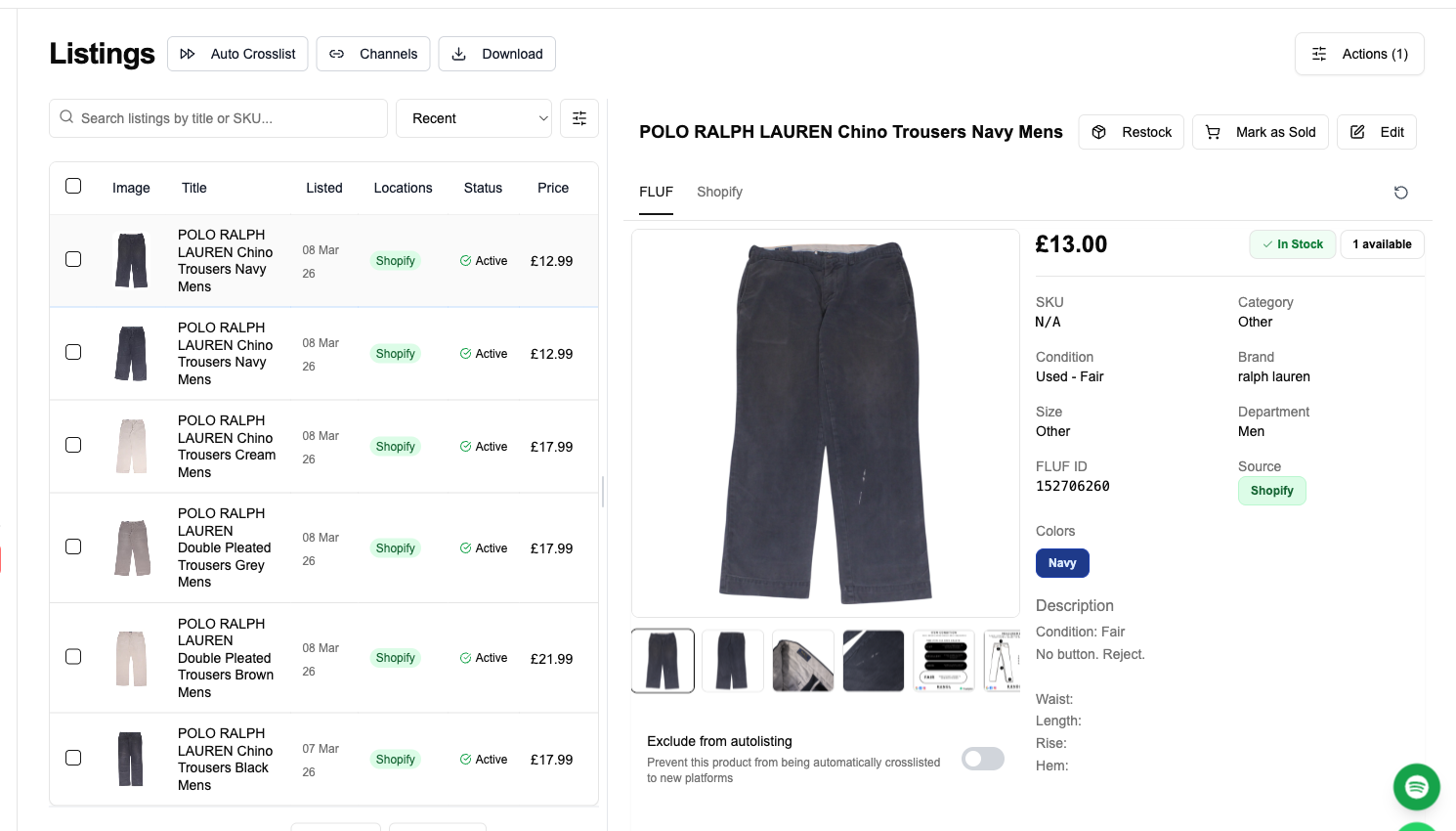
The practical barrier to running both is the duplicated work and the oversell risk: copy each Etsy listing into Whatnot by hand, then remember to pull it from Etsy the moment it sells live, or risk selling the same one-of-a-kind piece twice. FLUF Connect handles both. You import your existing Etsy inventory into one dashboard, choose the items you want available on Whatnot, check the mapped fields, and publish — then FLUF keeps the inventory tied together across every connected channel.
FLUF maps your Etsy product data into Whatnot’s format so you are not re-entering anything:
| Etsy field | Maps to Whatnot as |
|---|---|
| Title | Listing title |
| Photos | Listing images |
| Description | Item description |
| Price | Buy It Now / starting price |
| Category | Mapped to a Whatnot category |
| Condition | Condition note |
| Quantity | Available stock |
Because Whatnot is a live marketplace, the crosslisted items become Buy It Now / storefront inventory on your Whatnot account — a ready-built catalogue you can feature in live shows or leave available for buyers to grab between streams. You still host the shows; FLUF makes sure the inventory you feature is already loaded, priced and synced rather than rebuilt by hand.
What Syncs Automatically
Inventory sync is the part that makes running both channels safe. When an item sells — whether it goes during a Whatnot live show or quietly on Etsy — FLUF detects the sale and marks the item sold across your connected channels, so you never sell the same vintage piece twice. FLUF also records the order so your sales across channels land in one view. This is the capability that matters most for a live platform: the danger with live selling is speed, and FLUF’s sold-detection keeps your Etsy stock honest while you are busy on camera.
To be precise about scope: on Whatnot, FLUF runs crosslisting, order sync and automatic sold-detection. Relisting and offer automation are not part of the Whatnot integration, because Whatnot’s selling happens live rather than through static relists and offer threads — the platform’s mechanics simply work differently. On the Etsy side, FLUF additionally supports automated relisting, so your evergreen Etsy listings can be refreshed to stay visible. You get the right automation for each platform, not a one-size promise that does not match how the marketplace actually works.
How It Works, Step by Step
- Create a FLUF Connect account and connect both Etsy and Whatnot.
- Import your Etsy inventory so you are working from one product view instead of two apps.
- Select the items you want available on Whatnot — typically your vintage and one-of-a-kind stock.
- Review the mapped fields — title, photos, price, category — and publish to Whatnot.
- Host your live shows with inventory already loaded, and let FLUF sync stock so nothing oversells.
Tips for Your First Whatnot Show Using Etsy Inventory
- Theme the show. A focused “90s vintage”, “designer handbags” or “Y2K haul” show converts better than a random mix, because it tells the algorithm and the audience exactly who to bring.
- Lead with your slow movers. The pieces that have sat unsold on Etsy for months are perfect Whatnot fodder — the live urgency is what they were missing, not the price.
- Tell the story. Use the camera for what a static listing cannot do: show the stitching, the label, the wear, and explain why the piece is rare. That narrative is what drives bids.
- Start auctions low. Low opening bids pull people in; competition does the pricing for you. Keep your Etsy price as the reference point for Buy It Now items.
- Stream regularly. Whatnot rewards consistency — a weekly slot builds a following that shows up ready to buy, turning your Etsy back-catalogue into recurring live revenue.
Run that loop and Whatnot stops being a separate chore and becomes the fast-clearance channel for the inventory Etsy keeps discoverable — two complementary engines on one set of stock.
Pricing
FLUF Connect plans start at £9/month (Starter). There is no free plan, but every new account gets a 7-day trial for £1. Inventory sync, order sync and bulk operations are included in every plan, not a paid add-on. You can connect Etsy, Whatnot and every other supported marketplace on any tier; plans differ by how many products you manage. See FLUF pricing.
Take Your Etsy Inventory Live on Whatnot
Etsy keeps your shop discoverable and your evergreen stock selling; Whatnot gives the same inventory a fast, live, community-driven route to a buyer — and fashion is its fastest-growing category. With FLUF Connect you list once, push the right items to Whatnot, and let inventory sync keep everything honest while you host shows. Try FLUF Connect and put your vintage finds in front of a live audience — without rebuilding a single listing or risking an oversell while you are busy on camera. One catalogue, two very different ways to sell it, and the admin of running just one.
Sources & Verification
- Etsy active buyers/sellers and GMS — Etsy FY2025 10-K (SEC)
- Etsy fees — etsy.com/legal/fees
- Etsy vintage policy (20+ years) — etsy.com vintage policy
- Whatnot $6B+ 2025 sales and $11.5B valuation — Crunchbase News
- Whatnot women’s fashion +223% YoY — Value Added Resource
- Vintage sellers going live (seller case study, quote) — Glossy
- Whatnot seller fees — Whatnot fee breakdown and Whatnot Help Center
Frequently Asked Questions
Yes. FLUF Connect imports your existing Etsy inventory, maps the title, photos, description, price, category and condition into Whatnot's format, and publishes the items as Buy It Now / storefront listings on your Whatnot account. You can then feature that inventory in your live shows. FLUF keeps stock synced so an item that sells on either channel is marked sold on the other.
Yes. Whatnot is a live-selling marketplace — its core sales engine is real-time video shows where you run auctions and Buy It Now drops. FLUF Connect gets your Etsy inventory loaded onto Whatnot as ready, priced, synced listings so you are not rebuilding each item by hand, but you still host the shows yourself. FLUF handles the inventory; you bring the live energy.
Genuine vintage (Etsy requires vintage items to be at least 20 years old), one-of-a-kind pieces, jewellery, accessories, Y2K and collectible-fashion crossover items. Whatnot's live format rewards scarcity and storytelling, so rare pieces that need explaining tend to convert far better on camera than in a static Etsy grid. Fashion is currently Whatnot's fastest-growing category.
Whatnot's base commission is 8% in the US (6.67% plus VAT in the UK and EU), plus payment processing of about 2.9% + $0.30, for an all-in rate around 11% per US transaction. There is no per-listing fee. Whatnot also drops the base commission to 0% on the portion of a sale above $1,500 in select categories.
No — preventing that is the main point of using FLUF. When an item sells, whether during a Whatnot live show or quietly on Etsy, FLUF's sold-detection marks it sold across your connected channels, so you never sell the same one-of-a-kind piece twice. FLUF also records the order so your cross-channel sales appear in one view.
They are big in different ways. Etsy had 86.5 million active buyers at the end of 2025. Whatnot is newer but growing fast — it sold more than $6 billion in 2025, over double the previous year, and reached an $11.5 billion valuation in October 2025. Etsy gives you a vast search-driven audience; Whatnot gives you a fast-growing live one.
FLUF's Whatnot integration covers crosslisting, order sync and automatic sold-detection. Relisting and offer automation are not part of the Whatnot integration because Whatnot sells live rather than through static relists and offer threads. On the Etsy side, FLUF does support automated relisting to keep your evergreen listings visible. You get the automation that matches how each marketplace actually works.