
How to Sell on willhaben — The Complete Austrian Seller Guide
Everything you need to know about willhaben's listing rules, PayLivery costs, Austrian tax obligations and ranking — plus how to reach buyers beyond Austria.



- Reach: 5,762,948 average monthly active users in the EU, per willhaben’s own Digital Services Act disclosure — in a country of roughly 9 million people. willhaben’s own factsheet puts it at 55.3% of all Austrians.
- Listing cost: private Marktplatz ads carry no listing fee at all, run for 45 days, and allow unlimited images. Commercial ads cost €23.99 including VAT for 60 days.
- Seller fees: there are none. PayLivery — willhaben’s integrated payment and shipping — is charged entirely to the buyer, at €1.99 or 4.5% of the item price, whichever is higher.
- Best for: fashion, baby and children’s items, homeware, books and media, and anything bulky enough that local collection beats posting. Mode & Accessoires alone carries about 2.39 million live ads.
- The rule nobody tells you: ads must be written in German. English-only listings breach willhaben’s advertising guidelines; German with an English translation underneath is fine.
- Cross-list with FLUF Connect: publish the same stock to willhaben, Vinted, eBay, Shopify and more from one place — see how crosslisting works. Plans start at £9/month.
What is willhaben?
willhaben is Austria’s largest online classifieds marketplace — a single site covering second-hand goods, cars, property and jobs, where private sellers list at no charge and buyers browse locally. It is to Austria roughly what Kleinanzeigen is to Germany or Marktplaats is to the Netherlands: the default place an entire country goes to buy and sell used things.
It launched in 2006 as a joint venture between Styria Media Group and the Norwegian publisher Schibsted, whose share later passed to Adevinta. In March 2025 Adevinta sold its entire 50% stake to Sprints Capital and Styria, so the ownership you will read about in older guides is out of date. Today the holding company is split almost evenly between Styria Digital Marketplaces and Sprints Blossom S.à r.l, per willhaben’s own Impressum. The operating entity is willhaben internet service GmbH & Co KG, based in Vienna’s third district, led by Sylvia Dellantonio since 2010.
The scale is unusual for a country of nine million. willhaben’s DSA Article 24(2) self-declaration puts average monthly active users in the EU at 5,762,948. Its own Q1 2025 factsheet reports 93 million visits, 1.4 billion page impressions, more than 13 million live ads, and claims 55.3% of Austrians use the platform, with 74.9% using it at least weekly. Austria’s ÖWA measurement body ranked it second only to orf.at on unique users in May 2025 — and first on page impressions.
In November 2025 willhaben reported that more than 8 million items changed hands on the platform during 2024, avoiding over 160,000 tonnes of CO₂e.
willhaben at a glance
| Founded | 2006 |
| Headquarters | Vienna, Austria |
| Ownership | Styria Digital Marketplaces + Sprints Capital (since March 2025) |
| Monthly active EU users | 5,762,948 (DSA disclosure) |
| Live ads | Over 13 million across all verticals |
| Verticals | Marktplatz, Immobilien, Auto & Motor, Jobs |
| Top Marktplatz categories | Mode & Accessoires, Baby/Kind, Wohnen & Haushalt, Bücher/Filme/Musik |
| Revenue model | Paid commercial ads, paid visibility upgrades, vehicle and property listing fees, advertising |
Why sell on willhaben in 2026?
Because the whole country is already there
Marketplace reach is usually a trade-off: a big platform means big competition, a niche one means few buyers. Austria is small enough that willhaben avoids the trade-off. With more than half the population using it, a listing for a used pram or a winter jacket reaches essentially the entire addressable domestic market. There is no meaningful second place — Shpock, owned by Russmedia since 2021, is a distant challenger, and Facebook Marketplace has never achieved the same density in Austria.
Because listing costs nothing
Private Marktplatz ads carry no insertion fee, no commission and no payment charge. Unlike almost every marketplace covered in these guides, willhaben takes no percentage of what you sell. The revenue comes from commercial advertisers, vehicle and property listings, and optional visibility products. A private seller clearing a wardrobe can transact indefinitely without paying willhaben anything.
Because bulky items actually move
Collection in person — Selbstabholung — is the cultural default rather than a fallback. That makes willhaben viable for furniture, appliances, bicycles and gym equipment, categories where postage costs would otherwise destroy the economics. willhaben’s own resale-impact figures make the point: Sport & Sportgeräte accounted for more than 68,000 tonnes of avoided CO₂e in 2024 and Wohnen/Haushalt/Gastronomie more than 60,000 — those savings come from heavy goods, not from t-shirts.
Because the competitive picture just changed
In April 2026 Vinted connected its Austrian and German marketplaces for cross-border trade, with Österreichische Post as logistics partner. That matters because willhaben’s integrated payment and shipping product is domestic-only. An Austrian fashion seller can now reach German buyers on Vinted in a way willhaben structurally cannot support — which is an argument for using both rather than choosing.
Where willhaben costs you money
Honesty first: vehicles and property are not the same story. Cars list without charge only up to €22,000, motorbikes up to €8,000, and only one such ad may be active per user. Boats cost €44.99. Property listings are chargeable across the board and willhaben does not publish the private price list anywhere reachable. If your “selling on willhaben” plan involves vehicles at volume, budget for it.
Cost comparison on a €30 sale
| willhaben (private) | Vinted | eBay.at (private) | |
|---|---|---|---|
| Listing fee | €0.00 | €0.00 | Free allocation, then per-listing |
| Seller commission | €0.00 | €0.00 | Final value fee applies |
| Payment processing | €0.00 | €0.00 | Included in final value fee |
| Buyer-side protection fee | €1.99 minimum, or 4.5% | Buyer protection fee applies | None |
| Seller keeps | €30.00 | €30.00 | Less eBay’s fees |
The willhaben and Vinted columns look identical at this price point, and for a €30 item they broadly are. The difference is reach and format, not economics: willhaben sells anything to Austria, Vinted sells fashion across borders.
willhaben fees explained
Selling privately on willhaben’s Marktplatz is free of charge — no insertion fee, no commission, no payment fee. The costs that exist attach to commercial accounts, to vehicles and property, to optional visibility upgrades, and to the buyer side of PayLivery. This section covers each in turn, because the pages currently ranking for these queries get several of the numbers wrong.
Private Marktplatz listings
| Item | Cost | Duration |
|---|---|---|
| Private Marktplatz ad | €0.00 | 45 days, unlimited images |
| KFZ-Zubehör / Motorradteile | €0.00 | 45 days |
| Gebrauchtwagen up to €22,000 | €0.00 — one active ad only | 14 days |
| Motorrad & Quad up to €8,000 | €0.00 — one active ad only | 14 days |
Note the 45 days. Several English-language guides say six weeks and one widely-shared source says 30 days — the 30-day figure comes from willhaben’s Immobilien FAQ and does not apply to the Marktplatz.
Chargeable listings
| Item | Cost | Duration |
|---|---|---|
| Commercial Marktplatz ad | €19.99 excl. VAT / €23.99 incl. VAT | 60 days |
| Boats, yachts, jet skis | €44.99 | 60 days |
| Animal ads — private listings are not permitted | €23.99 incl. VAT, commercial format | 60 days |
| Commercial vehicles, caravans and motorhomes | Chargeable from the first ad | — |
| Property (all types) | Chargeable; price list not published publicly | 30 days |
One of the highest-ranking English guides to selling on willhaben quotes €12.90 for a commercial ad and €29.90 for boats. Both figures are wrong against willhaben’s own ad-submission page. If you have been budgeting from a third-party guide, re-check.
Vehicle visibility tiers
| Tier | Duration | Price | What it does |
|---|---|---|---|
| Basis | 14 days | €0.00 | Statistics only, no bump |
| Turbo | 35 days | €19.99 | Weekly bump to the top of results |
| Unlimited | Until sold | €59.99 | Unlimited weekly bumps plus placement above search results |
Marktplatz visibility upgrades
willhaben sells several paid boosts on ordinary Marktplatz ads: Anzeige vorreihen (a one-off jump to the top), Anzeige wöchentlich vorreihen (weekly over four weeks), Farblich hervorheben (a coloured background in the results list), TOP-Anzeige (labelled and placed above search results) and TOP Anzeige Startseite PLUS (homepage placement for 7 or 30 days).
Prices for these are not published anywhere public. They appear only inside the logged-in posting flow — willhaben’s own business bundle sheet is literally filenamed “OHNEPREISE”, meaning “without prices”. Any guide quoting exact figures for these is guessing. Check them at the point of purchase.
PayLivery — who pays what
This is where most confusion lives, because sources contradict each other. willhaben’s own help centre settles it:
“Verkäufer:in: ist PayLivery völlig kostenlos. Für die:den Käufer:in: Versandkosten … Käuferschutz ab 1,99 € bzw. ab 4,5% vom Artikelpreis”
In English: “For the seller, PayLivery is completely free of charge. For the buyer: shipping costs … buyer protection from €1.99 or from 4.5% of the item price.”
So the seller pays nothing. The buyer pays shipping plus a buyer-protection fee of €1.99 or 4.5% of the item price, whichever is greater, varying by category. Some categories — Baby/Kind, Spielen/Spielzeug, Wohnen/Haushalt, Haus/Garten/Werkstatt — carry discounted shipping from €1.99.
Two caveats matter more than the headline. First, “free” for the seller stops being costless when a transaction reverses: Austria’s Internet Ombudsstelle notes that willhaben retains the PayLivery costs on a reversed sale and the seller absorbs the return leg. Second, PayLivery is not available to commercial sellers — willhaben states plainly that the option “steht im gewerblichen Bereich noch nicht zur Verfügung” (“is not yet available in the commercial area”). If volume tips you into commercial classification, you lose access to the platform’s payment rails entirely. Nobody writes about that trade-off, and it is a real one.
Worked example: what you keep on a €30 sale
- Listing fee: €0.00
- willhaben commission: €0.00
- Payment processing: €0.00
- Buyer pays on top: €1.99 buyer protection (4.5% of €30 is €1.35, so the €1.99 floor applies) plus €5.70 Post S shipping to their door
- You keep the full €30.00. The buyer’s total is €37.69.
That buyer-side total is worth thinking about when you price. A €30 item effectively costs an Austrian buyer close to €38 with protection and postage — which is exactly why so many willhaben transactions settle as local collection with cash instead.
Commercial packages
Businesses buy Marktplatz Shop bundles — WILL ENTDECKEN/ENTWICKELN (10–100 ad slots, manual bump every 7 days), WILL EXPANDIEREN (10–700 slots, bump every 3 days) and WILL EXZELLENZ (10–2,000 slots, automatic bump every 2–3 days). Pricing is quote-only through willhaben’s sales team. The shop page does confirm one useful thing: no sales commission.
Setting up your seller account
Registration needs an email address and a phone number for SMS verification. You can list immediately afterwards — no identity document is required simply to post an ad. Identity checks arrive later, and only if you use PayLivery.
One account, strictly
willhaben enforces a single account per person and says so bluntly: “Sollten wir dir mehrere Benutzerkonten zuordnen können, werden diese ohne Vorwarnung deaktiviert” — “if we can attribute several user accounts to you, they will be deactivated without warning.” Do not run a second account to separate personal and hobby-business selling.
PayLivery verification is staged
| Stage | Trigger | What willhaben requires |
|---|---|---|
| Baseline | First PayLivery sale | Name, IBAN, postal address, country, email, phone, date of birth |
| Tier 2 | €1,000 cumulative sales | Colour photo ID — passport, national ID or driving licence |
| Tier 3 | €5,000 cumulative sales | A document showing bank logo, IBAN and account holder |
Payments are processed by Adyen. Savings accounts are not accepted and joint accounts trigger additional checks. Plan for the €1,000 threshold before you hit it — sellers routinely get caught mid-transaction.
Private or commercial?
willhaben classifies you, and its criteria are behavioural rather than legal. Advertising guideline §1.7 states that sellers who list regularly, in high volume, or with profit intent are treated as commercial “unabhängig von Steuerpflicht und Besitz eines Gewerbescheins” — “regardless of tax liability and possession of a trade licence.” Some categories are always commercial: animals, services, self-made goods, firewood and liquidation stock.
The consequences are concrete: commercial ads cost €23.99 each, and PayLivery becomes unavailable. Sellers regularly report ads deleted as commercial simply for clearing out a cellar at volume.
Creating listings that actually sell
Write in German — this is a rule, not a preference
willhaben’s advertising guidelines require it: “Inserate müssen in deutscher Sprache veröffentlicht werden. Alternativ kannst du dem deutschen Text eine englische Übersetzung hinzufügen.” — “Ads must be published in German. Alternatively you may add an English translation to the German text.”
An English-only listing breaches the guidelines and can be removed. German first, English underneath if you want it, is compliant. No English-language guide to willhaben currently says this, and it is the single most common way an expat seller gets an ad pulled.
The title is doing most of the work
Default sorting on willhaben is by recency, and buyers narrow down with the text search before anything else. Two habits from Austrian sellers are worth copying. First, spell out compound words separately: for a Gitarrenkoffer, also write “Koffer” and “Gitarre” in the text, because searchers use both. Second, resist stuffing — willhaben’s guidelines explicitly ban keyword stuffing and will pull ads for it.
willhaben does not publish title or description character limits anywhere in its 345 help articles. Write naturally and check the form’s own counter rather than trusting a third-party number.
Pricing strategy
Haggling is expected and happens in chat, not at handover. A widely-shared piece of Austrian seller advice is to build in headroom deliberately: “Ich stell alles … für 20% mehr rein weil ich genau weiß dass Leute handeln werden” — “I list everything at 20% more because I know for a fact people will haggle.”
Two rules constrain you. “Gegen Gebot” — best offer — is banned. The price field must carry a real figure. And if you are giving something away, list it at €1 rather than as a giveaway; the most-upvoted advice in Austrian selling threads is that the euro acts as a filter: “Wem 1€ zuviel sind der wär bei ‘gratis’ wahrscheinlich auch nicht gekommen. Automatischer Filter!” — “Anyone who thinks €1 is too much wouldn’t have turned up for ‘free’ either. Automatic filter!”
Condition and category
Condition is a required attribute with four values: NEU (new), NEUWERTIG (as new), GEBRAUCHT (used) and DEFEKT (faulty). Choose accurately — Austrian consumer law gives buyers a warranty claim for undisclosed defects even where the listing tries to exclude it.
The Marktplatz has 19 top-level categories: Antiquitäten/Kunst, Baby/Kind, Beauty/Gesundheit/Wellness, Boote/Yachten/Jetskis, Bücher/Filme/Musik, Computer/Software, Dienstleistungen, Freizeit/Instrumente/Kulinarik, Games/Konsolen, Haus/Garten/Werkstatt, Kameras/TV/Multimedia, KFZ-Zubehör/Motorradteile, Mode/Accessoires, Smartphones/Telefonie, Spielen/Spielzeug, Sport/Sportgeräte, Tiere/Tierbedarf, Uhren/Schmuck and Wohnen/Haushalt/Gastronomie.
Watch for category traps that turn a listing chargeable: a VW California lands in the paid Wohnwagen category, and a pickup load bed lands in paid Nutzfahrzeug.
What will get your ad removed
- Links, email addresses or QR codes in the ad, or pointing to your profile on another platform
- Duplicate ads — rejected without refund
- Items not physically in your possession, which rules out dropshipping and pre-orders
- Wanted ads outside the property vertical
- AI-generated content that is not labelled as such
- Sold items left active — deactivate promptly
Photography and presentation
willhaben allows unlimited images on every Marktplatz tier, which is unusually generous — most marketplaces cap you between four and twenty-four. Each file may be up to 6 MB and 8000×8000 pixels; willhaben downsamples everything to 800×800 JPEG, so there is no benefit in uploading enormous files. The first image is your title image and determines whether anyone clicks at all.
Because there is no image limit, use it. Front, back, both sides, a close-up of the label or serial number, and — critically — a clear photo of every flaw. Austrian buyers meeting you in person will inspect the item, and an undisclosed scratch discovered at handover is how sales collapse on the doorstep.
One important operational quirk: willhaben purges images roughly two to three months after an ad ends. If you plan to relist seasonally, keep your originals locally. Republishing an old ad whose images have been purged means shooting it again.
The posting form also has a session timeout. willhaben’s own advice is to draft long descriptions elsewhere and paste them in, which is worth following if you write detailed listings.
PayLivery, shipping and collection
How PayLivery works
The buyer pays, funds are held in escrow, and you receive a print-at-home label or a QR code if you have no printer. You must ship within 7 days or the payment automatically reverses to the buyer. “Sofort kaufen” is mandatory on PayLivery ads and cannot be switched off, and you have 24 hours to accept a purchase before the buyer is refunded.
Payout is released within 48 hours of delivery if no claim is raised. The buyer has 48 hours to raise one. Bank crediting adds several working days on top — a Friday release can land the following Wednesday.
Carriers and prices
PayLivery runs on Österreichische Post and DPD — not DHL, despite what several guides claim. All rates include tracking and insurance.
| Size | Home delivery | Poststation | Limits | Insured to |
|---|---|---|---|---|
| Post Versandtasche | €4.40 | — | 35.3 × 25 × 3 cm, 2 kg | €50 |
| Post S | €5.70 | €4.80 | 100 × 60 × 60 cm, 3 kg | €510 |
| Post M | €7.90 | €6.90 | 100 × 60 × 60 cm, 10 kg | €510 |
| Post L | €9.90 | €8.90 | 100 × 60 × 60 cm, 31.5 kg | €510 |
| DPD S / M / L | €5.60 / €7.50 / €9.70 | — | 3 / 10 / 31.5 kg | €520 |
Two add-ons exist: extended liability at €4.90 for fragile goods and electronics (Post only), and a €9.90 Sperrgut surcharge for bulky or non-rectangular parcels up to 200 cm. Parcels must be rectangular or the surcharge applies. Drop-off for DPD is at Billa Plus stores only; Post parcels go to post offices, but not to Hofer Post-Stations or OMV outlets.
PayLivery is Austria-only
willhaben is explicit: PayLivery “kann ausschließlich für Verkäufe im österreichischen Inland verwendet werden” — it can be used only for sales within Austria. There is no cross-border option, and willhaben’s own safety guidance goes further, telling sellers to “von einem Versand/Verkauf der Ware ins Ausland Abstand nehmen” — to refrain from shipping or selling goods abroad.
This is the structural ceiling on willhaben as a channel, and the clearest reason to run other marketplaces alongside it. It is also why Vinted’s April 2026 Austria–Germany link is a genuine competitive event.
Collection and cash
Local collection with cash payment is not a workaround — it is what willhaben, Austria’s Internet Ombudsstelle and the Austrian government all recommend as the safest method. Meet at a busy public place; Austrian sellers commonly suggest U-Bahn or S-Bahn stations, Park & Ride car parks, or inside a bank branch where there are cameras and a note-checking machine.
Disputes
The buyer has 48 hours to raise a claim with photo evidence. That opens 10 days for you and the buyer to resolve it directly, after which willhaben mediates over roughly 14 days. Subjective complaints — smell, fit, general dissatisfaction — are excluded. A return label is provided only if willhaben decides for the buyer, and willhaben’s decision has no legal effect on the underlying contract between you.
Seller sentiment on this is not warm. A representative view from an Austrian selling forum: “Als Verkäufer ist Paylivery ein extrem hohes Risiko. Der Käufer braucht nur zu behaupten im Paket wäre Steine … und Paylivery gibt fast immer dem Käufer recht.” — “As a seller, PayLivery is an extremely high risk. The buyer only has to claim there were stones in the parcel … and PayLivery almost always sides with the buyer.”
How willhaben ranks listings
willhaben publishes its ranking factors, which is refreshingly rare. According to its Infos zur Reihung page, results combine: the search terms and filters used, publication date, proximity to the buyer, ad attributes such as price and first registration, personalisation based on the viewer’s own search history, and paid products. Because personalisation is in the mix, two buyers searching the same term see different orderings.
The default sort is Aktualität — recency. Everything about willhaben visibility flows from that one fact.
The trap: delete-and-repost is punished
The obvious way to exploit a recency-sorted feed is to delete an ad and post it again. willhaben has closed that off explicitly, and the penalty escalates beyond the individual ad. From advertising guideline §1.6:
“Wiederveröffentlichungen eines Inserates binnen kurzer Zeit (30 Tage) nach Löschung desselben Inserates [werden] ohne Rückerstattung etwaiger Kosten abgelehnt. willhaben behält sich neben der Löschung, die Rückreihung des wiederveröffentlichten Inserates vor. Bei wiederholten systematischen Wiederveröffentlichungen […] behält sich willhaben die Rückreihung aller Inserate des verstoßenden Inserenten vor.”
In English: “Re-publications of an ad within a short time (30 days) after deleting the same ad will be rejected without refund of any costs. In addition to deletion, willhaben reserves the right to down-rank the re-published ad. For repeated systematic re-publication, willhaben reserves the right to down-rank all of the offending advertiser’s ads.”
Note the last sentence: repeat offenders can have their entire inventory demoted, not just the ad in question. willhaben has also stopped republishing from resetting an ad’s date, so the old refresh trick simply no longer works.
This is a meaningful difference from marketplaces where scheduled relisting is a sanctioned growth tactic. On Vinted and Depop, refreshing listings is standard practice and FLUF Connect automates it — see auto-relisting. On willhaben, do not do it.
What actually helps
| Factor | Impact | What you control |
|---|---|---|
| Publication timing | High | Post Friday evening to ride the weekend on a recency sort |
| Title wording | High | Include the words buyers actually search, including split compounds |
| Buyer proximity | Medium | Accurate location; nothing else |
| PayLivery enabled | Medium (indirect) | Buyers filter for protected listings — not a ranking boost, a demand filter |
| Paid upgrades | Variable | Results are inconsistent; test before committing budget |
| Delete-and-repost | Negative | Down-ranks the ad and potentially your whole account |
On PayLivery and visibility: sellers often report that PayLivery ads get more views. The likelier explanation is demand-side filtering rather than algorithmic preference — buyers actively sort and filter for protected listings, with one commonly expressed view being that above €100 they would not buy without it.
Getting paid and Austrian tax
This section is general guidance, not tax advice. Austrian rules on private selling are widely misreported in English, including by sources that import German law by mistake. Consult a Steuerberater for your own situation.
How you get paid
Cash on collection is the most common settlement. PayLivery sales release within 48 hours of delivery to your IBAN via Adyen, plus bank clearing time. There is no willhaben wallet balance to draw down.
Income tax on private sales
Selling your own used possessions is generally not taxable in Austria, but the mechanism is worth understanding because it differs from the German rule people often quote.
| Rule | Current figure |
|---|---|
| Spekulationsfrist (§31 EStG) | 1 year — a gain is taxable only if you sell within 12 months of acquiring the item |
| §31 Freigrenze | €440/year — and it is a Freigrenze, not an allowance: at €441 the whole €441 is taxable |
| Veranlagungsfreibetrag (§41(3)) | €730, tapering to zero at €1,460 |
| Tax-free basic income (2026) | €13,539 |
| VAT small-business threshold | €55,000 gross since 1 January 2025, with a 10% tolerance |
| Standard VAT rate | 20% |
Two corrections to widely-repeated claims. The VAT small-business threshold is €55,000 gross, not the €35,000 net figure still printed in many guides — it changed on 1 January 2025. And Austria has no “everyday items” exemption: that carve-out belongs to German law (§23 dEStG). The practical outcome is usually the same, because a coat bought for €120 and sold for €25 produces no gain, but the reasoning is different and the loss is not deductible.
When does it become a business?
There is no threshold number of sales in Austrian law. Any guide telling you that “X sales per year makes you commercial” has invented it. §1 GewO turns on three things: acting independently, acting regularly, and intending to make a profit — and a single act counts as regular if an intention to repeat is evident. Separately, willhaben applies its own commercial classification for platform purposes, which as noted above ignores your tax status entirely.
DAC7 reporting — what willhaben actually sends
The thresholds are commonly misstated as cumulative. They are not. You are exempt from reporting only if both conditions hold: fewer than 30 transactions and no more than €2,000 in a calendar year. Exceeding either triggers a report.
willhaben’s own DAC7 article confirms the scope is PayLivery transactions only. Sales settled by bank transfer or cash fall outside the reporting net — though not outside the law; your tax obligations are unchanged either way. willhaben collects name, address, tax ID or place and country of birth, and date of birth, and files by 31 January. Refuse the data request twice and PayLivery is blocked; supply false data and the account can be suspended. willhaben notes explicitly that this is a reporting obligation, not a tax-collection one.
Austria’s Finanzministerium has confirmed the counting rule: the count is of Geschäftsabschlüsse — completed transactions — not individual items. Penalties for platform non-compliance run to €200,000, which is why willhaben chases the data so persistently.
What sells best on willhaben
Live ad volume is the clearest available signal of where demand and supply concentrate. Counted across the Marktplatz in August 2026:
| Category | Live ads | Notes |
|---|---|---|
| Mode & Accessoires | ~2,390,000 | Largest category by a wide margin; also the most competitive |
| Baby & Kind | ~1,695,000 | Fast-turning; prams, car seats and outgrown clothing |
| Wohnen & Haushalt | ~1,601,000 | Furniture and appliances — collection-driven |
| Bücher, Filme & Musik | ~1,418,000 | High volume, low unit value |
| Antiquitäten & Kunst | ~1,247,000 | Where willhaben beats fashion-only platforms outright |
| Spielen & Spielzeug | ~879,000 | Strongly seasonal toward Christmas |
| Sport & Sportgeräte | — | Highest resale impact by weight: over 68,000 t CO₂e avoided in 2024 |
The categories where willhaben genuinely outperforms specialist resale apps are the heavy and the unusual: white goods, furniture, bicycles, gym equipment, antiques, tools. A fridge or a washing machine is close to unsellable on a postage-based platform and moves readily on willhaben.
willhaben publishes no data on typical price ranges or seasonality, so treat any guide quoting those with suspicion — including this one, which is why they are absent here.
Pro tips from Austrian sellers
- Post Friday evening. The default sort is recency, so a Friday-night listing sits near the top through the weekend browsing peak — without touching the delete-and-repost rule.
- Split your compound words. German compounds hide search terms. For a Gitarrenkoffer, also write “Koffer” and “Gitarre” in the description so both searches find you.
- Build 20% of haggling room into the price. Negotiation is expected. Sellers who price at their true floor end up below it.
- Price giveaways at €1. Free items attract people who do not turn up. A single euro filters them out without deterring anyone genuine.
- Apply the greeting filter. Experienced sellers ignore messages with no greeting, no complete sentence, or an absurd opening offer. It is the highest-signal filter available and costs nothing.
- Meet somewhere with cameras. Train stations, Park & Ride car parks, or inside a bank — where a note-checking machine is also available.
- Use the ÖAMTC Kaufvertrag for vehicles and list every defect in it. Austrian warranty law lets a buyer claim for an undisclosed defect even where the contract purports to exclude warranty.
- Haggle in chat, never at handover. Renegotiating at the doorstep is the single most complained-about buyer behaviour among Austrian sellers.
- Use “du”. willhaben’s own interface uses the informal address throughout, and so does every buyer. Formal German reads as stiff here.
Common mistakes to avoid
- Listing in English only. It breaches the advertising guidelines. Write German first; add an English translation below it if you want one.
- Deleting and reposting to get to the top. This down-ranks the ad, and repeat offenders can have every ad on the account demoted. It is the most damaging “growth tip” circulating about willhaben.
- Moving the conversation to WhatsApp. This is the single strongest fraud signal on the platform — see the warning below. Both willhaben and Austria’s consumer authorities say to break off contact.
- Assuming PayLivery protects you as the seller. It protects the buyer. On a reversed transaction you absorb the return leg and willhaben keeps its costs.
- Letting images expire. willhaben purges them two to three months after an ad ends. Keep your originals if you plan to relist.
- Running a second account. Both get deactivated without warning.
- Using “gegen Gebot”. It is banned; the price field must contain a real price.
- Selling only in Austria. PayLivery cannot cross the border, which caps your addressable market at one country — see the next section.
Austria’s Watchlist Internet has documented this repeatedly. A “buyer” pushes you to WhatsApp using deliberately mangled spelling to evade willhaben’s filters, then sends a link to a lookalike domain claiming your money is waiting. The fake portal walks you into your own bank’s login, and the push-TAN you approve “to confirm receipt” actually authorises an outgoing transfer. A fake support chat then threatens account suspension if you refuse.
Austria’s consumer ministry is clear that fraudsters cannot break PayLivery itself — the attack is social. The single best test: a genuine PayLivery purchase always appears as a message inside the willhaben chat. If it did not appear there, it is not real. And never approve a payment in your banking app to receive money.
Cross-listing beyond Austria with FLUF Connect
willhaben’s ceiling is geographic. PayLivery stops at the Austrian border, willhaben’s own safety guidance discourages selling abroad, and the platform has no international marketplace. Everything you list is competing for the attention of one country’s buyers.
Crosslisting solves that without abandoning willhaben. FLUF Connect publishes the same inventory to willhaben and to marketplaces that reach beyond Austria — Vinted across most of Europe, eBay globally, Etsy for handmade and vintage, Facebook Marketplace locally, plus Kleinanzeigen next door in Germany and Wallapop in Spain.
How it works
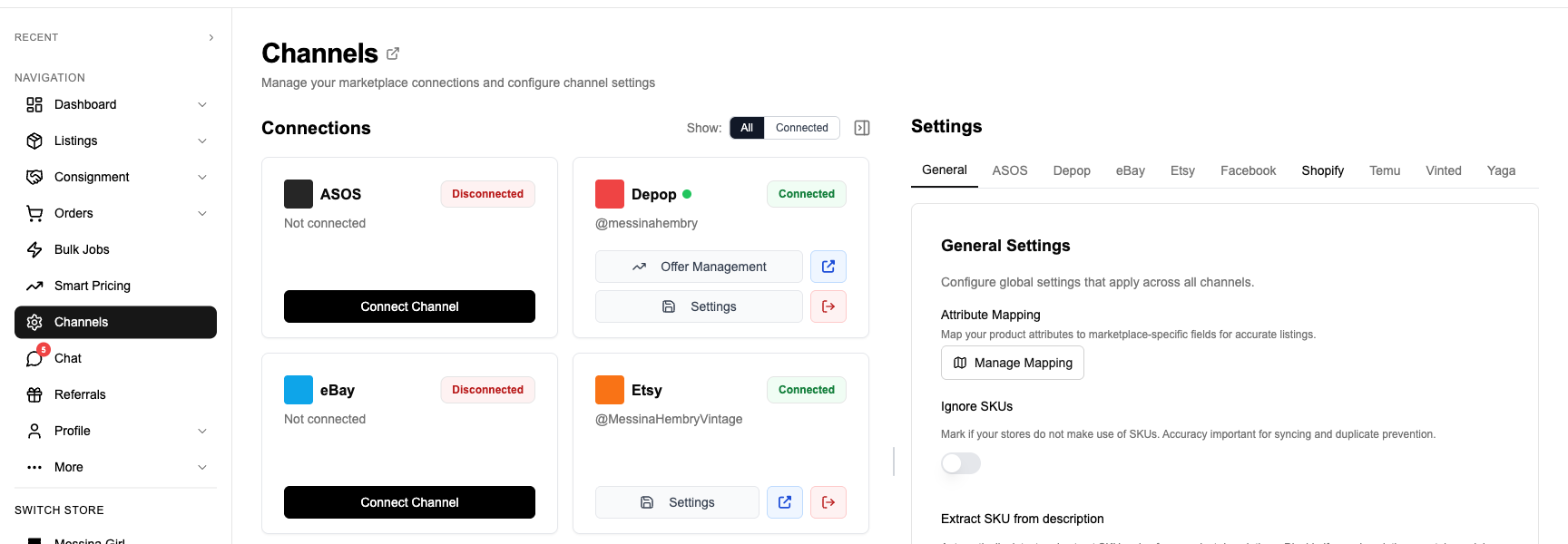
- Connect your willhaben account in FLUF Connect. Once connected, listings are created and managed without your browser needing to stay open.
- Import or create your product catalogue once.
- Select the channels you want each item on, and publish.
- Manage prices and delistings centrally.
What FLUF Connect supports on willhaben — and what it doesn’t
Being straight about this matters more than a longer feature list. willhaben is a newer channel and its capability set is deliberately narrow:
| Feature | willhaben | Why |
|---|---|---|
| Crosslisting (create, edit, delete) | Supported | Verified end-to-end including image upload and price edits |
| Auto-relisting | Not supported | Deliberate — willhaben down-ranks re-published ads, so automating it would harm you |
| Offer management | Not supported | willhaben has no offer system; “gegen Gebot” is banned |
| Order sync | Not supported | See below |
| Sold-elsewhere delisting | Not supported | See below |
| Bulk operations | Supported | Bulk create and bulk price changes |
FLUF Connect does not detect willhaben sales automatically. When an item sells on willhaben, remove it from your other marketplaces manually. Check both sold and expired listings as part of your regular inventory review.
Practically, that means: use willhaben for reach into Austria, and let channels with proper sale detection — Vinted, eBay, Shopify — carry your automated inventory sync. If you are running willhaben as one of several channels, keep an eye on your willhaben ads when something sells elsewhere.
What it costs
| Plan | Monthly | Crosslisted products |
|---|---|---|
| Starter | £9/month | Unlimited |
| Seller | £29/month | Unlimited |
| Pro | £99/month | Unlimited |
| Super Seller | Custom pricing — tell us what you need | Unlimited |
There is no free plan, but every new account gets a 7-day trial for £1. Automation — crosslisting, relisting, offers, bulk operations, inventory sync — is included from Seller upwards rather than sold as an add-on. Full details on the pricing page. If you are weighing FLUF Connect against other tools, we keep an honest breakdown at FLUF Connect vs List Perfectly, and a general primer at selling on multiple platforms.
Sources and verification
- willhaben Impressum — ownership structure, legal entity, DSA monthly active user disclosure
- willhaben Anzeigenaufgabe — current listing prices and durations
- willhaben Anzeigenrichtlinien — German-language requirement, re-publication down-ranking (§1.6), commercial classification (§1.7)
- willhaben Infos zur Reihung — published ranking factors
- willhaben Hilfe — PayLivery costs — buyer-protection fee and seller cost
- willhaben Hilfe — PayLivery shipping — Post and DPD size bands and prices
- willhaben Hilfe — PayLivery verification — staged KYC thresholds
- willhaben Hilfe — DAC7 reporting — thresholds, scope and filing date
- willhaben Factsheet Q1 2025 — visits, page impressions, reach
- OTS press release, 19 November 2025 — items sold and CO₂e avoided in 2024
- Businesswire, 3 March 2025 — Adevinta stake sale to Sprints Capital and Styria
- USP.gv.at — Kleinunternehmerregelung — €55,000 gross VAT threshold from 2025
- §31 EStG — Spekulationsfrist and the €440 Freigrenze
- Watchlist Internet — the seller-targeted PayLivery phishing pattern
- Internet Ombudsstelle Österreich — PayLivery dispute outcomes and cost allocation
- Internet World Austria, April 2026 — Vinted Austria–Germany cross-border launch
Figures were verified against primary sources in August 2026. willhaben does not publish Marktplatz visibility-upgrade prices, title and description character limits, or seasonality data publicly; those are deliberately absent above rather than estimated. Tax information is general guidance, not advice — consult a Steuerberater.
Related guides
- How to sell on Kleinanzeigen — Germany’s equivalent marketplace, next door
- How to sell on Vinted — now trading across the Austria–Germany border
- How to sell on eBay — for reach beyond Austria
- Crosslisting hub — every supported channel pair
- Inventory sync — how FLUF Connect prevents overselling across channels
- Selling on multiple platforms — the general playbook
- Crosslist from Vinted to willhaben
- Crosslist from eBay to willhaben
- willhaben vs Vinted
- Crosslist from Kleinanzeigen to willhaben
- Sell on Allegro — Poland-s biggest marketplace
- Willhaben vs Kleinanzeigen — compared
- Crosslist from Willhaben to eBay
- Crosslist from willhaben to Facebook Marketplace
- Crosslist from willhaben to Etsy — which seam of an Austrian catalogue is allowed
Related guide
- Crosslist from willhaben to Vinted — Austrian classifieds stock into a 27-country fashion audience
- Crosslist from Shopify to willhaben — an Austrian store’s stock on the country’s default marketplace, commercial-seller rules included
Related guides
- Crosslist from willhaben to Kleinanzeigen — why both escrow products stop at the border
- Sell online in Germany — every marketplace you can reach
- Crosslist from willhaben to Shopify
- Crosslist from Depop to willhaben
Subscribe to the seller news brief
The marketplace news that changes how you list, in one short email.
- Fee, policy and algorithm changes across 50+ marketplaces
- Only the topics you pick — the marketplaces you actually sell on
- Short enough to read in a minute. Daily or weekly, unsubscribe in one click
No spam. We never share your address.
Pick your topics first ›Frequently Asked Questions
For private sellers on the Marktplatz, yes — there is no listing fee, no commission and no payment charge. An ad runs 45 days with unlimited images. Costs appear elsewhere: commercial ads are €23.99 including VAT for 60 days, boats €44.99, cars list at no charge only up to €22,000 (and only one such ad at a time), and property listings are chargeable across the board.
Nothing. willhaben states that PayLivery is completely free of charge for the seller. The buyer pays shipping plus a buyer-protection fee of €1.99 or 4.5% of the item price, whichever is higher. The one exception worth knowing: if a transaction is reversed, willhaben retains its PayLivery costs and the seller absorbs the return leg.
Not on its own. willhaben's advertising guidelines require ads to be published in German, and permit you to add an English translation beneath the German text. An English-only listing breaches the guidelines and can be removed. This catches out a lot of expat sellers, because no English-language guide currently mentions it.
Free private Marktplatz ads run for 45 days. Commercial Marktplatz ads run 60 days, vehicle ads on the Basis tier 14 days, and property ads 30 days. Note that willhaben deletes an ad's images roughly two to three months after it ends, so keep your originals if you intend to relist later.
No — it actively harms you. willhaben's advertising guidelines say that re-publishing an ad within 30 days of deleting it will be rejected without refund, and that willhaben reserves the right to down-rank the re-published ad. For repeated systematic re-publication it reserves the right to down-rank every ad on the account. Republishing also no longer resets an ad's date, so the old refresh trick simply does not work.
Not through PayLivery. willhaben states that PayLivery can be used only for sales within Austria, and its own safety guidance advises sellers to refrain from shipping or selling goods abroad. If you want buyers outside Austria, the practical route is to list the same stock on a marketplace that trades cross-border — Vinted opened Austria-to-Germany trading in April 2026, and eBay reaches globally.
Selling your own used possessions is generally not taxable. Under §31 EStG a gain is only taxable if you sell within 12 months of acquiring the item, and there is a €440 annual Freigrenze — note that is a limit, not an allowance, so exceeding it makes the whole amount taxable. Austria has no “everyday items” exemption; that rule belongs to German law. This is general guidance, not tax advice — consult a Steuerberater about your own position.
Under DAC7, willhaben reports sellers who exceed either threshold: 30 or more transactions, or more than €2,000, in a calendar year. The thresholds are alternatives, not cumulative conditions. Crucially, willhaben's reporting scope covers PayLivery transactions only — cash and bank-transfer sales fall outside the report, though not outside your tax obligations. Reports are filed by 31 January.
No, and that is deliberate. willhaben ads expire after 45 days, so an ad vanishing from the index usually means it expired rather than sold. Guessing a sale from disappearance would delist genuinely available stock everywhere else you sell — a far worse outcome. Until willhaben exposes a reliable sale signal, treat willhaben sales as something you mark off by hand, and let channels with proper sale detection carry your automated inventory sync.
Yes. FLUF Connect publishes the same inventory to willhaben, Vinted, eBay, Shopify, Kleinanzeigen, Etsy and more from a single catalogue, so you are not retyping listings per platform. This matters more on willhaben than most channels, because PayLivery cannot cross the Austrian border — crosslisting is the only way to reach buyers outside Austria. Plans start at £9/month (Starter); There is no free plan, but every new account gets a 7-day trial for £1.