
Crosslist from eBay to Mercari — Automatically
Put your eBay listings in front of Mercari's US buyers without listing twice. Titles, photos, prices and condition transfer automatically, and a sale on either side clears the other.



- eBay: 136 million active buyers and $11.7 billion of US GMV in a single quarter. Mercari: $810 million of US GMV across its whole 2026 financial year. Mercari is an additive demand pool, not a replacement.
- Mercari’s fees went the other way to what most articles say. The zero-seller-fee experiment of March 2024 was reversed on 6 January 2025. Today it is a 10% seller fee, a 3.6% buyer protection fee, and no payment processing fee on either side.
- Even so, it is usually cheaper than eBay: 10% flat against eBay’s 13.6% plus $0.40 per order — and eBay charges that on shipping and sales tax too.
- But not always. eBay is cheaper on Guitars & Basses at 6.7%, on athletic shoes over $150 at 8% with no per-order fee, and on heavy equipment at 3%. Worth knowing before you move a whole catalogue.
- United States only. Mercari’s marketplace runs in Japan and the US. It closed its UK marketplace in 2019 and has no European marketplace today.
- Cost: start with a 7-day trial for £1, then plans from £9/month (Starter). There is no free plan; automation is included from Seller upwards.
Why Add Mercari to an eBay Business?
Let us be honest about the size difference before making the case, because an overstated one is easy to see through.
eBay reported 136 million active buyers and $22.4 billion of GMV in the second quarter of 2026, of which $11.7 billion was in the United States and growing 24% year on year. Mercari’s US business turned over $810 million across its financial year to 30 June 2026, up 11.2%, with 4.2 million monthly active users. eBay’s US GMV in one quarter is roughly fourteen times Mercari US’s entire year.
So Mercari is not a place to move to. It is a place to also be, and the argument for it is margin and category rather than scale.
Three things make it worth the second listing:
- The fee gap. Roughly three and a half points of margin on a typical item, before you count what a Store subscription and Promoted Listings add on the eBay side.
- No subscription and no insertion clock. Mercari has no store tiers to buy into, and no listing allowance that a slow-moving catalogue quietly consumes.
- Different demand. Mercari attributed its 2026 US growth specifically to strong demand in Entertainment & Hobbies, and it has built infrastructure around it — a dedicated envelope shipping label for trading cards, and Media Mail for books, CDs, DVDs and vinyl.
What sellers who run both actually report is not that one platform beats the other, but that stock behaves differently on each. Items that sit for months in one place move in weeks in another, and there is no reliable way to predict which is which from the listing alone.
The Fee Comparison — Including Where eBay Wins
What Mercari charges today
This is where most published comparisons are wrong, so it is worth setting out plainly. Mercari removed its seller fee entirely in March 2024, and put it back on 6 January 2025. The current structure, confirmed both in Mercari’s help centre and in its investor-relations material, is:
| Who pays | Fee | Charged on |
|---|---|---|
| Seller | 10% selling fee | Item price plus buyer-paid shipping |
| Buyer | 3.6% buyer protection fee | Item price plus buyer-paid shipping |
| Both | $0 payment processing | — |
| Seller | $0 to list | — |
Mercari’s explanation of why it reversed course is unusually candid, and worth reading if you are weighing the platform: under zero fees sellers kept everything but “experienced fewer sales because items were less affordable for buyers”, and the structure “underserved buyers, wasn’t helping sellers sell more, and ultimately negatively impacted the marketplace by reducing overall transactions.”
Payouts are free by direct deposit, taking five to seven business days, with a $3 flat fee if you want Instant Pay. There is a cancellation fee of up to 5% of the item price, capped at $25, for repeat seller cancellations — which matters more than it sounds, and we come back to it below.
What eBay charges
As published on eBay.com on 20 August 2026, a seller without a Store or on a Starter Store pays 13.6% in most categories up to $7,500, plus a per-order fee of $0.30 on orders of $10 or less and $0.40 above that. The final value fee is charged on the total — item price, handling, buyer-paid shipping and sales tax — so the realised rate against the item price alone is higher than the headline.
Side by side
| A $50 item, $8 shipping paid by the buyer | eBay | Mercari |
|---|---|---|
| Seller fee rate | 13.6% (most categories) | 10% |
| Charged on | Item + shipping + tax | Item + shipping |
| Per-order fixed fee | $0.40 | None |
| Payment processing | Included in the final value fee | None |
| Approximate seller cost | ~$8.29 | ~$5.80 |
| Monthly subscription | $0–$349.95 by Store tier | None |
| Listing allowance | 250 zero-insertion-fee listings, then $0.35 | Unlimited, free |
The cost moved, it did not vanish. Mercari charges buyers 3.6%, so your better net comes with a higher number at the buyer’s checkout. That is a real trade, not a free lunch, and pretending otherwise sets up disappointment.
eBay is genuinely cheaper in several categories. Guitars & Basses are 6.7% with no insertion fee at all. Athletic shoes priced at $150 or more are 8% with no per-order fee. Heavy equipment is 3%. Mercari’s flat 10% beats eBay hardest where eBay is most expensive — Books, Movies and Music at 15.3%, and Jewelry, Watches and Handbags at 15%. Move the stock where the gap is, not the whole catalogue on principle.
Also on the eBay side of the ledger
Two eBay costs are easy to forget when comparing headline rates. Good ‘Til Cancelled listings renew monthly and each renewal consumes an insertion-fee credit, so a large slow-moving catalogue burns its allowance indefinitely. And eBay applies a below-standard seller surcharge of 6%, rising to 7% after four consecutive months — which is directly relevant to crosslisting, for reasons covered under sync below.
Where Mercari Actually Operates
This section exists because the answer has changed twice and the wrong answer wastes people’s time.
Mercari’s marketplace operates in Japan and the United States. FLUF Connect supports Mercari US. Mercari closed its UK marketplace in 2019 — trading ended that January and the app shut in March — and it has no European marketplace today.
One recent development to read carefully: Mercari launched a Mercari Global App in the US in June 2026, which lets American buyers purchase from Mercari Japan. That is a buyer-side bridge, not a new selling market. It does not open Japan to US sellers, and it does not open Europe to anyone.
Worth calibrating the size of the two marketplaces too: Mercari US at $810 million is roughly one per cent of Mercari Japan’s marketplace GMV. When you read about “Mercari” in general business coverage, the subject is usually the Japanese business.
How the Crosslist Works
- Connect eBay. Sign in and approve once.
- Connect Mercari. Use the FLUF browser extension while signed in to your Mercari account.
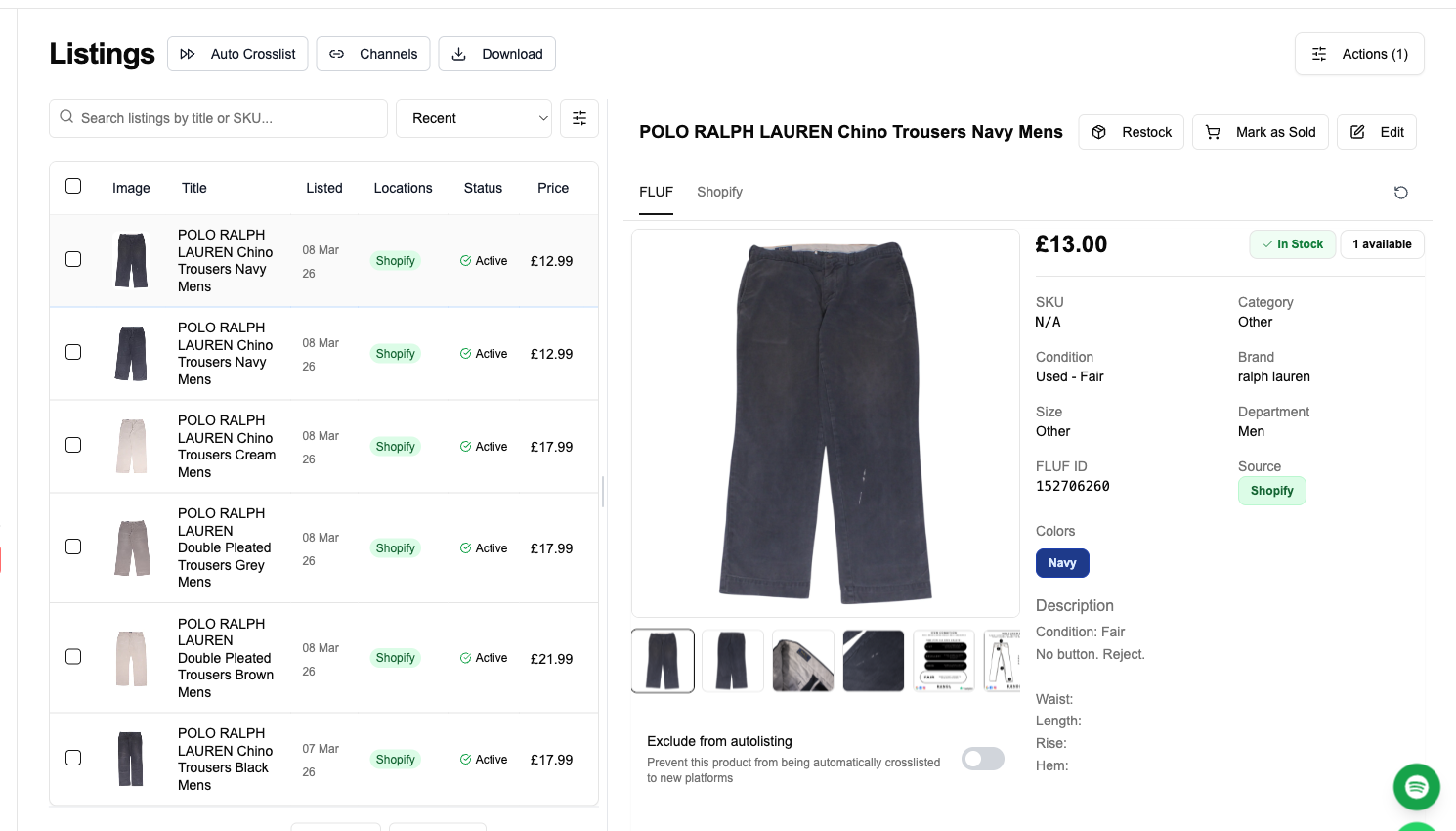
- Import your eBay listings. Titles, descriptions, photos, prices, condition and item specifics come into one catalogue.
- Crosslist. Select the items and confirm. Keep your browser and the FLUF extension running while publishing, and check progress in the dashboard.
What Transfers When You Crosslist from eBay to Mercari?
| eBay field | Mercari field | Transfer status | Notes |
|---|---|---|---|
| Title (80 characters) | Listing title | ✅ Automatic | eBay’s keyword-dense titles carry across. |
| Description | Description | ⚡ Cleaned | eBay allows HTML and up to 500,000 characters; Mercari’s is plain and much shorter. Templates, tables and policy footers are stripped. |
| Photos (up to 24) | Photos | ⚡ First 12 | Choose up to 12 photos and review the gallery before publishing. |
| Price | Price | ✅ Automatic | Mercari’s listing range is $1 to $2,000, extending to $5,000 through Mercari Authenticate in a handful of designer categories. |
| Condition | Condition | ⚡ Mapped | eBay’s condition taxonomy is category-specific and long; Mercari’s is five values. See below. |
| Category | Category | ⚡ Resolved by Mercari | Review and confirm the Mercari category before publishing. |
| Item specifics | — | ❌ Mostly dropped | Mercari has no equivalent structured aspect set. The useful values belong in the description. |
| Brand | Brand | ⚡ Mapped | Recommended rather than required on Mercari. |
| Weight and dimensions | Shipping class | ⚡ Converted | Weight in ounces drives the shipping selection; FLUF converts from your store weight and defaults to a pound if none is set. |
| Auction format | — | ❌ Not available | Mercari is fixed-price with offers. This is a real constraint — see below. |
| Quantity above one | — | ❌ Single-item | Mercari listings are one-of-one. |
Condition mapping
Mercari’s five values are New, Like New, Good, Fair and Poor. eBay’s set varies by category — clothing has New with tags through Pre-owned Fair, electronics has Open box and several refurbished grades, books have their own scale entirely.
| eBay | Mercari | Note |
|---|---|---|
| New / New with tags / New with box | New | Mercari defines New as completely unused |
| New without tags / New (other) / Like new | Like New | Used very lightly or not at all, but without tags |
| Used / Pre-owned Good / Very good | Good | Mercari’s default when nothing else matches |
| Pre-owned Fair / Acceptable | Fair | Well used, multiple visible signs of wear |
| For parts or not working | Poor | May only be usable for parts or repairs |
One trap worth flagging: Mercari applies category-specific interpretations to the same five labels. Electronics is the sharpest — New and Like New require 98% or better battery health, Good needs 80% or better, Fair covers 50 to 79%, and anything below is Poor. Shoes key on tread and sole wear, clothing on pilling and fading. A phone that is honestly “Like New” cosmetically may not be Like New by Mercari’s definition, and that is a returns problem rather than a listing problem.
The New-Seller Listing Cap
This one deserves its own section because it defeats the obvious plan.
A new Mercari account is limited to 100 active listings, with the ceiling raised as you complete sales. Mercari does not publish the criteria. The practical consequence is that an eBay seller with three thousand items cannot bulk-dump the catalogue onto a fresh Mercari account on day one, however good the tooling is.
The workable approach is to seed deliberately: pick the hundred items where the fee gap is widest — books, media, jewellery, handbags — or where the category is one Mercari is actively growing, and let the cap lift as those sell. Auto-crosslisting rules then keep the pipeline fed as headroom appears, rather than requiring you to remember to top it up.
What Syncs — And Why Overselling Is the Whole Game
| Event | What happens | Timing |
|---|---|---|
| Item sells on eBay | The Mercari listing is taken down automatically | Within minutes |
| Item sells on Mercari | Detected by a sold scan run through the extension, then cleared from eBay and every other connected channel | Per scan cycle |
| Price changed in FLUF | Pushed to Mercari as a single price edit that keeps the listing’s age, likes and views | Within minutes |
| Title or description edited | Not supported in place on Mercari — the listing has to be recreated | N/A |
| eBay order placed | Ingested into FLUF’s unified orders feed | Within minutes |
| Offer received on eBay | Handled by FLUF’s offer management | Per your rules |
| Auto-relisting on Mercari | Not supported | N/A |
Both platforms punish selling the same item twice, and eBay’s penalty is financial. eBay counts an unexpected cancellation as a transaction defect — and names the case explicitly, including where the seller cancels “because they sold it to someone else”. You are allowed defects on up to 2% of transactions; fall below standard and eBay may limit your selling activity and charge higher final value fees, a surcharge of 6% rising to 7%. Mercari, for its part, reserves the right to charge up to 5% of the item price, capped at $25, for repeat cancellations.
Sellers running both by hand describe the cost in their own words. One, on r/Mercari: “Twice now I’ve sold the same item within an hour of each other and had to cancel and refund one of the buyers… unless I’m monitoring my sales 24/7 I’m not sure how to avoid this situation.” Another, in the same thread, describes the workaround that follows: “if it’s a hot item that you believe will sell quickly, wait 24 hours before cross posting it.” That is a seller deliberately suppressing their own demand because the tooling cannot be trusted — which is exactly the problem automatic sold-out sync removes.
A note on auctions
Mercari has no auction format, and an eBay auction is genuinely incompatible with crossposting: if the item sells elsewhere mid-auction, ending the auction early can incur a fee. The practical answer that experienced crossposters land on is to use fixed-price with Best Offer on eBay for anything you intend to list on a second platform, and keep auctions for eBay-exclusive stock.
Crosslisting from eBay to Mercari: Before and After FLUF Connect
Without FLUF Connect
- Open the eBay listing and copy the title
- Copy the description and strip the HTML template and policy footer
- Download the photos, then check none of them is a format Mercari will reject
- Open Mercari and start a new listing
- Re-enter condition on Mercari’s five-value scale, checking the category-specific definition
- Upload up to 12 photos individually
- Set price, weight and shipping
- Publish, then record somewhere which eBay listing this matches
- Watch both platforms, and delist manually the moment either sells
Time per item: sellers report roughly 5 to 30 minutes on Mercari depending on how much of the eBay work can be reused — and the recurring cost is not the listing, it is the watching.
With FLUF Connect
- Select the eBay listings you want on Mercari
- Click crosslist to Mercari
- Review the pre-filled condition and price
- Confirm
Time per item: about 30 seconds, with sold-out sync running in both directions afterwards so neither platform can sell what the other already sold.
Automation Features for eBay and Mercari Sellers
Sold-Out Sync in Both Directions
Given the defect and cancellation penalties above, this is the feature that pays for itself on this pair. A sale on either channel clears the item from the other, without you watching two apps.
Price Edits That Keep the Listing
A price change on Mercari goes through as a single edit that preserves the listing’s identifier, age, likes and views — rather than the delist-and-recreate cycle sellers describe doing by hand, which throws all of that away. Anything beyond price still needs a fresh listing, and FLUF says so rather than silently failing.
Offer Management and Relisting on eBay
eBay supports both through FLUF’s offer management and auto-relisting. Mercari supports neither, so the automation you get is asymmetric — worth knowing rather than assuming parity.
Auto-Crosslisting Rules and Bulk Operations
Rules by category or price band keep Mercari fed as your listing ceiling rises. The obvious rule for this pair targets the categories where eBay is most expensive relative to Mercari’s flat 10% — books, media, jewellery and handbags.
How Much Does It Cost to Crosslist from eBay to Mercari?
Every FLUF Connect plan includes crosslisting, inventory sync, auto-relisting, offer management and bulk operations across all supported channels — not just eBay and Mercari.
| Plan | Monthly | Yearly | You save | Crosslisted products |
|---|---|---|---|---|
| Starter | £9/month | £59/year | 45% | Unlimited |
| Pro | £29/month | £199/year | 42% | Unlimited |
| Priority | Custom pricing — tell us what you need | Unlimited | ||
Automatic relisting, offer management, smart pricing and listing boosts are included from Pro upwards. Starter covers unlimited crosslisting, inventory sync, order sync and Instagram posting without them. Accounting integrations are included from Pro upwards. Yearly billing is charged once a year. New accounts get 7 days for £1, then move onto a plan.
Every new seller gets a 7-day trial for £1 with full access before choosing a plan. There is no free plan; automation is included in every paid plan rather than sold as an add-on. See the full pricing page. eBay’s and Mercari’s own fees are separate.
Related Guides
- Sell on eBay — the complete guide
- Sell on Mercari — the complete guide
- Crosslisting from Mercari to eBay
- Crosslisting from Vinted to Mercari
- Crosslisting from Depop to Mercari
- Crosslisting from eBay to Poshmark
- Full crosslisting hub — every channel pair
- How offer management works
- FLUF Connect pricing
Sources & Verification
- Mercari’s current fee structure — 10% seller fee, 3.6% buyer protection fee, no payment processing, free listing, payout and cancellation fees — Mercari’s fees help article, corroborated by Mercari’s investor-relations FAQ.
- The 6 January 2025 reversal of the zero-seller-fee structure, and Mercari’s own explanation of why it reversed — Mercari’s help article on the fee change. The March 2024 zero-fee launch is documented in Mercari’s own press release.
- Mercari US GMV, growth and monthly active users for the year ended 30 June 2026, and the Japan-versus-US split — Mercari’s investor relations.
- Mercari’s markets, and the June 2026 Global App as a buyer-side bridge rather than a new selling market — Mercari’s about page and its Global App announcement. The 2019 closure of Mercari UK is documented in contemporaneous trade reporting.
- Mercari condition definitions, including the category-specific interpretations and the battery-health thresholds for electronics — Mercari’s item-conditions guide. Photo count and listing guidance — Mercari’s listing guide. Price ceilings and Mercari Authenticate — Mercari’s help centre.
- Mercari’s cancellation fee of up to 5% capped at $25 — Mercari’s cancellation policy.
- eBay active buyers, quarterly GMV and the US and international split — eBay Inc.’s Q2 2026 results release.
- eBay’s final value fees, per-order fixed fees, the charging of the fee on shipping and sales tax, the 250-listing allowance, Good ‘Til Cancelled renewal behaviour, the below-standard surcharge and the category rates cited — eBay’s selling-fees page and Store selling fees, both as published on 20 August 2026. Neither page carries a printed effective date.
- Selling an item twice counted as a transaction defect, the 2% threshold and the consequences of Below Standard status — eBay’s seller standards policy.
- The new-seller listing cap of 100 items is reported by sellers from Mercari’s own in-app message; Mercari does not publish the criteria for raising it. Seller experiences of double sales and manual delisting are individual accounts from this r/Mercari thread and are quoted as such rather than as measured fact.
- Crosslist from eBay to Amazon
Frequently Asked Questions
Every new seller gets a 7-day trial for £1 with full access. After that, plans start at £9/month (Starter). There is no free plan. Every plan includes crosslisting, inventory sync, auto-crosslisting rules and bulk operations across all supported channels, not just these two — automation is built into Pro and above rather than sold as a paid add-on. eBay's and Mercari's own fees are separate.
It did, and then it changed its mind. Mercari removed the seller fee in March 2024 and reinstated it on 6 January 2025. Today a seller pays 10% on the item price plus buyer-paid shipping, the buyer pays a 3.6% buyer protection fee, and there is no payment processing fee on either side. Most articles you will find still describe the zero-fee period, which lasted about nine months. Mercari's own explanation for reversing it is that sellers kept everything but sold less, because items were less affordable for buyers.
Usually, but not always, and the exceptions matter. Mercari's flat 10% beats eBay's 13.6% plus a $0.40 per-order fee in most categories, and eBay charges its fee on shipping and sales tax as well as the item price. But eBay is cheaper on Guitars & Basses at 6.7% with no insertion fee, on athletic shoes priced at $150 or more at 8% with no per-order fee, and on heavy equipment at 3%. Mercari's advantage is widest where eBay is most expensive — Books, Movies and Music at 15.3%, and Jewelry, Watches and Handbags at 15%.
Yes, in both directions. A sale on eBay takes the Mercari listing down within minutes. A sale on Mercari is picked up by a sold scan run through the browser extension and then cleared from eBay and every other connected channel. That two-way protection is the main reason to automate this pair rather than run it by hand.
It costs you, on both platforms. eBay counts an unexpected cancellation as a transaction defect and names the case explicitly, including where the seller cancels because they sold it to someone else. You are allowed defects on up to 2% of transactions; below that standard eBay may limit your selling and charge higher final value fees — a surcharge of 6%, rising to 7% after four consecutive months. Mercari reserves the right to charge up to 5% of the item price, capped at $25, for repeat cancellations.
No, and this catches people out. A new Mercari account is limited to 100 active listings, with the ceiling raised as you complete sales; Mercari does not publish the criteria. The workable approach is to seed the hundred items where the fee gap is widest, then let auto-crosslisting rules keep the pipeline fed as headroom appears.
No. Mercari's marketplace operates in Japan and the United States, and FLUF supports Mercari US. Mercari closed its UK marketplace in 2019 and has no European marketplace today. The Mercari Global App launched in the US in June 2026 lets American buyers purchase from Mercari Japan — it is a buyer-side bridge, not a new selling market.
Mercari allows up to 12 photos. Review the selected gallery before publishing and correct any reported photo issues.
Not comfortably. Mercari has no auction format, and if an item sells on Mercari mid-auction, ending the eBay auction early can incur a fee. Experienced crossposters use fixed-price with Best Offer on eBay for anything destined for a second platform, and keep auctions for eBay-exclusive stock.
No to both, through FLUF. eBay supports auto-relisting and offer management and they run as normal. On Mercari, a price change goes through as a single edit that keeps the listing's identifier, age, likes and views — but anything beyond price requires a fresh listing, and FLUF tells you that rather than failing quietly.
Sign up for free
Join the community
You're in.
Open your dashboard