
Shopify to willhaben: Crosslist Your Store’s Stock in Austria
How an Austrian Shopify merchant pushes existing store products to willhaben — the commercial-seller rules, the variants problem, and the sold-state gap FLUF does not close.
7 days for £1, then from £9/month.



Key Takeaways
- Your Shopify catalogue is already the hard part. Titles, descriptions, photography, prices and stock exist as structured records. Pushing them to willhaben is a data-mapping job, not a re-photography job.
- Austria’s default marketplace is big and local. On 23 August 2026 the willhaben Marktplatz carried 12,700,895 live ads (willhaben Marktplatz). Its own trade site quotes 55.9% reach on ÖWA 2025-I and 3.9 million unique users (WILL MARKTPLATZ-SHOP).
- A Shopify merchant is a business, and willhaben knows it. Sellers listing regularly, in high volume or with intent to profit are classified as commercial regardless of tax status or trade licence, and commercial ad products become mandatory (willhaben Anzeigenrichtlinien).
- Ads run 30 days from activation, cannot be extended before they expire, and paid visibility products do not lengthen them (willhaben help centre, snapshot 4 August 2025). Any FLUF page saying 45 days is wrong.
- An ad is flat. A Shopify product is not. No variant concept, no quantity field, and duplicate ads are rejected without notice or refund. The variants section explains what that forces you to do.
- The blunt part: FLUF Connect does not mark a willhaben ad as sold. willhaben is a relisting-only channel for us. When the item sells in your Shopify store, we cannot pull the ad down — you remove it. Most crosslisting marketing promises the opposite.
- What the pair does give you is bulk creation from store data you already maintain and automatic relisting, so ads do not quietly age out. Connect willhaben once through the FLUF Chrome extension; after that, listing needs no open browser.
- FLUF Connect costs £1 for 7 days, then plans from £9/month (Starter). There is no free plan.
Why An Austrian Shopify Merchant Lists On willhaben
Picture the shop this page is written for. A furniture dealer in Graz with an ex-display Eckcouch and eleven dining chairs nobody ordered. A homewares store in Salzburg sitting on last season’s ceramics. A bike retailer with six 2025-model hardtails. All run a Shopify store, all have clean product records, and all share one margin problem: freight.
Domestic delivery is what quietly eats a small Austrian retailer. A €480 sideboard attracts a €120 courier bill and a real risk of transit damage. A mattress is worse. You either absorb the cost, or you show it at the checkout and watch the basket die — while the item occupies a bay in a rented Lager and depreciates every quarter.
Classifieds solve that problem by removing the parcel. The buyer drives to you with a trailer. For bulky, heavy or fragile goods that is not a downgrade from e-commerce — it is often the only channel where the unit economics work at all.
The scale is national. Reading the Marktplatz filter on 23 August 2026 gives 12,700,895 live ads, with the relevant categories well represented: Wohnen / Haushalt / Gastronomie at 1,634,882, Sport / Sportgeräte at 724,741 and Haus / Garten / Werkstatt at 607,245 (willhaben Marktplatz). Four verticals sit under one roof, which is why the site behaves as Austria’s general-purpose destination rather than a niche.
Ownership suggests it is not going anywhere: the operator is willhaben internet service GmbH & Co KG in Vienna, FN 271792 w, its holding company split almost exactly between Styria Digital Marketplaces (49.7928%) and Sprints Blossom (49.7927%) (willhaben Impressum).
Now the honest framing. This is not a second checkout. A classifieds ad is an advert with a chat thread attached: no cart, no order object flowing back to Shopify, and — outside PayLivery — no payment rail. Treat it as shelf space in front of the country’s default marketplace audience and it works; treat it as a channel that behaves like eBay and it will disappoint you.
The Commercial-Seller Question
This is the part most crosslisting guides skip, and it is what gets Austrian merchants’ ads rejected in week one. You cannot post as a private seller. Not “should not” — cannot. The published ad guidelines classify sellers as commercial where they advertise goods or services regularly, in high volume, or with intent to profit, and add that this happens “unabhängig von Steuerpflicht und Besitz eines Gewerbescheins” — independently of tax liability and of whether you hold a trade licence (willhaben Anzeigenrichtlinien, section 1.7). The help centre lists the triggers: traders posting a private ad, offering services, individuals posting regularly or in volume, self-made goods, and goods from a business, a business closure or an insolvency sale (willhaben help centre, snapshot 25 April 2025).
Read that list against a Shopify store clearing end-of-line stock and you are commercial on at least three counts before you write a word of ad copy.
Some categories are always commercial regardless of who posts them: business closures, insolvency sales, commercial furnishings, industrial goods not made for private use, services, and self-manufactured products. A separate group — pre-orders of unreleased products, meat and fish products, pharmacy-only medicines — is only permitted under a Marktplatz package contract at all.
The mechanics are in section 2 of the same guidelines. Where a vertical has its own commercial ad products, you must use them; you must flag the account as commercial at registration; your ads must comply with the E-Commerce Act, the Consumer Protection Act, the Unfair Competition Act and the Trade Act; and a company logo or homepage link is available only under a package contract. The terms of use add the disclosure duty directly — commercial providers must identify themselves as such under the Trade Act’s naming rules and the Unternehmensgesetzbuch (willhaben Nutzungsbedingungen, section 5.2.3).
That last point has a sharp edge for a store owner. Section 1.5 bans links to other websites, e-mail addresses, QR codes and references to your profile on another selling platform — with an explicit exception for the homepage link of commercial package customers. So “run cheap ads and funnel traffic to my Shopify store” is not available on the private path. If you want the link, you buy the package.
What does the commercial path cost? No self-serve price list is published; the Marktplatz Shop is sold as bundles through a sales team, and the signup form asks for a GISA number, a Firmenbuchnummer, an association number or an EU VAT ID before it will talk to you. The three tiers are WILL ENTDECKEN, WILL EXPANDIEREN and WILL EXZELLENZ, with selectable ad quotas of 10–100, 10–700 and 10–2000, background ad capacity of 150 / 1000 / 3000, bumping manually every seven days, manually every three, or automatically every three, plus a shop profile, personalised URL, website link, statistics and an interface for automated ad transfer (WILL MARKTPLATZ-SHOP). The landing page quotes 3,100 Marktplatz Shop customers.
Practical reading: start on the entry bundle with a modest quota and find out whether local demand exists before committing to a four-figure allowance. Get the quote — the price depends on quota and term.
Austrian Obligations That Follow You Into The Ad
A private seller’s ad and a business’s ad are different legal objects. Yours is the second kind, and the duties you already meet at your Shopify checkout follow you onto willhaben.
The 14-day right of withdrawal. Austria implemented the EU Consumer Rights Directive mainly through the Fern- und Auswärtsgeschäfte-Gesetz (FAGG). Consumers may withdraw from distance contracts within 14 days, without reasons and generally without cost. If you fail to inform them of that right properly, the period extends by twelve months — so an incomplete ad is not a small slip, it is a 12-month-and-14-day return window (WKO).
One nuance: a sale negotiated and completed face-to-face at your premises is not a distance contract, but a deal agreed in the willhaben chat and posted out is much closer to one. If a meaningful share of your willhaben sales will be shipped, assume the FAGG applies.
The two-year Gewährleistung. Under the Verbrauchergewährleistungsgesetz the statutory warranty period for consumer sales of movable goods is two years from handover. For second-hand goods it may be shortened to one year, but only by separate agreement — not by a line buried in ad text. Within the first year a defect is presumed to have existed at handover, so the burden of proof is yours (WKO: VGG Fristen und Beweislast). Note the asymmetry on a mixed marketplace: a genuine private seller beside you may lawfully exclude warranty, and willhaben’s guidelines tell private sellers to state that exclusion explicitly. You cannot borrow it.
Disclosure. The information duties of §5 of the E-Commerce Act apply to every commercial online service, and businesses in the Firmenbuch must state the registered company name under §14 UGB (WKO: Informationspflichten nach dem ECG). The pattern is modelled on willhaben’s own Impressum, which cites §§24 and 25 MedienG, §14 UGB, §5 ECG and Article 24(2) of the Digital Services Act. Your shop profile and ads need the identifying information your Shopify footer already carries.
Prices. Section 1.3 of the ad guidelines requires the price field to contain the actual Austrian gross consumer price including VAT. If your Shopify store shows net prices to trade customers, the number you push to willhaben is not the number in your product record.
Language. Ads must be published in German. An English translation may be added underneath, but a German-only shop is the baseline — which matters if your Shopify descriptions were written for an international audience.
How Products Move From Shopify To willhaben
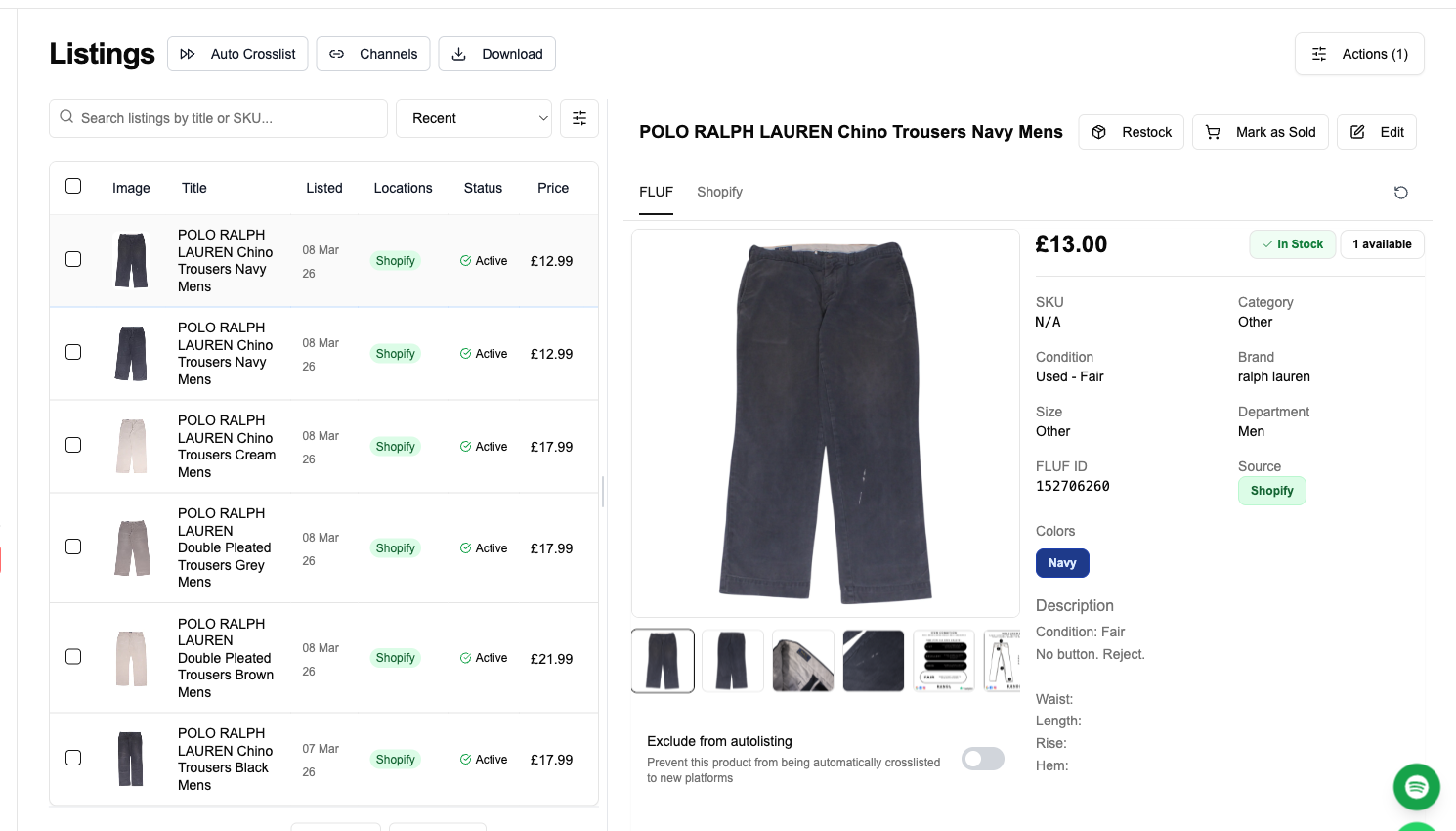
FLUF Connect keeps one product record per item and pushes it to the channels you switch on. Here the record originates in your store and travels outward.
Connect Shopify. Follow the prompts to import your products, photos, prices and stock. No browser extension or open tab is needed.
Connect willhaben. Live and self-serve too, but Austria-only, and the initial connection is made through the FLUF Chrome extension. That is a one-time step: afterwards listing needs no open browser. If you also sell in Germany, the same reasoning applies to Kleinanzeigen — see willhaben vs Kleinanzeigen and Kleinanzeigen to Shopify.
Choose what belongs there. Do not push the whole catalogue — push the stock whose economics are broken by freight, plus anything ageing in the warehouse. If you would rather someone collected it, it belongs on willhaben.
Map categories once. The Marktplatz tree is deep, and section 1.6 of the guidelines requires the most applicable category. Getting this right once per product type is most of the work.
Push in bulk, then review. This is the real value of the pair: a few hundred ads created from records that already exist.
Field And Category Mapping
A minimum of one photo is required, which almost no Shopify product will fail. Images are accepted up to 20 MB and 4000 × 4000 px, then converted to 1024 × 768 at 4:3; the app crops square from the centre, so a shot with the item hard against one edge loses part of itself in the mobile grid (willhaben help centre, snapshot 23 March 2025).
| Shopify field | willhaben ad field | What to watch |
|---|---|---|
| Product title | Anzeigentitel | Must be German. Strip SEO padding; keyword-stuffing terms that do not describe the article is prohibited. |
| Description (HTML) | Beschreibung | HTML tags are not permitted in ads. Rich Shopify descriptions must be flattened to plain text. |
| Variant price | Preis | Austrian gross price including VAT. Ads “gegen Gebot” or with no real price are not allowed on Marktplatz. |
| Compare-at price | — | No equivalent. A struck-through was-price cannot be represented. |
| Images | Bilder | Minimum one. Centre-weighted square crop in the app; 4:3 on desktop. |
| SKU / barcode | — | No SKU field. Put it in the description if your warehouse needs it back. |
| Inventory quantity | — | No quantity concept. An ad is one article, full stop. |
| Variants (size, colour) | — | No variant concept. See the section below — this is the real work. |
| Product type / collection | Kategorie | Must be the single most applicable category; wrong-area ads are rejected. |
| Location / address | Bundesland, PLZ | Location is a first-class search filter here, unlike in your store. |
| Storefront URL | — | Links to external sites are banned except for the homepage link of commercial package customers. |
| Condition metafield | Zustand | Buyers filter on it. Do not leave it at a default for used or ex-display stock. |
Two Shopify-native concepts have no home at all: quantity and variant. Everything else is a translation problem; those two are a modelling problem.
The Variants Problem
Shopify’s data model is explicit. A product variant “represents a version of a product that comes in more than one option, such as size or color”, and each variant carries its own price, SKU, barcode, images and inventory item (Shopify: ProductVariant object). Inventory sits at one or more locations, decremented as orders come in (Shopify: apps in inventory management). Even the entry Basic plan in Austria includes ten inventory locations (Shopify Österreich pricing).
A willhaben ad has none of that. It is one flat listing, one price, one location, and the guidelines are blunt about scope: each ad may contain only one article or service, or grouped like-for-like items such as a collection of books.
So the obvious answer is one ad per variant. That answer is right — but only because of a distinction the duplicate rule forces you to be precise about.
Section 1.6 says: place your ad only once at the same time, in the most applicable category, and duplicated ads are rejected without notification and without refund. That targets the same article listed twice — the old trick of running one sofa as three ads to occupy more of the results page. Genuinely different articles are genuinely different ads: a shelf unit in oak and the same unit in walnut are two objects, as are a size 42 and a size 44 of the same trainer. Listing each once is compliant; listing the oak one three times is not.
Where it gets uncomfortable is stock depth. Eight identical white ceramic vases are not eight articles — they are one article, eight times over. The workable pattern is a single ad, priced per unit, with the available quantity stated in the German description and refreshed as stock moves. Grouped like-for-like items are contemplated by the rules, so “8 Stück verfügbar, Preis pro Stück” sits inside them; eight near-identical ads do not.
The rest follows. Do not push a 40-variant product wholesale — a garment in five sizes and four colours is twenty ads to manage on a 30-day cycle. Push the variants that are actually stuck.
Put the differentiator in the title. Buyers search by text, and there is no option selector to reveal it — so “Eiche” or “Größe 44” belongs in the visible title.
Expect a manual step where the models disagree. Bundles, subscriptions and combined listings have no representation at all, nor does a made-to-order product whose options change the price. Those get simplified into one honest ad, or stay on your storefront.
What Syncs And What Does Not
Here is the section that should decide whether this pair suits you.
FLUF Connect does not mark a willhaben ad as sold. On willhaben, the supported feature is relisting — and only relisting. There is no order sync, no offer management and no mark-as-sold. So when a customer buys the sideboard in your Shopify store, FLUF detects that sale on the Shopify side, but it cannot reach across and pull down the willhaben ad. You remove the ad yourself.
We say that plainly because the whole crosslisting category markets the opposite promise, and the consequence is not abstract. The ad guidelines put the duty on you in so many words: keeping ads current, and deactivating or deleting them once the goods are sold, is the advertiser’s obligation for the whole life of the ad. An out-of-date ad is a rule breach as well as a wasted trip for a buyer.
The mitigation is workflow, not software. Give one person the job of clearing sold ads at a fixed time each day, and update unit counts in the same pass. It does not take long — but it does not happen by itself, and no setting in FLUF makes it happen.
What Shopify does support, in the other direction, is order sync and mark-as-sold — so a sale on a supported marketplace can close out your Shopify record. It does not help the willhaben ad, because the gap is on willhaben’s side of the pair.
Two further gaps. FLUF does no offer management on willhaben, so chat negotiation is entirely manual. And FLUF does no automatic relisting on Shopify — store products do not expire, so it is not needed. The relisting engine exists on this pair for the willhaben side.
If you want a pairing where more of the sold-state handling is automated, check what FLUF supports on each destination first. The crosslisting hub lists every published pair; willhaben to eBay and willhaben to Vinted cover the outbound direction.
A Before And After Workflow
Before. Someone opens the willhaben ad form, finds the product in the Shopify admin in another tab, retypes the title into German, flattens the description, downloads four photos and re-uploads them, picks a category, types the gross price, publishes, repeats. Six or seven minutes an ad once warmed up; forty items is most of a working day. Thirty days later every one of them expires and the same person starts again — assuming anybody noticed.
After. The store is connected once with credentials, willhaben once through the extension. You select products, check the German titles and categories on a review screen, and push. Photos, prices and descriptions come from records that were already correct because they run your storefront. The 30-day expiry is handled by relisting rather than by memory.
What stays manual. German copy still needs a human eye — a machine-flattened description reads like one. Category choice deserves a check for anything unusual. And sold ads come down by hand, every time.
Relisting And Ad Ageing
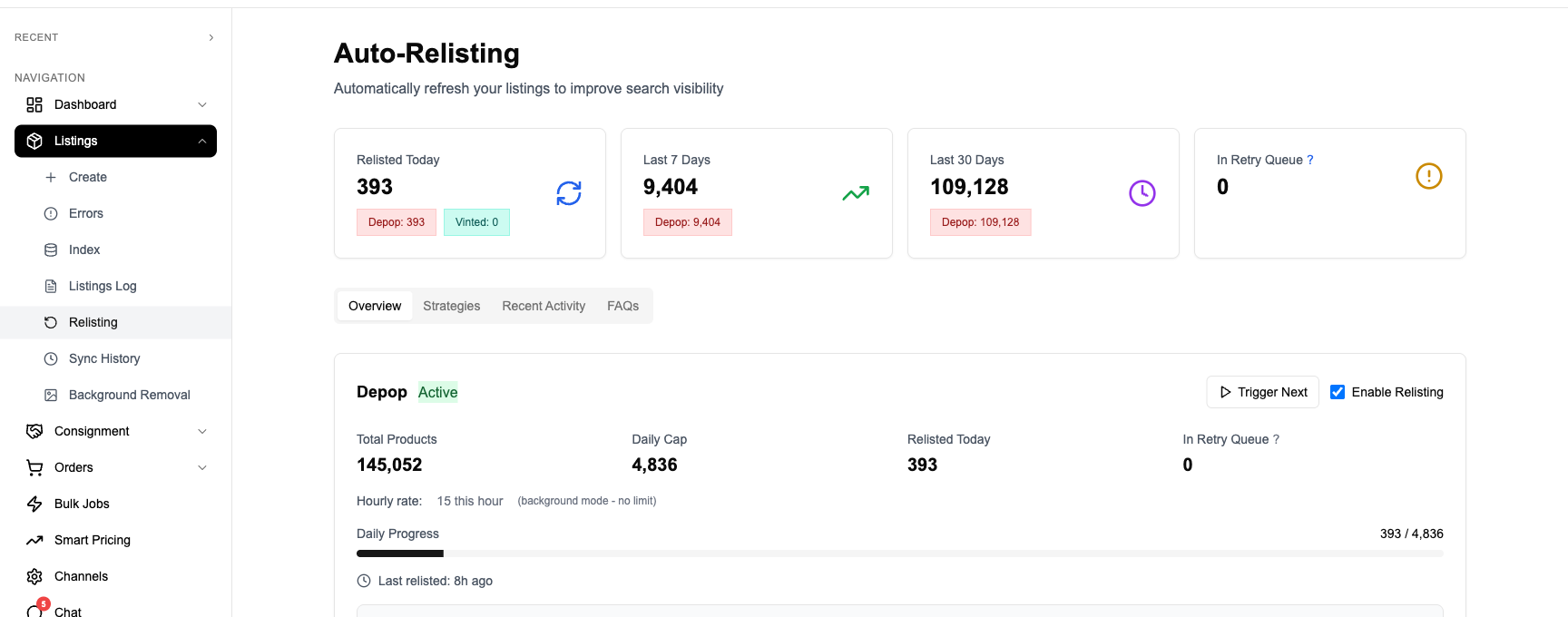
Settle the runtime question first, because FLUF’s own documentation has been inconsistent about it. The help centre is unambiguous: “Die Laufzeit einer Anzeige beträgt immer 30 Tage”, starting at activation; visibility add-ons do not extend it; an ad cannot be extended before the 30 days elapse, only republished afterwards (willhaben help centre, snapshot 4 August 2025). Deactivating does not pause the clock. Thirty days is the figure to plan against. Where an older FLUF page said 45, that page is wrong.
Ageing does the rest of the damage. Default sorting is by recency, so a 25-day-old ad sits under everything posted since. Automatic relisting is the feature FLUF does support here, and on a 30-day cycle it is the difference between forty ads working and forty ads existing.
Two rules govern how aggressive you can be. Re-advertising goods within the ad’s own runtime is expressly impermissible, and republishing a listing within 30 days of deleting the same listing is rejected without refund. There is also a reserved right to demote republished ads, and to demote all ads of a seller who does this systematically. So the honest description of relisting on this channel is: it renews ads at the end of their life, it does not manufacture a fresh timestamp every week. Anyone promising the latter is describing a policy breach.
For extra visibility inside the runtime, that is what the paid add-ons are for: TOP Anzeige on the homepage and above search results, a weekly bump for four weeks, a one-off bump, colour highlighting for the whole runtime, and a “Superschnell verkaufen” bundle combining the last two; prices show against each product at purchase (willhaben help centre, snapshot 16 September 2025). TOP Anzeige Startseite PLUS is commercial-only. Marktplatz Shop bundles carry their own bumping cadence instead.
PayLivery, briefly, since a sibling guide covers it in depth: free for the seller, with the buyer paying postage plus buyer protection of at least €1.99 or 4.5% of the item price (willhaben help centre, updated 21 January 2025), and Austria-domestic only (willhaben help centre). Coverage is broad but has pointed holes for exactly these shops: bicycles of nearly every kind are excluded, as are vases, plates, bowls, glasses and tea and coffee sets (willhaben help centre, snapshot 19 July 2025). A bike shop is, in practice, running collection-and-cash ads.
Pricing
Three separate bills, worth seeing side by side. Shopify: in Austria the plans are billed in euro — Basic at €24/month on annual billing (€32 paid monthly), Grow at €69, Advanced at €289 and Plus from €2,100. Shopify Payments in Austria charges 2% + €0.25 on standard online cards, 3.5% + €0.25 for Amex and international cards, and 1.3% for card-present sales (Shopify Österreich pricing).
willhaben: no selling commission on a Marktplatz sale, so you keep the price you set. What you pay for is access and visibility — a Marktplatz Shop bundle quoted against your ad quota, plus any add-ons.
FLUF Connect: £1 for 7 days, then plans from £9/month (Starter, sales detection every 90 minutes). Every plan is unlimited on listings and marketplaces; the tiers differ by which automations they include and how often we check your channels for sales — every 90 minutes on Starter, down to every 15 on Super Seller. Annual billing saves 40%. Automation — relisting, bulk operations, sync — is included from Seller upwards, not a paid add-on. There is no free plan.
For a merchant on Shopify Basic, adding FLUF Starter costs about as much as one delivered sideboard’s freight. That is the number the channel has to beat, and on bulky stock it usually does — provided you have accepted that the sold-ad cleanup is yours.
Related reading: the channel directory lists every marketplace FLUF supports and what is automated on each, and if part of your stock is fashion, Vinted reaches beyond Austria — see willhaben vs Vinted.
Sources & Verification
- willhaben Marktplatz — live ad counts, read 23 August 2026.
- willhaben Impressum — operator and ownership structure.
- willhaben Anzeigenrichtlinien — commercial classification, duplicate-ad rule, pricing, language, links, commercial customers.
- willhaben Nutzungsbedingungen — disclosure duty for commercial providers.
- WILL MARKTPLATZ-SHOP bundles and landing page — quotas, reach, customer count.
- willhaben help centre: ad runtime.
- willhaben help centre: commercial classification.
- willhaben help centre: paid visibility products.
- willhaben help centre on PayLivery: cost, Austria-only, categories.
- willhaben help centre: photo sizes and cropping.
- WKO: FAGG right of withdrawal.
- WKO: VGG warranty periods and burden of proof.
- WKO: information duties under the ECG and the UGB.
- Shopify Österreich pricing.
- Shopify: ProductVariant object and apps in inventory management.
- FLUF Connect channel capabilities: live channel registry, 23 August 2026.
- Crosslist from willhaben to Shopify
Frequently Asked Questions
No. willhaben classifies sellers as commercial where they advertise goods regularly, in high volume or with intent to profit, and its ad guidelines state this applies independently of tax liability and of whether you hold a trade licence. Goods originating from a business are also always commercial. A Shopify merchant therefore needs a commercial account and commercial ad products, and must flag the account as commercial at registration.
Thirty days from activation. willhaben's help centre states the runtime is always 30 days, that buying visibility add-ons does not extend it, and that an ad cannot be extended before those 30 days elapse — it can only be republished afterwards. Deactivating an ad does not pause the clock. If you have read 45 days anywhere on fluf.io, that figure is wrong.
No. willhaben is a relisting-only channel in FLUF Connect: there is no mark-as-sold, no order sync and no offer management on that side. When the product sells in your Shopify store, FLUF detects the Shopify sale but cannot pull the willhaben ad down. You remove it yourself. willhaben's own ad guidelines put that duty on the advertiser, so it is worth building a daily cleanup habit.
A willhaben ad is a single flat listing with no variant concept and no quantity field, and each ad may contain only one article. Genuinely different variants — oak versus walnut, size 42 versus size 44 — are different articles and can each have their own ad. Multiple identical units are not: list them as one ad priced per unit with the quantity stated in the German description. Duplicated ads are rejected without notice or refund.
Use the FLUF extension once to connect willhaben. Afterwards neither willhaben nor Shopify needs the extension or an open browser.
The same rules as in your own shop. Under the FAGG, consumers may withdraw from distance contracts within 14 days, and the period extends by twelve months if you do not inform them properly. Under the Verbrauchergewährleistungsgesetz the statutory warranty period for movable goods is two years from handover, reducible to one year for second-hand goods only by separate agreement. Disclosure duties under §5 ECG and §14 UGB also apply.
Only as a commercial package customer. Section 1.5 of willhaben's ad guidelines bans links to other websites, e-mail addresses and QR codes in ads, and bans references to your profile on another selling platform, with an explicit exception for the homepage link of commercial package customers.
PayLivery is free for the seller; the buyer pays postage plus buyer protection of at least €1.99 or 4.5% of the item price. It works only for sales inside Austria. Coverage is broad but has gaps that matter for some shops — bicycles of nearly every type are excluded, as are vases, plates, bowls, glasses and tea and coffee sets.
Three bills. Shopify in Austria is €24/month for Basic on annual billing (€32 monthly), with Shopify Payments at 2% + €0.25 on standard online cards. willhaben charges no selling commission but sells commercial access as Marktplatz Shop bundles quoted against your ad quota. FLUF Connect is £1 for 7 days, then plans from £9/month for Starter, with no cap on how much you list. There is no free plan.