Whatnot vs TikTok Shop — Which Should UK Sellers Use?
Second-hand fashion is ungated on Whatnot and invite-only with a £500 cap on TikTok Shop. That one policy difference settles the question for most sellers before any fee comparison starts.



- Second-hand is the deciding fact, not the fees. Whatnot lets you sell used fashion with no gate and no price ceiling. On TikTok Shop UK, second-hand fashion is invite-only and capped at £500 per listing under the policy effective 27 August 2026.
- Only three used categories are open on TikTok Shop without an invitation: books, ungraded trading cards, and golf balls and clubs. Everything else pre-owned needs approval.
- Whatnot’s UK commission is 6.67% plus VAT, charged on the item price only. TikTok Shop UK charges 9% including VAT — and its fee base includes the postage the buyer paid. That second detail costs more than the headline gap.
- Cash flow is not close. Whatnot releases UK earnings after delivery plus 96 hours, and reaches your bank in one to two business days. A new TikTok Shop seller starts on a 31-day settlement tier, plus roughly three business days to the bank, with a possible further 30-day reserve on top.
- Neither one forces you to go live. Whatnot’s Buy It Now listings sit in your Profile Shop permanently; TikTok Shop sells through shoppable videos and the Shop tab as well as LIVE.
- Getting started is minutes versus days. Whatnot needs a supported country and verified ID. TikTok Shop UK wants ID, a selfie holding it, proof of address under three months old, an unredacted bank statement, and stock held in the UK.
- Returns land differently. TikTok Shop gives UK buyers 30 days from delivery and makes the seller pay return postage on defect claims. Whatnot applies the statutory 14-day withdrawal right, does not require sellers to cover that return postage, and excludes those returns from your defect rate.
- Both report you to HMRC. Neither has a live-shopping carve-out. The de minimis is fewer than 30 sales and under €2,000 in a calendar year.
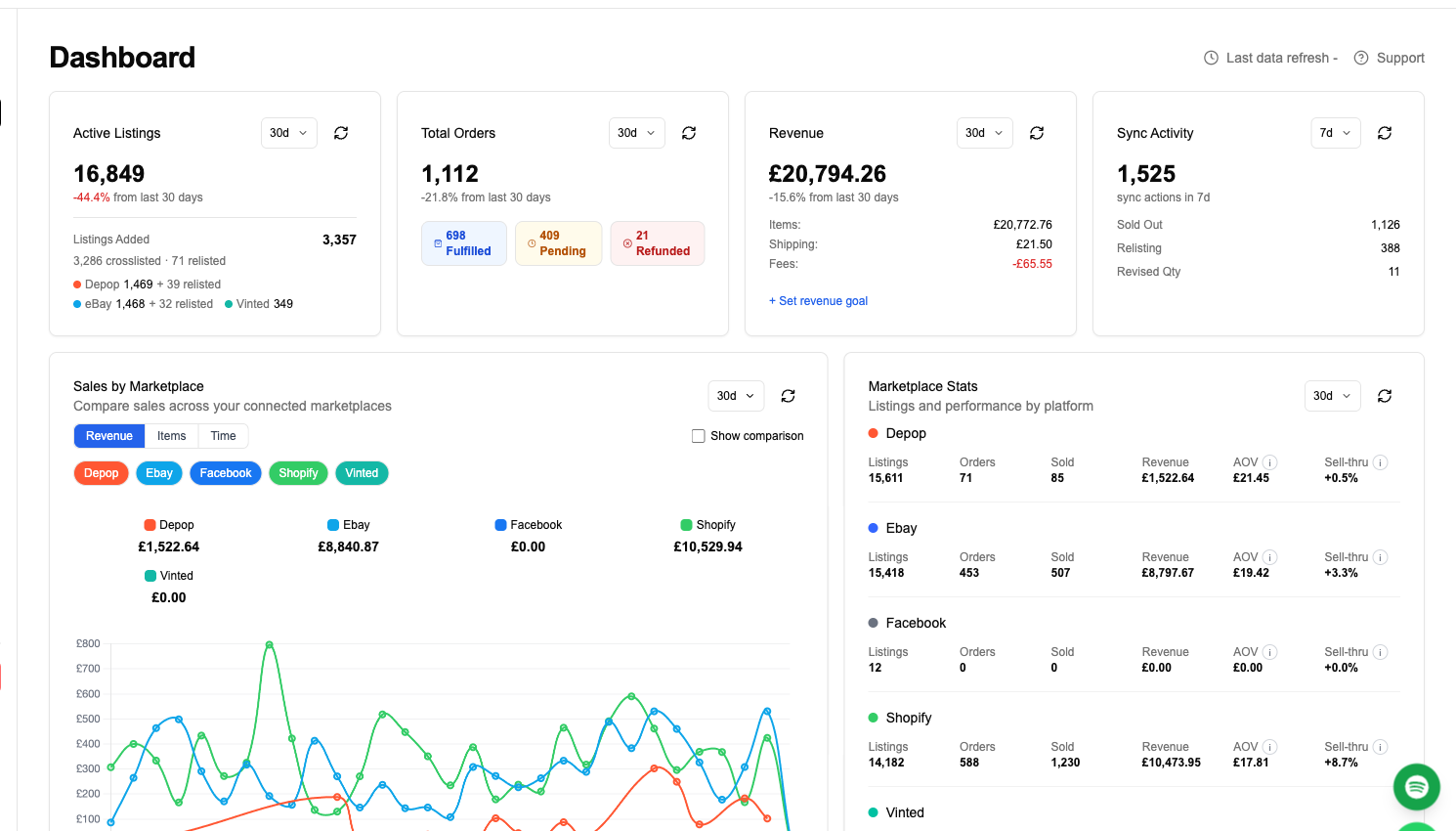
- Cost: FLUF Connect crosslists to 70+ marketplaces from one dashboard. £1 for 7 days, then plans from £9/month (Starter). There is no free plan.
The short answer
If you sell pre-loved clothing, Whatnot is the one you can actually use, and TikTok Shop is the one you have to apply to. That is not a preference, it is a policy difference, and it settles the question for most people reading this before any fee comparison starts.
If you sell new stock — sourced product, your own brand, refurbished electronics with the paperwork — the calculation opens up, and then reach and cost start to matter. TikTok Shop sits on top of a UK audience of over thirty million monthly TikTok users and pushes product through an algorithmic feed. Whatnot is smaller and more deliberate: people arrive intending to buy, and the average session is long.
Below is the detail behind both halves of that, with every number attributed. Where a widely-circulated figure has no primary source, we have said so instead of repeating it.
The second-hand gate, in full
TikTok Shop UK does allow second-hand goods. It is a gate, not a ban — used items are not among its prohibited categories. But the gate is narrow, and the details published in its second-hand product policy, effective 27 August 2026, are strict enough to exclude most independent resellers:
- Second-hand fashion is invite-only, and individual listings are capped at £500. Used underwear, socks and swimwear are banned outright.
- Only three used categories are open without an invitation: books, ungraded trading cards, and golf balls and clubs.
- Titles must contain the words “Second-hand”, “pre-owned” or “pre-loved”, and used fashion listings need at least two images, one of which must show the flaws.
- Graded cards are invite-only, capped at £1,000 per listing, and restricted to named graders including PSA, BGS and CGC.
- Pre-owned electronics means refurbished only, and requires a Companies House number, UKCA or CE marking, a minimum one-year warranty, and data-erasure and diagnostic certification from an approved vendor.
- No second-hand product may appear in a mystery or surprise listing.
Applying for an invitation means submitting your business background, your categories, images of your warehouse and your e-commerce performance data. That is a sensible bar for a platform trying to keep counterfeits out — the City of London Police arrested six TikTok Shop influencers in a counterfeit-goods operation in May 2026 — but it is a bar a one-person reselling business will usually fail on the warehouse-photograph question alone.
Whatnot has nothing equivalent for clothing. Its gated-category list covers Luxury Bags & Accessories, Surprise Sets, supplements and certain foods. General fashion, including used fashion, is not gated, and there is no per-listing price cap. Whatnot’s own 2025 category data puts Women’s Fashion up 223% year on year, behind Beauty at 791%, Electronics at 444% and Jewelry at 259% — so this is a growing part of the platform rather than a tolerated corner of it.
What each one actually takes
The headline rates are close enough to be misleading. What separates them is the base each percentage is applied to.
| Whatnot (UK) | TikTok Shop (UK) | |
|---|---|---|
| Commission | 6.67% + VAT (= 8.0% inc. VAT) | 9%, inclusive of VAT |
| Charged on | Item price only — shipping and taxes excluded | Item price plus buyer-paid shipping plus platform discount, less refunds |
| Payment processing | 2.42% of total order value + £0.25 + VAT | Not stated in TikTok’s own UK fee docs |
| Per-order fee | Included in the above | £0.50 inc. VAT “Shipped by Seller” fee per delivered order |
| Listing or storage fees | None | None |
| Reduced rates | Coins & Money 4% + VAT; 0% on the portion above £1,500 in several collectibles categories | 5% for specified Electronics and some Beauty & Personal Care; reductions do not stack |
| VAT on fees | Not charged if you add a UK VAT number (reverse charge) | Rate is already VAT-inclusive |
Whatnot’s seller fees page is explicit that commission is charged on the item price excluding shipping and taxes, while the processing fee is charged on the whole order value. TikTok Shop’s commission calculation is the opposite: buyer-paid shipping sits inside the base. On a £40 dress with £3.50 postage, TikTok takes 9% of £43.50 and Whatnot takes 6.67% plus VAT of £40. The gap compounds across a category where postage is a meaningful fraction of the order.
Two things worth knowing that do not fit the table. First, TikTok Shop UK’s commission rose from 5% to 9% on 2 September 2024, its first UK increase since launch, and European markets followed at 9% from January 2026 — so anyone quoting 5% is quoting a rate that ended two years ago. Second, Whatnot has run a UK promotion since 16 June dropping the fixed processing component from £0.25 to £0.15 on orders with a subtotal of £10 or less, which matters if you sell a lot of cheap items.
One asymmetry to be honest about: Whatnot is running 0% commission on Fashion in France and Belgium through 31 December 2026, and the UK is not included. UK fashion sellers pay the full 6.67%.
When you get paid, and why it matters more than the fee
This is the difference that changes how you can operate, and almost nobody compares it.
Whatnot’s payout timing page puts UK sellers on a stricter schedule than the US: earnings release once delivery is confirmed and 96 hours have passed since the sale, then land in your bank within one to two business days. Sellers with a high enough rating can use Early Payout, which releases funds when the label is generated. Using your own postage instead of Whatnot’s labels pushes the wait out to seven days.
TikTok Shop UK works on a settlement tier, and new sellers start at the bottom of it. Under the policy effective 15 July 2026, the Introductory tier settles 31 days after delivery. Standard is 8 days, Accelerated 3, Express 1, and moving up requires both a Seller Performance Score threshold and cumulative GMV — Accelerated needs a score of at least 3.0 and over $4,500 in GMV, Express at least 3.5 and over $30,000. After settlement, funds take roughly a further three business days to reach the bank. A separate 30-day reserve can be withheld on top if your seller-fault cancellation rate is high.
For a new seller buying stock, that is the whole argument. Selling a £300 parcel of inventory on Whatnot returns cash inside a week. The same sale on TikTok Shop, from a standing start, returns it in about five weeks — and the reserve can extend that. If you are funding next month’s stock from this month’s sales, the fee difference is a rounding error next to that.
Getting in the door
Whatnot’s seller application is nominally an application and practically instant — most sellers get access right away, and the requirements are living in a supported country and being old enough. All sellers verify a phone number, a payment method and government photo ID through Stripe or Persona. There is no company number, no trading history and no business registration requirement.
Selling is supported in ten countries: the US, the UK, Austria, Australia, Belgium, Canada, France, Germany, Japan and the Netherlands. The UK definition covers Great Britain and Northern Ireland but excludes Jersey, Guernsey and the Isle of Man, and your bank account’s country and currency must match your registration country.
TikTok Shop UK has two seller classes. A Sole Trader needs no company number but must supply a passport or driving licence, a selfie holding the ID, proof of a UK address dated within three months, and an unredacted bank statement. A Corporate Seller must be UK-incorporated with a registration number. Either way you must hold your stock in the UK, ship domestically and accept domestic returns, and the account’s representative must be UK-resident.
There is a quieter implication in that structure. Both TikTok tiers are defined as being in trade or business. Someone clearing out their own wardrobe has no registration path that describes them — whereas Whatnot’s onboarding does not ask the question at all.
On FLUF Connect specifically: our TikTok Shop integration is approved for the United Kingdom only. If you sell from outside the UK, the connection is not available to you regardless of what TikTok Shop supports in your own market.
Do you have to go live?
No, on both — but the non-live routes are shaped very differently.
Whatnot offers three listing formats. Buy It Now listings sit in your Profile Shop and sell at any hour, supporting offers, flash sales, multiple quantities, variants, SKUs and cost-of-goods tracking. Auctions are live-only, with pre-bids and sudden death. Giveaways are free to enter, cost the seller postage, and carry no fees. You can move a Buy It Now item into a show with Reserve for Live. Bulk loading is available by CSV or through the Shopify integration Whatnot added in April 2026.
TikTok Shop’s non-live surface is the feed. Shoppable videos are a standalone channel alongside the Shop tab and product showcase, so your catalogue is discoverable without you ever appearing on camera. Since 11 May 2026 that route is rate-limited to 25 shoppable videos and 50 shoppable photos per account per day, with quality checks before publication.
The honest framing is that Whatnot’s non-live mode is a storefront, and TikTok’s is content. A Whatnot Buy It Now listing keeps working while you sleep because it is a listing. A shoppable video keeps working only as long as the algorithm keeps serving it.
Whatnot’s own survey data ties earnings tightly to live hours: UK sellers who go live daily average around £30,000 a month, and roughly one in eight UK sellers is full-time, streaming about 21 hours a week. Those are company-reported figures from a survey of its own sellers, so treat them as an indication of the ceiling for committed streamers rather than a typical outcome.
Returns, refunds and who carries the risk
TikTok Shop UK gives buyers 30 calendar days from delivery to open a return — more than double the statutory window — and where goods are defective or damaged, the policy states plainly that sellers must bear the cost of return shipping. Sellers must respond within two working days, and missed service levels feed the Seller Performance Score, which in turn governs your settlement tier and any reserve. The penalties compound.
Whatnot applies the statutory UK and EU 14-day right of withdrawal, but its seller protection policy treats those returns gently: they are not counted against your defect rate or Premier Shop status, and sellers are not required to cover the return postage. Whatnot absorbs carrier delays, lost and misdelivered parcels, fraudulent buyer claims, and handles chargebacks itself. Where evidence is inconclusive on condition or damage disputes, it may split or cover the refund up to a reasonable limit. Each decision can be appealed once.
The seller carries the cost for late shipment, policy breaches such as counterfeit or prohibited goods, and failing to answer a buyer within two business days. From 2 March 2026 Whatnot began billing sellers back for refunds on late shipments without proof of drop-off, starting with US domestic orders and extending to other markets over time.
One operational constraint that catches people: on Whatnot you must use the integrated labels. Buying your own Royal Mail postage invalidates buyer protection, and delivery problems then fall on you. Domestic UK shipping runs on Royal Mail and international on DPD, priced by weight and dimensions, with up to 25 Royal Mail collections a day without an Online Business Account.
How big each one actually is
Whatnot raised $545m at a $20bn valuation on 7 August 2026, roughly doubling its October 2025 mark of $11.5bn, having raised about $1.5bn since 2019. It reports $8bn in live sales for 2025, more than double 2024, and claims to have been the number one Shopping app in both the US and UK during 2025. UK new buyers were up 300% across that year. Those last figures are company-reported.
TikTok’s UK numbers are platform-level rather than Shop-level. TikTok Newsroom reported around 6,000 TikTok Shop Lives per day in the UK and LIVE shopping up 55% year on year as of July 2026, with more than 300,000 UK small businesses on TikTok Shop — up from 200,000-plus in November 2025. TikTok itself passed 30 million monthly UK users in early 2025.
We could not find a published TikTok Shop UK GMV figure for any year, and the numbers circulating online have no traceable primary source, so we have not given one. Reach, though, is not really in dispute: TikTok’s audience is an order of magnitude larger than Whatnot’s, and the question is what fraction of it is in a buying posture when your product appears.
Running both with FLUF Connect
Most sellers who compare these two end up running both, because they serve different stock. FLUF Connect holds one master record per item and pushes it to the channels you connect, so the two catalogues do not drift.
| Capability | Whatnot | TikTok Shop |
|---|---|---|
| Create and update listings from FLUF | Yes, via the FLUF browser extension | Yes, over TikTok’s own API |
| Order sync back into FLUF | Yes | Yes |
| Mark as sold when it sells elsewhere | Yes | Yes |
| Automated relisting | No | No |
| Offer management from FLUF | No | No |
| Countries FLUF supports for this channel | UK, US, Germany, France, Austria, Australia, Belgium, Canada, Netherlands | United Kingdom only |
Both channels report orders back into your FLUF dashboard, and both participate in sold-out protection, so an item that sells in a Whatnot show can be pulled from TikTok Shop and the reverse. Neither supports automated relisting or offer management through FLUF today, and we would rather say that than imply otherwise.
Whatnot requires the FLUF browser extension; TikTok Shop does not. Check the FLUF mobile app’s Channels screen for current mobile support.
HMRC, and what both platforms send them
The UK trading allowance is £1,000 gross per tax year. Gross matters: platform fees do not come off before the test. Above it you register for Self Assessment by 5 October following the tax year. A £3,000 filing threshold was announced on 11 March 2025 but is not yet in force, has no start date, and is a filing threshold rather than a tax-free allowance — income between £1,000 and £3,000 stays taxable through a new online service.
Digital platforms have reported seller data to HMRC since 1 January 2024, with the first reports due 31 January 2025. The de minimis is fewer than 30 sales and under €2,000 in a calendar year — both conditions, not either. What gets reported includes your name, address, date of birth, tax identification number, quarterly income, fees withheld, and your bank account and sort code where the platform holds them. HMRC received close to four million seller reports for 2025, up 272% on 2024.
Neither platform has a live-selling exemption. Whatnot reports UK sellers through Ireland, because its reporting entity is not established in the UK, and the Irish authorities exchange the data with HMRC; it asks UK individuals for their National Insurance number and warns that not providing it can mean account closure or withheld payments. TikTok publishes its own UK reporting page confirming the same obligation, with in-app notifications from October 2024.
Two things people miss. The UK VAT registration threshold is £90,000 and counts your sales across all platforms, not per channel. And selling a single personal possession for £6,000 or more can bring capital gains tax into play — relevant if you are moving a luxury bag or a graded card rather than a jumper.
So which one
Pre-loved clothing, one person, no warehouse: Whatnot, and it is not close. No category gate, no £500 ceiling, faster money, lighter returns burden, and onboarding measured in minutes.
New stock, registered business, willing to make content: TikTok Shop’s reach is the strongest argument in UK e-commerce right now, and 300,000 UK businesses have concluded the same. Budget for the 31-day settlement while you climb the tiers, and price with the postage-inclusive commission base in mind.
Collectibles and trading cards: Whatnot’s 0% commission above £1,500 in the collectibles categories is a genuine advantage on high-value single items, and ungraded cards are one of the three open used categories on TikTok Shop — so both are viable, and running both is reasonable.
Refurbished electronics: TikTok Shop is realistically closed to you unless you already hold a Companies House number, UKCA or CE marking, one-year warranties and vendor-issued data-erasure certification. Whatnot’s Electronics category grew 444% in 2025 and has no such gate.
Collectors moving high-value single items: read Whatnot’s fee table twice before assuming the commission is what you pay. Its 0% band on the portion of a sale above £1,500 applies to Comics, Trading Card Games, Sports Singles, Toys & Hobbies and Coins & Money, and it is described as a limited-time arrangement rather than a permanent structure. On a £3,000 graded card the difference between paying 6.67% on the whole amount and paying it on the first £1,500 only is roughly £100, which is worth checking is still in force on the day you list rather than the day you read this.
Sources and verification
- Whatnot seller fees — the UK 6.67% plus VAT commission on item price only, the 2.42% plus £0.25 processing fee on total order value, the 0% band above £1,500, and the France and Belgium fashion promotion the UK is excluded from.
- Whatnot payout timing — delivery plus 96 hours in the UK, Early Payout, and the seven-day wait for own-label shipments.
- Whatnot seller locations and the seller application.
- Whatnot gated categories and listing formats.
- Whatnot seller protection and UK shipping.
- TikTok Shop UK second-hand product policy, effective 27 August 2026 — the invite-only gate, the £500 and £1,000 caps, the three open categories, and the title and image requirements.
- TikTok Shop UK commission calculation and the 9% VAT-inclusive rate.
- TikTok Shop UK settlement tiers — 31, 8, 3 and 1-day tiers and their thresholds.
- TikTok Shop UK seller onboarding and the 30-day UK returns window.
- TikTok Shop shoppable videos — the 25 video and 50 photo daily caps from 11 May 2026.
- The 5% to 9% UK commission rise of 2 September 2024.
- Whatnot’s $545m Series G at a $20bn valuation.
- TikTok Newsroom on UK Shop scale — 6,000 daily UK Lives and 300,000-plus UK small businesses.
- City of London Police counterfeit arrests, May 2026.
- gov.uk on digital platform reporting, the £1,000 trading allowance, the £3,000 filing threshold announcement, and CGT on personal possessions.
- Whatnot’s reporting obligations and TikTok’s UK reporting page.
What we could not verify, and therefore left out. Any TikTok Shop UK GMV figure — TikTok has never published one, and the numbers circulating online have no traceable source. Any TikTok Shop UK payment-processing percentage: its own fee documentation lists none, and the “1.4% plus 20p” figure repeated on blogs has no primary source, so we have recorded the absence rather than the rumour. TikTok’s per-category commission rates beyond the 9% standard and 5% reduced rate, which are published only inside a downloadable spreadsheet. Whatnot’s exact UK launch date, which appears nowhere in its own announcements. Whatnot’s buyer count, as distinct from the 20 million new accounts created in 2025. And any per-listing photo cap on either platform.
Related guides
Frequently Asked Questions
Only by invitation. Under TikTok Shop UK's second-hand product policy effective 27 August 2026, second-hand fashion is invite-only and individual listings are capped at £500, with used underwear, socks and swimwear banned outright. Applying means submitting your business background, categories, images of your warehouse and your e-commerce performance data. Only three used categories are open without an invitation: books, ungraded trading cards, and golf balls and clubs. Whatnot has no equivalent gate for clothing and no per-listing price cap.
Whatnot, in most cases, and the reason is the fee base rather than the headline rate. Whatnot UK charges 6.67% plus VAT commission on the item price only, excluding shipping and taxes, plus a processing fee of 2.42% of total order value plus £0.25 plus VAT. TikTok Shop UK charges 9% inclusive of VAT, but its commission base includes the buyer-paid shipping and platform discount. On a £40 dress with £3.50 postage, TikTok takes 9% of £43.50 while Whatnot takes 6.67% plus VAT of £40. TikTok also adds a £0.50 inc-VAT fee per delivered order shipped by the seller.
Whatnot releases UK earnings once delivery is confirmed and 96 hours have passed since the sale, reaching your bank in one to two business days; Early Payout releases funds on label generation for sellers with a high enough rating. TikTok Shop UK puts new sellers on an Introductory settlement tier of 31 days from delivery, with Standard at 8 days, Accelerated at 3 and Express at 1 — and moving up requires both a Seller Performance Score threshold and cumulative GMV. Add roughly three business days to reach the bank, and a possible further 30-day reserve. For a seller funding stock from sales, that is the whole argument.
No, on both, but the non-live routes are shaped differently. Whatnot's Buy It Now listings sit in your Profile Shop and sell at any hour, supporting offers, flash sales, quantities, variants, SKUs and cost-of-goods tracking, with bulk loading by CSV or through its Shopify integration. TikTok Shop sells through shoppable videos, the Shop tab and product showcase as well as LIVE — but since 11 May 2026 shoppable content is rate-limited to 25 videos and 50 photos per account per day. A Whatnot listing keeps working because it is a listing; a shoppable video works only while the algorithm serves it.
Considerably. Whatnot's application is near-instant — most sellers get access right away, needing only to live in a supported country and verify a phone, a payment method and government photo ID. There is no company number or trading history requirement. TikTok Shop UK asks a sole trader for a passport or driving licence, a selfie holding the ID, proof of a UK address dated within three months, and an unredacted bank statement, and requires you to hold stock in the UK with a UK-resident representative. Both TikTok tiers are also defined as being in trade or business.
Whatnot, clearly. It applies the statutory UK 14-day right of withdrawal, does not require sellers to cover the return postage on those returns, and excludes them from your defect rate and Premier Shop status. It also absorbs carrier delays, lost parcels, fraudulent buyer claims and chargebacks. TikTok Shop UK gives buyers 30 calendar days from delivery and states that sellers must bear the cost of return shipping on defective or damaged goods, with missed service levels feeding your Seller Performance Score and therefore your settlement tier.
Whatnot supports selling in ten countries — the US, UK, Austria, Australia, Belgium, Canada, France, Germany, Japan and the Netherlands — with the UK covering Great Britain and Northern Ireland but excluding Jersey, Guernsey and the Isle of Man. FLUF Connect's TikTok Shop integration is approved for the United Kingdom only, so if you sell from outside the UK the connection is unavailable regardless of what TikTok Shop supports in your market.
FLUF creates and updates listings on both, syncs orders from both, and marks an item sold on one when it sells on the other. Install the FLUF browser extension and stay signed in for Whatnot. Connect TikTok Shop through your seller account; it needs no extension. Neither channel currently supports automated relisting or offer management through FLUF.
Yes, and neither has a live-shopping carve-out. The de minimis is fewer than 30 sales of goods in a calendar year and under €2,000 received — both conditions, not either. Whatnot reports UK sellers through Ireland, because its reporting entity is not UK-established, and asks UK individuals for their National Insurance number, warning that not providing it can mean account closure or withheld payments. TikTok publishes its own UK reporting page confirming the same obligation, with in-app notifications from October 2024. The UK trading allowance is £1,000 gross, and the £3,000 threshold announced in March 2025 is not yet in force.
Sign up for free
Join the community
You're in.
Open your dashboard