
Marktplaats vs Facebook Marketplace: Which Is Better for Dutch Sellers?
How Marktplaats and Facebook Marketplace compare on fees, reach, Kopersbescherming, delivery and scams — and how to run both without selling one item twice.



- Two different shapes of classifieds: Marktplaats is a dedicated Dutch trading site that buyers search on purpose; Facebook Marketplace is a buy-and-sell section inside the Facebook app, built around people near you.
- Costs to the seller: private ads on Marktplaats are free in many categories, with paid categories and paid visibility extras on top. Facebook Marketplace launched in the Netherlands as a free service for buyers and sellers, with payment and delivery left to the two of you.
- Protected payment: Marktplaats offers Kopersbescherming (buyer protection), paid by the buyer, with the money held by a third party until the buyer confirms the item arrived. Facebook’s own checkout-with-shipping is described for the continental United States, so a Dutch Facebook deal is normally cash, a bank transfer or a payment link you agree between you.
- Shipping: Marktplaats buyers can choose PostNL, DHL or Brenger for delivery. On Facebook Marketplace in the Netherlands you arrange collection or posting yourself.
- Scams: fake payment links and “send a small amount to verify” requests target sellers on both. Keep chat and payment inside the platform, and never enter bank details from a link a buyer sends.
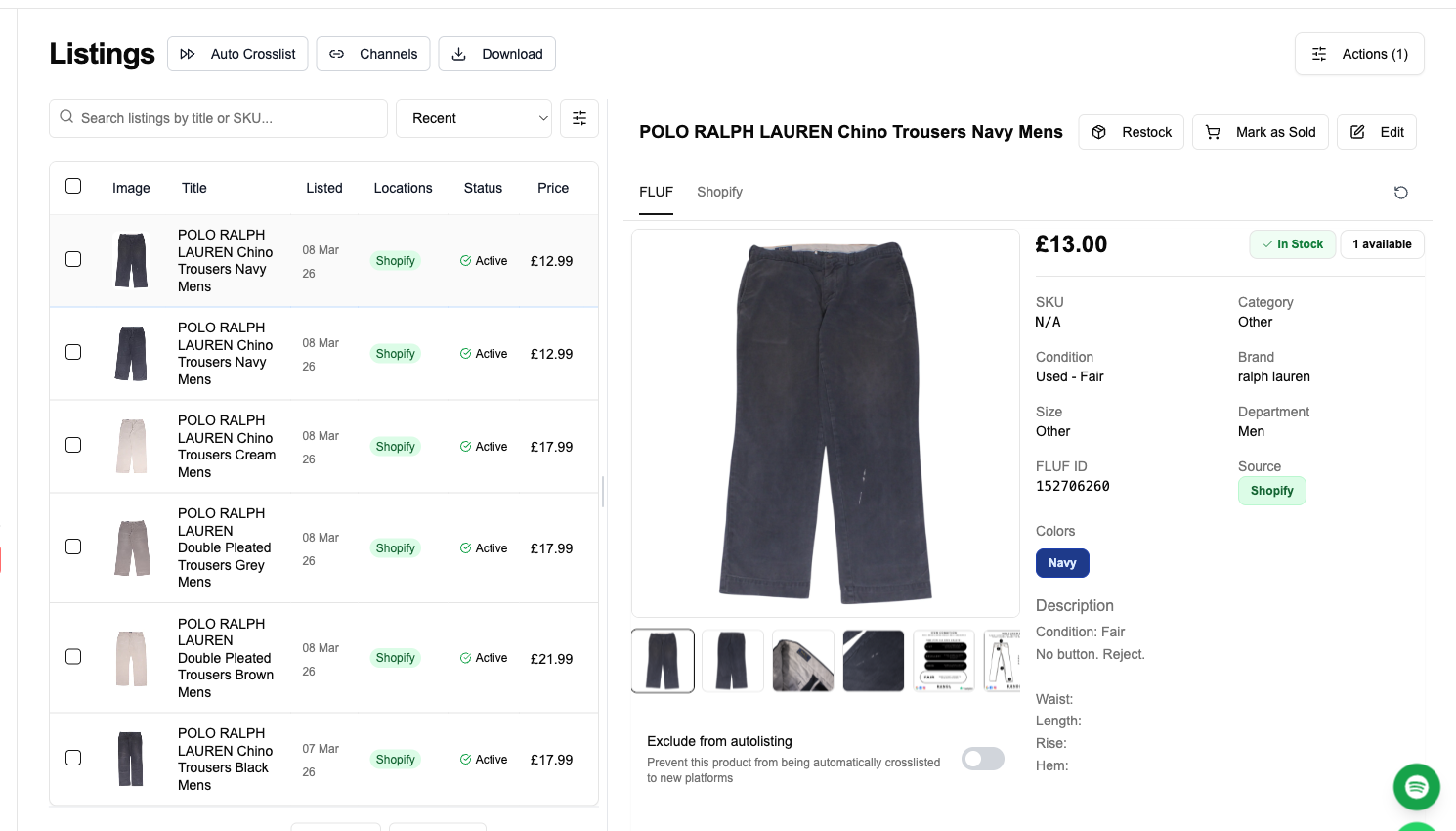
- Using both with FLUF Connect: a Marktplaats sale ends the Facebook listing for you. A Facebook sale is not detected, so you mark it sold in FLUF, which then ends the Marktplaats ad.
On this page
- The two platforms at a glance
- How buyers find your ad
- Placing an ad on each platform
- Fees and worked examples
- Audience and reach
- Payment, protection and delivery
- Scams that target Dutch sellers
- Which platform for which item
- Running both with FLUF Connect
- Sources and verification
- Related guides
The two platforms at a glance
If you sell secondhand goods in the Netherlands, most of your buyers will come from one of two places. The first is Marktplaats, the Dutch trading site that has been part of household life since 1999. The second is Facebook Marketplace, which Meta switched on for Dutch users in August 2017. Both are classifieds at heart: you post an ad, a buyer messages you, and you agree price, payment and handover between you. The differences sit in how buyers arrive, what the platform does for payment and delivery, and how much structure the ad needs.
Marktplaats describes itself as a business of Adevinta with more than 8 million unique visitors a month and around 350,000 new ads a day. Facebook Marketplace was announced on 3 October 2016 for the United States, the United Kingdom, Australia and New Zealand, and reached the Netherlands on 14 August 2017 together with 16 other European countries.
| Marktplaats | Facebook Marketplace (Netherlands) | |
|---|---|---|
| Started | 1999 | 2016 in the US; August 2017 in the Netherlands |
| Owner | Adevinta | Meta |
| Published reach | More than 8 million unique visitors a month (Marktplaats figure) | No Dutch figure published by Meta |
| Where it lives | Its own website and app | A section of the Facebook app and website |
| How buyers find ads | Search, categories and filters | Browsing items near their location, plus search |
| Private ad cost | Free in many categories; some categories are paid | Launched free for buyers and sellers |
| Paid visibility | Topadvertentie, Dagtopper, Omhoogplaatsen | No Marketplace-specific extras covered in this guide |
| Protected payment | Kopersbescherming, paid by the buyer | Not available for local Dutch deals |
| Built-in delivery choice | PostNL, DHL or Brenger when the buyer pays through Marktplaats | You arrange it with the buyer |
How buyers find your ad
The most useful way to think about the two platforms is not size but intent. On Marktplaats, a buyer usually types what they want: “kinderfiets 20 inch”, “eettafel eiken”, “iPhone 13”. They then narrow the results by distance, price and condition. Your ad wins when its title matches those words and it sits in the right category. A well-chosen category matters on Marktplaats because the category decides which filters a buyer can use to reach you.
On Facebook Marketplace, a large share of buyers are not searching for anything in particular. They open the Marketplace tab and scroll through items for sale around them. When Facebook introduced the feature, it said the section showed items for sale from people nearby, which buyers could filter by location, category or price. Buyers can search too, but the first photo and the price do most of the selling, because that is all a scrolling buyer sees before they tap.
That difference shapes how you write. For Marktplaats, lead the title with the thing, the brand and the key specification, and fill in the category attributes. For Facebook Marketplace, spend your effort on the first photo: daylight, a plain background, the whole item in frame. A short title that states what it is and one fact that matters (size, model, “werkt perfect”) is usually enough.
Local versus national
Marktplaats covers the whole of the Netherlands. A buyer in Groningen can find your ad in Breda, and if you offer shipping through Marktplaats, distance stops being a barrier. That makes it the natural home for items where the right buyer is rare: a specific camera lens, a vintage record player, spare parts for a particular scooter.
Facebook Marketplace is organised around where you are. That is a strength for anything a buyer has to collect in person, such as a wardrobe, a washing machine or a garden set. It is weaker for niche goods, because the few people who want your item may simply live too far away to see it.
Placing an ad on each platform
Marktplaats
On Marktplaats you pick a category, add photos, write a title and description, set a price, confirm your postcode and choose whether you can ship. Private sellers can place ads in the free categories without paying; other categories, cars among them, carry a charge that Marktplaats shows before you publish. Buyers contact you through Marktplaats Berichten, the site’s own messaging.
If an ad needs more attention, Marktplaats sells visibility extras: Topadvertentie, Dagtopper and Omhoogplaatsen, each designed to put your ad in front of more buyers. Prices depend on the category and are shown at the point of purchase, so check them in the app rather than relying on a figure from a guide.
Facebook Marketplace
Facebook’s own description of the flow is short: take a photo, add a description and price, confirm your location and category, and post. You sell under your personal Facebook profile, and buyers message you through Facebook. There is no separate account to create, which is why many Dutch households who have never used Marktplaats are comfortable posting on Facebook.
What each platform asks of you
| Step | Marktplaats | Facebook Marketplace |
|---|---|---|
| Account | A Marktplaats account | Your Facebook profile |
| Category | Chosen from a detailed tree; drives filters | Chosen from a shorter list |
| Location | Postcode | Your location on Facebook |
| Delivery | Optional shipping through Marktplaats | Arranged with the buyer |
| Messages | Marktplaats Berichten | Facebook messaging |
Handling enquiries
On both platforms most of the work starts after the ad goes live. Expect questions such as “is dit nog beschikbaar?”, price offers well below asking, and buyers who agree a pickup time and do not arrive. Two habits help on either site. First, put collection details in the ad (area, days you are home, whether you can help carry) so you answer them once. Second, keep every conversation inside the platform’s own messages. Marktplaats explicitly advises sellers to arrange everything in Marktplaats Berichten rather than moving to WhatsApp or email, because the move off-platform is often the first step of a scam.
Fees and worked examples
For a private seller, neither platform takes a commission on a local sale that you settle yourself. The money questions are about extras on Marktplaats and about who pays for payment protection.
| Cost | Marktplaats (private seller) | Facebook Marketplace (Netherlands) |
|---|---|---|
| Placing an ad | €0 in free categories; a charge in paid categories such as cars | €0; the service launched free for buyers and sellers |
| Commission on a sale you settle yourself | €0 | €0 |
| Payment protection | Kopersbescherming, always paid by the buyer | Not offered for local Dutch deals |
| Visibility extras | Topadvertentie, Dagtopper, Omhoogplaatsen (price shown in app) | None covered here |
| Postage | Chosen and paid for through Marktplaats when the buyer picks shipping | Whatever you agree with the buyer |
Worked example: a €30 lamp collected from your door
- Marktplaats: free category, no extras, buyer pays cash or by bank transfer on collection. You receive €30.
- Facebook Marketplace: same deal, same result. You receive €30.
At this price the only way Marktplaats costs you anything is if you buy a visibility extra. A single Topadvertentie on a €30 item can take a visible bite out of what you keep, so try a better title and first photo before paying.
Worked example: a €120 pair of headphones sent by post
- Marktplaats: the buyer pays through Marktplaats, picks PostNL or DHL and pays the Kopersbescherming charge on top of your price. The payment is held by Online Payment Platform, and it is released to you once the buyer confirms receipt, or automatically after 48 hours if the buyer does nothing. You receive your asking price.
- Facebook Marketplace: there is no protected checkout for this deal in the Netherlands. You and the buyer agree how to pay and how to post it. If you post before you are paid, the risk is yours; if the buyer pays first, the risk is theirs, which is why many Dutch buyers refuse to send money to a stranger on Facebook.
Costs that never appear in a fee table
- No-shows: a buyer who reserves the item and never arrives costs you a weekend and sometimes a real buyer you turned away. Both platforms have this problem.
- Low offers: buyers on both platforms often open well below your asking price. Decide your lowest price before you post.
- Chasing visibility: in busy Marktplaats categories it is easy to keep buying extras week after week. Set a limit per item.
- Fraud losses: a single fake payment link can cost far more than any fee. See the scams section below.
Audience and reach
Marktplaats is unusually open about its numbers. The company’s about page gives more than 8 million unique visitors a month, about 350,000 new ads a day and roughly 18.7 million live ads, and Adevinta’s brand page calls it the largest online trading platform in the Netherlands. On its 25th birthday in May 2024, Marktplaats also said that 19 million products a year find a new owner through the site and that “gratis” was searched more than 14.5 million times in the first quarter of that year.
Meta does not publish a Dutch Marketplace user count, and we have not used third-party estimates in its place. What Facebook did say at launch is telling: more than 450 million people a month were visiting buy-and-sell groups before Marketplace existed. Marketplace was built to give those group sellers a proper home, and that is still how it feels in the Netherlands: local, informal and busy with household goods.
The “gratis” figure is worth pausing on. A large share of Marktplaats traffic is people looking for bargains and giveaways. If you price high on Marktplaats, you are competing with a lot of cheap and free stock in the same results. On Facebook, where browsing is local, your neighbours are the competition, and a fair price for your area matters more than a national average.
| Marktplaats | Facebook Marketplace | |
|---|---|---|
| Buyer mindset | Looking for a particular thing, comparing prices | Browsing what is for sale nearby |
| Reach of one ad | The whole country, especially with shipping | Mostly your own area |
| Strong categories | Almost everything, from cars and bikes to parts and hobby goods | Furniture, household goods, children’s items |
| What wins the sale | Right category, clear title, fair price | First photo, price, quick replies |
Payment, protection and delivery
Kopersbescherming on Marktplaats
Kopersbescherming is Marktplaats’s protected payment. The buyer pays through Marktplaats, Online Payment Platform (OPP) holds the money on an intermediate account, and the seller is paid once the buyer confirms the item arrived as described, or automatically after 48 hours if the buyer takes no action. The protection applies when the buyer chooses delivery with PostNL, DHL or Brenger, and the charge for it is always the buyer’s.
For you as a seller the practical effect is simple. A distant buyer who would never transfer money to a stranger can buy with confidence, and you do not have to trust a screenshot of a bank transfer. The cost is borne by the buyer, so your price stays your price. Brenger is useful for bulky items: it lets a buyer elsewhere in the country arrange delivery of something that would never fit in a PostNL box.
If you read older Dutch guides, you will see the name Gelijk Oversteken. That was Marktplaats’s previous protected payment, and consumer programme Kassa reported in April 2022 that Marktplaats had stopped it. Kopersbescherming is the current service, so ignore any advice built around Gelijk Oversteken fees.
Facebook Marketplace in the Netherlands
When Marketplace arrived in the Netherlands, NOS reported that Facebook did not handle payment or shipping; buyers and sellers arranged both themselves. Facebook has since added checkout with shipping, but its help centre describes that as buying and selling across the continental United States. For a Dutch seller, a Facebook sale is still a private arrangement.
In practice that means one of three routes:
- Cash on collection: the buyer sees the item, pays, and takes it. This is the safest route for both sides and suits bulky goods.
- A bank transfer or payment request you create: fine when you know the money has actually arrived in your own banking app before the item leaves your hands.
- Posting after payment: possible, but the buyer carries all the risk, so expect fewer takers for anything expensive.
Delivery compared
| Marktplaats | Facebook Marketplace (Netherlands) | |
|---|---|---|
| Collection in person | Yes | Yes, the usual route |
| Carriers offered by the platform | PostNL, DHL, Brenger | None; you choose and book |
| Payment held until receipt | Yes, with Kopersbescherming | No |
| Who pays for protection | The buyer | Not applicable |
Scams that target Dutch sellers
Both platforms attract fraudsters, and in the Netherlands the tricks aimed at sellers are well documented. Marktplaats keeps a payment fraud page that describes the main ones, and the advice applies just as well to Facebook.
The fake payment link
A “buyer” agrees to your price with no haggling and sends a link so you can “receive the money”. The page looks like Marktplaats, iDEAL or Tikkie, but Marktplaats warns that the link leads to a fake payment site that asks for your bank details. You never need to log in to your bank to receive money. If a link asks you to, close it.
The small “verification” payment
Another version asks you to transfer a small amount, often a cent, “to check that you are real”. The request usually arrives on WhatsApp or as a payment request. Marktplaats names this tactic directly; the payment page is fake, and the goal is access to your bank account, not your cent.
Warning signs on either platform
- The buyer wants to move the chat to WhatsApp or email early.
- The account is brand new or has no history.
- The buyer agrees to your price without seeing the item or asking a single question, then pushes for a payment method you did not suggest.
- A courier “will collect” and you just need to confirm a payment first.
- Web addresses with small misspellings of a familiar name.
How big is the problem on Facebook?
There is no Dutch study we could verify. The best primary figure comes from the United Kingdom: in January 2024, TSB said that 34% of the Facebook Marketplace adverts it tested could be scam posts and that Marketplace accounted for 73% of its purchase fraud cases. Those are UK numbers from one bank’s customers, not Dutch ones, but they explain why Dutch buyers are wary of paying strangers on Facebook in advance, and why cash on collection remains the norm there.
On Marktplaats, the same page advises using the site’s own Betalen en Verzenden route for shipped sales. For sellers, keeping payment inside Marktplaats removes the need to judge whether a transfer is real.
Which platform for which item
Rather than picking a winner, match each item to where its buyers are. The table below reflects the differences described above: search and national reach on Marktplaats, local browsing on Facebook.
| Item | Better starting point | Why |
|---|---|---|
| Sofa, wardrobe, dining table | Both | Collection is local on either; Facebook shows it to neighbours, Marktplaats adds Brenger delivery for buyers further away |
| Children’s bike, pram, toys | Both | Families search Marktplaats and browse Facebook locally |
| Phone, camera, games console | Marktplaats | Shipped sales with Kopersbescherming protect both sides |
| Rare parts, records, hobby gear | Marktplaats | The right buyer may be anywhere in the country and will search for it |
| Garden furniture, household clear-out | Facebook Marketplace | Local buyers browsing nearby items, collected with cash |
| Car | Marktplaats | A paid category, but it is where Dutch car buyers search; check the charge before publishing |
Choose Marktplaats first if you
- want to post items and be paid through a protected route
- sell things a buyer will search for by name or model
- need buyers across the whole country, not only your town
- are happy to fill in categories and attributes properly
Choose Facebook Marketplace first if you
- sell bulky household goods that buyers collect
- prefer cash on collection
- already use Facebook daily and want the lightest possible way to post
- sell everyday items where a local buyer is easy to find
Running both with FLUF Connect
Many Dutch sellers end up posting the same item on both. The problem is not the posting; it is what happens when it sells. If the wardrobe goes to a Marktplaats buyer on Saturday morning and you forget the Facebook ad, you spend the afternoon apologising to people who wanted to collect it.
FLUF Connect lets you keep one catalogue and publish from it to Marktplaats, Facebook Marketplace and the other 51 marketplaces it supports. You connect both platforms with the FLUF browser extension. What happens after a sale depends on where it sold, and the two directions are not the same:
| What FLUF does | Marktplaats | Facebook Marketplace |
|---|---|---|
| Publish from your FLUF catalogue | Yes | Yes |
| Notices a sale on this platform | Yes | No — you mark it sold in FLUF |
| Ends this listing when the item sells elsewhere | Yes, for sales FLUF has detected or you have marked sold | Yes, for sales FLUF has detected or you have marked sold |
| Relisting | Yes, on the plans above Starter | No |
If it sells on Marktplaats
FLUF notices the sale, updates your stock, and ends the Facebook Marketplace listing for you. You do not need to touch Facebook.
If it sells on Facebook Marketplace
FLUF does not detect sales on Facebook Marketplace. When you agree a Facebook sale, open FLUF and mark the item sold. FLUF then ends the Marktplaats ad for you. If you skip this step, the Marktplaats ad stays live and can still attract a buyer.
Relisting
On the plans above Starter, FLUF can relist items on Marktplaats so an ad that has gone quiet appears as a new one. FLUF does not relist on Facebook Marketplace; repost those listings yourself when you want them to show up fresh.
What to check before you publish
- Category on Marktplaats: confirm the category and its attributes fit the item, because buyers filter by them.
- Paid categories: if the item belongs in a paid Marktplaats category, check the charge before publishing.
- Location: make sure the pickup area is right on both platforms, since Facebook shows items by location.
- Price: decide whether you want the same price on both, or a slightly lower Facebook price for a quick local sale.
- First photo: the same image leads on both, so choose the clearest one.
- Delivery wording: say in the description whether the item is collection only or can be posted, so Facebook buyers do not expect Marktplaats-style shipping.
Plans
7 days for £1, then from £9/month, then plans from £9/month. Starter is £9/month with unlimited listings; Growth is £19/month and Seller is £29/month. Crosslisting, inventory sync, order sync and bulk operations are on every plan; relisting, offer management and smart pricing come with the plans above Starter.
Sources and verification
- Marktplaats: Over Marktplaats — founded 1999, part of Adevinta, more than 8 million unique monthly visitors, about 350,000 new ads a day, around 18.7 million live ads.
- Adevinta: Marktplaats brand page — largest online trading platform in the Netherlands.
- Marktplaats press room: 25 jaar Marktplaats (19 May 2024) — 19 million products reused a year; “gratis” searched more than 14.5 million times in Q1 2024.
- Marktplaats: advertentietarieven — free and paid categories; Topadvertentie, Dagtopper and Omhoogplaatsen.
- Marktplaats: Kopersbescherming — buyer pays, OPP holds the money, PostNL, DHL or Brenger, payout on confirmation or after 48 hours.
- Marktplaats: Betaalfraude — fake payment links, small verification payments, keeping contact in Marktplaats Berichten.
- BNNVARA Kassa (April 2022) — Marktplaats stopped Gelijk Oversteken.
- Meta newsroom: Introducing Marketplace (3 October 2016) — first countries, posting steps, 450 million monthly visitors to buy-and-sell groups.
- NOS (14 August 2017) — Dutch launch with 16 other European countries; free; payment and shipping arranged by users.
- Facebook Help Centre: About shipping on Marketplace — shipping described for the continental United States.
- TSB (18 January 2024) — UK figures: 34% of tested adverts could be scams; 73% of TSB purchase fraud cases.
What we could not verify. Meta does not publish the number of Facebook Marketplace users in the Netherlands, so we give no Dutch figure. The exact Kopersbescherming percentage and any minimum or maximum were not shown on the Marktplaats pages we could load, so we say only that the buyer pays it. Current prices for Topadvertentie, Dagtopper, Omhoogplaatsen and paid categories vary by category and are shown in the Marktplaats app. We found no primary Dutch statistic on how often sellers meet fake payment links on either platform.
Related guides
Frequently Asked Questions
For a private seller, largely yes. Marktplaats lets you place ads in its free categories at no cost; some categories, such as cars, are paid, and visibility extras like Topadvertentie cost money. Facebook Marketplace launched in the Netherlands in 2017 as a free service for buyers and sellers. Neither takes a commission on a local sale you settle yourself.
Not for ordinary Dutch deals. Facebook’s help centre describes checkout with shipping for the continental United States. In the Netherlands you agree payment and collection or posting directly with the buyer, usually cash on collection or a bank transfer you can see has arrived.
Kopersbescherming is Marktplaats’s buyer protection. The buyer pays through Marktplaats and chooses delivery with PostNL, DHL or Brenger. Online Payment Platform holds the money until the buyer confirms the item arrived, or releases it automatically after 48 hours if the buyer does nothing. The charge is always paid by the buyer, so you receive your asking price.
No. Consumer programme Kassa reported in April 2022 that Marktplaats had stopped Gelijk Oversteken. Kopersbescherming is the current protected payment on Marktplaats, so ignore older advice about Gelijk Oversteken fees.
Keep all messages inside Marktplaats Berichten or Facebook’s own messaging, never open a payment link a buyer sends you, and never log in to your bank to “receive” money. Marktplaats warns about fake links that imitate Marktplaats, iDEAL or Tikkie, and about requests to transfer a small amount “to verify” your account. On Facebook, cash on collection is the safest route.
Both work. Facebook Marketplace shows your sofa or wardrobe to people nearby who can collect it. Marktplaats reaches buyers across the Netherlands and lets them choose Brenger delivery for bulky items. Many sellers post large furniture on both.
If it sells on Marktplaats, FLUF notices the sale and ends the Facebook Marketplace listing for you. FLUF does not detect sales on Facebook Marketplace, so when something sells there, mark it sold in FLUF and FLUF ends the Marktplaats ad. Until you do, the Marktplaats ad stays live.
FLUF relists on Marktplaats on the plans above Starter. It does not relist on Facebook Marketplace, so repost those listings yourself when you want them to look fresh.
There is a 7-day trial for £1, then Starter at £9/month with unlimited listings, Growth at £19/month and Seller at £29/month. Crosslisting, inventory sync, order sync and bulk operations are on every plan; relisting, offer management and smart pricing come with the plans above Starter. FLUF Connect supports 50+ marketplaces.