
Mercari vs Etsy: Which Is Better for Sellers in 2026?
Not a fee comparison — an eligibility comparison. Most Mercari inventory cannot legally be listed on Etsy, and the headline rates are five cents apart. Compared honestly, with sources. Or sell on both across 60+ channels.
7 days for £1, then from £9/month.



- This is not a fee comparison, it is an eligibility comparison. Most of what sells on Mercari cannot legally be listed on Etsy at all. Etsy’s own words: “Dropshipping and reselling are not allowed on Etsy, except in the specific cases outlined in this Help article, such as craft supplies.”
- Choose Etsy if you made it, designed it, curated it at 20 years old or more, or it is a craft supply — and you want a global buyer base with high average order values.
- Choose Mercari if you are clearing secondhand goods in the United States and want no listing fees, no advertising levy and no origin test.
- Headline rates are close; the shape is not. On a $100 sale Mercari’s seller pays $10.00 and Etsy’s pays about $9.95. But Etsy charges $0.20 per listing every four months whether or not it sells, and Offsite Ads can take the same order to $24.95.
- Reach is one-sided. Etsy is global, with about 87 million active buyers. Mercari US ships within the 50 states and DC only — no territories, no military addresses.
- Both platforms recently changed something important. Mercari reinstated a 10% seller fee on 6 January 2025 after ten months of charging nothing. Etsy sold Depop to eBay on 30 July 2026 and is now a single-marketplace company.
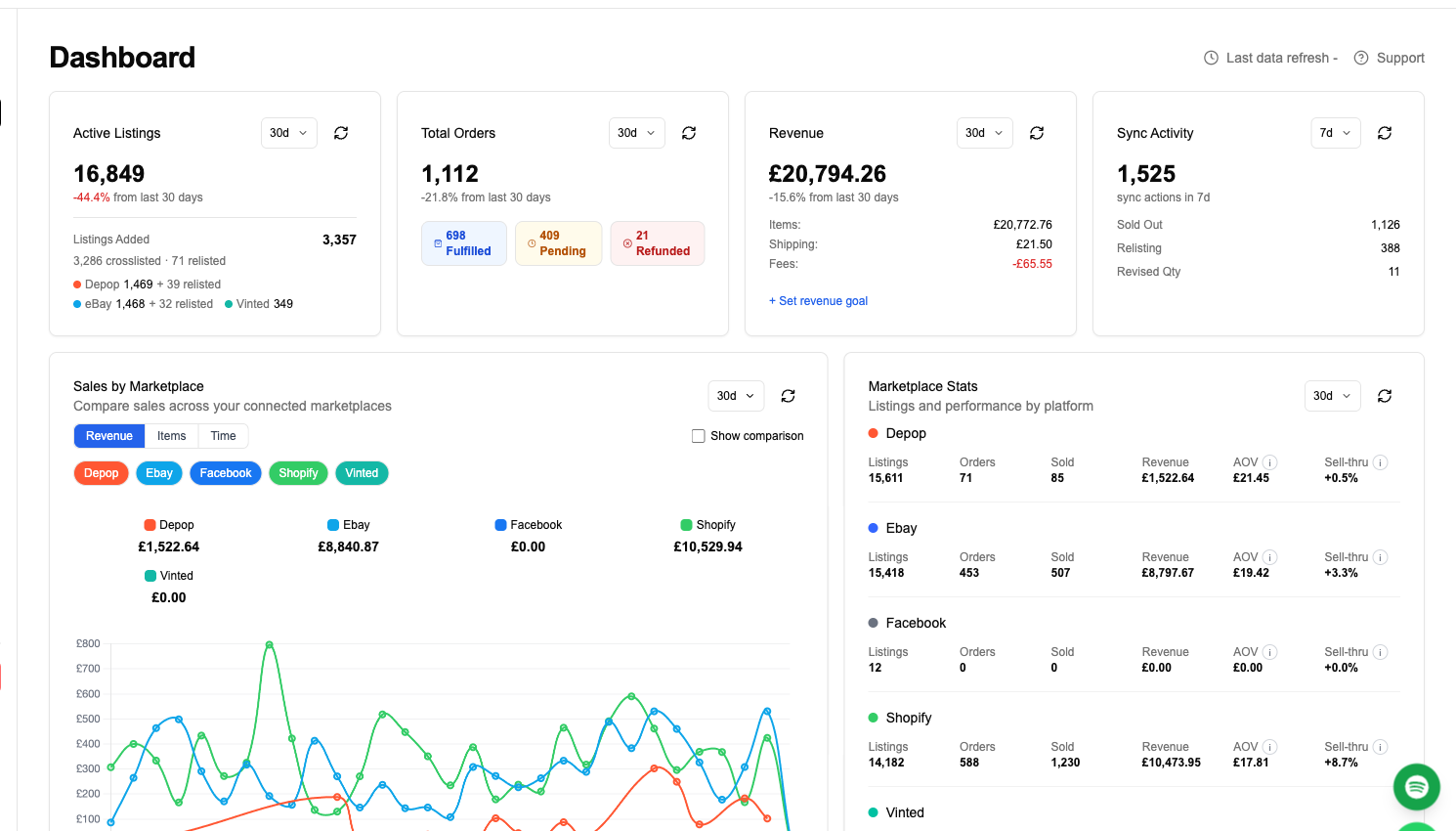
- Best strategy: sell on both, if your stock qualifies for both. Crosslist with FLUF Connect from £1 for 7 days, then plans from £9/month (Starter). There is no free plan.
At a glance
The short answer: Etsy decides what you are allowed to sell and charges a fee at every stage of the listing’s life; Mercari decides almost nothing about your stock and charges once, when it sells. A used iPhone, a pair of resold Jordans, a 2019 games console and a boxed Lego set are all perfectly listable on Mercari and all fall outside Etsy’s four permitted routes.
| Mercari | Etsy | |
|---|---|---|
| What it is | A US consumer-to-consumer marketplace for used and secondhand goods | A global marketplace for handmade, designed, vintage and craft-supply goods |
| Origin test | None. Items must be legal to sell and ship, and yours before you sell them | Yes — everything must be made, designed, handpicked or sourced by a seller |
| Where you can sell | United States only, 50 states and DC. No territories, no military addresses | Global, with Etsy Payments across dozens of countries |
| Listing fee | None. “Listing an item is always free on Mercari” | $0.20 per listing, charged again every four months |
| Seller fee on a $100 sale | $10.00 — a flat 10% | About $9.95 — $0.20 listing, 6.5% transaction, 3% + $0.25 processing |
| Buyer-side fee | A Buyer Protection fee of 3.6% | None |
| Advertising levy | None | Offsite Ads at 15%, or 12% and compulsory once the shop passes $10,000 in a trailing year |
| Active buyers | Not published in comparable form | About 87 million, trailing twelve months to 30 June 2026 |
| Company | Mercari, Inc. (US), a subsidiary of Mercari, Inc. of Japan | Etsy, Inc. — a single-marketplace company since selling Reverb in 2025 and Depop to eBay in July 2026 |
The wall, and which way it faces
Everything else on this page is downstream of one asymmetry, so it is worth being precise about it.
Etsy’s gate. Etsy’s Seller Policy, effective 9 July 2026, requires that “everything listed for sale on Etsy must be made, designed, handpicked, or sourced by a seller”. Its Creativity Standards set out the four routes:
| Route | What it covers |
|---|---|
| Made by a seller | “Physical items made by a seller by hand or using personal or computerised tools” — hand-crafted, hand-altered, hand-assembled, or produced by you on your own laser cutter, 3D printer or Cricut from your own design. |
| Designed by a seller | Your original design produced by a third-party production partner, or sold as a digital download. Production partners must be disclosed, and AI use must be disclosed. |
| Handpicked by a seller | “Items that are 20+ years old, that the seller personally curated or collected”, items from nature, and themed gift baskets you assembled. |
| Sourced by a seller | Craft supplies, craft blanks, craft kits and party supplies — things whose purpose is to let the buyer make something. |
Then the exclusions, quoted from Etsy’s own document, which are what actually decide this comparison. Not qualifying: “Resold clothing that is ready-to-use as-is, without further crafting”. “Resold commercially available items that are newer than 20 years old, even if the item is designed to appear vintage”. “Resold blank items that are ready to use without craft intervention, such as blank t-shirts, hats, or tumblers”. “Resold generic cooking tools or ingredients; chemical compounds; automotive/bicycle parts and repair tools; office, construction, gardening, cosmetic, or home DIY supplies”. “Electronics that can be used outside of special events”. Etsy also excludes items assembled per manufacturer instructions — flatpack furniture, a Lego set — and commercial items given only “superficial alteration”.
Enforcement is real and asymmetric in Etsy’s favour: “Etsy may remove any listings that violate our policies”, and “note that listing fees are non-refundable”. You pay to list something Etsy then takes down.
Mercari’s gate. There is not one, in the same sense. Mercari’s Marketplace Guidelines require only that items be legal to sell and legal to ship under federal, state and local law, and that you own the item before selling it. Its prohibitions are about safety and legality — counterfeits, weapons, restricted ingestibles, stolen goods and so on — rather than about where an item came from. It has a Handmade category as well.
Mercari does have two structural rules an Etsy seller notices immediately. Digital items are prohibited outright: “any items where the order is fulfilled electronically or requires a download”. And it bans “listing items not in your possession, shipping from a third party or stating the item will be shipped at a future date” — which blocks made-to-order, personalised, pre-order and print-on-demand work.
So the wall faces one way. A Mercari catalogue mostly cannot go to Etsy. An Etsy catalogue mostly can go to Mercari, minus anything digital and anything you have not made yet. That is the practical shape of the relationship, and it is why so few sellers genuinely sit on both.
Feature by feature
| Feature | Mercari | Etsy |
|---|---|---|
| Shop identity and branding | None — business and retail account names are prohibited | Full shop, About section, policies, banner |
| Variations | None. One listing represents one item, and duplicates are removed | Up to three variation types, with per-variant price, SKU and quantity |
| Multi-quantity listings | No | Yes, auto-renewing at $0.20 after each sale |
| Digital goods | Prohibited | Supported as a first-class product type |
| Made-to-order and personalisation | Blocked by the possession rule | Supported, with production-partner disclosure |
| Condition field | Five values: New, Like New, Good, Fair, Poor | None for handmade; “when did you make it” instead |
| Automatic markdowns | Smart Pricing walks the price toward a private floor | Sales and discounts, seller-set |
| Authentication | Mercari Authenticate at $5, plus $10 for a certificate | Not applicable |
| Advertising | None to buy | Etsy Ads, plus Offsite Ads which becomes compulsory above $10,000 |
| Subscription | None | Etsy Plus at $10 a month; Pattern at $15 a month |
| Photos per listing | Up to 12 | Up to 10 |
Fees, in full
| Component | Mercari | Etsy (US shop) |
|---|---|---|
| Listing | Free, always | $0.20 per listing, whether or not it sells; listings expire after four months and auto-renew at $0.20 |
| Commission | 10% of item price plus buyer-paid shipping, since 6 January 2025 | 6.5% of the displayed price plus what you charge for delivery and gift wrapping |
| Payment processing | None. The old 2.9% plus $0.50 was removed on 6 January 2025 | 3% + $0.25, on the total sale including tax and postage |
| Buyer-side | Buyer Protection fee of 3.6% of item plus buyer-paid shipping | None |
| Advertising | None | Offsite Ads at 15%, dropping to 12% and becoming compulsory for the lifetime of the shop once you pass $10,000 in the prior 365 days. Capped at $100 per attributed order, with a 30-day attribution window |
| Currency conversion | Not applicable | 2.5% if the listing currency differs from the payment account currency |
| Faster payout | Instant Pay at $3, once a day, capped at $600 a month | Instant transfer for eligible US sellers, fee shown at transfer |
| Other | $2 on a failed direct deposit; Authenticate at $5, or $15 with a certificate | A one-time shop set-up fee, amount varying by location and not published |
The $100 sale. On Mercari, item only: the seller pays $10.00 and the buyer pays $103.60. On Etsy, US seller with free shipping and no ads: $0.20 plus $6.50 plus $3.25, which is $9.95, or 9.95%. Five cents apart.
Which makes the headline comparison useless on its own, and puts the real difference in two places.
First, the cost of having stock. Etsy charges $0.20 to list and $0.20 again every four months. Five hundred listings renewing three times a year is $300 before a single sale, and it is charged on items that never sell at all. Mercari charges nothing for a listing that sits. For a seller with deep, slow inventory that is the whole argument.
Second, Offsite Ads. That same $100 Etsy order, if attributed to an offsite advertisement, costs $24.95 rather than $9.95. Below $10,000 in trailing-year sales you can opt out. At $10,000 you cannot — and Etsy is explicit that opting out beforehand does not save you: you will be required to participate at 12% on attributed orders for the lifetime of the shop, even if sales later fall back below the threshold.
One historical correction, because it is still repeated everywhere. Mercari removed seller fees in March 2024 and reversed it on 6 January 2025. Anyone telling you Mercari is free for sellers, or that it charges 2.9% plus $0.50 in processing, is quoting a structure that ended nineteen months ago.
Reach, and where each one actually operates
Mercari US is domestic. Its prepaid labels cover the 50 states and the District of Columbia, with “no support for U.S. territories or military addresses”. That is the whole market.
Its history outside the US is short. Mercari launched in the UK in March 2017 and closed it in January 2019, with the last day to buy or sell on the 15th; the UK entity subsequently went through insolvency proceedings. Mercari Japan is a separate marketplace under the same parent. In June 2026 Mercari launched a standalone Global App in the United States, letting US buyers shop Japanese Mercari inventory — note the direction. It runs Japan to the US, not US to the world, and a US seller on Mercari US still sells only to US buyers.
Etsy is global, with Etsy Payments operating across dozens of countries at per-country processing rates. It has also been shedding everything that is not Etsy: it sold Reverb on 2 June 2025, and completed the sale of Depop to eBay on 30 July 2026 for $1.4 billion in cash. Etsy, Inc.’s continuing operations now reflect the Etsy marketplace alone.
Scale and what sells
Etsy publishes properly, because it has to. From its quarter ended 30 June 2026, filed with the SEC: about 87 million active buyers, down 0.4% year on year; about 5.7 million active sellers, up 5.9%; merchandise sales of $2,582.9 million for the quarter, with the Etsy marketplace up 7.5%; revenue of $668.3 million; and a take rate of 25.9%, up 130 basis points, which Etsy attributes primarily to Etsy Ads. Trailing-twelve-month merchandise sales per active buyer were $124.
Two of those numbers deserve to sit together: buyers down 0.4%, sellers up 5.9%. That is more sellers competing for the same buyers, and it is Etsy’s own reporting rather than anyone’s commentary.
On categories, Etsy’s Q2 2026 shareholder letter is specific. “Vintage reached its strongest recent pace of growth in 1H26 as buyers increasingly turned to Etsy for distinctive, hard-to-find vintage items across collectible watches, furniture, and home decor.” Growth surged in toys and games and in cultural trends such as Mahjong and custom card games. Occasion-led categories — Mother’s Day, Father’s Day, graduation — grew solidly, with birthdays and weddings both up double digits. Etsy’s strategic line is that “handmade is a point of differentiation to lean into”.
Mercari publishes far less about its US business, and we are not going to fill the gap with numbers we cannot stand behind. It does not disclose US active buyers or a US merchandise figure in a form comparable to Etsy’s SEC filings, and the registered-user totals that circulate are not company-stated.
What Mercari does tell you is written into its product. It carries a dedicated First-Class Envelope label for trading cards up to 3 oz, and USPS Media Mail for books, films and printed music. Platforms build label types around the things people actually ship. Its own commentary attributes recent US growth to strong demand in entertainment and hobbies. Read the shipping options and the picture is clear enough without a statistic: cards, collectibles, media, electronics and everyday secondhand.
Shipping
| Mercari | Etsy | |
|---|---|---|
| Carriers | USPS, UPS and FedEx prepaid labels with tracking | Discounted USPS, UPS and FedEx labels, plus Global Postal Shipping for international orders, provided by Asendia, up to 4 lbs and excluding Canada |
| Who pays | Your choice per listing — buyer-paid at checkout, or seller-paid from your proceeds | The seller buys the label; the cost is charged to your Etsy payment account |
| Is shipping fee-free? | No. Both the 10% seller fee and the 3.6% buyer fee are charged on item price plus buyer-paid shipping | No. The 6.5% transaction fee applies to what you charge for delivery |
| Limits | Under 50 lbs actual or dimensional, longest side 34″, second-longest 20″. FedEx and UPS cannot serve Hawaii or Alaska | Set by the carrier and the service |
| Rate tiers | “Best” pricing for packages of one cubic foot or less with a longest side of 22″ or less; “Standard” above that, which may use dimensional weight | Carrier rates, discounted |
| Protection | Shipping Protection up to $200 on standard labels, $20 on a First-Class Envelope. Shipping on your own is not covered | Carrier terms |
| Free-shipping incentive | Sellers can offer it; it comes out of proceeds | Free Shipping Guarantee — guaranteeing free US shipping on orders of $35 or more earns priority placement in US search |
| Dispatch window | Three business days | Set by your processing profile |
Since 1 July 2026 Etsy has flagged that Canada Post and USPS labels are temporarily unavailable for certain EU destinations because of a new EU handling fee, with Global Postal Shipping remaining available to US sellers — worth checking before promising an international delivery date.
Getting paid
Mercari holds until the buyer acts. Funds are released to your Mercari balance once the buyer rates the order; they have 72 hours after delivery, after which the transaction completes automatically. Direct deposit is free, one per day, to a checking account, processed the next business day and typically landing within about five business days — with a $2 non-refundable fee only when a request is rejected. Instant Pay is $3 per withdrawal, once a day, capped at $600 a month, and requires a Visa or Mastercard debit card plus government-ID verification.
Worst case on Mercari is therefore roughly a week and a half from delivery, and the $600 monthly Instant Pay cap makes it unusable as a working-capital tool at any real volume.
Etsy pays on a schedule, but gates new sellers. Deposits can be daily, weekly, fortnightly or monthly, with new sellers defaulting to weekly every Monday. New sellers’ funds are generally eligible only 14 days after a sale. And Etsy may apply a payment account reserve, holding back a percentage of funds from each new physical-item sale for sellers without an established track record — re-evaluated over time and typically lifted within 90 days. Etsy’s Seller Policy also reserves the right to “recoup funds from your account, including your payment account reserve” when refunding a buyer.
On tax, both publish the same federal position for 2026: a 1099-K where gross payments exceed $20,000 and transactions exceed 200. Mercari states it in its own help centre and notes that gross payments include buyer-paid shipping and sales tax but exclude buyer-paid fees, refunds and cancellations. Some states run lower thresholds — Massachusetts, Maryland, Vermont, Virginia and the District of Columbia at $600. Etsy separately collects and remits US state sales tax on the seller’s behalf, using the listing category you assigned, and makes you responsible for categorising correctly.
Where each one is genuinely weak
Etsy. The eligibility wall is the biggest one, and it is a wall rather than a friction. You pay to list even when nothing sells, and again every four months. Listing fees are non-refundable even when Etsy removes the listing for a policy breach — the policy says so. The Offsite Ads trapdoor at $10,000 is permanent for the shop’s lifetime. The take rate is rising and Etsy says why: 25.9%, up 130 basis points, “primarily driven by Etsy Ads”. Active buyers are flat to slightly down while active sellers grew 5.9%. New sellers face 14-day holds and reserves. And appeals for Creativity Standards removals are limited in scope and time.
Mercari. The fee reversal is a credibility problem: sellers who built pricing around zero fees in 2024 were repriced in January 2025. The 10% is charged on buyer-paid shipping too, so shipping is not a route around it. Payout is gated on the buyer rating or a 72-hour window, then up to five business days of ACH. Instant Pay caps at $600 a month. Reach is US-only with no territories and no military addresses, and FedEx and UPS will not serve Alaska or Hawaii. There is no shop identity to build, no variations and no multi-quantity, so a deep catalogue means many separate listings. And overweight or oversize packages are surcharged against you after the fact.
How to choose
| If you are… | Lean | Because |
|---|---|---|
| Making things by hand | Etsy | It is the only one of the two with an audience that came looking for handmade, and Etsy’s own strategy leans on it |
| Reselling modern secondhand goods | Mercari | Etsy names resold ready-to-use clothing and electronics as not qualifying. This is not a grey area |
| Selling genuine vintage, 20 years or older | Both | It clears Etsy’s handpicked route and Mercari has no test at all. Etsy reports vintage at its strongest recent growth |
| Selling craft supplies | Etsy | Craft supplies are the one explicit reselling carve-out, and Etsy’s buyers search for them |
| Selling digital downloads | Etsy | Mercari prohibits digital items outright |
| Selling made-to-order or personalised work | Etsy | Mercari blocks anything not in your possession or shipped at a future date |
| Outside the United States | Etsy | Mercari US cannot take a non-US bank account |
| Holding deep, slow-moving inventory | Mercari | No listing fee and no four-month renewal clock |
| Approaching $10,000 a year on Etsy | Read the Offsite Ads terms carefully | Participation becomes compulsory at 12% for the lifetime of the shop |
Why not both
Because for many sellers, one of them will not have you — and that is the honest version of this comparison.
If you resell, Etsy is closed and there is no clever way round it. If you make things, though, both are open, and the split writes itself:
- Etsy carries the made-to-order, the personalised and the digital. Those cannot exist on Mercari at all.
- Mercari carries the finished stock sitting in boxes — batch work, seconds, samples, over-bought supplies. No listing fee means no penalty for it sitting.
- Genuine vintage goes on both. It is the one category that clears Etsy’s gate and Mercari’s indifference simultaneously.
- Split your variants deliberately. A size run is one Etsy listing and several Mercari ones, so crosslist the one-of-a-kind pieces and leave the deep variant lines where they belong.
- Close fast on both. Mercari is strictly one listing per item, so an oversell is a cancellation on a platform with a duplicate-listing rule.
FLUF Connect keeps one catalogue behind both, so a sale on either side is a single action.
Sources and verification
Checked against primary sources on 26 August 2026. Mercari’s help centre and policies were read directly; Etsy’s legal and help pages were read from Etsy’s own published text, and its financial figures come from its filings with the Securities and Exchange Commission.
- Etsy’s Creativity Standards — the four permitted routes, the 20-plus-years vintage definition, and every exclusion quoted above including resold ready-to-use clothing, resold blanks, resold generic supplies and electronics
- Etsy Seller Policy (effective 9 July 2026) — “made, designed, handpicked, or sourced by a seller”, the dropshipping and reselling prohibition, listing removal, and the recouping of funds from a payment account reserve
- Etsy Fees & Payments Policy — the $0.20 listing fee, the four-month expiry and auto-renew, the 6.5% transaction fee applied to delivery and gift wrapping, Offsite Ads at 15% and 12% with the $10,000 threshold, the $100 per-order cap and the 30-day attribution window, Etsy Plus at $10 a month, Pattern at $15, the 2.5% currency conversion fee, and the one-time set-up fee
- Etsy — payment processing fees — 3% + $0.25 for a US seller, assessed on the total including tax and postage
- Etsy — purchasing shipping labels and Global Postal Shipping — the carriers, Asendia’s 4 lb limit, and the EU label suspension from 1 July 2026
- Etsy — the Free Shipping Guarantee — priority US search placement for shops guaranteeing free shipping on orders of $35 or more
- Etsy — deposits and payment account reserve — the weekly Monday default, the 14-day eligibility for new sellers, and the reserve
- Etsy — Form 10-Q, quarter ended 30 June 2026 and the Q2 2026 shareholder letter — about 87 million active buyers down 0.4%, about 5.7 million active sellers up 5.9%, $2,582.9 million of merchandise sales, $668.3 million of revenue, a 25.9% take rate attributed primarily to Etsy Ads, $124 of trailing-twelve-month merchandise sales per buyer, the vintage and toys-and-games category commentary, and “handmade is a point of differentiation to lean into”
- eBay — completion of the Depop acquisition, 30 July 2026, and the sale of Reverb in June 2025
- Mercari — Marketplace Guidelines — items must be legal to sell and ship and owned by you, with no origin or creativity test
- Mercari — prohibited items — the digital-items prohibition and the ban on items not in your possession
- Mercari — fees — free listing, the 10% seller fee on item plus buyer-paid shipping, the 3.6% Buyer Protection fee, no payment processing fee, free direct deposit with a $2 failed-deposit fee, and Instant Pay at $3 capped at $600 a month
- Mercari — the January 2025 fee change — the reinstatement of the seller fee on 6 January 2025 and the removal of the separate processing fee
- Mercari — shipping for sellers — USPS, UPS and FedEx labels, the 50 lb and dimension limits, no US territories or military addresses, the FedEx and UPS exclusion for Hawaii and Alaska, Shipping Protection at $200 and $20, and the trading-card and Media Mail label types
- Mercari — shipping rate tiers — the Best and Standard structure and the one-cubic-foot, 22-inch boundary, effective 20 January 2026
- Mercari — getting paid — the 72-hour buyer rating window, direct deposit timing, and the Instant Pay terms
- Mercari — 1099-K — the $20,000 and 200-transaction threshold and what counts as gross payments
- Mercari — Global App launch, 18 June 2026 — a US buying app for Japanese inventory, launched in the US on 17 June 2026
- Nikkei Asia and EcommerceBytes — the closure of Mercari’s UK operation, announced December 2018 with trading ending 15 January 2019
- IRS — Form 1099-K threshold FAQs — the reversion to more than $20,000 and more than 200 transactions
Where a figure could not be traced to the organisation that sets it, this page leaves it out. That includes Mercari’s US merchandise volume, US active buyer or registered-user counts and average order value; buyer demographics for either platform; Mercari’s title and description character limits and direct-deposit minimum; Etsy’s shop set-up fee and instant-transfer fee amounts; and any category-share percentage for Mercari, all of which circulate widely but are not company-stated. Etsy’s fee pages localise by country, so the figures above are the US set — a UK shop sees different processing rates and a 0.48% Regulatory Operating fee that US sellers do not pay.
Related guides
- Sell on Mercari — the complete seller guide
- Sell on Etsy — the complete seller guide
- Mercari vs Vinted
- Poshmark vs Etsy
- Crosslist from Mercari to Etsy
- Crosslist from Etsy to Mercari
- All marketplace guides and comparisons
Related guides
- Mercari vs Facebook Marketplace — fees, reach and returns risk compared
Frequently Asked Questions
Usually not. Etsy's Seller Policy states that “dropshipping and reselling are not allowed on Etsy, except in the specific cases outlined in this Help article, such as craft supplies”, and its Creativity Standards name resold ready-to-use clothing, resold blanks, resold generic supplies and “electronics that can be used outside of special events” as not qualifying. A used phone, resold trainers, a modern dress and a boxed Lego set are all fine on Mercari and all outside Etsy's four routes.
Yes. Mercari imposes no origin test — its guidelines only require items to be legal to sell and ship and to be owned by you before sale — and it has a Handmade category. What it will not take is anything digital, and anything not physically in your possession, which rules out made-to-order, personalised, pre-order and print-on-demand work.
On a single $100 sale they are within five cents of each other: Mercari's flat 10% is $10.00, while Etsy's $0.20 listing fee plus 6.5% transaction fee plus 3% and $0.25 processing comes to about $9.95. The difference is elsewhere — Etsy charges $0.20 to list and again every four months whether or not the item sells, and an Offsite Ads-attributed order takes that same $100 sale to $24.95.
$10,000 in sales over the prior 365 days. Below it the fee is 15% on attributed orders and you can opt out. At $10,000 participation becomes compulsory at 12%, and Etsy is explicit that if you opted out beforehand you will be required to participate for the lifetime of the shop — even if sales later fall back below the threshold. The fee is capped at $100 per attributed order with a 30-day attribution window.
Not since 6 January 2025. Mercari removed seller fees in March 2024 and reversed that decision ten months later; sellers now pay 10% of the item price plus buyer-paid shipping. What did go for good is the separate payment-processing fee — the old 2.9% plus $0.50 was removed at the same time and has not returned.
Etsy is global, with Etsy Payments across dozens of countries and about 87 million active buyers in the twelve months to 30 June 2026. Mercari US is domestic: its prepaid labels cover the 50 states and the District of Columbia, with no support for US territories or military addresses. Mercari's UK operation closed in January 2019, and Mercari Japan is a separate marketplace.
Mercari releases funds once the buyer rates the order, or automatically 72 hours after delivery, then free direct deposit takes about five business days; Instant Pay is $3 a time and capped at $600 a month. Etsy pays on a schedule — weekly on Mondays by default for new sellers — but new sellers' funds are generally eligible only 14 days after a sale, and Etsy may hold a payment account reserve until you have a track record.
Etsy's own Q2 2026 shareholder letter reports vintage at “its strongest recent pace of growth” across collectible watches, furniture and home decor, surging growth in toys and games including Mahjong and custom card games, and double-digit growth in birthdays and weddings. Mercari does not publish comparable category data, but its product design is revealing: it carries a dedicated First-Class Envelope label for trading cards and USPS Media Mail for books, films and printed music.
No. eBay completed its acquisition of Depop from Etsy on 30 July 2026 for $1.4 billion in cash. Etsy also sold Reverb in June 2025, so Etsy, Inc. is now a single-marketplace company reporting the Etsy marketplace alone. Any page telling you Etsy owns Depop is out of date.
If you make things, yes — Etsy carries your made-to-order, personalised and digital work, which cannot exist on Mercari at all, while Mercari carries the finished stock sitting in boxes with no listing fee for it sitting. Genuine vintage clears both gates. If you resell modern goods, Etsy is closed to you and there is no way round it. FLUF Connect is £1 for 7 days, then plans from £9/month on Starter, with no cap on how much you list. There is no free plan.