
How to Sell Sports Cards on Whatnot — The Complete Guide for 2026
6.4 million sports cards sold per month on Whatnot. Card break formats, fee savings vs eBay, grading strategy, sourcing, hot products, and how to cross-list.



Key Takeaways
- Sports cards are Whatnot’s #1 category — 6.4 million sports cards sold per month in the US, over 76 million sold in 2025, and roughly two cards sold every second globally. No other platform moves sports cards at this speed.
- Lower fees than eBay — Whatnot charges ~11% effective (8% + 2.9% + $0.30). eBay charges ~13.25% FVF on collectibles. On a $5,000 graded card, Whatnot’s $1,500 commission cap saves you roughly $280 in fees versus eBay’s ~$660.
- Card breaks are the killer format — PYT, random team, hit drafts, rip-and-ship. Whatnot’s built-in break tools (randomiser wheel, break builder) make it the purpose-built platform for card breaking.
- K-shaped market in 2026 — high-end cards (rookie autos, 1/1s, low-numbered parallels) are rising. Commons, base, and mid-tier are stalling. Focus your Whatnot shows on premium hits and chase cards.
- 500+ sellers have crossed $1M lifetime sales — the top Whatnot sports card seller projects $15–18M in 2025 revenue. The opportunity is real for serious dealers.
- Cross-list with FLUF Connect — sync your card inventory with eBay and Shopify so a live-show sale instantly delists everywhere else. Get started in minutes.
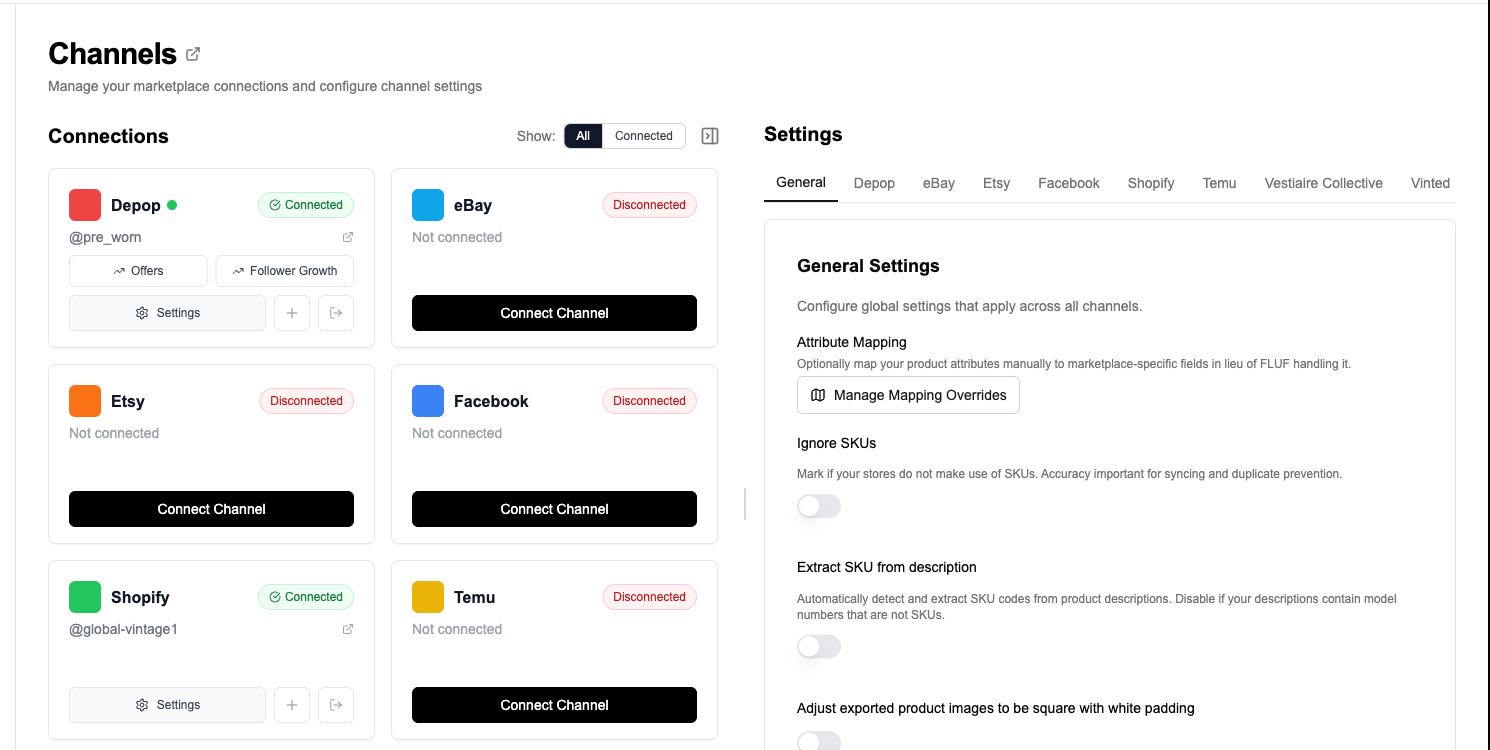
Table of Contents
- Why Sell Sports Cards on Whatnot?
- The Sports Card Market in 2026
- Fees for Sports Card Sellers
- Card Break Formats Explained
- Hot Products and Players (2025–2026)
- Grading: PSA, BGS, SGC
- Pricing Strategy for Live Auctions
- Where to Source Sports Card Inventory
- Camera and Presentation Tips
- Common Mistakes Sports Card Sellers Make
- Whatnot vs eBay for Sports Cards
- UK Sports Card Market on Whatnot
- Cross-List with FLUF Connect
- FAQ
Why Sell Sports Cards on Whatnot?
Sports cards are not just a category on Whatnot — they are the category. Whatnot reports 6.4 million sports cards purchased per month in the US alone, with over 76 million sold in 2025 and roughly two cards sold every second globally. Sports cards and TCG combined account for the majority of Whatnot’s $8 billion+ GMV. The platform was built around card breaks and live auctions, and the infrastructure reflects it: randomiser wheels, break builders, integrated shipping labels, and a buyer base that spends 80+ minutes per day in the app.
The live auction format is transformative for card dealers. A single two-hour show can move more inventory than a month of eBay listings. Top sellers like Rene Nezhoda of Bargain Hunters Breaks project $15–18 million in Whatnot sales in 2025. Dakota Peters of Achickrips generates $1 million+ per week across multiple Whatnot channels. A Boca Raton trading card shop grew from $40,000/month in-store to $1.5–3 million/month after adding Whatnot. These are not outliers — Whatnot reports 500+ sellers have crossed $1 million in lifetime sales, double the count from the previous year.
The appeal for sports card sellers is threefold: speed (sell 100+ cards in a single show), price discovery (competitive bidding routinely pushes prices above eBay comps), and community (your core buyers return every week, follow your schedule, and bring their friends).
The Sports Card Market in 2026
The global sports card market generated roughly $13 billion in 2023 sales and is projected to add $12 billion by 2029. But the 2026 market is not a rising tide lifting all boats — it is a K-shaped bifurcation where the top and bottom are moving in opposite directions.
What is rising
- High-end cards: superstar rookies, 1/1s, low-numbered parallels, autographs. Paul Skenes MLB Debut Patch Auto 1/1 sold for $1.11 million. Nick Kurtz debut patch hit $516,000.
- Premium sealed product: hobby boxes and wax at retail or above. Prices expected to hold or increase.
- WNBA cards: category searches grew +1,670% in 2025 (3x faster than NBA). Caitlin Clark items saw +2,400% search growth in 2024.
- Soccer/football cards: Lamine Yamal rookies up 150%+ in six months. Global sport = global collector base.
What is stalling or falling
- Commons, base cards, standard inserts: oversupplied, undifferentiated, hard to move at any price
- Non-superstar cards: the “who?” test — if the average sports fan does not recognise the name, the card has limited demand outside team collectors
- Lower-income collector spending: discretionary spending is under pressure, compressing demand for mid-tier product
Implications for Whatnot sellers
Focus your shows on premium hits and chase cards. Sealed product breaks remain strong because the drama of pulling a hit on camera drives engagement. But if your business model depends on selling base cards and common inserts at volume, margins will be thin in 2026. Source selectively, price aggressively on the premium end, and use eBay for steady passive sales of mid-tier singles that do not warrant live-show time.
Fees for Sports Card Sellers
| Fee | Rate | Notes |
|---|---|---|
| Seller commission | 8% of sale price | Standard across sports card categories |
| Payment processing | 2.9% + $0.30 per order | On total including shipping |
| Commission cap | 0% above $1,500 per order | Applies to Sports Singles (Football, Basketball, Baseball, Soccer, Hockey, UFC, Wrestling) |
| Listing fee | $0 | Unlimited |
| Effective take rate | ~11% on a $30 card | Drops significantly on high-value singles above $1,500 |
- Whatnot: Commission 8% × $1,500 (cap) = $120. Processing 2.9% × $5,005 + $0.30 = $145.45. Total: $265.45. You keep: $4,734.55.
- eBay: 13.25% × $5,005 = $663.16. You keep: $4,341.84.
- Whatnot saves you $397.71 on a single high-value transaction.
Card Break Formats Explained
Card breaks are Whatnot’s signature format for sports cards. Understanding the different break types — and which suits your inventory — is essential for running profitable shows.
| Format | How It Works | Best For |
|---|---|---|
| PYT (Pick Your Team) | Buyers purchase spots for specific teams. Top-prospect teams cost more. All cards for that team go to the buyer. | Premium hobby products with strong rookie classes. Most popular format overall. |
| Random Team | Buyers purchase spots at equal price. Teams assigned via live randomiser wheel. | Products where team distribution is uneven — randomisation balances value. |
| Tiered Random | Two assignments per spot (top tier + second tier). More balanced value distribution. | Full cases where value is concentrated in a few teams. |
| Division / League Break | Buyers purchase an entire division or league. All cards from those teams go to them. | Buyers wanting broader exposure to multiple teams. |
| Serial Number Break (0–9) | Buyers assigned digits. Cards with matching serial numbers go to them. | Products heavy on serial-numbered parallels. |
| Hit Draft / Snake Draft | Buyers draft pulls in randomised order after the box is opened. | Products with clearly tiered hits (autos, patches, base). |
| Rip and Ship | Buyer purchases the full sealed product. You open it live and ship everything to them. | Buyers who want the pack-opening experience without being in the room. |
| Singles Auctions | Individual cards auctioned live, 15–60 seconds each, with detailed on-camera presentation. | High-value graded slabs, rookie autos, and individual cards worth showing. |
Key rule: all product from a card break must be opened in the same live show. You cannot split a break across multiple streams. Unfilled breaks must be cancelled and refunded, or product carried forward unopened.
Hot Products and Players (2025–2026)
| Product / Player | Sport | Why It Matters |
|---|---|---|
| Topps Chrome Basketball | NBA | Cooper Flagg autos clearing $30K. Hobby boxes doubling on secondary market. |
| Panini Prizm Football | NFL | Flagship rookie chase. Black Finite 1/1s setting value ceilings. |
| Topps Series 1 Baseball | MLB | Debut patch cards setting new benchmarks. Paul Skenes driving demand. |
| Cooper Flagg | NBA | Most hyped prospect since LeBron. Autos commanding five-figure prices. Some analysts flag overvaluation risk. |
| Lamine Yamal | Football/Soccer | Rookies up 150%+ in six months. Global appeal. Panini Prizm Premier League and Topps UCL are the key products. |
| WNBA / Caitlin Clark | WNBA | Category searches +1,670% in 2025. Clark items +2,400% in 2024. Fastest-growing sports card segment. |
| Paul Skenes | MLB | Debut Patch Auto 1/1 sold $1.11M. Defining the 2025–2026 baseball card market. |
For Whatnot sellers, the actionable insight is clear: source sealed product featuring these players and break it live. The intersection of high-demand players and the live break format produces the strongest engagement and highest final prices on the platform.
Grading: PSA, BGS, SGC
Graded sports cards are the bread and butter of high-value Whatnot auctions. The grade provides instant trust during a 30-second live auction where buyers cannot physically inspect the card.
| Grading Company | Reputation | Price Premium | Best For |
|---|---|---|---|
| PSA | Gold standard. 70%+ market share. | Benchmark — highest resale premiums | Any card you plan to resell. Most recognisable slab on Whatnot. |
| BGS/Beckett | Premium niche. Sub-grades add depth. | BGS 9.5 ≈ PSA 10. Black Label (all 10s): 3–5x PSA 10. | Modern cards where sub-grades differentiate. Black Label chase. |
| SGC | Budget-friendly, growing acceptance. | Lower than PSA but gaining ground. | Vintage cards (SGC slabs are preferred by vintage collectors). Budget grading. |
Grading strategy for Whatnot sellers
- Grade cards worth $75+ raw — below that, the grading fee eats the margin
- PSA 10 = 2–5x raw value for modern cards; 5–10x for vintage
- PSA 9 = only 30–50% of PSA 10 value — the drop-off is brutal, so only submit cards you are confident will gem
- The December 2025 PSA inconsistency issue has caused 10–20% price drops on modern PSA slabs. Factor this into your pricing
Pricing Strategy for Live Auctions
Sports card pricing on Whatnot follows the same $1-start philosophy as TCG, but with higher stakes because individual card values range from $1 to $1 million+.
For breaks
Price PYT team spots based on the rookie class. If a product has one superstar rookie (e.g., Flagg), the team that drafted him commands a premium. Set the premium team spots at market rate and let the remaining teams auction from $1. This maximises total revenue while keeping the break accessible.
For singles
Start at $1 for cards worth $20–100. For cards worth $100+, starting at $5–25 is acceptable because the audience understands the value. Never start at market price — it kills bidding energy. The auction format works best when buyers feel they have a chance to get a deal.
Check eBay 130-point comps
Before every show, check eBay sold listings for every significant card you plan to auction. Sort by “recently sold” and note the range. This gives you a floor expectation. If a PSA 10 Cooper Flagg sells for $800–1,200 on eBay and your show averages 150 viewers, you should expect $700–1,400 on Whatnot depending on the night.
Where to Source Sports Card Inventory
| Source | Best For | Notes |
|---|---|---|
| Topps/Fanatics direct | Sealed product at wholesale | The ultimate competitive advantage. Requires distributor relationship. Nezhoda’s Topps relationship is cited as key to his $15M+ revenue. |
| Hobby shop partnerships | Collections, singles, sealed product | Buy collections that shops do not want to break down. Negotiate bulk pricing. |
| Card shows | Bulk singles, raw cards for grading, networking | The National Sports Collectors Convention is the largest annual event. Regional shows throughout the year. |
| Retail (Target, Walmart, Costco) | Retail-exclusive products for above-MSRP resale | Competitive and limited allocation. Works for hot releases only. |
| eBay/Mercari lots | Undervalued lots for resale | Arbitrage opportunities — buy below market, sell on Whatnot at auction. |
| Other Whatnot sellers | Bulk commons from breakers | Buy during other sellers’ shows at break prices. |
| Liquidation wholesalers | Overstock lots | Variable quality — inspect before buying. |
Camera and Presentation Tips
- Overhead camera for cards laid flat on a dark mat. Second camera at face level for chat interaction. The card camera must be close enough to read set numbers and grading labels.
- Lighting from above and to the side — avoid direct ring light reflection on foil and holo surfaces. Test with a foil card before going live.
- Slow, deliberate card handling — show front (3–5 seconds), back, all four corners for raw cards. For graded slabs, tilt gently to show the label and surface without glare.
- Call out details on camera — player name, set name, card number, parallel type, grade, and any relevant context (“this is his debut patch card, same as the one that sold for $1M last month”). Expertise drives bids.
- Dark background mat — black or charcoal isolates the card. Category-specific mats (team logos, brand mats) add personality.
- Gloves for raw cards — hold by edges in a penny sleeve. Never touch surfaces on camera.
Common Mistakes Sports Card Sellers Make
- Sourcing at retail and expecting wholesale margins — the sellers making $1M+ have distributor relationships. If you are buying hobby boxes at $200 retail, your margins are already compressed before fees.
- Ignoring the K-shaped market — stocking up on base-heavy products when only premium hits hold value. Focus sealed product purchases on sets with strong rookie classes.
- Starting auctions too high — $1 starts create bidding wars. Starting at comp value kills momentum.
- Not building a streaming schedule — “Every Tuesday and Friday at 8pm” builds an audience. Random streams attract random viewers (usually fewer).
- Shipping cards poorly — penny sleeve + top loader + team bag + cardboard sandwich minimum. Damaged cards = returns + negative ratings.
- Overinvesting before proving the model — start with lower-cost product to test your audience and show format before buying cases of Topps Chrome at $5,000+.
- Not tracking cost basis per card — in a live-show environment, it is easy to sell 200 cards and not realise you lost money until you run the numbers. Track everything.
Whatnot vs eBay for Sports Cards
| Factor | Whatnot | eBay |
|---|---|---|
| Speed of sale | Seconds (live auction) | Days to weeks |
| Fees | ~11% (with $1,500 commission cap) | ~13.25% |
| Price realisation | 20–60% above eBay for hot cards; below eBay on slow nights | Market-rate, predictable |
| Break infrastructure | Built-in randomiser, break builder, live tools | No break-specific tools |
| Global reach | 9 countries | 190 countries, 135M buyers |
| Authentication | Seller-responsible | Authenticity Guarantee on $250+ cards |
| Best for | Breaks, volume singles, community, high-value singles above $1,500 | Individual search-driven singles, rare vintage, global buyers |
The smart strategy: use Whatnot for breaks and community-driven live sales. Use eBay for rare singles that need a global search audience. Use FLUF Connect to sync inventory between both. Read our full Whatnot vs eBay comparison for more detail.
UK Sports Card Market on Whatnot
The UK sports card community on Whatnot is real but smaller than the US. The category skews differently — football (soccer) cards are the primary draw, with Panini Prizm Premier League, Topps UEFA Champions League, and Topps Match Attax leading demand. US sports (NBA, NFL, MLB) have a growing but niche UK collector base.
“Sports Trading Cards UK” operates as a Premier Shop on Whatnot, demonstrating that the UK market is large enough to sustain dedicated sellers. UK sellers face higher fees than US sellers (10% commission + 3.4% + £0.20 processing in the UK vs 8% + 2.9% + $0.30 in the US), which means tighter margins. Shipping is via Royal Mail (domestic) and DPD (international), both provided free by Whatnot.
If you are a UK-based card seller, the opportunity is real but the audience is smaller. Consider focusing on football cards (where UK demand is strongest) and supplementing with eBay for US sports cards that need a global buyer base.
Cross-List with FLUF Connect
Running Whatnot and eBay simultaneously without inventory sync is how overselling happens. FLUF Connect links your Whatnot, eBay, Shopify, and other channels. When a card sells during a live show, FLUF Connect delists it from every other channel in real time. No more cancellations, no more defects on your eBay account.
To get started, create a free FLUF Connect account and connect your channels. 1,000 products on the £19/month Growth plan on the free tier — see the pricing page for plans beyond that.
Selling sports cards on Whatnot and eBay? FLUF Connect syncs your card inventory in real time — a live-show break sale instantly delists from every other channel.
Frequently Asked Questions
How many sports cards does Whatnot sell?
Whatnot reports 6.4 million sports cards sold per month in the US, over 76 million in 2025, and roughly two cards sold every second globally. Sports cards are the platform’s #1 category.
What break format is most popular?
PYT (Pick Your Team) is the most popular format for sports card breaks. Buyers choose specific teams, and all cards for that team go to them. Random team breaks, hit drafts, and rip-and-ship are also widely used.
Are sports cards still a good investment in 2026?
The market is K-shaped: high-end cards (superstar rookies, 1/1s, autos) are appreciating. Commons, base, and mid-tier are stalling. Focus on premium product and chase cards. Sealed hobby boxes are holding or increasing in value.
How do Whatnot fees compare to eBay for sports cards?
Whatnot charges ~11% effective (with a commission cap at $1,500 for Sports Singles). eBay charges ~13.25% with a reduced rate above £5,000. Whatnot is cheaper across the board, especially for high-value cards where the commission cap applies.
Can I sell UK football cards on Whatnot?
Yes. Football (soccer) cards — Panini Prizm Premier League, Topps Champions League — are the strongest sports card category for UK Whatnot sellers. The UK community is smaller than the US but growing.
How should I ship sports cards from Whatnot?
Penny sleeve + top loader + team bag + cardboard sandwich for raw cards. Graded slabs in bubble wrap inside rigid mailers or small boxes. Whatnot provides the shipping label free (USPS in US, Royal Mail in UK).
Can I sync my sports card inventory across Whatnot and eBay?
Yes. FLUF Connect supports both platforms with real-time inventory sync. When a card sells on one channel, it delists from the other automatically. 1,000 products on the £19/month Growth plan on the free tier.
Explore more: Trading Cards | Pokémon Cards | Sneakers | Funko Pops | Vintage Clothing. Or read the full How to Sell on Whatnot guide.
Frequently Asked Questions
6.4 million sports cards sold per month in the US, over 76 million in 2025, roughly two cards sold every second globally. Sports cards are the platform number one category.
PYT Pick Your Team is the most popular format. Buyers choose specific teams, and all cards for that team go to them. Random team breaks, hit drafts, and rip-and-ship are also widely used.
The market is K-shaped. High-end cards like superstar rookies, 1/1s, and autos are appreciating. Commons, base, and mid-tier are stalling. Focus on premium product and chase cards.
Whatnot charges roughly 11% effective with a commission cap at $1,500 for Sports Singles. eBay charges roughly 13.25%. Whatnot is cheaper across the board, especially for high-value cards.
Yes. Football soccer cards like Panini Prizm Premier League and Topps Champions League are the strongest sports card category for UK Whatnot sellers. The UK community is smaller than US but growing.
Penny sleeve plus top loader plus team bag plus cardboard sandwich for raw cards. Graded slabs in bubble wrap inside rigid mailers. Whatnot provides the shipping label free.
Yes. FLUF Connect supports both platforms with real-time inventory sync. When a card sells on one channel, it delists from the other automatically. 1,000 products on the £19/month Growth plan on the free tier.