StockX vs eBay: Verified Asks vs Full Listings for Sneakers
Fees, authentication, returns and control compared, so you can decide where each pair should go, or sell on both with FLUF Connect.
7 days for £1, then from £9/month.



- StockX is for catalogue items only: You match your item to an existing product and size, then set an ask price. StockX supplies the photos and description. No custom listing control.
- eBay gives you control: You write the title, upload up to 24 photos, and write the description. Buyers see what you create, not a catalogue template.
- StockX fees: 7–9.5% transaction fee plus 3% payment processing (10–12.5% total, depending on seller level) plus $5 shipping per sale.
- eBay authenticated sneaker fees: 8% for items $100 or more (US) or £200 or more (UK), plus $14.95 flat shipping fee.
- Returns: StockX: 14 days, refunded as StockX credit. eBay: 30 days, refunded to original payment.
- Best for each: StockX if you sell high-volume verified items and want verification handled. eBay if you want to set the narrative and sell both new and used.
If you sell sneakers, trainers or collectibles, the choice between StockX and eBay comes down to control versus convenience. StockX verifies the item and handles shipping collection, but you choose the catalogue product and have no say in photos or description. eBay puts you in charge of the listing. You manage the photos and description yourself. One is not better; they solve different problems.
StockX vs eBay at a glance
| StockX | eBay | |
|---|---|---|
| Item type | New / deadstock catalogue items only | New and used, any brand or type |
| Listing control | None. StockX provides photos and description | Full control. You write the title and upload photos |
| Pricing model | Ask price only | Fixed price or auction |
| Seller fees (sneakers) | 7–9.5% transaction + 3% processing + $5 shipping per sale | 8% of total sale (authenticated sneakers, $100+ US or £200+ UK) + $14.95 flat shipping fee |
| Payout speed | 2–4 business days after authentication | Typically 2–3 business days from buyer payment |
| Returns | 14 days, refunded as StockX credit | 30 days, refunded to original payment method |
| Buyer audience | Collectors, resellers, sneaker enthusiasts | General buyers across all categories |
| Verification required | Yes, StockX authenticates every item | Yes, for sneakers $100+ (US) or £200+ (UK) |
How listing works on each platform
On StockX, the process is straightforward. Find the exact product and size in the catalogue, set your ask price, and wait for a buyer. The item photo, brand details and condition note are already there. A buyer matching your price triggers the sale, StockX arranges collection from you, authenticates the item at their facility, then ships it to the buyer. You have no chance to rewrite the description or add your own photos.
On eBay, you write everything. You upload up to 24 photos, compose a title with keywords, write a description that plays up the condition or rarity, and set a fixed price or auction. If you sell a rare sneaker or a limited edition trainer, you can tell the story through photos and words. eBay authentication is automatic for sneakers $100+ (US) or £200+ (UK); StockX authenticates everything.
Choose the wrong catalogue product or size on StockX and the pair fails verification when it arrives. On eBay, a listing in the wrong category mostly costs you visibility in search.
Fees compared: what a £100 sneaker sale costs you
StockX charges a tiered transaction fee based on sales volume. Level 1 sellers pay 9%, Level 2 pay 8.5%, Level 3 pay 8%, Level 4 pay 7.5%, and Level 5 pay 7%. On top of that, every sale carries a 3% payment processing fee. In US dollars, sellers also pay a $5 shipping fee per standard sale.
eBay’s fee for authenticated sneakers is flat: 8% of the total sale (item price plus shipping) for sneakers $100 or more. Standard sneakers under $100 pay higher rates (13.6% without a store). eBay also charges a $14.95 flat shipping fee for authenticated sneakers, collected from the buyer.
Worked example: a £100 trainer sale
Assume a UK seller selling a new trainer for £100 (no postage; buyer pays flat shipping).
StockX (Level 1 seller): 9% + 3% = 12% transaction + processing = £12. Minus $5 shipping fee (approximately £4): you receive £84. (Note: exact GBP conversion depends on StockX’s rate; fees are USD-based.)
eBay UK authenticated sneaker: 8% of £100 = £8. The buyer pays £14.95 separately for shipping; you keep £92. eBay’s fee comes out of the £100 item price only, not the shipping cost.
In this example eBay is cheaper, and that gap grows as prices rise. A £500 rare vintage pair on StockX (Level 1) costs £60 in fees (12%); the same item on eBay costs 8% = £40. StockX’s appeal is not lower fees; it is lower operational burden (no photography, no condition notes, no hunting for the right category).
Returns and buyer protection
StockX accepts returns within 14 days of delivery. Approved returns are refunded as StockX credit, not cash back to your original card. The Buyer Promise covers items that arrive substantially different from what was described: damaged goods, wrong size, or wrong item sent. If a buyer claims the item is not authentic, StockX’s authentication process already protects them, so that claim almost never reaches you as a seller.
On eBay, buyers have 30 days to open a return, and eBay’s Money Back Guarantee refunds them to their original payment method. For authenticated sneakers, eBay’s own authentication backs the buyer, so “not authentic” claims are rare on both platforms.
StockX’s 14-day window is shorter. eBay’s 30-day window is longer, which means more time for a buyer to change their mind or spot a flaw.
Audience and demand
StockX’s buyer base is collectors, resellers, and sneaker enthusiasts hunting for specific drops or rare sizes. They know the catalogue, they know the market prices, and they are hunting for a deal or a hard-to-find item. Price discovery happens through the bid/ask spread; demand is transparent because you see active bids before you post your ask. These buyers often check StockX first when they want a particular shoe or collectible.
eBay’s buyer base is much broader. Casual shoppers, beginners, and collectors all browse eBay. A rare vintage trainer might sell faster on StockX if it is in the catalogue and you set a competitive ask. On eBay, a buyer who does not know the catalogue structure can still find you through keywords, photos, and search ranking. eBay’s search engine rewards complete listings with multiple high-quality photos and detailed condition notes.
Seller reputation and feedback
On StockX, seller reputation is tied to verification performance. If items fail verification or you miss shipping deadlines, your account gets flagged and you lose access to higher tiers. Precision about condition and sizing is essential; mismatches damage your standing.
On eBay, reputation is built through buyer feedback stars and detailed seller ratings. Buyers rate you on item accuracy, communication, shipping speed, and shipping cost. These ratings are visible on your profile and affect search visibility. Negative feedback can stay on your record for 12 months. eBay also requires sellers to maintain a high delivery and return rate or risk account restrictions.
If you are brand new, eBay’s feedback system takes longer to build trust, but it is public and buyers can see your history. StockX’s system is simpler: pass authentication consistently, and you climb the tiers. Fail consistently, and your account is suspended.
Which platform suits which items
Use StockX when:
- You sell high-volume verified items (sneaker drops, new trainers, common collectibles in the catalogue).
- The item is already in the StockX catalogue and matches exactly.
- You want StockX to handle authentication and shipping collection.
- Your item is new or deadstock; used items are not eligible.
- You are comfortable with no custom listing control and standardised photos.
Use eBay when:
- You sell used, vintage or one-off items not in a standard catalogue.
- You want to tell the story of the item (limited edition, rare size, minor flaws you are transparent about).
- You sell across brands and categories (not just sneakers).
- You want full control over photos, title and condition notes.
- Your audience includes casual buyers, not just collectors hunting a specific model.
If you sell both new-in-box drops and used rare pairs, both platforms have a place. The item you are selling decides which fits better.
StockX catalogue matching and risk
Before you list on StockX, the catalogue is everything. StockX is built on exact product-to-catalogue matching. You cannot create a custom product page; you must find the exact item already listed in the StockX catalogue with the correct product ID and size. If an item is new (released after StockX indexed it) or regional (sold only in certain markets), it might not exist in the catalogue yet.
When StockX cannot match your item to the catalogue, or when it finds several similar products but no exact match, you pick the closest one. If what you send does not match the product you selected, the item fails verification and you lose the sale. Mismatches damage your seller record.
eBay has no matching risk. You write your own listing and control the product identity. A wrong category affects search ranking only. You also get to describe condition yourself on eBay; StockX uses standardised condition grades in the catalogue. If the item you send is better or worse condition than what the grade implies, authentication will reject it.
Why not sell on both? Use FLUF Connect
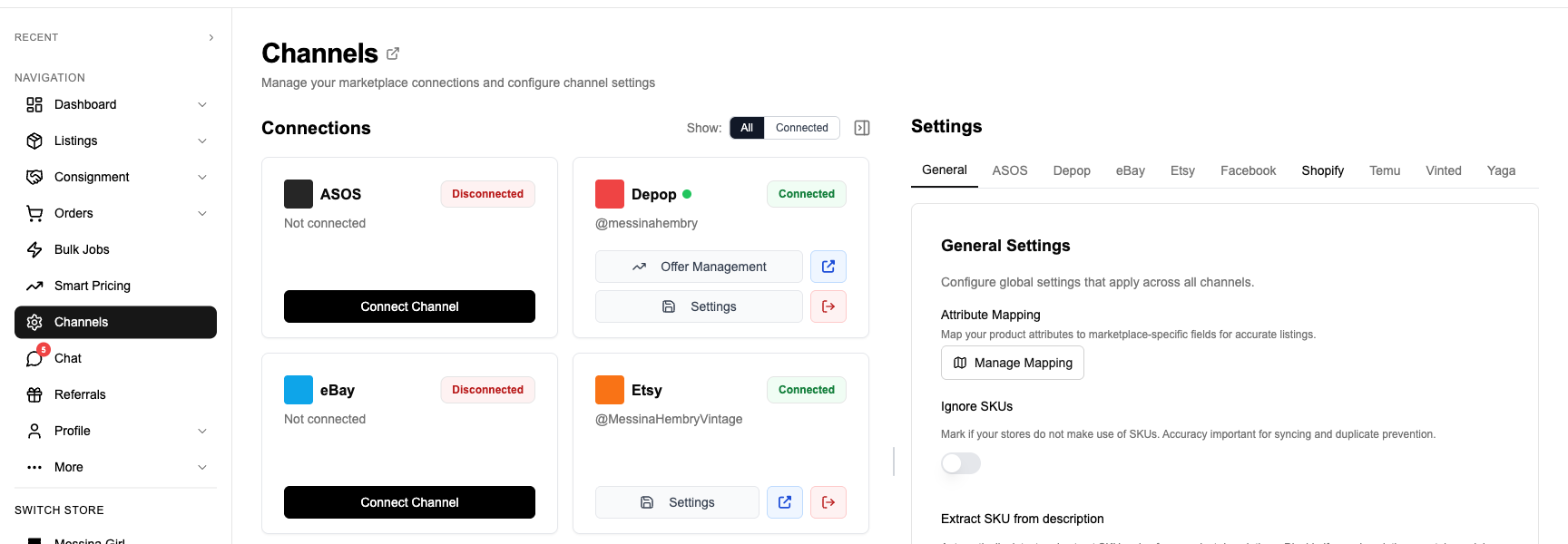
FLUF Connect lets you list the same item to StockX, eBay or 53 other marketplaces. The risk of selling the same sneaker twice is real; one product record prevents overselling across platforms.
| FLUF Connect feature | StockX | eBay |
|---|---|---|
| Create or update listings | Yes, add StockX asks from your inventory | Yes, create or update eBay listings |
| Notices a sale on this platform and updates stock elsewhere | No. You must mark it sold in FLUF | Yes. Automatic when eBay sale is detected |
| Ends this listing when the item sells on another platform | Yes. FLUF removes the StockX ask | Yes. FLUF ends the eBay listing |
| Relisting (plans above Starter) | No | Yes |
| Offer management (plans above Starter) | No | Yes |
You list a new trainer to both StockX and eBay from one product record. A buyer on eBay buys it first. FLUF detects the eBay sale and automatically removes your StockX ask. If someone buys on StockX first, you mark it sold in FLUF (because StockX sales are not auto-detected), and FLUF removes the eBay listing. This way both platforms stay in sync.
You can try FLUF with 7 days for £1, then from £9/month. Starter plan is £9/month with unlimited listings. Crosslisting, inventory sync, order sync and bulk operations are included on every plan.
Sources
- StockX: Updates to the StockX Seller Program
- StockX: 0% Payment Processing Fees for Sellers
- eBay US: Authenticity Guarantee for sneakers
- eBay UK: Authenticity Guarantee for sneakers
- Vendoo: eBay’s Sneaker Fees Explained
- StockX: What is the StockX Buyer Promise?
- eBay: Returns and refunds policy
- StockX: What does the verification process entail for sellers?
Sources checked September 2026.
Related guides
Frequently Asked Questions
No. StockX accepts only new and deadstock items. Used, vintage, or pre-owned sneakers and collectibles must go to eBay or other platforms.
Yes. StockX authenticates every single item before paying you. eBay authenticates sneakers automatically if they are $100 or more (US) or £200 or more (UK), so high-value sneakers get verified on both platforms.
You choose StockX for the convenience. No photography, no descriptions, no category hunting — just pick the exact size, set your price and ship. StockX handles the rest. If you sell 20 identical new trainers a week, that speed matters.
The sale is cancelled if the pair fails verification, for example when the size or condition does not match the catalogue product you chose. Failed verifications also count against your seller record on StockX.
eBay has more total buyers across all categories. StockX has a more niche audience of collectors and resellers hunting specific sneaker models and sizes. For a rare sneaker, StockX's buyers are more likely to pay the price you want.
FLUF detects eBay sales automatically and removes the StockX ask. StockX sales are not auto-detected, so you mark the item sold in FLUF manually, and FLUF then removes the eBay listing. No double sales either way.
Yes. If you already have asks live on StockX, you can import them into FLUF and manage them from one dashboard alongside your eBay and other marketplace listings.