Crosslist from Cardmarket to Whatnot — Take Your Cards Live
Move sealed boxes, graded slabs and your higher-value singles from Cardmarket's price list onto Whatnot's live shows — who can sell there, what each takes, and which stock is worth the move.
7 days for £1, then from £9/month.



- Best fit: sealed booster boxes, graded slabs and the higher-value singles you already list on Cardmarket. Bulk commons stay where they are.
- Check first: Whatnot only signs up sellers in certain countries. In the EU that means Germany, France, the Netherlands, Belgium and Austria, so a Cardmarket seller in Spain or Italy cannot open a Whatnot shop today.
- You have to apply. Whatnot asks for photo ID and a short video of your stock before it lets you sell. Cardmarket has no equivalent step for a private seller.
- Sale sync runs one way. FLUF sees a Whatnot sale. It does not see a Cardmarket sale, so you mark those sold in FLUF and it ends the Whatnot listing.
- Cost: 7 days for £1, then from £9/month. Starter covers this pair.
Two very different shops for the same box of cards
Cardmarket is a catalogue. You find the card, pick the set, the language and the condition, and your copy joins a price list that buyers sort by cheapest first. Nobody reads a description. Nobody sees your face.
Whatnot is a show. You go live, you talk, and people bid while you hold the card up to the camera. Whatnot’s own European report says sellers there ran more than 20,000 hours of live shows a week across Europe, and that as much as 60% of European sales cross a border.
That difference decides which of your stock is worth moving. On Cardmarket a €2 single sells because it is nine cents cheaper than the next one. That card will not hold a live audience. A sealed box, a graded slab or a chase single will.
Where you can sell, and where you cannot
This is the first thing to check, because it stops some sellers before anything else matters. Whatnot lists the countries a seller can register from: the United States, Canada, Australia, Japan, the United Kingdom, and in the EU, Germany, France, the Netherlands, Belgium and Austria. It also asks that you operate from the country you registered in, and that an EU seller holds a euro bank account.
Cardmarket’s reach is wider than that. It sells to buyers in more than 30 countries. So plenty of Cardmarket sellers, including most of Spain, Italy and Poland, cannot open a Whatnot shop at all yet. If that is you, eBay is the route that works from anywhere, and our Cardmarket to eBay guide covers it.
Getting approved to sell
Cardmarket lets a private seller start listing straight away. Professional status is the step that asks for paperwork: photo ID and a scan of your business registration.
Whatnot puts that check at the front for everyone. Its seller application asks for government photo ID, an active bank account in the right currency, and a short video showing the products you plan to sell. Approval takes anywhere from a few days upward. Start the application before you plan a batch around it.
What each one takes
| Cardmarket | Whatnot (UK and EU) | |
|---|---|---|
| Commission | 5% for a private seller, 3% for a professional seller, capped at €100 per article | 6.67% plus VAT; 4% plus VAT for Coins & Money |
| Payment processing | No separate fee on a standard payout | 2.42% plus €0.25 or £0.25, plus VAT, charged on the whole order |
| Listing fee | None | None |
| Monthly fee | None | None |
Take a sealed booster box at €200. Cardmarket’s 5% private-seller commission is €10, so you keep €190. On Whatnot the same box pays 6.67% plus VAT, which is €16.00, and processing of 2.42% plus €0.25 plus VAT, which is €6.11, leaving €177.89.
Whatnot costs more on that box. The reason to run it anyway sits above €1,500. Since 14 January 2026 Whatnot has charged no commission on the part of an order above 1,500 in USD, GBP or EUR in selected categories, and Trading Card Games and sports singles are on that list. Cardmarket’s own cap works the other way round: its €100 ceiling per article only bites once a single item passes €2,000 at the private rate. Sellers in France and Belgium have a further Whatnot discount, a reduced 4% plus VAT on Trading Card Games and sports cards through 31 December 2026.
Whatnot’s fee page labels the high-value rate limited-time, so treat it as a reason to move expensive stock now rather than a permanent saving.
Which cards to send
- Send: sealed booster boxes, bundles and starter decks; graded slabs; singles priced above roughly €50. These carry a show, and they are where Whatnot’s high-value commission break applies.
- Consider: a break. Whatnot allows card breaks, and its break policy requires everything to come out of sealed product. Breaks are a Whatnot format with no Cardmarket equivalent.
- Leave on Cardmarket: bulk commons, playset filler and anything under about €5. Cardmarket’s catalogue is built for that and Whatnot’s fixed processing fee eats it.
One Cardmarket habit does not travel. Its condition scale runs Mint, Near Mint, Excellent, Good, Light Played, Played, Poor, and buyers there read those letters closely. On a Whatnot show you say it out loud and hold the card to the camera instead. Write the grade into your title anyway, because Whatnot buyers searching after the show still want it.
What FLUF Connect does for this pair
| Cardmarket | Whatnot | |
|---|---|---|
| Crosslist listings | Yes | Yes |
| FLUF detects a sale here | No | Yes |
| FLUF ends the listing here when the item sells elsewhere | No | Yes |
| Relisting and offer management | No | No |
| FLUF browser extension | Needed to connect | Needed to connect |
When it sells on Whatnot: FLUF records the sale and ends the listing on your other channels. Your Cardmarket copy is the exception, so take that one down yourself.
When it sells on Cardmarket: open the item in FLUF and mark it sold. FLUF then ends the Whatnot listing.
That is the honest shape of this pair, and it is why card sellers usually keep sealed stock single-listed on one side until they trust their own routine.
How to crosslist from Cardmarket to Whatnot
- Apply to Whatnot first. Photo ID, bank account, product video. Nothing below works until you are approved.
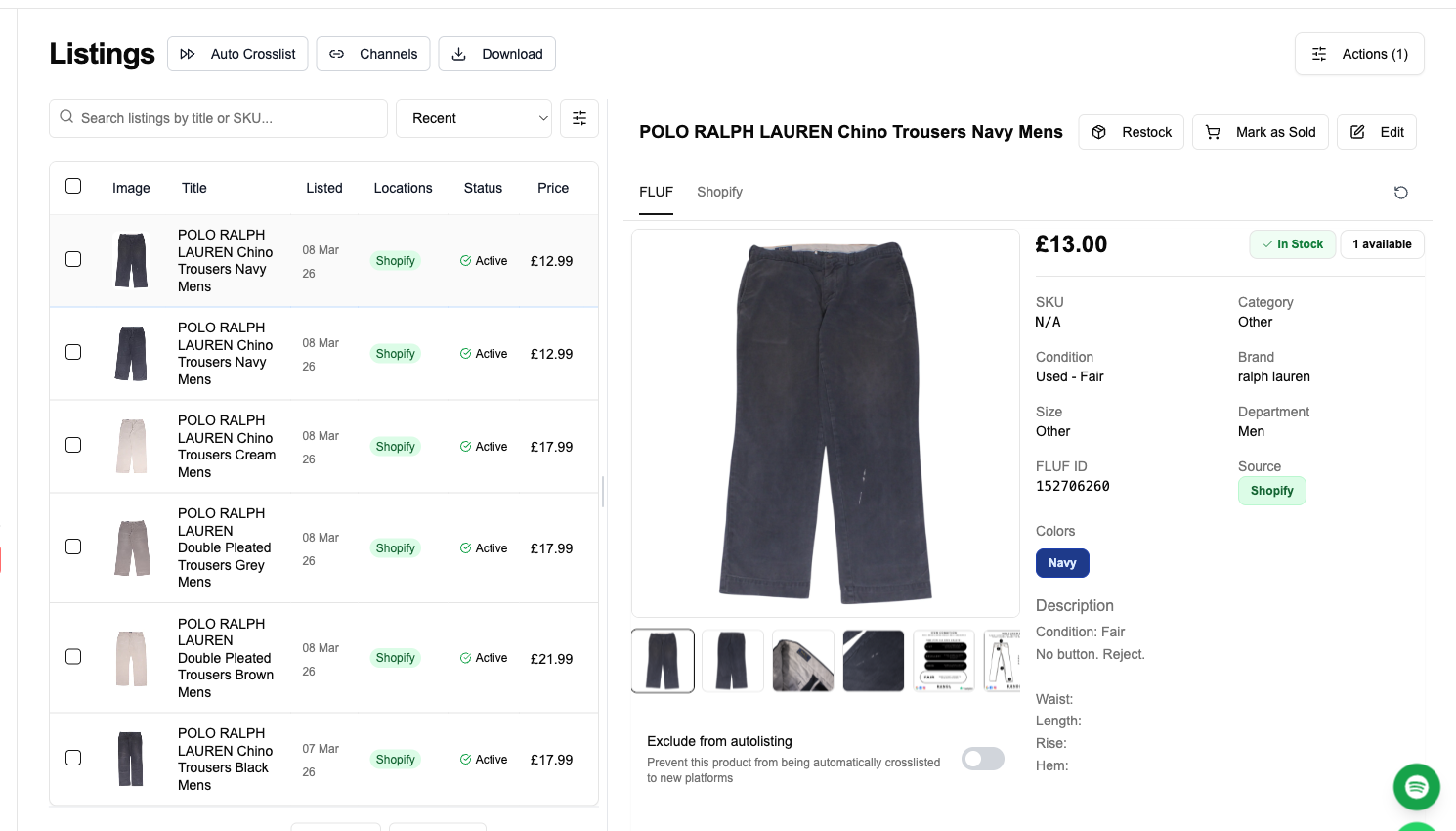
- Connect Cardmarket. Install the FLUF browser extension, sign in to Cardmarket, then add Cardmarket from Channels in FLUF. Your listings come into FLUF.
- Connect Whatnot the same way, from the Channels screen.
- Filter to the stock worth showing. Sort by price and select the sealed product, the slabs and the singles above €50.
- Check the titles. A Cardmarket entry is a catalogue row, so it may read as set code and condition letters. Rewrite it as something a buyer would say out loud.
- Crosslist a small batch, run one show against it, and use bulk operations once you know how your stock performs live.
What FLUF Connect costs for this pair
7 days for £1, then from £9/month. Starter gives you unlimited listings, crosslisting, inventory sync, order sync and bulk operations, which is all this pair uses. Relisting, offer management and smart pricing come with the plans above Starter.
| Plan | Monthly | Crosslisted products |
|---|---|---|
| Starter | £9/month | Unlimited |
| Seller | £29/month | Unlimited |
| Pro | £99/month | Unlimited |
| Super Seller | Custom pricing — tell us what you need | Unlimited |
Sources
- Cardmarket: professional seller guide
- Cardmarket: card condition scale
- Cardmarket: tax requirements
- CardPulse: Cardmarket fee guide 2026
- Whatnot: seller fees
- Whatnot: reduced commission on high-value orders
- Whatnot: seller location and currency requirements
- Whatnot: apply to sell
- Whatnot: card break policy
- Whatnot: European live selling report
Sources checked September 2026.
Related guides
Frequently Asked Questions
Not today. Whatnot signs up sellers in the United States, Canada, Australia, Japan, the United Kingdom, and in the EU only Germany, France, the Netherlands, Belgium and Austria. Cardmarket reaches buyers in more than 30 countries, so plenty of its sellers fall outside that list.
Yes. Whatnot asks every seller for government photo ID, a bank account in the currency of the country you registered in, and a short video of the stock you plan to sell. Apply before you plan a batch around it, because approval can take days or longer.
Sealed boxes, graded slabs and singles above roughly €50. Bulk commons and playset filler belong on Cardmarket, where buyers sort a catalogue by cheapest first and nobody needs a live show to decide.
Whatnot. Cardmarket's 5% private-seller commission is €10, leaving €190. Whatnot's 6.67% plus VAT and its 2.42% plus €0.25 processing fee come to about €22.11, leaving €177.89. Whatnot gets cheaper above 1,500 in your currency, where trading card orders currently pay no commission on the excess.
FLUF does not see Cardmarket orders, so open the item in FLUF and mark it sold. FLUF then ends the Whatnot listing for you.
FLUF records the Whatnot sale and ends your listings on the other channels it can reach. Cardmarket is not one of them, so take that copy down yourself.
Yes, for both sides of this pair. Cardmarket and Whatnot are both connected through the extension rather than a sign-in form on the FLUF website.
A 7-day trial for £1, then plans from £9 a month. The £9 Starter plan has no listing limit and covers everything this pair uses. The tiers above it add relisting, offers and smart pricing, which neither Cardmarket nor Whatnot uses anyway.