
Crosslist from Squarespace to Amazon — Automatically
A maker brand on Squarespace does not move its whole store to Amazon; it moves the physical products that carry an identifier and survive the referral fee. Which ones those are, what a Squarespace product is missing, and the sync step you do by hand.



- Squarespace sells four kinds of product; only the physical ones can go to Amazon. Third-party sellers cannot list downloads, services or gift cards there, so a maker brand starts by sorting its catalogue, not by connecting anything.
- Squarespace gives every variant a SKU but has no barcode field. Amazon needs an ASIN or a GTIN for each product, so an own-brand seller either buys barcodes, records ASINs, or applies for a GTIN exemption and creates those listings by hand.
- Makers have a second door: Amazon Handmade charges 15% (or $0.30) in the US and 12.24% in the UK, and waives the Professional monthly fee after the first month. Vintage and used goods are not admitted.
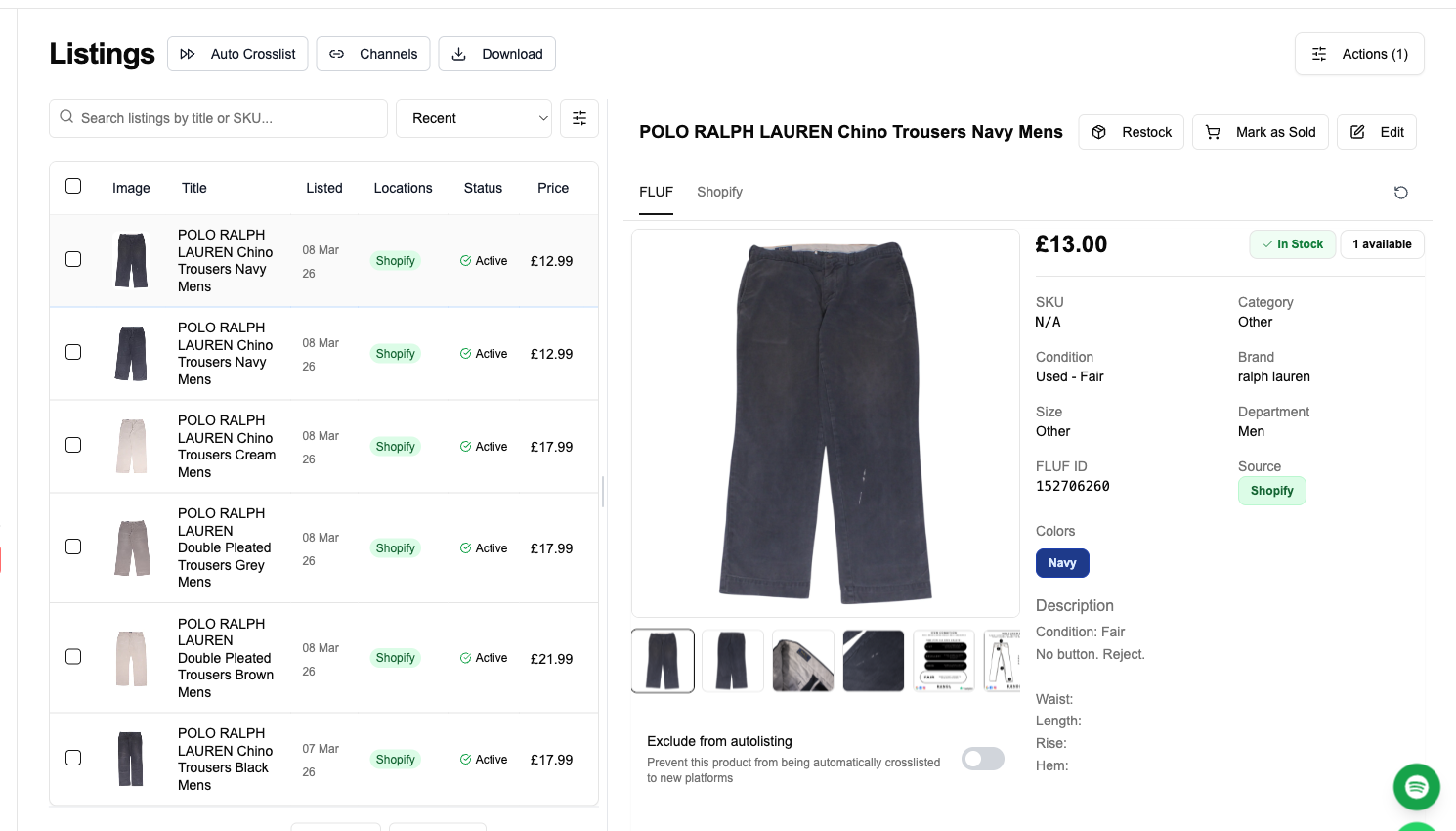
- FLUF Connect imports your Squarespace products, publishes them to Amazon, and pushes price and stock changes. A sale on any other connected channel zeroes the Amazon quantity and hides the Squarespace product.
- Neither end of this route reports its own sales to FLUF yet. A sale on Squarespace or on Amazon has to be marked sold in FLUF by you, and that one habit is what keeps the other side honest.
- Relisting, offer management and smart pricing are not available on Amazon; on Squarespace, your own storefront, FLUF never reprices at all. What you buy here is the listing work and the stock guard.
- 7 days for £1, then from £9/month, then plans from £9/month with unlimited listings on Starter.
On this page
- Sort the catalogue before you connect anything
- Handmade or a standard account: the maker’s decision
- A Squarespace SKU is not a barcode
- Six options, 250 combinations, and how Amazon sees them
- What a sale costs on each side
- Ship from the studio, or send stock to Amazon
- What transfers, field by field
- What stays in sync, and the manual step at both ends
- Setting it up, step by step
- What it costs
- Sources and verification
- Related guides
Sort the catalogue before you connect anything
A Squarespace store is usually small and deliberately mixed. A ceramicist sells mugs and a glaze workshop. A photographer sells framed prints, a Lightroom preset pack and a print-on-demand calendar. An illustrator sells enamel pins, a PDF colouring book and gift cards for the shop. Squarespace’s product editor treats all of that as one catalogue with four product types: physical, download, service and gift card, plus appointments, memberships and video on version 7.1.
Amazon does not. A third-party seller on Amazon sells physical objects only. Amazon’s own moderators put it plainly on the seller forums: “third party sellers are not able to sell digital downloads, only Amazon Retail can create this type of listing”, with Kindle books through KDP as the single exception. Downloads, workshops, bookings and gift cards stay on your own site. Nothing about crosslisting changes that, and no tool can route a 300 MB preset pack onto a marketplace that refuses the category.
So the first job is a list, not a connection. Walk your store page and mark each product one of three ways.
- Goes to Amazon as it stands. A physical product with a fixed design, a price you would defend on a page beside competitors, and either a barcode or a willingness to get one. Framed prints in standard sizes, candles, pins, notebooks, jewellery.
- Goes to Amazon after a change. Personalised items, which need Amazon’s own customisation flow; products with many variants, covered below; and anything whose description is a story rather than a specification.
- Stays on Squarespace. Every download, service and gift card, plus any physical item you sell at a price Amazon’s referral fee would make unprofitable.
That third group is larger than most owners expect. A £9 art print with a 15% referral fee and £3 postage has a thin margin on Amazon; a £90 limited edition does not.
Squarespace 7.1 allows 10,000 products per store page, but a design-led brand rarely passes a few hundred, and that is an advantage: Amazon rewards a small, well-specified catalogue over a sprawling one.
Handmade or a standard account: the maker’s decision
Before you register, decide which Amazon you are joining. There are two, and the choice changes your fees, your eligibility and how you list.
A standard Professional account costs $39.99 a month in the US and £25 excluding VAT in the UK, on top of a referral fee that varies by category. The Individual plan swaps that subscription for a per-item charge ($0.99 or £0.75 excluding VAT), but it is not an option for this route: Amazon lists “sell with apps and APIs” among the Professional-only features, and FLUF connects through exactly that door. The sub-forty-sales-a-month seller who might otherwise stay on Individual pays the subscription here whether or not the volume justifies it.
Amazon Handmade is the second door, and for a maker it is often the right one. Approved artisans pay 15% or $0.30, whichever is greater, per unit in the US, and the Professional monthly fee is waived after a single first-month payment. In the UK the programme deducts 12.24%, with the same first-month-then-waived treatment of the subscription. There are no listing fees. The catch is admission: Amazon audits applicants, accepts only goods that are handmade, hand-altered, hand-assembled or upcycled, and states outright that vintage or used clothing cannot be sold through Handmade in the UK. A photographer selling open-edition prints from a lab is not a Handmade seller; one who hand-pulls screen prints is.
Two practical notes. Handmade sellers still hold a Professional account, so the API access FLUF needs is intact. But we have not verified that a Handmade listing can be created from outside Seller Central, so the safe pattern is to build the Handmade storefront there, import those listings into FLUF, and let FLUF keep the quantity honest when a piece sells somewhere else.
A Squarespace SKU is not a barcode
Every Squarespace variant carries a SKU. Squarespace generates one automatically and lets you overwrite it with your own stock code. What it does not carry, anywhere in the product editor or the Commerce API, is a barcode. There is no GTIN, EAN or UPC field on a Squarespace product, because a storefront that sells only its own goods has never needed one.
Amazon is a catalogue rather than a storefront, and one paragraph on that is enough. Every product page on Amazon has a ten-character ASIN, and every seller who stocks the same product attaches an offer to the same page. To create or join one you supply an identifier: an ASIN if the page already exists, or a barcode that resolves to one. When FLUF imports your Squarespace products, it brings the SKU across and leaves the barcode empty, because there is nothing to read. Amazon will not accept a listing with neither, so FLUF does not send one; it tells you which product is missing an identifier and stops there.
For an own-brand maker there are three ways to fill that gap.
- Buy barcodes. A GS1-registered EAN or UPC per product, entered on the product in FLUF. This is the route if you plan to wholesale to shops later, because they will ask for the same code.
- Record an ASIN. Only useful if the product already exists on Amazon, which for a designed-in-house line it does not. It matters for the photographer selling a branded frame or a commercial print product that another seller has already catalogued.
- Apply for a GTIN exemption. Amazon grants these per product type for own brands and handmade goods, and you apply inside Seller Central with images of the item and its branding; the exemption is granted per product type, so you request it once per type. The consequence for crosslisting is the important part: an exempted product still has no barcode, so FLUF cannot create it. You build that listing in Seller Central yourself, once, then import it into FLUF and link it to the Squarespace product so stock stays in step from then on.
Decide this per product. A brand with twenty designs might barcode the ten it expects to wholesale, exempt five one-off pieces, and never list the rest.
Six options, 250 combinations, and how Amazon sees them
Squarespace lets a product carry up to six options and 250 variant combinations, each with its own SKU, price, stock count and image. A framed print with four sizes, three frame colours and two mounts is 24 variants under one product, and that is how Squarespace presents it: one page, three dropdowns.
FLUF imports a Squarespace product as a single listing, using its first variant’s price, SKU and stock. That is the honest limit of the current integration, and it shapes the catalogue decision more than any fee does. A product with one variant, which is most jewellery, candles, homeware and small-edition prints, moves cleanly. A product with a size and colour grid does not; if you want each combination on Amazon you split it into separate Squarespace products first, or create the Amazon parent-and-child family in Seller Central by hand and let FLUF manage stock on the children after import.
Amazon’s side has its own vocabulary. There is no category tree to browse; a listing declares a product type, such as wall art or home decor, and that type dictates which attributes are required, differently in each store. Squarespace has tags and store-page categories but no structured attributes beyond the variant options, so colour, material and country of origin are things Amazon asks for that Squarespace never made you record. FLUF fills what the product already holds and names the rest rather than guessing; a listing rejected for a missing material is fixable, a live listing claiming the wrong one is a return.
What a sale costs on each side
The comparison a maker actually needs is not Amazon against Squarespace’s subscription, which you pay anyway. It is the per-sale cost of your own checkout against the per-sale cost of Amazon’s, on the same item.
On Squarespace the per-sale cost has two layers. The plan takes a transaction fee on physical goods: 2% on Basic and 0% on Core, Plus and Advanced, with a separate scale for digital products of 7%, 5%, 1% and 0% across the same four plans. Then the processor takes its cut. Squarespace Payments charges 2.9% plus $0.30 on Basic and Core in the US, dropping to 2.7% on Plus and 2.5% on Advanced; in the UK the domestic-card rate is 2.0% plus £0.25 on Basic and Core, 1.7% on Plus and 1.5% on Advanced. International cards add 1.5% in the US. Stripe and PayPal remain available and set their own rates, and Squarespace Payments itself is offered only in fifteen countries including the US, UK, Ireland, Australia, Canada, New Zealand and most of Western Europe.
On Amazon the equivalent is the referral fee, charged on the item price plus postage, with a per-item minimum of $0.30 or £0.25. It is category-specific, and the maker categories are among the steeper ones.
| Category a maker is likely to use | Amazon.com referral fee | Amazon.co.uk referral fee |
|---|---|---|
| Home and Kitchen / Home Products | 15% | 8% up to £20, 15% above £20 |
| Jewellery | 20% of the first $250, 5% of anything above | 20% of the first £225, 5% of anything above |
| Fine Art | 20% of the first $100 (minimum $1), 15% to $1,000, 10% to $5,000, 5% above | Not listed separately on the UK pricing page; check the category in Seller Central |
| Clothing and Accessories | 5% at $15 or less, 10% to $20, 17% above $20 | 5% at £15 or less, 10% to £20, 15% above £20 |
| Books | 15% | 15% |
| Amazon Handmade (all categories) | 15% or $0.30, whichever is greater | 12.24% |
| Subscription | $39.99 a month Professional; waived after month one on Handmade | £25 excluding VAT a month Professional; waived after month one on Handmade |
Put a real product through it. A £48 ceramic vase on a Core plan sold through Squarespace Payments in the UK costs about £1.21 in processing and no transaction fee. On Amazon.co.uk in Home Products at 15% it costs £7.20 in referral fee alone; on Handmade, £5.88. Amazon is not the cheaper checkout, it is the one with buyers you have never met, and the price you set there should carry that difference.
The subscription bites at the low end: a maker selling six pieces a month pays about £4 a piece in subscription on a standard account and nothing on Handmade after month one.
Ship from the studio, or send stock to Amazon
Most Squarespace makers pack their own orders, and on Amazon that is called merchant fulfilment. You keep one shelf of stock, your Squarespace orders and your Amazon orders both draw from it, and FLUF’s job of keeping the two quantities aligned is simple because there is only one physical pile.
Fulfilment by Amazon changes that. Stock you send to an Amazon warehouse can be sold on Amazon, with Prime delivery, but it is no longer on your shelf for a Squarespace order unless you pay Amazon to ship it for you. In practice a small brand that chooses FBA runs two stock pools, and the count FLUF pushes to Amazon should be the count in the warehouse, not the count in the studio. Amazon’s US FBA fulfilment fees rose by an average of $0.08 per unit from 15 January 2026, with Amazon committing to no new fee types during the year; in the UK, FBA parcel fees were cut by an average of £0.26 and the Low-Price FBA rate extended to items at or below £20 from January 2026.
For a design-led brand the deciding factor is usually packaging. If the unboxing is part of the product, merchant fulfilment keeps it in your hands; if you sell a standardised item in volume and want the Prime badge, FBA earns its fees. Decide before you crosslist, because the quantity FLUF holds on Amazon depends on the answer.
What transfers, field by field
FLUF reads a Squarespace product and builds an Amazon listing from it. This table shows what arrives automatically, what is mapped, and what you supply once on the product in FLUF before it can go.
| Squarespace | Amazon | Transfer | Notes |
|---|---|---|---|
| Product name (200 characters) | Item name | Automatic | Amazon’s title length depends on the product type and store; a name written as a headline may need a specification-style rewrite. |
| Description | Product description | Automatic | Used on the new-listing path. If your offer attaches to an existing ASIN, that page keeps its own copy. |
| Images | Main image plus up to eight further images | Automatic | Squarespace allows far more images per product than Amazon displays; the first nine in your Squarespace order are sent. |
| Variant price | Your price | Automatic | Sent as-is in the store’s currency. Set an Amazon-specific price in FLUF if you want a margin for the referral fee. |
| Variant stock | Quantity | Automatic | Squarespace’s “unlimited” stock option has no Amazon equivalent; give the product a real count. |
| Variant SKU | Seller SKU | Automatic | Becomes the key Amazon uses for your listing, so keep it stable. |
| Variant options (size, colour) | Child ASINs | Manual | Only the first variant is imported. Split multi-variant products or build the family in Seller Central. |
| Tags and store-page category | Product type | Mapped, then confirm | Squarespace has no structured category; choose the Amazon product type per product in FLUF. |
| Nothing | Brand | Manual | Squarespace has no brand field. Enter your brand name once on each product in FLUF. |
| Nothing | ASIN or GTIN | Manual | Required. See the identifier section above. |
| Nothing | Condition | Set to new | A maker’s stock is new; used goods on a Squarespace store are the exception and need the condition set on the product. |
| Nothing | Colour, material, country of origin and other product-type attributes | Manual where missing | FLUF uses what the product already records and names anything it could not fill, rather than inventing a value. |
| Download, service and gift card products | Nothing | Not eligible | Amazon does not let third-party sellers list them. Leave them unselected. |
Everything Squarespace holds moves; the work is in the columns Squarespace never asked you to fill, and it is done once per product.
What stays in sync, and the manual step at both ends
This is the part of the route to read twice, because it is unusual. On most FLUF pairs at least one side reports its sales automatically. Here neither does, yet.
| Event | What FLUF does |
|---|---|
| Item sells on Squarespace | Not detected yet. Mark it sold in FLUF; the Amazon quantity then goes to zero. |
| Item sells on Amazon | Not detected yet. Mark it sold in FLUF; the Squarespace product is then zeroed and hidden. |
| Item sells on another connected channel (Etsy, eBay, Shopify and others) | Amazon quantity is set to zero and the Squarespace product is zeroed and hidden, automatically. |
| Price changed in FLUF | Pushed to Amazon and to Squarespace. |
| Stock changed in FLUF | Pushed to Amazon and to Squarespace. |
| Title or description edited in FLUF | Pushed to both. On Amazon, only if your listing owns its own page rather than sharing an existing ASIN. |
| Product edited inside Squarespace | Picked up when FLUF next reads your store; edit in FLUF if you want it on Amazon promptly. |
| Product deleted in FLUF | Removed from both channels. |
The caution on Amazon is deliberate: its order feed includes orders whose payment has not cleared, a share of which are later cancelled, and acting on one would pull a real item off your own site for a sale that never completed. On Squarespace, FLUF does not yet promise detection, so it does not claim it.
The manual step is therefore the discipline of this route. When an order arrives from either channel, open FLUF and mark the item sold; that one action zeroes it on the other side and on every other channel you have connected. For one-of-a-kind pieces it is the difference between a sold-out message and an apology email.
Setting it up, step by step
- Do the audit. Mark each Squarespace product as eligible, eligible after a change, or staying home. Decide Handmade or standard, and merchant fulfilment or FBA.
- Open an Amazon Professional account in the store you sell from. FLUF reaches Amazon sellers registered in the US, Canada, Mexico, Brazil, the UK, Ireland, Germany, France, Italy, Spain, the Netherlands, Belgium, Sweden, Poland, Turkey, the UAE, Saudi Arabia, Egypt, South Africa, India, Japan, Australia and Singapore, which matches Amazon’s own seller-registration stores. Note which region you registered in; FLUF asks.
- Connect Squarespace to FLUF. In Squarespace, go to Settings, Developer Tools, and create a Developer API key with Products and Inventory both set to Read and Write, and Orders to Read Only. The permission panel defaults to Read Only, and a read-only key will import your store and then fail every listing. Paste the key into FLUF’s Squarespace connection.
- Connect Amazon to FLUF. Sign in to your seller account when prompted and authorise FLUF; Amazon shows the consent screen, and there is nothing to copy.
- Import your Squarespace products. FLUF brings across names, descriptions, images, prices, stock and SKUs for the whole store page.
- Fill the Amazon columns. Brand, product type, and an ASIN or barcode on each product that will go. Add colour, material or other attributes the product type demands. Set an Amazon price if it differs from your site.
- Select and crosslist. Tick the eligible products and send them. Amazon accepts listings asynchronously and can still suppress one later for a missing attribute; FLUF shows what was refused and why so you can fix and resend.
- Adopt the sold habit. Every Squarespace or Amazon order: mark it sold in FLUF the same day.
Forty physical products with barcodes ready take an afternoon; without barcodes, as long as the identifiers do.
What it costs
7 days for £1, then from £9/month, then plans from £9/month. Starter includes unlimited listings, crosslisting to Amazon and Squarespace, inventory sync, order sync where a channel supports it, and bulk operations across 51 marketplaces. Relisting, offer management and smart pricing come with the plans above Starter, but note what that means on this pair: Amazon supports none of those three, and Squarespace is your own storefront, which FLUF never reprices. If Amazon and Squarespace are your only two channels, Starter is the plan that fits. Paying annually saves 40%. See the pricing page for the full comparison.
The stock that fails your audit has a home elsewhere in the same account. Prints and pins that are too cheap for Amazon’s referral fee sell well on Etsy; one-off pieces and samples suit Depop and Vinted; furniture and large ceramics suit Facebook Marketplace, where there is no referral fee and the buyer collects.
Sources and verification
- Squarespace Help Center — Transaction fees and payment processing rates
- Squarespace Help Center — Adding products to your store
- Squarespace Help Center — Adding product variants
- Squarespace Help Center — Download products
- Squarespace Help Center — Supported locations for Squarespace Payments
- Squarespace Developer Platform — Products API overview
- Squarespace Extensions
- Amazon.com — Pricing
- Amazon.co.uk — Pricing
- Amazon Handmade (US)
- Amazon Handmade (UK)
- Amazon Selling Partners — 2026 US referral and FBA fee update
- Amazon — Global Selling
- Amazon Seller Forums — moderator reply on digital goods
- Printful Help Center — requesting a GTIN exemption
What we could not verify: whether an Amazon Handmade listing can be created through a third-party integration rather than in Seller Central, so we recommend building Handmade listings there and importing them. Amazon’s Fine Art referral fee is published for Amazon.com but not on the Amazon.co.uk pricing page. The GTIN exemption process is described from Amazon’s guidance as relayed by Printful, because Amazon’s own help page sits behind a seller login. FLUF’s Squarespace and Amazon order detection are both not yet live, as stated above.
Related guides
Frequently Asked Questions
No. Amazon lets third-party sellers list physical goods only; its own moderators state that “only Amazon Retail can create this type of listing”, with Kindle books through KDP as the single exception. Download products, services, appointments and gift cards stay on your Squarespace site. Sort your catalogue into physical and non-physical before you connect anything, and leave the non-physical products unselected in FLUF.
No. A Squarespace SKU is your own stock code; Amazon needs a catalogue identifier, meaning an ASIN or a GTIN such as an EAN or UPC. Squarespace has no barcode field, so FLUF imports the SKU and leaves the identifier empty. You add one on each product in FLUF: buy GS1 barcodes, record the ASIN if the product already exists on Amazon, or apply for a GTIN exemption for own-brand and handmade goods.
Not the first time. An exempted product has no barcode and no ASIN, and Amazon will not accept a new listing without one, so FLUF does not attempt it. Create that listing once in Seller Central, then import it into FLUF and link it to the Squarespace product. From then on FLUF pushes price and stock changes and zeroes the Amazon quantity when the item sells on another channel.
If your goods are handmade, hand-altered, hand-assembled or upcycled and you pass Amazon's artisan application, Handmade is usually cheaper: a flat 15% (or $0.30 minimum) referral fee in the US, 12.24% in the UK, and the Professional monthly fee waived after the first month. Handmade in the UK does not admit vintage or used clothing. A photographer selling lab-printed open editions or a designer selling manufactured goods needs the standard account at $39.99 or £25 excluding VAT a month.
Not yet. FLUF does not currently detect Squarespace's own orders, and it does not detect Amazon's either, so on this route you mark the item sold in FLUF yourself when an order arrives on either side. That one action zeroes the Amazon quantity, zeroes and hides the Squarespace product, and removes the item from every other channel you have connected. Sales on those other channels, such as Etsy or eBay, are detected and pushed to both automatically.
Squarespace allows up to six options and 250 variant combinations per product, but FLUF imports a Squarespace product as one listing using its first variant's price, SKU and stock. If you want every combination on Amazon, split the product into separate Squarespace products before importing, or build the parent-and-child family in Seller Central and let FLUF manage stock on the children after you import them.
Your own checkout, almost always. On Squarespace Core, Plus or Advanced there is no transaction fee on physical goods, and Squarespace Payments charges 2.9% plus $0.30 in the US or 2.0% plus £0.25 in the UK on the entry plans. Amazon's referral fee is category-based and typically 15% of price plus postage, 20% on the first $250 or £225 of jewellery. Price for Amazon separately in FLUF rather than mirroring your site.
Professional. Amazon lists selling with apps and APIs as a Professional-only feature, and FLUF connects to your seller account through that route, so an Individual account cannot authorise it. The cost is $39.99 a month in the US or £25 excluding VAT in the UK. Approved Handmade sellers keep the Professional account with the monthly fee waived after month one.
FLUF connects Amazon sellers registered in the US, Canada, Mexico, Brazil, the UK, Ireland, Germany, France, Italy, Spain, the Netherlands, Belgium, Sweden, Poland, Turkey, the UAE, Saudi Arabia, Egypt, South Africa, India, Japan, Australia and Singapore. Amazon and Squarespace are two of 50+ marketplaces in the same account; the items that fail the Amazon audit usually suit Etsy, Depop, Vinted or Facebook Marketplace instead.