Crosslist from Squarespace to Vinted — Why Vinted Pro Only Wants Your Second-Hand Stock
Vinted Pro takes no commission from sellers, which makes it one of the cheapest channels in Europe to add to a Squarespace store. The catch is upstream: Pro sellers must be selling second-hand, and your product records are missing brand, condition and package size.
7 days for £1, then from £9/month.



- Qualify yourself before you do anything else. Vinted‘s catalogue rules say professional sellers must sell second-hand items and may not list large numbers of brand-new ones. If your Squarespace store sells vintage or preloved stock, this is one of the strongest channels in Europe. If you manufacture new own-label goods, it is the wrong channel and no software fixes that.
- You cannot use a private account. A registered business must sell as a Vinted Pro seller. Vinted detects trading patterns and forces the conversion, and non-compliance can suspend the account.
- Vinted takes no commission and no listing fee from Pro sellers. The cost of going Pro is consumer-law obligation, not percentage — a mandatory 14-day right of withdrawal that the private sellers you compete against do not carry.
- Your product data is missing three fields Vinted insists on — brand, condition and package size. Squarespace has no condition field at all, because it assumes new retail.
- One Vinted listing is one physical garment. A Squarespace product with a stock count of twelve across four sizes has no clean representation.
- Cost: from £9/month. There is no free plan, but every new account gets a 7-day trial for £1.
Start here: Vinted Pro is for second-hand stock
Almost every guide to this route opens with field mapping. That is the wrong place to start, because a large share of Squarespace clothing stores are not eligible for the destination at all, and finding that out after you have listed two hundred items is an expensive way to learn it.
Vinted’s UK catalogue rules are explicit that professional sellers are expected to sell second-hand items, that a large number of brand-new items is not permitted, and that items in new condition are acceptable where they are unique pieces (Vinted UK catalogue rules). Vinted’s own Pro landing page describes the proposition as listing second-hand items, and the help centre defines the service as being for members selling high volumes of second-hand items as part of a professional activity (Vinted Pro service).
Squarespace clothing merchants fall into three groups, and only one of them clears that bar cleanly:
| Your Squarespace store | Fit with Vinted Pro | Why |
|---|---|---|
| Vintage, thrift, archive or preloved | Strong | Stock is inherently second-hand and genuinely one-of-one, which is exactly the model Vinted is built around. |
| Boutique reselling new branded stock at volume | Poor | Large quantities of brand-new items run against the catalogue rules, however legitimate the business is. |
| Independent label producing new own-label garments | Wrong channel | Vinted Pro is not a wholesale or DTC outlet. A different marketplace will serve you better. |
There is a nuance worth stating plainly, because it trips people up. Ordinary private members may list some new items, including cosmetics. So “new items are allowed on Vinted” is true at platform level and simultaneously false for a Pro seller operating at volume. The rule that governs you is the Pro one.
If you are in the second or third row of that table, stop here. Read our comparison of Depop against Vinted, or look at Etsy if your goods are handmade — both accept new stock in ways Vinted Pro does not.
Going Pro is a legal status, not a settings toggle
A Squarespace store is a business. That single fact removes the choice about which kind of Vinted account you may hold, and it is where most of the real work in this migration sits.
Vinted’s UK Pro guide requires a professional registered as a sole trader, a non-profit organisation or a company in the United Kingdom, and asks for the business name, establishment and registered office address, telephone number, email, trade registration number where applicable, and an individual tax identification number if you are VAT-registered. That information is then displayed publicly on your profile, in your Additional Policies and on order confirmations (Vinted UK guide for Pro sellers). Sole traders can keep the displayed business address private; a limited company’s registration details are shown.
Vinted Pro is currently available in France, Italy, the Netherlands, Luxembourg, Belgium, Portugal, Spain, the UK, Ireland, Germany and Austria (Vinted Pro service). You can either convert your existing account or open a separate Pro one.
Trying to stay private is not a strategy. Vinted’s help centre warns that failing to declare yourself a Pro seller can result in sanctions under the EU Consumer Rights Directive and the Unfair Commercial Practices Directive, varying by country of registration, and the UK Pro guide raises the prospect of account suspension for non-compliance. Sellers report the platform acting on this without being asked. One UK seller described the sequence on the MoneySavingExpert forum:
“Within a few months, Vinted flagged my account and accused me of being a trader/reseller.” The same seller adds that when they pushed back, “they said there was ‘no other way’ and forced me into the Pro account” (MoneySavingExpert, September 2025).
The reassuring detail from the same thread, for sole traders worried about the paperwork, is how modest the ask turned out to be. A long-standing forum moderator replied that “Vinted are happy with a ‘business’ name and UTR number”, and made the wider point that the distinction is not really Vinted’s to make anyway: “Regardless of your status on Vinted it’s all being sent to HMRC anyway and ultimately they will decide who is a business” (same thread).
That last point is worth internalising. Under the UK’s digital platform reporting rules, platforms report seller identity and income to HMRC, and the reporting exemption only covers sellers with fewer than 30 sales and under roughly £1,700 in a calendar year. Guidance is direct about which side of the line a shop sits on: if you buy or make goods to sell at a profit, you are likely to be trading and will have to pay tax (GOV.UK, selling goods or services on a digital platform). For a Squarespace store owner, reporting is a certainty rather than a risk, so the Pro declaration changes nothing about your tax position. It only aligns your Vinted profile with what HMRC already sees.
The real cost of Vinted Pro is not commission
Here is the part that surprises people who arrive expecting marketplace economics. Vinted charges Pro sellers no listing fee and no commission. Its UK Pro page states that the service is free of charge and that you can list as many second-hand items as you like at no cost (Vinted Pro, UK), and UK accountancy firm Crunch reports the same in its independent guide (Crunch, your guide to Vinted Pro). Vinted’s revenue on an order comes from the buyer, through the Buyer Protection charge, which its published UK price list gives as roughly 3% to 8% of the item price plus £0.30 to £0.80, inclusive of VAT (Vinted UK price list).
Ignore the “5% plus 70p” figure that circulates on affiliate blogs. It contradicts what Vinted itself publishes, and the published range is the one your buyers actually pay.
So if there is no commission, where is the cost? It is in the obligations you take on, and specifically in returns. A Pro seller must grant buyers a legal right of withdrawal for 14 calendar days from the day following delivery, and must refund within 14 days (Vinted Pro sellers’ standard terms of sale). The Pro seller also carries sole liability for legal warranties on conformity and hidden defects, with a two-year action period for consumers in France and equivalent statutory frameworks in several other Pro markets.
The sharpest way to understand what that means competitively came from a forum moderator explaining why buyers find Vinted returns so uneven. Private sellers, she noted, “don’t have to accept any change of mind returns at all”, and Vinted “seem to get round the requirement for ‘paid for’ returns for faulty or not as described goods by insisting their private sellers are just private” (MoneySavingExpert, August 2025).
Read that from your side of the counter. You will be selling a comparable dress, at a comparable price, next to a private seller who can refuse a change-of-mind return outright while you must accept one for fourteen days. That asymmetry — not a percentage — is the genuine price of admission, and it belongs in your pricing and your returns budget from day one.
What your Squarespace product record does not contain
Squarespace holds a genuinely rich product record. At product level it carries name, description, type, URL, SEO options, tags and visibility, plus up to 100 images; at variant level a unique SKU, pricing, stock quantity, dimensions and attribute values, with up to six options and 250 variant combinations (Squarespace Commerce APIs, adding product variants).
It is rich for a shop, and thin for Vinted, because the two systems were designed around different assumptions. Squarespace assumes you are selling new retail goods you chose to stock. Vinted assumes you are describing a specific used garment to somebody who cannot touch it.
| Vinted asks for | Squarespace holds | What has to happen |
|---|---|---|
| Brand, from a controlled list | No brand field — usually in the title, a tag, or nowhere | Extract and map. An unmatched brand falls back to “No brand”, which badly hurts how findable the item is. |
| Condition, from controlled labels | Nothing. There is no condition field | Set per item. For a vintage store this is the single largest gap. |
| Size, per size system | Free-text variant option: “M”, “Medium”, “UK 12”, “IT 42” | Normalise to a controlled value, and pick the right size system for the market. |
| Package size (mandatory) | Weight and dimensions per variant, when filled in | Confirm the package size before publishing; it affects the buyer’s shipping price. |
| Colour, and up to three materials | Colour is often a variant; material lives in prose | Map the colour, parse the materials out of the description. |
| Category | Store pages and merchant-invented tags | Map onto Vinted’s category tree. |
| Up to 20 photos, no collages, no stock imagery | Up to 100 images, one image per variant | Trim to 20 — and drop any supplier or lookbook shot, which Vinted prohibits as copyrighted. |
Package size deserves the extra beat. It is required at upload, it has no Squarespace equivalent, and it silently determines what postage options the buyer is shown. Get it wrong and the listing looks fine to you while quietly costing conversions.
The photo rule matters more than it looks, too. Vinted asks that the first image show the entire item, tells sellers not to use collages, and prohibits stock or watermarked images found online on copyright grounds (what photos you should upload). A boutique that merchandises its Squarespace store with supplier imagery has nothing usable and needs to reshoot.
One listing, one garment
This is the structural mismatch, and it is the reason a Squarespace-to-Vinted move is not a straight export.
Vinted’s catalogue rules state that you should only have one listing per item, and Vinted has no stock-quantity concept at all. A listing is one physical object; when it sells, it is finished. Squarespace works the opposite way, with quantity per variant, decremented automatically on purchase (managing inventory).
Take a real case: one product, four sizes, twelve units in stock. There is no faithful representation of that on Vinted. There are only three honest options:
| Approach | What it costs you | Best for |
|---|---|---|
| Fan out to twelve listings, one per unit | Correct under the rules, but twelve times the listing work — and when unit seven sells, exactly one listing must close while eleven stay live | Higher-value stock where the effort pays back |
| List one unit per size, relist after each sale | Understates your depth, and every sale needs a human | Testing a channel before committing |
| List representative pieces only, and treat Vinted as a shop window | Leaves stock unlisted | Vintage sellers, whose stock genuinely is one-of-one |
Notice which seller escapes the problem entirely. A vintage or archive store has single-unit stock by nature, so the model that frustrates a boutique fits it perfectly. That is the same conclusion the eligibility rules push you towards, arriving from a different direction.
And note where the difficulty actually lives. It is not the first upload — that is a one-off. It is everything afterwards, because a Vinted sale and a Squarespace sale can land in the same minute, and nothing in either platform tells the other.
How to crosslist with FLUF Connect
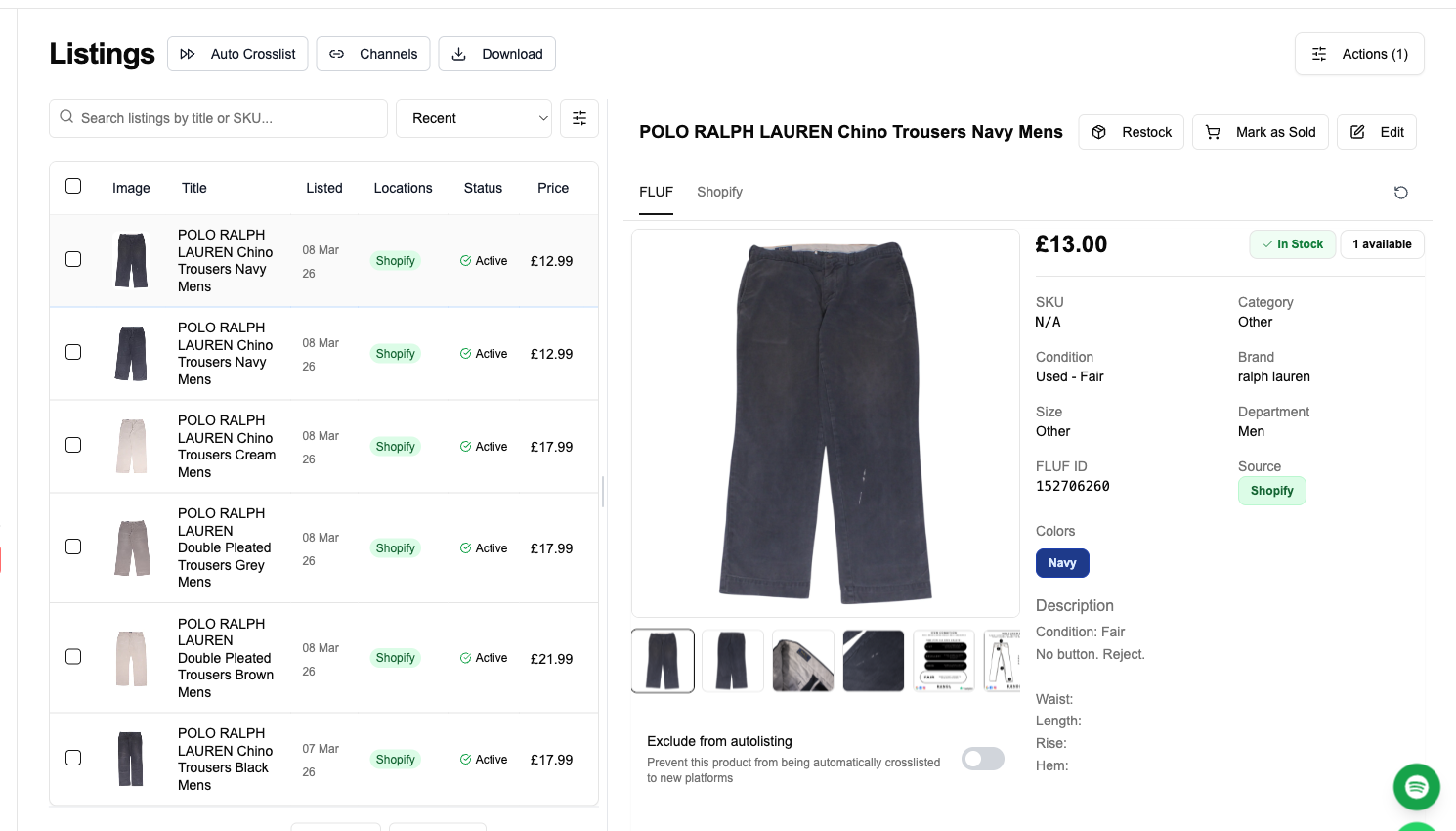
Import your Squarespace catalogue into FLUF Connect and review the listing details before publishing to Vinted.
Connect Squarespace using an API key generated in your account. No app install or open browser is required. Review the currency, price and stock for each variant before crosslisting.
Keep your Vinted connection signed in and available while publishing. Large batches can take time to complete; follow their progress in FLUF Connect.
Review the Vinted size, brand, colour, material and package size before publishing. Squarespace has no item-condition field, so enter an accurate condition for each item.
FLUF Connect will not push a Vinted listing with fewer than two photos, which is a deliberate floor rather than a platform limit. Single-photo listings on Vinted convert so poorly that pushing them wastes the listing.
What syncs, and the one gap you cover
Be precise about this, because the two directions are not symmetrical and pretending otherwise is how stores oversell.
| Event | What happens |
|---|---|
| An item sells on Vinted | Detected automatically. Vinted order sync picks the sale up and the matching Squarespace stock is dropped, along with any other channel carrying it. |
| An item sells on Squarespace | Not detected automatically. Squarespace order sync is not implemented, so the Vinted listing stays live until you mark the item sold in FLUF Connect. The fan-out to Vinted and every other channel then runs from there. |
| You change a price or a description | Pushed out from FLUF Connect to the channels carrying that item. |
| An item is relisted on Vinted | Supported. Vinted rewards freshness are included in every plan, and relisting from Seller upwards. |
On getting paid: an order completes when the buyer confirms it is fine, or automatically two days after delivery if nobody raises an issue, and the money reaches your Vinted balance about two days later. Withdrawing to a bank account takes up to five business days. Note the Pro difference — Pro sellers wait 14 days rather than two, because of the buyer’s statutory withdrawal right, so factor that into cash flow before you convert.
The second row is the one to build a habit around. Until Squarespace order sync ships, a sale on your own site is the case where you have to tell the system something it cannot see. It matters most on Vinted specifically, because a Vinted buyer can complete a purchase instantly — there is no offer step to slow it down, so a stale listing converts into a cancellation rather than a near miss.
Shipping changes hands
On Squarespace you own shipping completely: you set the rates, choose the courier, buy the label and absorb the errors. On Vinted the platform owns it and the buyer funds it. The buyer picks a carrier at checkout, and the label is issued against that choice; InPost drop-offs use a QR code rather than a printed label.
Vinted’s own 2025 results describe its Vinted Go service operating in five markets with access to more than 500,000 pick-up and drop-off points across Europe (Vinted financial results 2025). For a small store this is a real simplification — no rate tables, no courier account, no negotiating.
Vinted does set a dispatch clock: you have five business days from purchase to send the item, after which the order is cancelled the next business day. You can request an extension of three or five extra business days, which the buyer may decline. There is no performance score attached — a missed dispatch costs you the order and nothing more.
It costs you two things worth naming. You lose free shipping as a promotional lever, because you are no longer the one paying for postage. And you inherit the package-size decision described earlier, which is now the mechanism that sets your buyer’s delivery price. Returns follow the Pro rules rather than yours: the buyer usually pays return shipping unless you have said otherwise in your Additional Policies, and once the parcel is back you have two calendar days to confirm before the refund is issued (returning an item to a Pro seller).
What it costs
FLUF Connect starts at £9/monthFLUF Connect plans start at £9/month on Starter, with Seller at £29/month and Pro at £99/month; every plan is unlimited on listings and marketplaces, and the tiers differ by which automations they include and how often we check your channels for sales. There is no free plan, though every new account gets 7 days of full access. Bulk operations are included in every plan, and relisting and offers from Seller upwards rather than sold as add-ons.
Set against that, Vinted itself takes no commission and no listing fee from Pro sellers, so your marginal cost per sale on this channel is unusually low. The budget line to watch is returns, not fees.
Sources and verification
Facts on this page were checked against primary sources in August 2026. Marketplace rules change; verify anything that affects a commercial decision.
- Vinted UK catalogue rules — one listing per item, Pro seller second-hand requirement, maximum item value
- Vinted Pro service — definition, available countries, consequences of not declaring
- Vinted UK guide for Pro sellers — registration data, VAT, right of withdrawal
- Vinted Pro (UK) — no commission, no listing fee
- Vinted Pro sellers’ standard terms of sale — 14-day withdrawal, warranty liability
- Vinted UK price list — Buyer Protection range, last updated September 2025
- Vinted upload steps — required fields including package size
- Vinted photo rules — no collages, no stock imagery
- Returning an item to a Pro seller — return windows and who pays
- Vinted dispatch window — five business days, and extensions
- Vinted payout timing — including the 14-day hold on Pro accounts
- Vinted financial results 2025 — GMV, markets, Vinted Go footprint
- Squarespace Commerce APIs — product and variant fields
- Squarespace product variants — six options, 250 combinations
- Squarespace inventory — stock decrement behaviour
- GOV.UK digital platform reporting — HMRC thresholds and trading test
- Crunch guide to Vinted Pro — independent confirmation of Pro fees
Vinted does not publish a member count or a title and description character limit, so this page does not state one. Where a widely repeated number could not be traced to Vinted itself, it has been left out rather than repeated.
Related guides
Frequently Asked Questions
Not at volume. Vinted's UK catalogue rules say professional sellers should be selling second-hand items and may not list a large number of brand-new ones, though second-hand items in new condition are fine where they are unique pieces. Ordinary private members have more latitude, which is why you will see new items on the platform, but the Pro rules are the ones that apply to a registered business. If your store sells new own-label goods, Vinted is the wrong channel.
Yes, if you are a registered business. Vinted requires Pro sellers to be a sole trader, non-profit or company, and it acts on trading patterns whether or not you volunteer the information — sellers report being flagged and told there was no other way to continue. Vinted also warns that failing to declare can bring sanctions under the EU Consumer Rights Directive and the Unfair Commercial Practices Directive, and the UK guide raises account suspension for non-compliance.
No listing fee and no commission on sales. Vinted's UK Pro page states you can list as many second-hand items as you like at no cost, and independent UK accountancy guidance says the same. Vinted earns from the buyer instead, through the Buyer Protection charge, which its published UK price list gives as roughly 3% to 8% of the item price plus £0.30 to £0.80 including VAT. Ignore the 5% plus 70p figure that circulates on blogs — it contradicts Vinted's own price list.
Consumer-law obligation rather than percentage. A Pro seller must give buyers a legal right of withdrawal for 14 calendar days from the day after delivery and refund within 14 days, and carries sole liability for legal warranties on conformity and hidden defects. The competitive sting is that the private sellers listing similar items beside you can refuse change-of-mind returns entirely. Budget for returns, not for fees.
It does not map cleanly, because Vinted has no stock-quantity concept — one listing is one physical garment, and the catalogue rules ask for only one listing per item. You have three realistic options: fan out to twelve separate listings, list one unit per size and relist after each sale, or list representative pieces and treat Vinted as a shop window. Vintage and archive stores avoid the problem entirely because their stock is genuinely one-of-one.
Three details need particular attention: brand, condition and package size. Squarespace does not supply these as Vinted listing fields. Confirm the brand, accurately describe condition and choose a package size that fits the item before publishing.
Not automatically yet. Squarespace order sync is not implemented, so a sale on your own site is not detected and the Vinted listing stays live until you mark the item sold in FLUF Connect, which then fans out to every channel carrying it. The reverse direction does work on its own: a Vinted sale is picked up by order sync and the Squarespace stock is dropped. Build the habit around your own storefront, because a Vinted buyer can complete a purchase instantly.
Not for Vinted orders. The buyer chooses a carrier at checkout and funds the postage, and the label is issued against that choice, with InPost using a QR code instead of a printed label. That removes your rate tables and courier admin, but it also removes free shipping as a promotional lever and hands the package-size decision real weight, since it sets what delivery options your buyer is offered. Vinted also sets a dispatch window of five business days, after which an unsent order is cancelled the next business day, though you can request a three or five day extension that the buyer may decline.
Squarespace requires an API key from your account and no open browser. Keep your Vinted connection signed in and available for listing actions, and allow time for large batches to publish.
FLUF Connect plans start at £9/month on Starter, with Pro at £29/month and custom Super Seller plans above that; every plan is unlimited on listings and marketplaces, and the tiers differ by which automations they include and how often we check your channels for sales. There is no free plan, but every new account gets a 7-day trial for £1 with full access. Bulk operations are included in every plan, and relisting and offers from Pro upwards rather than charged as add-ons.