
How to Sell on Depop — The Complete Guide for 2026
Near-zero seller fees. 7M+ active buyers. The social marketplace where Gen Z buys vintage, streetwear, and one-of-a-kind fashion — now with FLUF Connect crosslisting.



- Active buyers: 7 million active buyers, 35+ million registered users across 150+ countries
- Seller fees: No seller commission in the UK (since March 2024) or US (since July 2024). Payment processing of 2.9% + £0.30 still applies. Australia still charges 10% seller fee
- Listing limit: Unlimited free listings
- Best for: Vintage fashion, streetwear, Y2K trends, handmade items, one-of-a-kind pieces
- Biggest advantage: Social marketplace with a young, trend-driven audience that browses like Instagram and buys like eBay
- Cross-list with FLUF Connect: Sync Depop with eBay, Vinted, Wallapop, Shopify & more — all in one dashboard
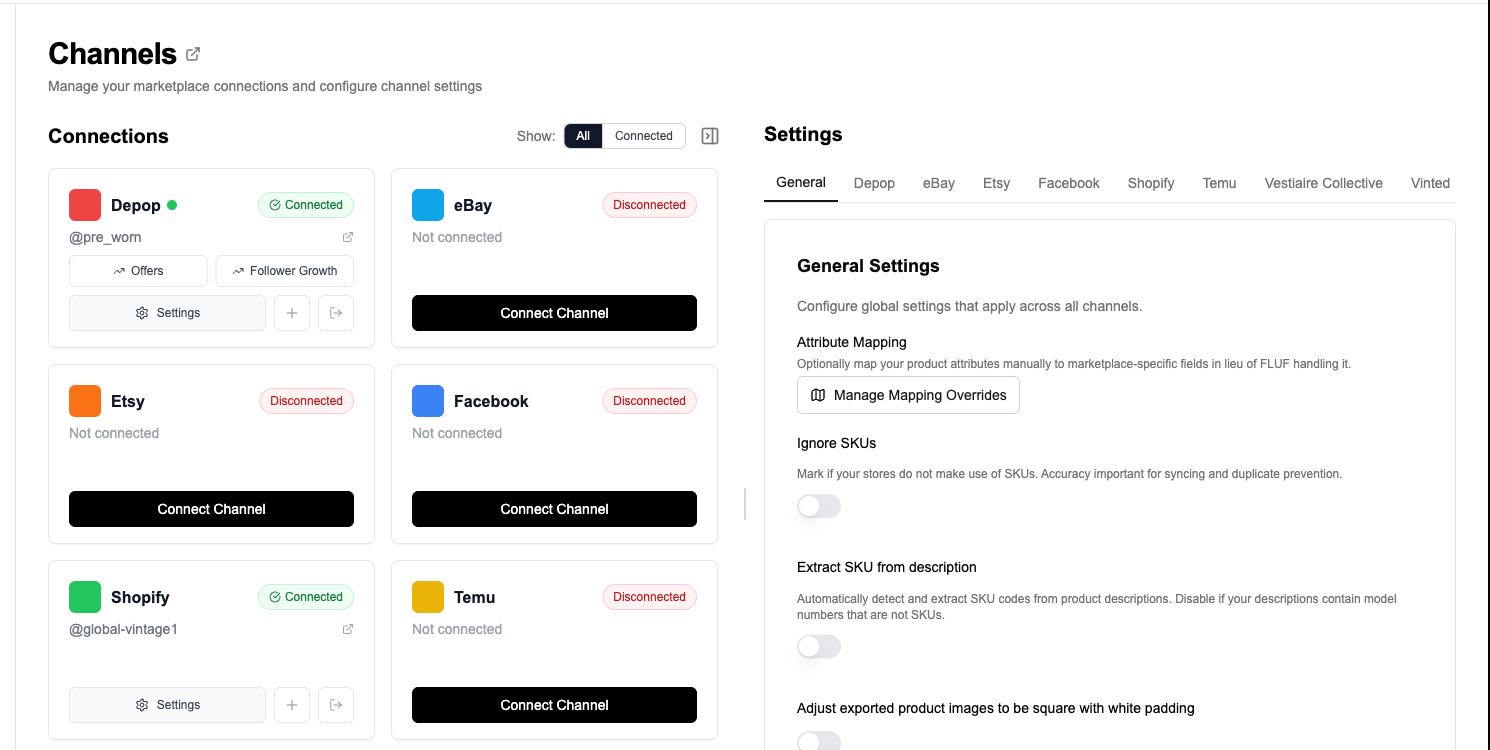
Table of Contents
- What Is Depop?
- Why Sell on Depop in 2026?
- How Much Does It Cost to Sell on Depop? — Fees Explained
- How to Set Up Your Depop Seller Account
- How to Create Depop Listings That Actually Sell
- Photography Tips for Depop Sellers
- Shipping and Returns on Depop
- How Does the Depop Algorithm Work?
- Getting Paid and Tax Obligations
- What Sells Best on Depop in 2026?
- Pro Tips from Experienced Depop Sellers
- Common Mistakes New Depop Sellers Make
- Cross-List Your Depop Products to Sell Faster
What Is Depop?
Depop is a social marketplace for buying and selling fashion, vintage clothing, streetwear, and unique items. Think of it as a cross between Instagram and eBay — a platform where your shop is your profile, your listings are your feed, and discovery happens through following, liking, and algorithmic recommendation as much as through search.
Founded in 2011 by Simon Beckerman in Italy (later headquartered in London), Depop started as a social network for creative entrepreneurs before evolving into one of the world’s leading fashion resale marketplaces. In June 2021, Etsy acquired Depop for $1.625 billion, recognising its unique position with younger buyers. Since the acquisition, Depop has expanded its infrastructure while maintaining the community-driven, trend-focused identity that made it popular.
Today, Depop has over 35 million registered users and 7 million active buyers across more than 150 countries, with the strongest presence in the UK, US, and Australia. The platform is heavily skewed towards younger buyers (nearly 90% under 34), making it the go-to marketplace for trend-driven fashion, vintage finds, and one-of-a-kind pieces. In a landmark shift starting March 2024 (UK) and July 2024 (US), Depop removed its 10% seller commission, adopting a buyer-pays model similar to Vinted. In February 2026, eBay announced it would acquire Depop from Etsy for approximately $1.2 billion, with the deal expected to close in Q2 2026.
| Metric | Detail |
|---|---|
| Founded | 2011 |
| Headquarters | London, UK (owned by Etsy since 2021) |
| Active buyers | 7 million (Dec 2025) |
| Active sellers | 3+ million |
| Registered users | 35+ million |
| Countries | 150+ |
| Core markets | UK, US, Australia |
| User demographic | ~90% under 34 (Gen Z & millennials) |
| Top categories | Vintage clothing, streetwear, Y2K fashion, handmade items, accessories |
| Annual GMS | ~$1 billion (2025) |
| Revenue model | Buyer service fee + seller payment processing (2.9% + £0.30). No seller commission since March 2024 (UK) / July 2024 (US). Australia: 10% seller fee |
| Parent company | Etsy, Inc. (acquired June 2021 for $1.625B). eBay acquiring Depop for ~$1.2B, expected Q2 2026 |
Why Sell on Depop in 2026?
Depop remains one of the most exciting platforms for fashion resellers in 2026. Here’s why it deserves a spot in your selling strategy, whether you’re clearing out your wardrobe or building a full-time resale business.
Near-Zero Seller Fees
Since March 2024 (UK) and July 2024 (US), Depop removed its 10% seller commission. The only fee sellers pay is payment processing (2.9% + £0.30 per sale in the UK). On a £30 item, that’s £1.17 — you keep £28.83. The buyer pays a separate service fee. Note: Australian sellers still pay a 10% seller fee.
A Young, Trend-Driven Audience
Depop’s user base is uniquely young. Nearly 90% of buyers are under 34, and they’re actively shopping for the vintage, streetwear, and Y2K fashion that dominates current trends. US buyer numbers grew nearly 60% year-over-year in 2025. If you sell fashion — especially anything with a retro, alternative, or designer angle — Depop’s audience is more engaged than any other platform’s.
Social Commerce Built In
Unlike traditional marketplaces where buyers search and buy, Depop works like a social network. Buyers follow sellers, like items, and discover products through an algorithmically curated Explore page. This means building a following on Depop creates a compounding advantage — your new listings reach your followers instantly, without relying solely on search ranking.
Backing from Major E-Commerce Players
Etsy acquired Depop in 2021 for $1.625 billion. In early 2026, eBay announced it would acquire Depop from Etsy for approximately $1.2 billion, with the deal expected to close in Q2 2026. Under eBay’s ownership, Depop will continue operating as a standalone brand. For sellers, this means continued investment in the platform’s infrastructure, payments, and seller tools — backed by one of the world’s largest e-commerce companies.
Low Barrier to Entry
You can start selling on Depop with nothing more than a smartphone. Take photos, write a description, set a price, and you’re live. There are no listing fees, no monthly subscriptions, and no approval process. For new resellers, it’s the lowest-friction way to start.
| Depop | Vinted | eBay (Private) | Etsy | |
|---|---|---|---|---|
| Listing fee | Free | Free | Free (first 1,000/month) | £0.16 per listing |
| Seller commission | 0% (removed March 2024 UK) | 0% (no seller fees) | £0 (since Oct 2024) | 6.5% transaction fee |
| Payment processing | 2.9% + £0.30 | Included | Included | 4% + £0.20 |
| Monthly subscription | None | None | N/A | None (Plus from £8/month) |
| Total cost on £30 item | £1.17 | £0 | £0 | ~£3.31 |
| Active buyers | 7 million | ~100 million | 132 million | ~96 million |
| Best for | Fashion, streetwear, vintage | Everyday fashion, bargains | All categories | Vintage, handmade, craft |
How Much Does It Cost to Sell on Depop? — Fees Explained
Depop overhauled its fee structure in July 2024, removing all seller fees in the UK, US, and Australia. This makes Depop one of the most affordable platforms to sell on — but there are still costs to understand, especially around shipping and boosted listings.
Seller Commission: Zero in UK and US
Before 2024, Depop charged a 10% selling fee on every transaction. That commission has been removed in the UK (March 2024) and US (July 2024). Australian sellers still pay a 10% selling fee on the item price (or item price + shipping if not using Depop Shipping).
In other markets, Depop may still charge a seller commission — check Depop’s fee page for your specific country.
Payment Processing Fee (Still Applies Everywhere)
Even in zero-commission markets, sellers pay a payment processing fee on every transaction: 2.9% + £0.30 per sale in the UK, 3.3% + $0.45 in the US, and 2.6% + A$0.30 in Australia. This is deducted from your payout automatically. On a £30 sale in the UK, that’s £1.17 in processing fees — significantly less than the old 10% commission (£3.00), but not zero.
All payments are handled through Depop Payments (powered by Stripe). Funds are deposited directly to your linked bank account.
Shipping Costs
Shipping is the main cost Depop sellers face. You have two options:
- Seller-paid shipping: You absorb the postage cost and offer “free shipping” to the buyer. This reduces your net profit but can increase sales.
- Buyer-paid shipping: You set a shipping price and the buyer pays it. Most Depop sellers use this approach.
Depop offers integrated shipping labels through partnerships with Royal Mail (UK), USPS (US), and other carriers, often at discounted rates. You can also ship independently with any carrier.
Boosted Listings
Depop’s Boosting feature lets you pay to increase the visibility of individual listings. When you boost an item, it appears higher in search results and on the Explore page. You only pay if the item sells through a boosted impression. The boost fee is 12% in the UK and 8% in the US and Australia of the item price. This is entirely voluntary — you choose which items to boost and can turn boosting off at any time.
Depop Verified (Sellers with High Volume)
Depop’s Verified badge is awarded to established sellers with consistent sales history, strong reviews, and high-quality listings. Verified status is free — it’s earned through performance, not paid for.
- Listing fee: £0.00
- Seller commission: £0.00 (removed March 2024)
- Payment processing (2.9% + £0.30): £1.17
- Shipping (if buyer-paid): £0.00 to you
- Total fees: £1.17 (3.9% of sale price)
- You keep: £28.83
If you also boost the listing (optional, 12% in the UK) and it sells through a boosted impression, you’d pay an additional £3.60 — keeping £25.23. Boosting is entirely voluntary and most sellers only boost their highest-margin items.
How to Set Up Your Depop Seller Account
Setting up a Depop seller account takes about 10 minutes. Depop doesn’t have separate “buyer” and “seller” accounts — every Depop user can list items for sale from day one.
Step-by-Step Setup
- Download the Depop app — available on iOS and Android. You can also use depop.com on desktop, but the app is the primary experience.
- Create your account — sign up with your email, Apple ID, or Google account. Choose a username that reflects your brand or niche (e.g., @vintagefindsldn, @y2karchive).
- Complete your profile — add a profile photo, write a bio describing what you sell, and include any relevant details (shipping times, bundle discounts, policies).
- Set up Depop Payments — connect your bank account to receive payouts. You’ll need to verify your identity with a government-issued ID. This is required before you can sell.
- Set your shipping preferences — choose whether you’ll use Depop’s integrated shipping labels or arrange your own shipping. Set your default shipping price.
- List your first item — take or upload photos, write a description, add hashtags, set your price, and publish. You’re live.
Profile Optimisation Tips
- Username: Keep it memorable and relevant to your niche. Avoid numbers and underscores where possible.
- Bio: State what you sell, your shipping schedule, and any bundle offers. Example: “Curated vintage & Y2K | Ships within 2 days | 10% off bundles of 3+”
- Profile photo: Use a clean, recognisable image — your logo if you have one, or a styled flat-lay of your best items.
- Location: Set this accurately — buyers filter by location, especially for local collection.
How to Create Depop Listings That Actually Sell
Creating effective Depop listings is part art, part science. The platform’s visual-first nature means your photos matter more than on any other marketplace — but your description, pricing, and hashtag strategy are what get you found in search.
Title and Description
Depop doesn’t have a separate “title” field — your description IS your listing copy. The first few words serve as the title in search results and notifications, so lead with the most important keywords.
Before and after example:
❌ “Cute top for sale, only worn once, need gone ASAP”
✅ “Nike Vintage 90s Swoosh Crop Top — Size S/M — Excellent Condition. Authentic Nike cotton crop with embroidered swoosh logo. Fits true to size S, also works as oversized XS. No flaws, minimal fading. #nike #vintage #90s #croptop #streetwear”
Include in every description:
- Brand name (if applicable)
- Era or style (vintage, Y2K, 90s, etc.)
- Size with fit notes (“fits like a UK 10-12”)
- Condition description (be specific about any flaws)
- Material and colour
- Measurements for non-standard sizing
- 5-10 relevant hashtags at the end
Pricing Strategy
Depop buyers expect competitive prices. Research comparable items by searching for your brand + item type and filtering by “Sold” to see what actually sells versus what just sits.
- Price for the audience: Depop’s demographic is young and price-conscious. A vintage Levi’s jacket might sell for £60-80 on eBay but £40-55 on Depop.
- Build in negotiation room: Most Depop buyers will send offers. Price 10-15% above your minimum acceptable price.
- Bundle discounts: Offer discounts on multiple items (e.g., “10% off 2+, 15% off 3+”). This increases your average order value and reduces per-item shipping costs.
- Psychological pricing: £29 sells better than £30. Use prices ending in 5 or 9.
Hashtags
Depop uses hashtags to categorise and surface listings. You get up to 5 dedicated hashtag slots plus any hashtags in your description text.
- Use all available hashtag slots
- Mix broad tags (#vintage, #streetwear) with specific ones (#nike90s, #levis501)
- Don’t spam irrelevant hashtags — Depop penalises this and may remove your listings
- Check trending hashtags on the Explore page for seasonal opportunities
Category and Subcategory Selection
Depop’s category system determines where your item appears in filtered searches. Choose the most specific subcategory available. Mislabelling your item’s category reduces visibility and may confuse buyers.
Photography Tips for Depop Sellers
Photography is the single most important factor in Depop sales. Depop is a visual-first platform — buyers scroll through images like an Instagram feed, and your photos need to stop them mid-scroll.
Depop Photo Requirements
- Number of photos: Up to 4 images and 1 video per listing
- Format: Square (1:1 ratio), minimum 640×640 pixels
- First photo: This is your thumbnail — make it your strongest, clearest shot
Styled Shots vs Clean Backgrounds
Unlike eBay (where clean white backgrounds work best), Depop rewards creative, styled photography. The top-selling Depop shops treat their listings like mini photoshoots:
- Model shots outperform flat-lays on Depop — buyers want to see how items look when worn
- Natural lighting is essential. Shoot near a window during daytime for soft, even light
- Consistent aesthetic: The most successful Depop sellers have a recognisable visual style across their whole shop
- Show details: Close-ups of labels, textures, stitching, and any unique details
- Show flaws honestly: Photograph any damage, stains, or wear. Transparency builds trust and prevents returns
Mobile Photography Tips
Most Depop sellers photograph with their phone — and that’s perfectly fine:
- Clean your camera lens before shooting
- Use portrait mode for model shots (creates a blurred background)
- Avoid harsh overhead lighting (it creates unflattering shadows)
- Edit consistently — pick one filter or editing style and apply it to all your photos for a cohesive shop look
Shipping and Returns on Depop
Understanding Depop’s shipping options and return policies is essential for keeping your seller rating high and your buyers happy.
Shipping Options (UK)
Depop offers integrated shipping labels through a partnership with Royal Mail (UK). You can also ship with any carrier independently.
| Option | Cost | Speed | Tracking | Best For |
|---|---|---|---|---|
| Depop x Royal Mail (integrated) | From ~£2.99 | 2-3 business days | Yes | Small items, convenience |
| Royal Mail 2nd Class (manual) | From ~£3.35 | 2-3 business days | Optional (extra cost) | Budget-conscious sellers |
| Royal Mail 1st Class (manual) | From ~£4.25 | 1-2 business days | Optional (extra cost) | Fast delivery |
| Evri (Hermes) | From ~£2.49 | 3-5 business days | Yes | Heavier parcels, cost savings |
| DPD / DHL | From ~£5.00 | Next day available | Yes | High-value items, next-day delivery |
Shipping Tips
- Always use tracked shipping for items over £15 — it protects you if a buyer claims non-delivery
- Ship within 5 days — Depop’s policy requires dispatch within 5 days of sale. Faster shipping improves your seller rating
- Upload tracking immediately after dispatch — this triggers buyer notifications and starts the delivery confirmation timer
- Package carefully — use tissue paper, recycled packaging, and handwritten thank-you notes. Depop buyers appreciate the personal touch and are more likely to leave positive reviews
International Shipping
Depop supports international listings and sales. If you’re willing to ship internationally, enable it in your settings to reach Depop’s global user base. Consider:
- Customs forms required for items over a certain value
- Royal Mail International Tracked starts from ~£7
- Factor international shipping costs into your pricing or charge separately
Returns Policy
Depop’s official policy:
- Buyers can request a return if the item is significantly not as described (wrong size, undisclosed damage, counterfeit)
- Items described accurately are generally not eligible for returns — Depop doesn’t mandate free returns
- If a dispute arises, Depop’s Resolution Centre mediates. They review listing photos, descriptions, and buyer evidence
- Sellers who accept voluntary returns tend to have higher buyer confidence and repeat customers
How Does the Depop Algorithm Work? — Getting Your Listings Seen
Depop’s algorithm determines which listings appear in search results, on the Explore page, and in personalised recommendations. Understanding how it works is the difference between getting consistent sales and watching your listings gather dust.
Search Ranking Factors
Depop’s search algorithm considers:
- Relevance: How well your description and hashtags match the search query
- Listing freshness: Recently listed and refreshed items rank higher
- Seller activity: Active sellers (listing, relisting, engaging) get prioritised
- Conversion signals: Items with likes, saves, and previous sales from your shop boost your overall shop ranking
- Price competitiveness: Items priced in line with the market for similar products
The Freshness Factor
This is the single most impactful ranking signal on Depop. New and recently refreshed listings get a visibility boost. Experienced sellers relist their oldest unsold items regularly to maintain visibility. This is why auto-relisting tools are so valuable for Depop sellers — manually deleting and re-uploading 20-50 listings per day is tedious work that automation handles in the background.
The Explore Page
Depop’s Explore page is curated algorithmically based on user behaviour, trending items, and seasonal themes. Getting featured on Explore can drive significant traffic. Factors that increase your chances:
- High-quality, styled photography (not flat-lays on messy beds)
- On-trend items that match current Depop trends
- Strong engagement metrics (likes relative to views)
- Consistent listing activity (daily is ideal)
Engagement Signals
Likes, follows, and shares on Depop function similarly to social media engagement — they signal to the algorithm that your content is valuable:
- Likes: The more likes a listing receives, the more the algorithm surfaces it to similar users
- Follows: Your follower count affects how many people see your new listings in their feed
- Shares: Sharing listings to social media (Instagram, TikTok) drives external traffic, which Depop’s algorithm rewards
Boosted Listings
Depop’s Boosting feature is a pay-per-sale advertising option. Boosted items appear higher in search and on the Explore page. You only pay the boost fee (12% in UK, 8% in US) if the item sells through a boosted impression — making it a low-risk way to increase visibility on your highest-margin items.
Best Times to List
Depop traffic peaks during evenings (7-10pm) and Sunday afternoons. Listing during these windows means your items appear in the “Recently Listed” sort when the most buyers are browsing. Weekday mornings tend to be quieter.
| Factor | Impact | What You Can Control |
|---|---|---|
| Listing freshness | Very high | Relist regularly (FLUF auto-relisting handles this automatically) |
| Description keywords | High | Include brand, era, size, colour, style in every description |
| Photo quality | High | Styled model shots, consistent aesthetic, good lighting |
| Seller activity | High | List new items regularly, respond to messages quickly |
| Engagement (likes, follows) | Medium | Build a following, share listings on social media |
| Price competitiveness | Medium | Research comparable sold items |
| Boosted listing | Medium | Pay-per-sale boost on high-margin items |
| Hashtag relevance | Medium | Use specific, accurate hashtags in all slots |
Getting Paid and Tax Obligations on Depop
Understanding how Depop payments work and what your tax obligations are will help you manage your cash flow and stay on the right side of HMRC (or your local tax authority).
How You Get Paid
All Depop transactions are processed through Depop Payments (powered by Stripe). When a buyer purchases your item:
- Funds availability: Money typically becomes available within 1-5 business days of dispatch confirmation
- Payout method: Direct deposit to your linked bank account
- New seller holds: If you’re a new seller or have a limited track record, Depop may hold funds for up to 7-14 days to protect against disputes. These holds decrease as you build positive selling history
- Balance: You can view your available balance and pending funds in the Depop app
Tax Obligations by Country
Important disclaimer: This is general guidance, not tax advice. Consult a qualified accountant for your specific situation.
United Kingdom
- HMRC’s trading allowance lets you earn up to £1,000 per tax year from self-employment (including Depop sales) without reporting it
- Above £1,000, you must register for Self Assessment and report your Depop income
- Since January 2024, Depop reports seller data to HMRC if you exceed 30 transactions or €2,000 (~£1,740) in a calendar year (DAC7 reporting). This is information reporting, not a tax threshold
- Selling personal possessions at a loss is generally not taxable
- VAT registration required if your taxable turnover exceeds £90,000
European Union
- DAC7 directive requires Depop to report seller information to tax authorities if you exceed 30 transactions or €2,000 in a calendar year
- VAT rules vary by country
United States
- 1099-K reporting threshold: $20,000 and 200+ transactions per year (restored by the Big Beautiful Bill Act, 2025). Below both thresholds, no 1099-K is issued
- State sales tax is collected and remitted by Depop automatically in most states
- Personal item sales at a loss are generally not taxable
Australia
- GST registration required if annual turnover exceeds AUD $75,000
- Income from reselling is generally assessable income and should be declared
Hobby vs Business
Clearing out your wardrobe? That’s generally not taxable. Buying items specifically to resell at a profit? That’s trading, and you should declare the income. The key factors tax authorities look at: frequency of sales, whether you buy to resell, and your intent to profit.
Record Keeping
Keep records of purchase costs (charity shop receipts, boot sale spending), postage expenses, packaging materials, and any fees. These are deductible expenses that reduce your taxable profit if you’re trading.
What Sells Best on Depop in 2026?
Depop’s sweet spot is fashion with personality — vintage, streetwear, one-of-a-kind pieces, and trend-driven items that stand out from fast fashion. Here’s what’s selling well right now.
| Category | Avg. Sale Price | Competition | Sell-Through Rate | Tip |
|---|---|---|---|---|
| Y2K & 2000s fashion | £15-35 | High | High | Low-rise, baby tees, butterfly motifs, and early 2000s brands like Juicy Couture |
| Vintage sportswear | £20-50 | Medium | High | 90s Nike, Adidas, Champion — especially windbreakers, track jackets, and fleeces |
| Streetwear | £25-80 | High | Medium-High | Supreme, Stussy, Carhartt, Palace. Authenticity is everything — buyers check carefully |
| Designer accessories | £30-150 | Medium | Medium | Vintage designer bags, belts, and jewellery — especially 90s/2000s era |
| Handmade & reworked | £20-45 | Low-Medium | Medium | Custom tie-dye, patchwork denim, hand-painted items. Depop’s audience loves one-of-a-kind |
| Denim | £20-55 | High | High | Levi’s 501s, vintage Wranglers, wide-leg and bootcut styles. Always include waist measurement |
| Knitwear & cardigans | £15-40 | Medium | High (seasonal) | Chunky knits, fairisle patterns, branded cardigans. Strong autumn/winter sellers |
| Trainers | £30-100 | High | Medium | Nike Dunk, New Balance 550, Asics — include size, condition, and colourway |
Trending on Depop in 2026
- Gorpcore — outdoor-inspired fashion: North Face puffers, Arc’teryx jackets, hiking boots styled with everyday wear
- Quiet luxury — minimalist, logo-free designer pieces: Celine, The Row, Bottega Veneta
- Vintage band tees — perennially popular, especially 90s/2000s tour merchandise
- Workwear — Carhartt, Dickies, oversized utility wear. Crossing over from streetwear into mainstream
- Sustainable fashion — Depop’s audience is environmentally conscious. “Pre-loved” and “thrifted” are positive selling points, not stigmas
How to Research What’s Selling
- Search and filter by “Sold” — search for your item type and filter by sold items to see actual sale prices and what’s in demand
- Check the Explore page daily — Depop curates trending items and themes. Align your inventory with what’s being featured
- Follow top sellers in your niche — study their pricing, photography, and descriptions. Browse the Depop Resellers Leaderboard to see who is leading in items sold, followers, and growth
- Monitor TikTok fashion trends — Depop’s audience heavily overlaps with TikTok. Trends on TikTok often translate directly to Depop sales within weeks
Pro Tips from Experienced Depop Sellers
These tips come from real Depop sellers who’ve shared their strategies on Reddit and seller communities — not generic advice from help pages.
- Relist your unsold items every 2-3 weeks — the freshness boost is real. Delete the listing, re-upload with the same photos and description. Your item gets treated as “new” by the algorithm. FLUF Connect’s auto-relisting automates this entirely — it rotates your oldest Depop listings daily without you lifting a finger.
- Respond to messages within an hour — Depop tracks response time, and fast replies dramatically increase conversion. A buyer who messages is already interested — a slow response lets them find the item elsewhere.
- Cross-list everything to at least one other platform — your Depop item is only visible to Depop users. The same listing on eBay or Vinted reaches entirely different buyer pools. Multi-platform sellers consistently outsell single-platform sellers. FLUF Connect syncs your inventory automatically.
- Post new listings during peak hours (7-10pm) — this is when Depop traffic is highest. Your new listing gets the freshness boost when the most buyers are browsing.
- Build your brand, not just a shop — top Depop sellers have a consistent visual identity across all their listings. Pick a photography style, a packaging approach, and a niche — then own it. Buyers follow shops with personality.
- Use the “Make Offer” feature strategically — send offers to users who’ve liked your items. A personalised discount often converts a “like” into a sale. FLUF Connect’s offer management can automate this process.
- Don’t ignore your shop’s aesthetic — your Depop profile is a grid, like Instagram. The overall look of your shop matters. Buyers browse shop pages before buying, and a cohesive, professional-looking grid builds trust.
- Include measurements, not just sizes — vintage sizing is wildly inconsistent. A “Size M” from the 90s fits differently to a modern M. Include chest width, length, and sleeve length to reduce buyer uncertainty and returns.
Common Mistakes New Depop Sellers Make
- Using blurry, poorly lit photos — Depop is a visual platform. Listings with dark, blurry, or cluttered photos get scrolled past. Use natural light, clean backgrounds, and show the item clearly. This is the #1 reason listings don’t sell.
- Spamming irrelevant hashtags — tagging a Nike t-shirt with #adidas #puma #gucci to appear in more searches will get your listing flagged and your account warned. Depop actively penalises hashtag spam.
- Not disclosing flaws — hiding stains, tears, or missing buttons leads to disputes, returns, and negative reviews. Photograph every flaw and mention it in the description. Honesty is the fastest way to build trust and positive reviews.
- Overpricing based on nostalgia, not market data — “I paid £80 for this” doesn’t mean it’s worth £60 used. Check sold prices on Depop, eBay, and Vinted to price realistically.
- Listing once and waiting — a listing uploaded three months ago is essentially invisible on Depop. The algorithm favours fresh listings. If something hasn’t sold in 2-3 weeks, relist it.
- Ignoring messages and offers — slow responses signal to buyers (and the algorithm) that you’re not an active seller. Treat every message as a potential sale.
- Only selling on Depop — your item can only sell once, but it can be visible on Depop, eBay, Vinted, Wallapop, and Shopify simultaneously. Selling on multiple platforms with automatic inventory sync is the single biggest growth lever for resellers.
Cross-List Your Depop Products to Sell Faster
Selling exclusively on Depop means your products are only visible to Depop’s 7 million active buyers. Adding eBay, Vinted, and Shopify to the mix puts the same inventory in front of hundreds of millions of additional buyers — without creating duplicate work.
Multi-platform sellers consistently report that items listed on 3+ platforms sell 2-3x faster than single-platform listings. The maths is simple: more eyeballs = more sales.
Which Marketplaces Pair Well with Depop?
- Depop + eBay: eBay’s older, search-driven audience complements Depop’s younger, trend-driven crowd perfectly. Your vintage Nike jacket reaches both demographics. Cross-list between Depop and eBay automatically.
- Depop + Vinted: Vinted’s 100 million users are Europe’s largest fashion resale audience, and they charge no seller fees. Cross-list between Depop and Vinted to double your zero-fee exposure.
- Depop + Shopify: Build your own branded store while maintaining your Depop presence. Sync Shopify and Depop for centralised order management.
- Depop + Wallapop: Reach Iberian, Italian, UK, and French buyers Depop alone does not surface — Wallapop covers general-purpose second-hand at scale across five markets. Cross-list from Wallapop to Depop or in the other direction.
- Depop + Leboncoin: French buyers shop on Leboncoin for everyday second-hand more than any other channel. Cross-list from Depop to Leboncoin with auto-translation built in.
How FLUF Connect Works for Depop Sellers
FLUF Connect is a multi-marketplace crosslisting and automation platform that connects your Depop account with eBay, Vinted, Wallapop, Shopify, and Facebook Marketplace. Here’s what it does for Depop sellers specifically:
- Connect your Depop account — link your Depop account to FLUF Connect. Takes under 5 minutes.
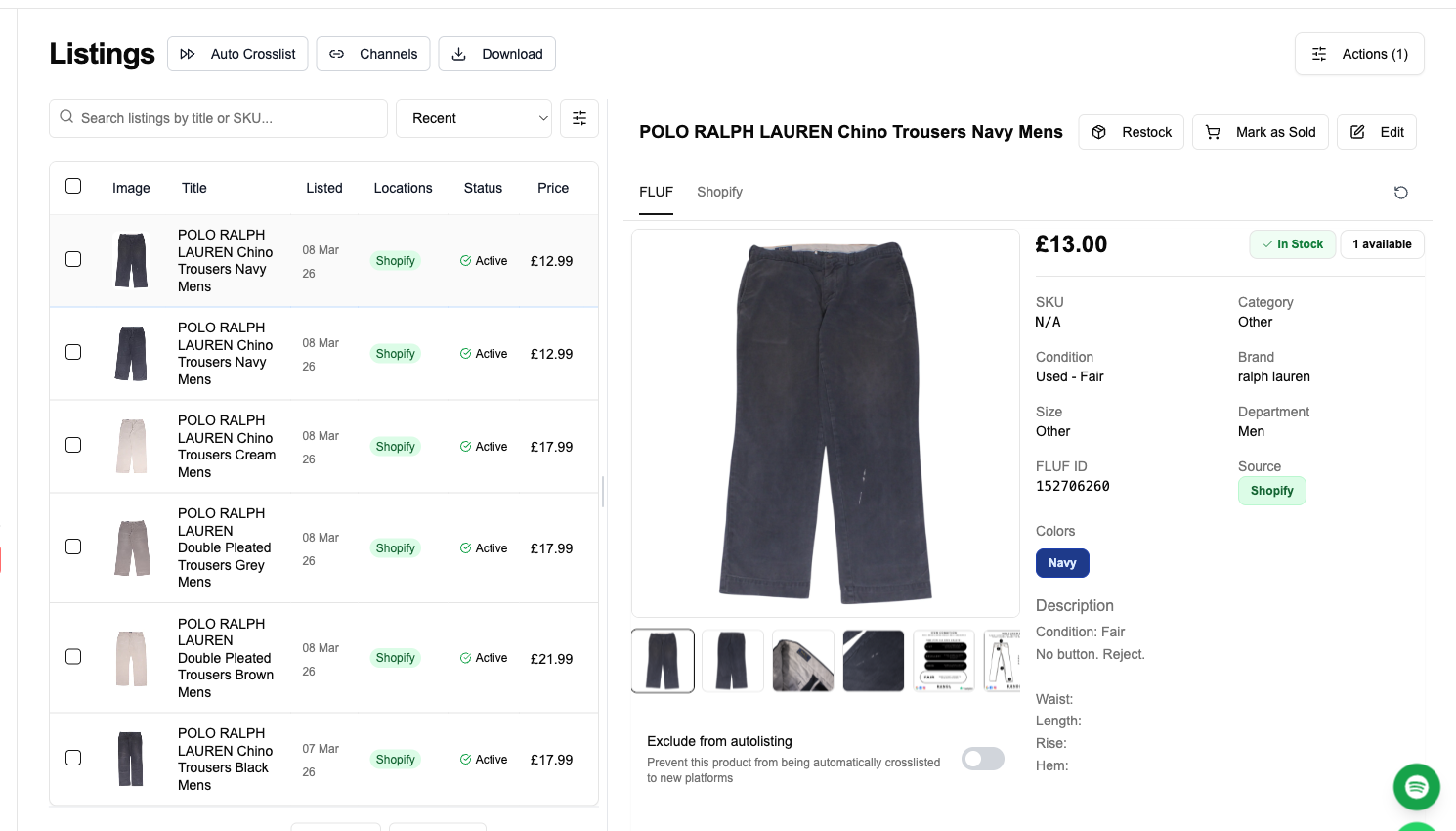
- Select products to cross-list — choose individual items or bulk-select hundreds at once. FLUF transfers your photos, description, price, hashtags, and item details automatically.
- Automatic inventory sync — when an item sells on any platform, FLUF removes it from all others within minutes. No more overselling, no manual delisting.
| Feature | Depop Support |
|---|---|
| Crosslisting | Yes — to/from eBay, Vinted, Shopify, Facebook Marketplace |
| Inventory sync | Yes — real-time across all connected channels |
| Auto-relisting | Yes — configurable daily rotation with smart strategies |
| Offer management | Yes — auto-send offers to likers, manage incoming offers |
| Order sync | Yes — orders sync to Shopify for centralised fulfilment |
| Bulk operations | Yes — bulk crosslist, bulk price changes, find & replace |
Pricing
Plans start from £19/month for up to 1,000 products. All plans include crosslisting, inventory sync, auto-relisting, and offer management. 1,000 products on the £19/month Growth plan included. See full pricing.
Why Depop Sellers Choose FLUF Connect
- automation included in every plan — auto-relisting and offer management included in every plan. Competitors like List Perfectly and Vendoo charge £30-50+/month for comparable features
- Vinted support — most competitors don’t support Vinted. FLUF gives your Depop inventory access to Vinted’s 100 million buyers
- Dedicated support — responsive, knowledgeable support from people who understand reselling
- Works for any product type — not limited to fashion. Works for accessories, electronics, homeware, collectibles — anything you sell
- Crosslist from Gumtree to Depop
New crosslisting guides (May 2026)
- Selling fashion to a US audience? Poshmark’s social closet model is the natural US counterpart to Depop. How to Sell on Poshmark
Crosslist from Poshmark to Depop
Poshmark sellers expanding outward: see our Poshmark to Depop crosslisting guide for field mapping, condition translation and inventory sync details.
New crosslisting guides (2026-05-29)
- Crosslist from Depop to Kloset Klub — add a curated South African resale audience
More Crosslisting Guides
Related: Selling on Grailed — the curated US marketplace for streetwear and designer menswear
Related: Crosslist from Depop to Grailed — move your best streetwear upmarket
Related guide: Grailed vs Depop.
Related Guide
Related guides
Related guide: How to crosslist from BigCommerce to Depop.
Sources & Verification
Last verified: 2026-06-28. Please contact us if any figure is out of date.
- Etsy investor relations — eBay to Acquire Depop from Etsy (18 Feb 2026) — 7 million active buyers (Dec 2025), nearly 90% under 34, 3M+ active sellers, ~60% US year-over-year growth, ~$1bn GMS, ~$1.2bn acquisition price, Q2 2026 close
- Depop newsroom — Evolving our fee structure (zero selling fees) — removal of the UK seller commission, buyer fee, processing fee still applies
- Depop Help Centre — Seller fees and charges — payment-processing rates, Australia seller fee, boost/boosted-listing fees
- Depop — Wikipedia — founding (2011, Simon Beckerman), Etsy acquisition (June 2021, $1.625bn)
- Business of Apps — Depop statistics — registered-user count
- GOV.UK — Tax-free trading allowance & VAT registration threshold — £1,000 trading allowance, £90,000 VAT threshold
Related guides
Frequently Asked Questions
Depop removed its 10% seller commission in the UK (March 2024) and US (July 2024). Sellers still pay a payment processing fee of 2.9% + £0.30 per transaction in the UK. On a £30 sale, you keep £28.83. Australian sellers still pay a 10% seller fee. Boosting listings is optional and costs 12% (UK) or 8% (US) of the sale price only if the item sells.
In the UK and US, the 10% seller commission has been removed (March 2024 for UK, July 2024 for US). Sellers pay a payment processing fee of 2.9% + £0.30 in the UK or 3.3% + $0.45 in the US. Australian sellers still pay a 10% seller fee plus 2.6% + A$0.30 processing. Boosting is optional at 12% (UK) or 8% (US). Shipping costs can be passed to the buyer.
Fashion with personality sells best. Top categories include Y2K and 2000s fashion, vintage sportswear (Nike, Adidas, Champion), streetwear brands (Supreme, Stussy, Carhartt), designer accessories, handmade or reworked items, vintage denim (especially Levi's), and knitwear. Depop's audience is young and trend-driven, favouring unique and vintage pieces over fast fashion.
The most effective strategies are: relist unsold items every 2-3 weeks for an algorithm freshness boost, use high-quality styled photography, write keyword-rich descriptions with brand, era, and size details, list during peak hours (7-10pm), respond to messages within an hour, and cross-list to other platforms like eBay and Vinted to multiply your exposure.
Yes, and it is one of the most effective ways to increase sales. Many successful sellers list on Depop, eBay, Vinted, and Shopify simultaneously. Tools like FLUF Connect automatically sync inventory across all platforms, so when an item sells on one, it is removed from the others, preventing overselling.
If you earn under £1,000 per tax year from all self-employment income (including Depop), you can use HMRC's trading allowance and don't need to report it. Above £1,000, you must register for Self Assessment. Selling personal possessions at a loss is generally not taxable. Since January 2024, Depop reports seller data to HMRC if you exceed 30 transactions or €2,000 in a calendar year (DAC7 reporting). This is general guidance — consult a qualified accountant for your specific situation.
You can use Depop's integrated shipping labels (powered by Royal Mail in the UK) or ship independently with any carrier. Set your shipping price per listing or offer free shipping by absorbing the cost. Always use tracked shipping for items over £15. Depop requires dispatch within 5 days of sale.
Yes, especially for fashion sellers. Depop has 7 million active buyers and 35+ million registered users, with nearly 90% of buyers under 34. Seller commission has been removed in the UK and US, leaving only a small payment processing fee. US buyer numbers grew nearly 60% year-over-year in 2025. It's particularly powerful when combined with other platforms — cross-listing to eBay, Vinted, and Shopify multiplies your reach without extra listing work.
Yes. FLUF Connect lets you crosslist Depop products to eBay, Vinted, Shopify, Etsy, and Facebook Marketplace automatically. Your photos, descriptions, and prices transfer in one click, and inventory stays synced in real time.
Depop's algorithm prioritises listing freshness, description keyword relevance, seller activity, engagement signals (likes, follows), and price competitiveness. The most impactful factor is freshness — regularly relisting unsold items gives them a significant visibility boost. Active sellers who list frequently, respond quickly to messages, and maintain high-quality photos consistently outperform passive sellers.