Crosslist from Depop to Poshmark — Automatically
Move your Depop inventory to Poshmark in minutes. Photos, prices and descriptions transfer automatically, and stock stays in sync across both apps.



Key Takeaways
- Depop is the Gen Z resale app — around 56 million registered users, 68 million items for sale and over $6bn of goods sold to date, with roughly 90% of active users under 26 and a UK-heavy base.
- Poshmark is the US social-selling marketplace — about 80 million registered users across the US, Canada and Australia, skewing 25-45 and female, with a 20% commission on sales of $15+ and a flat $2.95 under that.
- FLUF Connect mirrors a Depop listing onto Poshmark in seconds — photos, title, description, brand, size, condition and price all transfer, with categories smart-mapped from Depop’s product types to Poshmark’s Department → Category → Subcategory tree.
- Inventory syncs both ways: a Depop sale ends the Poshmark twin within minutes, and a Poshmark sale ends the Depop twin — so the same garment is never sold twice.
- The real constraint is fulfilment, not software. Poshmark’s prepaid label is a US-only USPS Ground Advantage label, so UK-based Depop sellers need a US fulfilment route before Poshmark pays off.
- The cheapest plan is Growth at £19/month for 1,000 products. There is no free plan; every plan includes the Depop and Poshmark bridge, inventory sync, relisting, offers and bulk operations.
Why Sell on Both Depop and Poshmark?
If you already sell on Depop and you are wondering whether Poshmark is worth the effort, the short answer is that the two apps reach almost entirely different shoppers — and the same item often sells for more on Poshmark. Crosslisting puts one piece of inventory in front of both audiences without you re-photographing or re-typing anything.
Depop is young and European-leaning. It reports about 56 million registered users and up to 600,000 new listings a day, and its community skews hard towards Gen Z — roughly 90% of active users are under 26. Depop is owned by Etsy, which acquired it in 2021 for $1.6bn, and it remains strongest in the UK, with the US its fastest-growing market. The buyer there is hunting vintage, Y2K and streetwear at impulse price points, and menswear is the fastest-growing cohort as gorpcore and vintage sportswear pull in a new audience.
Poshmark is older, American and brand-led. With around 80 million registered users concentrated in the US (plus Canada and Australia), its buyers skew 25-45 with more disposable income, and they shop by brand and by social feed rather than by raw search. A pair of Lululemon leggings that moves for £40 on Depop can list comfortably higher in dollars on Poshmark, where the audience expects to pay for recognised labels.
| Dimension | Depop | Poshmark |
|---|---|---|
| Registered users | ~56M, UK-heavy, US growing | ~80M, mostly US (+ CA, AU) |
| Buyer age skew | ~90% under 26, Gen Z | 25-45, mostly women |
| Seller commission | 0% marketplace fee on US/UK listings since mid-2024 | 20% on $15+, $2.95 flat under $15 |
| Transaction fee | US 3.3% + $0.45; UK 2.9% + £0.30 | Bundled into the 20% / flat fee |
| Top categories | Vintage, streetwear, Y2K | Branded womenswear, activewear, accessories |
| Discovery | App feed, hashtags, Explore | Social feed, sharing, Posh Parties |
There is a genuine pricing arbitrage here. Depop removed its 10% seller fee on US and UK listings in 2024, so you keep more of a Depop sale — but Depop’s young audience anchors prices low. Poshmark takes 20%, yet its older US buyers routinely pay enough more that 80% of a higher dollar price beats 100% of a lower pound price. Listing on both lets each item find the buyer willing to pay the most, instead of forcing one audience to absorb the other’s price expectations.
The Depop-to-Poshmark Fulfilment Reality Check
FLUF Connect is software, and software can copy your Depop closet to Poshmark in an evening. What it cannot do is move a parcel across the Atlantic for a US flat-rate label. Because most of Depop’s base is in the UK, this is the single most important thing to get right before you crosslist a single item.
Poshmark’s prepaid label is a USPS Ground Advantage label that costs $6.49 and only works for parcels posted inside the United States. Poshmark also gates sellers by US or Canadian billing address, shipping address and IP. If you are listing from Manchester, that label is useless to you.
So there are three honest paths:
- You are already a US-based Depop seller. This is the clean case — crosslist freely. Poshmark’s label flow just works, and you have a second, higher-spending audience for the same stock.
- You are a UK or EU Depop seller with a US fulfilment route. A US 3PL or a parcel forwarder (MyUS, Stackry, Shipito) gives you a US address; when a Poshmark order fires you have the item reshipped domestically. This adds roughly $3-8 per item, so it suits higher-value pieces.
- You are a UK seller with no US route. Then Poshmark is a later move. Crosslist into eBay, Vinted and Etsy first — all of which accept UK-origin shipments — and revisit Poshmark once fulfilment is solved.
We surface this up front because the failure mode is real: mirror 400 Depop items onto Poshmark, win a flurry of sales you cannot fulfil cheaply, and your Poshmark rating tanks within a week. Decide the logistics, then automate.
How to Crosslist from Depop to Poshmark with FLUF Connect
Once the fulfilment question is settled, the mechanics are quick: about 10 minutes of first-time setup, then roughly 30 seconds per listing.
- Create a FLUF Connect account. Sign up at FLUF Connect and pick the Growth plan (£19/month) if you have under 500 active products.
- Install the FLUF Connect browser extension. Neither Depop nor Poshmark exposes a public seller API for this, so the extension drives both inside your own logged-in browser session. Your credentials stay on your machine.
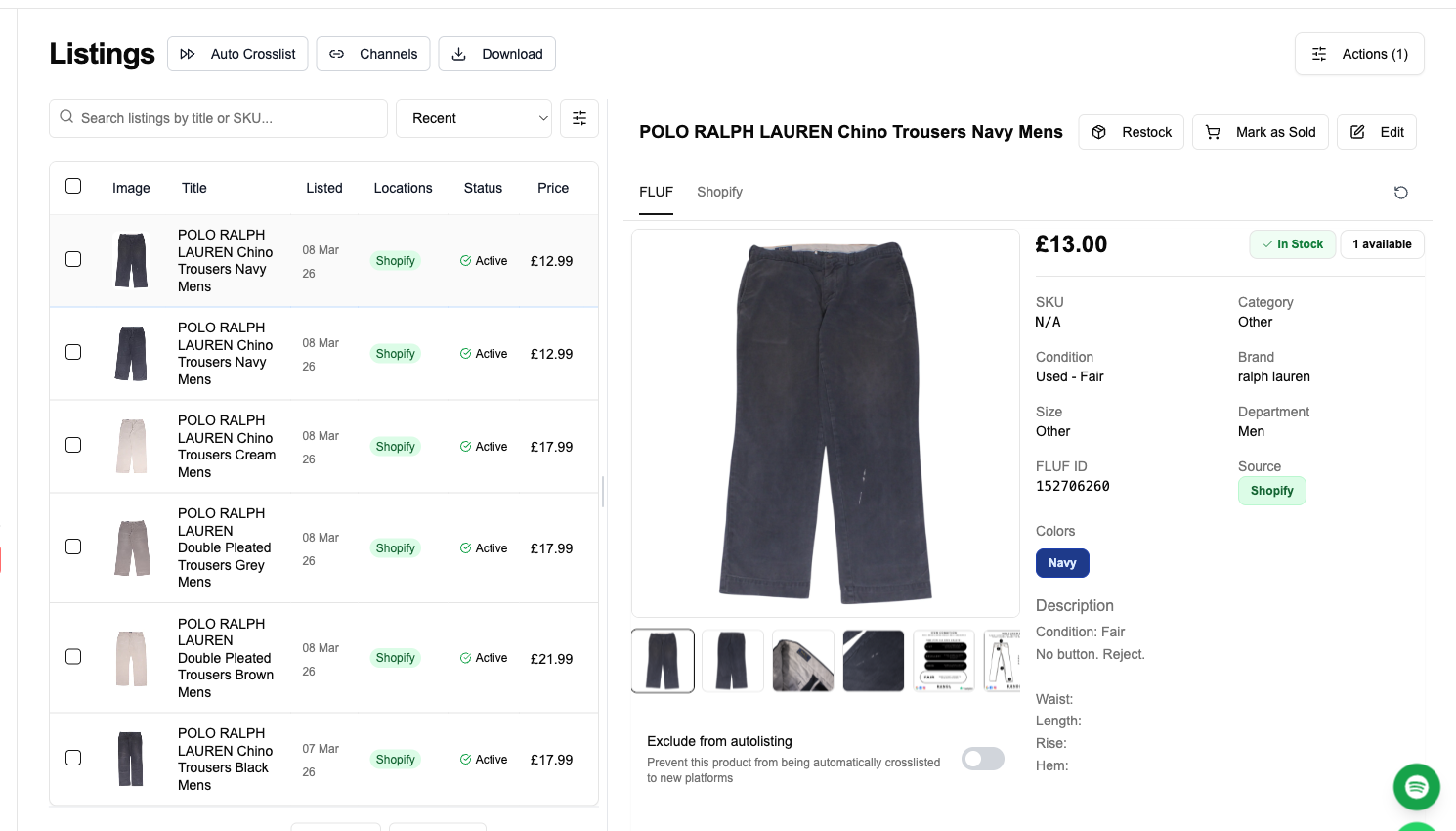
- Connect Depop. Log into Depop in your browser, open the extension, and run the handshake. FLUF imports your full Depop catalogue — titles, descriptions, photos, brand, size, condition and price — into one dashboard.
- Connect Poshmark. Log into Poshmark and connect it the same way. Set your Poshmark default department so new listings land in the right part of the tree.
- Review the mapping. FLUF shows what transfers automatically and flags the handful of Poshmark-only fields (department, original price) that benefit from a default.
- Select and crosslist. Tick the Depop items you want, click crosslist to Poshmark, and they publish into your Poshmark closet — typically within a couple of minutes per batch.
Behind the scenes FLUF reads each Depop listing, maps the fields to Poshmark’s format, uploads the images and publishes. You can also set auto-crosslist rules so new Depop inventory pushes to Poshmark automatically, and you can crosslist hundreds of items at once with category, price or brand filters.
What Transfers When You Crosslist from Depop to Poshmark?
This is where Depop and Poshmark differ most. Depop uses a Department → Group → product-type taxonomy with optional, free-text-leaning brand and descriptive condition; Poshmark uses a stricter Department → Category → Subcategory tree with a controlled brand picker and a binary condition flag. FLUF handles the translation, but it helps to know where the friction sits.
Field mapping — Depop to Poshmark
| Depop field | Poshmark field | Transfer | Notes |
|---|---|---|---|
| Title | Title | ✅ Automatic | Poshmark titles are short and brand-led; long Depop titles are trimmed. |
| Description | Description | ✅ Automatic | Hashtags carry over; Poshmark rewards brand and size in the first line. |
| Photos | Photos | ⚡ Mapped | Depop allows up to 8; Poshmark up to 16, so all your Depop photos fit. |
| Price | Price | ⚡ Smart mapped | Converted to USD; set a markup to absorb the 20% Poshmark commission. |
| Brand | Brand | ⚡ Mapped | Depop brand is optional; blank brands are inferred or list as unbranded on Poshmark. |
| Size | Size | ⚡ Mapped | FLUF maps Depop size sets to Poshmark’s size pickers per department. |
| Condition | Condition | ⚡ Mapped | Depop’s descriptive grades collapse to Poshmark’s New-With-Tags vs used flag. |
| Category | Department / Category | ⚡ Smart mapped | Depop product types map to the nearest Poshmark subcategory. |
| Colour | Colour | ⚡ Mapped | Poshmark allows up to two colours per listing. |
| — | Original (retail) price | ⚠ Manual / default | A Poshmark-only field; set a default or leave blank. |
Legend: ✅ Automatic · ⚡ Smart-mapped between different systems · ⚠ Poshmark-only, needs a default.
Category mapping examples
| Depop product type | Poshmark path | Note |
|---|---|---|
| Womenswear → T-shirts | Women → Tops → Tees – Short Sleeve | Direct match |
| Menswear → Hoodies | Men → Sweaters / Sweatshirts & Hoodies | Mapped to nearest subcategory |
| Accessories → Bags | Women → Bags | Department inferred from the item |
The two fields that need your attention on this pair are brand (Depop sellers often leave it blank, but Poshmark buyers filter by it heavily) and condition (Depop’s descriptive notes flatten into Poshmark’s binary flag, so put the detail in the description).
Inventory Sync Between Depop and Poshmark — What Stays in Sync?
The point of crosslisting is reach without the overselling risk. Here is exactly what FLUF keeps in step.
| Event | What happens | Timing |
|---|---|---|
| Item sells on Depop | Removed from Poshmark automatically | Within minutes |
| Item sells on Poshmark | Removed from Depop automatically | Within minutes |
| Price changed in FLUF | Updated on both channels | Minutes |
| Description edited in FLUF | Updated on both channels | Minutes |
| Item deleted in FLUF | Delisted from both | Minutes |
When a garment sells on Depop, FLUF Connect removes it from Poshmark (and any other connected channel) within minutes, so you never sell the same one-of-a-kind item twice.
To be honest about the limits: because Poshmark has no public seller API, sync runs through the browser-extension bridge and a short polling cycle rather than instant webhooks, so allow a few minutes rather than expecting it to be literally instantaneous. Order management is also lighter on Poshmark than on Depop — Poshmark order data is pulled on a schedule rather than streamed live.
Crosslisting from Depop to Poshmark: Before and After
Without FLUF Connect (manual)
- Open the Depop listing and screenshot or re-download each photo.
- Open Poshmark and start a new listing.
- Re-type the title, trimmed for Poshmark’s brand-led format.
- Re-write the description and add brand and size to the first line.
- Upload the photos one by one.
- Pick the Poshmark department, category and subcategory from scratch.
- Set condition, colour and a US dollar price that absorbs the 20% fee.
- Publish, then note in a spreadsheet that the item is now live in two places.
- When it sells, go back to the other app and pull the listing by hand.
Realistically that is 5-10 minutes per item, and the manual approach hits a wall around 50-75 active items once you are maintaining listings across apps.
With FLUF Connect
- Tick the Depop items in your dashboard.
- Click crosslist to Poshmark.
- Confirm the pre-filled mapping.
- Done — inventory syncs automatically from then on.
Manual: roughly 10-16 hours. With FLUF Connect: under an hour. That is most of a working day back to source and photograph more stock.
Automation Features for Depop and Poshmark Sellers
Crosslisting is the start. FLUF Connect also runs the repetitive work that keeps both closets selling.
Auto-relisting
Depop and Poshmark both reward fresh listings — newer items surface higher. FLUF can refresh your Depop listings on a schedule so they climb back up the feed without you re-posting by hand.
Offer management
Poshmark’s “Offer to Likers” is one of its strongest conversion tools, and Depop supports offers too. FLUF lets you run offer rules across the items that have attracted interest.
Auto-crosslist rules and bulk operations
Set a rule so every new Depop listing pushes to Poshmark automatically, filtered by brand, price or category. Bulk-edit prices, run find-and-replace across descriptions, and crosslist hundreds of items in one pass.
| Feature | Depop | Poshmark |
|---|---|---|
| Crosslisting | ✅ | ✅ |
| Inventory sync | ✅ | ✅ |
| Auto-relisting | ✅ | ✅ |
| Offer management | ✅ | ✅ |
| Bulk operations | ✅ | ✅ |
Repricing Your Depop Items for Poshmark
This is the step most Depop sellers get wrong, because the fee maths flipped in 2024. Depop scrapped its 10% marketplace selling fee on US and UK listings, so on Depop you now keep almost all of the sale price, paying only a payment-processing fee (3.3% plus $0.45 in the US, 2.9% plus £0.30 in the UK). Poshmark, by contrast, keeps a flat 20% on anything sold for $15 or more.
If you simply copy your Depop price across, Poshmark’s cut eats your margin. The fix is to reprice for the destination. Take a jacket you list at £40 on Depop: at a roughly 1.25 exchange rate that is about $50, and a straight copy leaves you $40 after Poshmark’s 20%. But Poshmark’s older, higher-spending US audience routinely pays more for the same piece, so listing it at $65-70 is normal — and 80% of $68 ($54) comfortably beats what the Depop price would have returned. FLUF Connect lets you apply a percentage uplift on crosslist so every Depop item lands on Poshmark already adjusted for the commission, rather than you editing prices one by one.
One more Depop-specific cost to factor in: Boosted Listings. Depop’s optional promotion takes a percentage of the sale (raised to 12% in the UK in December 2025), so if you lean on Boosts to move stock on Depop, Poshmark’s organic social discovery — sharing to followers, Posh Parties, Offer to Likers — can be a cheaper way to get the same item seen. Crosslisting lets you compare, for real, which channel sells a given piece faster and at a better net price.
Who Gains Most from Crosslisting Depop to Poshmark?
Not every Depop seller should rush to Poshmark, so it is worth being specific about who this pairing rewards.
- US-based Depop sellers gain the most outright. Poshmark’s prepaid label works for you immediately, and you tap an older audience that pays more for the branded, vintage and activewear pieces that already do well on Depop.
- Branded and activewear resellers see the clearest lift. Poshmark buyers search by label — Lululemon, Free People, Nike, Anthropologie — so the recognisable pieces in your Depop closet often command a premium they would not on Depop’s price-sensitive feed.
- High-volume vintage sellers benefit from the second shop window: the same one-of-a-kind inventory gets a fresh, non-overlapping audience without you sourcing a single extra item.
- UK sellers without US fulfilment should hold off, or solve logistics first. The software is ready; the parcel route is the gating factor.
If you fit one of the first three, crosslisting from Depop to Poshmark is one of the highest-leverage moves available — you are reusing inventory and photographs you already have to reach buyers you currently cannot.
How Much Does It Cost to Crosslist from Depop to Poshmark?
FLUF Connect pricing is the same whichever channels you connect:
| Plan | Price | Products | Includes |
|---|---|---|---|
| Growth | £19/month | 500 | All automation features |
| Seller | £99/month | 5,000 | All automation features |
| Super Seller | £299/month | Unlimited | Priority sync |
There is no free plan; the cheapest option is Growth at £19/month for 1,000 products. Every plan includes crosslisting across all supported channels — not just Depop and Poshmark — so you can add Vinted, eBay, Etsy and more at no extra cost. See the full pricing page for details.
Sources & Verification
- Depop Newsroom — Facts & Figures (registered users, items, listings/day, GMV)
- Business of Apps — Depop statistics (demographics, Etsy acquisition)
- Depop Help Centre — Seller fees and charges
- Poshmark user statistics
- Poshmark Support — US/Canada selling requirements
- Value Added Resource — Poshmark USPS Ground Advantage label
Start crosslisting from Depop to Poshmark
Related guides
Frequently Asked Questions
Plans start at £19/month (Growth — 1,000 products). There is no free plan. Every plan includes crosslisting, inventory sync, auto-relisting, offers and bulk operations across all supported channels, so automation is never a paid add-on.
FLUF Connect will mirror your Depop listings onto Poshmark in seconds, but Poshmark's prepaid label is a US-only USPS Ground Advantage label and Poshmark gates sellers by US or Canadian address and IP. UK sellers therefore need a US fulfilment route — a US 3PL or a parcel forwarder such as MyUS or Stackry — before Poshmark sales are economical. US-based Depop sellers can crosslist freely.
Yes. When an item sells on Depop, FLUF removes it from Poshmark within minutes, and a Poshmark sale ends the Depop listing the same way. Price and description edits made in FLUF push to both channels, so you never sell the same one-of-a-kind item twice.
No. Poshmark does not publish a seller API, so FLUF Connect uses a browser-extension bridge that drives Poshmark inside your own logged-in session — the same actions a human would take, but in seconds. Depop is the same, so the extension is used for both channels.
Depop's brand field is optional and often left blank, while Poshmark buyers filter heavily by brand, so blank brands are inferred where possible or list as unbranded. Depop's descriptive condition notes collapse into Poshmark's binary New-With-Tags-versus-used flag, so it is worth repeating any condition detail in the description.
FLUF Connect runs inside your own logged-in browser session rather than hammering Poshmark from a server, which mirrors normal human activity. As with any automation, list at a sensible pace and keep your account in good standing; FLUF's pacing is designed to stay within normal usage patterns.
First-time setup — installing the extension and connecting both accounts — takes about ten minutes. After that each item crosslists in roughly 30 seconds, and you can bulk-crosslist hundreds at once with category, price or brand filters.
Yes. Every FLUF Connect plan includes all supported channels, so the same Depop inventory can also go to Vinted, eBay, Etsy, Shopify and more from the same dashboard at no extra cost.