FLUF Connect

Promote your Etsy products on Instagram — posts, carousels and the link that pays

Not crosslisting — content. Turn Etsy product photographs into Instagram posts and carousels, understand why you cannot tag Etsy products, and see why your own link is worth 19 points of margin.

50+ marketplaces, one dashboard Auto inventory sync WhatsApp, email & in-app support
Key Takeaways — promoting your Etsy products on Instagram

  • This is not crosslisting, and we will not pretend otherwise. Instagram is not a marketplace FLUF syncs stock to. There is no inventory sync, no order sync, no relisting, no offers and no mark-as-sold. What FLUF does is turn your product photographs into Instagram posts and carousels, and schedule them.
  • Carousels are the format worth building around. A study of 35 million posts across 447,613 profiles through 2025 put carousels at 0.55% engagement against 0.37% for single images — about 49% ahead.
  • Ten images per carousel, and slide one decides the crop for all of them. Instagram crops the whole set to the first image’s ratio, defaulting to 1:1. Shoot the set to one shape or lose the edges of every other slide.
  • You cannot tag Etsy products. Not a limitation of ours — a rule of Meta’s. Tagged products must link to “a single, primary domain that you own”, and you cannot verify ownership of etsy.com. Checkout on Instagram was removed in September 2025, so the other permitted destination no longer exists either.
  • Which means the bio link is the route to your shop. Captions are not clickable. You get up to five links in your profile, and Story link stickers with no follower threshold.
  • That link is worth real money on Etsy specifically. Share & Save refunds 4% when a buyer orders within 30 days of clicking your own trackable link — and because Offsite Ads attribution is last-click, a sale your own link brought in is not a 15% Offsite Ads sale. The swing is roughly 19 points.
  • You need an Instagram professional account — Business or Creator. Personal accounts cannot be published to by any API.
  • JPEG only, 8 MB maximum, and export in sRGB, or Instagram converts your colour space and your ceramics change shade. 7 days for £1, then from £9/month. There is no free plan.
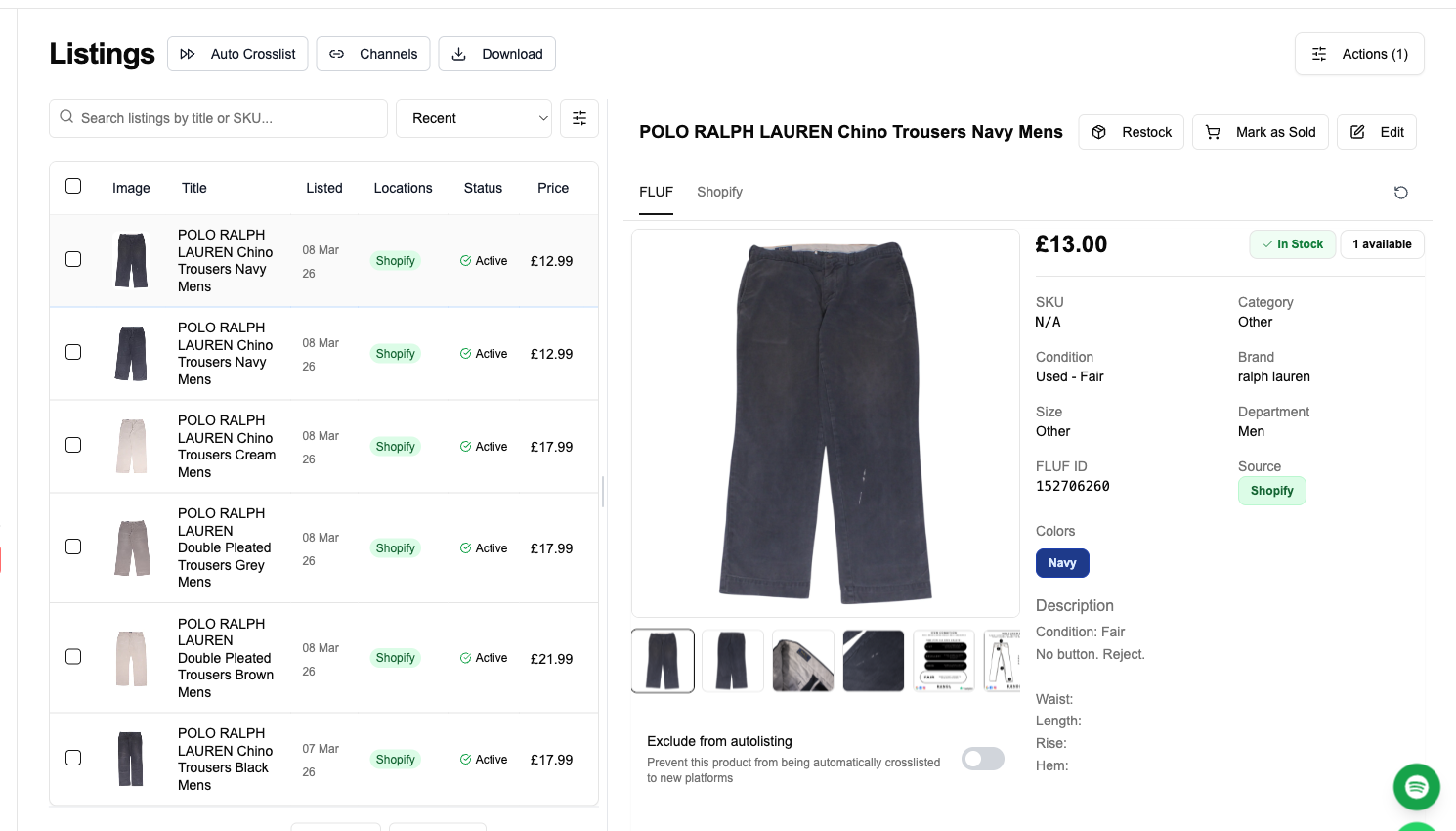
The FLUF Connect listings screen showing product photographs available to build an Instagram post from
The product photographs you already uploaded for Etsy, reused as the raw material for a carousel.

On this page

What this actually does, and what it does not

Every other page in this section is about crosslisting: taking stock from one marketplace and listing it on another, with quantities kept honest between them. This one is not, and the distinction matters enough to state before anything else.

Instagram is not a marketplace FLUF connects inventory to. It holds no stock of yours. There is nothing to sync. Specifically, and to remove any doubt:

  • No inventory or quantity sync to or from Instagram.
  • No order sync or order import.
  • No relisting, no offer management, no smart pricing.
  • No mark-as-sold in either direction. Selling something on Etsy does not remove an Instagram post, and nothing about Instagram touches your Etsy stock.

What FLUF does is narrower and genuinely useful: it takes photographs from your product records and publishes them to Instagram as posts — a single image, a carousel of up to ten, or a Reel — with a caption you write, either immediately or scheduled for later. That is a content and marketing feature. It drives people towards your Etsy shop; it does not sell anything on Instagram, because Instagram no longer sells anything on anyone’s behalf.

If what you want is a second place your stock is actually listed, this is the wrong page. Etsy to Amazon or Etsy to eBay are the crosslisting routes.

Why carousels, with the numbers

Instagram supports single images, carousels and Reels through its publishing API, and for product photography the carousel is the format with the evidence behind it.

A benchmark study of 35 million Instagram posts across 447,613 active profiles over the whole of 2025 found carousels at 0.55% engagement, Reels at 0.52% and static images at 0.37%, against a platform average of 0.48%. Carousels come out roughly 49% ahead of single images on that sample. The same study found the platform average down 24% year on year, which is worth knowing before you judge your own numbers harshly.

The mechanical reason is intuitive: a carousel gets a second chance. A viewer who scrolls past a single image is gone, where a carousel that gets one swipe has earned more time. For a handmade or vintage seller that suits the product too, since a single photograph rarely conveys texture, scale and construction at once.

Building a ten-slide product carousel

Ten is the ceiling — Meta’s documentation is explicit that “Carousels are limited to 10 images, videos, or a mix of the two”. You rarely want ten. Five to seven is usually the right length for one product, and the sequence matters more than the count.

A structure that works for handmade and vintage goods:

Slide What it does
1 The hero shot. It has to stop a scroll on its own, and it also sets the crop for every other slide.
2 Scale — the piece held, worn, or beside something recognisable. The single most-asked question in any maker’s DMs.
3 Texture or detail. The stitching, the glaze, the grain, the label.
4 The piece in use or in context, rather than on a white background.
5 Honesty. For vintage, the flaw. For handmade, the maker’s mark or the process.
6–7 Alternative colourways, the reverse, or a short video of it moving.

Two things not to do. Do not put a price card on slide one — it reads as an advertisement in a feed that punishes advertisements. And do not use the last slide for “link in bio” alone; almost nobody reaches it, and the caption does that job better.

The image rules that will silently ruin a set

Instagram’s publishing API is stricter than the app, and every one of these constraints fails quietly rather than loudly.

  • JPEG only. Not PNG, not WebP, not HEIC. Meta’s reference notes that even extended JPEG formats such as MPO and JPS are unsupported.
  • 8 MB maximum per image.
  • Aspect ratio must sit between 4:5 and 1.91:1. A tall product shot straight off a phone is often outside that.
  • Width between 320 and 1440 pixels. Narrower is scaled up, wider is scaled down — so exporting at 3000 pixels wide achieves nothing. 1080 × 1350 is 4:5, sits inside the ceiling and fills the tallest frame allowed.
  • sRGB. Images in other colour spaces are converted, and an Adobe RGB export will shift — a real risk if you photograph dyed fabric or glazed ceramics and have been careful about colour.
  • The first slide sets the crop. Meta states that carousel images are all cropped based on the first image, defaulting to 1:1. Shoot the whole set to one ratio.

The practical routine: export everything at 1080 × 1350, JPEG, sRGB, under 8 MB, and check the first slide is the ratio you want the set to be. That one habit removes most of the ways a carousel goes wrong.

Captions, hashtags and the 2,200 characters

Meta’s limits are generous: 2,200 characters of caption, up to 30 hashtags and up to 20 @mentions. Using all of any of them is rarely the right call.

What a product caption needs, in order: what the thing is, something specific about it that a photograph cannot convey, and where to get it. Materials, dimensions, how long it took, what it was before — the details that make handmade and vintage worth buying are exactly the ones that do not photograph.

On hashtags we are going to decline to give you a rule, because the honest position is that we could not verify one. Instagram’s guidance on how much hashtags still drive reach has shifted repeatedly and we found no current primary source this run. What is certain is the ceiling of 30. Anyone quoting an optimal number with confidence is quoting a blog post.

One newer obligation worth knowing if you edit product photographs with AI tools: Meta added an is_ai_generated parameter in June 2026 for labelling AI-generated media at publish time. If your images are AI-generated or AI-edited, that label is the correct thing to set.

Why you cannot tag Etsy products

This is the question every Etsy seller asks, and the answer is a firm no for a reason that has nothing to do with FLUF.

First, the publishing API itself. Meta’s content publishing documentation states plainly: “Shopping tags are not supported.” No third-party tool can add a shopping tag through the ordinary publishing route.

Second, and more fundamentally, the domain rule. Instagram requires that tagged products “direct to checkout on Instagram or to a single, primary domain that you own which has the products available for direct purchase”, and adds that “If your product links go to a different domain, you won’t be able to tag those products.” The domain must be submitted and approved.

An Etsy listing lives on etsy.com. You cannot verify ownership of etsy.com, because you do not own it. And the other permitted destination — checkout on Instagram — no longer exists: Meta’s own notice reads “As of September 2025, Shops on Facebook and Instagram now use website checkout.”

So an Etsy seller without their own e-commerce domain cannot tag products, whatever tool they use. Meta says as much itself, suggesting such businesses “consider setting up an ecommerce website to continue using shops on Instagram”. That is a real strategic fork, and it is worth knowing it exists rather than hunting for a setting that is not there.

There is one native alternative that needs no catalogue, no shop and no domain: Instagram’s “Add product details” option on a post, and the “Get orders” sticker in Stories, which let people request an order through Instagram chat. It is manual and it is not something a publishing tool can do for you, but for a maker with no website it is the sanctioned path.

Captions are not clickable. Instagram’s own removal notice is the clearest evidence of the position: “While you’re no longer able to add product mentions and hyperlinks in captions and profiles… Hyperlinks that were added are removed.”

What works:

  • Your bio, up to five links. Instagram documents that “You can add up to five websites to your Instagram profile by going to Edit Profile and selecting Links” — on mobile only. Five is enough to point at your shop, a specific collection and a current drop without a third-party link-in-bio service.
  • Story link stickers. Documented as an ordinary sticker with no follower threshold and no verification requirement stated. For a small maker this is the most direct route from a post to a listing.

On the perennial worry that linking out suppresses your reach: Instagram’s own Recommendations Guidelines list what is allowed but not recommended — safety-impeding, low-quality and false or misleading content — and links appear nowhere in it. Nor do links appear among the account-level reasons for not being recommended. Instagram has also said directly that “we don’t suppress content to encourage people to buy ads”. That is an absence of a stated penalty rather than an explicit denial, and we would rather characterise it that way than repeat folklore about putting the link in the first comment.

The Offsite Ads arithmetic that makes this worth doing

Here is the part that turns Instagram from a nice-to-have into a line on your margin, and it is specific to Etsy.

Etsy runs two mechanisms that both hinge on where a sale’s last click came from. Offsite Ads takes 15% of a sale — 12% for high-volume shops — when Etsy’s own purchased advertising brought the buyer in, with last-click attribution over 30 days. Above a revenue threshold you cannot opt out. Share & Save does the opposite: it refunds you 4% of the eligible order total when a buyer orders within 30 days of clicking your own trackable link.

Because attribution is last-click, a buyer who arrives through your own Instagram bio link is not an Offsite Ads sale. You avoid the 15% and you earn the 4%. On a £100 order that is roughly nineteen pounds of difference between a sale Etsy bought for you and one you brought yourself.

Two honest caveats. Etsy states the last-click rule and states the Share & Save terms, but it never spells out the exemption in those words — the conclusion follows from its attribution mechanics rather than from an Etsy promise. And Share & Save eligible links are the trackable ones from your shop, listings and promo codes; links in Etsy Messages or listing descriptions do not qualify, because the scheme exists to reward traffic you brought from off Etsy.

Still, that is the argument. Posting your own products to Instagram is not brand-building in the abstract. On Etsy it is the difference between two clearly-priced outcomes.

Connecting Instagram

  1. Convert to a professional account. Instagram’s path: Settings and privacy, then Account type and tools, then Switch to professional account. Business or Creator both work; a personal account cannot be published to by any API.
  2. Connect Instagram in FLUF Connect and authorise on Meta’s own screens.
  3. Pick the product whose photographs you want to use.
  4. Choose single image, carousel or Reel, order the slides, and write the caption.
  5. Post now or schedule it. Scheduled posts email you when they publish — and, importantly, email you if they fail, because a scheduled post that dies quietly is worse than one that never existed.

One note on Meta’s two authentication routes, since it explains a difference you may read about elsewhere. Meta offers Instagram API with Instagram Login, which needs no linked Facebook Page, and Instagram API with Facebook Login, which does. Product tagging and hashtag search exist only on the Facebook Login path — and, as covered above, product tagging is unavailable to an Etsy seller regardless.

Rate limits and scheduling

Instagram caps API-published posts over a rolling 24-hour period, and a carousel counts as a single post however many slides it has.

Instagram limits publishing activity. Check the limits and notices shown for your account when planning a large batch of posts.

Media containers expire if not published within 24 hours, and your images must be on a publicly reachable server at the moment of publishing. That last point matters if your product photographs live behind any kind of access control.

What it costs

7 days for £1, then from £9/month. There is no free plan and no free tier.

Crosslisting, inventory sync, order sync and bulk operations are on every plan. Relisting, offer management and smart pricing are included from Seller (£29/month) upwards; Starter does not include them. Paying annually saves 40%.

PlanMonthlyCrosslisted products
Starter£9/monthUnlimited
Seller£29/monthUnlimited
Pro£99/monthUnlimited
Super SellerCustom pricing — tell us what you needUnlimited

Instagram posting is a content feature rather than a marketplace connection, and it does not depend on the automation tiers.

Sources and verification

Every limit, rule and date was checked against a primary source on 7 September 2026.

What we could not verify, and therefore left out. Whether hashtags still meaningfully drive reach in 2026, and any current Instagram statement about it — we found no primary source, so no hashtag strategy appears above beyond the documented limit of 30. The current differences between Business and Creator accounts: Meta’s getting-started material covers Business only, so we say both work for publishing and stop there. Whether URLs in feed captions are technically inert as a documented rule, as opposed to the product-mention removal we can cite. The exact revenue threshold at which Etsy’s Offsite Ads becomes mandatory, and which side of it carries 12% rather than 15% — Etsy’s legal fee pages block automated access, so check your own Shop Manager. Whether Etsy offers any first-party catalogue integration with Meta, which we could not confirm from an Etsy source. And Instagram’s own app-side image rules as distinct from the API’s, which are not published.

Frequently Asked Questions

No, and it is important to be clear about that. Instagram is not a marketplace we connect inventory to — it holds no stock of yours, so there is nothing to sync. There is no inventory or quantity sync, no order sync or import, no relisting, no offer management and no mark-as-sold in either direction. Selling something on Etsy does not remove an Instagram post, and nothing about Instagram touches your Etsy stock. What FLUF does is turn your product photographs into Instagram posts, carousels and Reels, with a caption you write, immediately or scheduled.

No, for two separate reasons and neither of them is ours. Meta's content publishing documentation states plainly that “Shopping tags are not supported” through the publishing API. More fundamentally, Instagram requires tagged products to link to checkout on Instagram or to “a single, primary domain that you own” — and you cannot verify ownership of etsy.com. Checkout on Instagram was removed in September 2025, so the other permitted destination no longer exists. An Etsy seller without their own e-commerce domain cannot tag products whatever tool they use.

Ten, which Meta's documentation states as a hard limit — “Carousels are limited to 10 images, videos, or a mix of the two.” You rarely want ten; five to seven is usually right for one product. The more important constraint is that Instagram crops the whole carousel based on the first image, defaulting to 1:1, so shoot the entire set to one aspect ratio or you will lose the edges of every slide after the first.

The evidence says yes for product photography. A benchmark study of 35 million Instagram posts across 447,613 active profiles through 2025 put carousels at 0.55% engagement, Reels at 0.52% and static images at 0.37%, against a platform average of 0.48% — carousels roughly 49% ahead of single images. The mechanical reason is that a carousel gets a second chance: a viewer who swipes once has given you more time than a single image ever gets.

JPEG only — not PNG, WebP or HEIC — at up to 8 MB, with an aspect ratio between 4:5 and 1.91:1 and a width between 320 and 1440 pixels. Anything wider is scaled down, so exporting at 3000 pixels achieves nothing. Export in sRGB: other colour spaces are converted, which will shift the colour of dyed fabric or glazed ceramics. The reliable routine is 1080 × 1350, JPEG, sRGB, under 8 MB.

No. Captions are not clickable, and Instagram's own notice about removing product mentions and hyperlinks from captions and profiles is the clearest evidence of the position. What works is your bio, where Instagram documents up to five websites via Edit Profile then Links, and Story link stickers, which are documented as an ordinary sticker with no follower threshold. For a small maker the Story sticker is the most direct route from a post to a listing.

There is no stated penalty. Instagram's Recommendations Guidelines list what is allowed but not recommended — safety-impeding, low-quality, and false or misleading content — and links appear nowhere in it, nor among the account-level reasons for not being recommended. Instagram has also said directly that it does not suppress content to encourage people to buy ads. That is an absence of a documented penalty rather than an explicit denial, which is a more honest way to put it than the folklore about hiding links in the first comment.

Through Etsy's two last-click mechanisms. Offsite Ads takes 15% of a sale — 12% for high-volume shops — when Etsy's purchased advertising brought the buyer in, and above a revenue threshold you cannot opt out. Share & Save refunds 4% when a buyer orders within 30 days of clicking your own trackable link. Because attribution is last-click, a buyer arriving through your own Instagram bio link is not an Offsite Ads sale: you avoid the 15% and earn the 4%, roughly nineteen points of swing. Etsy states both rules but never spells out the exemption in those words, so treat it as a consequence of the attribution mechanics rather than an Etsy promise.

A professional one — Business or Creator both work. Personal accounts cannot be published to by any API, Meta's or anyone else's. Converting is done in the app: Settings and privacy, then Account type and tools, then Switch to professional account. Separately, FLUF connects to 50+ marketplaces for actual crosslisting; Instagram sits alongside those as a content feature rather than as one of them.

Start Crosslisting Today

Plans from £9/month. Set up in under 10 minutes.

×
Scroll to Top