FLUF Connect

Promote Your Depop Products on Instagram — Automatically

Turn the photos already in your Depop listings into Instagram posts and carousels that drive traffic to your shop. Publishing and scheduling, from one dashboard.

40 marketplaces, one dashboard Auto inventory sync WhatsApp, email & in-app support
Key Takeaways — Promoting Depop Products on Instagram

  • This is promotion, not crosslisting. FLUF Connect turns your Depop product photos into Instagram posts and carousels that drive traffic to your shop. It does not sync inventory, import orders, relist, manage offers or mark anything sold on Instagram — none of that exists on Instagram, for anyone.
  • The headroom is the point. A Depop listing carries up to eight photos, no separate title field, and five hashtags. An Instagram post carries a carousel of up to ten images, a caption of 2,200 characters and thirty hashtags. The material for a good post is already sitting in your listings.
  • Depop gives sellers no promotion tooling and no export. Its own growth guidance is entirely in-app, and its only substantive mention of Instagram is a warning about moving conversations off-platform.
  • Instagram’s reach: 3 billion monthly active users, and 2 billion daily actives on Meta’s own Q2 2026 earnings call.
  • Requirement: an Instagram professional account — Business or Creator. Meta’s publishing API issues tokens to nothing else.
  • Cost: start with a 7-day trial for £1, then plans from £9/month (Starter — 300 products). There is no free plan.
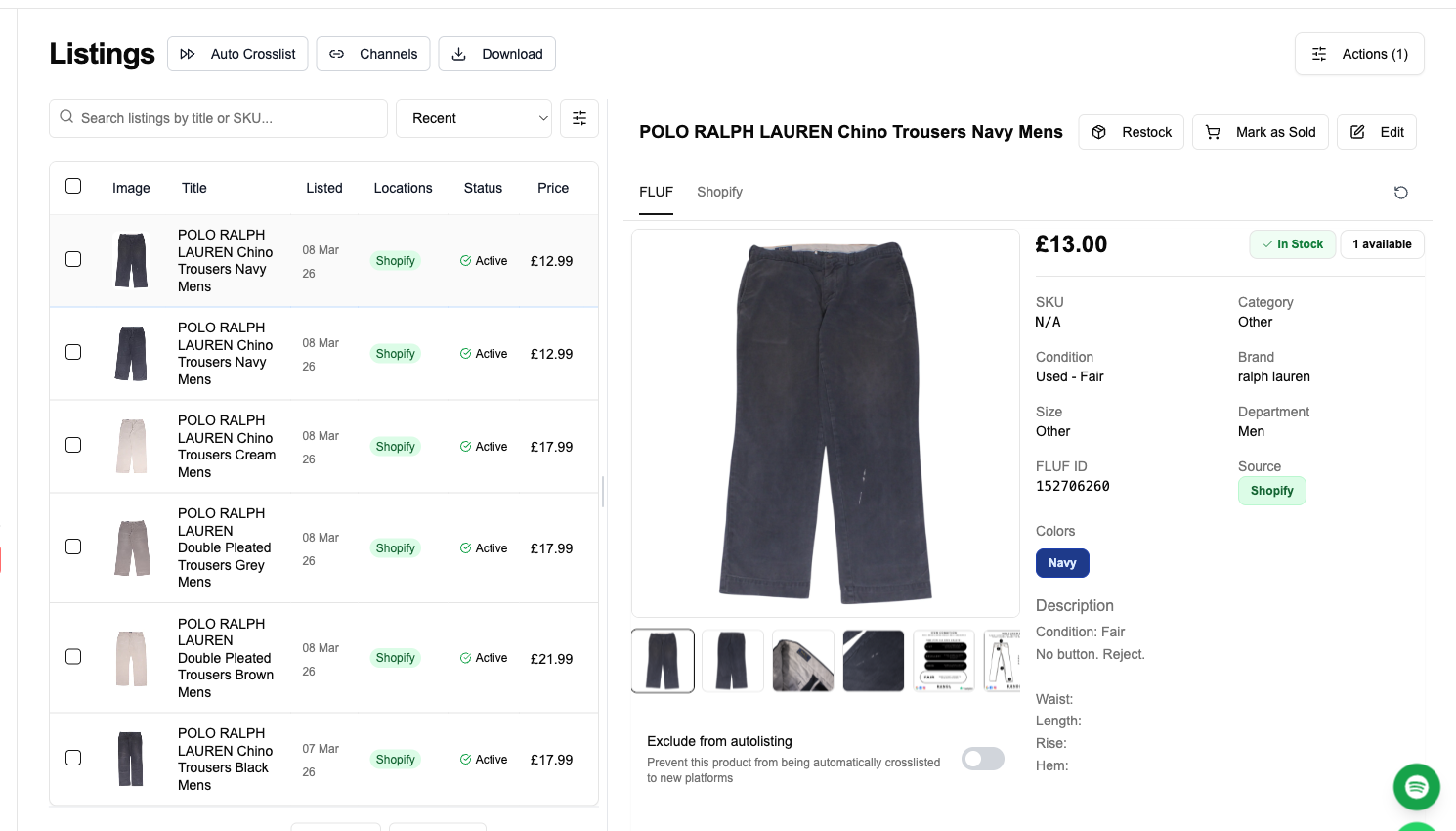
FLUF Connect listings dashboard showing Depop products selected for an Instagram carousel
FLUF Connect’s listings view — the same product photos that power a Depop listing, ready to become an Instagram carousel.

On This Page

What This Actually Does — And What It Does Not

Every other page in this section is about crosslisting: taking inventory from one marketplace and listing it for sale on another, with stock kept in step so nothing sells twice. This page is not that, and pretending otherwise would be dishonest in a way that would waste your time.

Instagram is not a marketplace. It holds no inventory, processes no orders and has no stock. What it has is Meta’s Content Publishing API, which lets an approved application publish media to a professional account. FLUF Connect uses that API to take the photographs already attached to your Depop listings and publish them as Instagram posts and carousels, with a caption you control, on a schedule you set.

What FLUF does with Instagram What it does not do
Publishes a single image post from a product photo Sync inventory or stock levels
Publishes a carousel of up to 10 product photos Import orders
Publishes the caption you write, with hashtags Relist anything
Schedules a post for a chosen time and emails you when it goes live Manage offers
Returns the permalink of the published post Mark an item sold on Instagram
Drives traffic to your Depop shop Sell anything on Instagram

If what you want is a second place for people to buy, this is not that page — a crosslist to eBay, Vinted or Etsy is. If what you want is a second place for people to find you, this is exactly it.

Why Depop Sellers End Up on Instagram Anyway

Depop is a big platform and a busy one. Etsy’s final annual report before selling the business recorded 55.6 million registered Depop users, 7.0 million active buyers and 3.2 million active sellers at the end of 2025, with gross merchandise sales of $1,074.9 million for the year, up 36.3%. Depop then changed hands: eBay completed its acquisition of Depop on 30 July 2026, stating its intention to preserve the brand, community and product experience.

Being on a busy platform is the problem as much as the opportunity. Three point two million active sellers are competing for the same feed, and Depop’s discovery is largely in Depop’s hands. The sellers who do best have an audience they brought with them — which, for a shop selling vintage and secondhand fashion to an audience where 87% of buyers over the past year were under 34, overwhelmingly means Instagram.

Depop knows this and offers no help with it. Its own guide to growing your shop is entirely about in-app behaviour: list consistently, improve your photos, price sensibly, use Depop’s own tools. There is no export, no social publishing, no integration. Search Depop’s help centre for Instagram and what comes back is prize-draw terms and a caution that if a conversation moves into Instagram DMs, Depop cannot help if things go wrong.

So the seller does it by hand: open the listing, save the photos one by one, open Instagram, upload, retype a caption, add hashtags, post. Every item, every time.

How It Works

  1. Connect Depop. Your listings, photos and product data come into one catalogue in FLUF Connect.
  2. Connect Instagram. You authorise FLUF through Instagram’s own login flow. The account must be a professional one — Business or Creator — because Meta’s publishing permission only issues tokens to professional accounts. Switching is free, in the Instagram app under Settings → Account type and tools.
  3. Choose the products. Select one item for a single-image post, or up to ten photos for a carousel. A carousel can be one item shown from ten angles, or ten items in a drop.
  4. Write the caption. Up to 2,200 characters and thirty hashtags — far more room than a Depop listing gives you.
  5. Publish or schedule. Publish now, or set a time. FLUF holds the job and publishes at the moment you chose, then emails you to confirm it went live.
  6. Get the permalink back. A successful publish returns the post’s Instagram URL, so the post is a tracked artefact rather than something you have to go and find.

One technical note that shapes the feature: Instagram’s Content Publishing API has no scheduling parameter. Nothing in Meta’s API accepts “publish this at 7pm”. FLUF holds the job on its own schedule and calls the publish endpoint at the appointed moment. The effect is scheduling; the mechanism is ours, not Instagram’s. We mention it because it explains why a scheduled post depends on FLUF being able to reach Instagram at that time, and why you get an email confirming it rather than a silent assumption.

What Transfers from a Depop Listing to an Instagram Post

The two formats are shaped very differently, and the differences run mostly in your favour.

Depop listing Instagram post What happens
Up to 8 photos and 1 video Up to 10 items in a carousel ⚡ Room to spare. Eight photos become an eight-slide carousel, or you group several items into one post.
No separate title field — the description carries everything Caption, up to 2,200 characters ⚡ The description becomes the basis of the caption, with far more space than Depop allows.
Up to 5 hashtags and 2 brand hashtags Up to 30 hashtags ⚡ Six times the tagging room.
Square photos, 1080×1080 recommended Aspect ratio between 4:5 and 1.91:1 ✅ Square sits comfortably inside Instagram’s accepted range.
Brand, size, colour, condition ⚡ No structured fields on Instagram; the useful ones go into the caption.
Price ⚠️ Your choice whether to put it in the caption. Instagram has no price field.
Stock / sold status ❌ Instagram has no concept of stock. A post stays up after the item sells unless you remove it.
Shipping and payment ❌ Handled entirely on Depop. The post’s job is to send people there.
The one thing to remember about sold items

An Instagram post is a published piece of content, not a listing. When the item sells on Depop, the post does not disappear and FLUF does not delete it — it stays in your grid like any other post. That is usually what you want, since a grid full of sold pieces is social proof. But if you post single items rather than drops, it is worth a habit of replying to your own post or updating the caption when something goes, so that people arriving from search are not messaging about a jacket that left three weeks ago.

Instagram’s Rules, in Detail

Meta’s Content Publishing documentation sets hard limits, and knowing them saves a rejected post.

Rule Value Why it matters for product photos
Carousel size Up to 10 images, videos or a mix FLUF refuses above ten with a clear message rather than silently dropping images.
Caption 2,200 characters, 30 hashtags, 20 @ mentions Generous — the constraint is readability, not the limit.
Image format JPEG only Meta states it plainly. A PNG or HEIC will not publish.
Image size 8 MB maximum Rarely a problem for marketplace photos.
Aspect ratio Between 4:5 and 1.91:1 Square Depop photos are inside the range. A very tall full-length shot may not be.
Carousel cropping Every slide is cropped to match the first image Put your best-framed photo first — it sets the crop for everything behind it.
Publishing rate 100 API-published posts per rolling 24 hours; a carousel counts as one post Far above any sane posting cadence. Meta’s carousel section separately cites 50, so treat the lower figure as the safe ceiling.
Account type Professional — Business or Creator A personal account cannot be published to at all.
Filters Not supported Edit before publishing, not after.

The carousel-cropping rule is the one that catches people. Instagram crops every slide to the aspect ratio of the first image, defaulting to square. A carousel that opens with a square flat-lay and continues with three portrait shots will crop those three. Ordering the photos deliberately, rather than in the order they happened to be uploaded to Depop, is the single highest-value thing you can do to a generated post.

A Necessary Aside: Instagram Is Not a Shop Any More

Plenty of advice still tells resellers to set up an Instagram Shop, tag products in posts and sell in-app. Most of that advice describes a product Meta has spent three years dismantling, and it is worth knowing where things actually stand before you invest effort.

  • February 2023 — Instagram removed the dedicated Shop tab from its navigation, saying shopping would continue in feed, reels, stories, explore and ads rather than in a destination.
  • August 2023 — Meta restricted product tagging through the Content Publishing API, stating that from 10 August some businesses without checkout-enabled shops would no longer be able to tag products, with tags removed retroactively from earlier posts for ineligible accounts.
  • September 2025 — Meta discontinued native checkout on Facebook and Instagram, ending in-app purchase, order management and dispute resolution and pushing merchants to their own websites.

Meta’s own developer documentation states that shopping tags are not supported in content publishing. What remains of product tagging requires an approved Instagram Shop with a catalogue, admin rights on the owning Business Manager, specific permissions and app review with a verified business — and is not available to Creator accounts, on Stories or on Live.

So the honest position, and the one Meta itself now pushes merchants towards, is that Instagram is a discovery surface that sends traffic somewhere else. For a Depop seller, “somewhere else” is your Depop shop, which already handles payment, shipping and buyer protection. That is not a workaround. It is the intended shape of the thing.

Before and After

Doing it by hand

  1. Open the Depop listing on a phone or desktop
  2. Save each photo individually
  3. Transfer them if you listed on desktop and post on mobile
  4. Open Instagram and start a new post
  5. Select the photos in the right order for the crop
  6. Retype the description as a caption, since Depop has no title to copy
  7. Add hashtags — different ones from the five Depop allowed
  8. Post, or remember to come back at the time you wanted to post
  9. Repeat for every item worth promoting

There is no credible published figure for how long this takes per post, and we are not going to invent one. What sellers report is not that any single post is slow — it is that the repetition makes it the first thing dropped in a busy week, which is exactly why shops post in bursts and then go quiet.

With FLUF Connect

  1. Select the Depop items you want to feature
  2. Order the photos, with your best crop first
  3. Write the caption
  4. Publish, or schedule it and get an email when it lands

Automation Features for Depop and Instagram

Scheduling

Set a post for a time you are not at your desk. FLUF holds the job, publishes at that moment and emails you the confirmation. Since Instagram’s API has no scheduling of its own, this is genuinely something you would otherwise be doing by hand or with a separate tool.

Carousels From a Drop

The carousel limit of ten and Depop’s four-photo listings combine usefully: two or three items make a natural carousel, and ten items make a drop announcement. Grouping is often better than posting each item separately, because it gives one post more material to hold attention.

Everything Else Runs on Depop

Depop supports FLUF’s auto-relisting and offer management, and both do real work on a shop’s revenue over time. Those are Depop-side features and continue independently of anything published to Instagram.

What Nobody Else Does

The social scheduling tools — Later, Buffer, Hootsuite, Metricool, Publer, Planoly, Sked Social — all publish to Instagram well, and none of them pulls products from a resale marketplace. The closest any offers is an RSS feed or a CSV you assemble yourself. Where a couple do advertise “product tagging”, they are tagging from an existing Instagram Shop catalogue, which is the capability Meta has been winding down. One crosslisting tool, List Perfectly, does advertise Instagram support on its top tier, though neither its pricing page nor its help centre explains the mechanism — so we will not characterise it beyond noting it exists.

How Much Does It Cost?

Every FLUF Connect plan includes crosslisting, inventory sync, auto-relisting, offer management, bulk operations and Instagram publishing across all supported channels.

Plan Price Products Includes
Starter £9/month 300 All automation features
Growth £19/month 1,000 All automation features
Seller £49/month 2,500 All automation features
Pro £99/month 5,000 All automation features
Super Seller £299/month Unlimited All automation features, priority sync

Every new seller gets a 7-day trial for £1 with full access before choosing a plan. There is no free plan; automation is included in every paid plan rather than sold as an add-on. See the full pricing page. Instagram itself charges nothing to publish.

Related Guides

Sources & Verification

  • Carousel limits, caption and hashtag limits, JPEG-only image format, size and aspect-ratio constraints, carousel cropping behaviour, publishing rate limits, the professional-account requirement, the absence of scheduling and the statement that shopping tags are not supported — Meta’s Instagram Content Publishing documentation.
  • Instagram monthly active users — TechCrunch reporting Adam Mosseri and Mark Zuckerberg, 24 September 2025; daily actives from Meta’s Q2 2026 earnings call transcript.
  • Removal of the Instagram Shop tab — Retail Dive, January 2023. The August 2023 restriction on product tagging via the Content Publishing API is stated on Meta’s own product-tagging documentation. The discontinuation of native checkout on Facebook and Instagram in 2025 is reported consistently across trade and vendor sources; Meta’s own guidance on it sits behind a login and we have not read it directly, so we cite the change rather than a precise Meta statement.
  • Depop registered users, active buyers and sellers, 2025 gross merchandise sales, the share of buyers under 34 and the US share of GMS — Etsy Inc.’s Form 10-K for the year ended 31 December 2025.
  • eBay’s completed acquisition of Depop on 30 July 2026 — eBay Inc..
  • Depop listing fields — five hashtags plus two brand hashtags — Depop’s own listing guidance. On photo count Depop’s own documentation conflicts: that article says four, while its search-ranking guidance refers to “the 8 image feature”. We use eight, which matches what live listings actually carry. The absence of seller-facing promotion tooling is evident from Depop’s guide to growing your shop, which is entirely in-app.
  • The behaviour of FLUF’s Instagram integration — single image or carousel of up to ten, caption, scheduled publishing with an email confirmation, the returned permalink and the professional-account requirement — is verified against FLUF’s own module (inc/flufconnect/fc-instagram.php).
  • The absence of resale-marketplace product import in Later, Buffer, Hootsuite, Metricool, Publer, Planoly and Sked Social was checked against each product’s own integrations and pricing pages on 20 August 2026.

Frequently Asked Questions

No, and we want to be exact about that. Instagram is not a marketplace — it holds no inventory, processes no orders and has no stock. What FLUF does is publish your Depop product photos as Instagram posts and carousels that drive traffic to your shop. There is no inventory sync, no order import, no relisting, no offer management and no mark-as-sold on Instagram, because none of those things exist there for anyone.

Every new seller gets a 7-day trial for £1 with full access. After that, plans start at £9/month (Starter — 300 products). There is no free plan. Every plan includes crosslisting, inventory sync, auto-crosslisting rules and bulk operations across all supported channels, not just these two — automation is built into every plan rather than sold as a paid add-on. Instagram itself charges nothing to publish.

A professional one — Business or Creator. Meta's publishing permission only issues tokens to professional accounts, so a personal account cannot be published to at all. Switching is free and takes a moment in the Instagram app under Settings → Account type and tools.

Up to 10 in a carousel, which is Meta's hard limit. Since a Depop listing carries four photos, that is either one item shown from several angles, two or three items together, or a drop of up to ten. FLUF refuses above ten with a clear message rather than silently dropping images.

Yes, through FLUF — though it is worth understanding how. Instagram's Content Publishing API has no scheduling parameter at all; nothing in Meta's API accepts a publish-at time. FLUF holds the job on its own schedule and calls the publish endpoint at the moment you chose, then emails you to confirm it went live and returns the post's permalink.

Nothing — it stays in your grid like any other post, and FLUF does not delete it. That is usually what you want, since a grid of sold pieces is social proof. If you post single items rather than drops, it is worth replying to your own post or updating the caption when something goes, so people arriving later are not messaging about a jacket that sold weeks ago.

Instagram crops every slide in a carousel to match the aspect ratio of the first image, defaulting to square. A carousel that opens with a square flat-lay and continues with portrait shots will crop those. Ordering the photos deliberately, with your best-framed one first, is the single highest-value edit you can make.

No, and neither can anyone else in the way the older advice describes. Meta's documentation states that shopping tags are not supported in content publishing. Instagram removed its dedicated Shop tab in February 2023, restricted product tagging through the publishing API in August 2023, and discontinued native checkout on Facebook and Instagram in September 2025. Instagram is a discovery surface that sends traffic elsewhere — for you, to your Depop shop, which already handles payment, shipping and buyer protection.

JPEG only, up to 8 MB, with an aspect ratio between 4:5 and 1.91:1. Square Depop photos sit comfortably inside that range; a very tall full-length shot may not.

They schedule to Instagram well, but none of Later, Buffer, Hootsuite, Metricool, Publer, Planoly or Sked Social pulls products from a resale marketplace — the closest any offers is an RSS feed or a CSV you assemble yourself. Depop itself provides no export and no promotion tooling; its own growth guidance is entirely in-app.

Start Crosslisting Today

Plans from £9/month. Set up in under 10 minutes.

×
Scroll to Top