eBay vs Kleinanzeigen: Which Is Better for Sellers in 2026?
A side-by-side comparison of fees, audience, listing style and the real eBay Kleinanzeigen name-change history — plus how to sell on both automatically with FLUF Connect.
7 days for £1, then from £9/month.



- n
- Choose eBay if: you want to reach buyers beyond Germany, sell higher-value or collectible items, and want auction pricing, tracked shipping and buyer protection built in.
- Choose Kleinanzeigen if: you sell almost entirely within Germany, deal in bulky or low-value items that are expensive to ship, and want cash-in-hand local pickup with no fee eating into the price.
- Fees: eBay charges UK business sellers a final value fee of 9.9%–12.9% depending on category, plus a per-order fee and VAT. Kleinanzeigen is free for private sellers and for local pickup deals; commercial sellers pay per-listing fees once they exceed five free ads a month.
- Audience: eBay reaches 136 million active buyers worldwide. Kleinanzeigen reaches 35 million+ monthly users, almost all in Germany.
- Not the same company: eBay and Kleinanzeigen shared a brand until May 2023 — they’re now separately run, and confusing the two trips up a lot of sellers.
- Best strategy: List on both. Kleinanzeigen catches local, cash-in-hand buyers; eBay catches everyone else. Cross-list both with FLUF Connect.
n
n
n
n
n
n
n
nn
 n
nnn
nn
eBay vs Kleinanzeigen at a Glance
n
eBay is a global marketplace for shipped, priced sales — auctions and fixed-price listings reaching buyers in 190+ markets. Kleinanzeigen is Germany’s classifieds site — mostly local pickup, cash in hand, and free to use. The two share a search-confusing history: Kleinanzeigen was branded “eBay Kleinanzeigen” until May 2023, but the platforms have run separately since eBay sold its classifieds arm years before that.
n
eBay launched in 1995 in San Jose, California, as an online auction site and grew into one of the world’s largest e-commerce marketplaces, covering nearly every product category from electronics to collectibles. Kleinanzeigen traces back to eBay’s own German classifieds business, which eBay sold — along with its other classifieds sites worldwide — to the Norwegian group Adevinta in a deal announced in July 2020 and completed in June 2021, worth roughly $9.2 billion. eBay kept a minority stake in Adevinta for a while afterwards but has no operational role in Kleinanzeigen today. The “eBay Kleinanzeigen” name lived on for two more years before Adevinta fully rebranded the site to “Kleinanzeigen” in May 2023, dropping the eBay name and logo entirely. Sellers who haven’t checked in since 2023 sometimes still call it “eBay Kleinanzeigen” out of habit — the products are the same, the company behind them is not.
n
The practical difference for a seller is what kind of sale each platform is built for. eBay is built for a stranger anywhere in the world to buy something, pay online, and have it shipped to them, with eBay mediating disputes along the way. Kleinanzeigen is built for a neighbour to message you, agree a price, and come and collect the item for cash — shipping and buyer protection exist on Kleinanzeigen, but they’re the add-on, not the default.
nn
| eBay | Kleinanzeigen | |
|---|---|---|
| Founded | 1995 | Formerly eBay’s German classifieds arm; rebranded from “eBay Kleinanzeigen” in May 2023 |
| Headquarters | San Jose, California, US | Berlin, Germany (owned by Adevinta) |
| Active buyers | 136 million worldwide | 35 million+ monthly users |
| Top markets | 190+ countries, global | Germany only |
| Best for | Shipped sales, electronics, collectibles, branded and vintage fashion | Local pickup — furniture, bikes, baby gear, bulky or low-value clearance stock |
| Seller fees (typical) | Private: £0. Business: 9.9%–12.9% final value fee + per-order fee | Private: £0. Commercial: per-listing fee after 5 free ads/month |
| Free listings | 300/month private, up to 1,000/month business (with a Shop) | Unlimited for private sellers; 5 free per 30 days per category for commercial sellers |
| Mobile app | Yes — mature, full-featured seller tools | Yes — built around local chat and quick posting |
nn
eBay vs Kleinanzeigen: Feature-by-Feature Comparison
n
eBay is the more feature-rich platform for a business seller — auctions, offer negotiation, seller analytics and integrated shipping are all native. Kleinanzeigen is deliberately minimal: post a classified ad, chat with the buyer, agree a price. Nothing about Kleinanzeigen’s design assumes a shipped, remote transaction, even though one is possible.
nn
| Feature | eBay | Kleinanzeigen |
|---|---|---|
| Auction listings | Yes | No |
| Fixed-price listings | Yes | Yes |
| Built-in messaging | Yes | Yes |
| Offer/haggle system | Yes — structured “Best Offer” | Informal — negotiated in chat, no structured offer tool |
| Seller analytics | Yes | Basic ad-view counts only |
| Promoted listings | Yes | Yes — paid “Hochschieben” bump-ups and highlights |
| Integrated shipping labels | Yes | Only within the “Sicher bezahlen” protected-payment flow |
| Buyer protection | Yes — Money Back Guarantee | Only on “Sicher bezahlen” orders; local cash deals have none |
| Social features (likes, follows) | Limited | No |
| Seller verification | Yes | Yes, for commercial accounts |
| Business accounts | Yes — dedicated Shop tiers | Yes — PRO packages for commercial sellers |
| International selling | Yes — 190+ markets | No — Germany only |
n
The two biggest gaps run in opposite directions. eBay has a structured offer/negotiation tool and genuine international reach; Kleinanzeigen has neither. Kleinanzeigen’s advantage is that everything is free for a private seller and there’s no listing fee standing between you and posting an ad — eBay’s business-seller fees apply from the first sale. The seller-verification gap is worth flagging too: eBay requires identity and payment verification for every seller account, commercial or not, while Kleinanzeigen only pushes formal verification onto commercial accounts — a private Kleinanzeigen seller can be up and posting within minutes of signing up.
nn
Listing Experience: eBay vs Kleinanzeigen
n
Listing on eBay takes longer because the platform expects more from you: a title optimised for search, item specifics (brand, size, condition, model number), a category chosen from a deep taxonomy, and — if you want it to compete — several photos and a considered price or starting bid. A well-optimised eBay listing for a resale item typically takes 5–10 minutes once you know the category.
n
Listing on Kleinanzeigen is closer to posting a classified ad in a newspaper: a title, a short description, a price, a location, and photos — there’s no item-specifics taxonomy to fight with, and most ads go live in under two minutes. That speed is Kleinanzeigen’s biggest advantage for someone clearing out a house or offloading furniture in bulk; you’re not expected to write a polished listing, just enough for a local buyer to recognise what it is.
n
Photo expectations differ too. eBay rewards clean, well-lit product photos, ideally on a plain background for smaller items — buyers are comparing your listing against dozens of others in a search results page. Kleinanzeigen photos can be more casual — a phone snap in the room the item is sitting in is completely normal, since the buyer is going to see the item in person anyway before handing over cash.
n
Category and tagging systems reflect the same split. eBay’s category tree is deep and specific (thousands of leaf categories), which is what powers its search and “item specifics” filters. Kleinanzeigen’s categories are broader — around 280 top-level categories covering everything from vehicles to jobs to property — with far less mandatory detail per ad.
n
For a total beginner, Kleinanzeigen is easier to get a first listing live on. For a seller who wants their listing to actually compete in search and attract remote buyers, eBay’s extra structure pays off — it’s just more work upfront.
nn
Fees Compared: How Much Do eBay and Kleinanzeigen Actually Cost?
n
This is where the two platforms diverge hardest, and the honest answer is: it depends entirely on whether you’re a private or a commercial seller, and whether the sale is local or shipped.
nn
| Fee Type | eBay (UK) | Kleinanzeigen |
|---|---|---|
| Listing fee | Private: 300 free/month, then £0.35. Business: from £0.30, higher allowances with a Shop | Private: unlimited, free. Commercial: 5 free per 30 days per category, then €1.99–€2.49 (up to €4.99 for services) |
| Transaction / final value fee | Private: £0. Business: 9.9%–12.9% depending on category | None — Kleinanzeigen takes no commission on any sale |
| Payment processing | Included in the final value fee (managed payments) | Free for the seller. On protected “Sicher bezahlen” sales the buyer pays €0.50 + 4.5% |
| Monthly subscription | Optional Shop tiers for business sellers, from Basic upward | Optional PRO packages for commercial sellers, higher listing volumes |
| Promoted listing cost | Variable — seller-set percentage of sale price | Fixed per-boost fee (Hochschieben/highlight), typically a few euros |
nn
- n
- eBay, private seller: Listing fee £0.00 + final value fee £0.00 = you keep £30.00. Since October 2024, private UK sellers pay no seller-side fees at all — eBay instead adds a Buyer Protection Fee to what the buyer pays, on top of your price.
- eBay, business seller (a general/clothing category at an 11.9% final value fee): Final value fee £3.57 + per-order fee £0.40 + regulatory operating fee £0.11 = you keep £25.92 (before VAT on those fees, which a VAT-registered seller can usually reclaim).
- Kleinanzeigen, private seller, local pickup: Listing fee €0.00 + commission €0.00 = you keep €30.00. Cash changes hands directly; Kleinanzeigen never touches the money.
- Kleinanzeigen, private seller, shipped via “Sicher bezahlen”: The €0.50 + 4.5% protection fee is added to what the buyer pays, not deducted from you — you still keep €30.00.
- Kleinanzeigen, commercial seller, beyond the free tier: You pay €1.99–€2.49 upfront just to post the ad, whether or not it sells — a flat cost that bites harder on a €30 item than a €300 one.
n
n
n
n
n
n
nn
We’ve run eBay’s example in GBP (matching FLUF’s eBay seller guide) and Kleinanzeigen’s in EUR, since Kleinanzeigen only operates in Germany and only ever charges in euros — treat £30 and €30 as roughly comparable order sizes, not an exact currency conversion.
n
The pattern that matters for resellers: eBay’s fees are a percentage of the sale, so they scale with price and hit hardest on higher-value items. Kleinanzeigen’s commercial-seller fees are flat per listing, so they hit hardest on low-value items sold in volume — exactly the kind of stock a bulk reseller or clearance seller tends to carry. Neither model is simply “cheaper” — it depends on what you sell and how much of it.
n
eBay is also mid-overhaul: from 1 July 2026, eBay Germany restructured its commercial seller fees into flat per-category rates instead of tiered thresholds, and dropped the fee to a flat 5% for used, refurbished and certified pre-owned items in the categories affected — a meaningful discount for anyone selling second-hand stock through a business account. UK fee bands (9.9%–12.9%) are separate from the German ones (5%–15%) — check the site you’re actually listing on.
nn
| eBay | Kleinanzeigen | |
|---|---|---|
| Payout method | Direct to bank account via eBay’s managed payments | Cash in hand (local pickup) or bank transfer (Sicher bezahlen) |
| Payout schedule | Typically within a few business days of a confirmed sale | Local: instant. Sicher bezahlen: after buyer confirms receipt |
| New seller holds | Common — new or unverified accounts may see an initial reserve | None for local deals; Sicher bezahlen escrow applies to every seller equally |
| Minimum payout | None — pays out automatically per cycle | Not applicable — no platform-held balance for local sales |
nn
The hidden cost sellers miss on eBay is VAT: business sellers pay 20% VAT on top of every fee eBay charges, not just on the sale itself. The hidden cost on Kleinanzeigen is the commercial per-listing fee resetting every 30 days — a seller posting steadily above the five-ad free tier is paying out continuously, even for ads that never sell.
nn
Audience and Demand: Who’s Buying on eBay vs Kleinanzeigen?
n
eBay’s audience spans every age group and buys with intent to have something shipped — 136 million active buyers across 190+ markets, weighted toward the US, UK, Germany and Australia. Kleinanzeigen’s audience is entirely German, geographically local by design — its search is postcode-and-radius based, not global — and reaches more than 35 million people every month, a striking share of Germany’s roughly 84 million population.
nn
| eBay | Kleinanzeigen | |
|---|---|---|
| Primary age group | All ages, broad spread | All ages — skews toward local households, families, students furnishing a first flat |
| Top markets | US, UK, Germany, Australia, and 190+ others | Germany only |
| Estimated active buyers | 136 million worldwide | 35 million+ monthly users (Germany) |
| Buyer intent | Shipped, remote purchase — comparison shopping, auctions, deal-hunting | Local, in-person purchase — often price-negotiated, pick-up-today urgency |
| Best-selling categories | Electronics, collectibles, auto parts, branded and vintage fashion | Furniture, bikes, baby and kids’ gear, household clearances, budget electronics |
| Buyer behaviour | Browses widely, compares listings, will wait for the right price via auction or offer | Searches locally, messages quickly, wants a fast in-person handover |
nn
According to a category-level comparison from reseller site sellingcurrently.com, Kleinanzeigen wins on furniture, bicycles, bulk clearances and low-value electronics, while eBay performs better on branded electronics, designer fashion and collectibles — the same piece notes everyday clothing under roughly €30 tends to do better on Vinted than on either eBay or Kleinanzeigen, since Vinted is purpose-built for exactly that category. Kleinanzeigen’s growth trajectory is less about new user acquisition — its penetration in Germany is already close to saturation — and more about deepening use among existing users through paid promotion and its PRO commercial tier. eBay’s buyer base is still growing globally, up modestly year-on-year per its most recent quarterly results.
nn
Shipping: eBay vs Kleinanzeigen
n
eBay is a shipping-first platform: sellers print integrated labels through eBay, tracking is expected (and required for full seller protection), and eBay’s Money Back Guarantee covers both domestic and cross-border sales. Sellers choose who pays shipping — free shipping baked into the price is a common tactic to rank higher in eBay’s search results. International shipping is a first-class feature, not an afterthought.
n
Kleinanzeigen is a local-pickup-first platform. The default transaction is the buyer coming to you, inspecting the item, and paying cash on the spot — no shipping, no tracking, no platform involvement at all. Shipping is possible and increasingly used, either arranged privately between buyer and seller (at their own risk, with no protection) or through Kleinanzeigen’s own “Sicher bezahlen” protected-payment flow, which bundles a shipping label with buyer protection for a fee the buyer pays. Kleinanzeigen doesn’t support international shipping in any form — the platform itself is Germany-only.
nn
| eBay | Kleinanzeigen | |
|---|---|---|
| Integrated shipping labels | Yes | Only within Sicher bezahlen |
| Who pays shipping | Seller’s choice — set per listing | Buyer, if shipped via Sicher bezahlen; not applicable to local pickup |
| Free shipping option | Yes — a common seller tactic | Not applicable — local deals have no shipping cost |
| International shipping | Yes — 190+ markets | No — Germany only |
| Return shipping | Covered by eBay’s return policy rules | No formal return process on local cash deals; Sicher bezahlen has buyer protection |
| Tracking required | Yes, for seller protection and timely payout | Only within Sicher bezahlen |
n
Packaging matters more on eBay, where a buyer never meets you and judges the transaction partly on how the item arrives. On Kleinanzeigen, packaging is often irrelevant — the buyer carries the item away themselves, sometimes literally under one arm.
nn
What Real Sellers Say About eBay vs Kleinanzeigen
n
Direct, English-language seller commentary comparing these two specific platforms is thin — Kleinanzeigen is a German-language, Germany-only site, and most of the seller discussion about it happens in German on German forums rather than in the English-language Reddit threads FLUF usually draws on for this section. We’re saying that plainly rather than inventing quotes that don’t exist: what follows is paraphrased sentiment from German seller forums and comparison sites, attributed to the publication, not fabricated as direct quotes from named individuals.
n
On the eBay Germany community forum, sellers discussing the difference between the two platforms consistently land on the same split: eBay for reach and structure, Kleinanzeigen for speed and zero cost. A recurring theme in threads on community.ebay.de is that new sellers often don’t realise Kleinanzeigen carries no built-in payment protection for local cash deals — several threads warn newer users to be cautious about prepayment requests from “buyers” claiming to be abroad, a scam pattern German-language forums flag repeatedly.
n
German comparison site sparweise.de summarises the seller trade-off bluntly: Kleinanzeigen suits selling used items locally with essentially no cost or friction, while eBay suits sellers who want national or international reach and are willing to pay for the extra structure and buyer trust that comes with it. The same piece is candid that eBay’s protections make it the safer platform for a seller who’s never met their buyer, precisely because Kleinanzeigen’s local, cash-based default has no equivalent safety net built in.
n
Sellers who use both tend to describe a simple mental split rather than a preference: bulky, local, or low-value stock goes on Kleinanzeigen because shipping it would cost more than it’s worth; anything worth shipping, or with a buyer pool bigger than the local area, goes on eBay. That’s less a “which platform wins” question than a sorting exercise — which is exactly the case for using both rather than picking one.
n
We want to be upfront about the limits of this section: because Kleinanzeigen only operates in Germany, and the seller discussion around it is overwhelmingly in German rather than English, this comparison couldn’t draw on the same volume of English-language Reddit threads FLUF typically cites for a marketplace pairing. Where we’ve used German-language sources, we’ve translated the substance of the point rather than a specific individual’s exact wording, and named the publication rather than inventing a username.
nn
How to Choose Between eBay and Kleinanzeigen
n
Neither platform is “better” outright — they’re built for different kinds of sale. The honest answer for most sellers is “it depends on the item,” and often “both.”
nn
- n
- Want to reach buyers outside Germany, or across the whole of your own country rather than just your local area
- Sell items worth shipping — electronics, collectibles, branded or vintage fashion, anything where the postage cost is small relative to the price
- Want built-in buyer protection, tracked shipping and a structured payout system rather than handling cash in person
- Run a business account and want offer negotiation, promoted listings and seller analytics
n
n
n
n
n
nn
- n
- Sell almost exclusively to buyers within Germany
- Deal in bulky or low-value items — furniture, bikes, baby gear — where shipping cost would eat the sale price
- Want to list and sell with zero fees as a private seller, with cash in hand the same day
- Are clearing volume fast and don’t need auction dynamics or a structured buyer-protection process for every sale
n
n
n
n
n
nn
A side-hustle reseller starting out in Germany often ends up using both without thinking of it as a strategic decision: heavy or awkward items go on Kleinanzeigen because listing them on eBay and then organising a courier would cost more than they’re worth, while anything postable goes on eBay for the bigger audience. A scaling reseller or small business tends to formalise that split — and that’s exactly where doing it manually across two platforms starts costing real time.
n
By seller type, the pattern usually looks like this. A casual or first-time seller clearing out a spare room is almost always better off starting on Kleinanzeigen — it’s free, fast, and doesn’t require learning eBay’s category and pricing structure just to sell a bookshelf. A scaling reseller sourcing stock specifically to resell will usually lean on eBay for anything shippable and profitable enough to absorb its fees, keeping Kleinanzeigen for the bulky or low-value overflow that would otherwise sit unsold. An established business with real volume tends to run both simultaneously rather than choosing — Germany-based stock that doesn’t justify courier costs goes local, everything else goes wherever the buyer pool is largest, which is rarely Kleinanzeigen alone once you’re outside Germany’s borders.
nn
Why Not Both? Sell on eBay and Kleinanzeigen at the Same Time
n
Limiting yourself to one of these platforms means giving up a genuinely different buyer pool, not just a smaller version of the same one. eBay’s buyers are shopping remotely and comparing listings; Kleinanzeigen’s buyers are searching locally and want to collect today. An item that sits unsold on eBay for weeks can move on Kleinanzeigen within hours if it’s the kind of thing a local buyer wants to come and get — and vice versa for anything with a niche, geographically scattered market.
n
The problem is doing it manually. Listing the same item on both platforms means writing two listings in two different formats, remembering to remove the ad from both the moment it sells, and — because Kleinanzeigen doesn’t expose seller-facing order data the way eBay does — manually checking whether a Kleinanzeigen item has actually gone before someone else buys the eBay copy. That’s exactly the kind of oversell risk that costs a reseller a refund and a bad review.
n
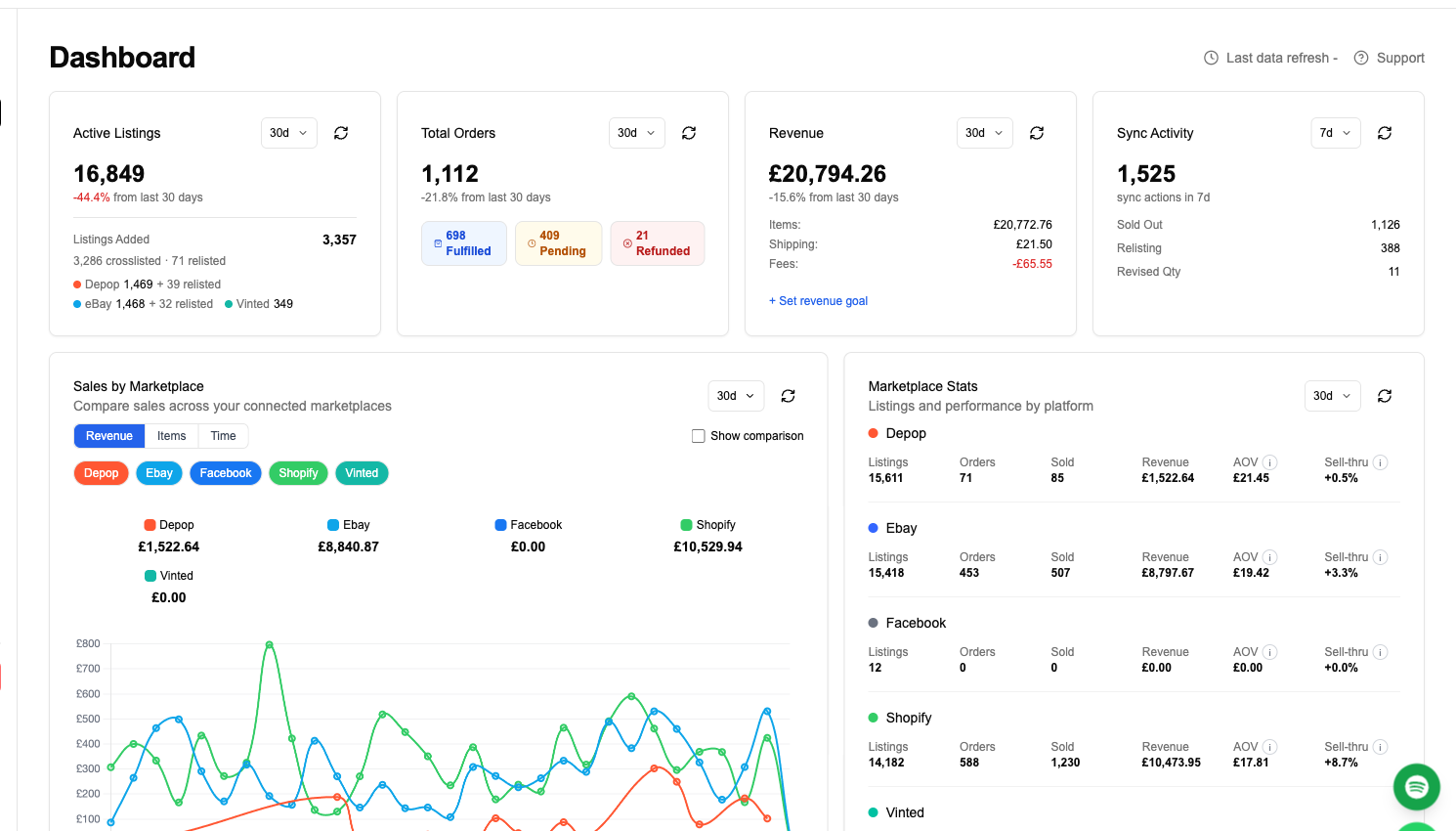
FLUF Connect automates the whole loop. List a product once, crosslist it to eBay, Kleinanzeigen and other marketplaces from the same dashboard, and FLUF handles real-time inventory sync — when an item sells on one channel, it’s automatically pulled from the others. There’s also a dedicated Kleinanzeigen to eBay crosslisting guide if you’re setting this pairing up specifically.
nn
| FLUF Connect Feature | eBay | Kleinanzeigen |
|---|---|---|
| Crosslisting | Yes | Yes |
| Inventory sync | Yes | Yes |
| Auto-relisting | Yes | Yes |
| Offer management | Yes | Not supported — Kleinanzeigen has no structured offer system to automate |
| Order sync | Yes | Yes |
| Bulk operations | Yes | Yes |
nn
eBay is one of FLUF’s most complete integrations: relisting, offer management, order sync, refunds and fulfilment all run through the connection. Kleinanzeigen supports crosslisting, inventory sync, order sync, auto-relisting and bulk operations, with offer management not applicable since Kleinanzeigen itself has no structured offer tool to hook into. Connecting eBay is a standard account login; Kleinanzeigen connects with a one-off step through the FLUF browser extension, after which no browser tab needs to stay open.
n
Every FLUF plan includes this automation as standard — relisting and inventory sync aren’t a paid upsell.
| Plan | Monthly | Yearly | You save | Crosslisted products |
|---|---|---|---|---|
| Starter | £9/month | £59/year | 45% | Unlimited |
| Pro | £29/month | £199/year | 42% | Unlimited |
| Super Seller | Custom pricing — tell us what you need | Unlimited | ||
Automatic relisting, offer management, smart pricing and listing boosts are included from Pro upwards. Starter covers unlimited crosslisting, inventory sync, order sync and Instagram posting without them. Accounting integrations are included from Pro upwards. Yearly billing is charged once a year. New accounts get 7 days for £1, then move onto a plan.
n
Save 42% when you pay yearlyn
Start with a 7-day trial for £1. After that, plans begin at £9/month, with no cap on how much you list, and the full automation feature set from day one.
n
nn
Related Guides
n
- n
- How to Sell on eBay — our complete eBay seller guide
- How to Sell on Kleinanzeigen — fees, Sicher bezahlen, and shipping explained
- Crosslist Kleinanzeigen to eBay — sync both automatically
- Depop vs Vinted — another head-to-head marketplace comparison
- Auto-Relist Your Listings — keep listings fresh on both channels
- FLUF Connect vs List Perfectly — how FLUF compares to other crosslisting tools
- Allegro vs eBay
- Willhaben vs Kleinanzeigen — compared
- Crosslist from eBay to Kleinanzeigen
- Kleinanzeigen vs Facebook Marketplace
- eBay vs Marktplaats
n
n
n
n
n
n
nn
Sources & Verification
n
Last verified: 2026-08-13. Please contact us if any figure is out of date.
n
- n
- eBay Inc. Q2 2026 results — 136 million active buyers
- eBay Inc. press release, July 2020 — sale of eBay’s classifieds business (including eBay Kleinanzeigen) to Adevinta, ~$9.2bn deal
- Adevinta press release — eBay Kleinanzeigen rebrand to Kleinanzeigen, May 2023, and current scale (35M+ monthly users)
- Kleinanzeigen help centre — “Sicher bezahlen” buyer protection fee (€0.50 + 4.5%, charged to buyer)
- Kleinanzeigen official fees page — commercial seller listing fees
- Händlerbund (Online-Händler-News) — March 2025 change to commercial seller free-listing allowance
- DashVue eBay UK fee guide — 2026 UK final value fee bands, per-order fee, regulatory operating fee, private-seller zero-fee policy
- eBay Germany seller portal — 1 July 2026 commercial fee restructure and 5% used/refurbished rate
- sellingcurrently.com — category-level comparison of where each platform performs best
- sparweise.de — German seller-perspective comparison
- FLUF Connect integrations page — supported marketplaces
n
n
n
n
n
n
n
n
n
n
n
n
n
Frequently Asked Questions
No, not any more. eBay sold its German classifieds business to Adevinta in a deal announced in July 2020 and completed in June 2021. The site kept the name "eBay Kleinanzeigen" for a couple of years afterwards, but Adevinta fully rebranded it to just "Kleinanzeigen" in May 2023, dropping the eBay name and logo. eBay has no operational role in Kleinanzeigen today.
For a private seller, both are essentially free — eBay charges UK private sellers £0 since October 2024, and Kleinanzeigen has always been free for private listings and local pickup sales. For a business or commercial seller, eBay charges a final value fee of roughly 9.9%–12.9% (UK) depending on category, while Kleinanzeigen charges commercial sellers a flat per-listing fee (around €1.99–€2.49) once they exceed five free ads a month — Kleinanzeigen never takes a percentage of the sale.
Yes. There's nothing stopping you listing the same item on both — many German sellers do exactly this, using Kleinanzeigen for local pickup and eBay for wider reach. FLUF Connect can crosslist and sync inventory between the two automatically, so an item that sells on one is removed from the other.
Kleinanzeigen. Listing is closer to posting a classified ad — a title, description, price and photos, with no item-specifics taxonomy to learn — and most ads go live in under two minutes. eBay expects more structure (category, item specifics, pricing format) which takes longer to learn but pays off in search visibility.
eBay, by a wide margin globally — it reports 136 million active buyers worldwide across 190+ markets. Kleinanzeigen reaches 35 million+ monthly users, but only in Germany. Within Germany specifically, Kleinanzeigen's penetration is enormous relative to the population.
Yes. FLUF Connect supports crosslisting, inventory sync, order sync, auto-relisting and bulk operations for both eBay and Kleinanzeigen. The one feature that doesn't carry over is offer management on the Kleinanzeigen side, because Kleinanzeigen itself has no structured offer/negotiation tool to automate.
Kleinanzeigen local pickup sales are paid instantly — it's cash in hand at the handover. eBay payouts land in your bank account within a few business days of a confirmed sale via its managed payments system, and new sellers may see an initial hold. Kleinanzeigen's "Sicher bezahlen" protected sales pay out after the buyer confirms receipt, similar in spirit to eBay's model.
Kleinanzeigen is overwhelmingly a secondhand marketplace by convention, though not by strict rule. eBay supports both new and used stock equally well, and from July 2026 eBay Germany even dropped its commercial seller fee to a flat 5% for used, refurbished and certified pre-owned items in the affected categories — a meaningful discount specifically for resale stock sold through a business account.
Yes — every new seller gets a 7-day trial for £1 with full access. After the trial, plans start at £9/month (Starter) with the complete automation feature set included, not gated behind a higher tier.
Yes. Paying yearly saves 40% compared to paying monthly, on every plan, with the full feature set either way — including for the eBay and Kleinanzeigen crosslisting features covered on this page.