
How to Sell on La Reboucle — The Complete Guide for 2026
La Redoute's curated secondhand marketplace — how it works, who's actually allowed to sell, fees, categories, and where it fits in a multi-channel selling strategy.



- What it is: La Reboucle is La Redoute’s curated secondhand marketplace, integrated directly into laredoute.fr, covering women’s, men’s and children’s fashion, home & furniture, and refurbished tech
- Who can sell: Since its October 2023 relaunch, La Reboucle works exclusively with a curated roster of professional resale and circular-economy sellers — not individual consumers. Buyers browse and buy; only vetted business partners list stock
- Scale: Passed 50,000 live products roughly a year after relaunch, with both catalogue size and customer numbers doubling year on year
- Fees: Current partner commission terms are set in private seller contracts and aren’t publicly published. La Redoute’s wider Marketplace programme (the seller infrastructure La Reboucle sits on) is publicly quoted at around €49.90/month + VAT plus an 8–20% category commission
- Best for: Registered resale, refurbishment and circular-economy businesses in France — not solo side-hustle resellers, who are better served by open platforms like Vinted
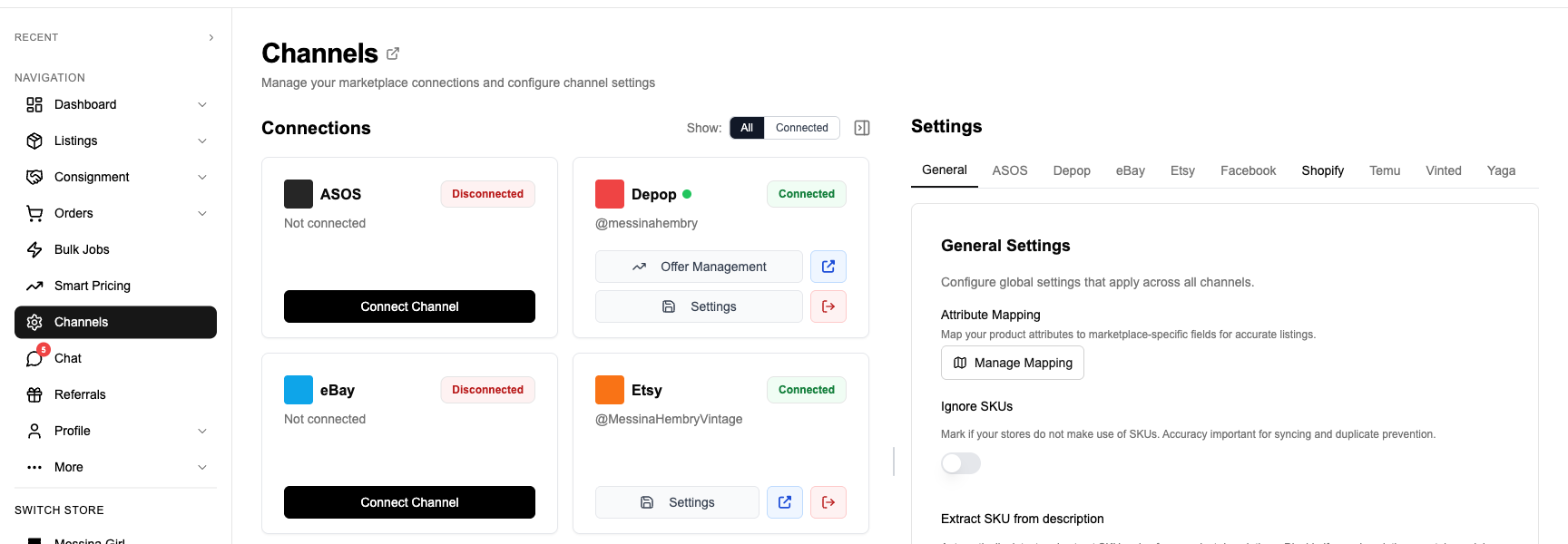
- FLUF Connect status: La Reboucle is on FLUF’s channel roster and part of the same Mirakl-powered integration family as 20+ other marketplaces. In-app crosslisting, inventory sync, relisting and offer management for La Reboucle are not live yet — see the Cross-List section for exactly what does and doesn’t work today
What Is La Reboucle?
La Reboucle is La Redoute’s secondhand and pre-loved marketplace, built into the main laredoute.fr site rather than run as a separate app. It sells used and refurbished clothing, footwear, accessories, children’s items, home textiles, furniture and — since 2025 — refurbished tech, all inspected and graded before listing.
La Redoute launched the original version of La Reboucle in January 2021 as a peer-to-peer (C2C) resale service, letting individual customers list and sell directly to each other, with listings pre-filled from a customer’s La Redoute purchase history (source). That version was discontinued in September 2022. La Redoute relaunched La Reboucle in October 2023 with a fundamentally different model: a curated “C-to-B-to-C” (business-to-consumer) marketplace, where a vetted roster of professional secondhand and circular-economy sellers supplies the stock, and consumers buy but no longer list items themselves (Viuz, October 2023).
That distinction matters for anyone researching “how to sell on La Reboucle” today: unlike Vinted or Depop, where any individual can open an account and list an item in minutes, La Reboucle’s current seller base is exclusively professional partners — companies like Smala (children’s fashion), Omaj (women’s fashion), Debongout (furniture and decor), Rediv (multi-category fashion), Crushon (men’s and women’s fashion), Family Affaire and Kidstorie (children’s, added 2025) and Recommerce (refurbished tech, part of the United.b group that also owns Boulanger and Electro Dépôt) (FashionNetwork, ecommercemag.fr).
La Redoute’s own second-hand lead, Edouard Roussel, describes La Redoute’s role in this model as “the trusted third party” — each partner runs its own logistics, and La Reboucle acts as the curated storefront and quality gate (FashionUnited, February 2025). Items must be in good, very good, or new condition, and buyers get a 30-day return window — closer to a graded-inventory retail experience than an open peer-to-peer marketplace.
| Metric | Detail |
|---|---|
| Originally launched | January 2021 (as an individual-to-individual resale service) |
| Relaunched | October 2023, as a curated professional-seller marketplace |
| Parent company | La Redoute (part of the Galeries Lafayette group) |
| Countries served | France only |
| Who can sell | Vetted professional resale and circular-economy businesses only — not individual consumers |
| Catalogue size | 50,000+ live products (reached roughly one year after the October 2023 relaunch), catalogue and customer numbers both doubling year on year (source) |
| Top categories | Women’s fashion, men’s fashion, kids & baby, home & furniture, refurbished tech |
| Revenue model | Commission-based, terms set per seller partnership contract |
Why Sell on La Reboucle in 2026?
La Reboucle is worth a look for one specific type of seller: a registered resale, refurbishment or circular-economy business with real inventory volume, looking for a curated, trust-led storefront in France rather than another open peer-to-peer app. Here’s what makes the case.
Built-in traffic from a major French retailer
La Reboucle sits inside laredoute.fr’s own navigation and app, rather than being a separate destination buyers have to discover on its own. That means secondhand listings are exposed to La Redoute’s existing shopper base browsing the site for new stock — a very different acquisition model to building an audience from zero on a standalone resale app.
A quality-graded, trust-heavy positioning
Every partner’s stock is inspected for condition, and buyers get a 30-day return window — a strong trust signal that positions La Reboucle closer to a graded-retail experience than a typical consumer-to-consumer listing, where condition disputes and no-return policies are common friction points.
A fast-growing catalogue in an under-served niche
The 2025 addition of a dedicated children’s range (pushing La Reboucle’s kids inventory to around 30,000 products) and a refurbished-tech category via Recommerce shows La Redoute actively expanding into categories many resale apps treat as secondary (FashionUnited). For a business selling kids’ fashion, furniture or refurbished electronics, that’s a growing, purpose-built shelf rather than a general fashion resale feed.
France’s secondhand market is large and growing
The wider French secondhand and resale market is estimated at more than €7 billion (source), and La Redoute is one of several major French retailers investing directly in resale rather than leaving the category to standalone apps — a sign that circular-economy retail is becoming a permanent fixture, not a trend.
Backed by an established retail group, not a startup
La Redoute is part of the Galeries Lafayette group, one of France’s largest retail operators. For a resale or refurbishment business weighing up which channels are worth the operational investment of onboarding, that matters: La Reboucle isn’t a venture-funded app that could pivot its model or shut down with a few months’ notice — it’s a resale line built inside an established retailer’s own infrastructure, with the group’s payment processing, customer service, and logistics network behind it. That stability is part of why La Redoute can afford to run La Reboucle as a curated, quality-first channel rather than an open, growth-at-all-costs marketplace.
The honest limitation: it isn’t open to individual sellers
The single biggest caveat, and the reason most resellers researching “sell on La Reboucle” won’t be able to: since the October 2023 relaunch, individual consumers can only buy on La Reboucle, not list. If you’re a side-hustle or solo reseller rather than a registered business, La Reboucle isn’t currently an option — Vinted, Vestiaire Collective and Depop remain the open, self-serve routes into French and European resale.
| La Reboucle | Vinted | Vestiaire Collective | |
|---|---|---|---|
| Who can sell | Curated professional partners only | Anyone (individuals and businesses) | Anyone, with authentication checks on luxury items |
| Listing fee | Not publicly disclosed (private seller contract) | Free to list | Free to list |
| Seller commission | Not publicly disclosed | Zero seller commission (buyers pay a buyer-protection fee) | Commission on sale, tiered by price |
| Geographic reach | France only | Pan-European, UK, US | Global, luxury-focused |
| Model | Curated B2C2C — retailer-vetted partner stock | Open C2C marketplace | Open C2C with authentication service |
La Reboucle Fees Explained
La Reboucle’s current seller economics are not published for public reference — as a curated partner marketplace, commercial terms are agreed individually. What follows is everything that is documented, plus the clearest available reference point: the fee schedule for La Redoute’s wider Marketplace programme, which shares the same seller-payment infrastructure.
What La Redoute’s own terms actually say
La Redoute’s published Marketplace seller terms state plainly that seller remuneration is “fixed in the services contract” (La Redoute Marketplace general conditions) — in other words, commission and fee rates are negotiated per seller relationship rather than published as a flat rate card. Payments are processed by La Redoute acting as a payment agent through the licensed payment institution MangoPay.
The closest public reference point: La Redoute’s Marketplace fee schedule
La Reboucle’s professional partners plug into the same seller infrastructure as La Redoute’s broader third-party Marketplace, whose published terms (via integration partner documentation) quote a monthly subscription of around €49.90 excluding VAT, plus a variable sales commission of roughly 8% to 20% depending on product category (Lengow). This is the general La Redoute Marketplace rate card, not a confirmed La Reboucle-specific figure — treat it as the closest documented benchmark, not a quote.
How the original C2C version worked (2021–2022, now retired)
For context, when the first version of La Reboucle ran as an individual-to-individual resale service, sellers could take payment two ways: a standard bank transfer, where La Redoute deducted a 5% commission, or conversion of the sale proceeds into a La Redoute e-gift card, which came with a 25% top-up bonus — sell an item for €10 and take home a €12.50 gift card instead of €9.50 cash (source). That fee structure no longer applies to the current professional-partner model, but it’s useful context for how La Redoute has historically monetised the service.
- Cash payout (5% commission): seller receives €28.50
- Converted to La Redoute e-gift card (25% bonus): seller receives €37.50 in store credit
- This applied only to the 2021–2022 individual-seller version of La Reboucle — current professional partner terms are set per contract and not publicly disclosed
Category-specific commission on the wider La Redoute Marketplace
| Category | Typical commission (La Redoute Marketplace) | Notes |
|---|---|---|
| Fashion & accessories | ~15–20% | Fashion sits at the higher end of La Redoute’s general commission band |
| Home & furniture | ~10–15% | Bulkier items often carry lower percentage commission but higher shipping cost |
| Electronics & tech | ~8–12% | Consistent with typical marketplace electronics commission bands |
These figures describe La Redoute’s general Marketplace, sourced via Lengow’s marketplace integration guide — La Reboucle-specific category rates are not publicly published, and a genuine quote will only come from La Redoute directly during onboarding.
Hidden costs to plan for
Whatever the commission rate lands at, budget for three things that rarely show up in headline fee percentages: outbound shipping (sellers typically advance postage costs and are reimbursed once a sale completes, per the original C2C model documented by ma-grande-taille.com), returns processing during the 30-day window, and the operational cost of grading and photographing stock to La Reboucle’s quality bar before it’s accepted into the catalogue.
Who Can Sell on La Reboucle — and How to Apply
La Reboucle does not have an open, self-serve seller signup. Since October 2023, it works with a curated list of professional partners rather than accepting individual applications on demand. If you run a registered resale, refurbishment or circular-economy business in France, the practical starting point is contacting La Redoute directly through the La Reboucle page, or via La Redoute’s general Marketplace seller channel, since both share underlying seller infrastructure and payment processing through MangoPay.
| Individual sellers | Professional / business sellers | |
|---|---|---|
| Can list on La Reboucle today? | No — buying only since October 2023 | Yes, by curated partnership |
| Application route | Not applicable | Direct contact with La Redoute; no public self-serve form found |
| Requirements (documented in La Redoute’s Marketplace terms) | N/A | EU/European location, catalogue fit with La Redoute’s assortment, ability to deliver French-language customer service, legal and tax compliance |
| Best alternative if you’re an individual reseller | Vinted, Vestiaire Collective, Depop | — |
La Redoute’s published Marketplace seller terms describe the selection criteria it applies to any third-party seller: geographic location within Europe, how well a seller’s product range complements La Redoute’s existing catalogue, and the ability to deliver a customer experience — including French-language support — that matches La Redoute’s own service standards (source). There’s no indication these differ specifically for La Reboucle partners, though La Reboucle layers on its own condition-grading bar (good, very good, or new only) given the secondhand and refurbished nature of the stock.
What this means in practice: if you already sell refurbished, vintage or pre-loved stock at meaningful volume — the kind of operation running a vintage resale business rather than clearing out a personal wardrobe — La Reboucle is worth approaching directly. If you’re testing resale as a side project, your time is better spent on the open platforms in this guide’s comparison table above, where you can be listing within minutes rather than waiting on a partnership conversation.
Because there’s no published step-by-step signup flow, treat this section as a starting map rather than a fixed checklist: expect an initial enquiry, a review of your catalogue and operational capacity against La Redoute’s stated criteria, and — once accepted — onboarding onto La Redoute’s seller and payment infrastructure before your first offers go live.
How to Create Listings That Sell
Because La Reboucle runs on a Mirakl-style catalogue model — the same underlying marketplace technology used by La Redoute’s main Marketplace and by dozens of other European retailers — listings work differently to a typical peer-to-peer app. Instead of writing a freeform listing from scratch, a seller’s product (identified by an EAN, GTIN or SKU) is matched to an existing catalogue product, and the seller then attaches an “offer” — price, quantity, and condition — to that matched product.
Product matching is the foundation
Because catalogue-attach listing depends on matching a barcode or product identifier to an existing entry, accuracy here matters more than on an open marketplace: a mismatched EAN can mean an item doesn’t list at all, or lists against the wrong product. Keep your product data (brand, model, size, colour) clean and consistent with how the manufacturer’s item is officially catalogued.
Condition grading has to be honest and consistent
La Reboucle only accepts stock in good, very good, or new condition — there’s no “fair” or “heavily worn” tier the way there is on more permissive resale apps. Grade conservatively: buyers get a 30-day return window, so an optimistic condition grade costs you a return and shipping both ways, not just a bad review.
Pricing strategy
Research comparable listings already live on La Reboucle and on La Redoute’s new-goods catalogue for the same or similar products — buyers on a retailer-integrated marketplace are often comparing your secondhand price directly against the new price shown a click away, which is a different psychology to a standalone resale app where buyers are already primed to expect used pricing.
Item specifics and completeness
Complete product data — full size run, accurate colour, brand, material — carries more weight on a catalogue-matched marketplace than on a freeform listing platform, because incomplete data is often what prevents a successful catalogue match in the first place. Treat data completeness as a listing-visibility lever, not admin overhead.
Unique or vintage items without a catalogue match
One-off vintage pieces, own-brand items, or anything without a clean EAN match are the hardest fit for La Reboucle’s catalogue-attach model, since there’s no existing product to attach an offer to. Some Mirakl-powered marketplaces solve this with a manual “product proposal” review process for catalogue-absent items; whether La Reboucle offers this today isn’t publicly documented, so confirm directly with La Redoute if unique inventory is a meaningful part of your stock.
Titles and descriptions matter less than product-data accuracy
On an open marketplace like eBay or Depop, a well-written title is a search-visibility lever — buyers find you by typing keywords into a search bar. On a catalogue-attach model like La Reboucle’s, your “listing” is really an offer against an existing product page, so the title and description buyers see are largely inherited from the matched catalogue entry rather than something you write from scratch. The lever that actually matters here is upstream: making sure the product you’re attaching an offer to is the correct one, with the right size, colour and material variant, before the offer goes live.
Bundling and multi-item lots
Because pricing and condition are set per offer against a single catalogue product, bundling multiple items into one listing isn’t a natural fit for this model the way it is on Vinted or Depop, where a seller can freely write a bundle description. If clearing bulkier or lower-value stock in bundles is core to your business, confirm with La Redoute whether bundled offers are supported before committing significant inventory to the channel.
Photography and Presentation
La Reboucle’s buyers browse inside laredoute.fr’s own retail environment, where they’re used to clean, well-lit, professional-standard product photography from La Redoute’s new-goods catalogue — so secondhand listings with phone-snap photography stand out for the wrong reasons.
- Match the retail bar, not the resale-app bar. Aim for even, neutral lighting and a clean, uncluttered background — closer to how you’d shoot for a retail catalogue than a casual marketplace listing.
- Show every angle a buyer needs to trust a condition grade. Front, back, close-ups of any wear, fastenings, soles, and labels — especially important given buyers can return an item within 30 days if the condition doesn’t match what they saw.
- Photograph true colour. Colour accuracy matters more here than on many resale apps, because product-matching depends on your listing aligning with a specific catalogued item’s official colourway.
- For furniture and home items, shoot in context and to scale. Buyers can’t try before they buy on a bulky item — a photo next to a common reference object (a door frame, a person) does more to prevent returns than a studio-style close-up alone.
- Disclose flaws in photos, not just text. A visible, well-lit photo of a mark or repair builds more trust than a line of small print buried in the description — and reduces the chance of a return dispute.
Shipping and Returns on La Reboucle
Shipping mechanics
Based on how the platform has been documented, sellers print a shipping label and drop the parcel at a relay point or collection location; postage costs are typically advanced by the seller and reimbursed once the sale is confirmed (source). For large or bulky home and furniture items, a peer-to-peer delivery partnership with Cocolis has been reported, offering delivery within roughly 15 days and shipment insurance of up to €500 (extendable to €5,000 via MAIF) — worth confirming directly with La Redoute if furniture is a meaningful part of your catalogue, since this reporting predates the October 2023 relaunch to the current partner model.
Returns
Buyers get a 30-day return window across La Reboucle’s catalogue — longer than the statutory minimum in most EU consumer contexts, and a deliberate trust signal given the platform’s retail-integrated positioning. As a seller, that window is also your biggest lever for reducing dispute rates: accurate condition grading and honest photography up front cost far less than processing returns after the fact.
| Aspect | What’s documented | Seller implication |
|---|---|---|
| Label & drop-off | Seller prints label, drops at relay point | Postage advanced by seller, reimbursed on sale completion |
| Furniture & bulky items | Reported Cocolis peer-to-peer delivery partnership | ~15-day delivery window, insured up to €500 (up to €5,000 via MAIF) |
| Returns | 30-day return window, platform-wide | Grade condition conservatively to minimise disputes |
| International shipping | Not applicable — France-only marketplace | No cross-border shipping or customs to plan for |
How Visibility Works on La Reboucle
La Reboucle doesn’t publish a seller-facing ranking algorithm the way open marketplaces like Depop or Vinted do, and that’s a direct consequence of its curated, catalogue-attach model: sellers aren’t competing in an open search feed against millions of individual listings, they’re supplying offers against a managed product catalogue inside La Redoute’s own retail environment.
Catalogue placement over search ranking
Visibility is driven more by where your product sits within La Redoute’s existing site structure — category pages, the “seconde main” section, cross-merchandising against equivalent new items — than by a competitive ranking signal you can directly optimise the way you would a Vinted or eBay listing title.
Product-data completeness affects discoverability
Because listings attach to an existing catalogue product, the completeness and accuracy of that underlying product data — correct EAN, full size and colour attribution — directly affects whether your offer surfaces correctly in category and filter browsing at all, which functions as this marketplace’s closest equivalent to a visibility lever.
Condition grading affects buyer trust and conversion
With a 30-day return policy and retail-style buyer expectations, an honest and consistent condition grade does more for sell-through than any discoverability tactic — a mismatched grade converts a browsing shopper into a return, not a repeat customer.
Category growth signals where La Redoute is investing
The 2025 expansion into children’s fashion and refurbished tech shows where La Redoute is actively growing the catalogue (FashionUnited) — categories getting fresh partner investment are a reasonable proxy for where buyer demand, and therefore your realistic sell-through rate, is strongest right now.
| Factor | Impact | What you can control |
|---|---|---|
| Product-data accuracy (EAN/GTIN match) | High | Keep brand, model, size and colour data clean and consistent |
| Condition grading accuracy | High | Grade conservatively; use photos to back up the grade |
| Category fit with current expansion | Medium | Prioritise categories La Redoute is actively growing (kids, tech, home) |
| Photo quality vs La Redoute’s retail bar | Medium | Match the lighting and framing standard of new-goods listings |
| Pricing vs the equivalent new item | Medium | Price against La Redoute’s own new-goods listing, not just other resale platforms |
Getting Paid and Tax Obligations
How you get paid
La Redoute processes marketplace payments on sellers’ behalf as a licensed payment agent, using the payment institution MangoPay (La Redoute Marketplace terms). Exact payout timing and schedule for La Reboucle partners specifically isn’t publicly documented — confirm this directly during onboarding, since it will be set out in your individual seller contract.
Business registration is a prerequisite, not an option
Because La Reboucle only accepts professional partners, you’ll need a registered business (SIREN/SIRET in France, or the equivalent EU business registration) and the ability to invoice, before a seller relationship is even on the table. This is a meaningful difference from platforms like Vinted, where individual, non-VAT-registered sellers are the default.
VAT and reporting
As a registered French or EU business selling through a marketplace, standard VAT rules apply to your sales, and — separately — the EU’s DAC7 reporting rules require digital platforms to report seller sales data to tax authorities. Because La Reboucle only works with registered businesses rather than casual individual sellers, DAC7’s individual-seller reporting thresholds are largely academic here; your obligations will already be governed by normal business VAT and corporate tax rules.
Record-keeping
Because commission and payout terms are set per seller contract rather than published centrally, keep your own copy of the negotiated terms alongside your standard sales records — invoices, sales reports, and returns data. If you already sell across several channels, this is exactly the kind of reconciliation work that’s easy to lose track of when it’s spread across separate marketplace back-ends and a bespoke partner agreement.
This is general information, not tax advice — talk to a qualified accountant familiar with French marketplace and DAC7 rules for your specific situation.
What Sells Best on La Reboucle
Because La Reboucle’s catalogue is curated by category-specialist partners rather than open to anything a seller chooses to list, “what sells best” is really a question of which categories La Redoute is actively investing in — and where a catalogue-attach model works cleanly.
| Category | Partner example | Why it fits |
|---|---|---|
| Women’s fashion | Omaj | Deep catalogue overlap with La Redoute’s core new-goods range, easing EAN matching |
| Men’s / women’s crossover fashion | Crushon | Broad brand coverage, strong catalogue-match rate |
| Children’s fashion | Smala, Family Affaire, Kidstorie | Fastest-growing category — ~30,000 kids products by early 2025 |
| Home & furniture / decor | Debongout | Complements La Redoute’s long-standing home & furniture catalogue |
| Refurbished tech | Recommerce | Newest category addition (2025), backed by a specialist refurbishment group |
Multi-category fashion partners like Rediv and Jaiio show that La Redoute isn’t locking each partner into one narrow niche either — the common thread across every accepted partner is proven volume, consistent grading, and a catalogue that meaningfully overlaps with items La Redoute already sells new.
Pro Tips for La Reboucle Sellers
- Treat your application like a retail pitch, not a marketplace signup. La Redoute is evaluating you against its own catalogue and service standards, not just checking a box — come with real volume data, sample product photography, and a clear operational plan for grading and shipping.
- Prioritise stock with clean EAN/GTIN matches. Because the catalogue-attach model depends on matching an existing product, inventory that maps cleanly to known brands and models will onboard and list far more smoothly than one-off or unbranded pieces.
- Lean into the categories La Redoute is actively expanding. Children’s fashion and refurbished tech have both seen fresh partner investment in 2025 — a strong signal of where buyer demand and catalogue growth are concentrated right now.
- Don’t treat this as your only channel. Because La Reboucle is curated, France-only, and doesn’t (yet) offer the automation levers — relisting, dynamic pricing, bulk tools — that open marketplaces do, it works best as one channel in a wider multi-marketplace strategy rather than your sole outlet.
- Photograph to a retail standard, not a resale-app standard. Buyers are shopping inside La Redoute’s main retail environment and will judge your listings against new-goods photography, not against a typical peer-to-peer app’s casual snapshots.
- Keep a paper trail on condition grading. With a 30-day return window and buyers comparing against new items, disputed condition grades are the most likely source of friction — dated, timestamped photos at the point of listing protect you if a return is contested.
- Ask specifically about category-level commission before signing. Given the wide published range for La Redoute’s general Marketplace (roughly 8% to 20%), the difference between the low and high end of that band is the difference between a healthy margin and a marginal one — get category-specific numbers in writing, not a headline rate.
- Watch the categories La Redoute is investing in, and revisit your product mix accordingly. Children’s fashion and refurbished tech both saw fresh partner additions in 2025 — if your business straddles multiple categories, weighting stock toward the ones La Redoute is actively growing is likely to outperform an even spread.
Common Mistakes to Avoid
- Applying as an individual seller. La Reboucle hasn’t accepted individual listings since October 2023 — if you’re not a registered business, you’re applying to the wrong channel; Vinted or Depop are the open alternative.
- Assuming La Reboucle’s fees match the general La Redoute Marketplace rate card. The published ~€49.90/month + 8–20% figures describe La Redoute’s wider third-party Marketplace, not a confirmed La Reboucle rate — always get your own written terms.
- Listing stock with messy or missing product identifiers. Because listings work by attaching an offer to a catalogued product, poor EAN/SKU data risks a failed match rather than just a slow-loading listing.
- Over-grading condition to avoid a lower price. With a 30-day return window and retail-savvy buyers, an inflated condition grade almost always costs more in return shipping and processing than it gains in sale price.
- Treating it as your only sales channel. La Reboucle is France-only, curated, and currently offers none of the relisting or automation tooling that busier open marketplaces do — relying on it exclusively concentrates risk in a single, still-maturing channel.
- Photographing to resale-app standards instead of retail standards. Buyers browsing inside laredoute.fr expect the same visual quality as new-goods listings — casual phone photography reads as lower trust in this specific context.
- Expecting a fast, self-serve onboarding. There’s no evidence of an instant signup flow for La Reboucle the way there is for Vinted or Depop — budget for a genuine sales conversation and vetting process, not a same-day account activation.
Cross-List Your Inventory with FLUF Connect
If you’re a resale or circular-economy business considering La Reboucle, you’re almost certainly already selling — or should be selling — on more than one marketplace. FLUF Connect is a multi-marketplace crosslisting and automation platform built for exactly that kind of physical-inventory business, syncing listings, stock levels and orders across 18+ marketplaces including Vinted, Depop, eBay, Vestiaire Collective, Etsy and Shopify.
Here’s the honest state of play for La Reboucle specifically. La Reboucle is on FLUF’s channel roster and shares the same underlying Mirakl-powered integration engine FLUF has already built for other catalogue-model marketplaces. But the in-app connection isn’t live for sellers yet — today, there’s no “Connect” button for La Reboucle inside FLUF Connect, and none of automatic crosslisting, real-time inventory sync, auto-relisting, offer management, or order sync work for this channel. The fastest way to start selling on La Reboucle today is to apply directly with La Redoute, as described earlier in this guide.
| Feature | La Reboucle support in FLUF Connect (as of August 2026) |
|---|---|
| Crosslisting | Not yet live — apply directly via La Redoute |
| Inventory sync | Not yet live |
| Auto-relisting | Not yet live |
| Offer management | Not yet live |
| Order sync | Not yet live |
| Bulk operations | Not yet live |
What FLUF Connect does today is give a curated-channel seller like a La Reboucle partner one dashboard for everything else in their business: connect Vinted, Vestiaire Collective, Depop, eBay and more, and let FLUF handle the crosslisting, stock sync, and relisting on those channels automatically, while you manage La Reboucle directly with La Redoute until FLUF’s integration goes live. If you sell on multiple platforms already, our guide to selling on multiple platforms at once covers the operational side of running several channels without overselling.
Pricing: start with a 7-day trial for £1, then plans from £9/month.
| Plan | Monthly | Yearly | You save | Crosslisted products |
|---|---|---|---|---|
| Starter | £9/month | £59/year | 45% | Unlimited |
| Pro | £29/month | £199/year | 42% | Unlimited |
| Super Seller | Custom pricing — tell us what you need | Unlimited | ||
Automatic relisting, offer management, smart pricing and listing boosts are included from Pro upwards. Starter covers unlimited crosslisting, inventory sync, order sync and Instagram posting without them. Accounting integrations are included from Pro upwards. Yearly billing is charged once a year. New accounts get 7 days for £1, then move onto a plan.
Save 42% when you pay yearly
Compared with juggling several marketplace back-ends manually, or with narrower tools like List Perfectly that don’t cover Vinted at all, FLUF Connect keeps every automated channel’s relisting, offer handling and stock levels in sync from a single view — with the whole automation feature set included from Seller upwards, not sold as a separate add-on.
For two more French fashion marketplaces that choose their partners, see the Sarenza guide and the Showroomprivé guide.
For the Paris department store’s selective marketplace, see Sell on Galeries Lafayette.
Sources & Verification
Last verified: 2026-08-13. Please contact us if any figure is out of date.
- La Reboucle — official La Redoute landing page and catalogue
- CMCM: “La Redoute et la seconde main : La Reboucle est morte, vive La Reboucle” — launch history, 2022 discontinuation, October 2023 relaunch as a professional-seller model
- Viuz, October 2023 — relaunch details and initial partner list
- FashionUnited, February 2025 — children’s category growth, B2B2C model confirmation, partner quote
- RelationClientMag — 50,000-product milestone and catalogue growth
- ecommercemag.fr — refurbished tech category expansion via Recommerce
- ma-grande-taille.com — original C2C-era mechanics: shipping process, fee structure, furniture delivery via Cocolis
- meilleurvidedressing.com — French secondhand market size context
- La Redoute Marketplace general conditions — seller eligibility criteria, payment via MangoPay, contractual fee structure
- Lengow: Vendre sur la marketplace La Redoute — general La Redoute Marketplace fee schedule (subscription + category commission)
- FashionNetwork France — partner roster and positioning
- FLUF Connect integrations page — supported marketplace count (internal primary source)
Subscribe to the seller news brief
The marketplace news that changes how you list, in one short email.
- Fee, policy and algorithm changes across 60+ marketplaces
- Only the topics you pick — the marketplaces you actually sell on
- Short enough to read in a minute. Daily or weekly, unsubscribe in one click
No spam. We never share your address.
Pick your topics first ›Frequently Asked Questions
As of the October 2023 relaunch, La Reboucle is business-only. It works exclusively with a curated roster of professional resale and circular-economy sellers — individual consumers can buy on La Reboucle but can no longer list items themselves, unlike the original 2021-2022 peer-to-peer version.
La Reboucle's current partner commission terms are set in private seller contracts and aren't publicly published. The closest public reference point is La Redoute's wider Marketplace programme, which is quoted at roughly €49.90/month plus VAT and an 8-20% category commission — but this is the general La Redoute Marketplace rate, not a confirmed La Reboucle figure.
Women's, men's and children's fashion, home textiles and furniture, and, since 2025, refurbished tech. Every item must be in good, very good, or new condition, and the platform has passed 50,000 live products since its October 2023 relaunch.
There's no public self-serve signup form. The practical route is contacting La Redoute directly, since La Reboucle's professional partners are onboarded through the same seller and payment infrastructure as La Redoute's wider Marketplace. Expect an evaluation of your catalogue fit and operational capacity rather than an instant account activation.
No, though they share infrastructure. La Redoute's main Marketplace sells new goods from registered third-party sellers; La Reboucle is the secondhand and refurbished layer, curated from a smaller roster of resale and circular-economy specialist partners.
It passed 50,000 live products roughly a year after its October 2023 relaunch, with both catalogue size and customer numbers doubling year on year. Its children's fashion range alone reached around 30,000 products by early 2025.
Not automatically today. FLUF Connect syncs listings and stock across 18+ marketplaces including Vinted, Depop, eBay, Vestiaire Collective and Shopify, but the in-app connection for La Reboucle specifically isn't live yet, even though the channel is on FLUF's roster.
No — as of August 2026, none of crosslisting, inventory sync, auto-relisting, offer management, or order sync are live for La Reboucle in FLUF Connect. The fastest way to start selling on La Reboucle today is to apply directly with La Redoute.
Vinted is an open, free-to-list peer-to-peer marketplace anyone can join instantly, with no seller commission. La Reboucle is a curated, France-only marketplace that only works with vetted professional resale partners, built inside La Redoute's own retail site rather than run as a standalone app.
No. La Reboucle currently serves France only, unlike pan-European platforms such as Vinted or global platforms such as Vestiaire Collective.
Sign up for free
Join the community
Plans from £9/month. Set up in under 10 minutes.
Free to join. Google and Apple sign-in work too.
You're in.