
Tise vs Vinted — Which Should Nordic Sellers Choose?
Tise's social, follow-based feed vs Vinted's search-first marketplace — fees, reach and discovery compared, plus how to run both from one dashboard.
7 days for £1, then from £9/month.



- n
- Both are free for sellers — neither Tise nor Vinted charges a listing fee, commission, or payout deduction. Buyers pay a protection/service fee on both.
- Different discovery models: Tise is a social, feed-based app — users follow sellers and browse a curated stream. Vinted is search-first — buyers type what they want and sort by price.
- Different reach: Tise is Nordic-first (Norway, Sweden, Denmark, Finland, plus newer Germany and Australia markets). Vinted operates in 26 markets worldwide, including all the Nordic countries Tise covers.
- Recent ownership change: eBay acquired Tise in a deal announced in late 2025, while Tise continues operating as its own app and brand.
- Available features: order sync and mark-as-sold on both channels. Automated relisting and offer management are supported on Vinted but not Tise. Use the FLUF browser extension to connect both.
- Cost: From £9/month after a 7-day trial for £1 (Starter).
n
n
n
n
n
n
n
nn
 n
nnn
nn
Tise vs Vinted: The Short Answer
nn
Tise and Vinted are both free-for-sellers secondhand fashion apps, but they’re built around different ideas of how people shop. Tise is a Nordic-born, social-feed app — Oslo-founded in 2014, recently acquired by eBay — where buyers follow sellers and browse a curated, Instagram-like stream. Vinted is a much larger, search-first marketplace operating in 26 countries, where buyers type exactly what they’re looking for and filter by size, brand and price. If your buyers are mostly in Norway, Sweden, Denmark or Finland and you want a community feel, Tise is worth running. If you want the widest possible reach — including the same Nordic buyers, plus the rest of Vinted’s 26 markets — Vinted is the bigger channel. Most sellers in the Nordic region gain from running both rather than picking one.
nn
What Is Tise?
nn
Tise is a mobile-first, secondhand fashion app founded in Oslo in 2014. It’s structured more like a social platform than a classifieds site: users follow individual sellers, like and comment on listings, and discover new items through a personalised feed rather than a search bar. It’s the market leader for secondhand clothing across its core Nordic countries — Norway, Sweden, Denmark and Finland — and has more recently expanded into Germany and, as of around March 2026, Australia.[1]
nn
In late 2025, eBay announced it was acquiring Tise, folding the app into eBay’s broader push into social and community-driven secondhand commerce in Europe. Tise has continued operating under its own brand and app since the deal.[2]
nn
What Is Vinted?
nn
Vinted is a Lithuania-founded, pan-European secondhand marketplace that has grown into one of the largest fashion resale platforms in the world. As of its FY2025 results (announced April 2026), Vinted reported €10.8 billion in gross merchandise value — up 47% year-on-year — €1.1 billion in revenue, and €62 million in net profit, operating across 26 markets including a January 2026 launch in the United States, its first market outside Europe and Australia.[3] Unlike Tise’s feed-based discovery, Vinted is fundamentally a search engine for secondhand clothes: buyers search a specific item, filter by size/brand/condition/price, and sort results — closer to how you’d shop a general e-commerce site than browse a social app.
nn
Fees Compared
nn
| Tise | Vinted | |
|---|---|---|
| Seller listing fee | None | None |
| Seller commission | None | None |
| Buyer-side fee | A “service fee” covering buyer protection, shown baked into the displayed price. Tise doesn’t publish the exact percentage — its own policy describes it only as varying by item price, category and promotions.[4] | A Buyer Protection fee at checkout, commonly cited around 5% of the item price plus a small fixed amount in established European markets.[5] |
| Paid promotion | Not a major feature of the platform | Optional paid boosts (Item Bump, Wardrobe Spotlight) |
nn
Neither platform costs a seller anything to list or sell — the entire cost of both marketplaces is absorbed by the buyer, which is worth knowing if you’re used to eBay- or Etsy-style seller fees. Sellers keep 100% of their listed price on both.
nn
Markets and Reach
nn
Tise’s core strength is depth in a small number of markets: it’s described as the market leader for used clothing across Norway, Sweden, Denmark and Finland, with roughly 2.5 million registered users at the time of the 2025 eBay acquisition reporting.[2] It expanded to Germany in spring 2026 and to Australia around March 2026 — both without seller fees, matching its existing model.
nn
Vinted’s reach is much broader: 26 markets as of its FY2025 results, spanning virtually the whole of Europe (including every Nordic country Tise covers), plus a January 2026 US launch. Vinted’s own regulatory transparency disclosure under the EU Digital Services Act put average monthly active users at 29.3 million across just 10 connected EU markets as of January 2026 — a figure far larger than Tise’s total registered-user count, even before accounting for Vinted’s other 16 markets.[6]
nn
Practically: any Nordic seller on Tise is already reachable on Vinted too, since Vinted operates in every country Tise does. The reverse isn’t true — a huge share of Vinted’s buyer base (the rest of Europe and the US) simply isn’t reachable through Tise at all.
nn
Discovery Model: Social Feed vs Search
nn
This is the most meaningful practical difference between the two platforms, and it should shape how you list on each. Tise’s discovery is social: your listings appear in the feeds of people who follow you, and engagement (likes, comments, follower growth) compounds over time the way it does on Instagram. A seller who’s built a following on Tise can move stock through that following even without ranking well in any particular search.
nn
Vinted’s discovery is search-first: a buyer types “Levi’s 501 W30” or “Zara midi dress size 12” and Vinted returns matching results sorted by price, condition or recency. There’s no following mechanic driving visibility the way Tise has — a Vinted listing’s performance depends almost entirely on accurate, specific titles and structured size/brand/category data matching what buyers actually search for, not on relationship-building with an audience.
nn
In practice, this means the same item can need two different listing strategies: a Tise listing benefits from a consistent posting style and engaging with your followers, while a Vinted listing benefits from precise, keyword-accurate titles that match how buyers actually search.
nn
Who Buys on Each Platform
nn
Both platforms skew toward younger, fashion-engaged buyers, but the mechanisms differ. Tise’s social, app-first, follow-driven model tends to attract a Gen Z and millennial audience used to browsing feeds the way they browse other social apps. Vinted’s audience is broader and less concentrated by age — Similarweb-style traffic data shows Vinted’s user base skewing female (roughly 65%) and concentrated 25–34, but with meaningfully rising penetration across older age brackets too; in Germany, for instance, Vinted shows unusually flat usage across ages 16–64 compared with other resale apps.[7] Neither platform publishes hard demographic breakdowns as an official disclosure, so treat both descriptions as directional rather than precise.
nn
The eBay Acquisition — What Changed and What Didn’t
nn
eBay’s acquisition of Tise was announced and closed in the second half of 2025, positioned publicly as eBay doubling down on social and community-driven secondhand commerce in Europe rather than folding Tise into eBay’s own marketplace.[2] For sellers, the practical effect so far has been continuity: Tise operates under its own brand, its own app, and its own fee-free-for-sellers model, unchanged by the ownership transition. It’s worth knowing about the deal mainly as context — it signals eBay sees value in Tise’s social-commerce model specifically, rather than an intention to fold it into a more traditional marketplace format.
nn
Which Should You Choose?
nn
If you can only run one platform: choose Vinted if your priority is maximum reach — it covers every market Tise does, plus 16+ more, and has a search-driven model that doesn’t depend on you having built a following. Choose Tise if you’re specifically targeting a Nordic audience and enjoy — or want to invest in — the community/follower side of selling, since a strong Tise following can drive sales that a cold-start Vinted listing wouldn’t get purely on search ranking.
nn
Why Not Sell on Both?
nn
Given neither platform charges a seller fee, and both cover the same core Nordic markets, there’s little downside to listing on both rather than choosing — the “either/or” framing mostly matters if the manual effort of maintaining two separate listings and two separate sold-status checks outweighs the extra reach. That’s exactly the friction FLUF Connect is built to remove.
nn
How FLUF Connect Manages Both From One Dashboard
nn
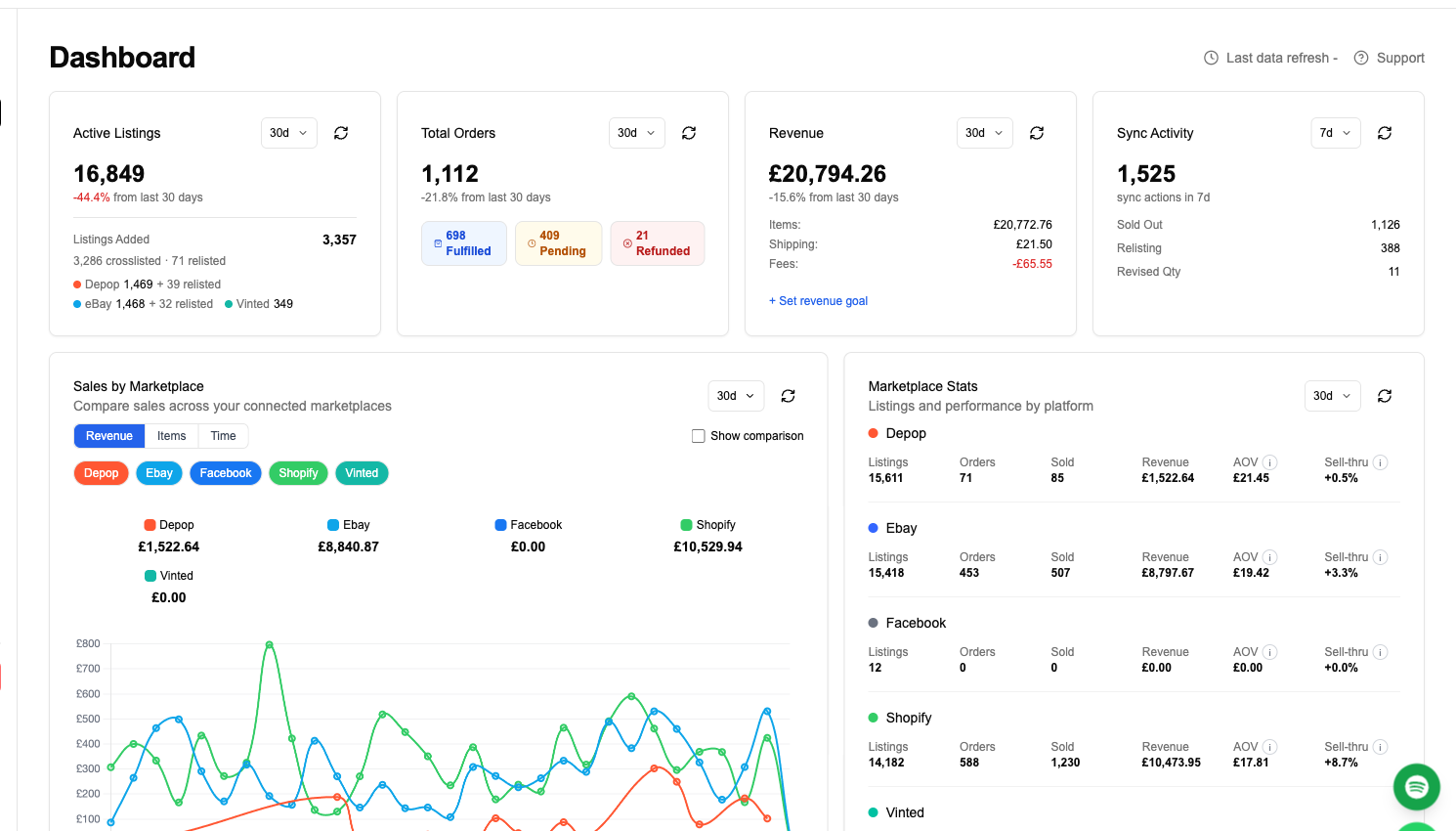
Connect Tise and Vinted with the FLUF browser extension. Tise does not need it to remain open after setup; Vinted needs the extension or mobile app available for listing actions.
nn
What Transfers Between Tise and Vinted
nn
| Field | Tise | Vinted |
|---|---|---|
| Title & description | Supported, feed-style presentation | Supported, search-optimised presentation matters more |
| Structured size/brand/category | Supported | Supported, central to Vinted’s search |
| Photos | Supported | Supported |
| Relisting | Not currently supported | Supported |
| Offer management | Not currently supported | Supported |
| Order sync | Supported | Supported |
| Mark-as-sold sync | Supported | Supported |
nn
Order sync and mark-as-sold are supported on both channels, so this pairing is more symmetrical than most. The one gap: automated relisting and buyer-offer management are supported on Vinted but not currently exposed through Tise’s platform for FLUF Connect to automate.
nn
Sold-Status Sync and Automation
nn
Because both channels support order sync and mark-as-sold, an item selling on either platform automatically updates its status on the other — no manual double-checking required. Vinted additionally gets automated relisting and offer management, which matters given Vinted’s high listing turnover; on Tise, relisting and responding to offers currently need to happen manually, so a Tise seller relying on repeat visibility should keep an eye on ageing listings themselves rather than expect FLUF Connect to refresh them automatically.
nn
Photography and Listing Style Differences
nn
Because Tise rewards a consistent, engaging feed presence, photos that read well in a scrolling social context — styled shots, on-body photos, a recognisable visual style across your listings — tend to perform better there than flat, catalogue-style product shots. Vinted’s search-first buyers care less about feed aesthetics and more about clear, accurate, well-lit photos that show true condition and fit, since a Vinted buyer has already decided what they’re looking for before they click into your listing. Running both effectively sometimes means shooting a slightly different photo set for each, or leading with feed-friendly photos first and functional detail shots second.
nn
Setting Up Your First Crosslist in FLUF Connect
nn
- n
- Connect your Tise account using the FLUF browser extension.
- Connect Vinted using the FLUF extension or mobile app and keep it available for listing actions.
- Pick a first batch of items to publish to both, ideally ones with clear brand and size data since Vinted’s search depends on it.
- Write (or let FLUF Connect help structure) a title and description that works for both a feed-browsing Tise audience and a search-driven Vinted audience — brand and item type up front works for both.
- Publish to both from FLUF Connect. Order sync and mark-as-sold now run automatically on both; Vinted additionally handles relisting and offers automatically, while Tise listings should be checked and refreshed manually.
n
n
n
n
n
nn
A Closer Look at the Core Nordic Overlap
nn
Because Vinted already operates in every country Tise does, the practical decision for a Nordic seller isn’t really “Tise or Vinted” by market — it’s about discovery style and audience size within the same geography. Norway is Tise’s home market and where its user base is deepest; Sweden, Denmark and Finland follow. Vinted’s presence in all four is well-established as part of its broader European network, meaning a Norwegian seller, for example, has access to the same domestic buyers on both platforms, plus everyone else across Vinted’s other 25 markets that Tise doesn’t reach at all. This is the core argument for treating the two as complementary rather than competing: the audience overlap in the Nordics is real, but Vinted’s audience beyond the Nordics is pure upside a Tise-only seller is leaving on the table.
nn
Working Through the Buyer-Fee Model
nn
Because both platforms push the entire cost onto the buyer rather than the seller, a seller’s take-home from an identical item priced identically is the same on either platform — the fee structure doesn’t change what you receive. Where it matters is buyer psychology: a buyer comparing the same item’s all-in price (item plus protection fee) across platforms may find one more competitive than the other depending on each platform’s fee percentage that day, since neither publishes a fixed, permanent rate. Sellers can’t directly control this, but it’s worth knowing that your listed price isn’t the full price a buyer sees at checkout on either platform — both add a fee on top at the point of purchase.
nn
A Fast-Growing Moment for Both Platforms
nn
Both platforms are in active growth phases right now rather than mature, stable ones. Vinted’s FY2025 GMV grew 47% year-on-year and the platform only entered the US market in January 2026 — its first expansion outside Europe and Australia. Tise, meanwhile, is expanding beyond its Nordic base for the first time (Germany and Australia in 2026) under new eBay ownership, which is investing specifically in growing Tise’s social-commerce model rather than treating it as a mature, steady-state app. For a seller, growth-phase platforms typically mean more platform-driven promotion, more new buyers being onboarded, and comparatively less competition than a saturated marketplace — which is a reasonable argument for being active on both while that’s true, rather than waiting to see which one “wins.”
nn
Common Scenarios
nn
“I only have a following on Tise, not Vinted — is it still worth adding Vinted?” Yes, because Vinted doesn’t rely on a following the way Tise does — a well-titled, accurately structured listing can be found by search on Vinted with zero existing audience, unlike Tise where a new seller’s visibility depends more on building followers over time.
nn
“Do I need completely different photos for each platform?” Not completely — but a second pass helps. Tise rewards a consistent, feed-friendly visual style; Vinted rewards clear, accurate condition photos a search-driven buyer can quickly assess. The same core photo set usually works for both with minor reordering or additional shots.
nn
“Which platform should get a new item first if I can only list one place today?” If the item is well-branded and easy to describe precisely (a specific model, size and condition), Vinted’s search will likely surface it to a buyer quickly. If you have an engaged Tise following that regularly buys from you, posting there first can move inventory just as fast through relationship rather than search ranking.
nn
App-First Culture vs Marketplace Culture
nn
It’s worth naming the cultural difference plainly: Tise feels and functions like a social app that happens to sell clothes, while Vinted feels like a marketplace that happens to have social features layered in lightly (likes, seller ratings, follows) rather than built around them. That shapes seller behaviour on each. Active Tise sellers tend to post regularly, engage with comments, and treat their profile the way a small creator would treat an Instagram account — consistency and personality matter. Active Vinted sellers tend to optimise more like a search-engine seller would: accurate titles, competitive pricing, quick responses to buyer questions, and enough listing volume that search visibility compounds. Neither approach is “better” — they’re suited to different kinds of sellers and different amounts of time you’re willing to put into audience-building versus listing optimisation.
nn
Scaling Beyond a Handful of Listings
nn
The gap between the two platforms becomes more pronounced as your inventory grows. A seller with 10–20 items can reasonably keep both a Tise following warm and a set of well-titled Vinted listings without much friction. At 100+ items, manually managing two platforms — separate uploads, separate sold-status tracking, separate relisting schedules — becomes the actual bottleneck, more than either platform’s individual mechanics. This is where a single dashboard managing both stops being a convenience and starts being close to necessary, since the alternative is either neglecting one platform or spending disproportionate time on manual admin rather than sourcing and photographing new stock.
nn
A Quick Checklist Before You Decide
nn
- n
- Your buyers are mostly Nordic and you enjoy building a following? Run Tise, and add Vinted for the reach a follower-based feed can’t reach on its own.
- You want maximum reach with minimal audience-building? Vinted’s search-first model gets a well-titled listing in front of buyers without needing an existing following.
- You’re already selling on one and wondering about the other? Given neither charges a seller fee, there’s little downside to adding the second — the only real cost is the manual effort of running two platforms, which FLUF Connect removes.
- You have 50+ items and growing? This is roughly where manually managing both platforms starts costing more time than it’s worth doing by hand — worth automating sooner rather than later.
n
n
n
n
nn
Pricing
nn
FLUF Connect plans start from £9/month (Starter) after a 7-day trial for £1. Every plan includes crosslisting to both Tise, Vinted, plus automated sold-status sync and offer management on both — automation isn’t a paid add-on on any tier, and Seller and above add relisting.
nn
Sources & Verification
n
- n
- [1] Concrete Playground — Tise Australia launch: concreteplayground.com
- [2] eBay Inc. — official announcement, eBay to acquire Tise: ebayinc.com
- [3] Vinted Newsroom — 2025 Financial Results (9 Apr 2026): company.vinted.com
- [4] Tise — Service Fee Policy / FAQ: support.tise.com
- [5] Vinted — Price list: vinted.com/pricelist
- [6] Vinted — “Our Platform” DSA transparency disclosure: vinted.ie/our-platform
- [7] Similarweb — vinted.com audience overview: similarweb.com
n
n
n
n
n
n
n
n
Related guides
- Tilt vs Vinted
- Crosslist from Vinted to Tise — the Nordic secondhand app, and why Norway is the market Vinted does not serve
- Crosslist from Tise to Whatnot
- Crosslist from eBay to Tise
- Selling online from Finland
Frequently Asked Questions
Both. Neither Tise nor Vinted charges sellers a listing fee, commission, or payout deduction. The buyer pays a protection or service fee on both platforms instead.
Discovery model. Tise is a social, feed-based app where buyers follow sellers and browse a curated stream. Vinted is search-first — buyers type what they want and filter by size, brand and price.
Yes, and more. Vinted operates in 26 markets, including every Nordic country Tise covers (Norway, Sweden, Denmark, Finland), plus 22+ others including a January 2026 US launch.
eBay acquired Tise in a deal announced and closed in late 2025. Tise continues operating as its own standalone app and brand under eBay ownership.
Not currently. Tise's platform doesn't expose a relisting mechanic for FLUF Connect to automate. Automated relisting is supported on Vinted.
Not currently, for the same reason — Tise doesn't expose that mechanic. Buyer offers are supported and automatable on Vinted.
Yes. Order sync and mark-as-sold are supported on both channels, so a sale on either platform automatically updates the listing's status on the other.
Tise needs the extension only during connection. Vinted needs the FLUF browser extension or mobile app available for listing actions.
Plans start at £9/month (Starter) after a 7-day trial for £1. There is no free plan. Crosslisting is included in every plan, and automation from Pro upwards, not a paid add-on.
Yes. FLUF Connect supports connecting Tise and Vinted alongside any of its other supported channels — eBay, Depop, Etsy, Shopify and more — all from the same dashboard.