Crosslist from Shopify to TikTok Shop — Why the Catalogue Sync Is the Easy Part
Getting your Shopify products onto TikTok Shop takes an afternoon. Getting them sold is a content problem that has nothing to do with your product feed. Here is the honest cost, the 34-day payout gap, and the four fields Shopify simply does not hold.



- The catalogue is the foundation, not the channel. Your Shopify feed creates a browsable shop tab, but across the UK’s top 50 TikTok Shop sellers the overwhelming majority of revenue came from content — short video and LIVE — rather than from browsing.
- Most of that revenue is creator-driven, not seller-driven. The integration is necessary and nowhere near sufficient.
- UK commission is 9%, and has been since 2 September 2024. The January 2026 rise to 9% was the EU. Articles reporting it as a UK change are wrong.
- Your first payout lands roughly 34 days after delivery. New sellers start on the Introductory settlement period — 31 days from delivery, plus about 3 business days.
- Four Shopify fields simply do not exist for TikTok’s purposes: package dimensions, a populated GTIN, brand authorisation evidence, and a compliant product video under 5MB.
- Cost: from £9/month. There is no free plan, but every new account gets a 7-day trial for £1.
The number that should decide whether you bother
Analysis of the top 50 TikTok Shop sellers in the UK over a 30-day window in spring 2026 broke their revenue down by surface. Short video produced 65.9%. LIVE produced 26.0%. The product card and shop tab — the browsable listing that a catalogue sync creates — produced 8.2%. Attribution told the same story from a different angle: 82.0% of revenue was affiliate and creator driven, against 10.1% self-operated (Lengow, using Kalodata data).
Treat those as the shape rather than as constants, because the mix genuinely moves by market and by year. Separate analysis of TikTok Shop in the United States over the first half of 2026 found the browsable Shop surface accounting for 51.4% of attributed sales and LIVE for only 8.2%, with video at 40.4% (Momentum Works and Tabcut). US livestream share has fallen steadily — 26% in July 2024, 18% a year later — while the UK is still growing its LIVE habit. Two different markets, two different pictures, and nobody publishes an authoritative UK-wide split at all.
What survives both readings is the part that matters to you: content and creators drive the majority of what sells on TikTok Shop, and a listing on its own captures a minority of it. Every integration vendor in this space sells you the listing. That is not dishonest exactly — you genuinely cannot access the rest without a live, compliant catalogue underneath it — but it is only the foundation.
So the honest framing for a Shopify merchant is this. Getting your products onto TikTok Shop is a solved problem and should take an afternoon. Getting them sold is a content and creator problem that has nothing to do with your product feed. Decide whether you have appetite for the second thing before you invest in the first.
The prize is real if you do. TikTok reports more than 30 million people in the UK using the platform each month, making it TikTok’s largest user community in Europe (TikTok Newsroom). More than 200,000 UK small businesses were selling on TikTok Shop by October 2025 (TikTok Newsroom), a figure TikTok put at over 300,000 by July 2026, alongside LIVE shopping growth of 55% year on year and more than 6,000 UK live sessions a day (TikTok Newsroom, July 2026).
Keep the effort behind those headlines in view. The seller behind a widely reported £100,000 day was streaming for twelve hours to get it, and goes live for a minimum of six hours daily (BBC News, July 2026). That is the real unit of work on this channel, and it is not something a product feed shortens.
One thing we will not do is quote a TikTok Shop UK sales total. Nobody publishes one — not TikTok, not a regulator, not Companies House, whose UK filing consolidates several regions and contains no Shop line at all. Any article citing a precise UK GMV figure is repeating a global number or an invention.
What it actually costs, with the date corrected
Start by correcting the error that has spread through most 2026 coverage. UK commission went from 5% to 9% on 2 September 2024. The rise to 9% on 8 January 2026 applied to Germany, Spain, France, Italy and Ireland. Several UK-targeted articles report the EU change as a UK change, which makes their whole cost model a year out of step.
| Charge | Amount | Detail |
|---|---|---|
| Platform commission | 9% | Inclusive of applicable taxes including VAT. Reduced to an effective 5% for eligible Electronics and Beauty and Personal Care. |
| Commission base | Includes postage | Customer-paid shipping is commissionable. Model this before you offer free delivery. |
| Shipped by Seller service fee | Reported at £0.50 per package | Trade press reported this from 15 July 2025, with Fulfilled by TikTok and Shipped via Platform exempt. TikTok’s current UK shipping guide confirms a fee is charged on delivery but does not restate an amount — verify in Seller Centre. |
| Subscription or listing fee | None | Not documented anywhere in TikTok’s UK fee pages. |
| Affiliate commission | You set it | Per product, paid on the average discounted price, released to the creator after delivery. |
Sources: UK Commission Rate Policy, Introduction to Seller Fees, Affiliate Commission and Payout Rules.
Three things are widely asserted that we could not verify, and we would rather say so than pad the table. The first is the per-package self-ship fee above. TikTok’s own category page refers to an initial new seller reduced commission period for the UK but publishes neither the rate nor the duration — those live in a spreadsheet inside Seller Centre. The “2% for 90 days” figure quoted elsewhere is the United States programme; the EU launch offer was 4% for two months. Neither is a UK number. Separately, several fee guides assert a UK transaction or payment-processing fee on top of the 9%; none of TikTok’s UK pages document one, and payments are handled by third-party processors under separate agreements rather than by TikTok.
The 34-day cash-flow gap
This is the fact most likely to hurt and least likely to be mentioned anywhere else.
TikTok Shop settles on one of five periods, all measured from delivery rather than from the order. A new seller starts on Introductory: 31 days. Standard is 8 days, Accelerated 3, Express 1. On top of whichever applies, TikTok states it usually takes about 3 business days from the end of the settlement period before funds reach your bank (Settlement on TikTok Shop).
So a Shopify merchant accustomed to Shopify Payments arriving within days should plan for roughly 34 days from delivery on their first TikTok Shop orders, and delivery is itself several days after the sale. If you are funding stock from cash flow, that gap is the thing that bites, not the 9%.
There is a second-order version of the same problem. TikTok can withhold settlement funds in a reserve for 30 calendar days after delivery, and one of the triggers is failing the Seller-Fault Cancellation Rate threshold — which brings us to the part that matters most to anyone selling the same stock in more than one place.
Dispatch clocks and the cancellation trap
TikTok Shop runs your account against measured operational thresholds, and the penalties escalate from fees to order-volume limits to deactivation.
| Metric | Rule | What happens if you miss it |
|---|---|---|
| Dispatch, Ship by TikTok | Hand to the carrier within 2 working days | Counts toward late dispatch |
| Dispatch, Ship by Seller | 7 working days or the order auto-cancels; delivery within 4 working days of receipt | Automatic cancellation, counted against you |
| On-Time Delivery Rate | Keep it at or above 90% | Late Delivery Fees are charged |
| Seller-Fault Cancellation Rate | 2.5% or below over a rolling 7 days | Order volume limits, deactivation — and a 30-day settlement reserve |
Read the last row alongside the first section of this page. Seller-fault cancellations include running out of stock. If you are selling the same inventory on Shopify, TikTok Shop and anywhere else, an oversell is not an apology — it is a metric breach that can freeze your money for a month. Buyer change-of-mind cancellations do not count against you; your own stock errors do (Seller-Fault Cancellation Rate policy, Customer Order Shipping Policy).
Returns are generous to the buyer and you should price for it. Customers have 30 calendar days from delivery, TikTok automatically approves most return requests, and where the fault is with the product the seller bears the return shipping. Change-of-mind return costs are shared between TikTok and the seller (Cancellation, Return and Refund Policy).
One correction while we are here: a number of sites claim TikTok removed the Ship by Seller option in February 2026 and mandated platform logistics. TikTok’s own shipping policy, updated 18 June 2026, still documents Ship by Seller as a live option.
Four fields Shopify does not have
A Shopify product record carries title, description HTML, vendor, product type, tags, images, variants with SKU, barcode, price and inventory, and weight. TikTok Shop asks for several things that list does not contain.
| TikTok Shop needs | The Shopify problem |
|---|---|
| Package dimensions, stated accurately alongside weight | Shopify stores weight but has no native product dimensions field at all. This is a genuine data gap, not a mapping issue. |
| GTIN, validated against GS1 registries | Shopify’s barcode field is optional and routinely empty, especially for own-brand stock. TikTok checks the company prefix, so an invented barcode fails. |
| Brand authorisation for branded goods | No Shopify field exists. The vendor field is not evidence. Approval needs a letter of authorisation, checked against WIPO and UKIPO records. |
| One video, 5MB maximum | Most merchants have none, and 5MB is a hard ceiling. TikTok’s content policy also prohibits videos made mainly of still images, so a slideshow of product photos is non-compliant. |
| Nine square images, at least 800 by 800, each a different angle | Shopify imagery is usually non-square lifestyle photography, often with near-duplicate angles. Duplicate angles are explicitly prohibited. |
| Descriptions of at least 30 words, in plain text with safety information and package dimensions | Shopify descriptions are HTML, and one-line descriptions are common. |
| Titles stating type, material, features, quantity and size | TikTok bans marketing copy, promotions, URLs and symbols in titles. “SALE” and emoji are everywhere in Shopify catalogues. |
| Category from TikTok’s leaf tree, with per-category attributes | Shopify product type and tags do not map. TikTok treats an incorrect category as a breach. |
Sources: Best Practices for Product Listings, Guide to Brand Authorisation, UK Content Policy, GS1 UK.
Worth knowing about the official Shopify channel specifically: TikTok orders are created in your Shopify admin only if inventory is available. If it is not, no Shopify order appears at all, so the failure mode is a silently missing order rather than an error you can see. Refunds, returns and cancellations must also be handled in TikTok Seller Center rather than in Shopify, and only one TikTok Shop can be connected per Shopify store (Shopify Help).
Merchants say this plainly in public. A UK seller of nine months wrote on the Shopify App Store in August 2026: “BEWARE! They will not provide a courier for pallet deliveries and if you ship anyway they will not recognise the shipping and refund the customer even though the item has been delivered!” A longer-standing seller reported in June 2026: “Tiktok cancelled all the orders and refunded the money to the buyers even though it was fulfilled via Shopify.” Both from the TikTok channel’s Shopify App Store reviews, which average 4.8 stars across more than 15,000 reviews — the negatives are a minority, but they cluster around fulfilment and order sync, which is exactly where this route is fragile.
If your stock is pre-owned, read this first
Plenty of Shopify stores sell refurbished or pre-owned goods, and TikTok Shop treats that as a separate regime rather than an ordinary category.
All second-hand products can only be sold once a seller has been onboarded through a limited, invite-only process, which you apply for yourself. The application asks for your trading history, the categories proposed, images of your warehouse and stock, and links to your other e-commerce stores with performance data (UK Restricted Products Policy).
Once approved, three rules reshape your listings. Second-hand fashion must not exceed £500 per listing. Titles must contain the words “Second-hand”, “pre-owned” or “pre-loved”. And at least one photograph must show the scratches, stretch marks or imperfections — a requirement no product feed can satisfy, because your Shopify record almost certainly has no damage image in it. Graded trading cards carry a £1,000 cap; refurbished electricals are restricted to phones, tablets, smart watches and laptops with condition limited to Good, Very Good or Excellent. Mystery and surprise listings are prohibited for all second-hand goods.
How to crosslist with FLUF Connect
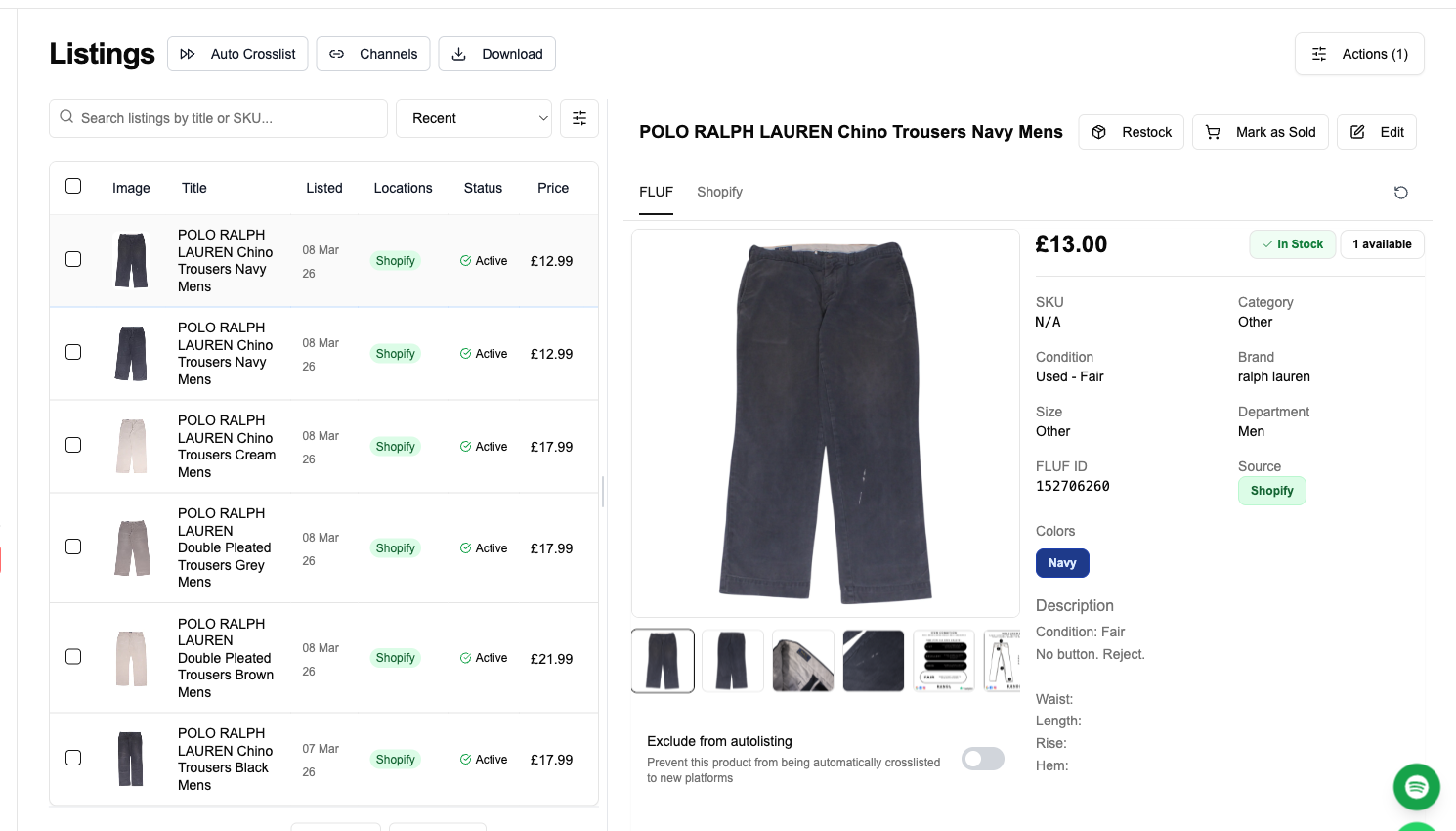
Connect TikTok Shop and Shopify by following the consent prompts. Neither needs an open browser or a computer left running afterwards.
Review the TikTok listing preview: category, required attributes, up to nine square photos of at least 800 × 800 pixels, a description of at least 30 words and a title without promotional claims. Supply package dimensions, valid product identifiers, brand authorisation and required imperfection photos before publishing.
One constraint to plan around: FLUF Connect’s TikTok Shop authorisation is approved for the United Kingdom only. TikTok Shop itself operates in many more markets, and expanded to ten European markets in June 2026, but sellers outside the UK cannot complete our authorisation yet. We will extend the list as each market is approved.
What syncs, and the gap you cover
Be precise here, because the two directions are not symmetrical.
| Event | What happens |
|---|---|
| An item sells on Shopify | Detected automatically. Shopify order sync picks the sale up and TikTok Shop stock is dropped, along with every other channel carrying it. |
| An item sells on TikTok Shop | Not detected automatically. TikTok Shop order sync is not implemented yet, so mark the item sold in FLUF Connect and the fan-out to every other channel runs from there. |
| You change price, stock or description | Pushed out to the channels carrying that item. |
| An item sells anywhere else | TikTok Shop stock is dropped, which is the direction that protects your cancellation rate. |
The second row is the habit to build, and it matters more here than on most channels precisely because of the Seller-Fault Cancellation Rate. An undetected TikTok sale leaves that unit live everywhere else, and the resulting oversell lands on whichever channel sells it next. Marking it sold immediately closes that window.
What it costs
FLUF Connect starts at £9/monthFLUF Connect plans start at £9/month on Starter, with Seller at £29/month and Pro at £99/month; every plan is unlimited on listings and marketplaces, and the tiers differ by which automations they include and how often we check your channels for sales. There is no free plan, though every new account gets 7 days of full access. Bulk operations are included in every plan, and relisting and offers from Seller upwards rather than sold as add-ons.
Sources and verification
Checked against TikTok Shop UK’s own Seller Centre policy pages in August 2026, with publication dates noted where TikTok gives them. TikTok revises these pages frequently — the shipping, returns, settlement and prohibited-products policies were all updated between May and August 2026 — so verify anything that affects a commercial decision.
- UK Commission Rate Policy — 9% standard, 5% reduced categories
- Introduction to Seller Fees — no subscription or listing fee
- Settlement on TikTok Shop — the five settlement periods and the reserve
- Seller-Fault Cancellation Rate — the 2.5% threshold and its consequences
- Customer Order Shipping Policy — dispatch windows and delivery rates
- Cancellation, Return and Refund Policy — the 30-day window and who pays
- Restricted Products Policy — the second-hand invite-only regime and its caps
- Best Practices for Product Listings — titles, descriptions, images, video
- UK Content Policy — the ban on still-image videos
- Seller Registration Policy — sole trader and corporate requirements
- Lengow, using Kalodata data — the revenue split by surface and attribution
- TikTok Newsroom — 30 million UK monthly users
- TikTok Newsroom — 200,000 UK small businesses, Royal Mail partnership
- Retail Gazette — 300,000 UK sellers reported July 2026
- Shopify Help — order creation only when inventory is available
- GS1 UK — GTIN validation on TikTok Shop
Deliberately omitted: any TikTok Shop UK sales total, the UK new-seller introductory commission rate, a separate UK transaction fee, a product title character limit, and UK buyer age or gender splits. None of these could be traced to the organisation that sets them.
Related guides
- Sell on TikTok Shop — the complete seller guide
- Sell on Shopify
- Crosslist from Vinted to TikTok Shop
- Crosslist from eBay to TikTok Shop
- TikTok Shop vs Depop
- Crosslist from Etsy to TikTok Shop
- Crosslist from Gumtree to TikTok Shop
- Crosslist from WooCommerce to TikTok Shop
- Crosslist from TikTok Shop to Shopify
- Crosslist from Shopify to Trendyol
- Temu to TikTok Shop
- Shopify vs TikTok Shop
- Crosslist from Squarespace to TikTok Shop
- BigCommerce to TikTok Shop
Frequently Asked Questions
By itself, very little. Analysis of the UK's top 50 TikTok Shop sellers found only 8.2% of revenue came through the product card and shop tab — the surface a catalogue sync creates — with short video at 65.9% and LIVE at 26.0%. The mix does shift by market: in the United States over the first half of 2026 the browsable Shop surface accounted for 51.4% and LIVE for just 8.2%. What holds either way is that content and creators drive the majority of sales and a listing alone captures a minority. Budget for content and creator partnerships before you judge whether TikTok Shop works for you.
9%, inclusive of applicable taxes including VAT, with an effective 5% rate for eligible Electronics and Beauty and Personal Care products. Note the commission base includes customer-paid shipping, so postage is commissionable. There is no subscription or listing fee. A per-package service fee for self-shipped orders, reported at £0.50 from July 2025, is confirmed in principle by TikTok's UK shipping guide but not restated with an amount there — check Seller Centre rather than relying on secondary figures.
No, and this is the most common error in current coverage. The UK rate went from 5% to 9% on 2 September 2024. The rise to 9% on 8 January 2026 applied to Germany, Spain, France, Italy and Ireland. Any UK cost model built on a January 2026 UK change is a year out of step. TikTok also refers to a reduced commission period for new UK sellers, but publishes neither the rate nor its duration outside Seller Centre — the “2% for 90 days” figure quoted elsewhere is the United States programme.
Slower than you are used to on Shopify. TikTok Shop settles from the delivery date, not the order date, and new sellers begin on the Introductory period of 31 days. Standard is 8 days, Accelerated 3 and Express 1. On top of that, TikTok says it usually takes about 3 business days after the settlement period ends before funds reach your bank, so plan for roughly 34 days from delivery on early orders. If you fund stock from cash flow, that gap matters more than the 9%.
It counts against your Seller-Fault Cancellation Rate, which must stay at or below 2.5% over a rolling seven days. Running out of stock is explicitly a seller-fault cancellation. Breaching the threshold escalates to order volume limits and account deactivation, and it can also trigger a settlement reserve that withholds your funds for 30 calendar days after delivery. Buyer change-of-mind cancellations do not count against you; your own stock errors do.
Four are genuine data gaps rather than mapping problems. Shopify has no native product dimensions field, yet TikTok requires accurate package weight and dimensions. Shopify's barcode field is optional and often empty, while TikTok validates GTINs against GS1 registries so an invented one fails. Brand authorisation for branded goods has no Shopify equivalent at all — the vendor field is not evidence. And TikTok wants one product video of 5MB or less, which most merchants do not have.
The photos usually need work and the slideshow is not allowed. TikTok wants up to nine square images of at least 800 by 800 pixels, each showing a different angle, and explicitly prohibits duplicate angles — whereas Shopify imagery tends to be non-square lifestyle photography with near-identical shots. On video, TikTok's content policy prohibits videos made up primarily of still images, screenshots or GIFs, so assembling your product photos into a slideshow is non-compliant rather than a shortcut.
Only after a separate approval. All second-hand products require onboarding through a limited, invite-only process that you apply for yourself, and the application asks for your trading history, warehouse and stock images, and links to your other stores with performance data. Once approved, second-hand fashion is capped at £500 per listing, titles must contain “Second-hand”, “pre-owned” or “pre-loved”, and at least one photograph must show the item's imperfections — which no product feed can generate for you.
Not automatically yet. TikTok Shop order sync is not implemented, so a sale there is not detected and the item stays live elsewhere until you mark it sold in FLUF Connect, which then fans out to every other channel. The reverse direction works properly: a Shopify sale is detected and TikTok Shop stock is dropped. Given that overselling drives seller-fault cancellations and can freeze your settlement for 30 days, marking TikTok sales promptly is worth making a habit.
Not at present. TikTok Shop itself runs in many markets and expanded to ten European markets in June 2026, but FLUF Connect's TikTok Shop application is approved for the United Kingdom only, so sellers elsewhere cannot complete the authorisation. We will extend the list as each additional market is approved. Every other channel in FLUF Connect is unaffected by this limit.